Our Top Picks


What's inside
- Diagnostic sets for medical students, explained simply
- What a student actually uses on an ear, nose, and throat rotation
- The products in this guide
- Full diagnostic sets versus starter kits
- Handles, power, and why rechargeable matters
- Cases, replacement heads, and spare tips
- How to judge optical quality without guesswork
- Skills laboratory, placement, and home practice
- Cleaning, safety, and professional habits
- Which type of buyer should choose which format
- Additional planning notes
- Frequently asked questions
- Conclusion
- Check prices on Amazon
- Disclosure
As an Amazon Associate I earn from qualifying purchases. This post may contain affiliate links at no extra cost to you.
Diagnostic sets for medical students, explained simply
A diagnostic set is the small group of illuminated instruments used to look inside the ear, examine the eye, and support a basic ear, nose, and throat examination. For a medical or nursing student, buying one is rarely about prestige. It is about arriving at skills sessions and clinical placements with working equipment, understanding how each head fits onto a handle, and practising a calm, repeatable examination routine until it becomes second nature.
The eight options in this guide fall into three broad families. First, there are full otoscope and ophthalmoscope sets in cases, including two 36 piece kits and a rechargeable hospital style set. Second, there are nurse starter kits that combine a smaller otoscope with a stethoscope, a blood pressure instrument, and sometimes tuning forks. Third, there are focused ear, nose, and throat kits that add instruments for the nose and throat. None of these families is automatically better. The right choice depends on your course list, your next rotation, and how much optical capability you genuinely need.
Students comparing study equipment often juggle several purchases at once, and readers planning a wider study setup may also find our guide to best student laptops engineering useful when budgeting for the semester ahead.
What a student actually uses on an ear, nose, and throat rotation
On an ear, nose, and throat rotation, the otoscope is the workhorse. It provides light and magnification for viewing the ear canal and the tympanic membrane, and it is also used, with the appropriate attachment described by a manufacturer, during some nose examinations. Supervisors expect a student to hold the instrument safely, choose a suitable speculum size, and describe what can be seen in plain clinical language. Those habits are learned through supervised practice, and owning a set makes that practice possible outside scheduled teaching.
The ophthalmoscope is used less often by beginners but carries more anxiety, because viewing the retina takes patience and a systematic approach. A set that includes an ophthalmoscope head lets a student rehearse the steps, distance, and light adjustment taught in class, instead of meeting the instrument for the first time during an assessment. Even short, regular practice sessions with a willing partner, following course instruction, build familiarity with the sequence.
Around those two heads sit the supporting items: specula in several sizes, a case that keeps everything together, spare tips, and in starter kits the stethoscope and blood pressure cuff used for routine observations. A diagnostic set should be judged as a working system, not as a photograph of shiny instruments. Ask whether the handle feels secure, whether heads attach and detach cleanly according to the manufacturer instructions, whether replacement tips are easy to source, and whether the case will survive a year of being carried between sites.
The products in this guide
Zyrev Otoscope Oph Diagnostic Set, 36 Piece Kit with Leather Case
This option is a 36 piece medical and nursing student otoscope and ophthalmoscope diagnostic kit supplied with a leather case and described for educational and professional settings. Our research for this guide is based on published specifications and manufacturer descriptions, so the points below focus on the format, the included instruments named by the maker, and the situations that format is designed for, rather than on any claim about a single sample unit.
Choose this style of kit when the goal is breadth in a single case, because a 36 piece layout is built around having specula, heads, and accessories together rather than buying each part separately over a semester.
For ear, nose, and throat rotations, the practical value is organisation. A student can open one case, find the otoscope head for an ear examination, switch to the ophthalmoscope for a fundoscopic practice session, and return everything to a known place before the next patient encounter.
The leather case matters more than it first appears. Clinical teaching areas are busy, bags are set down and picked up many times a day, and a structured case helps protect optical heads from knocks while also making a missing tip easier to notice during a quick inventory check.
- 36 piece diagnostic kit format
- Otoscope and ophthalmoscope heads included in the set description
- Leather case for transport and storage
- Positioned for educational and professional settings
Before ordering, cross check the current manufacturer listing against your course equipment list. Kit contents can be revised by a maker, course requirements differ between schools, and a short check at that stage prevents the common problem of owning a good kit that is missing the one item a skills tutor asks for in week one.
Welch Allyn 97-MDS-CMN Standard Diagnostic Set with Rechargeable Handle
This option is a standard diagnostic set that pairs a coaxial ophthalmoscope and a MacroView otoscope with a nickel cadmium rechargeable handle, from a brand widely associated with hospital grade examination equipment. Our research for this guide is based on published specifications and manufacturer descriptions, so the points below focus on the format, the included instruments named by the maker, and the situations that format is designed for, rather than on any claim about a single sample unit.
This is the hospital standard end of the shortlist. Instead of a large count of small accessories, the emphasis in the product name is on the two optical heads and on a rechargeable handle that is shared between them.
A coaxial ophthalmoscope is designed so the illumination and viewing paths sit close together, which in published descriptions of this optical style is associated with a clearer view into the pupil and reduced reflections during eye examination practice. A MacroView otoscope, as the name indicates, is presented around a wider view of the tympanic membrane than a basic pocket otoscope typically offers.
The rechargeable handle changes daily habits. Rather than carrying spare disposable cells, a student or clinician returns the handle to its charging routine between sessions. Readers should confirm the charging arrangement described by the manufacturer for their region and teaching site before relying on a single handle for back to back clinics.
- Coaxial ophthalmoscope head
- MacroView otoscope head
- Nickel cadmium rechargeable handle
- Standard diagnostic set format from Welch Allyn
Before ordering, cross check the current manufacturer listing against your course equipment list. Kit contents can be revised by a maker, course requirements differ between schools, and a short check at that stage prevents the common problem of owning a good kit that is missing the one item a skills tutor asks for in week one.
ASA TECHMED Deluxe Nurse Starter Kit
This option is a deluxe nurse starter kit described as a complete set of diagnostic tools that is portable, durable, lightweight, and comprehensive. Our research for this guide is based on published specifications and manufacturer descriptions, so the points below focus on the format, the included instruments named by the maker, and the situations that format is designed for, rather than on any claim about a single sample unit.
A starter kit answers a different question from a dedicated diagnostic set. New nursing and medical students often need several everyday instruments at once for skills laboratories and early placements, and a combined kit reduces the number of separate purchases at the start of a course.
The words portable, durable, and lightweight in the product description point to the intended use pattern: carried between classrooms, skills sessions, and clinical areas rather than left mounted in one examination room. Weight matters when a kit travels in a bag already holding textbooks, a laptop, and placement paperwork.
Because this format spreads its value across many tools, buyers should read the manufacturer listing carefully for exactly which diagnostic items are included, and compare that list with the equipment list issued by their school before the first skills session.
- Complete starter kit format for nursing students
- Described as portable, durable, and lightweight
- Broad set of diagnostic tools in one purchase
- Suited to skills laboratories and early placements
Before ordering, cross check the current manufacturer listing against your course equipment list. Kit contents can be revised by a maker, course requirements differ between schools, and a short check at that stage prevents the common problem of owning a good kit that is missing the one item a skills tutor asks for in week one.
Cynamed All in 1 Premium Otoscope Diagnostic Set, 36 Piece Kit with Leather Case
This option is a premium 36 piece medical and nursing student otoscope diagnostic kit with a leather case, described for educational and training use and for eye and ear care examination. Our research for this guide is based on published specifications and manufacturer descriptions, so the points below focus on the format, the included instruments named by the maker, and the situations that format is designed for, rather than on any claim about a single sample unit.
This second 36 piece option shows why two kits with the same piece count can still suit different buyers. The description stresses an all in one approach and training use, so the comparison should focus on the exact head configuration, tip assortment, and case layout published for each kit rather than on the headline number alone.
For home ear care as well as student practice, an otoscope set of this kind is used for looking into the ear canal under illumination. Students should follow their programme instruction on technique, including how to straighten the ear canal appropriately for the age of the patient and how to brace a hand for safety if the patient moves.
As with the other leather case kits here, storage discipline is part of the value. Keeping each head and tip in its place supports quick checks before an objective structured clinical examination, where fumbling for a part costs time and confidence.
- 36 piece all in one diagnostic kit
- Leather case included in the description
- Positioned for educational and training settings
- Ear and eye examination focus
Before ordering, cross check the current manufacturer listing against your course equipment list. Kit contents can be revised by a maker, course requirements differ between schools, and a short check at that stage prevents the common problem of owning a good kit that is missing the one item a skills tutor asks for in week one.
Cynamed 2-in-1 Ear Scope Set with Sight Chart, Replacement Tips, and Carry Case
This option is a multi function otoscope for ear, nose, and eye examination, described as a professional kit for home use and for medical students, supplied with a sight chart, replacement tips, and a carry case. Our research for this guide is based on published specifications and manufacturer descriptions, so the points below focus on the format, the included instruments named by the maker, and the situations that format is designed for, rather than on any claim about a single sample unit.
This set takes a lighter, more flexible route. A 2 in 1 ear scope format is aimed at readers who want one instrument that can be adapted across ear, nose, and eye examination tasks, without moving up to a full multi head diagnostic case.
Replacement tips are a small detail with real consequences. Specula are patient contact items, they are handled constantly during practice, and having spares in the case means a dropped or used tip does not end a study session. Programmes have their own infection control rules, and students should follow local policy on cleaning and disposal rather than improvising.
The included sight chart is a useful training extra. It supports basic visual acuity practice away from a fully equipped examination room, which makes this kit relevant to community placements and home study as well as classroom work.
- 2 in 1 multi function otoscope design
- For ear, nose, and eye examination
- Sight chart and replacement tips included
- Carry case included in the description
Before ordering, cross check the current manufacturer listing against your course equipment list. Kit contents can be revised by a maker, course requirements differ between schools, and a short check at that stage prevents the common problem of owning a good kit that is missing the one item a skills tutor asks for in week one.
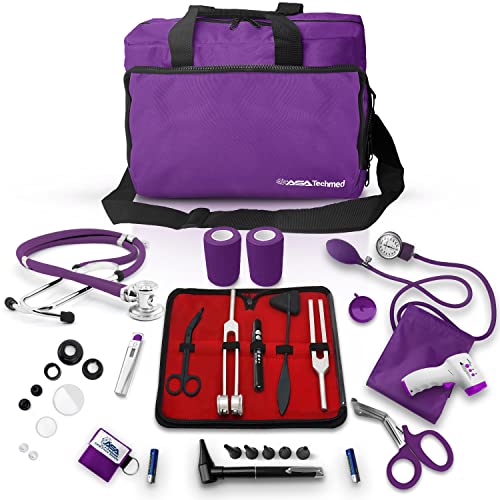
ASA TECHMED Nurse Essentials Starter Kit, 18 Pieces with Stethoscope and Blood Pressure Monitor
This option is an 18 piece nurse essentials starter kit that includes a stethoscope, a blood pressure monitor, an otoscope, tuning forks, and more, aimed at nurses, nursing and medical students, and home use. Our research for this guide is based on published specifications and manufacturer descriptions, so the points below focus on the format, the included instruments named by the maker, and the situations that format is designed for, rather than on any claim about a single sample unit.
Where a pure diagnostic set concentrates on the eyes and ears, this 18 piece essentials kit spreads across the observations students perform most often. Blood pressure measurement and stethoscope work are daily skills on most placements, so including those tools alongside an otoscope and tuning forks reflects a realistic first placement bag.
Tuning forks deserve a mention because they are easy to overlook when shopping. They are used in standard hearing assessments described in clinical teaching, such as comparing air and bone conduction, and in neurological examinations for vibration sense. Having them in the same kit as the otoscope means the ear examination toolkit is complete in one place.
This is a sensible route for a student whose programme expects them to arrive with their own general equipment, while a dedicated eye and ear set can be added later if a rotation demands more advanced optics.
- 18 piece nurse essentials format
- Stethoscope and blood pressure monitor included
- Otoscope and tuning forks included
- Aimed at nurses, nursing and medical students, and home use
Before ordering, cross check the current manufacturer listing against your course equipment list. Kit contents can be revised by a maker, course requirements differ between schools, and a short check at that stage prevents the common problem of owning a good kit that is missing the one item a skills tutor asks for in week one.
Primacare DS-9199 Nurse Essentials Starter Kit with Hard Case
This option is a nurse essentials starter kit that combines an adult aneroid sphygmomanometer, a classic stethoscope, and a mini diagnostic otoscope, supplied with a hard case. Our research for this guide is based on published specifications and manufacturer descriptions, so the points below focus on the format, the included instruments named by the maker, and the situations that format is designed for, rather than on any claim about a single sample unit.
Primacare keeps the focus tight: blood pressure, listening, and a mini otoscope for ear checks, protected by a hard case. For many nursing placements that trio covers the instruments a student reaches for most often, and a smaller kit is easier to keep track of in a shared changing room or a busy ward bag.
An aneroid sphygmomanometer is the dial gauge style of blood pressure instrument widely taught in manual measurement classes. Learning on an aneroid device is a deliberate choice in many programmes, because manual technique with a stethoscope is still a core assessed skill even where automated monitors are common.
The hard case distinguishes this kit from soft pouch starter sets. A rigid shell offers more protection against crushing in a full bag, which matters for a gauge mechanism that should be treated as a precision instrument and checked against programme guidance on calibration.
- Adult aneroid sphygmomanometer included
- Classic stethoscope included
- Mini diagnostic otoscope included
- Hard case for protection in transit
Before ordering, cross check the current manufacturer listing against your course equipment list. Kit contents can be revised by a maker, course requirements differ between schools, and a short check at that stage prevents the common problem of owning a good kit that is missing the one item a skills tutor asks for in week one.
CynaMed ENT Diagnostic Kit for Ear, Nose, and Throat Examination
This option is an ear, nose, and throat examination instruments set that includes an otoscope, an ophthalmoscope, an earwax remover, a nasal dilator, a metal ear cleaner, a tongue depressor, and a laryngeal mirror. Our research for this guide is based on published specifications and manufacturer descriptions, so the points below focus on the format, the included instruments named by the maker, and the situations that format is designed for, rather than on any claim about a single sample unit.
This kit is the most explicitly ENT flavoured option in the group. The instrument list goes beyond the two standard optical heads and adds tools named for the nose, the throat, and ear care, which maps closely onto the anatomy covered in an ear, nose, and throat teaching block.
A laryngeal mirror and a tongue depressor point to oropharyngeal examination practice, while a nasal dilator relates to viewing inside the nostril. Students should treat these as training instruments to be used under the supervision and technique instruction of their programme, since ENT examination skills are taught progressively and assessed formally.
Readers comparing this set with the 36 piece kits should count relevance rather than pieces. A smaller set whose instruments all match an ENT rotation can be more useful than a larger general case whose extra items stay untouched for a whole term.
- Dedicated ear, nose, and throat instrument set
- Otoscope and ophthalmoscope included
- Nasal dilator, tongue depressor, and laryngeal mirror included
- Ear care tools named in the product description
Before ordering, cross check the current manufacturer listing against your course equipment list. Kit contents can be revised by a maker, course requirements differ between schools, and a short check at that stage prevents the common problem of owning a good kit that is missing the one item a skills tutor asks for in week one.
Full diagnostic sets versus starter kits
The clearest decision in this guide is between optical depth and everyday breadth. A full diagnostic set puts its budget into otoscope and ophthalmoscope heads, illumination, and a handle. That suits a medical student heading toward rotations where eye and ear examination are examined skills, and it suits anyone who expects to keep the same set into early postgraduate practice, subject to local equipment policies.
A starter kit puts its budget into coverage. A stethoscope, a blood pressure instrument, an otoscope, and tuning forks together cover most of the physical examination tasks a nursing student or early medical student is asked to demonstrate. The otoscope in such a kit is usually a compact or mini format, which is entirely appropriate for learning canal anatomy and basic technique, even though a hospital grade head offers a more refined optical view.
Some students buy in stages, and that is often the wisest pattern. Start with the kit your programme requires for the first placement, learn which instruments you reach for daily, and then decide whether a higher specification diagnostic set is justified by your next rotation. Buying the largest case on day one can leave money tied up in accessories that a particular course never uses, while buying too little can mean a rushed second purchase before an assessment.
Readers who are equipping a whole study desk at the same time may want to compare screen sizes in our roundup of best 15 inch laptops alongside their clinical equipment list, so that large purchases are planned together rather than competing in the same week.
Handles, power, and why rechargeable matters
Every illuminated head depends on its handle. In case based student kits, the handle is typically a battery powered unit whose exact cell requirements are stated by the manufacturer, and students should follow that published information rather than substituting cells on guesswork. In the Welch Allyn set in this guide, the handle is a nickel cadmium rechargeable design, which reflects a hospital pattern: the handle is charged as part of a routine, shared between the coaxial ophthalmoscope and the MacroView otoscope, and expected to be ready at the start of a clinic.
Rechargeable handles reward organisation. A student who charges equipment the night before a placement avoids the flat battery moment that every clinical teacher has seen. Battery powered handles reward a different habit, keeping the correct spare cells available. Neither approach is wrong, but both fail when treated casually, so build charging or battery checks into the same routine as packing a stethoscope and an identification badge.
Light quality also deserves attention. Published descriptions of diagnostic heads discuss brightness and the shape of the illuminated field, because a clinician needs to distinguish subtle differences in the appearance of the tympanic membrane or the retina. Students should learn the normal appearance thoroughly under supervision, since recognising normal anatomy is the foundation for noticing anything unusual and escalating it appropriately.
Cases, replacement heads, and spare tips
A case is not packaging. It is the system that keeps optical surfaces clean, stops heads from rattling against metal instruments, and turns packing into a thirty second inventory. Leather cases appear on the two 36 piece kits in this guide, a hard case protects the Primacare starter kit, and a carry case is named for the Cynamed 2 in 1 set. Each style involves a trade: soft and structured cases tend to be pleasant to carry and quick to open, while a hard shell offers stronger protection against crushing in an overloaded bag.
Replacement tips and specula are consumables in daily student life. Tips are handled, cleaned, or disposed of according to local infection control policy, and they are small enough to lose. A kit that includes replacement tips, such as the Cynamed 2 in 1 set, reduces friction at the start of ownership. Over a full course, the ongoing availability of the correct tips matters as much as the number included on day one, so check the manufacturer information for the fitting style before assuming that any generic tip will attach securely.
Replacement heads sit at the other end of the scale: rarely needed, but important to understand. Heads can be damaged by drops, and a student set may be expected to last for years. Published manufacturer material is the right source for compatibility, because a head and a handle from different product families should never be assumed to mate correctly. When in doubt, ask the maker or an authorised supplier, using the exact model name of the set you own.
How to judge optical quality without guesswork
Optical claims are easy to inflate and hard for a student to verify in a shop, so anchor your judgement in named design features and in your course requirements. A coaxial ophthalmoscope, as included in the Welch Allyn set, aligns viewing and illumination in a way that published explanations of the design link to reduced corneal reflection. A MacroView otoscope is presented by its maker around a wider field of view for the ear. A mini otoscope in a starter kit makes no such claim and does not need to: its role is basic, supervised ear examination and technique learning.
Magnification, field of view, and illumination should be read together. A larger image is helpful only if it is evenly lit and if the student has been taught what structures to identify. That is why skills tutors emphasise sequence and description over equipment. A modest instrument used methodically will teach more than an advanced head used hurriedly, and supervisors assess the method, the consent conversation, and the explanation to the patient alongside the findings.
Storage for course files matters too, and students who keep imaging examples and lecture material on removable media can compare options in our guide to best 500gb sd cards when organising a study library.
Skills laboratory, placement, and home practice
Different settings reward different kits. In a skills laboratory, a broad starter kit shines, because one session may move from blood pressure measurement to listening skills to a short ear examination. On a hospital placement, reliability and familiarity matter most, and a student often uses departmental equipment for some tasks while keeping personal basics at hand, always following local policy on personal instruments.
At home, a set is a study aid. Students rehearse the order of an examination, practise holding an otoscope with the correct hand position for each ear, and talk through findings as if presenting to a supervisor. A sight chart, such as the one included with the Cynamed 2 in 1 set, supports basic vision checking practice. Home practice should stay within the boundaries set by a programme: these are training activities, not a substitute for professional assessment of a real symptom.
Anyone with ear pain, hearing change, discharge, dizziness, or a sudden change in vision needs timely professional care through the proper clinical route. A student kit is for education and supervised clinical learning. Keeping that boundary clear protects patients, protects students, and is part of the professionalism that courses assess from the first term onward.
Cleaning, safety, and professional habits
Follow the manufacturer cleaning instructions for each instrument and the infection control policy of your placement provider. Those two sources govern what may be wiped, what must be disposed of, and what should never be immersed. Never invent a cleaning method for an optical head, because inappropriate liquids or abrasion can damage a lens surface and turn a serviceable instrument into a poor one.
Safety technique is taught, not improvised. Otoscopy teaching covers consent, positioning, gentle handling, and stopping if a patient reports pain. Ophthalmoscopy teaching covers room lighting, patient instruction, and working at an appropriate distance. Tuning fork assessments follow defined sequences described in clinical teaching material. A good kit supports that teaching; it does not replace it, and no product description in this guide should be read as clinical instruction.
Finally, keep an inventory habit. After each session, return every head, tip, and accessory to its place, note anything missing, and deal with charging or battery needs immediately. That small routine is the difference between a set that lasts a whole course and a case of loose parts by the second semester.
Which type of buyer should choose which format
Choose a 36 piece leather case kit if your course list asks for a complete otoscope and ophthalmoscope set and you want accessories and storage solved in one purchase. Choose the rechargeable Welch Allyn standard set if your priority is hospital style optical heads on a shared rechargeable handle and your budget is planned around long term clinical use. Choose the CynaMed ENT kit if your next block is specifically ear, nose, and throat work and the named nose and throat instruments match your syllabus.
Choose a nurse starter kit if your first placement bag needs a stethoscope and blood pressure equipment as much as an otoscope. Between them, the ASA TECHMED deluxe kit stresses portability and comprehensiveness, the 18 piece ASA TECHMED kit names tuning forks explicitly, and the Primacare kit keeps the selection tight and protects it with a hard case. Choose the Cynamed 2 in 1 set if you want a lighter ear scope with a sight chart and replacement tips for study and supervised practice.
Printing course handbooks and placement documents is a small but real cost of student life, and readers setting up at home may also look at our comparison of best airprint color laser printers when planning a study corner.
Additional planning notes
A structured case turns packing into a quick inventory, because each head, tip, and accessory has a visible home. Students who check a case at the end of a session notice a missing speculum immediately, while a loose bag hides the problem until the next clinic. That habit also protects optical surfaces, since heads stored in place are less likely to rub against metal instruments or be crushed under books. Over a full academic year, this small routine does more for reliability than any single accessory purchase.
Illuminated instruments are only useful when the handle has power, so charging and battery checks belong in the same routine as packing identification and a stethoscope. A rechargeable handle rewards a fixed charging point at home, while a battery powered handle rewards keeping the correct cells available as the manufacturer directs. Planning power the night before a placement removes a predictable source of stress on the morning of a clinic. Tutors notice calm preparation, and a working light is one of the simplest parts of that preparation to control.
Clinical teachers consistently emphasise sequence, consent, and explanation, because a safe examination depends on method as much as on instruments. A student who can position a patient, choose an appropriate speculum, and describe findings clearly is demonstrating the skills an assessment is designed to measure. Equipment supports that method by being familiar, organised, and ready, which is why practising with the same set builds confidence. New buyers should therefore value reliability and course fit ahead of the longest accessory list.
Frequently asked questions
Do medical students need both an otoscope and an ophthalmoscope?
Many programmes expect students to learn both instruments, because ear and eye examination are core clinical skills, but the exact requirement and timing vary by school. Check your course equipment list and skills syllabus. If ophthalmoscopy is taught later in the course, a starter kit now and a fuller diagnostic set later can be a sensible sequence.
Are starter kits suitable for nursing students?
Starter kits are designed with nursing students in mind, combining the observation tools used most often on placement, such as a stethoscope and a blood pressure instrument, with a basic otoscope. Confirm the contents against your placement requirements, since some programmes supply certain items centrally or specify a particular style of instrument for teaching.
What should a student check before buying an unfamiliar set?
The general checks are consistent: confirm every named head and accessory is present, confirm the handle and charging or battery arrangement from published manufacturer information, confirm replacement tips are available for the fitting, and confirm the set meets your programme rules. Missing optical heads are expensive problems, so a contents check matters more than cosmetic condition.
Conclusion
There is no single best diagnostic set for every student, because courses ask for different things at different stages. Match the format to your next rotation: full optical sets for dedicated ear and eye work, ENT kits for a focused ear, nose, and throat block, and starter kits for broad placement readiness. Read the published contents list carefully, plan for tips and power from the first week, keep the case organised, and let supervised teaching, not marketing language, shape how the instruments are used.
Check prices on Amazon
Live listings for the shortlist in this guide are pulled from Amazon below, so prices and availability are always current at the moment you look.


Disclosure
WidgetVerdict is a participant in the Amazon Services LLC Associates Program, and this site earns from qualifying purchases made through links on this page. Product selection for this guide is based on published specifications and manufacturer documentation, reviewed as part of our research process, and inclusion does not imply that any instrument has been endorsed by a medical school or clinical provider. Always follow your programme requirements and local clinical policy when choosing and using diagnostic equipment.