What's inside
- Key Takeaways
- Quick Picks
- How Did We Choose the Best Gaming Mouse for 40 Dollars?
- What Actually Improves When You Spend Up to This Frame?
- Which Corners Get Cut at This Price — and Which Cuts Matter?
- What About Small Hands and Left-Handed Players in This Tier?
- How Do Different Game Genres Fare on This Shortlist?
- Does the Brand on the Box Matter at This Price?
- How Should You Test a New Mouse Inside Its Return Window?
- Which Grip Styles Does This Bracket Serve Well?
- How Do the Six Stack Up Against Each Other?
- What Should You Check on the Listing Before You Buy?
- How Long Will a Mouse at This Price Actually Serve?
- How Should You Spend the Rest of a Small Setup Budget?
- How Do You Calibrate a Budget Mouse Once It Arrives?
- What Goes Wrong Most Often When Buying in This Tier?
- Final Recommendation
- Frequently Asked Questions
- Related Guides
As an Amazon Associate I earn from qualifying purchases. This post may contain affiliate links at no extra cost to you.
widgetverdict.com is reader-supported. When you buy through links on our site, we may earn an affiliate commission.
Where to buy: this bracket lives and dies on Amazon’s rotating promotions, so every pick below links to a listing we verified for this guide; two famous names sit at the top of the frame and dip inside it often enough to earn their places, while the other four are priced for this tier all year round. Treat the $40 in the title as the whole frame — mouse, delivered, ready to play.
Hunting the best gaming mouse for 40 dollars used to mean choosing which flaw you could live with: a sensor that spun out on fast swipes, a cable stiff as a garden hose, clicks that went soft by spring. That era is over. Sensor trickle-down has been relentless, and the optical chips in today’s budget mice descend directly from flagships a few seasons old. What separates the six below is no longer whether they track — they all track — but how honestly each maker spent the small budget: on the switch, the shell, the cable and the feet, or on lighting and box art.
This guide therefore reads like an audit. Each pick is examined for where its money visibly went and where it quietly did not, because at this level a mouse is a bundle of trade-offs wearing a brand badge. We also included two stretch picks — mice whose natural home is a higher shelf but which appear inside this frame during promotions often enough that a patient buyer can treat them as $40 mice. If your need is urgent, the four everyday picks will not punish you for skipping the wait.
Key Takeaways
- Modern budget sensors are genuinely good; spend your attention on shape, switch feel and cable quality instead of DPI figures.
- Four picks live inside the frame year-round; two are promotion-dependent stretch picks worth waiting for if your current mouse still works.
- Wired dominates this tier for good reason — the money a wireless radio would consume goes into the parts your hand touches.
- The one wireless pick here earns its place with a honeycomb shell and tri-mode links rather than flagship pricing tricks.
- Replaceable, standard parts matter more at this price: a mouse you can re-foot and re-cable mentally is a mouse you will keep longer.
Quick Picks
| Pick | Badge | Why it earns its place |
|---|---|---|
| Razer DeathAdder Essential | Best shape for the money | The most proven ergonomic silhouette in gaming, stripped to its essentials. |
| Redragon M602 Wired RGB Gaming Mouse | Most buttons per dollar | Nine programmable controls and proper software at a price that invites experimentation. |
| BENGOO Gaming Mouse Wired | Simplest starter mouse | Plug in, pick a sensitivity, play — the gentlest possible first gaming mouse. |
| SOLAKAKA SM600 Wireless Gaming Mouse | Best budget wireless | A honeycomb tri-mode mouse that frees the desk without leaving the frame. |
| Logitech G305 LIGHTSPEED Wireless Gaming Mouse | Stretch pick: wireless done properly | The benchmark budget wireless mouse, inside the frame whenever promotions run. |
| Razer Basilisk V3 | Stretch pick: premium wheel | A flagship-grade scroll wheel and optical switches when its price dips into reach. |
How Did We Choose the Best Gaming Mouse for 40 Dollars?
We applied a stricter honesty test than usual, because small budgets forgive nothing. Every candidate had to track fast flicks without spinning out at the sensitivities real players use, click with switches that feel deliberate rather than hollow, and arrive with a cable — or a radio — that does not fight the player. Beyond that baseline, we scored each mouse on visible spending: textured grips rather than glossy plastic, braided or flexible cables rather than stiff rubber, feet with some area to them rather than four dots, and software that exists and works rather than a download link to nowhere.
We also weighted the ownership curve. Budget mice are often a player’s first gaming mouse, bought alongside a first PC, and they get replaced either because they fail or because the player outgrows them. Picks that fail gracefully — wearing slowly, staying usable as a spare, suiting a second machine or a younger sibling later — ranked above picks that feel exciting for a month and tired by the fourth. The two stretch picks passed a different gate: their appearances inside this price frame had to be a recurring pattern rather than a single remembered sale, so that recommending patience is honest advice rather than a lottery tip.
Reader questions shaped the shortlist too. The most common budget-mouse regret we hear is not failure but mismatch — a mouse bought for its button count by a player who needed a shape, or for its shape by a player who needed buttons. So the six were arranged to make philosophies unmistakable: each pick is the clearest available expression of one priority, which means choosing between them is really choosing between priorities, and that choice a reader can make confidently from their own games and hands.
Finally, we protected the frame itself. It is easy to write a budget guide that quietly becomes a guide to spending a little more, then a little more again. Here, the four core picks are the guide; the stretch picks are an optional waiting game, clearly labelled, for readers whose current mouse still functions. If every promotion vanished tomorrow, the first four would still make this a list worth publishing.
What Actually Improves When You Spend Up to This Frame?
Compared with the truly cheap mice bundled into keyboard combos and checkout-aisle bins, the step up to this bracket buys three concrete things. The first is sensor behaviour under speed: bargain-bin sensors lose tracking during the fast, wide swipes that shooters demand, while every sensor here — even the most modest — holds its line. The second is switch quality. The main buttons on these six feel engineered: a defined actuation point, a consistent return, no pre-travel wobble when your finger rests on them between actions. The third is the shell itself — seams that meet cleanly, coatings that grip, shapes drawn from real ergonomic research rather than copied silhouettes.
The step also buys consistency between units, an underrated gift. Cheap mice vary — one clicks crisply, its twin from the same bin feels hollow — while the six here come off production lines with tolerances tight enough that the mouse in the review is the mouse in your box. For a buyer who cannot try before ordering, that predictability is worth real money, and it is a large part of what this frame is actually purchasing.
What the frame does not buy is equally worth naming. You will not get flagship weight engineering, swappable parts ecosystems, or the exotic polling rates of esports flagships, and you do not need them. You will mostly not get wireless from the major brands except on promotion, because a good radio and a good battery consume budget that budget brands spend elsewhere. And you will not get meaningful differences in raw accuracy: a player who cannot aim with the simplest pick here will not aim with the fanciest, because the limiting factor at this level is practice, not hardware.
Which Corners Get Cut at This Price — and Which Cuts Matter?
Some cuts are cosmetic and harmless. Lighting shrinks to fewer zones or a single colour family. Packaging becomes a plain box. Software loses the cloud profiles and the social features nobody opens twice. These are the right cuts, and the picks below make most of them. Other cuts hide in places your hand learns about slowly: a scroll encoder that develops a rattle, feet so small the mouse feels scratchy on a hard pad, a cable whose stiffness steers the mouse on a bare desk. We screened for exactly those, because a mouse that saves money on its encoder has saved it in the worst place.
Software is the cut with the longest shadow. A value brand’s utility may never be updated, may arrive as a bare download, and may simply vanish from the maker’s site in a few years — which is why hardware controls matter so much in this tier. Every pick here changes sensitivity on the mouse itself, and the ones with onboard memory keep their settings without a surviving download. When you compare two similar budget mice, prefer the one that needs its software least; you are buying insurance against the maker’s future indifference, priced at zero.
The cut that matters most varies by player. Competitive shooter players should protect the sensor and the cable above all; the BENGOO’s modest sensor ceiling and basic lead are its honest limits, and faster hands will prefer the DeathAdder Essential or the SM600. Players in button-heavy genres should protect the side buttons and the software, which points at the Redragon M602 and its nine programmable controls. Everyone should protect the shape: a shell that fits is worth more than any two features, and this tier now offers real ergonomic variety rather than one copied claw shape in six colours.

Razer DeathAdder Essential — Best shape for the money
Some shapes become standards because they solve the hand’s geometry once and for all, and the DeathAdder silhouette is the clearest example in gaming. The Essential keeps that exact ergonomic form — a long, gently sloped right-handed shell with flared main buttons and a hump placed toward the rear — and removes almost everything that does not serve it. What remains is a 6,400 DPI optical sensor, five programmable buttons, mechanical switches with a firm, businesslike click, and rubberised side grips that do their job without decoration.
The result is a mouse whose entire budget is visible in your palm. Palm players settle onto it like furniture; claw players find the rear hump a reliable anchor; even fingertip players tolerate it better than most ergonomic shells because the buttons are large and the sides are uncluttered. The sensor’s ceiling sounds modest beside flagship numbers, yet in play it tracks cleanly at every sane sensitivity, and the mouse’s honesty about its limits is refreshing — it promises a great shape and competent internals, then delivers exactly that. For a first gaming mouse, or a spare that will never embarrass itself, this is the reference point of the whole bracket.
One more virtue appears after a month of ownership: predictability. The clicks do not change character, the wheel keeps its step, and the coating resists the polished shine that makes cheaper shells feel greasy by summer. Players stepping up from this mouse later usually keep it as their travel or second-desk mouse rather than discarding it, which is the strongest testimony a budget product can earn — it graduates instead of being replaced.
- Sensor: optical, up to 6,400 DPI
- Connection: wired USB
- Buttons: 5 programmable
- Switches: mechanical, tactile click
- Shape: right-handed ergonomic, medium-large
Strengths
- The most time-tested ergonomic shape in its class
- Firm, consistent clicks with no hollow feel
- Side grips and coating feel a tier above the price
Trade-offs
- Sensor ceiling is the lowest among the branded picks
- Single-zone lighting only, and modest at that
- Large shell overwhelms small hands and pure fingertip grips
Best for: medium and large hands wanting a proven ergonomic shape above all else. Not suited for: small-handed players, or anyone who needs more than five buttons.

Redragon M602 Wired RGB Gaming Mouse — Most buttons per dollar
Redragon’s M602 approaches the budget from the opposite direction to Razer: instead of one perfected shape, it offers abundance. Nine programmable buttons include a rapid-fire key beside the left click and a full set of side and top controls, all remappable in Redragon’s software with macro recording for the repetitive sequences that grind-heavy games demand. The sensor reaches 7,200 DPI with on-the-fly adjustment, the shell carries adjustable weighting in spirit if not in name — it is a substantial mouse that plants itself — and the RGB lighting runs in several modes for players who want their desk to glow on a budget.
Abundance has a texture, and here it feels surprisingly decent. The clicks are light, the side buttons are distinguishable by touch, and the braided cable resists the kinks that plague rubber leads at this price. The shape is a broad right-handed form with a textured thumb side; it will not convert DeathAdder loyalists, but it gives larger hands plenty to hold. For players whose games reward bindings — MMOs, MOBAs, builders and sims — the M602 delivers a control surface that mice twice its price sometimes fail to match, and it does so without asking you to believe in a flagship sensor story.
The M602 also teaches a useful budget lesson: features scale down in price faster than fundamentals do. A rapid-fire key and a macro suite were premium talking points not long ago; here they arrive in a mouse whose sensor and shell are merely competent, and for the right player that trade is exactly correct. If your game rewards a well-timed macro more than a perfect flick, this allocation of money is not a compromise at all — it is the correct engineering decision wearing a budget badge.
- Sensor: optical, up to 7,200 DPI
- Connection: wired USB, braided cable
- Buttons: 9 programmable, macro support
- Lighting: multi-mode RGB
- Shape: right-handed ergonomic, broad
Strengths
- Nine remappable buttons with working macro software
- Braided cable and textured grip exceed the tier’s norms
- Rapid-fire key is a genuine extra for grind-heavy games
Trade-offs
- Substantial weight will tire fingertip players
- Software is functional rather than polished
- Styling and lighting lean loud for shared or office desks
Best for: MMO and MOBA players who bind widely and want macros without a flagship bill. Not suited for: lightweight-mouse converts or minimalists who find nine buttons a crowd.

BENGOO Gaming Mouse Wired — Simplest starter mouse
The BENGOO is the mouse you hand to someone building their first gaming setup and say: start here, learn what you like, upgrade when you know why. It is an uncomplicated wired design with six programmable buttons, four sensitivity levels topping out at 3,600 DPI, breathing RGB backlighting and an ergonomic shell shaped for right-handed comfort. Nothing about it requires a manual. Plug it in, tap the DPI button until the cursor speed feels like yours, and play — an onboarding experience the more configurable picks here cannot match for sheer lack of friction.
Its limits are equally uncomplicated, and naming them is the honest service. The sensor ceiling is the lowest in this guide, so very high-sensitivity players will run out of headroom; the shell is a generic ergonomic that fits medium hands adequately rather than anyone perfectly; and the finish is plainly built to a price. But judged as what it is — a complete, functional gaming mouse for the cost of a team lunch — it acquits itself well. It also makes an ideal household second mouse: the one that lives in the drawer, works on every machine, and absorbs the clicks of homework and casual games while the main mouse stays sacred.
There is a developmental argument for it too. New players do not yet know whether they are palm, claw or fingertip, whether they like light clicks or firm ones, whether side buttons matter to them. A mouse this inexpensive is a cheap education: six months on the BENGOO produces a player who can read the rest of this guide — and any guide — with personal evidence instead of guesses, and who will spend their next budget with precision.
- Sensor: optical, up to 3,600 DPI in four steps
- Connection: wired USB
- Buttons: 6 programmable
- Lighting: breathing RGB backlight
- Shape: right-handed ergonomic, medium
Strengths
- Zero-learning-curve setup for first-time gaming mouse owners
- Four hardware sensitivity steps, no software required
- Inexpensive enough to serve as a household spare
Trade-offs
- Lowest sensor ceiling here; high-sensitivity players take note
- Generic shape fits many hands adequately, none perfectly
- Finish and cable are plainly built to the price
Best for: first gaming setups, younger players and anyone buying a capable spare. Not suited for: high-sensitivity specialists or players who already know their exact grip preferences.

SOLAKAKA SM600 Wireless Gaming Mouse — Best budget wireless
Wireless at this price usually means a laggy office mouse in a costume. The SM600 is the exception that justifies the category: a honeycomb-shell mouse with three connection modes — Bluetooth, 2.4 GHz wireless and wired USB-C — so it can game on the dongle, hop to a laptop on Bluetooth, and charge or play tethered without missing a session. The pierced shell trims weight and gives it the airy feel competitive players chase, while two side buttons plus full macro-capable programmability keep it honest as a gaming tool rather than a styling exercise.
The honeycomb trade-offs deserve plain words: the openings admit dust and the occasional crumb, the shell’s texture is felt more by fingertip players, and a pierced body will never feel as rock-solid as a sealed one under a hard squeeze. In ordinary play none of that intrudes. The clicks are crisp, the sensor behaves at the sensitivities this tier plays at, and the freedom of an uncluttered desk — no cable sweeping the pad during wide turns — is the kind of upgrade players refuse to give back once tasted. If your $40 must include wireless, this is where it should go.
Practical ownership notes: keep the 2.4 GHz receiver on a short extension near the pad for the cleanest link, charge it during a lunch break rather than overnight marathons, and give the shell a weekly shake and wipe — honeycomb mice reward owners who treat cleaning as a ten-second habit rather than a quarterly project. Do those small things and the SM600 feels like a loophole in the price structure rather than a compromise inside it.
- Sensor: optical gaming sensor, adjustable DPI
- Connection: Bluetooth, 2.4 GHz wireless, wired USB-C
- Design: honeycomb lightweight shell
- Buttons: programmable with macro support, 2 side buttons
- Battery: rechargeable internal
Strengths
- True tri-mode freedom at a wired-mouse price
- Light pierced shell suits fast, wide mouse movement
- Wired mode doubles as charging, so it never sits dead
Trade-offs
- Honeycomb openings collect dust and need a wipe-down habit
- Shell flexes more than sealed designs under hard grips
- Battery life is days-to-weeks, not the months of AA designs
Best for: players who want a cable-free desk inside a strict budget. Not suited for: tidy minimalists bothered by pierced shells, or anyone who forgets to charge things.

Logitech G305 LIGHTSPEED Wireless Gaming Mouse — Stretch pick: wireless done properly
Every budget wireless mouse is implicitly compared with the G305, so when promotions pull it inside this frame, the comparison ends. Seen through a $40 lens, its virtues sharpen: the HERO sensor is frugal enough to run for months on one AA cell, the LIGHTSPEED link is the same technology trusted on tournament desks, and the compact symmetrical shell has been refined by years of production into something with no sharp edges — literally or figuratively. The receiver tucks into the body for travel, the settings live on board, and the whole mouse has the unshowy competence of a tool designed by people who expected it to be judged in five years, not five days.
Why call it a stretch pick rather than the default answer? Because honesty about pricing patterns matters in a budget guide: outside promotion windows it sits above the frame, and pretending otherwise would betray readers who need a mouse this week. Inside the frame, though, it is the safest purchase in this entire guide — the one least likely to be replaced within a year, the one whose resale and hand-me-down value stays real. If your current mouse still works and you can wait for the next sale cycle, waiting for this is the highest-value move available at this budget.
It is also the pick most likely to end the hobby’s upgrade itch for a while. Owners routinely report the same arc: they buy it as a stopgap, intend to replace it with something grander, and discover months later that they have stopped browsing mouse listings entirely. The AA economy helps — a drawer of rechargeable cells makes its running cost effectively zero — and the shell’s neutrality means it never argues with a new game, a new grip or a new desk.
- Sensor: HERO optical, frugal and precise
- Connection: LIGHTSPEED 2.4 GHz wireless
- Battery: single AA, months of play per cell
- Buttons: 6 programmable, onboard storage
- Shape: symmetrical, compact
Strengths
- Tournament-grade wireless link with months of battery life
- Compact shell suits most grips and travels anywhere
- Long production run means mature, predictable quality
Trade-offs
- Only inside this frame during promotions
- Small shell can feel cramped for large palm grips
- No lighting and plain feet, by deliberate design
Best for: patient buyers who want the definitive budget wireless mouse at a budget price. Not suited for: anyone whose mouse died yesterday and cannot wait for a sale.
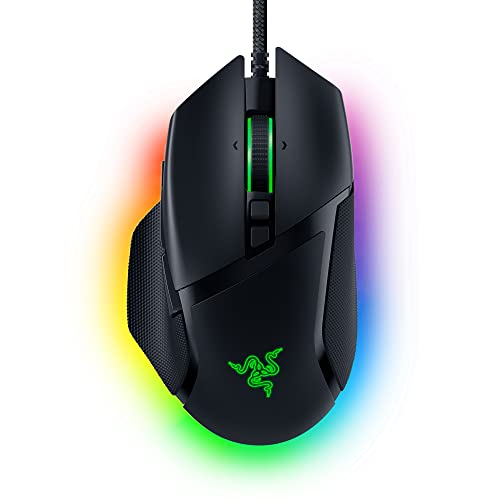
Razer Basilisk V3 — Stretch pick: premium wheel
The Basilisk V3 in a $40 guide sounds like a misprint, and on an ordinary week it is one — this is a premium wired mouse whose street price periodically collapses into this frame during major sale events, at which point it becomes the most hardware anyone can buy for the money, full stop. What you would be getting: Razer’s Focus+ optical sensor, optical main switches that cannot develop contact bounce, a thumb rest shape with a removable sensitivity clutch, and the finest scroll wheel fitted to any mouse in this article — tilting, ratcheted or free-spinning at your command, with an automatic mode that shifts behaviour when you flick it.
Treating it as a budget pick requires understanding what kind of bargain it is. You are not buying a budget mouse; you are buying a flagship at a budget moment, with the flagship’s expectations attached — it deserves a decent pad, its software rewards an hour of setup, and its broad ergonomic shell assumes a medium-to-large right hand. Players inside that description who catch it in-frame gain a mouse that would headline a guide at twice the budget. Players outside it — small hands, wireless devotees, the impatient — should let the moment pass and choose from the four everyday picks without regret.
A word on how to catch it: the dips cluster around the big retail events and the brand’s own storefront promotions, and they rarely last long. Decide in advance that this is the mouse you want, set the alert, and buy without a midnight deliberation when it fires — the readers who hesitate to comparison-shop at the moment of the dip are the ones who watch it climb back out of the frame. Preparation, at this tier, is a feature.
- Sensor: Razer Focus+ optical
- Connection: wired USB, flexible Speedflex cable
- Buttons: 11 programmable, removable sensitivity clutch
- Wheel: tilt wheel with tactile and free-spin modes
- Switches: optical main switches
Strengths
- Flagship wheel, sensor and switches when caught in-frame
- Thumb clutch serves shooters and precision work alike
- Full PTFE feet give it an unusually smooth stock glide
Trade-offs
- In-frame pricing is an event, not an everyday event — patience required
- Broad shell excludes small hands
- Wired only, despite the premium positioning
Best for: medium-to-large right hands ready to pounce during a major sale. Not suited for: buyers on a deadline, small hands, or anyone set on wireless.
What About Small Hands and Left-Handed Players in This Tier?
Honesty requires admitting this bracket serves them worst. The ergonomic picks assume a medium-to-large right hand, and true left-handed gaming mice effectively do not exist at this price — the left-handed player’s realistic routes are the symmetrical shells here, the G305 above all, used with their buttons configured for the left hand, or saving toward the specialist options covered in our left-handed guide. Small-handed right-hand players fare better: the G305’s compact body and the BENGOO’s medium shell both work, and the SM600’s pierced body gives smaller hands an easy, light grip. What we would not advise is forcing a fit — a DeathAdder Essential bought because it is famous, in a hand it overwhelms, is a worse mouse than any pick on this page that actually fits.
How Do Different Game Genres Fare on This Shortlist?
Shooter players are the bracket’s natural winners, because their needs — a sensor that holds a flick, clicks that land together, a cable or radio that stays out of the way — are exactly what trickle-down improved first. The DeathAdder Essential and the SM600 cover right-handed and wireless-leaning shooter players respectively, and the G305 covers everyone else when its price behaves. Nothing here will be the reason a shooter player loses a duel they should have won.
Strategy and MOBA players should weight the middle of the list: the M602’s button field and macro support map directly onto ability rotations and camera controls, and its substantial shell suits the palm-heavy style those long sessions encourage. Simulation and builder players, who live on the scroll wheel and the middle click, are the one group this bracket serves least generously — the wheel is where budget engineering shows first — which is another reason the in-frame Basilisk V3, with its flagship wheel, tempts far beyond its price whenever it appears.
Does the Brand on the Box Matter at This Price?
More than the specification sheet suggests, but for operational rather than snobbish reasons. A major brand’s budget mouse comes with firmware that has been patched, software that still downloads, a warranty process with a postal address, and a production line consistent enough that the mouse reviewed is the mouse shipped. The value brands in this guide — Redragon, BENGOO, SOLAKAKA — compete by spending on hardware instead of infrastructure, which is a legitimate trade that this guide endorses in specific models. The line we draw is at the no-name tier below them, where the listing itself is the only documentation a product will ever have.
There is also a second-order effect worth knowing: branded budget mice hold their shape in the second-hand and hand-me-down economy. A DeathAdder Essential or a G305 given to a younger player arrives with a findable manual, replaceable feet that actually exist, and settings advice a search away. An anonymous mouse arrives with none of that. When two picks feel equal in the hand, choose the one whose support ecosystem you can picture using in year two — it is the tiebreaker that ownership keeps validating.
How Should You Test a New Mouse Inside Its Return Window?
Treat the first week as an audition with a script. Day one belongs to setup: sensitivity matched to your old mouse’s feel, side buttons bound, cable or receiver placed properly. Days two and three belong to your main game at your normal session length — not a heroic marathon, which makes every mouse feel wrong by hour five. Somewhere in the week, add an hour of ordinary desktop work, because a mouse that games beautifully and types miserably is a part-time tool at a full-time desk.
Judge by specific evidence, not vibes. Pressure points that appear at the same minute of each session are structural. Clicks you miss because a button sits where your thumb is not are structural. A shape that merely feels unfamiliar on day one and invisible by day four is adaptation, and it is the normal experience of changing shells. If the evidence says structural, use the return window without guilt and move one step down this list — the bracket is deep enough that your mouse is in it, and settling for a hand that aches is the only genuinely bad outcome available at this price.
Which Grip Styles Does This Bracket Serve Well?
Palm players are spoiled here. The DeathAdder Essential was drawn for them, the M602 gives larger palms a broad platform with buttons to spare, and the Basilisk V3 — when caught in-frame — adds a thumb wing that palm players describe as the hand finally being allowed to rest. If your whole hand lives on the mouse, this bracket’s ergonomic trio covers every budget mood from sensible to opportunistic, and none of them will ask your hand to change its habits.
Claw players should look at the G305 first among equals: its compact shell and low rear let fingers arch without the body crowding the palm, and its light clicks suit the claw’s higher click frequency. The SM600 serves claw players who want wireless now rather than on promotion, its pierced sides giving hooked fingers extra purchase. The BENGOO, surprisingly, works as a claw trainer — its medium shell and unremarkable shape let new players discover the grip without an ergonomic shell steering them elsewhere.
Fingertip players get the thinnest pickings, as they do at most prices, but not none. The SM600’s light honeycomb body is the easiest here to steer with fingers alone, and the G305 can be fingertipped by smaller hands, especially with a lighter cell fitted. The big ergonomic shells, by contrast, will keep inviting a fuller grip than fingertip players intend; if that is your style, accept the wireless pair as your shortlist and let the others go without a second thought.
How Do the Six Stack Up Against Each Other?
| Pick | Connection | Buttons | Standout trait |
|---|---|---|---|
| DeathAdder Essential | Wired | 5 | Proven ergonomic shape |
| Redragon M602 | Wired | 9 | Macros and rapid-fire key |
| BENGOO Wired | Wired | 6 | Simplest possible setup |
| SOLAKAKA SM600 | Tri-mode wireless | Programmable set | Honeycomb shell, three links |
| G305 LIGHTSPEED | Wireless | 6 | Months of AA battery life |
| Basilisk V3 | Wired | 11 | Tilt wheel with free-spin |
Note also what the table does not contain: a bad mouse. A decade ago a budget roundup needed a warning section for the picks that would spin out, double-click by spring or shed their coating by summer. This one does not, because the floor of the market rose — which is exactly why the differences that remain are about fit and philosophy rather than competence, and why reading the detailed sections matters more than reading the rankings.
The honest reading of this table is that the bracket contains three different philosophies: shape-first (DeathAdder Essential), features-first (M602, Basilisk V3) and freedom-first (SM600, G305), with the BENGOO standing apart as the low-friction starting point. Choose your philosophy before you choose your mouse and the shortlist shortens itself — most buyers who feel torn between all six are actually torn between philosophies, and their games already know the answer.
What Should You Check on the Listing Before You Buy?
Budget listings are where marketplace sloppiness lives, so spend sixty seconds as an auditor. Confirm the model name in the listing title matches the pick exactly — this tier breeds near-identical variants with different sensors inside the same shell. Check which version is being sold where a mouse has wired and wireless siblings, and read the connector in the specification rather than assuming. Look at the seller: the brand’s own storefront or a long-established retailer is worth more than a small saving from an unknown name, because warranty conversations at this price are only pleasant with sellers who answer.
While you are there, glance at what is in the box. A spare set of feet, a receiver extension, a short charging lead — small inclusions signal a maker who has thought about ownership, and their absence is not a deal-breaker but is information. At this price the box contents are one of the few honest signals available before the mouse reaches your hand, and the picks in this guide were partly chosen because their makers sweat details at exactly that level.
Then check the unglamorous details that decide ownership: whether replacement feet exist for the model, whether the cable is attached or replaceable, and what the return window is. A budget mouse with a thirty-day return path is a safer purchase than a marginally better mouse sold as-is, because shape fit is personal and no review — including this one — can guarantee your hand’s verdict. Finally, ignore bundled “gifts” in your value maths; a free mousepad of unknown quality does not change which mouse is better, and this tier’s bundles are priced accordingly.
How Long Will a Mouse at This Price Actually Serve?
Longer than the jokes suggest, if you understand what ages. The electronics in these six are not the weak point: sensors do not wear out, and the switches in the branded picks are rated far beyond a typical ownership span. What ages is the interface between mouse and world — feet thinning and catching, cable insulation stiffening where it bends daily, coatings polishing smooth. Every one of those is slowed by the same cheap habits: a clean pad, a cable routed without a hard bend at the shell, and an occasional wipe of the sensor window.
Plan realistically and the maths flatter the bracket. A mouse in this frame that serves three years — an ordinary expectation for the DeathAdder Essential or the G305, and a fair one for the rest with basic care — costs its owner very little per month of play, and usually retires to a drawer as a working spare rather than to a bin as e-waste. That afterlife matters: budget mice become the household’s backup, the travel mouse, the younger sibling’s first gaming mouse. Buy the pick whose second life you can picture, and the purchase defends itself twice.
How Should You Spend the Rest of a Small Setup Budget?
A $40 mouse performs at its best on a surface that costs a fraction of it. If your current pad is a frayed giveaway from a trade show, a fresh large cloth pad will improve your aim more than any upgrade within this guide, because worn pads drag unevenly and make every sensor feel inconsistent. Likewise, a simple cable holder or a strip of desk-edge management transforms the wired picks, removing the tug that players often misdiagnose as mouse weight. Budget buyers get the most from thinking in systems: mouse, surface and cable path together, rather than one hero product on a neglected desk.
Settings are the other free upgrade, and they compound with the hardware in ways buyers underestimate. A budget mouse at a well-chosen sensitivity on a fresh pad will out-aim a flagship at a careless sensitivity on a worn one, every session, which is why this guide keeps returning to calibration: it is the only upgrade that transfers perfectly when you eventually change mice.
Settings are also the other free upgrade. Drop your in-game sensitivity until you can turn comfortably with a full forearm sweep, set the mouse’s hardware step to match, and spend one practice session letting your arm relearn distances. Players routinely discover that the “bad sensor” they were replacing was a good sensor running at a sensitivity no human could control. Do that experiment with your current mouse before the new one arrives, and you will know exactly what the new hardware fixed and what it never needed to.
How Do You Calibrate a Budget Mouse Once It Arrives?
Start with the pad, not the settings: wash or replace a tired surface, because a new sensor on a worn pad feels inconsistent and the mouse will take the blame. Then set the hardware sensitivity step so your in-game turn speed lets you rotate fully with one comfortable arm sweep, and leave the other steps alone for a week — constantly flipping sensitivity is how players convince themselves a mouse feels wrong. Bind the side buttons to your two most-used non-movement actions and resist adding more until those two are reflexes.
While you calibrate, also learn your new mouse’s wheel. Budget encoders vary more than sensors do: roll slowly through a document and a weapon wheel, feel where each detent lands, and decide whether the step is where your finger expects. It is the control you will use second-most, and five conscious minutes with it now prevents a month of vague dissatisfaction you cannot name.
Finish with the cable or the receiver. Route wired leads so they leave the mouse with slack and never cross the pad’s active area; place wireless receivers within sight of the mouse, ideally on the short extension many include. These five minutes of housekeeping are worth more than the difference between any two picks in this guide, and they are the reason two owners of the same mouse can report completely different experiences with it.
What Goes Wrong Most Often When Buying in This Tier?
Chasing the biggest DPI number on the box is the signature error of this bracket. DPI is a ceiling, not a quality score, and every player reading this uses a small fraction of even the BENGOO’s range. A related trap is buying the mouse with the most lighting zones and assuming the budget followed the light; in this tier, glow is cheap and sensors are not, so the correlation often runs backwards. Judge by shape, switches and cable, and let the lighting be whatever it happens to be.
Overvaluing wireless is a subtler failure at this level. Players stretch for a radio and accept a worse shell, worse switches and a worse cable-free experience than the wired picks they passed over — then game three feet from the receiver anyway. Wireless is wonderful when the whole package is right, as the SM600 and the G305 show; as a box-ticking exercise it quietly taxes every other part of the mouse.
Another common failure is ignoring hand size because the price felt too small to justify measuring. A large ergonomic shell in a small hand causes the same clawing strain at this price as at any other, and returns are just as available — use them. Finally, beware the marketplace lookalikes: this tier is heavily imitated, with shells copied and names approximated. Buy from the verified listings linked here rather than a suspiciously cheaper twin, because the genuine article’s sensor and switches are the entire point.
Final Recommendation
For most buyers, the DeathAdder Essential is the answer: the shape is a classic for measurable reasons, the clicks feel honest, and nothing about it will need explaining or excusing a year from now. If your games live on keybinds, the Redragon M602 gives you a control surface the Razer cannot match at this money. Go wireless with the SM600 if the desk demands it, start simple with the BENGOO if this is a first mouse — and if your old mouse can survive a few more weeks, set a price alert for the G305 and the Basilisk V3, because catching either inside this frame is the closest thing budget gaming offers to a free upgrade.
One closing thought for readers assembling an entire first setup around this budget: resist spreading the money evenly. The mouse is the component your hand argues with most, and this bracket’s depth means a well-chosen pick here lets you economise harder elsewhere — on the pad you will replace yearly, on the keyboard you can upgrade later — without the daily friction a bad mouse imposes. Choose the shape first, the philosophy second, and let the lighting be whatever it turns out to be.
Frequently Asked Questions
Can a mouse at this price really keep up in competitive games?
Yes. Sensor tracking at this level exceeds what ranked play demands, and the limiting factors become your sensitivity settings, your pad and your practice. Plenty of high-ranked players developed on hardware no better than the middle of this list, because aim is a trained skill that hardware can only obstruct, not supply. What you give up versus flagships is refinement — weight tuning, exotic materials, extreme polling options — not the ability to land shots.
Is the wireless pick fast enough for shooters?
On its 2.4 GHz connection, yes; that is the mode to game on. Bluetooth is there for laptops and casual use, and the wired mode covers charging while you play. Keep the receiver close and unobstructed and the SM600 will not be the weak link in your setup. The G305’s LIGHTSPEED link, when it is in-frame, is a tier above still — it is the same system used on professional stages, with a battery economy no rechargeable budget mouse approaches.
How long will a budget mouse like these last?
With a clean pad and ordinary care, expect years of service from the branded picks; switches in this class are rated in the tens of millions of clicks. Keep the original box if you can — it makes a warranty conversation smoother, protects the mouse in a house move, and turns a hand-me-down into something that feels like a gift rather than a cast-off. Small courtesies to your future self are a recurring theme at this budget, because the products themselves are good enough to still be around when those courtesies come due.
The budget brands’ mice typically age through their cables and feet first, both of which a careful owner can baby along — avoid sharp desk edges and grit on the pad.
Should I wait for a sale or buy one of the everyday picks now?
If your current mouse double-clicks, disconnects or hurts your hand, buy now — the everyday four are good mice, not consolation prizes, and weeks of play are worth more than the gap between them and the stretch picks. If it merely feels old, waiting is rational: set alerts, keep playing, and let the sale come to you. The one bad option is the middle path of buying a placeholder you already dislike; this bracket is good enough that no purchase here needs to be temporary.
Are the budget brands here safe to buy from?
The specific models listed, yes — each earned its place by passing the same tracking, click and build checks as the branded picks, and each links to a verified listing rather than a lookalike. What we would not do is generalise that trust to every model a value brand sells; this tier rewards choosing model by model, which is precisely what a guide is for.
Do I need software for these mice to work?
No. Every pick functions fully when plugged in or paired, with hardware sensitivity switching on the mouse itself. Software adds remapping, macros and lighting control — genuinely useful on the M602 and Basilisk V3 — but it is an enhancement, never a requirement for play. This matters most for the value brands, whose downloads may not be maintained forever; a mouse that keeps its manners without its utility is a mouse with a longer useful life.
A final practical note on timing. This bracket’s prices breathe with the retail calendar — the stretch picks dip at the big events, the everyday picks soften whenever a successor model is rumoured, and value brands discount in small, frequent waves. None of that changes which mouse you should want; it only changes when the wanting becomes buying. Decide your pick from the shape and philosophy sections above, then let the calendar do the negotiating. A mouse chosen on evidence and bought on a dip is the whole strategy of this guide in one sentence, and it works at this budget better than at any other.
Related Guides
Best Gaming Mouse for MMO RPGs
Best Wireless Left Handed Gaming Mouse
Best Wireless Gaming Mouse with Wireless Charging

[…] Best Gaming Mouse for 40 Dollars […]