What's inside
- Key Takeaways
- Quick Picks
- How were these six separated from dozens of near-identical listings?
- What does pocket-spring cushioning actually change?
- Why do armrests matter more than their size suggests?
- How should you set up a sub-150 chair during its first evening?
- Which games and habits suit this class of chair best?
- What happens to thin foam across a year of evenings?
- How do you judge a recline mechanism you cannot test in a shop?
- Why does this bracket suit students and first flats so well?
- Which small upgrades rescue a cheap chair’s weak points?
- How should two players share one of these chairs fairly?
- What should you check in the first session to catch a dud?
- Does colour choice change anything beyond looks?
- When does a footrest stop being a bonus and become a burden?
- How do you stop a light chair sliding around during play?
- What role does your desk play in whether these chairs feel right?
- Should you buy the extended protection plans offered at checkout?
- How do seasons change your relationship with a PU seat?
- What is the kindest way to retire one of these chairs?
- How can a buyer tell a serious listing from a careless one?
- Why do players outgrow this bracket at different speeds?
- What should a gift buyer know before choosing for someone else?
- How do you keep the peace with housemates over a squeaky chair?
- Does a heavier base ever matter at this price?
- How do you read the phrase ergonomic in a budget listing?
- What is a fair lifespan bargain for money this small?
- Comparison Table
- What buying errors are unique to this rock-bottom bracket?
- Final Recommendation
- Frequently Asked Questions
- Related Guides
As an Amazon Associate I earn from qualifying purchases. This post may contain affiliate links at no extra cost to you.
widgetverdict.com is reader-supported. When you buy through links on our site, we may earn an affiliate commission.
Where to buy: the six chairs reviewed here are all sold through Amazon, so open the listing for the one you fancy and confirm the colour, the warehouse it ships from and the returns terms before money changes hands.
Shopping for the best gaming chairs under 150 dollars is an exercise in deciding what you are willing to give up, because at this level something is always given up. The honest trade-offs are these: armrests are usually fixed or merely two-dimensional, the foam is a thinner grade of sponge rather than anything moulded, and the polyurethane skin is a lighter weight that will show its age sooner than the coverings on pricier seats. Any guide that pretends otherwise is selling you a listing, not advising you. What a careful buyer can still get for this money is a real steel-framed chair with a working recline, a lift that holds, and a seat shape that makes a gaming evening measurably better than the kitchen chair it replaces.
The six models below were chosen because each one spends its small budget on a different priority. One puts pocket springs inside the cushion, which is rare at any price and remarkable at this one. One stretches the seat wider and adds a four-layer spring cushion for bigger players. Two include a vibrating lumbar pillow marketed as massage — a modest feature we describe accurately in the relevant sections rather than inflating. One is a compact all-rounder that has served as a first gaming chair for years of buyers. The last is a linked-armrest design for players who recline with a controller. Read the trade-off lists as carefully as the strengths; at this ceiling, the trade-offs are where the truth lives.
A word about expectations before the picks. None of these chairs will feel like the flagship seats in glossy gaming rooms, and none should be bought as a five-year heirloom. Bought with open eyes — as a two-to-three-year tool that transforms daily comfort now — the best of them are genuinely good value. Bought as a miracle, each will disappoint by spring.
Key Takeaways
- Thin foam and fixed or 2D armrests are the normal, honest compromises at this ceiling — plan around them.
- Pocket-spring cushions appear twice in this group and noticeably change how the seat feels after hour two.
- The massage label here means a USB-powered vibrating lumbar pillow, nothing more mechanical than that.
- A wider seat with a stated 330 lb capacity serves bigger players better than a standard shell stretched thin.
- Footrests at this level are light leg rests for watching and waiting, never something to stand on.
- Your room’s heat and sunlight will age these PU covers faster than your games will wear the frames.
Quick Picks
| Pick | Badge | Why it earns a place |
|---|---|---|
| BestOffice Gaming Chair | Best all-round starter | Balanced proportions and executive manners make it the safest first gaming chair in the whole group. |
| WOTSTA Gaming Chair with Massage | Best with footrest bundle | A grey high-back seat pairing a slide-out footrest with a vibrating lumbar pillow for laid-back evenings. |
| HapGIFT Gaming Chair | Best for controller players | Linkage armrests travel with the backrest, keeping forearms planted through every degree of recline. |
| Wide-Seat Gaming Chair with Footrest | Best for bigger sitters | A 52-centimetre seat and four-layer pocket-spring cushion give larger players room standard shells deny them. |
| Homall Gaming Chair with Massage Lumbar | Best bright finish | The white Homall formula gains a footrest and a massage lumbar pillow while keeping its 135-degree recline. |
| GTPLAYER Pocket Spring Gaming Chair | Best seat cushion | Pocket springs under the padding deliver the most grown-up sitting feel available at this budget. |
How were these six separated from dozens of near-identical listings?
Listings in this bracket copy each other shamelessly, so the first pass deleted any model whose page could not state its own construction plainly: frame material, cushion type, recline range, capacity. Survivors were then ranked by what the money visibly bought. A pocket-spring cushion outranks a printed racing stripe. A wider seat with a reinforced build outranks a speaker built into the headrest. A footrest counts as a genuine feature; a vibrating pillow counts as a minor one and was never allowed to carry a pick into this list by itself.
Fit range came next. This group deliberately spans compact, standard, wide and tall-leaning patterns so that readers of different builds can find at least one honest option, and each pick section states plainly who should walk past it. Finally, we favoured chairs whose photographs, dimensions and descriptions agree with one another — a basic coherence test that a surprising number of ultra-cheap listings fail, usually because the page was assembled from another model’s assets.
We also weighed the cost of being wrong. Every chair here is sold with a returns route, and the simpler models are light enough to repackage without a second pair of hands. At this budget, an easy exit is a real feature, because fit is personal and no specification table can guarantee that a given backrest will agree with a given spine.
What does pocket-spring cushioning actually change?
Two picks in this roundup hide individual pocketed coils inside the seat, a construction borrowed from mattresses. Each spring compresses independently, so the cushion firms up under your sitting bones while staying softer where your thighs rest, and it recovers its shape when you stand instead of holding a body-shaped dent. Plain sponge cannot do this; it compresses as a single slab and slowly stays compressed. Over a long session the difference registers as less fidgeting, because pressure is spread across many small supports rather than concentrated on two points.
Springs are not magic, and their benefit depends on the padding above them. A thin foam layer over good springs still feels firm, which many players prefer and some describe as hard during the first week. What springs reliably deliver is durability of feel: the seat in month twelve sits much closer to the seat in month one than a sponge cushion does. For a budget defined by compromises, that consistency is one of the few upgrades worth actively hunting.
Why do armrests matter more than their size suggests?
Your forearms carry a surprising share of your upper body’s weight, and wherever they rest, your shoulders follow. Fixed armrests set at one height force a compromise: shrug if they are high, slump if they are low. Two-dimensional arms that rise and slide improve the odds without transforming them. Linkage arms solve a different problem entirely — support while reclined — while giving up vertical adjustment altogether. None of these systems is wrong; each matches a posture. Keyboard players who sit upright for ranked matches should prioritise height that meets their elbows at a natural angle. Controller players who lean back should prioritise arms that travel. The pick sections below label each chair’s arms accordingly, because this single component quietly decides how your shoulders feel at midnight.

BestOffice Gaming Chair — Best all-round starter
There is a reason this BestOffice design keeps reappearing in budget roundups: it makes almost no enemies. The high back is tall without being cavernous, the bolsters suggest sportiness without imprisoning your thighs, and the colour range lets the chair blend into a study, a bedroom or a first flat. It is sold as an ergonomic office and gaming chair for men and women alike, and that dual pitch is honest — the shape is a desk chair’s shape, with a racing flavour rather than a racing commitment.
Sitting in it for mixed duty is its home ground. Homework, spreadsheets and video calls occupy the morning; games occupy the evening; the chair’s upright default and moderate cushion serve both without excelling at either. The foam is the standard sponge of the class, supportive for a couple of hours and increasingly noticeable after that, which is why marathon players should look at the pocket-spring picks further down. Assembly is uncomplicated, the casters behave on hard floors, and the whole package is light enough to move between rooms when a household shares it.
Buyers at the extremes of height should measure carefully. The backrest’s useful height suits average torsos, and the seat width welcomes average hips; very tall or broad players will find their honest options elsewhere in this same guide, which is exactly why the wide-seat pick exists.
- Pattern: high-back hybrid for work and play
- Cushion: padded sponge seat of standard depth
- Colours: several finishes beyond the usual black
- Movement: swivel, recline and rolling casters
Strengths
- The inoffensive styling survives parents, partners and video-call backgrounds equally well.
- Moderate bolsters let you shift position freely during long, slower-paced games.
- It assembles quickly and moves easily, suiting shared or rented spaces.
Trade-offs
- Sponge padding flattens perceptibly across a year of heavy daily sitting.
- Armrests give limited adjustment for players with very long or short arms.
- Nothing about it is specialised, so dedicated lounging or marathon play outgrows it.
Best for: a first gaming chair that must also behave like respectable furniture. Not suited for: players over six feet or anyone planning daily six-hour sessions.
The BestOffice listing on Amazon shows every colourway side by side, which helps when matching an existing room.

WOTSTA Gaming Chair with Massage — Best with footrest bundle
WOTSTA’s grey high-back bundles the two extras budget buyers ask for most: a footrest that slides out when the evening turns relaxed, and a lumbar pillow with a USB-powered vibration motor sold under the massage label. Let us be precise about that pillow, because precision is this guide’s job. It buzzes gently against your lower back. Some players find the sensation pleasant during loading screens and long cutscenes; it is not a kneading mechanism, it has no rollers, and it will not do anything therapeutic. Judged as a comfort novelty it is harmless fun. Judged as massage, the word does heavy lifting the hardware cannot.
Strip the pillow away and a solid budget chair remains: a manufacturer-stated 300 lb capacity, a headrest, lumbar support, and a recline suited to leaning back with your feet up on the rest. The grey PU finish is a welcome change from the black-and-red uniform of the class and hides everyday marks better than white. The footrest, as with every model in this bracket, is a calf rest — treat it as furniture for your legs while you watch, not as a step or a brace.
The overall pattern fits a player whose gaming chair doubles as the room’s relaxation seat: matches upright, films reclined, feet up, pillow humming quietly if that is your taste. Players who never lounge should spend the same money on cushion quality instead and look at the GTPLAYER below.
- Capacity: manufacturer-stated 300 lb
- Extras: slide-out footrest, vibrating lumbar pillow on USB power
- Finish: grey polyurethane leather
- Support: headrest plus lumbar pillow pairing
Strengths
- The footrest-and-recline combination turns spectating into genuine rest.
- Grey upholstery sidesteps both the cave look of black and the upkeep of white.
- The vibrating pillow unplugs and removes cleanly when you tire of it.
Trade-offs
- The massage feature is vibration only, and buyers expecting rollers will feel misled.
- Footrest hardware at this price rewards gentle handling and punishes rough use.
- Cable routing for the pillow adds a small daily untidiness near the chair.
Best for: players who lounge in the same chair they compete in. Not suited for: anyone buying primarily for the massage claim, which should never be the reason.
Inspect the WOTSTA listing on Amazon for the footrest photographs before deciding whether the bundle suits you.

HapGIFT Gaming Chair — Best for controller players
HapGIFT’s defining mechanism is the linkage between backrest and armrests. Bolted-to-the-seat arms are the budget norm, and they abandon your forearms the moment you recline, leaving elbows floating while your torso lies back. HapGIFT’s arms are tethered to the moving back, so the pads track your arms through the recline arc and stay useful at the angles where a controller player actually lives. It is a thoughtful piece of engineering to find at this ceiling, and it shapes everything about how the chair feels after the first hour.
The chair around that mechanism is a PU leather racing design for adults and teens, height-adjustable, with a high back and lumbar support. Upright, it behaves conventionally at a desk; the linkage only reveals itself when you lean. There is a corresponding sacrifice: arm height is dictated by the linkage geometry, so players who need their elbow support set to a precise millimetre for keyboard work will find the arrangement approximate. Horses for courses — this horse runs best with a gamepad.
Build expectations should match the class. The frame and lift do their jobs, the foam is the usual sponge grade, and the moving arm joints appreciate a bolt check after the first fortnight. Within those realities, the HapGIFT offers something genuinely rare under this budget: a recline you can actually use without your arms paying for it.
- Armrests: linkage type following the backrest
- Cover: PU leather in a racing pattern
- Adjustment: seat height, recline and swivel
- Sizing: adults and older teenagers
Strengths
- Elbow support survives the recline instead of being left behind at desk angle.
- The purely mechanical design avoids batteries, motors and proprietary spares.
- It flatters handheld and controller play more than any rival in this list.
Trade-offs
- Armrest height cannot be fine-tuned independently for exact typing posture.
- Extra moving joints mean extra bolts to snug during early ownership.
- Pure desk players pay for a mechanism they will rarely exploit.
Best for: console and controller players who recline as a default posture. Not suited for: touch-typists chasing laboratory-grade armrest adjustment.
Study the HapGIFT chair on Amazon, where the linkage arms are easiest to understand from the side photographs.

Wide-Seat Gaming Chair with Footrest — Best for bigger sitters
Most budget gaming chairs are cut for a narrow template human, and bigger players are told to simply endure the bolsters. This wide-seat model starts from the opposite end: a seat roughly 52 centimetres across, a four-layer pocket-spring cushion, linkage armrests, a removable footrest and a manufacturer-stated capacity of 330 lb. That combination is the most considered answer to a large player’s needs anywhere near this money, and it earns its place here on construction rather than on the width figure alone.
The layered cushion deserves attention. Pocket springs form the resilient core, spreading load across many coils, while the layers above handle surface softness. For a heavier sitter this matters twice: comfort on the day, because pressure is distributed rather than spiked, and longevity across the year, because springs recover where sponge alone would stay crushed. The linkage arms repeat the HapGIFT trick of following the recline, and the footrest gives longer legs a destination during films and queues.
Honesty requires two cautions. The stated capacity is the maker’s figure, as with every chair here, and players near it should also read the dedicated big-and-tall roundup where frames are heavier still. And width is not the same as depth: long-legged players should confirm the seat depth in the listing, because a wide-but-shallow cushion solves only half the fit problem.
- Seat width: approximately 52 centimetres between bolsters
- Cushion: four-layer construction over pocket springs
- Capacity: manufacturer-stated 330 lb
- Extras: removable footrest, linkage armrests
Strengths
- Genuine width lets bigger players sit naturally instead of perching between bolsters.
- The spring core resists the rapid flattening that ends budget chairs for heavy users.
- Linked arms and a footrest complete a lounging setup without extra furniture.
Trade-offs
- The larger footprint needs a larger corner, so measure your floor space first.
- Players well above the stated capacity should step up to the heavy-duty class.
- Its generous cushion can feel oversized and unsupportive to petite sitters.
Best for: broad or heavy players who have been ignored by standard budget patterns. Not suited for: small rooms or small sitters, both of whom will feel swamped by it.
The wide-seat listing on Amazon gives the full dimension set, so check seat depth as carefully as width.

Homall Gaming Chair with Massage Lumbar — Best bright finish
Homall takes its long-running white racing chair and bolts on the two features modern buyers keep requesting: a slide-out footrest and a lumbar pillow with a vibration motor. The underlying chair is the familiar formula — PU leather, a recline reaching 135 degrees, full swivel, headrest and lumbar pillows — in the bright white finish that makes it the extrovert of this roundup. In a pale room or a streaming setup lit for camera, that finish is a genuine aesthetic asset rather than a gimmick.
The massage pillow needs the same plain description given to the WOTSTA: a USB-powered cushion that vibrates against your lower back. It is a pleasant background buzz for some players and an irrelevance to others, and it carries no therapeutic promise in this guide. The footrest is the more substantive addition, extending the chair’s recline into a proper lean-back-with-legs-raised posture for films and handheld play, within the usual light-duty limits of the type.
White upholstery is a commitment. It shows denim dye, pen marks and the grey film of everyday dust sooner than any other colour, and it asks for a weekly wipe as the price of its looks. Buyers happy to pay that price get the cheeriest chair in the group; buyers who know they will not, should take the same budget to the grey WOTSTA or the spring-cushioned GTPLAYER and enjoy lower maintenance.
- Finish: white polyurethane leather
- Recline: up to 135 degrees with swivel
- Extras: slide-out footrest, vibrating lumbar pillow
- Support: headrest pillow included in the box
Strengths
- The white shell photographs beautifully and lifts the mood of a small setup.
- A footrest at this money widens the chair’s usefulness beyond the desk.
- The base design is a known quantity with years of ownership feedback behind it.
Trade-offs
- Light upholstery demands frequent cleaning to keep its showroom brightness.
- The vibration pillow is a novelty feature, not a massage mechanism.
- Its recline ceiling is shallower than some lounge-focused rivals here.
Best for: style-led setups, streamers on camera and bright rooms. Not suited for: low-maintenance households or players who eat at their desk daily.
Look at the Homall massage model on Amazon to judge the white finish under real listing photographs.
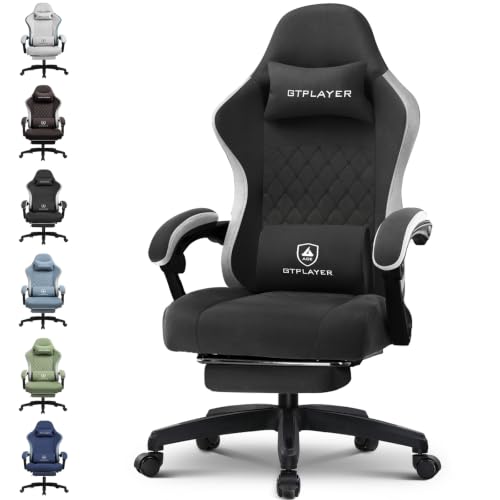
GTPLAYER Pocket Spring Gaming Chair — Best seat cushion
GTPLAYER’s contribution to this bracket is putting a pocket-spring cushion where rivals put plain sponge, then adding linkage armrests and a footrest around it. The cushion is the headline and should be. Individual coils respond independently to your weight, so the seat feels planted rather than padded, and it springs back when you stand instead of memorising your shape in compressed foam. Across a three-hour session, that liveliness is the difference between a chair you forget and a chair you keep shifting in.
The supporting cast is well chosen. Linkage armrests follow the backrest for controller play, the footrest covers spectating, and the high back with lumbar support handles the standard ergonomic duties. GTPLAYER sells several chairs that look similar at a glance, so confirm you are looking at the pocket-spring variant — the cushion construction is the entire argument for this pick, and the cheaper sponge sibling is a different ownership experience wearing the same clothes.
Firmness is the talking point in early ownership. A spring seat does not welcome you like a sofa; it holds you like a good mattress, and players migrating from a soft old office chair sometimes spend a week deciding whether they approve. Most do, because the support stays identical in month six while softness elsewhere is already fading. If you know you love a plush, sink-in feel, this is your warning to choose differently.
- Cushion: pocket-spring core with padded surface
- Armrests: linkage type moving with the backrest
- Extras: footrest for reclined viewing
- Support: lumbar support with a high-back shell
Strengths
- The spring seat keeps its character far longer than sponge rivals manage.
- Pressure spreads across many coils, reducing the two-point ache of flat foam.
- Linked arms plus a footrest make it the group’s most complete lounger.
Trade-offs
- The decisive firmness will not charm players who want a plush welcome.
- Similar-looking GTPLAYER variants make careful listing-checking essential.
- Its feature count means more joints and rails to keep snug over time.
Best for: players who sit long and value a seat that stays itself. Not suited for: lovers of soft, deep, sofa-like cushioning.
Verify the pocket-spring wording on the GTPLAYER listing on Amazon before ordering, since the variant matters.
How should you set up a sub-150 chair during its first evening?
Assemble it fully before judging anything, with every bolt only snugged until the backrest sits square, then tightened in rotation. Set the lift so your feet plant flat and your knees bend near ninety degrees; if your feet dangle, a low footrest or a stack of books under the desk is a legitimate interim fix while you learn the chair. Position the lumbar pillow at belt height — most people initially park it too high, where it pushes the mid-back forward and feels like a fist. Then play a genuine session, not a five-minute perch. Budget foam and spring seats both reveal their real character somewhere in the second hour, and returns decisions made before that point are guesses.
Over the first fortnight, expect a light retightening round: new bolts bed into painted brackets and relax slightly, and a two-minute pass with the supplied key silences most early creaks. Keep that key taped beneath the seat or in the desk drawer. Owners who maintain this tiny habit report markedly quieter chairs than owners who let small looseness compound into rattles.
Which games and habits suit this class of chair best?
Almost everything played at a desk for one to three hours at a stretch suits these chairs well: shooters, sports titles, indie games, homework-adjacent strategy, and the ordinary mixture of play and browsing that fills most evenings. The class strains at the extremes — the all-day remote worker who also games at night is asking one thin cushion to do two jobs, and the competitive player practising eight hours daily will out-sit any sponge seat here. For those lives, this budget is a stepping stone rather than a destination, and the kindest advice is to buy the pocket-spring or wide-seat pick now and let it serve honourably while you save toward the next tier.
What happens to thin foam across a year of evenings?
Sponge cushioning fails by slow compression rather than by tearing. Each session squeezes air from the cells beneath your weight; each night the foam recovers a little less than it lost. The change is gradual enough that owners rarely notice a single bad day — instead, somewhere around month eight, the seat simply feels like a different, harder chair than the one that arrived. Sitting bones find the plywood base sooner, and the front edge of the cushion, where players perch during tense moments, thins fastest of all.
You can slow the process meaningfully. Stand up between matches rather than sliding off the front edge, which drags and folds the foam. Avoid kneeling on the seat to reach a shelf, a concentrated load that crushes cells in one spot. Keep the chair out of hot rooms and sunny windows, since warmth accelerates the breakdown of cheap foam chemistry. And rotate your sitting position through the week if your games allow it — centre for shooters, slightly back for strategy — so the wear spreads across the cushion instead of drilling one permanent hollow.
When the foam finally gives up, the chair is not necessarily finished. A replacement seat pad restores a workable surface for very little money, and the frame, lift and backrest usually have life remaining. This is the pragmatic rhythm of the whole bracket: buy the structure once, refresh the soft parts as they tire, and the total cost across three years still undercuts a single premium chair.
How do you judge a recline mechanism you cannot test in a shop?
Read the listing for three mechanical facts. First, the stated angle range tells you the extremes, but the lock positions tell you the truth about daily use — a chair that locks at several points serves work and play, while one that locks only fully upright or fully back forces a choice between postures. Second, look for mention of tilt tension adjustment, the knob beneath the seat that decides whether leaning back feels like resting against a spring or falling through a trapdoor. Third, note whether the backrest and seat tilt together as one unit or the back reclines independently; independent recline suits desk players who want their feet planted while their torso rests.
Once the chair arrives, test the mechanism like an inspector rather than a fan. Lock it at your working angle and push; a sound lock holds without creeping. Rock gently and listen: a smooth mechanism is nearly silent, while grinding or clunking on day one predicts a noisy year. Cycle the recline a dozen times. These five minutes are the closest you will get to a showroom test, and they fall inside the returns window while a remedy is still free.
Why does this bracket suit students and first flats so well?
The economics of early independence are brutal, and furniture competes with deposits, textbooks and a graphics card that is somehow always next on the list. A chair from this group asks for a modest sum, arrives in one box that fits in a small car, assembles with a single Allen key, and improves every hour spent at the only desk the room has. When the lease ends, it can be sold locally in an afternoon, donated, or carried to the next place without professional movers. Expensive chairs are better objects, but they are also commitments, and there is a season of life where commitment is the scarcest resource of all.
There is also a learning function. A first chair teaches you your own preferences — firm or soft, bolstered or flat, upright or reclined — at a price where a wrong guess is a lesson rather than a loss. Players who have owned one of these for two years shop for their next chair with genuine self-knowledge, and that education is worth part of the purchase price by itself.
Which small upgrades rescue a cheap chair’s weak points?
After the first month — never before, because new foam lies to you — your body will have identified the chair’s single real deficiency, and most deficiencies in this bracket have a cheap, specific answer. A drifting lumbar pillow can be replaced by a strap-fixed memory-foam version that stays where you put it. A hard seat can gain a thin gel or foam pad that restores the surface without rebuilding the chair. Squeaky casters on wooden floors can be swapped for soft rollerblade-style wheels in ten minutes with no tools beyond your hands. A missing footrest, for players who discover they lounge more than expected, is answered by a separate under-desk rest that outperforms most built-in rails anyway.
What you cannot upgrade is the skeleton: frame width, backrest height and lift range are fixed at purchase. That asymmetry is why this guide keeps returning to fit and frame as the decisions that matter, while treating every soft, bolt-on shortcoming as a solvable errand. Buy the bones correctly and the rest is shopping; buy the bones wrongly and no accessory will save the relationship.
How should two players share one of these chairs fairly?
Shared chairs fail socially before they fail mechanically. The taller player’s lift setting leaves the shorter player’s feet dangling; the lumbar pillow migrates to whoever adjusted it last. Households that share well adopt two habits: each person resets height and pillow position as part of sitting down, the way drivers adjust a mirror, and the chair’s Allen key lives in a known drawer for the fortnightly bolt check that shared use makes more necessary. Wear also doubles, which argues for the spring-cushioned picks in shared homes — their seats tolerate the doubled compression cycles with far less visible ageing than sponge manages.
What should you check in the first session to catch a dud?
Sit down and go quiet. A healthy chair at this price is not silent like a premium model, but it should not announce every shift with a crack or a groan. Roll a slow circle and feel for a caster that drags. Raise the lift fully, sit, and check again in ten minutes whether you have sunk. Recline to your film angle and confirm the lock holds when you reach for a drink. Inspect the stitching along the bolster seams and the underside of the cushion, where flaws hide from listing photographs. Anything that fails these simple tests in week one rarely improves, and the returns window is the cheapest repair shop you will ever be offered — use it without sentimentality.
Does colour choice change anything beyond looks?
More than buyers expect. White and pale finishes reflect the room’s light and make small setups feel larger, but they record every denim transfer, coffee splash and dusty handprint, so their owners effectively sign a cleaning contract. Black hides nearly everything and absorbs heat in sunny rooms, becoming the warmest seat in the house by mid-afternoon in summer. Grey splits the difference on both counts, which is why the WOTSTA’s finish is quietly one of its strongest arguments. Two-tone racing schemes hide wear unevenly — the light panels age visibly while the dark panels look new — and can date a room’s style faster than a plain finish does. Choose with your climate, your laundry habits and your room’s light in mind, not only with your favourite team’s colours.
When does a footrest stop being a bonus and become a burden?
Footrests earn their keep in rooms where the gaming chair is also the film chair. In a tight desk setup they can become an obstacle: the folded rail reduces clearance under the seat, catches on PC towers and cable runs, and tempts players to rest their feet on it during desk work, which drags posture forward. If your chair lives permanently at a desk in a small room, the neater picks without rails — the BestOffice and the HapGIFT — may serve the space better. If your chair rolls out to face a television every evening, the calculus reverses completely, and a footrest becomes the feature you use most after the seat itself.
How do you stop a light chair sliding around during play?
Budget chairs are light, and light chairs wander — a hard push against the desk during an intense moment sends casters rolling on smooth floors. A low-pile rug or a chair mat under the setup adds the friction that stops the drift without locking you in place. Players on laminate sometimes fit one locking caster at the front, a cheap part that converts the whole chair’s behaviour. Weight helps too, oddly: a chair used with a footrest extended is harder to scoot accidentally, because your legs anchor the geometry. None of these fixes costs much, and all of them beat the unconscious habit of bracing your feet against the desk legs, which wrecks posture while solving nothing.
What role does your desk play in whether these chairs feel right?
A chair is half of a two-part machine. Desk height decides the lift setting; desk depth decides how close your eyes sit to the screen; the desk’s underside decides whether the chair can tuck away at all. Before ordering, measure the clearance beneath your desk’s lowest obstruction — a drawer block or a modesty panel — and compare it against the armrest height of your chosen pick at a working seat height. A mismatch of two centimetres exiles the chair to the middle of the room forever. Monitor height matters in the same system: a screen set too low will pull your head forward no matter how thoughtfully the backrest is shaped, and owners routinely blame the chair for a geometry problem the desk created.
Should you buy the extended protection plans offered at checkout?
For chairs in this bracket, the maths usually argues against it. The common failures — foam fatigue, PU cracking, a tired lift — are either classed as wear and excluded, or fixable with inexpensive commodity parts and a video tutorial. The plan’s price is a meaningful fraction of a replacement chair, and the bracket’s whole philosophy is cheap repairability. Keep the money, keep the Allen key, and keep the packaging until the returns window closes; that combination protects you better than a policy document does.
How do seasons change your relationship with a PU seat?
Winter makes polyurethane firm and cold to first contact, a small daily shock that a throw blanket over the cushion solves completely. Summer makes the same surface cling to bare skin and trap warmth through long sessions, which is when owners of pale chairs discover that a breathable seat cover earns its drawer space. Spring and autumn are the material’s honest seasons, when it simply wipes clean and asks nothing. Players in year-round hot climates should weigh this cycle heavily — for them the fabric roundups elsewhere on this page may describe a better daily life — while players in temperate rooms will barely notice the effect beyond the occasional warm evening.
What is the kindest way to retire one of these chairs?
When the foam has flattened and the skin has cracked beyond cosmetic rescue, the frame usually still has value to someone. Listed honestly with its faults photographed, a used budget chair sells quickly to a student furnishing a first room, because the lift, base and backrest outlive the soft parts. Donation is the other honourable route. What these chairs should not become is a slow disintegration in a garage corner: the steel and plastic separate easily for recycling in most areas, and a chair that served three years of evenings deserves a tidier ending than mildew.
How can a buyer tell a serious listing from a careless one?
Serious listings agree with themselves. The dimensions in the text match the dimensions in the diagram; the photographs show one consistent chair from several angles; the capacity, recline range and cushion construction are stated in plain numbers rather than adjectives. Careless listings borrow a hero photograph from a more expensive model, contradict their own measurements between the title and the description, and describe the foam with poetry instead of construction. In a bracket where the products genuinely resemble one another, the quality of the page is one of the few proxies you have for the quality of the quality-control behind the box. Every pick in this guide passed that coherence test, which is a large part of why the list stops at six.
Why do players outgrow this bracket at different speeds?
Session length is the accelerator. A player whose gaming fits into weeknight hours may find a chair here sufficient for years, because the foam rests more than it works. A player who adds streaming, remote work or university study to the same seat multiplies its daily load threefold and will meet the bracket’s limits within a year. Neither player bought wrongly; they simply bought the same tool for different workloads. When you read owner reports that contradict each other wildly, this difference in daily hours explains most of the disagreement, and it is why this guide keeps asking how long you sit rather than only what you play.
What should a gift buyer know before choosing for someone else?
Gaming chairs are among the most gifted items in this whole category, and the failure mode is always fit. A chair chosen by photograph for a player whose height and build the giver only roughly knows is a lottery ticket with a large box. If you are buying for someone else, favour the middle of every range: the BestOffice’s average-friendly pattern or the GTPLAYER’s broadly comfortable spring seat forgive the most guessing. Keep the receipt route open, choose the plainer finish, and resist the vibrating extras — the recipient’s posture will thank you for spending the budget on the seat they will actually live in.
How do you keep the peace with housemates over a squeaky chair?
Budget chairs develop voices, and thin walls carry them into other people’s sleep. The fortnightly bolt check is the first remedy, because most squeaks are a loosened joint rather than a failing part. A drop of silicone lubricant on the tilt mechanism’s pivot — never on the lift’s piston, which should stay clean — settles the second category. Casters on hard floors are the third noise source, answered by a rug. Attend to these small acoustics and a cheap chair can live in a shared flat without becoming a diplomatic incident, which is more than can be said for many expensive hobbies.
Does a heavier base ever matter at this price?
Players who lean far back or perch on the front edge test a chair’s stability in ways upright sitters never do. A wide-stance base with long caster arms resists the tipping sensation that a compact base allows during a deep recline, particularly for taller players whose centre of gravity rides higher. If you are tall and love a recline, weight the picks with the broadest footprint and keep the recline lock honest by testing it early. Everyone else can treat the base as background engineering and spend their attention on the seat, where their evenings will actually be decided.
How do you read the phrase ergonomic in a budget listing?
As a direction of travel rather than a certification. It usually means the backrest is curved, a lumbar support of some kind is present, and the seat height adjusts — a reasonable starter kit that says nothing about whether the geometry matches your body. The word carries no standard, no test and no guarantee in this market. Your tape measure and the returns window are the only ergonomics authorities that will ever rule on your specific chair, which is why this guide publishes dimensions and fit warnings for every pick instead of repeating the adjective back at you.
What is a fair lifespan bargain for money this small?
Divide the chair’s life into two clocks. The comfort clock runs on foam and springs: sponge models give their best for roughly the first year of daily use and then decline gracefully, while the spring seats hold their character considerably longer. The structure clock runs on steel and cylinders and typically ticks for years beyond the comfort clock’s end. A buyer who understands the two clocks stops feeling cheated when the cushion tires, because the purchase was always a frame with a renewable surface. Judge this bracket by that standard and several of these six look less like compromises and more like quietly sensible engineering for the money involved.
Comparison Table
| Chair | Cushion type | Standout extra | Suits best |
|---|---|---|---|
| BestOffice | Sponge padding | Colour choice | Shared work-play rooms |
| WOTSTA Massage | Padded sponge | Vibrating lumbar pillow | Lounging in grey |
| HapGIFT | Padded sponge | Linkage armrests | Reclined controller play |
| Wide-Seat with Footrest | Four-layer pocket spring | 52 cm seat width | Bigger players |
| Homall Massage | Padded sponge | White finish, footrest | Bright streaming setups |
| GTPLAYER Pocket Spring | Pocket-spring core | Springs plus footrest | Long-session sitters |
What buying errors are unique to this rock-bottom bracket?
Chasing the longest feature list is the signature error: every powered extra is paid for by thinning the seat you actually sit on. Ignoring dimensions is the second; these chairs vary by several centimetres in width and back height, and the wrong one cannot be adjusted into the right one. Third, buyers believe the word massage describes machinery it does not. Fourth, they assemble the chair, sit for ten minutes on brand-new foam, and either rave or rage prematurely. Fifth, they park a white or pale chair in a sunny, snack-heavy room and are surprised by the cleaning regime they have volunteered for. Each error is avoidable with ten minutes of reading — which, at this price, is the highest-value ten minutes in the whole purchase.
Final Recommendation
Start with the cushion and work outward. The GTPLAYER’s pocket springs give this bracket its most durable seat, and the wide-seat model extends that same spring idea to players the standard patterns exclude — between them they cover the majority of buyers honestly. The HapGIFT is the controller player’s thoughtful outlier, the WOTSTA and Homall sell relaxation bundles whose vibrating pillows should be treated as garnish, and the BestOffice remains the calm default for a first setup. Whichever you choose, choose it for its frame and its fit rather than its extras, keep the returns packaging until hour three has spoken, and your modest budget will have bought exactly what this class can genuinely deliver: evenings that end because the game did, not because the chair gave up first. That is the honest promise of this bracket — not luxury, but a seat that respects both your spine and your wallet while you find out what kind of player you really are.
Frequently Asked Questions
Is the massage function on these chairs worth paying for?
Treat it as a free novelty rather than a reason to buy. The pillows vibrate through a USB connection; some players enjoy the buzz while waiting in lobbies, but no chair in this bracket contains rollers or any mechanism a massage therapist would recognise.
How long will a chair at this level hold up?
The frames generally outlast the surfaces. Expect the PU skin and sponge to show their age within a couple of years of daily use, while spring-cushioned models keep their sitting feel noticeably longer.
Can a heavier player use a standard model from this list?
Only within the maker’s stated figure, and the wide-seat pick is the one designed with you in mind; players approaching its stated limit should read the big-and-tall guide for heavier frames.
Do I need a chair mat with a budget gaming chair?
On softwood or laminate floors, yes — the hard standard casters can track marks into the surface over months. On tile or short-pile carpet over a hard base, most owners manage without one.
Should I worry about the chemical smell of a new chair?
New foam and PU often carry a factory odour that fades within days in a ventilated room. Air the chair near an open window before its first long session, and treat a smell that persists for weeks as a reason to contact the seller rather than a quirk to live with.
Why do two chairs with identical photographs differ in feel?
Budget production tolerances mean foam density and stitching tension vary between samples of the same model, so inspect your own chair during the returns window and exchange a poor sample rather than enduring it.
Related Guides
One closing thought for the undecided: the difference between the best and worst chair in this bracket is not visible in photographs, so let the construction notes above do the choosing and let the colour be the last decision rather than the first. Buyers who can stretch the budget a little will find sturdier frames in Best Computer Gaming Chairs Under 200, and anyone whose weight is the deciding factor should continue to Best Gaming Chairs for Large Guys. If reclining with extras is your whole brief, Best Reclining Massage Gaming Chairs examines that niche in depth.
[…] before the first swivel. Readers who realise the recline matters more than the buzz should compare Best Chairs for Long PC Gaming Sessions, and larger players eyeing the heated model should also read Best Gaming Chairs for Large Guys. For […]