What's inside
- Key Takeaways
- Quick Picks
- How were chairs judged for the eighth hour rather than the first?
- Why does lumbar support design matter more over time?
- How much of long-session comfort is simply heat?
- How should you pace a genuinely long session in any of these chairs?
- What setup details multiply a good chair’s effect?
- Why does cushion depth matter less than cushion behaviour?
- How do armrests shape endurance over a whole evening?
- What role does the tilt mechanism play after midnight?
- How does a chair’s sound change your sense of a long night?
- Why do long-session players end up owning footrests and cushions?
- How should a streamer or creator judge these chairs differently?
- What changes when the same chair hosts work by day?
- How do you know a chair fits your session length before buying?
- Why is the second hour the most honest hour?
- How should room lighting and late hours influence the choice?
- What does a warranty tell you about a long-session chair?
- How do seasons test a long-session setup?
- Which chair here suits the player who cannot sit still?
- How do you maintain a chair that works this many hours?
- What should you do when a long session still ends uncomfortably?
- How does age change what a player needs from a chair?
- Why do teammates’ chairs feel so different from your own?
- How much should you spend when your sessions are genuinely long?
- What is the first-week setup ritual for a long-session chair?
- Does a gaming chair or an office chair age better under marathon use?
- How do you share a long-session chair with a second player?
- Comparison Table
- Which errors shorten long sessions most reliably?
- Final Recommendation
- Frequently Asked Questions
- Related Guides
As an Amazon Associate I earn from qualifying purchases. This post may contain affiliate links at no extra cost to you.
widgetverdict.com is reader-supported. When you buy through links on our site, we may earn an affiliate commission.
Where to buy: all six chairs in this roundup link to their Amazon listings, where the size charts and fabric options can be checked against your own setup before you order anything.
The best chairs for long pc gaming sessions are not decided in the first twenty minutes, which is when most reviews are effectively written. They are decided at hour five, when a cushion has either kept its shape or surrendered it, when a lumbar support has either stayed where your back needs it or drifted into irrelevance, and when the material against your legs has either let the evening’s heat escape or sealed it in. A chair for a long session is therefore a different purchase from a chair for a quick match, and this guide judges the six below by the standards of the eighth hour rather than the first impression.
Three philosophies compete in this list. The flagship gaming chairs — Secretlab’s TITAN Evo and Razer’s Enki — bet on moulded foam and lumbar support engineered into the backrest itself. The fabric Kaiser 3 XL bets on breathability and room. The Respawn 110 Pro bets on a recline-and-footrest formula for players whose long sessions include long, leaned-back stretches. And two mesh office chairs, built for the working day rather than the gaming evening, bet that ventilation and adjustable lumbar mechanisms beat everything the racing style offers. Each bet wins for a recognisable kind of player, and the pick sections name those players plainly.
One boundary before we begin: this guide talks about comfort, posture support and fatigue in the ordinary, everyday sense. No chair here is a medical device, none treats anything, and any seller implying otherwise should be read with suspicion. What a good long-session chair does is simpler and still valuable — it supports your body evenly, lets you change position, and stays neutral for hours, so the game holds your attention instead of the furniture competing for it.
Key Takeaways
- Hour five is the real test: foam that keeps its shape and lumbar support that stays put decide everything.
- Built-in, adjustable lumbar mechanisms outlast loose pillows across a long evening of shifting positions.
- Mesh backs and fabric covers move air in ways leatherette cannot, which matters more the longer you sit.
- The ability to change posture — recline, tilt, footrest, flip-up arms — is a comfort feature in itself.
- Secretlab and Razer engineer support into the backrest; the office chairs answer with ventilation and adjustability.
- Breaks still matter: no chair in this guide makes an unbroken eight-hour sit a good idea.
Quick Picks
| Pick | Badge | Why it earns a place |
|---|---|---|
| Secretlab TITAN Evo | Best overall for marathon play | Cold-cure moulded foam and an adjustable built-in lumbar keep their shape and support deep into a session. |
| Razer Enki Gaming Chair | Best posture-led design | A built-in lumbar arch and carefully graded cushion density encourage a supported, upright playing position. |
| AndaSeat Kaiser 3 XL Fabric | Best breathable gaming chair | A fabric cover over an XL frame gives larger players airflow that leatherette models cannot match. |
| Respawn 110 Pro Gaming Chair | Best recline and footrest | A 155-degree recline with an extending footrest suits sessions that alternate between play and rest. |
| Ergonomic Mesh Office Chair for Long Hours | Best mesh workhorse | Four-way lumbar adjustment, a thick cushion and full mesh ventilation target the longest daily sits. |
| SIHOO B100 Mesh Ergonomic Chair | Best adaptive value | Adaptive lumbar support, a wide headrest and flip-up arms bring office ergonomics to a gaming desk cheaply. |
How were chairs judged for the eighth hour rather than the first?
We weighted the slow variables. Foam construction came first: moulded cold-cure foam and graded-density cushions hold their support profile far longer within a session — and across years of sessions — than cut sponge, which compresses progressively under your sitting bones until the base makes its presence felt. Lumbar design came second, with a clear hierarchy: an adjustable mechanism inside the backrest beats a shaped fixed arch, which beats a loose pillow that migrates every time you shift. Over eight hours you will shift constantly, and support that needs re-placing hourly is support that spends much of the evening in the wrong place.
Thermal behaviour came third, because heat is the discomfort players most often misattribute to padding. A chair can have excellent foam and still become unpleasant at hour four if its cover seals warmth against your back and thighs; mesh and woven fabric exist in this list precisely to answer that failure mode. Fourth came posture range: recline depth, tilt behaviour, armrest flexibility and, in one case, a footrest, because the freedom to change position is how a body tolerates duration. Finally, we checked the ordinary buying facts — size options, stated capacities as the makers give them, and whether the listing’s claims stayed within what the construction could plausibly deliver.
Why does lumbar support design matter more over time?
Your lower back’s curve needs filling, not pushing. In the first hour, almost any lumbar arrangement feels supportive, because your muscles are fresh and doing much of the work themselves. As the session lengthens and those muscles tire, the support takes over the job — and its exact position and firmness start to matter enormously. A pillow placed at belt height at seven o’clock may be sitting at mid-back by ten, having ridden up with every recline and shuffle, and a support in the wrong place is worse than a gentle one in the right place because it creates a pressure point your body keeps trying to escape.
Built-in mechanisms solve the migration problem by construction. Secretlab’s internal lumbar adjusts in depth and height from dials on the backrest, so it stays where you set it all evening. Razer’s Enki takes the opposite approach, moulding a pronounced arch into the backrest’s shape so the support is simply where the chair is. The mesh office chairs use their own answers — a four-way adjustable unit on one, an adaptive sprung design on the SIHOO that follows your back as you move. All four philosophies appear below, and the right one depends on whether you prefer to set support once, have it shaped for you, or have it follow you around.
How much of long-session comfort is simply heat?
More than the industry admits. Sit still for hours and your body warms the contact surfaces steadily; a leatherette cover traps that warmth and adds humidity, until the discomfort you feel at hour five is substantially thermal even though you would describe it as the chair getting hard. Mesh eliminates the problem at the back entirely by letting air pass through, and woven fabric reduces it at every contact point. This is why players in warm rooms, and players who run hot generally, consistently rate fabric and mesh chairs above their foam specifications, while players in cool rooms barely notice a difference. Know your room and your own thermostat before letting any review — including this one — rank these six for you.

Secretlab TITAN Evo — Best overall for marathon play
The TITAN Evo in its regular size is the benchmark long-session gaming chair, and its advantages are all slow-acting ones. The seat and backrest are cold-cure moulded foam — poured and shaped rather than sliced from a block — so the density is graded where your weight actually lands, and the cushion that supports you in hour one is recognisably the same cushion in hour six. The lumbar support lives inside the backrest and adjusts for both height and depth, which means it can be tuned to your belt line once and then forgotten, immune to the drift that afflicts pillows. The magnetic memory-foam head pillow snaps into place without straps and, just as importantly, stays there when you lean back.
The regular size is stated by the maker for a standard capacity class — the listing references its standard sizing up to roughly the mid-200 lb range — and taller or heavier players should step to the XL covered in the fabric and big-and-tall guides rather than squeezing into this pattern. Within its intended fit, the chair’s details compound: a firm, supportive seat that discourages slumping, armrests with real adjustment range, and a recline that feels damped rather than loose. The leatherette finish is the one concession to the class’s habits; it will run warmer than the fabric version of the same chair, which is the better buy for hot rooms.
For a player whose sessions regularly pass four hours, this is the pick whose engineering is aimed at your exact problem. It costs flagship money and behaves like it, particularly in the unglamorous categories — foam memory, lumbar persistence, mechanism smoothness — that decide how a chair feels in its second year.
- Foam: cold-cure moulded seat and backrest
- Lumbar: internal, adjustable for height and depth
- Headrest: magnetic memory-foam pillow
- Finish: premium leatherette in the regular size
Strengths
- Moulded foam keeps an even support profile across the longest sessions here.
- Built-in lumbar adjustment stays exactly where you set it all evening.
- The magnetic pillow removes strap fiddling and mid-session repositioning.
Trade-offs
- The firm seat surprises players arriving from soft office chairs.
- Leatherette traps more heat than the fabric variant of the same design.
- Regular sizing excludes bigger players, who must pay XL money instead.
Best for: committed players with long sessions who want support engineered in, not added on. Not suited for: hot rooms without the fabric version, or players above the regular size range.
Use the size guide on the Secretlab listing on Amazon to choose between regular and XL before anything else.

Razer Enki Gaming Chair — Best posture-led design
Razer’s Enki approaches the long session from posture rather than plushness. Its backrest carries a built-in lumbar arch — a pronounced, moulded curve positioned to meet the small of your back — and its seat cushion uses graded density, firmer where support is needed and softer at the edges, so the chair quietly encourages the position it was designed around. The dual-textured synthetic leather pairs a smoother contact surface with tougher outer panels, a detail aimed at the wear patterns of players who slide in and out many times a day.
The effect across a long session is distinctive. The Enki does not invite sprawling; it invites sitting properly, and then makes sitting properly comfortable enough to sustain. Players whose marathon sessions are competitive — ranked ladders, raid nights, tournament practice — often prefer exactly that, because the chair keeps them alert and braced rather than melted into a recline. The arch is fixed, though, and bodies differ: a player whose lumbar curve sits higher or lower than Razer’s template will feel the arch as a presence rather than a support, and there is no dial to move it.
Razer’s eco-leaning synthetic leather and the chair’s restrained black-and-green identity give it a cleaner, more adult presence than most gaming chairs. For the player who wants a long-session chair that behaves like performance equipment — supportive, structured, unapologetic — the Enki is the most coherent expression of that idea in this list.
- Lumbar: built-in moulded arch in the backrest
- Cushion: graded density for posture support
- Cover: dual-textured synthetic leather
- Character: upright, braced, competition-leaning
Strengths
- The shaped arch supports an upright posture without any adjustment ritual.
- Graded cushion density resists the centre-sag that ends long sessions early.
- Tougher outer panels answer the scuffs of daily entry and exit.
Trade-offs
- A fixed arch cannot be moved to match an unusually placed lumbar curve.
- Loungers will find the posture-first design short on sprawl.
- Synthetic leather still warms up across hours in a heated room.
Best for: competitive players whose long sessions are spent upright and focused. Not suited for: players who recline deeply or need lumbar support at an atypical height.
Look at the Enki’s backrest profile in the Amazon photographs to judge whether its arch matches your build.

AndaSeat Kaiser 3 XL Fabric — Best breathable gaming chair
The Kaiser 3 XL in fabric is the gaming chair for players who have identified heat as their long-session enemy. The woven cover lets air move through the contact surfaces in a way no leatherette can, so the slow thermal build-up that ruins hour five in a PU chair is blunted from the start. Under the fabric sits an XL frame — a wide seat and tall back for larger adults — with neck and lumbar support, a proper recline, and the substantial build that AndaSeat’s flagship line is known for.
Size is the second half of its long-session case. A player who fits properly moves less desperately; pressure spreads across a cushion actually shaped for his weight, and the tall back keeps support behind the head during a recline rather than ending at the shoulders. The fabric does ask for different care than leatherette — spills soak rather than wipe, and a fabric cleaner becomes part of the household — but for players in warm climates that trade is not close.
Against the Secretlab, the Kaiser trades a little mechanism polish for breathability and room. Against the mesh office chairs, it keeps the gaming virtues they surrender: a deep recline, a headrest made for leaning back, and a silhouette that belongs in a gaming room. For the larger player with long sessions in a warm space, it is arguably the most precisely aimed pick in this entire guide.
- Cover: breathable woven fabric
- Frame: XL pattern for larger adults
- Support: neck pillow and lumbar support included
- Movement: full recline with a high back
Strengths
- Fabric ventilation directly attacks the heat build-up of long sessions.
- The XL proportions give big players support and headroom together.
- It keeps a genuine gaming recline that mesh office chairs cannot offer.
Trade-offs
- Fabric absorbs spills and needs proper cleaning rather than a wipe.
- The large footprint requires a large corner to live in.
- Its foam, while good, lacks the moulded refinement of the Secretlab.
Best for: larger players in warm rooms whose sessions run past three hours. Not suited for: snack-heavy desks or small rooms short on floor space.
Check the Kaiser 3 XL fabric listing on Amazon for its full internal seat width before ordering.

Respawn 110 Pro Gaming Chair — Best recline and footrest
Respawn’s 110 Pro is built on the insight that long sessions are rarely spent in one position. Its backrest reclines to 155 degrees, an extending footrest carries your legs when the session turns passive, and the chair’s bonded-leather pattern with lumbar support handles the upright hours in between. For the player whose evening flows between matches, spectating, chat and video — posture changing with each — this flexibility is a long-session feature in its own right, because movement is how bodies tolerate duration.
The footrest follows the class pattern: a leg rest for reclined relaxation, happiest with calves rather than with anyone’s full weight. Used as intended, the combination of deep recline and raised legs changes the pressure map of your whole body for a while, which is precisely the point during a long evening. The chair’s styling is full gaming theatre, and its price band sits well below the flagships, which shows in the foam — supportive sponge rather than moulded engineering, and the component that will age first under daily marathon use.
That trade defines its buyer. If your long sessions are posture-hopping and social, the Respawn serves the pattern better than a rigid flagship would. If your long sessions are six upright hours of ranked play, the Enki and TITAN Evo answer your actual problem more directly.
- Recline: up to 155 degrees with an extending footrest
- Cover: bonded leather gaming pattern
- Support: lumbar support with a high back
- Role: mixed posture play and spectating
Strengths
- Deep recline plus footrest enables genuine position changes mid-session.
- The price undercuts the flagships while keeping the lounging hardware.
- It suits the social rhythm of game nights better than posture-strict rivals.
Trade-offs
- Sponge foam will tire sooner than moulded foam under daily marathons.
- Bonded leather is the least durable cover in this group.
- The footrest hardware needs the gentle treatment its class always requires.
Best for: players whose long evenings alternate between competing and relaxing. Not suited for: upright-only competitors or buyers wanting a five-year cushion.
See the Respawn 110 Pro on Amazon to view the footrest extended at full recline.

Ergonomic Mesh Office Chair for Long Hours — Best mesh workhorse
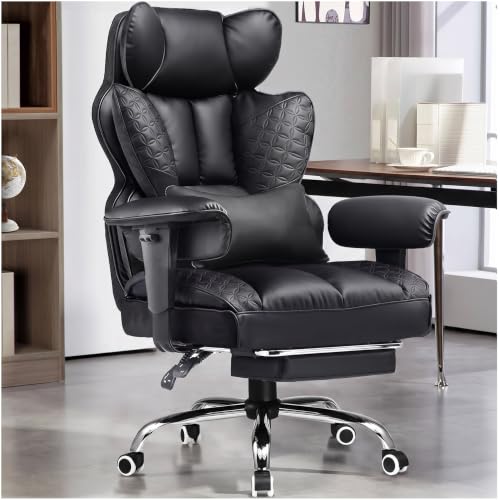
This mesh office chair was designed for the longest sits of all — the full working day — and it brings that brief to the gaming desk without apology. The back is breathable mesh, so the thermal problem that haunts leatherette simply does not exist behind you. The lumbar support adjusts four ways, letting you place it at the right height and depth for your back rather than accepting a designer’s guess. The seat cushion is a substantial 3.5-inch pad rather than the mesh sling some office chairs use, which matters for gaming, where you sit heavier and shift more than a typist does. The listing states a 330 lb capacity, BIFMA testing and a five-year warranty, a paperwork package that signals a maker expecting scrutiny.
What it surrenders is gaming theatre. There is no deep racing recline with a headrest cradling your skull, no footrest, and the tilt-and-rock motion is tuned for working postures rather than sprawling. Its headrest and arm arrangements serve a desk. For the hybrid player — work all day at the same desk, game all evening — that surrender is often the right trade, because the chair’s working hours outnumber its gaming ones and its ventilation and lumbar precision serve both shifts.
Long-session comfort is this chair’s home turf, and it shows in the details: a cushion thick enough to stay kind at hour nine, a back that never gets hot, and support you can re-tune as your body changes across the day. Players who game from their work chair should start their reading here.
- Back: full breathable mesh
- Lumbar: four-way adjustable support unit
- Cushion: 3.5-inch padded seat, stated 330 lb capacity
- Testing: BIFMA-tested with a five-year warranty stated
Strengths
- Mesh ventilation removes back heat from the long-session equation entirely.
- Four-way lumbar adjustment fits more individual backs than any fixed shape.
- The thick seat pad avoids the sling feel that gamers dislike in mesh chairs.
Trade-offs
- No gaming-style deep recline or footrest for leaned-back spectating.
- Mesh can feel cool and unfamiliar to players used to padded backs.
- Its office appearance will not satisfy a themed gaming room.
Best for: work-and-play hybrids who sit the longest total hours at one desk. Not suited for: players who recline deeply or want a gaming silhouette.
Read the warranty and testing details on this chair’s Amazon listing, since they distinguish it from generic mesh rivals.

SIHOO B100 Mesh Ergonomic Chair — Best adaptive value
SIHOO’s B100 brings the mesh formula to a friendlier price, built around an adaptive lumbar support that responds to your back rather than waiting to be adjusted. As you shift, lean and resettle across a long session, the support follows — an approach that suits restless sitters, who are most of us by hour three. The wide headrest gives taller players a place to rest their head during cutscenes and calls, the flip-up armrests clear the way when you want to sit close to the desk or cross your legs, and the whole chair swivels and tilts in the relaxed manner of a modern office seat.
The adaptive design trades precision for forgiveness. A player who knows exactly where their lumbar support belongs may prefer the four-way manual adjustment of the chair above; a player who has never successfully set a lumbar dial will get more real support from a system that manages itself. SIHOO has built a following in exactly this value-ergonomics niche, and the B100’s specification — adaptive support, mesh breathability, a proper headrest — reads like a checklist of what long sitters actually use.
For gaming, it plays the same role as its mesh sibling: a superb desk chair for long total hours, light on recline theatre. Its flip-up arms are a quietly gaming-friendly touch, clearing space for a racing wheel, a guitar controller or simply a closer seat at the desk during intense play.
- Lumbar: adaptive support that follows your back
- Back: breathable mesh with a wide headrest
- Armrests: flip-up design for close desk work
- Role: value ergonomic chair for long desk days
Strengths
- Self-adjusting lumbar support serves restless sitters without any setup ritual.
- Flip-up arms adapt the chair to wheels, instruments and close desk play.
- Mesh airflow keeps long sessions thermally neutral at a modest price.
Trade-offs
- Adaptive support cannot be locked to one precise position.
- It lacks the deep recline and footrest of the gaming-bred picks.
- The seat cushion is less substantial than the thicker mesh rival above.
Best for: value-minded long sitters who fidget and want support that keeps up. Not suited for: players wanting a fixed, precisely dialled lumbar position.
Compare the B100’s headrest width on its Amazon page if you are tall, since that detail decides its fit for you.
How should you pace a genuinely long session in any of these chairs?
Even the best chair in this guide is a tool for tolerating duration, not a licence to ignore it. Stand and move for a few minutes every hour — refill a drink, look out of a window, let your eyes rest at distance. Change one variable each time you sit back down: a degree more recline, the lumbar a touch deeper, your feet in a new place. These micro-changes redistribute pressure before it accumulates into the ache that ends sessions. Hydration and room temperature do more than owners expect, too; a cool room extends comfortable sitting measurably, whatever the chair. Treat the chair as the foundation and your habits as the structure built on it, and the longest sessions become a pacing exercise rather than an endurance test.
What setup details multiply a good chair’s effect?
Screen height is the silent partner of every chair here. A monitor set too low drags your head forward until no backrest can help, so raise the screen until its top third sits near eye level. Desk depth decides whether your forearms can rest while your back stays against the chair; a shallow desk forces a perch on the cushion’s front edge, abandoning the lumbar support you paid for. Foot position completes the geometry — flat on the floor or on a footrest, never hooked around the chair’s base for hours. Get these three right and a mid-priced chair will outperform a flagship trapped in a bad setup, which is the most cost-effective secret in this entire category.
Why does cushion depth matter less than cushion behaviour?
Thickness is the specification buyers can see, so it is the one listings advertise. Behaviour is what you feel at hour five. A deep cushion of low-grade sponge compresses progressively, so its last centimetre — the one against the seat base — ends up doing all the work while the rest becomes decoration. A thinner cushion of well-graded foam spreads load across its full depth and keeps spreading it, which is why the flagship seats in this guide can feel simultaneously firmer and kinder than a plush budget cushion twice as deep. When you compare listings, treat any mention of moulding, cold-cure process or density grading as more informative than a raw thickness figure, and treat a chair that advertises only thickness as one that has told you its weakest fact.
Your own weight rewrites the equation again. A lighter player may never compress a mid-grade cushion far enough to find its limits, while a heavier player reaches the base of the same cushion within an hour. This is why session-length advice cannot be separated from the sitter: the Kaiser XL and the reinforced cushions exist because duration multiplied by load is the true test, and it is a test every body administers differently.
How do armrests shape endurance over a whole evening?
Shoulders tire quietly. Armrests set at the right height carry your forearms so the shoulder muscles can stand down between actions; set wrongly, they either hoist your shoulders toward your ears or leave your arms hanging from the shoulder joint for hours, and both errors surface late in a session as a dull ache players often blame on the backrest. Four-dimensional armrests — height, width, depth and angle — earn their complexity on long sessions precisely because they can be re-set as your posture migrates from upright play to reclined spectating. Flip-up arms, like the SIHOO’s, answer a different endurance problem: they vanish when a wheel, a guitar or a close-to-desk posture needs the space, then return for ordinary play. Judge armrests by whether they can follow your evening, not by their padding in a photograph.
What role does the tilt mechanism play after midnight?
A good tilt turns a chair from a clamp into a cradle. Synchronous tilt, where the seat and back move in a considered ratio, keeps your hip angle comfortable as you lean; a simple centre pivot can lift your knees and cut circulation at the very moment you settle in to relax. Tilt tension matters just as much over duration: set correctly, your body weight alone rocks you gently, and that micro-movement through a long session is worth more than any static perfection, because stillness is what tissues object to. When you test a chair in its first week, spend ten minutes just rocking and reclining at different tensions. The setting you choose at midnight, half-watching a stream, is the one the mechanism will be judged by for years.
How does a chair’s sound change your sense of a long night?
Nobody lists it in a specification table, yet the acoustics of a chair shape how a marathon session feels in a quiet house. A mechanism that creaks at every shift becomes a metronome of irritation by hour six, and it wakes households. Quality shows up here as silence: damped recline stops, tight armrest mounts, casters that roll rather than chatter. You can maintain most of it — the periodic bolt check and a drop of silicone on a pivot are the whole liturgy — but you cannot retrofit it into a chair whose mechanism was loose when it left the factory. During your first-week tests, sit in silence for a moment and move deliberately. What you hear then is the soundtrack of every future evening, so choose a quiet one if your games run late and your walls are thin.
Why do long-session players end up owning footrests and cushions?
Because duration exposes the gaps no single chair fills perfectly, and experienced players patch them individually. An under-desk footrest restores leg geometry for shorter players in tall chairs. A thin seat pad refreshes a cushion in its third year without replacing the chair. A lumbar roll supplements a backrest whose built-in support sits slightly off your own curve. None of these purchases signals a failed chair; they signal an owner fine-tuning a system. Budget for the possibility when you buy, favour chairs whose shortcomings are the patchable kind — a pillow that can be swapped, arms that can be removed — and be wary of designs whose one flaw is structural, because structure is the part no accessory reaches.
How should a streamer or creator judge these chairs differently?
Your chair is on camera and your sessions are the longest in gaming, so two extra criteria apply. Silhouette matters: the flagship chairs read as intentional furniture in frame, while the mesh pair reads as office equipment, and the right answer depends on the room you are selling. Endurance matters more: a creator’s chair works double shifts of gameplay and editing, which accelerates foam ageing and rewards the moulded constructions in this list. Creators should also value a recline that looks composed rather than collapsed — your audience watches you lean back a thousand times a year, and the chairs that hold their shape at angle are the ones that keep a stream looking professional at hour seven.
What changes when the same chair hosts work by day?
The duty cycle doubles and the posture narrows. Working hours are upright hours, spent at a fixed desk with feet flat, which wears the front half of the cushion and asks the lumbar support to perform in one position all day. Gaming hours then inherit whatever the workday did to the foam. Hybrid players should therefore weight cushion recovery — moulded foam and spring constructions rebound between shifts better than sponge — and should re-set the chair between roles rather than leaving it in gaming recline for a morning of email. The mesh pair in this list was designed for exactly this double life, and their presence here is a reminder that the best long-session gaming chair for a working adult may not be a gaming chair at all.
How do you know a chair fits your session length before buying?
You cannot know with certainty, but you can interrogate the evidence. Count your real sessions for a week — most players overestimate — and note when discomfort currently arrives and where. Heat points to covers; a numb, hard feeling points to foam behaviour; a migrating ache points to lumbar placement. Then match the failure to the pick designed against it, rather than buying the most expensive chair and hoping it covers every failure at once. The returns window is your laboratory: schedule your two longest regular sessions inside it, because a chair that survives your worst evening will survive your ordinary ones, and a chair that fails the worst evening will fail them slowly for years.
Why is the second hour the most honest hour?
The first hour is subsidised by fresh muscles and novelty. The third hour onward is where you will live if the chair is wrong. But the second hour is when the subsidies run out and the chair’s own contribution stands alone — foam either still distributing or starting to bottom, lumbar either in place or wandering, heat either escaping or accumulating. When you read owner impressions, weight the ones describing hour two and beyond; when you test your own chair, reserve judgement until a full session has passed through that hour. It is the cheapest expertise in this whole purchase, and almost nobody uses it.
How should room lighting and late hours influence the choice?
Long PC sessions often end after midnight, and the chair interacts with that in small ways. Dark finishes disappear under dim light, which some players find calming and others find cave-like by the fifth hour. A chair that squeaks matters more at 1 a.m. than at noon. A recline you can find by touch, and armrests that do not clatter against the desk in the dark, are genuine night features. None of this will appear in a listing, so let your first-week testing happen at the hours you actually play — a chair auditioned only in bright afternoon conditions has not met the version of you it will serve most.
What does a warranty tell you about a long-session chair?
Duration of cover is a maker’s bet on its own foam and mechanisms, and in this list the signals vary from the mesh chair’s stated five-year warranty to the shorter terms typical of gaming brands. Read what is covered rather than how long: frame and mechanism cover is worth more than upholstery promises, because the frame is the part you cannot replace cheaply. A long warranty does not make a chair comfortable, but a maker willing to stand behind a mechanism for years is telling you something about the tolerances inside it — and for a chair bought specifically to be sat in for thousands of hours, that confidence is relevant evidence.
How do seasons test a long-session setup?
Summer is the audit. A chair that felt perfect in February reveals its thermal character in August, when leatherette grows tacky and even good foam feels close. Mesh and fabric chairs pass this audit almost without comment, which is why their owners become evangelists. Winter reverses the test mildly: mesh can feel cool at first contact and leatherette firms up, both trivial beside summer’s verdict. If you are buying in winter for year-round marathon play, discount your first impressions accordingly and weight the cover material as heavily as players in warm climates do instinctively.
Which chair here suits the player who cannot sit still?
Restlessness is a legitimate sitting style, and it punishes rigid designs. The fidgeter crosses legs, perches sideways, leans on one arm, then the other — and needs a chair that tolerates all of it without bolsters fencing him in or a fixed lumbar arch protesting each new position. The SIHOO’s adaptive support and flip-up arms were practically designed for this player, and the Respawn’s posture range runs a close second. The Enki, by contrast, has a position in mind for you and will spend the evening suggesting it. Neither philosophy is wrong; they are answers to different temperaments, and knowing yours is worth more than any specification in this guide.
How do you maintain a chair that works this many hours?
High-hour chairs are machines with service intervals. Monthly, snug the mechanism and armrest bolts, because thousands of posture shifts work them loose faster than a casual chair ever experiences. Quarterly, clear the caster axles of hair and fibre, which accumulate in proportion to hours rolled. Treat the cover according to its kind: leatherette wiped and conditioned, fabric vacuumed and spot-cleaned, mesh dusted so its pores stay open. A chair maintained on this rhythm keeps the silence and smoothness it arrived with; a neglected one becomes a collection of small noises and resistances that owners misread as the chair wearing out, when it is mostly the chair asking for ten minutes of attention.
What should you do when a long session still ends uncomfortably?
Diagnose before you shop. Note the location and the hour: discomfort that arrives at the same time in the same place is information, not fate. Thigh pressure late in the evening suggests cushion behaviour or a seat edge problem. A hot, restless back suggests the cover. An ache that follows you away from the desk suggests your breaks and screen height deserve attention before your furniture does. Change one variable at a time — a footrest, a lumbar repositioning, a raised monitor — and give each change two full sessions. Players who iterate this way usually discover their chair was two small corrections away from excellent, and they learn more about their own sitting than any replacement purchase would have taught them.
How does age change what a player needs from a chair?
The player who happily perched on a stool at nineteen wants shaped support and easy recline at thirty-nine, not because anything is wrong but because recovery slows and sessions compete with a working day. Chairs bought for duration should anticipate the owner a few years on: adjustability you do not need today — lumbar depth, armrest range, tilt tension — becomes the headroom that keeps the same chair right as your body and habits evolve. That is a quiet argument for the adjustable designs in this list over the fixed ones, and for buying the best mechanism your budget reaches rather than the softest first impression.
Why do teammates’ chairs feel so different from your own?
Because every chair in this category is a compromise tuned to a body and a habit, and borrowing one exposes the tuning. A friend’s Enki may feel like a vice to a lounger and a revelation to a competitor. This is why chair advice between players should travel with a description of the adviser — their build, their games, their session length, their room — and why the most useful sentence in any review is the one where the writer tells you who they are. This guide has tried to label every pick with its intended player for exactly that reason: the right question is never which chair is best, but which chair is best for the evenings you actually have.
How much should you spend when your sessions are genuinely long?
Cost per hour is the honest arithmetic. A flagship chair used for five hours daily across four years works out to a trivial sum per session, while a cheap chair replaced twice and endured daily costs more in money and considerably more in evenings. Players with genuinely long sessions are precisely the buyers for whom the moulded foams and engineered lumbar systems in this list repay themselves, because their hours multiply every small advantage. Players whose long sessions happen twice a month should invert the logic and let the Respawn or the SIHOO carry them comfortably without flagship expense. Let your calendar, not your aspirations, set the budget.
What is the first-week setup ritual for a long-session chair?
Day one is for geometry: seat height so your feet rest flat, armrests meeting your elbows without lifting your shoulders, lumbar placed at belt height and set to its gentlest depth. Day two is for honesty: play your longest normal session and change nothing, noting where and when discomfort arrives. Day three is for one correction — lumbar depth, tilt tension or screen height — followed by another full session. By the end of the week the chair should feel unremarkable, which is the highest compliment duration can pay: a long-session chair succeeds by disappearing, leaving only you, the game and the hours moving at the speed they should.
Does a gaming chair or an office chair age better under marathon use?
Different parts age in each. Gaming chairs spend their recline mechanisms and their foam; office chairs spend their mesh tension and their tilt springs. Moulded foam and mesh are the two slowest-ageing surfaces in this entire guide, which is not a coincidence — they are the technologies their industries developed for the heaviest daily use. Bonded leather and cut sponge sit at the other end, honest materials for lighter duty that marathon players will consume ahead of schedule. Buy the surface that matches your hours and the rest of the chair will usually keep pace.
How do you share a long-session chair with a second player?
Write the settings down. Players who share a chair and a desk lose more comfort to forgotten adjustments than to any design flaw: the lumbar depth one player perfected is a mystery to the next, and both end up sitting in a compromise neither chose. A note on the monitor with each player’s height clicks, lumbar setting and armrest position turns a handover into a thirty-second ritual. Pillow-based chairs make sharing easier in one way — each player can keep a personal lumbar cushion — and harder in another, since the pillow is never where the last session left it. Either way, the household that treats settings as shared knowledge gets two well-fitted players out of one chair.
Comparison Table
| Chair | Lumbar approach | Cover | Session style it suits |
|---|---|---|---|
| Secretlab TITAN Evo | Internal adjustable | Leatherette | Upright marathon play |
| Razer Enki | Moulded fixed arch | Synthetic leather | Competitive posture |
| AndaSeat Kaiser 3 XL | Pillow and support set | Woven fabric | Warm rooms, bigger players |
| Respawn 110 Pro | Lumbar support cushion | Bonded leather | Mixed play and lounging |
| Mesh Office Chair | Four-way adjustable | Mesh and pad | Work-plus-play days |
| SIHOO B100 | Adaptive, self-following | Mesh | Restless value seekers |
Which errors shorten long sessions most reliably?
Setting the lumbar support once, wrongly, and never revisiting it is the most common: support placed too high pushes you into a slouch that feels fine for an hour and dreadful by midnight. Sitting on the cushion’s front edge — usually because the desk is too far away — abandons the backrest entirely and is the second. Third, players lock the tilt and sit rigid for hours, when gentle rocking and position changes are what duration actually demands. Fourth, they blame the chair for a screen set at notebook height. Fifth, they buy for the first impression, choosing the softest showroom feel, when long sessions reward the firmer, shaped support that feels merely fine at minute ten and wonderful at hour six.
Final Recommendation
Match the chair to the way your long sessions actually unfold. Upright competitors should take the Enki’s arch or the TITAN Evo’s adjustable internals, with the Secretlab the more forgiving and longer-lived of the two. Warm-room and larger players belong in the Kaiser 3 XL’s fabric. Posture-hopping social players will use every degree of the Respawn’s recline. And the growing number of players whose desk serves a job first should seriously consider the mesh pair, whose ventilation and lumbar precision were designed for the longest sits of all. Whichever you choose, set it up with the screen and desk geometry described above, pace your hours like an athlete rather than a statue, and your longest sessions will stop feeling like something your body survives and start feeling like what they were meant to be — the best part of the day, played at full attention from the first queue to the last. When the credits roll at 2 a.m. and you stand up feeling like yourself rather than like the chair’s imprint, you will know the purchase did its work.
Frequently Asked Questions
Is a firmer chair really better for long sessions?
For most players, yes. Soft foam feels kind for twenty minutes and then compresses until you are effectively sitting on the seat base, while a firmer, shaped cushion distributes your weight and holds that distribution for hours.
Mesh or padded back for an eight-hour day?
Mesh wins on ventilation and never sags, while a padded back wins on recline comfort and a cushioned feel. Players in warm rooms or hybrid work-play days usually prefer mesh; dedicated gamers in cool rooms often prefer padding.
How important is a headrest for PC gaming?
It matters most when you recline — during cutscenes, videos and breaks — and barely at all during upright play. If your sessions include leaned-back stretches, prioritise it; if you sit bolt upright, spend the money on lumbar design instead.
Can a footrest really extend a session?
It extends comfort by changing your posture completely for stretches of time, moving load off the seat and giving your legs a new position. As one position among several it helps; as a permanent posture it is no better than any other fixed pose.
How often should I actually get up during a marathon?
Briefly and regularly beats rarely and heroically. A few minutes of standing and walking each hour — between matches, during loading, while a teammate takes a break — resets pressure and attention far better than one long walk after five unbroken hours at the desk.
What is the single best upgrade for an existing setup?
Screen height, almost always. Raising a monitor to eye level removes the forward head posture that no chair can compensate for, and it costs less than any component in this guide.
Related Guides
Players who prefer woven covers across the board should read Best SoftWeave Fabric Gaming Chairs, and larger players will find frames built for them in Best Gaming Chairs for Large Guys. If your long sessions end in a full recline, Best Reclining Massage Gaming Chairs explores the lounging end of the market.