What's inside
- Where to Buy
- Finding Your First Real Camera
- Key Takeaways
- Quick Picks
- How We Chose These Picks
- Comparison
- How to Choose Your First Mirrorless Camera
- Kit Lens or Body Only: Which Should a Beginner Choose?
- How Much Video Does a Beginner Actually Need?
- Common Mistakes When Buying a First Mirrorless Camera
- Final Recommendation
- Frequently Asked Questions
- Related Guides
As an Amazon Associate I earn from qualifying purchases. This post may contain affiliate links at no extra cost to you.
[SITE_DOMAIN] is reader-supported. When you buy through links on our site, we may earn an affiliate commission.
Where to Buy
Five of the six best entry-level mirrorless cameras below arrive with a lens in the box, and one arrives as a body waiting for glass you choose yourself, so read the kit lines before anything else. The Canon EOS R50 kit and the Canon EOS R10 kit both pair their bodies with Canon’s RF-S 18-45mm zoom; the Nikon Z 30 ships with a 16-50mm; the Fujifilm X-T30 III comes with an XC 13-33mm; and the Panasonic Lumix G100D is bundled with a 12-32mm lens plus extras. Only the Sony ZV-E10 II is a body-only purchase, which suits a household that already owns Sony E-mount lenses and nobody else quite as well.
Finding Your First Real Camera
The best entry-level mirrorless cameras share a paradox: they must be simple enough that a beginner shoots with them on the first weekend, yet deep enough that the same beginner is not shopping again eighteen months later. That tension shapes every choice in this guide. A first camera is a teacher as much as a tool. It should forgive shaky technique while its owner learns exposure, reward curiosity with controls that invite experimentation, and belong to a lens system with room to grow when the kit zoom starts to feel like a fence rather than a window.
Sensor size is the first fork in the road, and this set of six splits three ways. Canon’s two cameras and Sony’s creator body carry APS-C sensors, the format that balances file quality, lens size and cost most comfortably for a newcomer. Panasonic’s G100D comes from a smaller-sensor lineage whose lenses stay compact, which matters to travellers. Fujifilm’s X-T30 III and Nikon’s Z 30 keep their sensor details out of their listing titles entirely, and this guide respects that silence rather than filling it with assumptions: where a title does not print a figure, the specification box below says so in plain words.
Video deserves a beginner’s honesty too. Four of these six listings mention 4K or video work directly, because the modern first camera is expected to film a school play as happily as it photographs one. But headline video figures hide the practical questions — how the camera behaves handheld, whether the screen turns toward the person filming themselves, whether the kit lens focuses quietly. The reviews below take those questions one camera at a time, using only what each listing actually states and marking the gaps where a listing stays quiet.
Key Takeaways
- Canon’s EOS R50 is the most complete starter package here: a 24.2 megapixel APS-C sensor, a stabilized 18-45mm kit zoom and 4K video in one box.
- Sony’s ZV-E10 II is the video-first outlier — a 26 megapixel body with 4K up to 60fps and an articulating touchscreen, sold without a lens.
- Nikon’s Z 30 is pitched by its own listing as the company’s most compact, lightweight mirrorless stills and video camera, with a 16-50mm zoom included.
- Fujifilm’s X-T30 III pairs its body with an unusually wide-starting XC 13-33mm kit lens, handy for interiors and group shots.
- Panasonic’s G100D bundle adds a spare battery pack and a shoulder bag to its 12-32mm stabilized kit lens — small mercies a beginner genuinely uses.
- Canon’s EOS R10 is the step-up sibling of the R50 on the same RF-S 18-45mm kit lens, for a beginner who already knows they will shoot action.
Quick Picks
| Pick | Badge | Why it earns a place |
|---|---|---|
| Canon EOS R50 with RF-S 18-45mm Kit | The complete starter box | 24.2 megapixel APS-C sensor, stabilized kit zoom and 4K video aimed squarely at photography and content creation. |
| Sony ZV-E10 II Body | The creator’s blank canvas | 26 megapixel APS-C Exmor R sensor, 4K up to 60fps and an articulating touchscreen — bring your own E-mount lens. |
| Nikon Z 30 with 16-50mm | The pocketable Nikon | Nikon’s most compact, lightweight mirrorless stills and video camera per its listing, with a wide-angle zoom in the box. |
| Fujifilm X-T30 III with XC 13-33mm | The wide-angle kit | A Fujifilm body whose kit zoom starts at 13mm, wider than any rival here, for rooms and gatherings. |
| Panasonic Lumix G100D with 12-32mm Bundle | The ready-to-go bundle | A stabilized 12-32mm kit lens plus a spare battery pack and shoulder bag bundled by the seller. |
| Canon EOS R10 with RF-S 18-45mm Kit | The ambitious beginner’s Canon | The R10 body on the same RF-S 18-45mm kit lens as its smaller sibling, aimed at faster-moving subjects. |
How We Chose These Picks
An entry-level shortlist has to resist two temptations. The first is stuffing it with the cheapest bodies on the market, as if a low price excused a dead-end mount or a screen that cannot tilt. The second is recommending yesterday’s professional cameras at discount, as if a beginner benefits from menus written for working photographers. These six were chosen against a plainer test: could a person who has only ever used a phone unbox this camera on a Saturday, make satisfying pictures by Sunday evening, and still find the camera interesting a year later?
Kit completeness counted heavily, because a beginner’s budget is real. Five picks include a lens; the one body-only exception, Sony’s ZV-E10 II, is flagged as such everywhere it appears, and its review explains exactly who a body-only purchase makes sense for. Mount futures counted too: Canon’s RF, Sony’s E, Nikon’s Z and Fujifilm’s X are living systems with lenses at every level, and Panasonic’s G-series lineage carries a deep catalogue of compact glass. Finally, every figure quoted in the reviews comes from the listing titles themselves. Several titles are terse — Nikon’s and Fujifilm’s especially — and where they withhold a sensor size or a resolution, the spec boxes record the omission instead of papering over it.

Canon EOS R50 with RF-S 18-45mm Kit — The complete starter box
Canon’s listing for the R50 reads like a checklist written by someone who has watched beginners struggle: a 24.2 megapixel CMOS APS-C sensor, an RF-S 18-45mm F4.5-6.3 IS STM lens in the box, 4K video, and the words vlogging, content creation and photography all in one breath. That breadth is the point. The R50 does not ask a new photographer to decide on day one whether they are a stills person or a video person; it assumes, correctly, that a first camera will be asked to do both before the month is out, and it equips itself accordingly.
The kit lens deserves more respect than kit lenses usually get. Its 18-45mm range covers the walk-around territory a beginner actually inhabits — the wide end for rooms, birthdays and street scenes, the long end for stepping closer to a face without stepping closer in person. The IS in its name is image stabilization built into the lens, which quietly rescues handheld shots at dusk and smooths the walking-and-talking footage that new creators shoot constantly. STM focusing motors are the quiet kind, a detail that matters the first time a beginner records a piano recital and hears no hunting whir on the playback.
Who is it for, precisely? The graduating phone photographer who wants one box, opened once, that contains a working camera system. The parent who will photograph children and also film them. The new creator whose channel ideas are still forming and who cannot yet say whether the camera will live on a tripod or in a hand. In each case the R50’s virtue is the absence of a second decision: no lens to research, no adapter to wonder about, no gap between buying and shooting.
The growth path matters as much as the start. The R50 sits on Canon’s RF mount, so the lenses a beginner covets in year two — a fast prime for portraits, a longer zoom for the sideline — exist within the same system and mount without ceremony. A first camera that leads somewhere is worth more than a slightly cheaper one that leads nowhere, and the R50’s listing, for all its marketing warmth, describes exactly that kind of on-ramp.
Strengths
- Complete kit: the RF-S 18-45mm IS STM zoom is in the box, so the camera shoots the day it arrives.
- A 24.2 megapixel APS-C sensor gives beginners real cropping room while they learn to compose.
- 4K video plus explicit vlogging and content-creation framing suits the stills-and-video double life of a first camera.
Trade-offs
- The kit zoom’s F4.5-6.3 aperture range is dim at the long end, so indoor available-light work will push sensitivity up.
- One lens range, 18-45mm, means telephoto subjects stay distant until a second lens joins the bag.
- The listing title names no in-body stabilization, so steady video leans on the lens IS and the shooter’s hands.
- Sensor: 24.2 megapixel CMOS, APS-C, as listed
- Lens included: RF-S 18-45mm F4.5-6.3 IS STM kit lens
- Video: 4K, as listed
- Framing: vlogging, content creation and photography, per the listing title
- Colour: Black
- In-body stabilization: Not stated in the listing title — verify with the manufacturer documentation
Best for: a first-time buyer who wants a complete, lens-included Canon kit with a stated 24.2 megapixel APS-C sensor and 4K video for mixed stills and filming. Not suited for: a beginner whose main subject is indoor sport across a gym, because the kit zoom’s F4.5-6.3 aperture gathers too little light at 45mm for fast shutter speeds in dim halls.
One habit will double what this camera teaches: shoot the kit zoom at its two ends deliberately for a month. A week pinned near 18mm teaches a beginner how much a wide view includes and how ruthlessly it exposes cluttered edges; a week near 45mm teaches compression and subject isolation. The R50 forgives both experiments with quick feedback on its screen, and the photographer who runs them arrives at their second lens purchase — if they ever make one — knowing exactly which focal length they were missing, rather than guessing from a forum thread.

Sony ZV-E10 II Body — The creator’s blank canvas
Sony’s listing is the most technical of the six, and it is aimed at a different beginner: not the person buying their first lens, but the person buying their first dedicated video camera. The ZV-E10 II carries a 26 megapixel APS-C Exmor R sensor, records 4K at up to 60 frames per second, and presents its work on an articulating touchscreen that swings out and turns to face the person in front of the lens. Every one of those details serves the solo creator — the cook filming their own hands, the tutor recording lessons alone in a room, the reviewer who is presenter, camera operator and audience in one body.
The frame rate deserves translating for newcomers. 4K at up to 60fps means motion stays smooth at full playback speed and can be slowed to half speed in editing while remaining fluid, which is the difference between graceful slow motion and a stuttering slideshow. For a beginner whose content leans on movement — skateboarding, dance, workshop demonstrations, a dog that will not sit still — that headroom is the single most consequential figure in this camera’s title.
Then the catch, and it is printed in the listing’s own wording: this is a camera body. No lens is included. For a household that already owns Sony E-mount glass — a partner’s a6000-series camera in a drawer, a sibling’s abandoned kit zoom — the body-only price structure is a gift. For everyone else it is a two-part purchase, and the honest beginner should add a lens to the plan before comparing this camera’s cost against the five kits surrounding it. Sony’s E mount is one of the deepest lens catalogues in the industry, so the choice will not be hard; it simply must not be forgotten.
The articulating screen shapes daily use more than any sensor figure. A screen that turns fully toward the subject lets a lone creator frame themselves without a monitor, a mirror or a prayer, and it folds flat against the body when the camera travels. Beginners underestimate this feature because it sounds like a convenience; in practice it is the difference between a camera that gets used for video weekly and one whose video mode gathers dust after the first frustrating attempt at self-framing.
Strengths
- 4K recording up to 60fps gives beginners genuine slow-motion headroom that 30fps-only cameras cannot match.
- The articulating touchscreen faces the subject, so solo creators can frame themselves without extra gear.
- A 26 megapixel APS-C Exmor R sensor is the highest stills resolution stated anywhere in this guide.
Trade-offs
- Body only: no lens is in the box, so a first-time buyer must budget and choose glass separately.
- The listing title names no stabilization of any kind, so handheld smoothness depends on the lens fitted.
- Its creator-first layout centres video; a stills-only beginner pays for filming features they may never open.
- Sensor: 26 megapixel APS-C Exmor R, as listed
- Mount: Sony E-mount
- Video: 4K up to 60fps, as listed
- Screen: articulating touchscreen, as listed
- Lens included: none — body only, per the listing title
- Stabilization: Not stated in the listing title — verify with the manufacturer documentation
Best for: a beginner whose priority is filming themselves, on a stated 26 megapixel APS-C sensor with 4K up to 60fps and a screen that turns to face them. Not suited for: a buyer with no E-mount lens anywhere in the house and a fixed total budget, because this listing is a body only and cannot take a single photograph until a lens is bought.
Choosing that first lens is a decision worth one paragraph of guidance. A beginner creator should start with a zoom that covers wide to short-telephoto rather than a glamorous fast prime: the zoom forgives framing mistakes, covers a desk setup and a walking shot with the same glass, and teaches focal lengths by use. The prime can come later, bought with knowledge instead of hope. Fitted that way, the ZV-E10 II stops being a body in search of a purpose and becomes the most video-capable starter in this guide.

Nikon Z 30 with 16-50mm — The pocketable Nikon
Nikon’s listing makes one claim loudly and stays quiet about almost everything else: this is, in the title’s words, the company’s most compact, lightweight mirrorless stills and video camera, sold with a wide-angle 16-50mm zoom lens, as a Nikon USA model. Treat that claim as the camera’s whole personality. The Z 30 is the pick for the beginner who knows their own habits honestly — who has watched a bigger camera stay in the hotel room, the car, the closet — and who would rather own the camera that fits the bag they actually carry.
Size discipline of this kind has a compounding benefit for beginners. A camera that comes along on ordinary days generates ordinary practice: the commute, the market, the dog walk, the light through a kitchen window at 7 a.m. Skill in photography is mostly accumulated exposure to moments, and a compact body collects those moments at a rate a bulky one cannot. The 16-50mm zoom helps by covering the everyday range — its wide end starts at 16mm, broader than the Canon kits’ 18mm, which shows in group photographs taken in small rooms where the photographer cannot step backwards through a wall.
The omissions in Nikon’s title are worth naming directly, because a beginner comparison-shopping on figures will notice them. The listing states no sensor size, no megapixel count and no video resolution. Those facts exist — Nikon publishes them — but they are not in this listing’s title, and this guide’s rule is to argue only from what the listing prints. A buyer for whom a stated resolution is a deciding factor should open Nikon’s own documentation for the Z 30 before ordering; a buyer choosing on size, mount and kit completeness can proceed on what is printed here.
What is printed, beyond the size claim, is the mount’s future. The Z 30 belongs to Nikon’s Z system, the same mount family as the professional bodies further up this site’s guides, so a beginner’s second lens, and even a second body years later, stay inside one ecosystem. Compact today does not mean cornered tomorrow. For the traveller-beginner, the student with a small bag and a smaller budget, or the parent who wants a real camera that rides in a coat-adjacent sling, the Z 30’s argument is coherent: be small enough to be present, and let presence do the teaching.
Strengths
- Nikon’s own listing calls it the company’s most compact, lightweight mirrorless stills and video camera — size is the design brief.
- The included 16-50mm zoom starts wider than the Canon kits here, easing indoor group shots.
- It is a Nikon USA model, the official-channel version, per the listing title.
Trade-offs
- The listing title states no sensor size or megapixel count, so figure-led comparison requires Nikon’s documentation.
- No video resolution is printed in the title either, despite the stills/video framing.
- A compact body means compact handling; large-handed beginners should hold one before committing if they can.
- Format: mirrorless stills and video camera, per the listing title
- Lens included: 16-50mm wide-angle zoom
- Design claim: Nikon’s most compact, lightweight mirrorless camera, as listed
- Model status: Nikon USA Model
- Sensor size: Not stated in the listing title — verify with the manufacturer documentation
- Video resolution: Not stated in the listing title — verify with the manufacturer documentation
Best for: a beginner who will genuinely carry a camera daily, choosing Nikon’s smallest Z-mount body with a 16-50mm zoom that starts wide for small rooms. Not suited for: a buyer who compares cameras by printed sensor and video figures, because this listing’s title states neither a megapixel count nor a recording resolution to compare.
A practical note on carrying: a compact camera rewards a compact strap and punishes a bulky bag. Owners who pair the Z 30 with a wrist strap or a slim cross-body sling find it behaves like an extension of the day’s clothing; owners who bury it in a padded backpack built for a full-size kit rediscover the stayed-at-home problem in miniature. The camera’s whole proposition is presence, and the accessories should be chosen to protect that proposition rather than to protect the camera from a life it was bought to live.
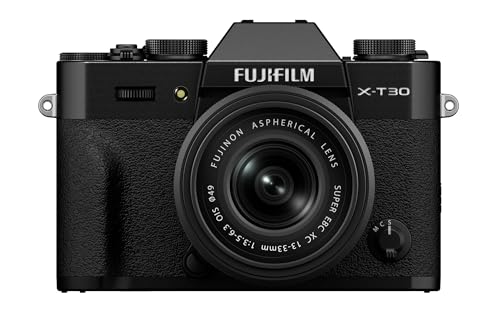
Fujifilm X-T30 III with XC 13-33mm — The wide-angle kit
Fujifilm’s listing is the shortest of the six — a body, an XC 13-33mm lens kit, black — and the most interesting number in it hides in the lens name. Thirteen millimetres at the wide end is meaningfully broader than the 16mm and 18mm starting points of the Nikon and Canon kits. In the geometry of real rooms, that difference is the difference between fitting the whole birthday table in frame and amputating its ends; between a flat’s interior looking like a place and looking like a corridor. For beginners whose photography is domestic and social — family, food, gatherings, the interiors of a life — the widest kit zoom in this guide is a quietly radical inclusion.
The trade hiding inside that range is reach. A zoom that ends at 33mm gives up the longer portrait territory the Canon 18-45mm touches; faces will be photographed closer, or cropped later. Beginners should understand the exchange they are making: Fujifilm has spent this kit’s range on width, betting that a starter’s world is near and wide rather than far and narrow. For the travel photographer shooting architecture and street scenes, for the parent in a small kitchen, for anyone whose recurring frustration is “I cannot get it all in,” the bet pays out weekly.
Fujifilm’s broader appeal to beginners is tactile. The X-T line is known for dials and deliberate handling — controls you can learn by touch and see at a glance — and while this listing’s title does not enumerate them, the camera belongs to that design family, and a beginner who enjoys the physical act of photography tends to practise more. Enjoyment is an underrated specification. The camera that feels like an instrument rather than an appliance gets picked up on evenings when nothing in particular is happening, and those evenings are where style forms.
As with the Nikon, the title’s silences are recorded rather than filled: no sensor size, no resolution, no video figure is printed. Fujifilm documents the X-T30 III fully on its own channels, and the figure-driven buyer should consult them. What the listing does establish is the combination — this body, this unusually wide kit lens, in black — and for the beginner whose problem is width, that combination is the recommendation.
Strengths
- The XC 13-33mm kit lens starts at 13mm, the widest wide end of any kit in this guide.
- A lens is included, so the Fujifilm system can be started with one purchase.
- The X-T family’s dial-led handling rewards beginners who learn by touch and repetition.
Trade-offs
- The zoom ends at 33mm, the shortest reach here, so distant subjects stay small in frame.
- The listing title prints no sensor, resolution or video figures for spec-sheet comparison.
- Wide-angle distortion at 13mm stretches faces near frame edges — a technique to learn, not a flaw to fear.
- Body: Fujifilm X-T30 III mirrorless camera body, as listed
- Lens included: XC 13-33mm kit lens
- Colour: Black
- Sensor size: Not stated in the listing title — verify with the manufacturer documentation
- Video specification: Not stated in the listing title — verify with the manufacturer documentation
Best for: a beginner whose subjects are rooms, gatherings and streets, served by a kit zoom that starts at 13mm and fits whole scenes without backing through walls. Not suited for: a beginner who photographs children playing sport from a sideline, because a zoom ending at 33mm cannot pull distant action close.
Learning to use 13mm well is a small curriculum of its own. Keep the camera level and horizons stop bowing; move one step nearer instead of zooming and the wide view gains a foreground to stand on; keep faces toward the middle of the frame and the stretching at the edges becomes a tool rather than an accident. A beginner who masters those three habits on this kit owns a visual skill that transfers to every wide lens they will ever buy — which is another way of saying the X-T30 III’s odd kit range is a teaching instrument disguised as a compromise.

Panasonic Lumix G100D with 12-32mm Bundle — The ready-to-go bundle
Panasonic’s listing is the only one of the six that arrives as a bundle, and the extras are chosen with unusual sympathy for a beginner’s first month. Alongside the Lumix DC-G100D body and its G Vario 12-32mm f/3.5-5.6 OIS lens, the box carries a Green Extreme battery pack and a shoulder bag. A spare battery is the accessory every new photographer wishes for on the first long day out — the zoo trip, the wedding, the holiday where the camera dies at the exact moment the light turns kind — and a bag that fits the kit from day one removes the other classic beginner failure, the camera left behind because carrying it was awkward.
The lens itself is the quiet star. A 12-32mm range starts genuinely wide, close to the Fujifilm kit’s territory, and the OIS in its name is optical image stabilization inside the lens — the feature that keeps handheld photographs sharp at slower shutter speeds and steadies walking footage. For a beginner whose technique is still forming, stabilization is not a luxury; it is the margin that turns early attempts into keepers and keepers into confidence. Panasonic’s G-series cameras are also known for compact lenses as a system property, so the second and third lenses this beginner eventually buys will stay small enough to keep the whole outfit in that same shoulder bag.
Positioning matters: the G100D is the most video-and-vlogging-flavoured of the kit cameras here alongside Sony’s body, a camera conceived for creators who talk to it. Beginners whose ambitions lean toward filming — travel diaries, craft tutorials, family video letters — will find its design intent aligned with theirs, while stills-first beginners should weigh the Canon and Nikon kits, whose listings lead with photography.
The title’s silences follow the pattern of this guide: no sensor dimensions or resolution are printed, and the bundle’s third-party accessories are named by brand — Green Extreme for the battery pack — rather than being Panasonic’s own. Neither point is a defect; both are simply the facts a buyer should hold while deciding. What is printed is a complete, stabilized, wide-starting kit with the two accessories beginners most often have to buy separately within a month.
Strengths
- The bundle includes a spare battery pack and a shoulder bag — the two extras beginners need soonest.
- The G Vario 12-32mm lens carries OIS optical stabilization, steadying early handheld work.
- A 12mm wide end rivals the Fujifilm kit for interiors and travel scenes.
Trade-offs
- The zoom’s f/3.5-5.6 aperture is a kit-lens figure; dim rooms will still test a beginner’s technique.
- The listing title states no sensor size or resolution for figure-led shoppers.
- Bundle accessories are third-party branded, so their fit and finish are the seller’s choice, not Panasonic’s.
- Body: Panasonic Lumix DC-G100D, as listed
- Lens included: G Vario 12-32mm f/3.5-5.6 OIS
- Bundle contents: Green Extreme battery pack and shoulder bag, per the listing title
- Stabilization: OIS in the included lens, as listed
- Sensor size: Not stated in the listing title — verify with the manufacturer documentation
- Video specification: Not stated in the listing title — verify with the manufacturer documentation
Best for: a beginner who wants everything in one delivery — a stabilized 12-32mm kit, a spare battery for long days and a bag that fits it all. Not suited for: a buyer who wants the camera maker’s own accessories throughout, because the bundled battery pack is a Green Extreme unit named in the listing, not a Panasonic one.
The bundle also teaches a budgeting lesson worth stating once. Beginners routinely under-price the second month of ownership: the spare battery, the bag, the memory cards, the strap. A bundle that absorbs the first two of those into the purchase price changes the true cost comparison against the bare kits in this guide, and a fair-minded shopper should count the extras at what they would genuinely have spent. Counted that way, the G100D bundle is frequently the most honest total price on this page, even before its stabilized wide lens makes its own argument.

Canon EOS R10 with RF-S 18-45mm Kit — The ambitious beginner’s Canon
Canon’s listing for the R10 is almost aggressively brief — a mirrorless camera, a lens kit, the RF-S 18-45mm named — and that brevity forces the honest framing: this is the R50’s bigger sibling, sold with the identical kit zoom, for the beginner who already suspects their subjects will move. Where the R50’s listing courts the creator, the R10’s reputation within Canon’s range is as the enthusiast-leaning body, the one with more physical control and more speed in reserve. A beginner choosing between the two Canons in this guide is really choosing a self-description: all-round starter, or starter with sporting ambitions.
Sharing the kit lens with the R50 cuts both ways, and both ways are instructive. The 18-45mm F4.5-6.3 IS STM is the same stabilized, quiet-focusing walk-around zoom, so everything said about its range and its dim long end applies here unchanged. What changes is the body behind it and the headroom it offers as technique improves. A beginner who starts with youth football, dance rehearsals, birds in the garden or a dog with opinions about squirrels will press against a starter body’s limits sooner than the holiday photographer will, and the R10 is the Canon in this guide bought to postpone that day.
The listing prints no sensor or video figures at all — terser even than the R50’s title — so the spec box below records those silences in the standard wording, and the figure-led buyer should read Canon’s own R10 documentation before deciding. This guide will not invent numbers to fill the gap. What can be said from the listing is the combination itself: this body, this lens, Canon’s RF system underneath, with every RF and RF-S lens a future option.
Who should skip it? The beginner whose photography is entirely still — landscapes, family, travel, food — and who would be paying for headroom they will never lean on; the R50 serves that photographer completely, with a fuller listing of stated features. The R10 earns its place for the minority of beginners who know, from phone photography, that their favourite subjects refuse to pose. For them, buying the step-up body first is cheaper than buying the starter twice.
Strengths
- The step-up Canon body in this guide, for beginners whose subjects move.
- Ships with the same stabilized RF-S 18-45mm IS STM kit lens as the R50, so it shoots immediately.
- Sits on Canon’s RF mount, keeping the full RF and RF-S lens catalogue open for later.
Trade-offs
- The listing title is the sparsest here: no sensor, resolution or video figure is printed.
- The shared kit zoom’s F4.5-6.3 aperture remains the system’s low-light bottleneck.
- A stills-only beginner pays for performance headroom the R50’s buyer never misses.
- Body: Canon EOS R10 mirrorless camera, as listed
- Lens included: RF-S 18-45mm kit lens
- Mount: Canon RF, per the lens designation in the listing title
- Sensor: Not stated in the listing title — verify with the manufacturer documentation
- Video specification: Not stated in the listing title — verify with the manufacturer documentation
Best for: a beginner who already photographs moving subjects and wants Canon’s step-up body with a lens included, inside the RF system from day one. Not suited for: a buyer deciding purely on printed figures, because this listing’s title states no sensor size, resolution or video specification to weigh against rivals.
A closing thought on the two-Canon question, since it is the decision most readers of this guide will actually face. Choose by subject, not by status. List the last fifty photographs on your phone: if most are people posing, places and plates of food, the R50’s stated kit answers them all; if a third of them are motion — games, performances, animals mid-stride — the R10’s headroom is the honest purchase. Either way the lens, the mount and the learning curve are shared, which makes this the rare comparison in which the cheaper answer is not a compromise but a correct fit for most beginners.
Comparison
| Pick | Sensor as listed | Lens in the box | Video as listed | Defining trait |
|---|---|---|---|---|
| Canon EOS R50 | 24.2MP APS-C CMOS | RF-S 18-45mm IS STM | 4K | Complete creator-and-photo starter kit |
| Sony ZV-E10 II | 26MP APS-C Exmor R | None — body only | 4K up to 60fps | Articulating touchscreen for solo filming |
| Nikon Z 30 | Not stated in the listing title | 16-50mm zoom | Not stated in the listing title | Nikon’s most compact, lightweight mirrorless |
| Fujifilm X-T30 III | Not stated in the listing title | XC 13-33mm | Not stated in the listing title | Widest kit zoom, starting at 13mm |
| Panasonic Lumix G100D | Not stated in the listing title | 12-32mm f/3.5-5.6 OIS | Not stated in the listing title | Bundle with spare battery pack and bag |
| Canon EOS R10 | Not stated in the listing title | RF-S 18-45mm | Not stated in the listing title | Step-up Canon body on the shared kit lens |
The table’s empty cells are information, not negligence. Two listings — Canon’s R50 and Sony’s ZV-E10 II — print their sensors and video figures proudly, and four withhold them, which tells a beginner something real about how each maker sells: Sony and the R50 compete on stated numbers, while Nikon competes on size, Fujifilm on lens range, Panasonic on bundle completeness and the R10 on its position in Canon’s range. None of those is a dishonest basis for choosing; they are simply different currencies, and the wise beginner converts them into the one question that matters — which of these fits the photographs I already take?
Read the lens column as the beginner’s true spec sheet. A body is outgrown in years; a kit lens shapes every photograph from the first day. The two stabilized Canon kits and Panasonic’s OIS lens forgive shaky hands, the Fujifilm and Panasonic zooms open widest for small rooms, the Nikon splits the difference, and the Sony row stands empty on purpose — a reminder that its buyer is purchasing a sensor and a screen, with the lens decision still gloriously, expensively ahead of them.
How to Choose Your First Mirrorless Camera
Start with subjects, not specifications. Write down the last month of photographs you took on your phone and sort them honestly: people, places, food, sport, video clips, night scenes. The dominant category should pick your camera. Video-heavy lists point to the Sony or the Panasonic; action lists to the R10; rooms and gatherings to the Fujifilm’s wide kit or the Nikon’s compact one; a balanced list to the R50. Beginners who shop by headline megapixels buy a number; beginners who shop by subject buy a tool they will still be using when the number is forgotten.
Next, decide the lens question before the body question. A kit lens included in the box is worth real money and real convenience, and five of these six include one. The body-only Sony is the exception that proves the rule: it is a superb purchase for a household with E-mount lenses already in it and a misleading one for a household without, because its true starting cost includes glass. Whichever route you take, confirm the mount name — RF, E, Z, X, or Panasonic’s G system — because that name, not the body, is the decade-long commitment.
Then weigh the screen and the handling in person if you possibly can. Beginners live on the rear screen: composing, reviewing, filming themselves. An articulating screen that faces forward changes what a solo creator can do; a compact body changes whether the camera leaves the house. Specifications cannot capture either, which is why this guide keeps returning to carrying and framing — the two activities a first camera will actually be used for, daily, long after its resolution figure has stopped impressing anyone.
Budget for the second month while you are at it. A memory card, a spare battery and a bag are not accessories in the decorative sense; they are the difference between a camera that works on the first trip and one that fails during it. Panasonic’s bundle absorbs two of the three. Buyers of the other five should price those items into the comparison from the start, and should treat any leftover budget as lens money in waiting rather than as a reason to climb one body higher than their subjects require.
Consider also what your household already owns. A surprising number of beginners live one drawer away from a lens collection — a parent’s old Sony, an uncle’s Canon — and a mount shared with that drawer can turn a body-only purchase from a trap into the smartest buy on the page. Conversely, a house with no photographic history at all argues for the most self-contained kit available, which is why the R50 and the G100D bundle keep surfacing in this guide’s advice: they ask nothing of the buyer’s past.
Finally, forgive yourself the perfect choice. Every camera in this guide belongs to a living system, takes photographs far beyond a phone’s reach, and will teach its owner the same fundamentals — light, timing, focal length, patience. The differences that fill the reviews above are real but second-order; the first-order decision is simply to begin, with a camera whose size, screen and kit match the life it will be carried through.
Kit Lens or Body Only: Which Should a Beginner Choose?
For a true first camera, the kit — almost always. A lens in the box removes the paralysing second decision, guarantees a combination the maker balanced for each other, and usually prices the glass below its separate cost. Five of the six picks here follow that logic, and a beginner with no lenses in the house should start among them. The kit zoom’s range also functions as a free education: months of shooting at different focal lengths reveal, from your own files, whether your eye prefers wide scenes or compressed details, which is the knowledge every later lens purchase depends on.
Body-only buying makes sense in exactly three beginner situations. The household already owns lenses for that mount, as with a family Sony E-mount collection. The beginner’s purpose is narrow and known — the ZV-E10 II bought specifically to film, paired with one chosen lens. Or the beginner is not a beginner at all but a returning photographer who sold a body and kept the glass. Outside those cases, body-only is a deferred decision wearing a discount’s clothing, and the deferred decision always arrives at a less convenient time than the purchase would have.
Torn beginners who have read this far still have another practical option besides agonising: buy the kit now, and let the kit lens become the diagnostic instrument it secretly is. After three months, look at where the zoom ring has lived. If nearly every frame sits at the wide end, your eye is a wide eye and the Fujifilm or Panasonic logic was yours all along; if the ring is worn at the long end, reach is your hunger and the next lens writes its own specification. No review, including this one, can supply that data. Only your own files can, and a kit zoom is the cheapest way ever devised to collect them.
How Much Video Does a Beginner Actually Need?
Less than the marketing suggests, and differently shaped. Most beginners film in short clips — a minute of a recital, thirty seconds of a toddler, a walking tour of a holiday rental — and for those, any camera in this guide that records video at all will feel miraculous next to a phone’s compromises in low light. The figures that genuinely change a beginner’s filming life are not the resolution headline but the screen that turns to face them, the lens that focuses quietly, and stabilization that forgives walking. Judge video by those, in that order.
The exception is the beginner who is really a creator in waiting. If the plan involves publishing footage — a channel, a course, a portfolio — then the ZV-E10 II’s stated 4K up to 60fps and articulating touchscreen stop being luxuries and become the working specification, and slow-motion headroom plus self-framing will be used weekly. The honest self-test is output: footage destined for an audience justifies creator features; footage destined for the family archive needs only competence, which every kit here supplies.
Common Mistakes When Buying a First Mirrorless Camera
Buying a body-only camera without noticing. It happens constantly, because product photographs show lenses mounted and titles whisper the omission in two words. In this guide the Sony is body only and says so in its review’s first paragraphs; make a habit of finding the lens line in any listing before admiring anything else about it. A camera without a lens is a paperweight with a sensor, and the beginner who discovers that on delivery day starts their photography with a week of waiting.
Choosing by megapixels alone. The two stated figures in this guide — 24.2 and 26 — differ by an amount no beginner will ever see in a print or on a screen, while the unstated differences in screens, stabilization and kit lenses will shape every shooting day. Resolution is the easiest number to print and among the least useful to buy by; treat it as a threshold to clear, not a ladder to climb.
Ignoring the mount’s future. A first camera is a first step into a lens system, and the systems here differ in depth and direction. All five mounts in this guide are living ones, which is precisely why these six were chosen — but a beginner tempted by a bargain outside this list should ask whether new lenses are still being made for its mount before celebrating the discount.
Spending the whole budget on the body. The photographer who buys the step-up body and cannot afford a memory card, a spare battery or a bag has purchased capability they cannot carry anywhere. Hold back a sensible slice for the working kit — Panasonic’s bundle exists because this mistake is so common — and let the body’s tier be set by what remains after the camera can actually be used.
Final Recommendation
For most beginners, the Canon EOS R50 kit is the answer this guide reaches first: a stated 24.2 megapixel APS-C sensor, a stabilized kit zoom in the box, 4K video, and a listing that names photography and content creation in the same breath — a complete, forgiving start on a mount with years of lenses ahead of it. Creators who film themselves should step sideways to the Sony ZV-E10 II and budget for a lens; travellers who prize smallness should take the Nikon Z 30 or the wide-kitted Fujifilm X-T30 III; the Panasonic G100D bundle suits anyone who wants the battery and bag problem solved in the same delivery; and the Canon EOS R10 waits for the beginner whose subjects already move too fast for a starter body.
Whichever of the six lands in your hands, give it a season before judging it. A first camera’s real specification is the photographer it produces, and that takes a hundred ordinary days of carrying, framing and missing — then making — the shot.
Frequently Asked Questions
Is a kit lens good enough for a beginner?
Yes — it is the right lens to learn on. A kit zoom covers the focal lengths beginners use daily, and its limitations teach exactly the lessons (light, distance, background) that a later specialist lens purchase should be based on. Every kit in this guide is stabilized or paired with a body meant for learning, and none of them will be the reason a beginner’s first-year photographs disappoint.
Which of these cameras is best for video?
On stated figures, the Sony ZV-E10 II: 4K up to 60fps and an articulating touchscreen, built for creators. Among the lens-included kits, the Canon R50’s listing names 4K video and vlogging directly, and the Panasonic G100D’s stabilized lens and creator design suit filming too. Remember the Sony is a body only, so its video life begins after a lens joins it.
What does APS-C mean, and should a beginner care?
APS-C is a sensor size — smaller than full frame, far larger than a phone’s sensor. A beginner should care mainly through its consequences: lenses stay smaller and cheaper than full-frame equivalents, low-light performance is strong, and the format is the industry’s mainstream for learning. Two picks here state APS-C sensors in their titles; where a title is silent, this guide says so rather than guessing.
Can a beginner skip the kit and buy a better lens instead?
They can, and the Sony ZV-E10 II in this guide is exactly that shape of purchase — but only with a plan and a budget for the lens itself. Choosing one good zoom deliberately beats inheriting a kit zoom by default for a buyer who knows their subjects. For everyone else, the kit’s convenience and price are worth more than the theoretical upgrade.
How long will an entry-level camera stay relevant?
Years, if the mount is alive. Bodies age in features, but the lenses, batteries and skills a beginner accumulates transfer within the system. That is why every pick here sits on a current mount — Canon RF, Sony E, Nikon Z, Fujifilm X or Panasonic’s G line — so the second purchase, whenever it comes, builds on the first instead of replacing it.
Related Guides
Once the first camera is chosen, the natural next step up is surveyed in our guide to the best mirrorless cameras for enthusiasts, where larger sensors and deeper controls take over. Beginners who discover that carrying weight decides everything should compare the best lightest mirrorless cameras for travel and everyday carry. And those whose first trips are already on foot and under a pack will want the best mirrorless cameras for backpacking, chosen for multi-day trails.


