What's inside
- Before You Record: A Plain Note on Consent Law
- Key Takeaways
- Quick Picks
- How We Chose These Picks
- Comparison
- How to Choose a Covert Body Camera
- What Makes a Camera Genuinely Low-Profile in Practice?
- Where Should You Never Use a Camera Like This?
- How Long Can a Low-Profile Camera Realistically Record?
- Common Mistakes
- Final Recommendation
- Frequently Asked Questions
- Related Guides
As an Amazon Associate I earn from qualifying purchases. This post may contain affiliate links at no extra cost to you.
[SITE_DOMAIN] is reader-supported. When you buy through links on our site, we may earn an affiliate commission.
Each camera below is linked to its own Amazon listing, where its current figure and full description can be checked. Buyers of low-profile cameras should read the listing of their chosen model with particular care — dimensions, indicator-light behaviour and recording controls are the details that decide whether a camera is genuinely unobtrusive, and those details live on the listing and in the manufacturer documentation rather than in any title.
The best covert body cameras serve a narrow, legitimate purpose: letting a person keep a faithful record of their own experiences — for personal safety, for documenting their own work, their own property, their own encounters — without the camera becoming the loudest object in the room. This guide uses the word covert in that limited sense throughout: low-profile in form, quiet in presence, unremarkable to look at. It does not recommend recording anyone in places or situations where they have a reasonable expectation of privacy, and it carries a legal note below that every reader should treat as part of the buying decision, because the law on recording consent is not the same in any two places.
Six small cameras make the set. Their shared virtues are physical: pocket-sized bodies, thumb-sized bodies, rotating lenses that let a camera sit naturally instead of pointing theatrically, storage large enough that the device need not be fiddled with, and — on two picks — loop recording with stated endurance of eight hours and of four to six hours, so the camera can simply be carried and trusted. A covert camera that must be adjusted, checked and restarted is not covert for long; the specification that matters most in this class is the one that lets its owner ignore it.
Readers should also understand what this class is not. These are ordinary mini body cameras whose titles describe small, portable, wearable recorders; none of them is disguised as another object in the picks below, and this guide deliberately keeps the selection to body-worn forms. The low profile comes from size and plainness, not from deception — a distinction the legal note develops, because it is also the distinction the law tends to care about.
Claims discipline applies here as everywhere on this site: resolutions are reported as their titles print them, storage as stated, endurance only where a title states it. Two picks print battery figures; four do not, and their reviews say so, because a camera bought for a long, worrying day deserves an honest number more than a comforting guess.
Before You Record: A Plain Note on Consent Law
Recording law is local, and it is not one law but several layered ones. In the United States, federal law generally permits recording a conversation with the consent of one party to it — but a number of states require the consent of all parties, and the list of two-party-consent states, the penalties, and the exceptions differ from state to state. Video raises separate questions from audio: many regimes treat silent video in public places more leniently than audio recording anywhere, and treat any recording in places where people expect privacy — homes, changing rooms, restrooms, medical settings — far more severely. Other countries are stricter still: much of Europe regulates recording through privacy and data-protection law that can make an undisclosed recording unlawful even where an American one-party rule would allow it.
This guide is not legal advice and cannot summarise your jurisdiction. The practical duties it can state are these: know whether you are in a one-party or all-party consent place before you record a conversation; never record in a place where the people recorded have a reasonable expectation of privacy; check your employer’s policy as well as the law, since workplaces may forbid recording regardless of what the law permits; and when in doubt, disclose — a recording announced is a recording whose legality is rarely the argument. The cameras below are sold openly as recorders, and this guide’s consistent advice is to use them as openly as your safety allows.
Key Takeaways
- The BLVBWSD 128GB pairs loop recording with the set’s longest stated endurance — 8 hours continuous — for carry-and-trust use.
- The 128GB IR mini adds infrared night vision and loop recording with built-in memory, at a stated 4–6 hour battery.
- The Ryntevor is the pocket proposition: a rechargeable 64GB mini in 1080P HD whose low profile is its size and plainness.
- Two picks rotate their lenses 180°, letting the body sit naturally while the lens finds the room.
- Consent law varies by state and country — one-party and all-party regimes differ — and the legal note above is part of the purchase.
- Four of six titles print no battery figure; long-day buyers must confirm endurance on the listing.
Quick Picks
| Pick | Badge | Why it earns its place |
|---|---|---|
| Ryntevor Hidden Body Cam 64GB | The pocket recorder | A rechargeable small pocket camera in 1080P HD with 64GB, sold as a portable mini video recorder. |
| Mini Body Cam Rotating Lens 64GB | Aim without theatre | 1080P with a 180° rotating lens and a stated 120° wide angle, so the body can sit naturally. |
| Mini Body Camera 128GB IR | The looping night archive | Built-in 128GB, infrared night vision and loop recording in HD 1080P, with a stated 4–6 hour battery. |
| Mini Body Camera Rotating Lens 128GB | Eight stated hours | 128GB with a 180° rotating lens, loop record and a stated 8 hours of continuous recording. |
| Mini Body Camera 1080P 64G | The plain witness | 1080P audio and video on a 64G card with night capability — an ordinary mini, unremarkable by design. |
| Mini Body Camera Thumb U1 | The tiny chest unit | A small, tiny thumb camera in 1080p with night capability, worn on the chest. |
How We Chose These Picks
Low profile was judged physically, not theatrically. A pick earned its place by being small, plain and body-worn in its title’s own description — pocket cameras, thumb cameras, mini recorders — rather than by promising disguise. That line was drawn deliberately: a guide for personal safety and personal documentation has no business recommending devices designed to deceive people about what an object is, and the selection below stays on the recordable side of it.
Unobtrusiveness of operation came second. A camera that must be raised, aimed and restarted announces itself however small it is, so titles were read for the features that let a device be carried quietly: loop recording that removes media management, storage deep enough to ignore, rotating lenses that correct aim without remounting, endurance figures that cover the day being documented. The two loop picks and the two rotating picks anchor the set for exactly those reasons.
Legitimate purpose was the third test, applied to framing rather than hardware. Each pick’s title describes ordinary recording work — work, travel, home, security, personal records — and the reviews write to those purposes: documenting one’s own rounds, one’s own property, one’s own encounters, for safety and for memory. Uses that depend on another person’s ignorance of being recorded in a private setting are outside this guide’s scope, and the legal note explains the landscape that makes them risky as well as wrong.
Honesty of specification closed the selection. Endurance is claimed only for the two titles that print it; night capability only where titles claim it — infrared on the 128GB mini, night version on two others, and notably not on the rotating-lens 64GB pick, whose review keeps that absence visible. In a category where marketing reaches eagerly for the word hidden, a guide’s refusal to exaggerate is itself a selection criterion.

Ryntevor Hidden Body Cam 64GB — The pocket recorder
The maker’s title for this camera uses the vocabulary of hidden spy devices, and this review will translate it into the plainer language the product actually offers: a small, rechargeable pocket camera with 64GB of storage, recording 1080P HD video, sold as a portable mini recorder. Its low profile is not a disguise — the camera looks like a small camera — but a matter of scale and placement: a device that rides in a shirt pocket or sits unremarked on a desk’s edge, present the way a pen is present, because it is roughly a pen’s social size.
That pocket proposition suits a specific, legitimate pattern of use: the person who wants a record of their own day without wearing anything. Landlords entering their own properties with notice, officials conducting their own inspections, individuals documenting their own working rounds in places where a chest camera would escalate every conversation it entered — for these owners, a pocket recorder that starts quietly and asks nothing is the proportionate instrument, used within the consent rules their jurisdiction sets.
The 64GB capacity fits the pattern: days of incidental recording, rescued selectively. Rechargeable power keeps the device in the same nightly rhythm as a phone. The title does not print a battery-hours figure, a screen or a night capability, and this review records those absences without decoration — a buyer whose documentation happens after dark, or across very long days, should extract the relevant facts from the listing before this camera is trusted with them.
There is also an honesty dividend to a camera that is merely small. Footage from a device anyone could have noticed carries a different weight from footage gathered by trickery: it documents the owner’s own experience without manufacturing an advantage over the people in the frame. Owners who may one day hand their recordings to an employer, an insurer or a court should value that provenance, and should keep their use inside the law of the place they are in — the note at the head of this guide is the starting point, their own jurisdiction’s rules are the destination.
Readers who recognise their rounds in this description can check price on Amazon for the Ryntevor’s current figure. It is the set’s purest pocket proposition, and its review deliberately promises nothing beyond what its title prints: small, rechargeable, capacious enough, and quiet by virtue of being ordinary.
One practical counsel belongs to pocket recording generally: a pocket is a lens’s worst environment — lint, tilt and cloth conspire against the picture — so the first evening’s test should be conducted in the actual pocket of the actual garment, walking the actual round. A camera that records a waistband beautifully for eight hours has documented nothing but itself, and the return window exists to discover that cheaply.
Pocket carry has a second, underappreciated virtue for the documentation of one’s own rounds: the camera is present in rooms where a worn camera would change the room. A property inspection, a difficult handover, a conversation with a contractor — in each, a chest camera becomes a participant, while a pocket recorder, declared where the law or courtesy requires and otherwise simply present as the owner’s own note-taking, keeps the encounter’s temperature where it was. Proportion is a form of professionalism, and this is the proportionate instrument for owners whose authority in the room does not need equipment to announce it.
- Resolution: 1080P HD, per title
- Storage: 64GB, per title
- Power: rechargeable stated
- Form: small pocket camera; portable mini recorder
- Night capability: no claim appears in the title — low-light use is a listing question
- Endurance: no figure appears in the title — the listing holds the number
- Screen: none is described in the title
Strengths
- Pocket form suits owners who will not wear a camera
- 64GB supports selective, incident-based keeping
- Low profile comes from size and plainness, not disguise
Trade-offs
- Pocket placement fights lint, tilt and cloth
- Its endurance lives on the listing, not in the title
- No night claim is made in the title
Best for: owners documenting their own rounds and properties who want a pocket-sized, unremarkable recorder.
Not suited for: after-dark documentation, since its title claims no night capability.

Mini Body Cam Rotating Lens 64GB — Aim without theatre
A camera that must be held up and pointed is a camera that has announced itself; a camera whose lens rotates 180° inside a body that stays where it was put has not. That is this pick’s whole covert argument, and it is a mechanical one: mount or pocket the little body naturally — on a strap, a seam, a bag — then turn the lens to the room. The stated 120° wide angle completes the discretion, because a wide frame forgives approximate aim, and approximate aim is what unobtrusive recording actually looks like in the wild.
The title addresses the camera to personal civilians alongside law enforcement, and the civilian purposes are the ones this review writes for: recording one’s own work rounds, one’s own deliveries and inspections, one’s own side of encounters that have a history of being retold inaccurately. Audio and video are both stated at 1080P, and in such encounters the audio is usually the record that matters — the words of an agreement, a refusal, a promise — captured by a device nobody had to perform for.
Storage at 64GB matches the set’s middle tier, sized for selective keeping rather than continuous archiving; this is not a loop camera, so its owner manages the card like a notebook — rescue what matters, clear what does not, and never let the notebook fill on the day it is needed. That discipline is the price of the design’s simplicity, and owners who know they will not pay it should look at the loop picks below instead.
The title prints no night claim and no battery figure, and both silences matter more in this guide than most: a low-profile camera is often bought for the evening walk, the night round, the dim corridor, and this title promises nothing there. The listing is where a night-minded buyer must look, and the return-window test — your own route, your own light — is where the answer becomes real.
The hinge itself deserves a return-window judgement of its own. A rotating lens that holds its detents keeps its aim through a day of movement; one that drifts converts discretion into a documentary about a ceiling. Test the hinge’s firmness in the first week, wearing the clothes of the real round. Buyers satisfied on that point can find the camera’s current figure on its Amazon listing; the design’s proposition — aim without theatre, record without ceremony — is the most mechanically elegant in this set.
There is a courtesy embedded in this design that deserves naming: because the camera need not be pointed, its owner need not perform the pointing. Conversations stay conversations. For documentation whose legitimacy rests on the owner’s own participation — their rounds, their property, their encounters — that naturalness is not a trick. It is simply a record of life as it was actually being lived by the person keeping it.
Drivers of their own vehicles will find a second life for this design that its title does not mention and its geometry suggests: set on a dashboard or clipped to a visor, a wide-angle rotating camera becomes a journey recorder for one’s own trips — the hire-car handover, the disputed junction, the long drive kept for memory. The lens’s rotation, designed for awkward garments, adapts to awkward windscreens without a dedicated mount, and the 64GB behind it holds a trip’s worth of road. It is the same virtue in a new seat: aim without theatre, wherever the owner happens to sit.
- Resolution: 1080P, per title
- Storage: 64GB, per title
- Lens: 180° rotating lens stated
- Field of view: 120° wide angle stated
- Recording: audio and video stated
- Stated audience: personal civilians, police law enforcement
- Night capability: no claim appears in the title — treat darkness as unconfirmed
- Endurance: no figure appears in the title — the listing holds it
Strengths
- Rotating lens aims without moving the body
- 120° frame forgives approximate placement
- Audio recording captures the words that matter
Trade-offs
- No loop recording — the card is managed manually
- No night claim is made in the title
- The hinge’s firmness must be judged in the return window
Best for: civilians documenting their own rounds and encounters in lit places, mounted improvised and aimed once.
Not suited for: night documentation, since the title makes no after-dark claim.

Mini Body Camera 128GB IR — The looping night archive
Loop recording is the covert virtue nobody advertises, because it sounds like a storage detail. It is actually a behavioural one: a camera that overwrites its oldest footage never fills, never stops, and never asks its owner to perform maintenance in the field — and a camera that asks nothing is a camera that stays unnoticed. Add 128GB of built-in memory, so the loop’s horizon stretches across days, and infrared night vision for the dark hours, and this mini becomes the set’s most complete carry-and-trust instrument: worn, forgotten, and quietly keeping a rolling record of its owner’s own rounds.
The loop’s discipline must be learned, as with any conveyor: a moment that matters must be rescued before the horizon reaches it. With 128GB at HD 1080P the horizon is measured in days of recording, which gives the owner a humane margin — the same-evening rescue, the weekend skim — rather than a panicked one. Owners should learn their own horizon in the first week, with unimportant footage, so the arithmetic is known before it is needed.
Infrared is the night technology named in the title, and in a low-profile guide its meaning is specific: the camera attempts the dark without visible light of its own. For the owner’s own geography — the unlit yard, the night round, the walk between buildings — that is the correct kind of attempt. Its stated world spans home and outdoors alongside guard and enforcement work, and the home-and-outdoors reading is the civilian one this guide endorses: a record of one’s own property and one’s own movements after dark.
The stated battery is four to six hours — printed, finite, and to be respected. That is an evening round, a night market, a care shift’s core, not a through-the-night vigil, and buyers whose documentation runs longer should take the eight-hour pick below or accept a charging rhythm. A stated limit, honestly read, is worth more than an invented one; this camera’s title is one of only two in the set that gives its buyer a number at all.
Built-in memory completes the unobtrusive design in a way worth spelling out: there is no card to swap in public, no media ritual to explain, nothing to fumble. The camera and its archive are one object, carried as one object, and handed over as one object if the record is ever needed by anyone else. Readers whose rounds fit inside its stated hours can check price on Amazon for the current figure — remembering that built-in memory means the figure they see is close to the whole cost of ownership.
Set against its civilian-guide appearance, the same camera is judged here on a different axis — not forgetfulness as convenience, but forgetfulness as discretion: the less a recorder interrupts its owner’s behaviour, the more natural the record it keeps of that owner’s own life. On that axis, the loop and the infrared make this the set’s quiet achiever.
There is a seasonal argument for this camera that its stated roles imply: the dark half of the year is when rounds feel longest and documentation matters most — the evening property check, the winter care visit, the yard at closing time in January. Infrared, in that season, is not a specification flourish but the difference between a record and a silhouette. Owners whose worry is specifically the winter round should weight this pick’s named IR more heavily than any resolution banner in the set, because a legible dark record outranks a beautiful daylight one for the hours that prompted the purchase.
- Resolution: HD 1080P, per title
- Memory: built-in 128GB stated
- Recording mode: loop record stated
- Battery: 4–6 HR battery life stated
- Night capability: night vision IR stated
- Stated roles: home, outdoor, law enforcement, security guard
- Card handling: memory is built in — no field swaps to perform
Strengths
- Loop recording removes all field maintenance
- Infrared serves the owner’s own dark geography
- Built-in memory keeps camera and archive as one object
Trade-offs
- Unrescued footage is overwritten at the loop’s horizon
- Stated endurance bounds the day at 4–6 hours
- Built-in memory cannot be separated for handover
Best for: night rounds and recurring shorter duties documented by owners who want zero media ritual.
Not suited for: documentation longer than six hours without a charging break, per its stated battery.
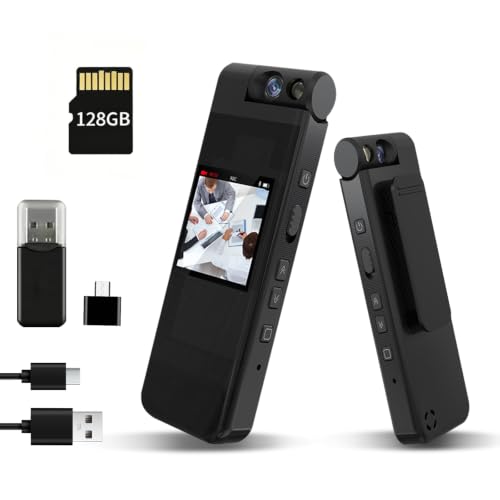
Mini Body Camera Rotating Lens 128GB — Eight stated hours
Eight hours of continuous recording, printed in a title beside 128GB of storage, loop recording and a 180° rotating lens: this BLVBWSD mini assembles the covert guide’s entire wish list in one sentence. The endurance covers a working day; the loop removes the full-card failure; the capacity stretches the loop’s horizon; and the rotating lens lets the body sit naturally while the eye finds the room. For an owner documenting their own long day — a full shift of rounds, a day of site visits, a market day from setup to teardown — this is the pick that asks the least intervention across the most hours.
Continuous is the operative word in its endurance claim, and it should be read as the maker states it: eight hours of unbroken recording, which is a different promise from eight hours of standby punctuated by incidents. An owner whose documentation is continuous by nature — the record is the shift, not the highlights — will value exactly that wording, and should still verify it against their own first week, because a stated figure is a starting point for a home test, not a substitute for one.
The rotating lens earns a second mention in a long-day context: across eight hours a wearer changes posture, vehicles and rooms, and a fixed lens faithfully records each change as a new tilt. A hinge that can be re-aimed in one second, without unmounting anything or drawing attention to the act, is what keeps a long record level. That is the mechanical heart of unobtrusive recording — not smallness alone, but correctability without ceremony.
Audio and video recording in 1080P HD are both stated, work and travel are the title’s stated worlds, and the combination fits the guide’s legitimate centre: one’s own work, documented across its full length, and one’s own travels, kept as a record rather than performed as content. The title prints no night claim, and evenings are therefore a listing question — a notable silence beside so complete a specification, and one this review keeps visible.
Loop discipline applies here as it does to the IR mini, with a longer horizon: 128GB of looped storage forgives a forgetful owner for days, but the rescue habit — same-evening copies of anything that matters, stored twice, named with dates — remains the owner’s side of the bargain. A loop is a promise that the camera will always be ready; it is not a promise that it will remember forever.
Readers whose days are long, lit and their own to document can find this camera’s current figure on its Amazon listing. In a set defined by compromises — hours against size, night against simplicity — this pick’s compromise is the mildest: it gives up the dark, and in exchange offers the longest stated, self-managing day in the guide.
Site work is the natural home of this specification, and worth picturing concretely: the supervisor walking a building project from gate to top floor, the inspector covering a facility whose inspection is measured in hours, the events manager whose day is one continuous venue. In each case the record’s value lies in its unbrokenness — the whole walk, not the highlights — and an eight-hour continuous claim with a loop behind it is the only specification in this set that promises unbrokenness at that scale without the owner once touching the device. That is the purchase, stated plainly.
- Resolution: 1080P HD, per title
- Storage: 128GB, per title
- Recording mode: loop record stated
- Battery: 8 hours continuous recording stated
- Lens: 180° rotating lens stated
- Recording: audio and video stated
- Stated roles: work, travel
- Night capability: no claim appears in the title — evenings are a listing question
Strengths
- Longest stated endurance in this guide at 8 hours
- Loop plus 128GB removes media management for days
- Rotating lens keeps a long record level
Trade-offs
- No night claim is made in the title
- Loop overwrites unrescued footage in time
- Continuous figure should be home-tested before a critical day
Best for: owners documenting their own full working days and travels with minimal intervention.
Not suited for: after-dark documentation, since its title claims no night capability.

Mini Body Camera 1080P 64G — The plain witness
Plainness is a form of discretion that marketing rarely celebrates, because it cannot be photographed. This mini — 1080P, audio and video, a 64G card, night capability in its title’s phrase — is an ordinary small body camera of the kind sold by the thousand for security work, work records, guarding and travelling. Its low profile is statistical: it looks like everyone’s camera, rides like everyone’s camera, and draws exactly the attention that any small black box on a chest draws, which in most rooms is none at all after the first minute.
For the owner whose documentation is occasional and overt-adjacent — the record kept for safety, produced when needed, never hidden as a project — that ordinariness is the correct specification. The camera does not pretend to be jewellery or a pen; it is a recorder, worn or carried by someone entitled to record their own working day, and its footage carries the provenance of an open instrument. Owners who may hand recordings to employers or insurers will find that provenance worth more than any disguise.
The 64G card serves the selective pattern: hours of uneventful record, punctuated by the moments that get rescued in the evening. Night capability extends the pattern into the dark half of the year — the title’s phrase is night version, undescribed beyond that, and an owner whose rounds are nocturnal should test its reality on their own route during the return window rather than take any guide’s word for a technology no title names.
No battery figure is printed in the title, so a long day’s trust must be earned from the listing’s number and a home rehearsal. What the title does establish is the simplest contract in this set: a small recorder, a decent card, both senses recorded, nothing to configure and nothing to explain. For many owners — particularly those documenting their own work in places where recording is understood — simple and open beats clever and quiet.
It is also, deliberately, this guide’s control case: the camera against which the covert-specific designs must justify themselves. If the rotating lenses, loops and pocket forms in this set do not answer a problem your documentation actually has, this plain witness is the honest purchase, and its current figure on Amazon is usually the set’s most forgiving. Check it there, and let the fancier mechanisms argue their way past it only if your days genuinely need them.
A final wearing note: a plain chest camera’s discretion depends on its owner’s ease. Worn confidently, mentioned naturally when an encounter turns serious, it settles into a room’s furniture within minutes. The covert quality, in other words, is partly a behaviour — and this camera, more than any other here, leaves the behaviour to the wearer.
Employers buy this kind of camera in small fleets, and the plainness that serves the individual serves the fleet better: one model, one card size, one routine, no accounts to administer and no apps to approve. A small security firm, a property agency, a care provider equipping its rounds — each needs a recorder that a new starter can be taught in a minute and that produces files in a form the office already understands. The fancy mechanisms in this guide earn their place in individual hands; the plain witness earns its place in fleets, which is its own kind of first place.
- Resolution: 1080P, per title
- Storage: 64G card included, per title
- Recording: audio and video stated
- Night capability: night version stated
- Stated roles: security, work records, guarding, travelling
- Endurance: no figure appears in the title — a long day needs the listing’s number first
- Loop recording: not claimed in the title — the card is managed manually
Strengths
- Ordinary appearance draws ordinary attention — very little
- Open-instrument provenance suits formal handovers
- Simple contract with nothing to configure
Trade-offs
- No loop recording to forgive a forgetful owner
- Endurance is a listing lookup for this pick
- Chest-worn presence is visible by design
Best for: owners documenting their own work openly, who want a plain and proven-feeling recorder.
Not suited for: owners who need the camera to manage its own media, since there is no loop in its title.

Mini Body Camera Thumb U1 — The tiny chest unit
Small, tiny, thumb: the U1’s title stacks its diminutives without embarrassment, and in a covert guide that stacking is a specification. A camera the size of a thumb, worn on the chest, recording audio and video in 1080p with night capability, is a camera whose entire presence in a room is a dark rectangle an inch wide. For owners documenting their own encounters — the guard’s round, the worker’s day, the traveller’s passage — that inch is the difference between a recorder that joins the conversation and one that merely witnesses it.
Chest placement is doing quiet work in this design. The chest is where a person’s own experience is centred: their voice is loudest there, their hands enter the frame there, the people they face fill the frame there. A tiny camera at that address records its owner’s day from inside it, which is precisely the record that personal documentation — for safety, for memory, for an accurate account — is supposed to be. It is not a vantage over other people’s private lives, and this guide’s legal note governs its use as it governs every pick here.
Night capability, in the title’s words night version, suits the guard-and-travel framing: the round after dark, the platform, the walk to the car. The technology is not described, so the claim is credited as a claim, and the owner’s own route remains the only honest test. What can be said is that the title bothers to make the claim at all, which two of its rivals in this set do not.
The silences are storage and endurance: no card figure, no battery figure in the title. A thumb body holds thumb-sized compromises, and a buyer planning a full day’s documentation must read both numbers on the listing before trusting the day to them. That homework is the U1’s price of admission, and it is a fair one — the camera spends everything on size, and asks its buyer to spend five minutes on arithmetic.
Travellers complete the pick’s portrait: a recorder that vanishes into a shirt’s chest, that asks for no bag, no mount kit and no explanation at a border of anyone’s day, is a recorder that actually gets carried — and a carried recorder, however modest its specification, documents infinitely more than the superior camera left in the hotel drawer. Readers who travel light and document their own journeys can check price on Amazon for the U1’s current figure.
In this guide’s terms, the U1 is discretion by subtraction: nothing added, nothing disguised, just less camera than anyone expects a camera to be. Owners whose need is their own record, kept quietly at chest height, will find that subtraction sufficient — and will find every larger design in this set answering a question they never asked.
The U1 also suits a purpose its title’s travel word quietly covers: the solo journey documented for the people at home. A thumb camera at the chest keeps a walking tour, a market morning, a strange city’s commute from inside the experience, hands free for maps and railings and coffee. That footage is a diary, not evidence, and the camera’s modesty — its refusal to be a production — is exactly what diary-keeping wants. Not every low-profile camera is bought in worry; some are bought in curiosity, and this is the set’s best instrument for the curious.
- Resolution: 1080p, per title
- Size: small, tiny, thumb format stated
- Recording: audio and video stated; POV format
- Wearing position: chest stated
- Night capability: night version stated
- Stated roles: security guard, work records, travel
- Storage and endurance: neither figure appears in the title — both are listing lookups
Strengths
- Thumb size is the lowest profile in the set
- Chest geometry centres the owner’s own experience
- Night claim covers the guard’s second habitat
Trade-offs
- Its storage figure sits on the listing page
- Its endurance figure sits on the listing page
- No screen or loop is described in the title
Best for: guards and travellers documenting their own days at the smallest possible profile.
Not suited for: owners who need a stated storage capacity in the title before planning an archive around it.
Comparison
| Pick | Profile and signature feature | Owner it suits first |
|---|---|---|
| Ryntevor 64GB | Pocket form; rechargeable; 1080P HD | The pocket documenter |
| Rotating Lens 64GB | 180° rotating lens; 120° wide angle; 64GB | The natural mounter |
| 128GB IR Mini | Built-in 128GB; loop record; IR; 4–6 HR battery | The night rounder |
| BLVBWSD 128GB | 180° rotating lens; loop record; 8 hours stated | The full-day documenter |
| Mini 1080P 64G | Plain chest mini; 64G card; night version | The open witness |
| Thumb U1 | Tiny thumb format; chest; 1080p; night version | The minimalist |
How to Choose a Covert Body Camera
Begin with the law of your own place, before any hardware question is entertained. Whether your jurisdiction records conversations on one party’s consent or everyone’s, whether your workplace adds its own prohibition, and whether your intended places are public or private — those answers bound the purchase more tightly than any specification in this guide, and the note at its head is the map for finding them. A camera bought before that homework is a camera that may be unusable for the very purpose that inspired it.
Then define the documentation honestly: whose day, which places, what hours. Your own rounds in lit places point to the rotating-lens picks; your own rounds after dark point to the infrared loop camera; your own full working day points to the eight-hour BLVBWSD; your own pocket, on your own property rounds, points to the Ryntevor. Each of those sentences is a legitimate purchase. Documentation aimed at other people’s private moments is not a sentence this guide will complete.
Choose your media temperament next. Loop cameras forgive forgetfulness and demand rescue discipline; card cameras demand management and permit permanence. The covert context sharpens the choice, because a camera that needs field maintenance draws the eye — so owners who know their own habits should weight the loop designs heavily unless their archive genuinely requires manual media.
Storage arithmetic deserves one worked moment before the listing, because covert documentation fails quietly in spreadsheets before it fails in the field. Take your recording day in hours, multiply by what an hour at your chosen resolution consumes — a figure the listing or documentation will state or imply — and compare the product with the capacity in the title. The loop picks forgive an optimistic answer; the card picks do not. Five minutes of multiplication at a desk is the cheapest insurance in this entire category.
Finish on the listing, with the unglamorous details that decide real discretion: the body’s actual dimensions, whether indicator lights can be understood from the description, the endurance figure where the title omits it, and the night story where the title is silent. Discretion lives in those details, not in the word hidden printed on a box.
What Makes a Camera Genuinely Low-Profile in Practice?
Three things, in order of importance: behaviour, placement and size. Behaviour first — a camera whose owner never touches it, checks it or apologises for it becomes furniture within minutes, whatever its dimensions. Placement second — a device that sits where devices naturally sit, in a pocket, on a chest, among the objects of a working day, inherits the invisibility of the ordinary. Size third — genuinely useful, genuinely last, because a tiny camera fiddled with hourly is louder than a larger one ignored completely.
The picks in this guide were chosen against that ordering. The loop cameras minimise behaviour; the rotating lenses perfect placement; the thumb and pocket forms minimise size. A buyer who understands which of the three their own documentation lacks will choose better than a buyer shopping for the smallest box.
Where Should You Never Use a Camera Like This?
Anywhere the people around you have a reasonable expectation of privacy: homes you are visiting beyond the errand that brought you, changing rooms, restrooms, medical and care settings where you are not the patient documenting your own care, and other people’s private conversations in any setting. The legal note at the head of this guide explains that the law often agrees with that list and sometimes extends it; the ethical version is shorter and stricter, and owners should follow whichever of the two is stricter where they stand.
Workplaces deserve a specific sentence: an employer’s recording policy can forbid what the law allows, and a recording made against policy can cost the job it was meant to protect. Check the policy with the same care as the statute. The cameras in this guide are for documenting your own experience within the rules of the places you move through — used that way, they are protection; used any other way, they are a liability with a lens.
How Long Can a Low-Profile Camera Realistically Record?
As long as its title states, and no longer in this guide’s telling: eight stated hours on the BLVBWSD, four to six stated hours on the IR mini, and silence from the other four titles — silence that a buyer planning a long day must convert into a number via the listing before trusting it. Small bodies hold small batteries, and covert purchases fail most often not on discretion but on a day that outlasted a guess.
Loop recording changes the storage side of the same question, not the power side: a loop camera can record indefinitely in storage terms and still stops when its battery does. Plan the day against the battery figure, plan the archive against the loop’s horizon, and the two plans together are the camera’s real endurance.
Common Mistakes
Treating covert as a synonym for secret-from-everyone is the foundational error this guide exists to prevent. The legitimate centre of this category is a personal record of one’s own experience, kept within consent law and workplace policy; a buyer whose plan requires another person’s privacy to be violated has not found a loophole in this guide, only a risk the legal note describes. Buy for documentation, disclose where you can, and let the camera’s smallness serve your comfort rather than anyone’s deception.
Buying the smallest body and ignoring its operation reverses the physics of discretion. A tiny camera that must be restarted, re-aimed and emptied in the field announces itself through its owner’s hands all day. The loop and rotating designs in this set exist because their makers understood that unobtrusiveness is a workflow before it is a dimension.
Skipping the endurance homework because the day feels short is the third failure, and it is unforgiving: documentation days expand — the round runs long, the incident happens at hour five — and a camera whose figure was never read cannot be blamed for a guess it never made. Two titles here print their numbers; the other four titles’ numbers live one click away, and a serious buyer makes the click.
Assuming a recording will be believed because it exists overrates the file and underrates its provenance. A record kept openly, by an owner entitled to keep it, in a place they were entitled to keep it, persuades employers, insurers and courts; a record with a dubious story persuades nobody and can damage its keeper. The most covert-capable camera in this guide is still, in the end, only as credible as the honesty of the person carrying it.
Final Recommendation
For a full, lit, working day documented with minimal touch, the BLVBWSD’s eight stated hours, loop and rotating lens make it this guide’s centre. For dark rounds, the IR loop mini is the only design here built for them, inside its stated four to six hours. For pocket-carried property rounds, the Ryntevor; for natural mounting and wide rooms, the rotating 64GB; for open, ordinary witnessing, the plain mini; and for the smallest possible chest presence, the U1. Every one of those recommendations assumes the same foundation: the owner’s own experience, documented within the law of the place they stand.
Do the legal homework first, the endurance homework second, and the home rehearsal third — wear the camera through an ordinary day of your own, in your own places, and learn its aim, its horizon and its battery before any day that matters depends on them. A low-profile camera’s promise is that it will be there, quietly, when your account needs a witness; the rehearsal is how that promise gets kept.
Record your own life faithfully and let other people’s privacy alone, and a small camera becomes what it should be: not a secret kept from the world, but a memory kept for yourself — accurate, proportionate, and there on the one day when your word, unsupported, would not have been enough.
Frequently Asked Questions
Is it legal to record conversations with a body camera?
It depends where you are. Some jurisdictions allow recording a conversation you take part in with one party’s consent — yours; others require every party’s consent, and video and private places raise further rules. The legal note near the top of this guide outlines the landscape; check your own state or country’s current rules and your employer’s policy before recording.
Which of these records the longest?
By stated figure, the BLVBWSD 128GB, at 8 hours of continuous recording with loop recording. The IR mini states 4–6 hours. The other four titles print no endurance figure, so confirm theirs on the listing.
Which pick works after dark?
The 128GB IR mini claims infrared night vision in its title; the plain 64G mini and the Thumb U1 claim a night version. The Ryntevor and both rotating-lens titles make no night claim, so treat their darkness as unconfirmed.
Do any of these loop-record?
Two titles say so: the 128GB IR mini and the BLVBWSD 128GB. Loop recording overwrites the oldest footage as storage fills, so rescue important clips before the loop reaches them.
Are these cameras disguised as other objects?
No. Every pick here is a small body-worn or pocket camera that looks like a camera; their low profile comes from size and plainness. This guide deliberately excludes disguised devices and recommends using any recorder within consent law and workplace policy.
Which is the smallest camera in the set?
The Thumb U1, described in its title as small and tiny in a thumb format for chest wearing. The Ryntevor is the pocket alternative for owners who prefer not to wear a camera at all.
Related Guides
From the lowest profile, the neighbouring guides cover the discreet body cameras that simply stay out of the way, and then leave cameras entirely for the edible ink printers and the tattoo transfer printers of the print room.
Related guides
- Best Thermal Imaging Cameras Hunting: Six Handheld Thermal Monoculars for Night Observation
- Best Mirrorless Cameras for Bird Photography: Crop Reach, Fast Bursts and the Lens Question Answered First
- Best 4K Cameras Travel Shooters Actually Carry
- Best 1080 Webcams: Six Full HD Cameras Judged on Light, Focus and Voice


