What's inside
- Where to Buy
- The Camera That Earns Its Place in the Pack
- Key Takeaways
- Quick Picks
- How We Chose These Picks
- Comparison
- How to Choose a Mirrorless Camera for Backpacking
- How Many Lenses Should a Backpacker Carry?
- What Does an IP53 Rating Mean on a Wet Trail?
- How Do You Keep a Camera Alive for a Week Off-Grid?
- Common Mistakes When Packing a Camera for the Trail
- Final Recommendation
- Frequently Asked Questions
- Related Guides
As an Amazon Associate I earn from qualifying purchases. This post may contain affiliate links at no extra cost to you.
[SITE_DOMAIN] is reader-supported. When you buy through links on our site, we may earn an affiliate commission.
Where to Buy
The best mirrorless cameras for backpacking are bought twice — once with money, once with your back — so read these listings as packing lists. Two arrive ready to walk: the OM System OM-5 Mark II with its single 14-150mm lens, and the Canon EOS R10 with an 18-45mm kit zoom. Four are bodies whose trail weight you will decide in the lens aisle: the Panasonic Lumix G9 II, the Fujifilm X-T50, the Nikon Z50 II and the Sony a6700. Whichever listing you open, price the whole outfit — body, one lens, spare battery, cards — because that total, in grams and in money, is the camera you will actually carry up the mountain.
The Camera That Earns Its Place in the Pack
The best mirrorless cameras for backpacking are judged by a court no other category convenes: the pack audit at the trailhead, where every item must justify its grams against water, food and shelter. A camera earns its place in that audit by being three things at once — light enough to carry for a week without resentment, tough enough for the weather a week actually contains, and capable enough that its photographs repay the carrying. The six outfits in this guide each strike that triple bargain differently, and the differences are philosophies: one lens against two, sealing against size, resolution against endurance.
Weather is the backpacking photographer’s constant, and it divides this set honestly. One listing prints a formal sealing rating — the OM-5 Mark II’s IP53 — and the others leave their weather resistance to manufacturer documentation, a silence this guide records rather than fills. A backpacker whose routes cross wet ranges should weight that printed rating heavily; a desert and fair-season walker can weight other virtues. Either way, the reviews below argue only from what listings state, because a camera bought for the backcountry should be bought on evidence, not on brochure weather.
Power is the third currency, after grams and toughness. A backpacking camera lives away from sockets for days, so its real specification includes how its files, its battery discipline and its owner’s habits stretch a finite charge across a route. None of the listings here prints an endurance figure, and the guide says so — but the choices that conserve power (one lens instead of swaps, moderate resolution instead of maximal, a body whose systems sip rather than gulp) run through the reviews as a theme, because on day five the best camera is the one that still turns on.
Key Takeaways
- OM System’s OM-5 Mark II kit is the trail-ready default: one 14-150mm lens, 20.4MP, 5-axis stabilization and an IP53 sealing rating printed in its listing.
- Panasonic’s Lumix G9 II is the capability flagship: a 25.2MP Micro Four Thirds sensor with Phase Hybrid AF and powerful stabilization, listed for high-speed performance and mobility.
- Canon’s EOS R10 kit is the lightest complete Canon route in — an 18-45mm stabilized-class kit zoom on a body bought for moving subjects.
- Nikon’s Z50 II is listed as a compact body with easy colour presets and wireless photo sharing — the social backpacker’s camera.
- Sony’s a6700 brings the deepest crop-lens catalogue and a colourist’s video toolkit: 26 megapixels, 4K, log shooting and LUT handling.
- Fujifilm’s X-T50 in silver is the dial-led charmer — a compact X-system body for backpackers who shoot deliberately and travel socially.
Quick Picks
| Pick | Badge | Why it earns a place |
|---|---|---|
| OM System OM-5 Mark II with 14-150mm | The trail-ready kit | 20.4MP, 4K video, 5-axis stabilization and IP53 sealing behind one lens that never comes off. |
| Panasonic Lumix G9 II Body | The mobility flagship | 25.2MP Micro Four Thirds sensor, Phase Hybrid AF, powerful stabilization — the G series flagship, built to move. |
| Fujifilm X-T50 Body Silver | The deliberate traveller | A compact silver X-system body for the backpacker who shoots slowly and shares socially. |
| Canon EOS R10 with RF-S 18-45mm | The complete Canon kit | Canon’s step-up body with its kit zoom included — wildlife-capable reach as the system grows. |
| Nikon Z50 II Body | The compact sharer | A compact Z body with easy colour presets and wireless photo sharing, Nikon USA model. |
| Sony a6700 Body | The video backpacker | 26MP APS-C sensor, 4K video, log shooting and LUT handling on the deepest compact-lens catalogue. |
How We Chose These Picks
The selection began at the pack audit. Every candidate outfit had to be carryable for a week by a person also carrying their shelter and food, which eliminated the full-frame systems and left the compact formats where backpacking cameras live. Within that field, the six were chosen to span the trail’s real divisions: a sealed one-lens kit for the walker who never swaps glass, a flagship body for the photographer whose trip is the photography, two complete-or-compact kits for generalists, and two bodies — Sony’s and Fujifilm’s — for the backpacker who films or shoots socially as seriously as they walk.
Evidence discipline follows this site’s rule, with backcountry stakes attached: a sealing rating is claimed only where a listing prints one (the OM-5 Mark II), a sensor figure only where printed (the G9 II’s 25.2 megapixels, the a6700’s 26, the OM-5’s 20.4), and weights — printed by none of these listings — are argued from outfit design rather than invented. A backpacker planning around a number that was never stated is planning on a fiction, and this guide refuses to write fictions for people who will be three days from the road.

OM System OM-5 Mark II with 14-150mm — The trail-ready kit
On a backpacking trip, the OM-5 Mark II’s listing reads like a packing list written by someone who has actually walked: a 20.4 megapixel body with 4K video, 5-axis image stabilization and IP53 weather sealing, sold with one M.Zuiko 14-150mm F4.0-5.6 II lens. Start with the lens, because on the trail the lens is the itinerary. Fourteen to one-fifty covers the valley panorama, the camp portrait, the summit cross and the deer at the tree line without the body ever being opened to the weather — no swap in the wind on the ridge, no dust invited onto the sensor at the exact viewpoint where dust lives. For a backpacker, a lens that never comes off is not a convenience; it is a protection system.
The IP53 rating is the second pillar, and it is the only formal sealing grade printed anywhere in this guide. Backpacking weather is not a photo opportunity; it is a schedule — the shower on day two, the drizzle on day four, the dust of the dry section — and a body rated to keep working through it changes the photographer’s behaviour in the most valuable way: the camera stays out, on the strap, in the conditions where the trip’s most honest photographs happen. Cameras that retreat into the pack at the first spots of rain come home with a fair-weather album of a trip that was not fair-weathered.
Five-axis stabilization is the third pillar, and its trail value is specific: it replaces the tripod you did not bring. Dawn at the high camp, handheld at a slow shutter; the long end of the 14-150mm at dusk, when the light is best and the animals move; the stream blurred deliberately on a rock-steadied frame. Twenty-point-four megapixels completes the logic — files large enough for the wall print the trip deserves, small enough that a week’s cards and a finite battery budget stretch across the route.
The trades are the superzoom’s familiar ones, named plainly: an F4.0-5.6 aperture that leans on stabilization and sensitivity in dark forests, one lens as a single point of failure, and a listing that prints no weight for the outfit. None of them dents the central proposition. Of the six ways into the backcountry this guide offers, the OM-5 Mark II kit is the one that asks the fewest further questions — buy it, pack it, walk.
Strengths
- IP53 weather sealing with a formal rating, printed in the listing — the trail’s weather, answered.
- One 14-150mm lens covers the whole route with zero swaps in wind and dust.
- 5-axis stabilization stands in for the tripod that stayed home.
Trade-offs
- The superzoom’s F4.0-5.6 range is a daylight aperture; deep forest gloom will test it.
- One lens is one point of failure on a route days from a camera shop.
- 20.4 megapixels is a sensible trail resolution, not a cropping reserve.
- Sensor: 20.4MP, as listed
- Lens included: M.Zuiko Digital ED 14-150mm F4.0-5.6 II
- Video: 4K, as listed
- Stabilization: 5-axis image stabilization, per the listing title
- Weather sealing: IP53 weather-sealed, as listed
- Colour: Black
Best for: a multi-day backpacker who wants one sealed, stabilized outfit — a 14-150mm lens on an IP53-rated 20.4 megapixel body — and no lens changes from trailhead to summit. Not suited for: a backpacker whose routes run through dark old-growth forest at dawn, because the kit lens’s F4.0-5.6 aperture gathers limited light at its long end.
Packing counsel for this outfit: carry it on the strap, not in the pack. A camera in the lid is a camera used at stops; a camera on a hip belt or chest strap is used at the hundred unplanned moments between stops, which is where backpacking photography actually lives. The OM-5’s sealing exists precisely so it can ride outside in the weather its owner is walking through — honour the design by exposing it, and wipe it down at camp like any other piece of trusted gear.

Panasonic Lumix G9 II Body — The mobility flagship
Panasonic’s listing for the G9 II is the most capability-dense in this guide: a Micro Four Thirds camera with a 25.2 megapixel sensor, Phase Hybrid AF, powerful image stabilization, high-speed performance and mobility, described as the flagship model of the G series, body DC-G9M2BODY. Read that combination as a thesis about backpacking photography at its most serious. The G9 II is for the walker whose trip is a photographic expedition — the birding trek, the wildlife route, the landscape traverse — where the camera is not a passenger but the purpose, and its owner will carry capability the way other backpackers carry comfort.
Each printed claim maps to a trail problem. The 25.2 megapixel Micro Four Thirds sensor is the highest resolution stated in this guide, and in this format it buys the crop-happy wildlife photographer’s essential resource: frames that can be tightened at the desk after the animal refused to approach. Phase Hybrid AF is the focusing system for subjects that move — birds, weather, water — acquired with phase-detection confidence. Powerful stabilization, Panasonic’s own adjective in the listing, is the handheld promise that lets a flagship work without support gear. And mobility, the listing’s closing word, is the maker’s acknowledgment that all of this must still be carried up a mountain.
The Micro Four Thirds system is the G9 II’s silent partner in that mobility. The format’s telephoto lenses are the lightest serious reach in photography — the reason expedition photographers who count grams so often end up in this system — so the body-only purchase here opens onto the catalogue where a backpacker’s second lens weighs least. A G9 II with one compact telephoto is a wildlife outfit no larger-format system can match for carried weight per millimetre of reach.
The honest costs: this is a body-only flagship, so the trail outfit’s total — body plus the lens or two the expedition needs — must be assembled and weighed by its owner, and the listing prints no sealing rating, so weather protection must be verified in Panasonic’s documentation rather than assumed from the body’s flagship status. Within those terms, the G9 II is the guide’s capability ceiling: the backpacking camera for the photographer who walks furthest into the subject and expects the files to prove it.
Strengths
- A stated 25.2MP Micro Four Thirds sensor — the highest resolution printed in this guide, for cropping wildlife frames.
- Phase Hybrid AF and powerful stabilization are both named in the listing, aimed at moving subjects shot handheld.
- The G series flagship, per the title, on the system with the lightest telephoto lenses in photography.
Trade-offs
- Body only: the expedition outfit’s lenses, weight and cost are the buyer’s to assemble.
- The listing prints no weather-sealing rating, unlike the OM-5 Mark II’s stated IP53.
- Flagship capability invites flagship lens ambitions — pack discipline must be self-imposed.
- Sensor: 25.2MP Micro Four Thirds, as listed
- Autofocus: Phase Hybrid AF, per the listing title
- Stabilization: powerful image stabilization, as listed
- Class: flagship model of the G series, per the listing title
- Model: DC-G9M2BODY — body only
- Weather sealing: Not stated in the listing title — verify with the manufacturer documentation
Best for: a photography-first backpacker — wildlife, birds, landscapes — building an expedition outfit on a stated 25.2 megapixel Micro Four Thirds flagship with phase autofocus. Not suited for: a minimalist walker who wants the outfit decided for them, because this body-only listing leaves every lens, gram and weather-protection question to the buyer.
Route-planning note for the G9 II owner: let the lens choice follow the route’s subject, not the catalogue’s glamour. A birding traverse wants the long lens and accepts its grams as the trip’s purpose; a landscape traverse wants the wide zoom and the tripod’s small cousin, a tabletop support for the dawn shot. The flagship body serves both expeditions equally — which is exactly why its owner, not its maker, must do the deciding this review keeps returning to.
Fujifilm X-T50 Body Silver — The deliberate traveller
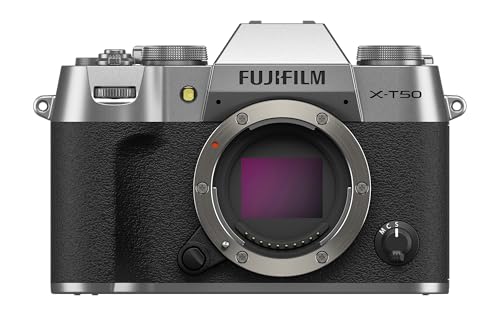
Fujifilm’s listing for the X-T50 is three facts — a mirrorless digital camera body, in silver — and a world of implication carried by the X-T name. The X-T line is Fujifilm’s dial-led branch, built for photographers who operate by touch and deliberation, and the X-T50 is its compact, travel-weighted expression. For the backpacker whose photography is a practice rather than a record — the walker who stops, considers, composes, and would rather make twelve considered frames a day than four hundred hurried ones — this little silver body is the guide’s most characterful invitation.
Deliberation is a genuine backpacking virtue, and not only aesthetically. The considered photographer shoots fewer frames, which stretches batteries and cards across a route the trigger-happy walker exhausts by day three. A camera whose handling slows its owner down — dials to set, a scene to read, a frame to earn — is a power-management strategy disguised as a philosophy. Add Fujifilm’s reputation for colour that walkers love straight from the camera, valuable when the editing suite is a week away and the trail journal is illustrated nightly, and the X-T50’s candidacy sharpens: it is the backpacking camera for the diarist.
The silver finish is function in this context too. A beautiful object gets carried on the strap rather than buried in the pack, gets taken to the village and the viewpoint and the camp kitchen, and accumulates the trip’s social photographs — the ones of people, which are the ones that matter in twenty years. The listing’s silences are extensive (no sensor, video or sealing figures are printed) and the spec box records them for Fujifilm’s documentation; the X-system’s compact primes, meanwhile, give the body-only buyer a bench of small lenses genuinely suited to a pack.
Who should walk past it? The backpacker who needs a sealing rating printed before trusting a body to a wet range — that buyer has the OM-5 Mark II two reviews back — and the wildlife walker who needs stated autofocus and stabilization systems, whom the G9 II serves. The X-T50’s buyer is the walker-philosopher: fewer frames, better kept, from a camera that makes the keeping pleasurable.
Strengths
- Fujifilm’s dial-led X-T handling rewards deliberate, economical shooting that stretches batteries and cards.
- A compact silver body that owners carry visibly — and therefore use constantly.
- The X system’s compact primes suit a pack better than almost any rival catalogue.
Trade-offs
- The listing title prints no sensor, video, stabilization or sealing figures at all.
- Body only: the trail lens must be chosen and budgeted separately.
- Deliberate handling is a mismatch for fast, chaotic subjects like trail-side wildlife at speed.
- Body: Fujifilm X-T50 mirrorless digital camera body, as listed
- Colour: Silver
- Mount: Fujifilm X
- Sensor: Not stated in the listing title — verify with the manufacturer documentation
- Video specification: Not stated in the listing title — verify with the manufacturer documentation
- Weather sealing: Not stated in the listing title — verify with the manufacturer documentation
Best for: a deliberate backpacker-diarist who shoots sparingly and socially, on a compact silver X-system body paired with one small prime. Not suited for: a wet-range walker who requires a printed sealing rating before trusting a body outdoors, because this listing’s title states none while the OM-5 Mark II prints IP53.
A ritual suits this camera on the trail: the evening review. One pass through the day’s frames at camp — deleting the failures, noting the keepers, charging nothing, spending little power — turns the X-T50 into the trip’s journal-keeper and keeps the card discipline the route demands. Backpackers who adopt the ritual come home with an edited story rather than an archive to dread, which is the diarist’s whole point.

Canon EOS R10 with RF-S 18-45mm — The complete Canon kit
Seen from the trailhead rather than the classroom, Canon’s EOS R10 kit changes its meaning. The listing is terse — a mirrorless camera, a lens kit, the RF-S 18-45mm named — but the combination is the only complete Canon outfit in this guide: a step-up body with a walk-around zoom included, on the RF system whose telephoto catalogue is the backpacking wildlife shooter’s long-term prize. Buy the kit for the route you are walking this season; keep it for the system it opens, because the R10’s real backpacking argument is a two-season one.
Season one is the kit itself. The 18-45mm range covers the walker’s grammar — the wide valley view, the camp scene, the portrait at the pass — in one lens that never leaves the body, which on the trail is a protection and a simplicity at once. The R10 body behind it is the one Canon positioned for moving subjects, and trails supply them constantly: the marmot that bolts, the raptor that crosses the col, the dog that will not pose. A body bought for motion, fed by a kit lens, is a coherent first-season outfit for the backpacker whose subjects have legs and opinions.
Season two is the catalogue. Canon’s RF system holds the lenses a wildlife-leaning backpacker eventually wants — including the remarkably packable telephotos the RF line has become known for — and every one of them mounts the body bought here. That growth path distinguishes the R10 kit from a dead-end bargain: the backpacker whose bird photography deepens does not start again, they add a lens. In a category where systems are decades, that continuity is worth real money and real grams.
The listing’s silences are the ones recorded before: no sensor or video figures are printed, and no sealing rating is claimed, so the wet-weather backpacker should verify protection in Canon’s documentation and pack a rain cover regardless. What is printed — body, kit lens, system — is a complete and future-proofed trail outfit, and the most accessible route in this guide into a flagship lens catalogue.
Strengths
- A complete kit: body and 18-45mm zoom in one box, ready for the trailhead.
- The step-up Canon body, positioned for the moving subjects trails supply.
- RF-mount growth: Canon’s telephoto catalogue is the wildlife backpacker’s long game.
Trade-offs
- The kit zoom’s range ends at 45mm — wildlife reach awaits a second-season lens.
- No sealing rating is printed in the listing, so rain protection is the owner’s to arrange.
- The title states no sensor or video figures for spec-led comparison.
- Body: Canon EOS R10 mirrorless camera, as listed
- Lens included: RF-S 18-45mm kit lens
- Mount: Canon RF, per the lens designation in the listing title
- Sensor: Not stated in the listing title — verify with the manufacturer documentation
- Weather sealing: Not stated in the listing title — verify with the manufacturer documentation
- Video specification: Not stated in the listing title — verify with the manufacturer documentation
Best for: a backpacker who wants a complete Canon kit now and a telephoto future later, starting with the included 18-45mm zoom on Canon’s RF system. Not suited for: a backpacker whose route is a week of coastal rain, because this listing prints no weather-sealing rating to rely on.
Trailcraft for the kit owner: the 18-45mm’s modest range teaches the walker’s oldest photographic skill — approaching with your feet. Backpackers are uniquely equipped for it, since the approach is the activity itself: the extra twenty minutes to the better vantage, the patient wait at the water source. The R10 kit’s limitation becomes a discipline, and the discipline, once learned, makes every later lens more valuable rather than merely longer.

Nikon Z50 II Body — The compact sharer
Nikon’s listing for the Z50 II describes a compact mirrorless stills/video camera with easy colour presets and wireless photo sharing, as a Nikon USA model. Translate that into trail language and a distinct backpacker appears: the social walker. The one whose photographs leave the camera the same evening — the summit shot sent to family from the refuge’s Wi-Fi, the route’s story posted from the tent — and for whom a camera that shares easily is not a gadget but the point of carrying it. Easy colour presets serve the same walker: finished-looking images without an editing suite, colour decided in the camera by a preset rather than at a desk a week later.
Compact is the listing’s own word for the body, and on the trail compact is compounded by the Z system’s DX lenses, which keep the body-only buyer’s first lens small. The Z50 II also sits on the same Z mount as Nikon’s professional bodies elsewhere on this site, so the social walker’s camera is not a toy at the end of a branch — it is the light end of a main line, with the catalogue above it if the hobby deepens into expeditions.
The sharing features deserve a power-aware footnote, because wireless transfer spends battery that a week-long route budgets carefully. The wise social backpacker treats sharing as a camp ritual — one session in the evening, phone in airplane mode the rest of the day — rather than a continuous habit, and the camera’s presets make that single session productive: images arrive at the phone already coloured, already finished, ready to send. Used that way, the Z50 II’s connectivity is a feature with a discipline, like everything else in a pack.
The title prints no sensor, video or sealing figures, and the spec box records the gaps for Nikon’s documentation. What it prints — compact body, presets, wireless sharing, official-channel status — is a coherent identity: the backpacking camera for the walker whose audience is waiting tonight, not at the end of the season.
Strengths
- Wireless photo sharing is stated in the listing — the summit shot reaches family the same evening.
- Easy colour presets produce finished images in-camera, with no editing suite on the route.
- A compact body, per the title, on Nikon’s mainline Z mount.
Trade-offs
- Body only: a Z-mount lens must be chosen and carried on top of the body’s promise.
- Wireless habits spend battery; a week-long route needs sharing discipline.
- No sensor, video or sealing figures are printed in the title for comparison.
- Design: compact mirrorless stills/video camera, as listed
- Features: easy colour presets and wireless photo sharing, per the listing title
- Model status: Nikon USA Model
- Mount: Nikon Z
- Sensor: Not stated in the listing title — verify with the manufacturer documentation
- Weather sealing: Not stated in the listing title — verify with the manufacturer documentation
Best for: a social backpacker who shares nightly, on a stated compact Z-mount body with colour presets and wireless transfer built into its brief. Not suited for: an off-grid purist walking a week beyond signal, because this body’s defining features — presets for instant sharing and wireless transfer — answer an audience the deep backcountry does not have.
A presets practice worth adopting: choose one colour preset at the trailhead and shoot the whole route in it. The constraint gives the trip’s photographs a single visual voice — the way a film stock once unified a journey’s album — and the evening share becomes a chapter rather than a jumble. The Z50 II’s presets are listed as “easy,” and their best use is exactly this: a small decision, made once, that makes a week’s images cohere.
Sony a6700 Body — The video backpacker
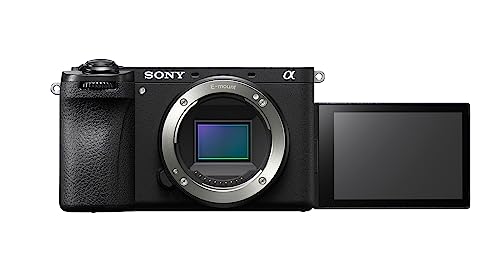
For the backpacker who films the route — the thru-hiker documenting a long trail, the climber whose sponsors expect footage, the walker building a channel from the path — Sony’s a6700 listing states the working toolkit: a 26 megapixel APS-C sensor, 4K video, log shooting and LUT handling, with vlog friendly functions. On the trail those phrases translate into a production discipline. Log recording keeps the high-altitude contrast — snowfields against dark rock, the exposure nightmare of the mountains — recoverable at the desk. LUT handling lets the filmmaker see the finished look in the field and shoot for it. And 26 megapixels of stills resolution means the same body covers the photographic record without a second camera in the pack.
The body-only format, a liability in some guides, is a considered choice here: the video backpacker’s lens is a specific decision — often one compact zoom that covers the vlogging range, or a fast prime for camp interviews — and Sony’s E mount offers the deepest bench of compact APS-C glass to make it from. The outfit’s trail weight is therefore the owner’s design, and a disciplined designer can build the lightest serious filming kit in this guide around this body.
Power is the video backpacker’s binding constraint, and honesty requires centring it. Filming spends batteries at a rate stills never approach, and a route’s charging opportunities — a refuge socket, a solar panel’s slow generosity — set the real shooting budget. The a6700’s owner should plan the production around that budget: stills on the walking days, filming concentrated at the camps and the set-piece viewpoints, spare batteries carried as deliberately as water. The camera’s toolkit rewards exactly that planned style; log footage of twelve considered scenes outvalues an hour of exhausted-battery nothing.
The listing prints no stabilization or sealing figures, and the spec box records them for Sony’s documentation — the filming backpacker in wet ranges should verify protection and pack accordingly. What is printed is the most complete video specification in the guide, on the deepest compact lens system, and for the backpacker whose route is content, that combination is the recommendation.
Strengths
- Log shooting and LUT handling are stated — a grading workflow for high-contrast mountain light.
- A stated 26 megapixel APS-C sensor leads this guide on stills resolution.
- E-mount’s compact APS-C catalogue lets the owner design the lightest filming outfit here.
Trade-offs
- Body only, and video’s battery appetite demands a charging plan the listing cannot make for you.
- No stabilization figure is printed in the title.
- No sealing rating is stated, so wet-range filming needs verification and protection.
- Sensor: 26 megapixel APS-C, as listed
- Video: 4K, with log shooting and LUT handling, per the listing title
- Framing: vlog friendly functions, as listed
- Mount: Sony E
- Colour: Black
- Weather sealing: Not stated in the listing title — verify with the manufacturer documentation
Best for: a backpacker who films the route seriously, needing stated log recording and LUT handling on a 26 megapixel APS-C body inside Sony’s compact-lens system. Not suited for: a stills-only walker counting every gram of battery, because this body’s defining toolkit is a video workflow whose power demands a stills practice never incurs.
Field production counsel: scout with stills, film with intent. The a6700’s stills cost little power and let the walking day double as location scouting — frame the col, the falls, the camp at stills prices, then return in the right light with the battery budget reserved for the filming itself. Backpacker-filmmakers who work this way come home with both archives full; those who film continuously come home with neither, and with strong opinions about solar chargers.
Comparison
| Pick | Sold as | Resolution as listed | Sealing as listed | Trail identity |
|---|---|---|---|---|
| OM System OM-5 Mark II | Kit, 14-150mm | 20.4MP | IP53 weather-sealed | One lens, all weather |
| Panasonic Lumix G9 II | Body only | 25.2MP | Not stated in the listing title | Expedition flagship |
| Fujifilm X-T50 | Body only | Not stated in the listing title | Not stated in the listing title | Deliberate diarist |
| Canon EOS R10 | Kit, 18-45mm | Not stated in the listing title | Not stated in the listing title | Complete kit, growing system |
| Nikon Z50 II | Body only | Not stated in the listing title | Not stated in the listing title | Compact nightly sharer |
| Sony a6700 | Body only | 26MP | Not stated in the listing title | Video production on foot |
The sealing column is the table’s conscience: one printed rating and five silences. That asymmetry is not a ranking — the five silent bodies may be sealed to their makers’ own standards, and their documentation will say — but a backpacker buying for a wet route tonight can only rely on what is printed, and what is printed is the OM-5 Mark II’s IP53. Evidence has a geography, and on the trail it matters.
Read the sold-as column next, because it predicts the first season’s experience. The two kits walk out of the shop complete; the four bodies begin a design project whose quality depends on the owner’s lens discipline. Neither is superior — the G9 II’s assembled expedition outfit will out-photograph any kit here, at the price of decisions the kit buyer never faces. The table simply insists the project be entered knowingly.
How to Choose a Mirrorless Camera for Backpacking
Run the pack audit in writing. List the outfit exactly as it would be carried — body, lens or lenses, two batteries, cards, a strap or harness, a dry bag — and weigh the list against the trip’s other non-negotiables. If the camera system displaces water capacity or a layer of warmth, it is too heavy for that route whatever its specifications say, and a lighter pick from this guide is the correct downgrade. Backpacking is the one photographic genre where the equipment decision is literally a safety-adjacent decision, and it should be made with a scale and a route profile, not with desire.
Choose the lens strategy before the body. The trail divides photographers into never-swappers, who should buy the OM-5 Mark II’s single-lens answer or a kit zoom, and deliberate swappers, who can exploit a two-lens outfit’s range. Swapping on a ridge in wind is a sensor-dust appointment and a dropped-lens risk; the backpacker who knows they will not swap should not pay, in grams or money, for a system designed around swapping. Body choice follows strategy the way a boot follows a foot.
Weight weather honestly against your routes. A printed sealing rating — IP53 on the OM-5 Mark II — is evidence; its absence from a listing is a homework assignment, not a verdict. Walkers on wet coasts and high ranges should either buy the rated body or verify a rival’s protection in its documentation and carry a proper rain cover regardless. Desert and summer walkers can spend the same money and grams on resolution or reach instead. The route chooses the priority; the ego should not.
Budget power like water. Estimate your shooting days, learn your body’s real endurance from its documentation and your own first weekend, and carry batteries to the route’s length plus a margin — stored warm, rotated, and treated as the consumable they are. Video multiplies the budget severalfold, which is why the a6700’s review reads like a production plan. A camera that dies on day five is the heaviest camera in this guide, whatever it weighs.
Think about the summit-day problem separately, because it concentrates every trade in this guide. On the longest day, when the pack is lightest by design and the photographer most tired, the camera must still be reachable, operable with gloves or cold fingers, and alive. Bodies with larger, simpler controls forgive cold hands; screens that demand fine touch do not. None of the listings here speaks to glove operation, so treat it as a rehearsal question — handle your finalists with the gloves you actually walk in — and let the answer break ties that specifications leave open. Many backpackers discover their true favourite camera with numb fingers, and the discovery is reliable precisely because it cannot be argued with.
Altitude and cold deserve their own sentence in the plan. Batteries surrender charge faster in the cold at elevation, cards and lubricants behave differently, and condensation waits for the warm tent at the end of the day — the classic routine of sealing the camera in its dry bag before bringing it inside exists because cold glass fogs instantly in warm, moist air. None of that is in any listing, and all of it decides whether the camera survives the route it was bought for. The experienced backpacker’s camera craft is mostly this invisible layer of habit, and it transfers between bodies unchanged, which is one more reason to choose a system and stay in it.
Finally, rehearse at home. Walk a local loop with the full pack and the camera carried as it will be carried — strap, hip belt, chest harness — and notice what the arrangement does to your willingness to stop and shoot. The best backpacking camera is the one whose carrying system disappears, and that is a property of the harness and the habit as much as of the body. Every pick here can disappear for somebody; the rehearsal tells you which one disappears for you.
How Many Lenses Should a Backpacker Carry?
One, for most walkers, most routes. The evidence of this guide’s two kits points the same way: a single zoom that covers the walker’s grammar — 14-150mm on the OM-5, 18-45mm on the Canon — keeps the body sealed against dust, the pack simple and the decisions few. The second lens is the most commonly regretted item in backpacking photography, carried for a category of shot that occurs twice and resented on every climb between occurrences.
The exceptions are expeditions with a declared subject. A birding route justifies the telephoto as a second lens because the telephoto is the trip; a landscape traverse may justify a fast wide prime for the night sky. The test is whether the lens serves the route’s purpose or the photographer’s anxiety. Purpose packs; anxiety also packs, and charges more per gram in resentment. Answer honestly at the trailhead and the lens count settles itself.
There is a subtler arithmetic underneath the lens count: every lens carried is also a lens cleaned, capped, insured against drops and worried about at river crossings. The one-lens walker’s peace of mind is a real expedition asset, banked against the two-lens walker’s extra reach. Photographers planning their first camera-carrying trek should start with one lens and a clear conscience, and let a completed route — with its honest list of shots missed for want of a focal length — write the case for a second lens, if a case exists at all.
What Does an IP53 Rating Mean on a Wet Trail?
IP53 is a formal ingress-protection grade — tested resistance to dust and to water sprayed at angles — and its presence in the OM-5 Mark II’s listing is the only printed sealing claim in this guide. On a wet trail it means the body is built to keep working through rain showers, spray and dusty sections that would send an unrated camera into a dry bag. It does not mean submersible, and it does not cover a dropped-in-the-river accident; it means weather, endured professionally.
For the other five picks, the absence of a printed rating is an instruction to verify, not an assumption of fragility. Makers document their weather resistance in their own channels, and a backpacker whose route is wet should read that documentation for the exact body, then carry a rain cover anyway — because on day four of rain, the difference between rated and unrated matters less than the difference between a photographer who planned for water and one who hoped about it.
How Do You Keep a Camera Alive for a Week Off-Grid?
With a power budget and a card budget, both planned before departure. Shoot deliberately — the X-T50 review’s philosophy is also an energy policy — review sparingly on the camera’s screen, keep batteries warm in an inside pocket at night, and let the phone stay off except for the Z50 II owner’s single evening sharing session. Cards should be sized for the route’s realistic frame count at your resolution, with one spare beyond the estimate, because a full card on day six is a camera that has died with its battery full.
Protection is the other half of survival: a dry bag inside the pack for the worst weather and the river crossings, a lens cloth that lives in the same pocket every day, and a strap arrangement that makes a drop unlikely rather than merely survivable. Backpacking cameras rarely die of their specifications; they die of water, dust and gravity, all three of which are managed by habits cheaper than any feature in this guide.
Common Mistakes When Packing a Camera for the Trail
Carrying the camera inside the pack. It is the most common and most costly error in this entire category: a camera in the lid or the main compartment is a camera used at planned stops only, while the trip’s real photographs — the light between stops, the animal on the path, the weather arriving — happen to a photographer whose camera is zipped away. Every outfit in this guide was chosen to be carried on the body; honour that with a strap or harness, or do not carry a camera at all and save the grams entirely.
Bringing the second lens for reassurance. Reassurance is the heaviest substance in a pack. The lens carried “just in case” for a shot that needs a specific route, season and luck is almost never mounted, and its grams are spent on every step. Pack for the route’s declared subjects — the guide’s lens-strategy section is blunt about this because the mistake is universal.
Trusting a listing’s silence about weather. A body with no printed sealing rating may be well protected or barely protected, and the trail is the worst place to discover which. Verify in documentation, pack a rain cover, and treat any unrated body as unrated until evidence says otherwise. Hope is not a sealing standard.
Under-budgeting batteries and cards. The camera that stops on day five converts all its carried grams into pure loss. Power and storage are part of the camera system for planning purposes — weigh them, count them, carry the margin. The backpackers whose photographs fill this genre’s magazines are not carrying better cameras; they are carrying cameras that are still alive on the last morning.
Final Recommendation
For most backpackers, the OM System OM-5 Mark II kit is the answer that asks nothing further: one 14-150mm lens that never leaves an IP53-sealed body, 5-axis stabilization in place of a tripod, 20.4 megapixels sized for the route. The photography-first walker should build around the Panasonic Lumix G9 II and its stated 25.2 megapixel expedition specification. The Canon EOS R10 kit serves the generalist who wants completeness now and a telephoto system later; the Nikon Z50 II serves the walker whose family waits for the evening’s pictures; the Fujifilm X-T50 serves the diarist; and the Sony a6700 serves the filmmaker, with the deepest toolkit and the strictest power discipline of the six.
One last word about the photographs themselves, because gear talk can swallow a backpacking guide whole. The routes these cameras are bought for produce a kind of image no studio can: earned landscapes, weather with a narrative, companions photographed in the middle of effort rather than at its polished end. The camera that serves those images is not the one with the longest specification but the one that was out, alive and ready at the unrepeatable minute — and every choice in this guide, from sealing ratings to battery budgets to the lens that never comes off, is aimed at that single minute. Buy for the minute, and the miles will take care of themselves.
Every camera in this guide will be carried up the same hill by the same legs. Choose the one whose compromises you will still be grateful for on the descent — that gratitude, and not any specification, is what a backpacking camera is actually made of.
Frequently Asked Questions
Which backpacking camera here is best for bad weather?
The OM System OM-5 Mark II, on evidence: it is the only listing in this guide that prints a weather-sealing rating, IP53. The other bodies may be protected to their makers’ standards, but those claims live in manufacturer documentation rather than in these listings, so verify there — and carry a rain cover regardless of rating.
Is a kit lens enough for a whole backpacking trip?
For most routes, yes. The OM-5 Mark II’s 14-150mm covers wide scenes to real telephoto in one lens, and the Canon R10’s 18-45mm covers the walker’s everyday grammar. Trips with a declared special subject — birds, night skies — justify one additional lens chosen for that subject, and the body-only picks here exist for exactly those expeditions.
How many batteries should I carry for a week?
Plan from your body’s documented endurance and your shooting style, then add a margin — and treat video as a separate, much larger budget. None of these listings prints an endurance figure, so establish your real consumption on a rehearsal weekend before the route. Batteries are part of the camera system’s weight; count them in the pack audit.
Which of these is best for wildlife on the trail?
The Panasonic Lumix G9 II is the expedition answer: a stated 25.2 megapixel sensor for cropping, Phase Hybrid AF for moving subjects, and the Micro Four Thirds system whose telephoto lenses are the lightest serious reach available. The Canon R10 kit is the growth answer — start with the kit, add RF telephoto reach as the hobby deepens.
Can I charge a camera while backpacking?
Only as your route allows — refuge and hut sockets on some trails, portable power on others — and none of the listings here specifies charging arrangements, so check each maker’s documentation for in-camera charging support before relying on it. The dependable strategy is carried batteries, budgeted like water, with any charging opportunity treated as a bonus rather than a plan.
Related Guides
Backpackers choosing between small systems generally should compare the full field in the best lightest mirrorless cameras for travel and trail alike. Those starting photography with the walking habit will find their first-camera shortlist in the best entry-level mirrorless cameras that survive a pack. And walkers whose trips are becoming expeditions should look up the ladder to the best mirrorless cameras for enthusiasts, where the same systems grow more capable.


