Our Top Picks



What's inside
- What a quarter-inch shank means in practice
- The profiles a useful set must contain
- Carbide versus high-speed steel, and what carbide grades mean
- Bearings: the small parts that decide accuracy
- Set composition: counts, cases, and honest value
- Speed, feed, and vibration: running quarter-inch bits safely
- Matching a set to your router and your work
- Sharpening, cleaning, and knowing when a bit is done
- Buying checklist for quarter-inch sets
- Beyond the core: the supporting profiles worth having
- Handheld versus table-mounted: the same bits, two disciplines
- How materials answer back: softwood, hardwood, and board
- Set or singles: the economics across a decade
- Safety essentials specific to small-shank bits
- Organisation in the working shop
- Check prices on Amazon
- Three projects that reveal a set’s character
As an Amazon Associate I earn from qualifying purchases. This post may contain affiliate links at no extra cost to you.
A quarter-inch router bit set is often the first serious accessory purchase a woodworker makes, and it shapes everything that follows. The router itself, whether a compact palm model, a mid-size plunge machine, or a unit mounted beneath a table, can only cut the profiles its bits carry. A thoughtfully assembled set puts the everyday profiles within reach from the first weekend: straight bits for grooves and dadoes, roundovers for softening edges, chamfers for crisp bevels, flush-trim bits for copying templates, and a decorative profile or two for furniture work. A poorly assembled set, by contrast, duplicates near-identical cutters while omitting the sizes a workshop actually reaches for.
The quarter-inch shank defines the category. It is the standard fitting for compact and mid-size routers across most markets, light enough for one-handed trim work and rigid enough for careful table use in shallow passes. Half-inch shanks exist for larger machines and heavier cuts, and this guide does not pretend the two are interchangeable. Its subject is the quarter-inch ecosystem on its own terms: what a good set contains, how its cutters are made, which details separate bits that stay sharp and run true from bits that chatter, burn, and wander.
Everything here is discussed at the category level, drawn from manufacturer specifications, published speed guidance, and patterns in owner reports from working woodworkers. No individual product is named, because the value of a set lies in measurable things any buyer can check: carbide grade and thickness, bearing quality, profile selection, shank finish, case design, and the honesty of the documentation packed alongside the steel.
What a quarter-inch shank means in practice
The shank is the smooth cylindrical portion that the collet grips, and on this class of bit it measures one quarter of an inch in diameter. That modest diameter sets the physics of the whole category. A quarter-inch shank flexes more than a half-inch shank under side load, so bits in this class reward shallow passes, sensible feed rates, and cutters whose cutting diameter stays in proportion to the shank. Most profiles in quarter-inch sets keep cutting diameters between roughly a quarter inch and about one and a half inches, and the larger decorative profiles in that range are intended for table-mounted use with multiple light passes rather than a single deep cut.
Collet grip depends on insertion depth and cleanliness as much as on the collet itself. Standard workshop practice, repeated in router manuals across brands, is to insert the shank until it nearly bottoms out, then withdraw it slightly, roughly an eighth of an inch, so heat expansion and collet geometry do not conspire to loosen or jam the bit. A set whose shanks are uniformly ground, free of paint overspray on the gripping surface, and marked with a clear insertion line makes that practice easy to follow. Paint or lacquer on the shank, found on some decorative-looking sets, reduces grip and should be regarded as a defect rather than a finish.
Runout: the invisible specification
Runout is the wobble a bit exhibits as it spins, measured as the deviation of the cutter from a perfect circle. Excess runout shows up in the work as chatter marks, uneven profile depth, and premature dulling, because one cutting edge ends up doing most of the work. Buyers cannot measure runout from a product listing, but they can read the signals: shanks ground to a smooth, consistent finish, cutters brazed concentrically to the body, and manufacturers willing to state a tolerance figure in their specifications. Owner reports about a set tend to mention runout indirectly, praising bits that run smooth and quiet or complaining about vibration that no adjustment cured. A set that runs true also runs safer, since vibration fatigues both the operator’s hands and the collet’s grip over a long session.
The profiles a useful set must contain
Profile selection is where sets diverge most, and where piece count misleads most reliably. A large set count can conceal three near-identical straight bits and no rabbeting cutter at all. The working core of a quarter-inch set, the profiles that earn their space in the case month after month, is well established among woodworkers, and buyers should audit any candidate set against it before being impressed by the total number on the box.
Straight bits: the backbone
Straight bits cut flat-bottomed grooves, dadoes, rabbets in conjunction with a fence or bearing, mortise waste, and general recesses. A useful set carries several diameters, commonly spanning small sizes for inlay and sign work up to three-quarter inch or so for dadoes matching common sheet material. Two-flute designs dominate this class; the flutes clear chips and define the surface finish. Up-cut spiral geometry, where offered in this shank size, pulls chips out of deep mortises and grooves, at the cost of a slightly rougher top edge, while straight flutes shear more gently on visible edges. What matters for a set buyer is diameter coverage without silly duplication: three straights in genuinely different sizes serve better than five clustered within a sixteenth of an inch of one another.
Roundover and chamfer bits: the edge workers
If straight bits are the backbone, roundover bits are the hands. They soften the sharp arrises on table tops, shelves, boxes, and chair parts, and they do so in graded radii, so a good set includes at least two or three radii rather than a single token size. Each roundover carries a guide bearing at its tip whose diameter determines the shoulder the profile leaves, and better sets include or support alternate bearings that convert a roundover into a beading profile. Chamfer bits perform the parallel job with a flat bevel, usually at forty-five degrees, though other angles appear; they suit modern furniture, break edges quickly, and double as a jointing aid for mitred work. Between them, these two families account for the majority of cuts most home workshops make, and their quality sets the tone for the whole purchase.
Flush-trim and pattern bits
Flush-trim bits carry a bearing exactly equal to the cutter diameter, so the cutter copies whatever the bearing rides along: a template, a factory edge, or a previously shaped part. They trim veneer and laminate flush, duplicate curved components from a master pattern, and clean up band-sawn parts to a drawn line. Bearing position varies, with end-bearing designs common in sets and shank-bearing pattern variants appearing in better-equipped collections. For set buyers, one sound flush-trim bit in a mid diameter is worth more than a second decorative profile, because template work underpins everything from repeated shelf brackets to identical drawer fronts across a kitchen run.
Rabbeting, cove, and roman ogee
A rabbeting bit cuts the stepped recess that receives cabinet backs, picture-frame glass, and door panels. Its defining convenience is bearing interchangeability: swapping the bearing changes the rabbet width while the cutter stays the same, so a single bit with a small family of bearings covers several standard recesses. Sets that include a rabbeting bit with spare bearings show an understanding of real cabinet work. Cove bits cut the concave quarter-hollow used in crown-style transitions, drip edges, and decorative drawer fronts, often paired with a roundover on the opposite edge to form a rule joint for drop-leaf tables. The roman ogee is the set’s traditional showpiece, cutting the S-curve profile associated with classic furniture edges and raised trim. It is also the profile most likely to be oversized for a quarter-inch shank, so buyers should note its cutting diameter and plan table-mounted, multi-pass use for it from the outset.
| Profile family | Primary job | What to check in a set |
|---|---|---|
| Straight | Grooves, dadoes, mortises | Diameter spread without duplication |
| Roundover | Softened edges | Two or more radii, smooth bearings |
| Chamfer | Bevelled edges | Clean grind at a true forty-five degrees |
| Flush-trim | Template and pattern copying | Bearing exactly matching cutter diameter |
| Rabbeting | Recesses for backs and glass | Interchangeable bearings included |
| Cove and ogee | Decorative hollows and S-curves | Diameter proportionate to the shank |
Carbide versus high-speed steel, and what carbide grades mean
The cutting edges of nearly every worthwhile quarter-inch bit are tungsten carbide, brazed onto a steel body. Carbide holds an edge far longer than high-speed steel in abrasive material such as manufactured board, holds it through the resin and glue lines that dull lesser edges, and tolerates the heat of continuous routing. High-speed steel bits persist at the margins of the market, sharpen more easily to a keen edge, and can suit a handful of softwood-only tasks, but in set form they date quickly: a set bought for general workshop use will meet plywood, laminated board, and hardwood within its first projects, and that is carbide country.
Carbide itself is not one material. Grades differ in grain size and binder content, and finer micro-grain grades take a sharper edge and resist chipping better than coarse industrial grades, at higher cost. Manufacturer specifications in this category sometimes name the grade family, using terms such as micro-grain, and sometimes state only that the cutters are carbide, which tells the buyer little. Thickness matters alongside grade: a generously thick carbide blank can be resharpened more times across the bit’s life and survives the occasional hidden staple or grit inclusion that would shatter a thin edge. Buyers comparing sets should look for stated carbide thickness or visible heft in the cutter, and treat unnamed, tissue-thin edges as a warning sign even when the profile list looks generous.
Brazing, body steel, and balance
The joint between carbide and body is made with a silver-bearing braze, and its quality is visible on close inspection: a clean, continuous fillet with no voids or scorching suggests controlled manufacture. The steel body beneath should be hardened enough to resist collet scarring and bearing-seat wear, and finished so the bit balances at speed. Anti-kickback body design, in which the body shape limits how deeply the edge can bite per revolution, appears on larger profiles and is a genuine safety feature rather than marketing garnish, particularly for the bigger cove and ogee cutters in a set. Painted bodies are common and harmless on the body itself, provided the coating stops short of the shank and the bearing seat, as noted earlier.
Bearings: the small parts that decide accuracy
Every guided profile in a set depends on a ball bearing the size of a fingernail, and bearing quality quietly decides whether edges come out smooth or ridged. A good bearing spins freely without grit, has no perceptible play when wiggled, and is shielded or sealed against the fine dust that routing produces in quantity. A failing bearing announces itself with a rising whine, heat discolouration, or a burn line burned into the work where it stopped turning and dragged. Because bearings are consumables, better sets use standard sizes held by a small socket-head screw, so an owner can replace one in minutes rather than retiring the bit. Sets that pin or swage their bearings permanently in place convert a minor maintenance item into a lost cutter.
Bearing diameter is also a profile dimension. On roundovers and rabbeting bits, changing the bearing changes the cut, so sets that include a small assortment of bearings multiply the value of the cutters they accompany. Buyers should confirm that the set’s bearings share a common internal diameter with widely available replacements, since an odd size can be difficult to source later. Owner reports return to bearings again and again: the bits people keep for a decade are rarely the ones with exotic profiles, they are the ones whose bearings stayed smooth and whose edges stayed keen.
Set composition: counts, cases, and honest value
Sets in this class range from compact collections of a dozen or so essentials to wide assortments several times that size. The right size depends on the work. A woodworker building boxes, boards, and small furniture may use fifteen profiles for years without wanting a sixteenth. A cabinet and trim enthusiast will reach into the thirties. What should not drive the decision is arithmetic alone, because assortment quality follows a curve: beyond the working core described earlier, additional profiles grow steadily more specialised, and the per-bit manufacturing budget in a very large set is necessarily thinner. Several experienced voices in owner discussions advise buying a modest, well-made core set and adding individual bits as projects demand them, a strategy that also spreads cost across the years when each profile is actually needed.
The case is part of the tool
Carbide is hard and brittle in equal measure: an edge that survives hardwood for years can chip if it knocks against a neighbouring bit in a drawer. Storage therefore belongs in any serious evaluation. Good cases, whether wooden boxes with fitted holes or moulded inserts, hold each bit by its shank, separated from its neighbours, with the profile labelled or at least silhouetted so the right cutter is easy to find and easy to return. A case that displays the bits upright also serves as a quiet inventory check before a project starts. Loose trays and foam that crumbles within a year leave sharp edges rattling together, and the resulting micro-chips show up later as mysterious lines in finished edges. When a set will live in a working shop rather than a showroom, the case deserves the same scrutiny as the carbide, a point makers of fine furniture for pieces such as those in our guide to best solid wood desks would recognise from their own edge-finishing routines.
Labelling and documentation
Each bit should be identifiable without guesswork. Better sets mark the profile name or size on the shank or body, and include a chart matching each cutter to its profile and recommended maximum speed. That chart is not decoration. Recommended speeds vary substantially with cutter diameter, and a set that prints them acknowledges the physics its buyers must respect. Documentation that also covers bearing sizes and replacement part numbers signals a manufacturer expecting the bits to be maintained rather than discarded, which correlates strongly with the other quality signals in this guide.
Speed, feed, and vibration: running quarter-inch bits safely
Rotational speed must fall as cutter diameter rises, a rule rooted in rim speed rather than opinion. Small straight bits tolerate the full speed of most routers, while large decorative profiles in a quarter-inch set may carry recommended maximums well below a router’s top setting. Manufacturer speed charts generally group bits by diameter bands, and the figures in a set’s documentation should govern. Running an oversized ogee at full speed risks vibration, poor finish, and in the worst case cutter failure, none of which any profile is worth. Variable-speed routers earn their place in this category precisely because set owners, by definition, own cutters of many diameters.
Feed rate is the operator’s half of the equation. Feeding too slowly lets the edge rub and generate heat, glazing the wood and dulling the carbide; feeding too quickly overloads the shank and invites chatter or a grabbed cut. The sound of a well-fed cut is a steady working note, distinct from the scream of a rubbing edge or the laboured growl of an overloaded one, and the chips tell the same story: proper chips carry heat away, while fine dust signals rubbing. Quarter-inch shanks enforce humility here. Depth per pass should stay modest, commonly a fraction of the cutter diameter on profile work, with the final pass taken shallow for surface quality. Router-table fences and featherboards, where available, stabilise the work so the operator can hold that steady feed without fighting the piece.
Climb cutting, grain direction, and tear-out
Three technique topics recur wherever set owners discuss results. Grain direction decides tear-out: routing against rising grain lifts fibres, so sequencing cuts across end grain before long grain lets the later pass clean up the corners, a standard strategy for frames and table tops. Climb cutting, feeding in the same direction as cutter rotation, can leave a cleaner surface on difficult grain but pulls the router or workpiece forward and should be reserved for very light, experienced final passes, never a full-depth cut. Chip breakers and backer boards address the remaining weak point, the exit corner, where an unsupported edge blows out; a sacrificial block held at the exit face supports the fibres through the last millimetre. None of these techniques costs money, and together they separate the finish a set delivers in practised hands from the finish blamed on the steel.
Matching a set to your router and your work
Compatibility begins with the collet. Compact trim routers accept quarter-inch shanks almost universally, which is why this set class pairs so naturally with them for edge work, hinge mortises, and laminate trimming. Mid-size routers usually ship with both quarter-inch and larger collets, letting a set serve handheld and table roles in the same shop. Before buying, owners should confirm their machine’s collet size from its manual rather than from memory, and check that any older router’s collet still grips evenly, since a worn collet can mimic every symptom of a bad bit. Workshops centred on a height-adjustable desk-height bench or a convertible workstation, of the kind compared in our guide to best adjustable standing desks, often mount the router beneath a dedicated table plate instead, which keeps bit changes quick and the collet accessible.
The work itself should dictate the profile audit. Furniture makers need the roundover radii, a cove, and an ogee family. Cabinet work leans on straights, rabbeting with bearings, and flush-trim cutters. Sign and craft work prizes small straights and V-groove cutters, which some sets include and others omit entirely. Drawer and box makers should look for dovetail cutters in the assortment, noting the angle, since drawer-side thickness determines which angle pairs with which jig. Reading a set’s contents against a list of the next six planned projects is the most reliable selection method this guide can offer, and it routinely demotes impressive piece counts in favour of the right fifteen cutters.
Sheet goods change the wear equation
Workshops that live on manufactured board should weight durability higher than workshops in solid timber. The adhesives and mineral content in plywood, laminated panels, and fibreboard abrade edges at a pace solid wood never matches, and they punish thin carbide quickly. For such work, micro-grain carbide, thicker blanks, and the discipline of cleaning pitch from edges before it bakes on matter more than an extra handful of profiles. Solid-wood shops face gentler wear but trickier grain, so edge keenness and bearing smoothness move up the list. Either way, a set is a consumable system with a long life, not a permanent purchase, and choosing for the dominant material keeps that life as long as possible. Makers planning a run of home-office pieces, for instance the cable-managed desks surveyed in our guide to best home office desks with cable management, will feel the sheet-goods wear pattern within the first project if the carcasses are laminated board.
Sharpening, cleaning, and knowing when a bit is done
Carbide edges in home workshops are maintained rather than truly sharpened. The standard method laps the flat face of the cutter, never the profiled edge, on a fine diamond plate with a light lubricant, restoring keenness without altering the geometry the bearing expects. A handful of strokes per face, repeated when the router begins to work harder or the surface shows burnishing, keeps a set cutting cleanly for years. Pitch and resin, by contrast, need cleaning rather than abrasion: a soak in a purpose-made blade cleaner or a household equivalent, followed by a brass or nylon brush, removes the brown build-up that owners frequently mistake for dullness. A cleaned bit that suddenly cuts like new is such a common story in owner reports that cleaning should always precede any verdict on an edge.
Retirement criteria deserve equal clarity. A bit should leave service when its carbide is chipped beyond a lap’s repair, when the shank is scored or bent, when the bearing seat is worn loose, or when the braze line shows cracking. Continuing with a damaged cutter risks the workpiece first and the operator second, and no single bit in a set justifies either. Because sets make individual profiles cheap to replace singly, owners can retire one cutter without mourning the whole box, another quiet argument for the core-set strategy described earlier.
Reading the cut: a diagnostic habit
Experienced router users diagnose from the workpiece. Burn marks point to dullness, pitch, excessive speed for the diameter, or a hesitant feed. Chatter ridges point to runout, an over-extended bit, too deep a pass, or a bearing beginning to fail. A profile that arrives shallower at one end of a board than the other suggests fence or table misalignment rather than the cutter. Torn fibres at entry suggest the cut sequence should start on end grain or with a backer. Treating each symptom as information, and changing one variable at a time, turns a new set into a known quantity within its first few projects, and the same habit protects future purchases from blame that belongs to setup. Compact workspaces benefit here too, since a small bench of the sort in our guide to best small computer desks can still host a trim router and a careful diagnostic routine even where a full table cannot fit.
Buying checklist for quarter-inch sets
- Audit the profile list against planned projects before counting pieces.
- Confirm straight bits span several genuinely different diameters.
- Look for at least two roundover radii and a true forty-five-degree chamfer.
- Check that carbide is described by grade or thickness, not merely named.
- Verify bearings are standard sizes, screwed in place, and replaceable.
- Ensure the rabbeting bit, if included, arrives with alternate bearings.
- Read the speed chart: large profiles should carry lower maximum speeds.
- Inspect shanks for a clean ground finish with no paint on the grip.
- Judge the case as storage for brittle edges, not as packaging.
- Confirm the set matches your router collet from the machine manual.
Budget bands in this category map roughly onto carbide quality and bearing quality rather than profile count. Entry sets can be entirely serviceable for occasional softwood and board work, provided the core profiles are present and the bearings spin freely. Mid-range sets typically buy thicker micro-grain carbide, better cases, and fuller documentation. Premium sets add tighter tolerances, anti-kickback bodies on the large profiles, and replacement-part support that treats the set as a system to be maintained. None of those tiers excuses a missing rabbeting bit or a case that lets cutters collide, and none guarantees the opposite, which is why the checklist outranks the price band as a decision tool.
A sensible first month with a new set
New sets repay a short breaking-in routine. Begin with the straight bits on scrap of the same species as the project, noting feed and sound at a couple of depths. Move to a roundover and adjust the height in small steps until the shoulder line looks right, recording the setting for repeat work. Spin each bearing by hand before first use and again after the first session, learning what a healthy bearing feels like while the memory is cheap. Enter the router table, if one is used, with the largest profile last and at its documented speed. By the end of a few such sessions the set stops being an assortment of strangers and becomes a known bench of cutters whose behaviour the owner can predict, which is the real product a good set sells.
Storage habits formed in that first month protect the purchase thereafter: bits returned to their labelled places while the dust is still being swept, edges never laid loose on a steel bench, the case kept closed against the fine dust that works into bearings. Workshops differ in space and rhythm, but the principle travels well. Treat the set as precision instruments that happen to be made of steel and carbide, and they will hold their edges, their bearings, and their accuracy through years of edges, grooves, and profiles.
Beyond the core: the supporting profiles worth having
A set’s second tier decides how often its owner must stop a project and order a single cutter. V-groove bits letter signs, cut decorative veining, and fold mitred sheet material where that technique is used; the common ninety-degree form earns a place in most workshops, with narrower angles serving finer lettering. Core-box bits carve the round-bottomed flutes seen on columns, finger pulls, and traditional tray bases, and they cut those flutes in sizes that should step gradually rather than leap. Dovetail bits, where included, must be read alongside the jig they serve, since angle and depth are a matched system rather than a free choice. Keyhole bits plunge and slide to form the hanging slot behind picture frames and wall organisers, a small profile that solves a recurring household problem in seconds.
Dish and bowl profiles, round-nose bits in larger diameters, and classical combination profiles appear in broader assortments and suit tray making and traditional trim. Their presence is welcome, provided they have not displaced the core. A useful audit is to sort a set’s contents into three piles in the mind: profiles for the next project, profiles for the next year, and profiles for a hypothetical someday. A set whose first two piles are strong is well composed at almost any total count. A set whose third pile dominates is a collection of curiosities wearing a workshop costume.
Single-purpose heroes: hinge, mortise, and surfacing work
Some cutters in the quarter-inch world are bought for one repeated job. Shallow mortising for butt hinges rewards a short, wide straight bit whose length keeps the router base stable on narrow door edges. A dedicated hinge routine, with a simple shop-made template, turns a dreaded task into a repeatable one, and set owners often find their mid-size straight bit pressed into exactly this service. Surfacing and flattening small slabs with a sled uses wide, shallow cutters run at conservative depth; quarter-inch sets rarely include a true slab-flattening diameter, and owners should treat that absence as honest sizing rather than a gap, because the shank class argues against very wide cutters. Recognising which jobs belong to the set and which belong to a different tool class altogether is part of reading a set realistically.
Handheld versus table-mounted: the same bits, two disciplines
Every bit in a set may serve two masters. Handheld, the router moves and the work stays still, guided by an edge guide, a fence clamped to the bench, the bit’s own bearing, or a template. On a table, the router inverts beneath a plate, the work moves, and fences, mitre gauges, and featherboards take over guidance. Profiles behave differently in the two disciplines. Large ogee and cove cutters belong on the table, where the fence can expose a fraction of the profile for successive passes and the operator’s hands stay clear of the cutter. Small roundovers and flush-trim bits shine handheld, where the whole workpiece may be too large or awkward for any table.
Sets rarely state this division, so buyers should perform it mentally while reading the contents list: mark each profile handheld, table, or both, and check that the balance matches the shop. A set heavy with large table profiles sold to a trim-router owner working handheld is a mismatch no carbide quality can rescue. Conversely, a compact-router workshop gains little from cutters whose recommended technique assumes a fence and a tall sub-fence. The honest middle, and the composition most core sets aim for, is a handheld-friendly majority with a few table profiles included for the day a simple shop-built table arrives, as one eventually does in most workshops.
Dust, noise, and the working environment
Routing is among the dustiest operations in a small workshop, and bit choice influences the mess. Straight bits in deep grooves bury their chips in the cut, spirals lift them toward extraction, and profile bits throw a fan of chips sideways at table height. A router with extraction connected, a mask suited to fine dust, and hearing protection belong to the same purchase conversation as the set itself, because the best carbide in the world is no pleasure behind a cloud of fibreboard dust. Noise follows diameter and speed: large profiles at high speed are the loudest combination in the category, one more reason the documented speed for each cutter deserves respect. Neighbours, household members, and the operator’s own hearing all benefit when the set’s large profiles are run at their intended pace with the door closed and extraction running.
How materials answer back: softwood, hardwood, and board
Pine forgives. Its fibres shear easily, its pitch is the main nuisance, and almost any sound set produces a clean edge in it on the first attempt. Hardwoods grade the set more strictly. Oak’s open grain can chip at exit corners, maple burns at the slightest hesitation, and cherry scorches in a way that survives sanding as a shadow if the pass was too slow. A set that performs in maple, holding a keen edge and leaving a surface that needs only light sanding, has demonstrated the carbide quality that softwood never asks about. Buyers whose projects lean toward hardwood furniture should therefore weight edge quality and documented carbide grade above assortment breadth, because their material will audit the purchase on every board.
Exotic and reclaimed stock add grit, mineral streaks, and the occasional embedded fragment to the audit. Reclaimed timber deserves a metal scan and a sceptical eye before any good bit meets it, and many workshops keep an older, retired set for first passes over suspect boards, reserving the good cutters for the cleaned material beneath. That two-tier habit, mentioned often in owner reports from restorers, extends the life of a quality set considerably and explains why experienced woodworkers rarely discard an old set outright when a new one arrives.
End grain, long grain, and the order of operations
The sequence in which edges are routed changes the result as surely as the cutter does. On a rectangular frame or table top, routing the end grain first lets any exit tear-out occur where the subsequent long-grain pass will remove it, leaving four clean corners by design rather than by luck. Inside curves slow the feed naturally as the bearing geometry changes the engagement, while outside curves tempt the operator to hurry; holding a constant feed through both is a skill the first projects with a new set quietly teach. Stopped profiles, which begin and end mid-board for raised-panel effects and decorative rails, need marked start and stop lines and a plunge or table lift routine rehearsed on scrap. A set with a plunge-friendly straight bit and a mid-size roundover covers most stopped work a home shop attempts.
Set or singles: the economics across a decade
The arithmetic of sets rewards a long view. A core set spreads its cost across profiles that individually would total considerably more, which is why sets dominate first purchases. Across a decade, the pattern in owner reports is remarkably consistent: the core set remains in service, a dozen or so singles join it for specific projects, a few set profiles are replaced individually as they wear, and the never-used decorative cutters remain in the case as a standing lesson in assortment optimism. None of that makes the set a mistake. It makes the set a foundation, priced as one, and it argues for spending the foundation budget on carbide, bearings, and case rather than on the highest profile count the same money can stretch to.
Gift purchases follow the same logic with one adjustment. A set given to a new woodworker should skew toward the forgiving core, straights, roundovers, a chamfer, a flush-trim, and a rabbeting bit, in a case that labels everything plainly. The recipient’s first projects will be boxes, boards, and shelves, and early success with clean edges does more for a developing hobby than a drawer of classical profiles awaiting furniture skills. Experienced recipients, by contrast, often prefer the budget pointed at two or three premium singles in profiles their current set lacks, a preference worth asking about rather than guessing.
Reading reviews and specifications with a cold eye
Owner commentary on sets clusters around a few measurable complaints and praises, and learning to translate them sharpens any shortlist. Praise for bits arriving sharp usually means the grind geometry was clean and the edges lapped, not merely that carbide was present. Complaints about burning divide into technique causes and genuinely thin or poorly ground edges, distinguishable by whether the same owner reports success after cleaning and slowing the feed. Complaints about a profile looking different from its picture deserve attention, since profile fidelity is a manufacturing choice: a roman ogee ground with flattened curves is a different, cheaper cutter wearing a famous name. Specifications that state bearing sizes, carbide thickness, and speed limits invite verification; listings that offer only a piece count and a photograph invite the opposite assumption.
Safety essentials specific to small-shank bits
Quarter-inch bits invite a false sense of smallness. The cutters spin at the same speeds as their larger relatives, store comparable energy in a large profile, and demand the same discipline: eye and hearing protection, no loose clothing near the collet, work secured before the switch is touched, and both hands committed to the router or the workpiece, never one of each in confusion. Bit changes happen with the machine unplugged or its battery removed, and the collet nut is checked with the wrench rather than by memory. A bit that has struck metal, been dropped on concrete, or shows any crack at the braze line is retired on suspicion alone, because the cost of suspicion is one cutter and the cost of optimism can be a great deal more.
Extension collets and adapters deserve a firm word. Devices that extend a bit beyond its designed reach, or adapt a shank to a collet it was not ground for, multiply runout and loosen the safety margins the shank diameter already narrows. Owner reports treat them as a common hidden cause of chatter and poor finish. The correct response to a reach problem is a longer bit designed for the task or a different setup, not an adapter. Similarly, a bit should never be clamped by only the top of its shank to gain depth; the insertion guidance given earlier in this guide exists because grip length is a safety dimension, not a suggestion.
Templates, jigs, and the bearing-guided workflow
Much of a set’s value unlocks through templates. A flush-trim or pattern bit following a well-made template reproduces curves with a fidelity freehand work cannot match, and the template material matters: dense, smooth-edged sheet stock gives the bearing a true path, while a rough or spongy template prints its own flaws into every copy. Double-sided tape, clamps kept clear of the cutter path, and a starting pin or a plunged entry on the table are the small disciplines that make template routing feel calm rather than daring. Jigs extend the same idea to repetition: a dovetail jig fixes the spacing the bit must follow, a hinge jig fixes the mortise outline, and a circle jig turns a straight or spiral bit into a compass. Set buyers who enjoy jig work should confirm their assortment includes the guided bits those jigs assume, since a jig without its matching cutter is furniture for the shelf.
Organisation in the working shop
A set begins life organised by its case and tends, without a counter-habit, toward a drawer of loose cutters. The counter-habit is simple: one home per bit, profiles grouped as the case grouped them, and a pencil note inside the lid recording which cutters were replaced, when, and with what bearing size. Shops that sharpen on a schedule often keep the diamond plate in the same drawer as the case, so maintenance happens where the bits live. Humidity deserves a thought in unheated workshops, where a light film of camellia or machine oil on the steel bodies, kept off the shanks’ gripping surface and wiped before use, prevents the surface rust that otherwise blooms over a damp winter and roughens a bearing seat.
Labelling pays a second dividend when a project is planned away from the bench. A photographed case chart, or simply the set’s printed insert kept with project notes, lets a woodworker design an edge treatment at the kitchen table with confidence about which radii and profiles are actually owned. Many a project has been designed around a twelve-millimetre roundover that turned out, at the bench, to be a ten. The discipline sounds clerical because it is, and it is also the difference between a set that functions as a system and a box of sharp possibilities.
What a second set usually looks like
Workshops that thrive eventually buy a second set, and its shape is instructive. It is rarely a bigger assortment. It is usually a compact duplicate of the core profiles, kept for a second router so the table machine and the trim router can both stay set up during a project, or a premium handful of the most-used profiles bought as singles to stand alongside the original case. That pattern confirms the argument running through this guide: in quarter-inch routing, a small number of profiles do most of the work, and quality concentrated on those profiles outperforms breadth spread thinly across dozens.
Check prices on Amazon
Live listings for the shortlist in this guide are pulled from Amazon below, so prices and availability are always current at the moment you look.
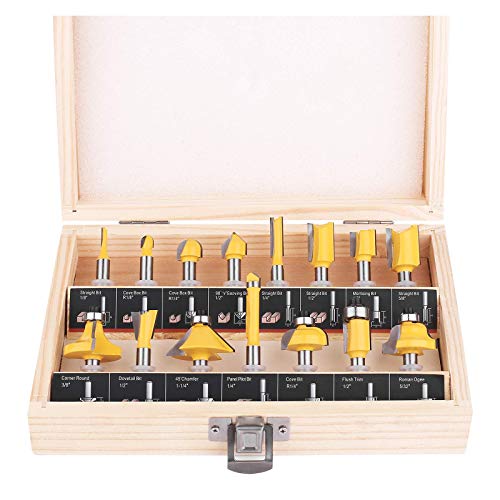
KOWOOD Router Bits Set of 15 Pieces 1/4 Inch Woodwork Tools for Beginners


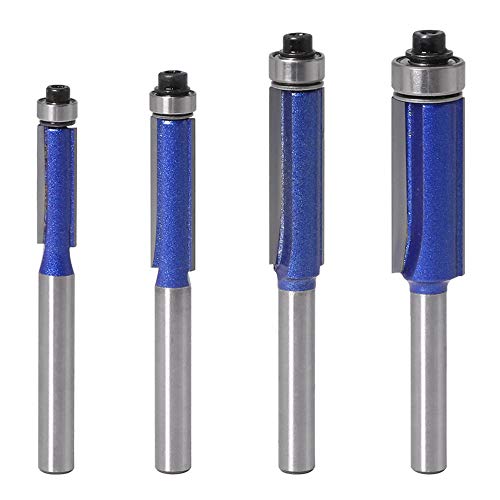
Wolfride 4PCS Flush Trim Router Bit Set 1/4 Inch Shank Top Bearing Flush Trim Router Bit

Three projects that reveal a set’s character
A cutting board sounds humble and audits a set thoroughly. The juice groove calls for a round-nose or core-box bit run at a steady feed inside a template or against a fence, the edges ask for a mid roundover, and the end grain exposes any tendency to tear at exit corners. A set that produces a board needing only light sanding has passed a genuine examination. A small wall cabinet raises the stakes: straights for the dadoes, a rabbeting bit with the right bearing for the back recess, a flush-trim pass to level face-frame parts, and a restrained ogee or chamfer on the door. Between them those two projects touch nearly every core family in a typical set, which is why teachers of routing often assign versions of both.
The third revealing project is a run of identical parts, six drawer boxes or a set of matching shelves, because repetition exposes consistency. Bearings that warm and wander, edges that dull mid-run, or a profile whose depth drifts as the collet warms all announce themselves by the fourth identical piece. Owner reports about sets frequently trace back to a batch project of exactly this kind, where the difference between a satisfying afternoon and a frustrating one was not the profile list but the behaviour of two bearings and one straight bit across an hour of continuous work. Buyers reading such reports should note which specific cutters drew praise or blame, since a set is only ever the sum of its most-used members.
Keeping perspective: the router matters too
No set outperforms the machine spinning it. A router with a worn collet, a sloppy depth lock, or a base that rocks on its casting will make excellent bits look ordinary, and a precise compact router will flatter a modest set. Before condemning a new set for chatter or inconsistent depth, the methodical owner checks the collet for scoring, confirms the depth mechanism holds under load, and runs the same bit in a second machine if one can be borrowed. That order of suspicion, machine first and cutter second, saves money and reputations in workshops everywhere, and it closes the loop with the runout discussion at the start of this guide: accuracy is a chain, and the set is one strong link among several.
A short glossary for first-time set buyers
A few terms recur in set listings and reward a plain definition. The arris is the sharp corner where two faces of a board meet, and breaking an arris means softening it with a small chamfer or roundover. A shoulder is the flat step a profile leaves beside its curve, controlled on bearing-guided bits by the bearing diameter. Chip load describes how much material each cutting edge removes per revolution, the hidden variable behind feed-rate advice. A fence is any straight guide the work or router registers against, while a template is a shaped guide the bearing follows. Shear angle describes edges ground at an angle to the axis, slicing fibres rather than chopping them, which is why shear-ground cutters leave cleaner surfaces in difficult grain. None of these terms is exotic, yet listings assume all of them, and a buyer fluent in the vocabulary reads a contents list the way a joiner reads a cutting list, seeing the finished work inside the flat description.
That fluency also protects against the oldest confusion in this corner of woodworking, the shared word router itself. The bits in this guide belong to a spinning woodworking machine and have nothing to do with networking hardware, a mix-up that genuinely occurs when households search for accessories by name alone. A quarter-inch shank, a carbide profile, and a guide bearing belong to the workshop; anyone who arrived here while equipping a network can take the vocabulary above as a souvenir and the knowledge that their search term lives a double life.
One last habit ties the vocabulary to the bench: dry-reading a new profile before it spins. Hold the cutter beside the edge it will shape, trace the bearing’s path with a fingertip, and picture where the shoulder will fall and where the cut will exit. That ten-second rehearsal, applied to an unfamiliar ogee or a first rabbeting setup, prevents the classic beginner error of presenting the wrong face of the board to the cutter, an error no carbide grade can undo. Experienced woodworkers perform the same rehearsal automatically, which is part of why their first cuts look deliberate; the set simply waits, indifferent and ready, for the hands to learn what the eyes have already understood about each profile in the case.
The rehearsal habit has a quieter companion: listening during the first seconds of any cut with a bit that has been stored a while. A bearing that sat through a damp season sometimes announces stiffness as a faint ticking before it warms and frees, and catching that sound at the start of a shallow first pass is far cheaper than discovering a seized bearing halfway along a finished edge. A drop of light oil, worked in by hand before the bit is chucked, usually settles the matter and returns the cutter to silent service.
Certain links on this page are affiliate links. Following one and later making a purchase may earn the publisher a commission, at no added cost to the reader, and that possibility plays no part in how the profiles, materials, or safety points in this guide were selected or ordered. The standards described here come from manufacturer documentation, published speed charts, and recurring patterns in reports from working woodworkers, and they can be applied to any set on any shelf, whether or not a link here points toward it.
Choose the set whose core profiles match the furniture already forming in your mind, and its steel will still be earning its place on the bench long after the box it arrived in has been forgotten.