What's inside
- Where to Buy
- Key Takeaways
- Quick Picks
- How We Chose These Picks
- Comparison
- How to Choose a Backyard Bird Feeder Camera
- Where Should a Feeder Camera Sit for Sun and Birds at Once?
- Do Feeder Cameras Disturb the Birds They Film?
- How Much Footage Will You Actually Watch?
- Common Mistakes When Buying a Feeder Camera
- Final Recommendation
- Frequently Asked Questions
- Related Guides
As an Amazon Associate I earn from qualifying purchases. This post may contain affiliate links at no extra cost to you.
widgetverdict.com is reader-supported. When you buy through links on our site, we may earn an affiliate commission.
Where to Buy
A feeder camera lives or dies by its listing page, because colour, panel size and box contents differ between near-identical models. The red HEAPETS Smart Bird Feeder page is where you can check price on Amazon for the 2K solar model. Shoppers drawn to sharper clips should open the Kiwibit Smart Bird Feeder 4K listing and confirm its current Amazon price there. The metal-bodied Humbirdy 4K Smart Bird Feeder carries its own figure on its product page, as does the BirdSnap Smart Bird Feeder with its 3W panel. For the Birdbuddy Pro Solar, Amazon shows the delivered cost on the listing itself. Finally, the NETVUE Birdfy Smart Feeder page displays the price for the classic solar version described below.
The best backyard bird cameras all solve the same small heartbreak: the interesting visitor always lands while you are indoors, at work, or looking the other way. A camera bolted to the feeder itself removes luck from the arrangement. It watches the perch all day, recognises motion the moment a bird commits to landing, and sends the evidence to a phone before the bird has finished its first seed. Choosing among the six feeders in this guide is therefore less about whether the idea works — it plainly does — and more about which version of the idea fits a particular garden, a particular roofline of shade, and a particular appetite for reviewing footage.
Every pick here is a solar-powered feeder camera, so the real axes of comparison are narrower and more useful than marketing suggests. Video resolution divides the set into a 2K group and a 4K group, and that division decides how confidently a small, fast, brown bird can be named from a clip. Artificial intelligence identification appears in every title, yet the cost of using it after the trial period is stated clearly by only some makers. Slow-motion playback, night behaviour, Wi-Fi band support and the physical build of the feeder — plastic shell or durable metal — complete the genuine differences. This guide keeps its feet on those stated facts and marks everything else as a documentation check.
A garden is an unforgiving test bench. Rain drives sideways into seams, squirrels treat every feeder as a puzzle with a food prize, and a panel that faces the wrong way slowly starves the battery through a grey week. The reviews below therefore spend as much time on placement, power and weather as on pixels. A feeder camera that records glorious footage for nine days and then goes dark has failed at its only job, which is to be watching on the tenth day, and the eleventh, without being carried indoors for charging like a household gadget.
Key Takeaways
- Resolution splits the six into two camps: HEAPETS, BirdSnap, Birdbuddy and Birdfy record 2K video, while Kiwibit and Humbirdy step up to 4K, with Kiwibit adding 8MP still photographs.
- Lifetime-free bird identification is printed outright in only two titles — Birdfy promises lifetime bird ID free and free cloud storage, and Humbirdy declares no subscription — the other four leave ongoing identification costs unstated.
- Slow motion is a stated feature for Kiwibit and for Humbirdy, which quantifies it at 10x, making both better suited to wingbeats and squabbles than the rest of the set.
- Solar hardware is described most precisely by BirdSnap, whose title names a 3W solar panel and an IP65 weather-resistant build, and by Birdbuddy, which instead details its 1/2.7-inch sensor and high dynamic range.
- Wi-Fi details vary in a way that matters to modern homes: Humbirdy supports both 2.4G and 5G bands, whereas BirdSnap states 2.4GHz only, so router placement deserves thought before ordering either.
Quick Picks
| Pick | Badge | Why it earns a place |
|---|---|---|
| HEAPETS Smart Bird Feeder 2K | The welcoming gift pick | 2K video, AI identification, arrival alerts and a weatherproof red feeder that suits a first camera feeder. |
| Kiwibit Smart Bird Feeder 4K | Sharpest stated detail | 4K live stream, 8MP photographs and slow-motion video for naming small visitors with confidence. |
| Humbirdy 4K Smart Bird Feeder | No-subscription metal build | 4K video, 10x slow motion, dual-band Wi-Fi and a durable metal body with no subscription declared. |
| BirdSnap Smart Bird Feeder 2K | Free recognition, named panel | Free AI bird recognition, a specified 3W solar panel, IP65 resistance and night vision at 2K. |
| Birdbuddy Pro Solar | Low-light sensor story | 2K video with HDR and a 1/2.7-inch sensor described as strong in low light, plus 5MP photographs. |
| NETVUE Birdfy Smart Feeder 2K | Lifetime identification included | Lifetime bird ID free, free cloud storage, two-way audio and automatic recording with notifications. |
How We Chose These Picks
Feeder cameras were admitted only when the listing described a complete watching system: a feeder, a camera, a solar supply and an identification service in one product. Standalone garden cameras that merely point at a feeder were excluded, because the perch-level viewpoint is the entire charm and scientific value of this category. A bird photographed from across the lawn is a bird at a distance; a bird photographed from eight inches away, filling the frame with feather detail, is a portrait, and the two experiences retain owners very differently.
Identification claims received the closest reading. Every title in this set mentions AI recognition in some wording, so the discriminating question became what happens after the box is opened: does the maker print a lifetime or no-subscription promise in the headline itself, or does the headline stay silent? Silence is not evidence of a charge, and this guide never treats it as such, but a printed promise is evidence of no charge for that feature, and buyers who dislike subscriptions are entitled to weight printed promises heavily.
Power arrangements were checked third. Each of these feeders pairs a battery with a solar panel, yet panel wattage is printed by only one maker, and battery capacity by none of them. Where a title gave a figure, the review uses it; where it did not, the spec box says so plainly and the prose discusses placement instead — the one power variable every owner controls regardless of hardware. A panel in genuine sun forgives a modest battery, and a panel under a dripping eave defeats a generous one.
Finally, the set was balanced across resolutions and body materials so that the comparison stays instructive. Two 4K models, four 2K models, one metal feeder among moulded shells, one model with two-way audio, one with a stated ingress rating: the spread lets a reader locate the trade they actually care about rather than choosing between six copies of the same feeder wearing different logos.
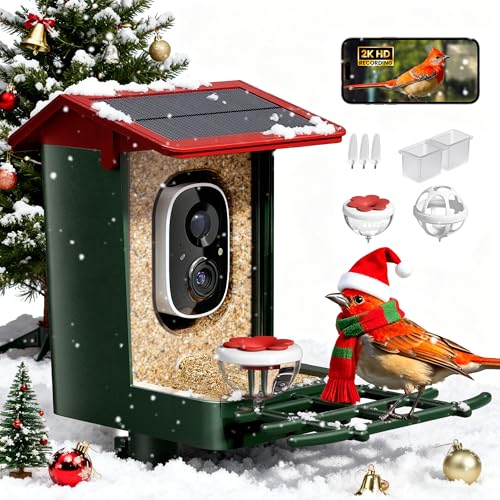
HEAPETS Smart Bird Feeder 2K — The welcoming gift pick
HEAPETS builds its pitch around immediacy. The title promises 2K HD video, AI bird identification and instant arrival alerts, wrapped in a weatherproof feeder finished in red, and pitched openly as a gift for bird lovers. That framing is honest about where this model sits: it is the feeder camera a family buys first, or gives to a parent whose garden already hosts a loyal crowd of regulars, and its job is to make the first week delightful rather than to win a specification contest against the 4K models below.
Arrival alerts deserve more respect than spec sheets give them. A feeder camera generates far more footage than anyone watches, and the difference between a gadget that fades into neglect and one that becomes a household ritual is the quality of its interruptions. An alert that arrives while the bird is still feeding turns a phone buzz into a small event — children summoned, binoculars abandoned, a live view opened in time to watch the visitor choose its seed. HEAPETS puts that alert in its headline, which suggests the maker understands the product is really a notification with a feeder attached.
The red finish is not a trivial detail either. Birds habituate to a feeder’s colour within days, so the colour is for the humans: a red feeder reads as a deliberate garden ornament rather than a piece of surveillance hardware, and for a gift purchase that distinction carries weight. Weatherproofing is claimed in general terms, without a numbered rating, so the spec box records the claim as stated and leaves the rating as a documentation item. Owners in exposed gardens should mount this feeder where a fence or shrub breaks the worst of the driving rain, a precaution that costs nothing.
Easy setup completes the title’s promises, and in this category setup has two halves: the physical mounting, which any of these feeders handles in an afternoon, and the digital pairing, which depends on garden Wi-Fi reach. HEAPETS states no Wi-Fi band in its title, so a buyer whose router sits far from the feeder should be ready to test signal at the mounting post before drilling anything permanent. None of this diminishes the model’s role here. As an entry into feeder watching with 2K clarity and alerts that respect your attention, it is coherently designed.
- Video: 2K HD Video
- Identification: AI Bird ID
- Alerts: Instant Arrival Alerts
- Power: Solar Powered
- Build: Weatherproof Design, Red finish
- Setup: Easy Setup (as stated in the listing title)
- Wi-Fi band: Not stated in the listing title — verify with the manufacturer documentation
- Ingress rating number: Not stated in the listing title — verify with the manufacturer documentation
Strengths
- Arrival alerts are named in the title, putting live watching ahead of archive digging.
- 2K video is ample for identifying the medium and large birds that dominate most feeders.
- The red weatherproof feeder presents as garden ornament, suiting its stated gift role.
Trade-offs
- Its 2K ceiling gives up the fine feather detail the two 4K models in this guide can resolve.
- No subscription terms for identification are printed, so ongoing costs need checking.
- No numbered weather rating appears in the title for exposed, unsheltered gardens.
Best for: a household buying its first feeder camera, or giving one, where instant alerts and a cheerful red feeder matter more than maximum resolution. Not suited for: a birdwatcher determined to separate near-identical small species from clips alone, because the 2K video stated here resolves less fine detail than the 4K Kiwibit and Humbirdy models.
Think about seed as casting. A feeder camera films whoever the menu attracts, and HEAPETS’ alert system means the cast announces itself in real time. Mixed seed draws a mixed crowd; a single-seed experiment — sunflower hearts for a fortnight, then nyjer — turns the feeder into a slow, pleasant survey of which neighbours prefer what, with the camera keeping the attendance register. Owners who treat the feeder as a small field station rather than a novelty tend to keep it filled, mounted and watched for years.
Placement advice specific to this model: because its weatherproofing is described without a number, give it the sheltered side of the post and a clear southern aspect for the panel if your garden allows both. Those two choices, made once with a ladder in hand, decide more of this feeder’s working life than any setting buried in its app.

Kiwibit Smart Bird Feeder 4K — Sharpest stated detail
Kiwibit’s model — the title calls it the Smart Bird Feeder with Camera 2 Mini — makes the strongest detail claim in this set: a 4K live stream, 8MP photographs and slow-motion video, alongside AI species identification. For the birdwatcher whose garden hosts the difficult cases, the warblers and finches whose names turn on a wing bar or an eye ring, that extra resolution is not vanity. Identification from footage is an evidence problem, and 4K frames simply hold more evidence per landing than 2K frames do.
Slow motion is the second half of the argument, and it is rarer in this category than it should be. So much feeder behaviour happens in bursts — the flick of a tail, the hierarchy settled in one sharp peck, the take-off that reveals a flash of colour hidden at rest. Played back slowly, those instants become readable, and for younger watchers they become the most replayed clips in the house. Kiwibit states slow motion without a multiplier; Humbirdy below prints 10x. Both claims put behaviour, not just presence, at the centre of the product.
The 8MP still photograph figure also deserves its place in the headline. Many owners discover that the images they keep, print and send to relatives are stills rather than clips, and a feeder that treats the photograph as a first-class output serves that habit. A sharp still of a cardinal in falling snow, pulled from a feeder eight inches away, competes with photographs taken through lenses costing far more, because proximity is the great leveller in bird photography and the feeder supplies it for free.
What the title does not print is equally instructive. No subscription language appears, so the long-term cost of the AI identification is a question for the product page and documentation rather than an assumption in either direction. No panel wattage and no ingress number are stated either. Kiwibit is therefore the detail specialist of this guide: buy it for what its camera resolves, verify its running arrangements with the same care you would give any connected device, and site its panel as thoughtfully as the rest.
- Video: 4K Live Stream
- Still photographs: 8MP Photos
- Playback: Slow-Motion Video
- Identification: AI Bird Species Identification
- Power: Solar Powered
- Form: Smart Bird Feeder with Camera 2 Mini
- Subscription terms: Not stated in the listing title — verify with the manufacturer documentation
- Solar panel wattage: Not stated in the listing title — verify with the manufacturer documentation
Strengths
- 4K stream plus 8MP stills give this feeder the strongest stated detail for hard identifications.
- Slow-motion playback turns wingbeats, disputes and take-offs into readable behaviour.
- Species identification is named in full in the title, matching the detail-led design.
Trade-offs
- Ongoing identification costs are not addressed in the title and must be checked before purchase.
- No numbered weather resistance figure is printed for very exposed mounting positions.
- Its headline omits two-way audio, so talking to the feeder is not part of this listing.
Best for: a detail-focused watcher whose garden attracts small, similar species that 2K footage leaves ambiguous, and who values slow-motion behaviour clips. Not suited for: a purchase that requires identification costs settled in the headline itself, because this title prints no lifetime or no-subscription promise of the kind Birdfy and Humbirdy state.
A practical habit multiplies the value of a 4K feeder: keep a simple log. Date, weather, species the app proposes, and your own confidence beside it. Within a season the log teaches you which identifications to trust instantly and which to double-check against a field guide, and the slow-motion clips become your appeals court for the disputed ones. The camera supplies the evidence; the log turns evidence into knowledge, and knowledge is what keeps a watcher watching after the novelty of the first month has passed.
Kiwibit’s resolution also changes how a feeder should be positioned. Fine detail survives only when the subject is well lit, so a 4K camera under a permanently shaded eave wastes part of its advantage. Give this model the brightest perch in the garden that still keeps birds comfortable, and its sensor will repay the decision every clear morning.

Humbirdy 4K Smart Bird Feeder — No-subscription metal build
Humbirdy attacks the two anxieties that follow feeder cameras home: what it costs to keep, and how long the feeder itself survives. The title answers the first in two words — No Subscription — and the second with a durable metal body. Between those poles it stacks a 4K ultra HD video feed with live view, 10x slow motion, AI identification and both 2.4G and 5G Wi-Fi. Read whole, this is the specification of a feeder designed by someone who had read the complaints left under other feeders.
The dual-band Wi-Fi point sounds technical and is actually domestic. Many gardens sit at the edge of a home network, where the longer-reaching 2.4G band is the reliable one, while newer routers and mesh systems prefer to steer devices onto 5G. A feeder that speaks both bands removes a whole category of pairing frustration, and removes it permanently rather than until the next router upgrade. For a device that must stay connected through winters and router replacements, that flexibility is a genuine longevity feature, arguably worth more than a small increment of resolution.
Metal construction addresses the garden’s true engineers: squirrels. A determined squirrel treats thin plastic as a timetable rather than an obstacle, and raccoon visits test hinges and lids harder still. A metal feeder will not defeat every animal, and this guide will not pretend otherwise, but it changes the economics of persistence for both sides — the feeder survives seasons that retire moulded shells, and its camera keeps its perch through the attempts. Combined with solar power, the design points toward years of unattended service.
The 10x slow-motion figure, printed as a number rather than a vague promise, suits the same practical character. Ten times slower turns a half-second squabble over the perch into a five-second sequence a child can narrate. Humbirdy’s headline leaves panel wattage and a numbered ingress rating unstated, so those checks belong in the documentation, yet on the questions buyers ask most — will it keep charging me, will it survive, will it connect — this listing answers in its own title.
- Video: 4K Ultra HD Video with Live View
- Subscription: No Subscription (as stated in the listing title)
- Slow motion: 10x Slow Motion
- Identification: AI Smart Bird Feeder with Camera
- Wi-Fi: 2.4G/5G Wi-Fi
- Build: Durable Metal
- Power: Solar Powered
- Solar panel wattage: Not stated in the listing title — verify with the manufacturer documentation
Strengths
- No-subscription wording in the title settles the running-cost question at the headline.
- Durable metal body stands up to squirrel attention better than a moulded shell can.
- Dual-band Wi-Fi and a quantified 10x slow motion round out a practical specification.
Trade-offs
- Panel wattage is unstated, so heavily shaded gardens cannot judge its charging margin from the title.
- No numbered ingress rating is printed despite the outdoor, all-season role.
- The metal build that aids durability also makes this a heavier feeder to mount high.
Best for: an owner who refuses ongoing subscriptions and wants a metal feeder, dual-band Wi-Fi and 4K video in one purchase built to stay outdoors for years. Not suited for: a renter mounting a feeder on a lightweight bracket or branch, because the durable metal body stated here carries more weight than the moulded feeders in this set.
Owners of metal feeders learn one seasonal chore: check the seed tray after hard frosts and heavy rain, because metal sheds water differently from plastic and a damp corner can cake seed against an edge. A minute with a dry cloth during the weekly refill keeps the buffet fresh and the footage worth watching. It is a small price in attention for a feeder whose structure should outlast several generations of the birds it films.
Humbirdy’s live view deserves a mention for a use its makers may not have intended: weather watching. A 4K eye fixed on the garden shows the first snow settling, the storm arriving, the fox crossing at dusk on his way elsewhere. The feeder becomes the household’s window that is always open, and many owners report the live view, checked idly with morning coffee, is the feature they would surrender last.

BirdSnap Smart Bird Feeder 2K — Free recognition, named panel
BirdSnap distinguishes itself with specificity where rivals deal in adjectives. Its title names a 3W solar panel — the only wattage printed anywhere in this guide — an IP65 weather-resistant rating, free AI bird recognition, 2K live video, 2.4GHz Wi-Fi and night vision. A buyer can reason about this feeder from its headline alone: how hard its panel works, how much weather its seals are rated to shrug off, and what its identification costs. That habit of printing numbers is itself a recommendation.
The IP65 figure translates into garden language as protection against dust and water jets, which is the weather a feeder actually meets: wind-driven rain, a hose swung carelessly, the drip line under a gutter. Ratings do not make a feeder immortal, and seals age, but a stated rating gives an owner a fair basis for mounting this model in a more exposed position than an unrated rival — on the open post at the lawn’s edge where the light is best and the birds feel safest, rather than tucked apologetically under cover.
Free AI recognition, printed plainly, removes the subscription question for the identification feature, and the 2.4GHz Wi-Fi choice aligns with it: 2.4GHz is the band that reaches gardens, travelling farther through walls and wet foliage than 5G does. BirdSnap has plainly optimised for the long, unglamorous haul — a feeder that stays powered, stays sealed and stays connected at the far end of a real garden, recording 2K footage of whatever the seed attracts. Night vision completes the brief by extending the watch past dusk, when feeders host a different cast entirely.
That night cast deserves a sentence of its own. Moths, bats passing through the frame, the occasional nocturnal mammal investigating fallen seed — a feeder camera with night vision documents the garden’s second shift, and for many households those grainy, surprising clips become favourites. BirdSnap is the only model here whose title claims night capability outright, and for a watcher whose curiosity runs after dark, that single line may outweigh a resolution step elsewhere.
- Video: 2K Live Video
- Identification: Free AI Bird Recognition
- Solar panel: 3W Solar Panel
- Weather resistance: IP65 Weather Resistant
- Wi-Fi: 2.4GHz Wi-Fi
- Night capability: Night Vision
- Power: Solar Powered
- Slow motion: Not stated in the listing title — verify with the manufacturer documentation
Strengths
- The 3W panel is the only stated panel wattage in this guide, making power planning concrete.
- An IP65 rating gives exposed mounting positions a printed basis rather than a hope.
- Free recognition and night vision extend value across both cost and hours of the day.
Trade-offs
- Resolution stops at 2K, behind the 4K pair, for the finest feather-level distinctions.
- Wi-Fi is 2.4GHz only, so homes that have retired that band need a workaround.
- No slow-motion feature is claimed in the title for behaviour playback.
Best for: a watcher with an exposed, sunny mounting post who wants a stated panel size, a numbered weather rating and free identification without a subscription question. Not suited for: a detail-first identifier choosing between feeders purely on clip resolution, because this model’s stated 2K video sits below the 4K stream of the Kiwibit and Humbirdy listings.
BirdSnap’s printed figures invite a more deliberate installation than most feeders receive, and it rewards one. Measure the panel’s sun honestly across a day before fixing the bracket; a post that is sunny at breakfast and shaded from noon onward will run the battery down through a dull week no matter what the wattage says. With sun confirmed and the IP65 seals trusted, this is the feeder to place boldly in the open, where flight paths are unobstructed and the camera sees birds arriving rather than merely arriving already.
The night vision suggests a second experiment: leave a small amount of seed at dusk for a week and review what the darkness brings. Gardens keep secrets from their owners for years; a rated, watchful feeder at the lawn’s edge is how those secrets finally get told.

Birdbuddy Pro Solar — Low-light sensor story
Birdbuddy approaches the feeder camera from the sensor outward. Its title specifies a 1/2.7-inch sensor with excellent low-light performance, high dynamic range, 2K video, 5MP photographs and AI identification, in a solar-powered Pro feeder. That is the vocabulary of camera design rather than gadget marketing, and it signals the model’s bet: that the quality of light at a feeder — dawn glare, deep shade under a hedge, the flat grey of a winter afternoon — decides more photographs than raw resolution does.
High dynamic range is the feature that earns its keep at the two best bird hours. Early and late in the day, a feeder scene contains bright sky behind dark plumage, and a camera without HDR must choose which to render honestly. HDR holds both: the sky stays a sky and the bird stays a bird, with feather detail surviving in the shadowed side of the frame. Birdwatchers, who plan their watching around exactly those difficult hours, will recognise HDR as the specification written for them rather than for a showroom.
The low-light claim pairs with it naturally. Much feeder traffic happens in the first hour after dawn, when overnight hunger outweighs caution and the garden’s shyest species visit before the day gets loud. A sensor described for low light, in a feeder that never sleeps because the sun tops up its battery, is positioned to record the visits other feeders render as murk. The 5MP still figure sits below Kiwibit’s 8MP, yet a clean, well-exposed 5MP frame from good light management often prints better than a noisy larger one, and Birdbuddy’s whole design argues that exposure is where quality begins.
What the headline omits should be noted with the same fairness applied elsewhere: no subscription terms, no panel wattage, no ingress number and no slow-motion claim are printed. Birdbuddy’s case rests on image quality in difficult light, stated in unusually concrete sensor terms. Buyers whose gardens are bright and open may not need that specialisation; buyers whose feeder hangs in hedge shade, under trees, in the long twilight of northern winters, are exactly who it was written for.
- Video: 2K Video
- Sensor: 1/2.7-inch sensor with excellent low-light performance
- Dynamic range: High Dynamic Range (HDR)
- Still photographs: 5MP Photos
- Identification: AI Bird ID
- Power: Solar (Birdbuddy Pro Solar)
- Subscription terms: Not stated in the listing title — verify with the manufacturer documentation
- Solar panel wattage: Not stated in the listing title — verify with the manufacturer documentation
Strengths
- A named 1/2.7-inch sensor with a low-light description targets dawn and shade honestly.
- HDR addresses the bright-sky, dark-bird exposure problem at the best watching hours.
- Solar power in the Pro model removes routine indoor charging from ownership.
Trade-offs
- Still resolution of 5MP trails the 8MP figure printed by the Kiwibit listing.
- No subscription position is stated in the title, leaving running costs to be confirmed.
- Neither slow motion nor a numbered weather rating appears in its headline.
Best for: a watcher whose feeder sits in shade or far-north twilight, where the stated low-light sensor and HDR matter more than a 4K badge. Not suited for: large printed still photographs as the main output, because the 5MP figure stated here is the smallest still claim among the feeders that print one.
Birdbuddy rewards an owner who thinks like a photographer about the feeder’s micro-location. A metre left or right along a hedge changes the background behind the perch from bright sky to dark foliage, and HDR performs its best work against the harder of those backgrounds. Spend an afternoon watching where the light falls at the hours birds feed most, then mount the feeder to exploit it. The sensor’s talents are real, but they multiply when the scene is arranged to need them.
There is also a community habit around this brand’s feeders — shared clips, identification discussions, seasonal comparisons — that suits watchers who enjoy company in the hobby. A feeder camera can be a solitary pleasure; it can also be the start of conversations with neighbours who received the same dawn visitor an hour later, garden by garden down the street.

NETVUE Birdfy Smart Feeder 2K — Lifetime identification included
NETVUE’s Birdfy writes the most generous headline in this guide. Lifetime bird ID free, free cloud storage, solar power, automatic recording with notifications, two-way audio and a 2K camera, gathered into the Birdfy Classic feeder. Where other makers leave the ownership economics to be discovered, Birdfy prints them as the lead argument: buy the feeder once, and the identification and storage that make it useful will not keep billing you for the privilege.
Free cloud storage changes behaviour in a way that is easy to underestimate. When clips live in the cloud at no cost, owners keep them — the whole season, the odd visitor, the fledging sequence — instead of rationing a card and overwriting last month’s wonders. The feeder becomes an archive of the garden’s year, searchable by the identification the same service supplies for free. For a household that wants to look back and ask when the first swift returned, or whether the robin in November is the robin from March, that archive is the product, and Birdfy gives it away in the headline.
Two-way audio is Birdfy’s other singular claim here, and it invites a more playful relationship with the feeder. An owner can greet the garden from the office, call a child to the window by speaking through the feeder when something rare lands, or simply listen — the microphone half of two-way audio is arguably the richer gift, bringing the dawn chorus and the rustle of wings into the house at feeder distance. No other title in this set mentions audio at all, which makes Birdfy the choice for watchers who want to hear the garden as well as see it.
Automatic recording with notifications completes a design philosophy of removing friction: the sun powers it, the cloud stores for it, the identification names things for free, and the owner is summoned only when something has actually happened. The headline leaves panel wattage, ingress rating and slow motion unstated, and resolution is 2K rather than 4K. Buyers choose Birdfy not for the sharpest frame in this guide but for the most completely waived set of ongoing costs and chores — a feeder that asks almost nothing and keeps a generous record.
- Video: 2K Camera
- Identification: Lifetime Bird ID Free
- Storage: Free Cloud Storage
- Audio: 2-Way Audio
- Recording: Auto Record & Notification
- Power: Solar Powered
- Model line: Birdfy Classic (NETVUE by Birdfy)
- Ingress rating number: Not stated in the listing title — verify with the manufacturer documentation
Strengths
- Lifetime free identification plus free cloud storage remove both recurring costs entirely.
- Two-way audio is unique in this set, adding listening and speaking to watching.
- Automatic recording with notifications keeps the owner’s role to enjoying arrivals.
Trade-offs
- 2K resolution concedes fine detail to the 4K Kiwibit and Humbirdy models.
- No slow-motion playback is claimed for wingbeat and behaviour study.
- Panel wattage is unstated, so shaded-garden charging margins need a documentation check.
Best for: a household that wants the archive without the bills — lifetime identification, free cloud storage and two-way audio wrapped around a solar 2K feeder. Not suited for: a watcher building a slow-motion behaviour library of feeder disputes and take-offs, because this title claims no slow-motion feature at all.
Birdfy’s free archive encourages a project that costs nothing and deepens every year: the garden list. Start it the week the feeder goes up, add each newly identified species with its date, and let the cloud clips serve as the evidence drawer. By the second spring the list has become a small natural history of one address, and comparing arrival dates across years turns casual watching into genuine phenology — the science of seasonal timing — conducted from a kitchen table.
The two-way audio also suggests a kindness worth practising sparingly:use the speaker to alert the household, not to startle the birds. A feeder’s value depends on its visitors trusting the perch, and a voice used rarely, gently, and never at a nervous newcomer keeps that trust intact while still letting a grandparent across the country say good morning to the garden.
Comparison
| Feeder | Video stated | Identification cost in title | Distinguishing stated feature |
|---|---|---|---|
| HEAPETS Smart Bird Feeder | 2K HD | Not stated in the listing title | Instant arrival alerts; red weatherproof feeder |
| Kiwibit Smart Bird Feeder 2 Mini | 4K | Not stated in the listing title | 8MP photos; slow-motion video |
| Humbirdy Smart Bird Feeder | 4K Ultra HD | No Subscription | Durable metal body; 2.4G/5G Wi-Fi; 10x slow motion |
| BirdSnap Smart Bird Feeder | 2K | Free AI Bird Recognition | 3W solar panel; IP65; night vision |
| Birdbuddy Pro Solar | 2K | Not stated in the listing title | 1/2.7-inch low-light sensor; HDR; 5MP photos |
| NETVUE Birdfy Classic | 2K | Lifetime Bird ID Free | Free cloud storage; 2-way audio |
How to Choose a Backyard Bird Feeder Camera
Begin with the identification ledger, because it is the cost that repeats. Two listings in this guide print their position in the headline — Birdfy with lifetime identification free, Humbirdy with no subscription — and BirdSnap prints free recognition. The remaining three are silent in their titles, which means their arrangements must be read on the product page or in the documentation before money moves. Neither silence nor a printed promise should be assumed to cover every premium feature an app offers, so read what each promise actually names.
Resolution comes second, and it should be matched to your birds rather than your ambitions. Gardens dominated by robins, blackbirds, pigeons and other large, distinctive visitors surrender their names happily to 2K footage. Gardens on a migration route, or feeders that attract flocks of small finches and warblers, generate the hard cases where the 4K models earn their place. Photographs follow the same logic: 8MP stills from the Kiwibit crop and print more generously than 5MP stills from the Birdbuddy, while the Birdbuddy counters with sensor behaviour in poor light that a bright-garden buyer may never need.
Then walk the garden with the sun in mind. Every feeder here is solar, but solar is a location before it is a specification. Stand at the intended post at several hours of the day and be honest about shade. BirdSnap’s stated 3W panel gives the keenest planner something concrete to work with; the others ask for placement faith. A feeder that must live in genuine shade is a feeder whose battery will need occasional human help regardless of brand, and it is kinder to choose the mounting spot first and the model second.
Finally, decide what kind of watcher you are. The listener chooses Birdfy and its two-way audio. The behaviour student chooses a slow-motion model. The exposed-garden realist chooses the rated IP65 build. The shade-garden photographer chooses the low-light sensor. Each of the six is the right answer to a different honest question, which is why this guide ranks none of them first overall.
Where Should a Feeder Camera Sit for Sun and Birds at Once?
The two needs pull in opposite directions more often than catalogues admit. Birds prefer a feeder near cover — a hedge or shrub within a short flight — so they can retreat when a hawk’s shadow crosses, while a solar panel prefers open sky. The workable compromise is a post at the edge of cover rather than inside it: close enough to the hedge that a nervous finch feels the escape route behind it, open enough overhead that the panel sees the sky for the middle hours of the day.
Height matters to both parties. A feeder around head height deters most ground predators, gives the camera a pleasing, level view of the perch, and keeps refilling a step-stool job rather than a ladder expedition. Face the camera’s perch toward the light where you can, so morning sun models the birds instead of silhouetting them, and keep the panel’s own orientation independent of the feeder’s facing if the design allows it — the birds care about the perch, the battery cares about the panel, and a good installation satisfies both separately.
Do Feeder Cameras Disturb the Birds They Film?
A well-sited feeder camera is among the least disturbing observation tools ever devised, because the observer is absent. Birds habituate to the feeder’s shape and colour within days — the perch becomes furniture — and the camera asks nothing of them at all: no hide, no human silhouette, no held breath. The footage that results, of relaxed birds feeding, preening and squabbling naturally, is precisely the behaviour that field observation struggles to witness at close range.
The courtesies are few and simple. Keep voices through two-way speakers rare and gentle, refill feeders at a consistent, calm time of day, and clean the feeder regularly, since a camera that draws birds to one dining spot concentrates the hygiene duty that all communal feeding carries. Owners who follow those habits find the camera changes their own behaviour more than the birds’: they watch more, intervene less, and learn the garden’s cast as individuals rather than as species.
How Much Footage Will You Actually Watch?
Less than you record, by design, and the feeders differ in how gracefully they handle that arithmetic. Notification-led models such as the HEAPETS and the Birdfy summon you for arrivals and let the rest pass into storage, which suits owners who want the garden’s highlights without a reviewing hobby. Birdfy’s free cloud storage makes that passivity generous — nothing need be deleted in a hurry — while owners of the other models should establish a weekly rhythm of skimming, saving the keepers and clearing space before the card or trial fills.
One more calibration concerns the feeder itself rather than the camera watching it. Port size and perch length decide which species can feed comfortably and which merely snatch and flee, and the camera will faithfully document a badly matched feeder as a parade of brief, nervous visits. Watch the first week’s footage for birds that land, look, and leave without eating; that pattern usually indicts the perch or the seed, not the garden. Adjust one variable at a time — a different seed, a tray added beneath, the feeder raised a hand’s breadth — and let the next week’s clips judge the change. This slow, evidence-led tinkering is where a camera feeder quietly outperforms a plain one: a plain feeder’s failures leave no record, while a camera feeder shows you exactly which visitors struggled, at what hour, and after which adjustment they finally settled in to feed at leisure like residents rather than burglars.
Treat the first fortnight as calibration. Every garden has a false-alarm signature — a swaying branch, a neighbour’s cat on a schedule, sparrows in such numbers that each landing is technically an event — and alert sensitivity exists to be tuned against it. Watch more than usual for those two weeks, adjust until the notifications mean something again, and the feeder settles into its proper role: a quiet colleague who taps your shoulder only when the garden has done something worth seeing.
Common Mistakes When Buying a Feeder Camera
Mounting first and measuring light later is the error that haunts this category. A feeder fixed to the prettiest post in permanent shade will fade through its first grey week and be judged a failure by an owner who never gave its panel a chance. Every model here is solar; every solar model is a sun instrument. Walk the site at different hours before the bracket is drilled, and let the sun, not the view from the kitchen window, have the casting vote on position.
Assuming identification is free forever, because the box says AI in large letters, is the second trap. In this guide the makers who guarantee it print the guarantee in the title itself. Where the title is silent, the arrangement may still be fair — but it must be read, not presumed, and the time to read it is before the feeder is mounted and the household is attached to its alerts. The same discipline applies to cloud storage, which only Birdfy promises free in its headline.
A third mistake is filling a new feeder with the cheapest seed mix and concluding the garden has no interesting birds. Camera feeders reveal the cast that the menu selects. Husks and filler attract a narrow, messy crowd; sunflower hearts, peanuts and nyjer in their proper feeders widen the cast dramatically, and the camera will document the difference within days. Budget for seed as part of the system, and clean the tray as faithfully as you would a bird table, because the camera concentrates diners in one place.
Finally, do not judge a feeder camera by its first rainy week. Batteries arrive partly charged, panels meet their worst light, birds take days to trust a new object, and apps demand tuning. The feeders in this guide are seasonal instruments; their honest trial is a month of weather, habituation and adjustment. Owners who grant that month are rewarded with the settled, watchful routine the category promises. Owners who demand perfection by Friday usually own a cupboard of abandoned gadgets instead.
Final Recommendation
For most gardens the decision narrows to temperament. Choose the Humbirdy if subscriptions offend you and your squirrels are ambitious, the Birdfy if you want the archive and the audio with every ongoing cost waived in writing, the Kiwibit if your visitors are small and difficult and you intend to name them all, the BirdSnap if your post stands in open weather and you like your specifications printed as numbers, the Birdbuddy if your feeder lives in shade and difficult light, and the HEAPETS if this is a first feeder or a gift and the alerts matter most. Whichever lands on your post, give it sun, give it good seed, and give it a month — then check your phone on a grey Tuesday and find a goldfinch looking back at you from eight inches away, and the whole arrangement will explain itself.
Frequently Asked Questions
Is 2K footage enough to identify birds at a feeder?
For the large and distinctive species that dominate most gardens, yes — 2K frames name robins, blackbirds and woodpeckers without strain. The 4K models earn their advantage on small, similar species, where a wing bar or eye ring visible in a sharper frame settles an argument that 2K leaves open.
Which feeders here promise free identification in their titles?
Birdfy prints lifetime bird ID free, Humbirdy declares no subscription, and BirdSnap states free AI bird recognition. The HEAPETS, Kiwibit and Birdbuddy titles are silent on ongoing cost, so their arrangements should be confirmed on the product page before purchase.
Can a solar feeder camera run through winter?
It can, provided the panel receives real daylight and the battery starts the dark months healthy. Short days and low sun reduce charging for every model here, which is why panel placement matters more in November than in June, and why a mid-winter top-up charge is prudent rather than a sign of failure.
What does two-way audio add to a bird feeder?
On the Birdfy, the only model here whose title claims it, you can listen to the garden at feeder distance — wing rustle, seed cracking, the dawn chorus — and speak through the feeder, which most owners use to summon family to a screen rather than to address the birds themselves.
Do these feeders work at night?
BirdSnap states night vision outright in its title. The other listings do not claim a night feature in their headlines, so after-dark capability for those models is a documentation check rather than an assumption.
Related Guides
Three neighbouring guides extend the watching habit beyond the feeder post. When the visitors you care about never touch a feeder at all, the best trail cameras for bird watching, placed at baths and flight lines covers the woodland approach. Birders who carry their watching with them should read the best lightweight cameras for birding, from pocket zooms to the heavy flagship, and those ready to trade the garden for the far shore will find their instruments in the best super zoom point and shoot cameras for birding, ranked by stated reach.
Related guides
- Best 1080 Webcams: Six Full HD Cameras Judged on Light, Focus and Voice
- Best 16 MP Camera Phones: Why the Number Stopped Mattering
- Best Thermal Imaging Cameras Hunting: Six Handheld Thermal Monoculars for Night Observation
- Best Mirrorless Cameras for Bird Photography: Crop Reach, Fast Bursts and the Lens Question Answered First


