What's inside
- Key Takeaways
- Quick Picks
- How We Chose These Picks
- What Walls Can Actually Hold a Fold-Down Desk?
- How Much Surface Do You Get When It Folds Down?
- How Do You Handle Power and Cables on a Desk That Folds?
- What Chair and Lighting Does a Wall Desk Need?
- The Six Wall Desks, Reviewed One by One
- Where Else in the Home Does a Wall Desk Earn Its Keep?
- Wall Desk or Floating Shelf Desk — What Is the Difference?
- How Do the Six Compare Side by Side?
- How Do You Install a Wall Desk So It Stays Installed?
- How Do Hinges, Struts and Locks Age, and What Maintenance Do They Want?
- How Should You Test a Wall Desk in Its First Fortnight?
- What Are the Most Common Mistakes When Buying a Wall-Mounted Desk?
- What Does a Wall Desk Do to a Room’s Feel and Value?
- How Do You Choose Between a Cabinet Desk and a Bracket Table?
- What Tools and Skills Does Installation Honestly Require?
- Can a Wall Desk Work for Two People or for Children Sharing?
- What Should You Do With the Wall Space Around the Desk?
- How Does a Wall Desk Handle Standing Work and Other Heights?
- What Is the Sensible Budget Logic for a Wall Desk?
- How Quietly Does a Wall Desk Live in a Room at Night?
- Final Recommendation
- Frequently Asked Questions
- Related Guides
As an Amazon Associate I earn from qualifying purchases. This post may contain affiliate links at no extra cost to you.
widgetverdict.com is reader-supported. When you buy through links on our site, we may earn an affiliate commission.
Where to buy: each of the six wall desks below links to its Amazon listing from the Quick Picks table and from its review heading, so you can study the mounting diagrams and dimension drawings on the listing itself. Do that before ordering — and while you are there, check the listing’s fixing requirements against the wall you actually own, because a wall-mounted desk is the one purchase where the building is part of the product.
The best wall mounted desks make a trade no freestanding desk can offer: they give you a real work surface that costs zero floor space. Folded away, a wall desk is a shallow cabinet, a shelf, or a panel an inch or two deep. Folded down, it is a desk. For the flat where the office must vanish before dinner, the spare room that is also a guest room, the hallway wide enough for ambition but not for furniture, that disappearing act is not a gimmick — it is the difference between having a workspace and not having one.
The six designs below split into two families. The cabinet family — YUSING, HOMCOM, ARROWSTONE and GYHPD — hides the folded desk inside a wall unit with storage, so the closed desk still earns its wall as shelving and cupboard space. The table family — GOYLSER and TEAMIX — is a hinged top on brackets, simpler, larger in some cases, and honest about being a surface that folds rather than a cupboard that transforms. Both families live or die on the same unglamorous foundation: the wall, the fixings, and the honesty of the person installing them.
That foundation deserves emphasis before any product is praised. A wall-mounted desk holds your laptop, your arms and your leaning weight on a hinge attached to a wall. On a stud wall or solid masonry with the right fixings, that is a sound arrangement used by workshops for generations. On a hollow partition with the wrong plugs, it is a slow accident. Every review below is written on the assumption that the installation is done properly, and the guide returns to installation repeatedly, because with this category the mounting is not a detail — it is the product.
Key Takeaways
- A wall desk costs zero floor space; folded, the cabinet models are only a few inches deep.
- The ARROWSTONE SKEENA arrives pre-assembled and adds a VESA monitor mount to the fold-down format.
- The GYHPD uses dual gas struts and a lockable design, and its listing states a 200 lb capacity.
- The GOYLSER is the big-surface pick at 47 inches long, aimed at laundry rooms and kitchens as much as offices.
- Cabinet models (YUSING, HOMCOM) keep storage on the wall even when the desk is folded away.
- Fixings decide everything: mount into studs or solid masonry, never into plasterboard alone.
Quick Picks
| Pick | Badge | Why it earns its place |
|---|---|---|
| YUSING Wall Mounted Table | Best storage cabinet desk | A fold-down laptop desk with storage compartments that stays useful as a wall unit when closed. |
| HOMCOM Foldable Desk Wall Mounted Convertible Table | Best Murphy-style unit | A white wall cabinet with bookshelf and hidden storage that converts into a study desk. |
| ARROWSTONE Ample.Space SKEENA Wall-Mounted Desk | Best pre-assembled | Arrives pre-assembled with storage and a VESA monitor mount in a space-saving Murphy design. |
| GOYLSER Wall Mounted Folding Table | Best big folding surface | A 47-inch rustic brown fold-down top for offices, laundry rooms and kitchens alike. |
| GYHPD 31 Inch Wall Mounted Folding Desk | Best engineered fold | Dual gas struts, a monitor mount and a lockable design in a compact 31-inch unit. |
| TEAMIX Wall Mounted Folding Table | Best simple drop-leaf | A black floating desk on heavy-duty brackets, with no cabinet machinery to complicate the wall. |
How We Chose These Picks
We began with the fold. A wall desk is operated daily, often one-handed, often with a laptop waiting in the other arm, so the folding mechanism’s character — struts, hinges, locks, the weight of the top itself — decides whether the desk is a pleasure or a chore. Models that described their mechanism in concrete terms (gas struts, lockable designs, heavy-duty brackets) earned attention; vague promises did not.
Storage was the second lens, because the wall a desk occupies is wall that shelves could have used. The cabinet family answers by building the storage into the unit, so closing the desk does not waste the wall. The table family answers by being so shallow when folded that the wall barely notices. Both are legitimate; the reviews say which answer each pick gives, and the comparison table keeps them honest side by side.
Third, we weighed installation burden. One pick arrives pre-assembled, which in this category is a significant mercy: the hardest joinery is done in a factory, and the buyer’s job reduces to the wall fixings themselves. Others arrive as kits whose assembly is part of the project. Neither is disqualifying, but the difference belongs in the open.
Finally, we respected the listings’ own claims and repeated only those. Where a listing states a capacity, we report it as the listing’s statement. Where it does not, we talk about construction and fixing quality rather than inventing numbers, because a load figure guessed by a guide is worse than none.
What Walls Can Actually Hold a Fold-Down Desk?
Three wall types cover most homes, and they are not equal. Solid masonry — brick, block, concrete — is the forgiving host: drill, plug, and bolt, and the wall will hold the desk and a leaning adult’s forearms without complaint. Timber stud walls are equally sound provided the brackets land on the studs themselves; the studs are the structure, and a stud finder is therefore the most important tool in this entire category. The desk’s mounting rail or brackets should be laid out against the stud positions before a single hole is drilled, even if that means the desk sits a few inches from your first-choice spot.
Hollow plasterboard on its own is the host to refuse. Board alone cannot carry the leverage of a loaded fold-down top; the fixings will worry loose over weeks of folding until the desk sags or worse. If the only available wall is a partition, the honest options are to span multiple studs with a mounting board fixed through to them, or to choose a freestanding or folding-leg desk instead. Metal stud partitions deserve the same caution doubled.
Renters face a permissions question layered over the physics: wall desks leave holes that must be filled, and a cabinet unit leaves several. That is usually a deposit conversation rather than a prohibition, but have it before the drill comes out, not after.
How Much Surface Do You Get When It Folds Down?
Less than a freestanding desk of the same headline width, and planning around that truth prevents disappointment. The cabinet models trade depth for their storage: the fold-down leaf must fit inside or against the cabinet, so the working depth suits a laptop, a notebook and a lamp rather than a monitor on a stand — unless, like the ARROWSTONE, the design mounts the monitor to the wall unit itself and frees the leaf entirely. The table models, GOYLSER especially, give back depth and length because no cabinet constrains them; the GOYLSER’s 47-inch top is a genuine workbench-class surface when down.
Think in sessions. A wall desk is at its best hosting a defined session — laptop work, homework, sewing, a craft project, a folding station in the laundry — after which the surface clears and folds. It is at its worst as a permanent command centre with three devices living on it, because a fold-down desk that can never fold is just a shallow desk with a hinge. Buy it for the session-based life and it excels; buy it to imitate a fixed office and the fixed office wins.
How Do You Handle Power and Cables on a Desk That Folds?
A folding desk punishes lazy cabling twice: once when a cable snags the fold, and again when the desk cannot close because a charger brick lives on the leaf. The working arrangement is a single power strip fixed to the wall beneath or beside the unit, at a height the folded desk clears, with device chargers plugged into it permanently. The laptop’s own cable runs from the strip to the leaf with a loop of slack at the hinge line — enough to fold without strain, never enough to dangle into the mechanism.
Cabinet models hide this arrangement best, since the strip can live inside the unit’s shadow. Bracket tables leave it visible, which argues for a tidy single bundle clipped along the wall rather than a spray of individual cables. Wireless peripherals earn their keep here more than at any fixed desk: every cable you remove is a fold that closes cleanly. Make “the desk folds flat with everything plugged in” your acceptance test on installation day, and adjust the slack until it passes.
What Chair and Lighting Does a Wall Desk Need?
The chair problem is storage wearing a disguise. A wall desk frees the floor, and then a conventional office chair moves in and occupies it permanently, quietly cancelling the purchase. The honest pairings are a folding chair that hangs on a hook, a stool that slides under a bed or into a cupboard, or — in rooms where the desk folds but the chair can stay — a compact chair that tucks fully beneath the leaf’s folded position without blocking the wall. Decide the chair’s home before mounting the desk, because the pair is the workstation, not the desk alone.
Lighting wants the same foresight. A lamp cannot live on a leaf that folds, so the light must mount to the wall, clamp to the unit, or stand on the floor beside it. Wall-mounted swing-arm lamps above cabinet desks are the classic solution; a slim picture-light style bar over a bracket table works surprisingly well. Plan the light’s position while the drill is already out, and the desk will be usable on winter evenings rather than merely present.
The Six Wall Desks, Reviewed One by One
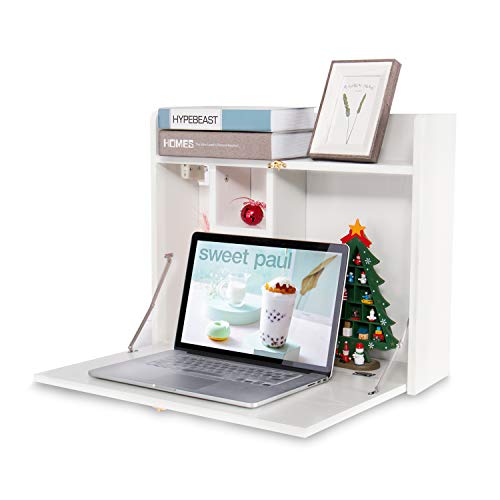
YUSING Wall Mounted Table — Best storage cabinet desk
The YUSING is the classic wall-cabinet desk executed plainly: a white wall unit whose lower section folds down into a laptop desk, with storage compartments in the unit that remain accessible and useful whether the desk is open or closed. That last point is the design’s intelligence. A wall desk occupies prime vertical territory, and the YUSING pays rent on it every hour of the day — as shelving and compartment storage when shut, as a workstation when open — instead of only during working sessions.
The format suits the laptop-and-notebook worker precisely: the leaf hosts the machine and the pad, the compartments take the chargers, stationery and the small library a study corner accumulates, and the whole office folds into a tidy white box when guests use the room. Homework supervision, household admin, a sewing session — the desk’s session-based rhythm fits them all, and its unobtrusive finish lets it live on a bedroom or living-room wall without arguing with the furniture.
Its limits are the cabinet family’s own: the leaf is sized for laptops rather than monitor rigs, and the unit asks for a proper wall fixing job with several anchor points. Buyers wanting a screen should look at the ARROWSTONE or GYHPD, whose mounts solve the display question inside the format.
- Format: wall cabinet with fold-down leaf
- Storage: compartments in the unit
- Finish: white
- Aimed at: laptop work in home and office corners
Strengths
- Storage works around the clock, open or folded.
- Closes into a tidy, unobtrusive wall unit.
- Suits laptop sessions in shared rooms perfectly.
Trade-offs
- Leaf depth is laptop-scale, not monitor-rig scale.
- Several wall fixings to install and, one day, to fill.
- No built-in monitor solution in the unit.
One underappreciated virtue of the cabinet format shows up at resale and moving time in reverse: the YUSING’s compartments mean the desk leaves with its contents organised rather than scattered, and the unit itself, unbolted and patched over, leaves a wall that forgets it within an hour of filling. For a product category defined by commitment to one wall, it is a graceful guest.
Best for: a laptop worker in a shared room who wants the office to fold into a cupboard. Not suited for: a permanent monitor setup, which needs a fixed desk or a mount-equipped unit.

HOMCOM Foldable Desk Wall Mounted Convertible Table — Best Murphy-style unit
HOMCOM calls this a Murphy desk, borrowing the name from the bed that folds into a wall, and the borrowing is apt: the white unit presents as a bookshelf cabinet, stores books and craft materials in the open, hides a further layer of storage, and converts into a study desk when the session begins. Of the cabinet models here, it leans hardest into being furniture first — the piece a spare room can wear proudly even in a household that rarely folds the desk down at all.
That furniture-first character suits the guest-room office better than any other pick: visitors see a bookcase, residents get a desk, and the conversion between the two takes a minute rather than a furniture move. The hidden storage earns a mention for households with paperwork or craft supplies that should not be on permanent display — the unit keeps secrets as well as books.
The costs are footprint on the wall and the assembly-and-mounting project a full cabinet entails. This is the largest wall commitment in the guide, and it should be made where the desk will live for years. Renters on short leases and the commitment-shy should look at the TEAMIX’s simpler brackets instead.
- Format: wall cabinet, Murphy-style conversion
- Storage: bookshelf plus hidden storage
- Finish: white
- Aimed at: small study spaces and spare rooms
Strengths
- Reads as a bookcase, works as a desk, stores in both states.
- Hidden storage swallows the unsightly essentials.
- Ideal guest-room double agent among these picks.
Trade-offs
- The largest wall commitment in the roundup.
- Assembly plus mounting is a half-day project.
- Furniture presence dominates a small wall.
The HOMCOM also suits crafters more than its study-desk framing suggests: sewing kit, sketching materials and homework archives all live naturally in a bookcase with hidden storage, and the fold-down leaf is a cutting and layout surface that clears itself by closing. A spare room that hosts hobbies as well as guests gets three uses from one wall, which is the strongest argument furniture in a small home can make.
Best for: a spare room that must be a bookcase for guests and an office for you. Not suited for: short-lease renters, who will fill more holes than the desk is worth to them.

ARROWSTONE Ample.Space SKEENA Wall-Mounted Desk — Best pre-assembled
Two words on the SKEENA’s listing do heavy lifting: pre-assembled. Wall desks are joinery before they are furniture, and the SKEENA arrives with that joinery done — the buyer’s project shrinks to positioning and fixing the unit to the wall, which is the part that should consume your care anyway. Inside the Murphy-style folding design sit storage and the feature that separates this pick from the whole category: a VESA monitor mount, which lets a screen live in the unit permanently while the leaf below it folds.
The monitor mount changes what a wall desk can be. Every other cabinet model asks the display question awkwardly — laptop only, or a monitor ferried in per session. The SKEENA answers it structurally: mount the screen once, fold the leaf up beneath it at night, and the workstation is a wall panel; fold the leaf down in the morning and the screen is already at eye height, with the leaf free for keyboard and notebook. For a genuine daily home office in a room that cannot spare the floor, this is the most complete answer in the guide.
The discipline it asks is the usual one, doubled: a unit carrying a monitor concentrates weight and leverage on its fixings, so studs or masonry, proper anchors, and a level installation are non-negotiable. Do that work once, carefully, and the SKEENA repays it every single day.
- Format: folding Murphy-style unit
- Assembly: pre-assembled
- Display: VESA monitor mount built in
- Storage: included in the unit
Strengths
- Pre-assembled: the factory did the hard joinery.
- VESA mount makes a permanent screen possible in a folding desk.
- Storage and desk share one shallow wall footprint.
Trade-offs
- Monitor weight makes fixing quality absolutely critical.
- Heavier unit to position during installation — bring a helper.
- Commits you to the mounted-screen layout it designs around.
Think about the morning ritual the SKEENA creates: walk in, lower the leaf, wake the screen that never left its mount, sit down. No laptop ferrying, no monitor balancing, no setup tax between intention and work. Rituals that short are what separate a home office that gets used daily from one that gets used eventually, and no other pick in this guide removes as much friction from the start of the working day.
Best for: a daily home worker with a monitor and no floor to spare. Not suited for: a plasterboard partition wall, or anyone unwilling to find the studs first.

GOYLSER Wall Mounted Folding Table — Best big folding surface
The GOYLSER abandons the cabinet idea entirely and sells length instead: a fold-down top forty-seven inches long in a rustic brown finish, pitched by its own listing at offices, laundry rooms and kitchens with equal seriousness. That pitch is the insight. A long folding surface is not only a desk — it is a laundry folding station that becomes a sorting table, a kitchen overflow counter that becomes a baking bench, a hallway worktop that becomes a wrapping station in December. The cabinet desks are offices in disguise; the GOYLSER is a surface for hire by any room that needs one temporarily.
As an office desk it offers the most generous top in this guide, wide enough for a laptop, a lamp and paperwork side by side, or for two children doing homework in shifts of one. The rustic finish suits utility rooms and farmhouse kitchens better than corporate corners, and there is no storage beyond what you place on it — when it folds, everything must leave, which disciplines the session-based use this format wants.
Brackets carry the whole story here, so installation quality is the review’s recurring footnote: a 47-inch lever full of laundry baskets or textbooks asks its fixings real questions. Into studs or masonry, with the brackets level, it is a workhorse. Into board alone, it is a countdown.
- Format: fold-down table on brackets
- Length: 47 inches
- Finish: rustic brown
- Aimed at: office, laundry room and kitchen duty
Strengths
- The longest working surface in the guide when down.
- Genuinely multi-room: laundry, kitchen and office in one purchase.
- Simple format with nothing to assemble beyond the mounting.
Trade-offs
- No storage; everything clears off before folding.
- Long top multiplies leverage on the wall fixings.
- Rustic finish will not suit every office corner.
In the laundry room specifically, the GOYLSER solves the folding problem that gives the room its name: clothes fold on a surface at standing height, then the surface itself folds and the room breathes again. Households that have folded laundry on a bed for years underestimate the upgrade until the first week, after which the bed is forgiven and the table is permanent.
Best for: a utility-minded household wanting one big surface that appears on demand. Not suited for: a user who needs the desk’s contents to stay in place between sessions.

GYHPD 31 Inch Wall Mounted Folding Desk with Storage & Monitor Mount — Best engineered fold
The GYHPD is the engineer’s entry in a category of carpenters. Its fold runs on dual gas struts — the same damped hardware that lifts a car boot — so the 31-inch top lowers and raises with control instead of gravity’s opinion, and the design locks, which matters in households with children, pets or earthquakes of enthusiasm. Storage rides in the unit, a monitor mount is built in, and the listing states a 200 lb capacity for the desk, a figure we report as the manufacturer’s own claim and a sign of the bracket engineering underneath.
Gas struts change the daily feel of a wall desk more than any other feature here. A top that floats down and lifts with a finger is a top you will fold away every evening; a top that drops and heaves is one you will leave down until the desk becomes permanent furniture with a guilty conscience. In a compact 31-inch format, the GYHPD packs the SKEENA’s monitor idea into a smaller, more mechanical package suited to single-room living.
The compactness is also the limit: thirty-one inches is a one-person, one-screen workstation, and the struts and locks are moving parts that deserve respect rather than slamming. For the solo worker in a studio or a bedroom corner, it is arguably the most considered design in this guide.
- Format: folding unit, 31 inches
- Mechanism: dual gas struts, lockable
- Capacity: 200 lb as stated in the listing
- Display: monitor mount built in
- Storage: included in the unit
Strengths
- Gas-strut fold is controlled, quiet and one-hand friendly.
- Lockable design suits households with children.
- Monitor mount and storage in the smallest cabinet footprint here.
Trade-offs
- 31 inches caps the setup at one screen and one person.
- Struts are moving parts that reward gentle use.
- Engineering-led looks may feel technical in a soft room.
The lock deserves a second look from parents: a lockable fold means the desk can be secured shut with its contents inside, which turns the unit into a small strongroom for a laptop, documents and the household’s sharper craft tools. Few desks at any size offer to be a cupboard with a key; at thirty-one inches on a wall, it is a genuinely distinctive trick.
Best for: a solo worker in a studio flat who folds the office away nightly. Not suited for: a sprawling multi-device setup, which will burst a 31-inch leaf by Tuesday.

TEAMIX Wall Mounted Folding Table — Best simple drop-leaf
The TEAMIX strips the wall desk to its essence: a black drop-leaf top on heavy-duty brackets, floating on the wall, folding flat against it. No cabinet, no compartments, no transformation theatre — just a surface that exists when you lower it and nearly ceases to exist when you raise it. For a small space that needs an occasional desk rather than a daily office, that minimalism is the correct engineering: fewer parts, fewer fixings than a cabinet, and a folded profile slim enough for a hallway.
The black finish gives it a modern, deliberate look in home office corners and small bedrooms, and the heavy-duty brackets are the specification that matters — on a bracket table, the brackets are the product, and TEAMIX leads with them. Used as a laptop station, a study leaf for a child’s room, or a landing-spot desk for household admin, it performs the format’s core promise without charging you for storage you may not need.
Everything the cabinet models hold, this table does not: your session kit lives elsewhere and commutes to the leaf. Buyers who understand that and want the simplest possible wall desk will find the TEAMIX the easiest recommendation in this guide to live with.
- Format: drop-leaf table on brackets
- Brackets: heavy-duty, per the listing
- Finish: black
- Aimed at: small-space home office and study
Strengths
- The simplest installation story among the six.
- Folds to a genuinely slim wall profile.
- Heavy-duty brackets put strength where it counts.
Trade-offs
- No storage of any kind in the unit.
- Session kit must live elsewhere in the room.
- Plain format lacks the cabinet models’ closed-door tidiness.
The TEAMIX also wins the redecoration argument: when the room changes, two brackets unscrew and the wall is a wall again, with the table light enough to remount in the next room the same afternoon. Cabinet units move like furniture; this moves like a picture frame, and in homes that rearrange yearly, that difference compounds.
Best for: an occasional-desk household wanting the least machinery on the wall. Not suited for: a daily worker whose kit needs a permanent home inside the desk unit.
Where Else in the Home Does a Wall Desk Earn Its Keep?
The category’s imagination should not stop at the home office. In a child’s bedroom, a wall desk at the right height is a homework station that folds away before the room becomes a playroom, and its height can be re-set as the child grows by remounting — a trick no fixed desk can perform without new legs. In a kitchen, a bracket table under a window becomes the recipe-and-laptop counter that folds before the room’s real work begins. In a rental’s hallway, a TEAMIX-style leaf creates the admin desk — post, bills, the household’s paperwork hour — in a space that legally should not be able to hold a desk at all.
Workshops and garages deserve the final word, because the fold-down bench is their ancestral furniture: a surface for the project in hand, folded flat so the car still fits. The GOYLSER’s length and the TEAMIX’s bracket honesty translate directly. A category that serves the studio flat and the garage with the same mechanism has earned its place in the house’s permanent toolkit.
Wall Desk or Floating Shelf Desk — What Is the Difference?
A floating shelf desk — a fixed horizontal surface mounted to the wall — looks like a wall desk that never folds, and the resemblance is the trap. The fixed shelf is always ready and can be deeper, but it spends its floor space forever, chair included, and in a small room that permanence is the cost the folding desk exists to avoid. The folding desk pays for its disappearing act with depth, mechanism and the nightly ritual of clearing the leaf.
Choose by the room’s other life. If the room has no other life — a dedicated study, however small — the fixed shelf is simpler and sturdier for the same money. If the room must be a bedroom, a dining room or a hallway by turns, the fold is not a feature but the entire point, and every pick in this guide is built around honouring it.
How Do the Six Compare Side by Side?
| Desk | Format | Storage | Monitor solution | Signature trait |
|---|---|---|---|---|
| YUSING Wall Mounted Table | Cabinet with fold-down leaf | Compartments | Laptop on the leaf | Storage works open or closed |
| HOMCOM Convertible Table | Murphy-style cabinet | Bookshelf plus hidden storage | Laptop on the leaf | Furniture-first presence |
| ARROWSTONE SKEENA | Folding Murphy unit | In the unit | VESA mount built in | Pre-assembled |
| GOYLSER Folding Table | Bracket table, 47 in | None | Laptop on the top | Length and multi-room use |
| GYHPD 31 Inch Desk | Folding unit, 31 in | In the unit | Monitor mount built in | Gas struts, lockable |
| TEAMIX Folding Table | Drop-leaf on brackets | None | Laptop on the leaf | Simplicity and slim fold |
The table divides cleanly into cabinets and brackets. Cabinets cost more wall and more installation, and repay it with storage and, in two cases, a mounted screen. Brackets cost little of either and repay it with surface and simplicity. Decide which currency your room is rich in — wall or floor — before comparing within a family.
How Do You Install a Wall Desk So It Stays Installed?
Plan the position with the chair, not just the wall. Sit in the chair you will use, at the height you will use it, and mark where a desktop should meet your forearms; wall desks have one chance to get their height right, and that chance is before the holes. Check what lives inside the wall at that height — cables and pipes favour the cautious — with a detector, and find the studs or confirm the masonry across the whole fixing width.
Fix in the order the instructions give, level at every stage, and use the fixings the wall type demands: long screws into studs, proper masonry plugs and bolts into brick, and nothing at all into unsupported board. A mounting board screwed across two studs is the professional’s trick when bracket holes and stud positions refuse to align. When the desk is up, load it gradually — books before laptops, a day of light use before a leaning adult — and re-check the fixings after the first week, because new installations settle and the second tightening is the one that lasts.
How Do Hinges, Struts and Locks Age, and What Maintenance Do They Want?
A wall desk’s moving parts live a sheltered life compared with most hardware, and their maintenance is measured in minutes per year. Hinges want a visual check when you notice any new play in the leaf, and a drop of suitable lubricant if a squeak develops. Gas struts, like the GYHPD’s pair, announce their old age honestly by lifting less eagerly; until then they ask nothing. Locks and latches want the discipline of being used — a latch operated daily stays free, while one left for a year can stiffen.
The fixings deserve the same annual glance as the mechanism. Work each bracket’s bolts with a driver once a year and take up any fraction of slack; check the wall around the anchors for hairline cracks that would suggest movement; and re-level your expectations if the household’s use has grown heavier than the installation assumed. Five minutes a year is the entire maintenance contract, and it is the difference between a desk that serves a decade and one that sags in its third year.
How Should You Test a Wall Desk in Its First Fortnight?
Load it the way life will. Work full sessions at it in the first days, lean on the leaf while thinking the way you actually do, fold and unfold it twice daily even when once would do, and listen: new creaks at the brackets, a leaf that no longer sits level, a latch that needs a firmer hand. Then check the fixings at the fortnight mark and take up any slack while the installation is young — this second tightening, done once, is what separates the desk that serves for years from the one that develops a personality.
Also test the room’s verdict: fold the desk away and use the room for its other purpose, guests or dinner or a child’s floor game, and notice whether the transformation feels complete. A wall desk that leaves the room still feeling like an office has failed socially even if it succeeds mechanically, and the fix is usually storage discipline — the cabinet models exist precisely to absorb the evidence.
What Are the Most Common Mistakes When Buying a Wall-Mounted Desk?
The gravest mistake is fixing into plasterboard alone because the studs were inconveniently placed. The desk will feel solid for a fortnight and then begin its slow sag, usually discovered by a laptop. Move the desk to the studs, or add a mounting board, or choose another wall — those are the only three honest options.
The second mistake is mounting at standing-counter height because the tape measure was held carelessly, or at a height copied from a photograph. A wall desk cannot be shimmed later; measure from your seated elbow. Third, buyers forget the chair: a fold-down desk in a hallway still needs somewhere for the sitter’s legs and a chair to live nearby, or the desk hosts only standing tasks. Fourth, overloading the leaf with a permanent village of devices until folding becomes impossible — at which point the desk’s entire purpose has been quietly resigned.
What Does a Wall Desk Do to a Room’s Feel and Value?
A folded wall desk is one of the few pieces of office furniture that can make a small room feel larger in photographs and in person, because it returns the floor — the thing the eye measures a room by — to emptiness. Estate agents have understood this for years: a spare room that photographs as a bedroom with a tidy wall unit rents and sells differently from the same room photographed around a permanent desk. For owners, that is a pleasant side effect; for renters furnishing a room they will one day hand back, the fold-away office protects the room’s identity throughout the tenancy.
There is a subtler daily effect. A desk that must be unfolded to be used creates a threshold: work begins with an action and ends with one, and many home workers find that small ceremony genuinely helps the day have edges. The fixed desk is always half-inviting; the wall desk is either open for business or visibly closed, and households that struggle with work leaking into evenings often find the fold is the boundary they were missing.
How Do You Choose Between a Cabinet Desk and a Bracket Table?
Ask three questions in order. First, does a screen need to live in the unit? If yes, the choice narrows to the SKEENA or the GYHPD before any other consideration speaks. Second, does the session kit need a home inside the desk? If yes, cabinets win, because a bracket table with its kit stored elsewhere is a desk plus a commute. Third, how often will the surface fold? Daily folding favours the struts and light leaves; weekly folding forgives heavier cabinet doors; a surface that will fold twice a year should honestly be a fixed shelf instead, and no one in this guide will be offended.
Answer those three and the six picks sort themselves: the screen question picks two, the storage question picks two more, and the folding-frequency question decides between the GOYLSER’s length and the TEAMIX’s simplicity for everyone left over.
What Tools and Skills Does Installation Honestly Require?
Less than fear suggests and more than optimism hopes. The honest kit is a drill with bits for your wall type, a spirit level long enough to span the brackets, a stud finder for timber walls, a tape measure, a pencil, and a helper for the cabinet units. The honest skills are measuring twice, drilling straight, and stopping when a hole behaves strangely — a bit that meets unexpected resistance or sudden emptiness is information, and the correct response is to investigate rather than to push.
Budget an unhurried morning for a cabinet unit and an hour for a bracket table, including the tea break during which the unit hangs on its first fixings and you stand back to judge the height with fresh eyes. Rushing a wall installation is how desks end up level but wrong — level at a height your shoulders will litigate daily. The wall will hold your work for years; give the work the morning it deserves.
Can a Wall Desk Work for Two People or for Children Sharing?
Sequentially, yes, and the format has a hidden advantage for sharing: folding the desk between users enforces the reset that shared fixed desks never get. Each user’s session begins on a clear leaf, and the cabinet models let each person keep a compartment of their own — a fairer division of territory than most shared desks achieve. Simultaneously, no: a fold-down leaf is one person’s width of concentration, and two chairs at one leaf is a negotiation nobody wins.
For children sharing homework space in shifts, the bracket tables at a family height work well, and the lockable GYHPD adds the option of securing the unit between shifts. For couples alternating office days in a one-room flat, the cabinet desks with their ritual of opening and closing give each worker a beginning and an end to the day that a permanent desk cannot.
What Should You Do With the Wall Space Around the Desk?
A wall desk turns one patch of wall into a workstation, and the surrounding wall either joins the project or fights it. Above a cabinet unit, a shallow shelf or a pinboard extends the office vertically without touching the floor, and it should be mounted in the same session, while the drill and the level are out and the stud positions are known. Beside a bracket table, a hook rail for the folding chair and the bag completes the disappearing act: desk folded, chair hung, bag hooked, hallway innocent.
Resist decorating the fold zone itself. Anything hung where the leaf or the cabinet door travels will be met by it, daily, at hinge speed. Keep the swing area sacred, put the art on the neighbouring wall, and the installation will never have to argue with the interior design.
How Does a Wall Desk Handle Standing Work and Other Heights?
A wall desk is mounted at one height forever, which makes it a poor improviser and an excellent specialist. Mounted at seated height, it will never be a standing desk; mounted at standing height, it pairs with a tall stool for perching and serves standing sessions in kitchens and workshops beautifully. Households wanting both postures from one wall should be honest that this category gives them one, and choose the posture they use for the longer sessions.
The exception is the household that mounts two: a seated leaf in the bedroom corner and a standing leaf in the kitchen or utility room, each cheap in floor space, each perfect at its own height. It sounds extravagant until compared with a single height-adjustable desk, at which point two fixed leaves on two walls look like the pragmatic answer they are.
What Is the Sensible Budget Logic for a Wall Desk?
Price the whole installation, not the box. The honest total includes the desk, the fixings your wall demands, possibly a mounting board, a stud finder you may keep for life, a chair solution that stores away, and a lamp that does not need the leaf. Cabinet models bundle storage that a bracket table buyer may end up purchasing separately as shelving; bracket tables bundle nothing and therefore hide nothing. Compare totals, and the apparent price gap between the families narrows considerably.
Then price the alternative honestly: the floor space a fixed desk would occupy, valued at what rooms cost in your building. In a small flat, a square metre of floor is the most expensive furniture component in the entire comparison, and the wall desk is the only design that declines to buy it. That is the economic heart of the category, and it is why these six products exist.
How Quietly Does a Wall Desk Live in a Room at Night?
A small virtue, rarely listed: a folded wall desk makes no visual noise. It does not hold a dark monitor over the room, does not bristle with the day’s cables, does not reflect the television from a screen you forgot to sleep. In bedrooms especially, that silence matters — the office is not merely tidied but absent, and sleep comes easier in a room that is not half a workplace. The cabinet models with their furniture finishes complete the vanishing act; even the bracket tables, folded, read as a shelf line rather than as equipment. For anyone whose office shares a wall with their pillow, this nightly disappearance may be the feature that justifies the entire category.
Final Recommendation
For a daily home office with a screen and no floor to give, the ARROWSTONE SKEENA is the standout: pre-assembled, storage included, and the VESA mount that turns a folding leaf into a real workstation. The GYHPD is its compact, gas-strut rival for solo studio living. Households wanting storage and tidiness without a screen should take the YUSING; guest rooms should take the HOMCOM; and anyone whose need is simply a surface that appears on demand — in a laundry, a kitchen or a hallway — should take the GOYLSER for length or the TEAMIX for simplicity. Whatever you choose, spend your care on the wall and the fixings, because a wall desk is only ever as good as what it is screwed into — mounted honestly into structure, it will out-fold and out-last furniture three times its price.
Frequently Asked Questions
Can a wall-mounted desk hold a desktop monitor?
Only the designs built for it: the ARROWSTONE and GYHPD in this guide include monitor mounts that carry the screen on the unit itself. Putting a heavy monitor on a fold-down leaf is a different and worse idea — the leaf is a work surface, not a shelf, and its hinges will agree with that assessment over time.
What if my wall is plasterboard?
Find the studs behind it and fix into them, spanning them with a mounting board if the bracket spacing demands it. If the wall is a hollow partition with no accessible structure where the desk must go, choose a freestanding desk instead; no plug made for board alone should be trusted with a loaded, levered desk.
How high should I mount a fold-down desk?
At the height a normal desk surface meets your seated forearms — measure from your own chair, in your own posture, before drilling. Too high strains shoulders within the hour; too low rounds your back. The seated-elbow measurement, taken carefully, is the only number that matters.
Does a wall desk work in a child’s bedroom?
Yes, and it is one of the format’s happiest uses: a homework leaf that folds away before play, mounted at a height you can raise in a few years by remounting the unit higher on the same wall. Choose a lockable or latch-closed model for younger children, and keep the folded unit’s contents as child-safe as the room itself.
Can I install one alone?
The bracket tables, yes, with patience. The cabinet units are a two-person lift while fixings are started, both for safety and for levelling; the pre-assembled SKEENA especially rewards a second pair of hands. Budget the helper as part of the installation, not as an optional luxury.
How much weight can I put on a fold-down leaf while working?
Work within the listing’s own guidance for your model — the GYHPD, for instance, states a 200 lb capacity — and in all cases treat the leaf as a work surface for a laptop, books and your forearms, not as a seat, a step or a shelf for storage boxes. Sensible loads on sound fixings are the category’s home ground; heroics are not.
Will a wall desk damage my deposit in a rental?
It leaves fixing holes that need filling and painting at the end of the tenancy — a normal, repairable consequence, but one to raise with the landlord first. Keep the removed screws and a note of the paint colour, and the wall can be returned to innocence in an afternoon.
Related Guides
Best Desks for Triple Monitor Setups
Best L Shaped Computer Desks for Home Office


