What's inside
- Key Takeaways
- Quick Picks
- How did we choose these six chairs?
- What actually wears out first on a budget gaming chair?
- How wide is wide enough when you sit for hours?
- Which of these six fits your desk, your body and your games?
- How should you assemble and settle a new chair in its first week?
- Why does the base matter more than the brochure suggests?
- What should tall and short players check before anything else?
- How do you keep a PU chair looking decent for years?
- Which sitting style gains most from each design here?
- What does the warranty and returns picture look like at this level?
- How much assembly effort should you expect on delivery day?
- Does a gaming chair in this bracket suit work-from-home days too?
- When is it smarter to save longer instead of buying now?
- How does room temperature change the way these seats feel?
- What separates a good sample from a bad one in the same model?
- Should you add accessories to a chair in this class?
- How do you read a listing’s capacity figure sensibly?
- Comparison Table
- What mistakes do buyers in this price band keep repeating?
- Final Recommendation
- Frequently Asked Questions
- Related Guides
As an Amazon Associate I earn from qualifying purchases. This post may contain affiliate links at no extra cost to you.
widgetverdict.com is reader-supported. When you buy through links on our site, we may earn an affiliate commission.
Where to buy: every chair named below links out to its Amazon listing, where the colour options, the current stock position and the delivery estimate for your postcode are all shown before you commit to anything.
Hunting for the best computer gaming chairs under 200 dollars means accepting a compromise before you even open a listing, and this guide refuses to hide which compromise each model makes. Two hundred dollars is the ceiling where gaming chairs stop being toys and start being furniture, yet it is still not enough money to buy cold-cure foam, a metal five-star base and four-way armrests in the same box. Something always gives. On one chair the giveaway is thin polyurethane upholstery that will crack at the seams after a couple of summers. On another it is a nylon base that flexes under a heavier sitter. On a third the padding feels generous for a month and then packs down into a board.
So the useful question at this budget is not which chair claims the longest feature list. It is which chair spends its limited money on the parts you cannot easily replace: the steel frame inside the backrest, the gas lift cylinder, and the density of foam in the seat you will compress for thousands of hours. A headrest pillow costs almost nothing to swap later. A lumbar cushion can be upgraded for the price of a pizza. A bent frame or a sinking lift cannot be fixed at any sensible cost, and that is why this roundup grades the six chairs below on skeleton first and cosmetics second.
Three of the six are straightforward racing-style seats with pillows and tilt locks. One adds a slide-out footrest for players who lounge between matches. One leans on linked armrests that travel with the backrest when you recline. The last one is the plainest-looking of the set and, for a shared home office, possibly the easiest to live with. None of them is a bargain miracle. Each is a defensible way to spend a sub-200 budget, provided you walk in knowing exactly where its maker saved money.
Key Takeaways
- At this ceiling, a steel internal frame matters more than any pillow, badge or strip of contrast stitching.
- Expect polyurethane leather on nearly everything here; plan on conditioning it and keeping it out of direct sun.
- Footrests in this class are light-duty leg rests for cutscenes, not supports for your full body weight.
- Linked armrests move with the recline angle, which suits console-style leaning far better than fixed posts do.
- Measure your desk height before ordering, because seat-height ranges differ by several centimetres between these six.
- Foam described as high-density sponge is not the same as moulded cold-cure foam, and your thighs will learn the difference.
Quick Picks
| Pick | Badge | Why it earns a place |
|---|---|---|
| GTPLAYER Gaming Chair with Footrest | Best for lounging | Its retractable footrest and full recline turn a desk seat into a passable rest spot between ranked sessions. |
| Homall Gaming Chair White | Best proven design | Years on the market have ironed out its surprises, and the white finish brightens a small room like few rivals. |
| PayLessHere Gaming Chair | Best simple starter | A stripped-back racing seat that puts its money into the frame and lift rather than accessories you may never use. |
| BestOffice Gaming Chair | Best for smaller rooms | Compact proportions and a restrained shape make it the easiest of the six to squeeze beside a narrow desk. |
| HapGIFT Gaming Chair | Best linked armrests | Armrests tethered to the backrest stay under your elbows at every recline angle instead of abandoning them upright. |
| Auto Dynasty Gaming Chair | Best office crossover | Muted styling lets it pass as an executive desk chair on weekday calls and a gaming seat after hours. |
How did we choose these six chairs?
We started from the frame and worked outward. Any model whose listing could not confirm a metal internal frame or a recognisable class of gas lift was dropped, however handsome its product photography looked. From there we weighed seat construction: pocket springs and thicker sponge scored above thin foam stretched over plywood, because seat collapse is the complaint that ends more budget-chair ownerships than every other fault combined. Upholstery came next. All six finalists wear polyurethane leather, so we looked at how each maker handles seams, bolsters and the high-wear front edge of the cushion.
Adjustability was scored honestly rather than generously. A recline range printed in a listing means little if the tilt tension fights you or the lock only engages at two angles, so we favoured chairs whose mechanisms are described in plain mechanical terms. Armrest style mattered more than armrest count: fixed and linked designs both appear below, each labelled for the sitting style it actually serves. Finally, we checked that every model is a real, orderable product with a coherent listing, rather than a placeholder page borrowing photographs from a different chair entirely.
One more filter deserves stating plainly. Several chairs in this price band advertise extras — cup holders, speakers, Bluetooth, vibrating cushions — that consume budget better spent on the seat itself. We treated those features as neutral at best. A chair that reclines smoothly and supports a spine through a long evening beats a chair that plays music through its headrest while its foam dies young.
What actually wears out first on a budget gaming chair?
The upholstery usually fails before the mechanics. Polyurethane leather is a plastic skin bonded to a fabric backing, and the bond weakens with heat, sweat and the repeated flexing of getting in and out. The first signs are a network of fine cracks along the seat bolsters, followed by flaking where your belt or jeans rivets rub. You can slow this down: keep the chair away from radiators and sunny windows, wipe it with a damp cloth rather than solvents, and never use it as a step stool. You cannot stop it entirely, which is why this guide treats the cover as a consumable with a lifespan measured in years, not decades.
The gas lift is the second casualty. A lift that slowly sinks overnight has lost its seal, and the fix is a replacement cylinder rather than any adjustment trick. Chairs built on heavier cylinder classes tend to hold height longer, particularly under sitters near the top of the stated capacity. The third failure point is the tilt mechanism’s spring housing, which announces itself with a creak that deepens over months. Tightening the star knob under the seat changes tension, not the creak. Knowing this order of failures helps you read listings critically: a maker who talks about frame and lift construction is selling longevity, while a maker who talks only about colours is selling a photograph.
How wide is wide enough when you sit for hours?
Seat width is quoted between the bolsters, and bolsters are the part of a racing chair designed to hug. That hug feels supportive for a twenty-minute race and restrictive across a four-hour strategy session, because your thighs cannot spread and your posture cannot drift. If you are broad through the hips, or you sit cross-legged, or you simply fidget, favour the chairs below with flatter cushions and gentler bolsters. The tape-measure test is crude but effective: measure the width of the chair you currently sit in comfortably, then compare it with the internal width in each listing rather than the overall width, which includes armrests and tells you almost nothing.
Depth matters in the opposite direction. A seat pan that reaches the back of your knees cuts circulation and encourages slumping forward onto the front edge, where the foam is thinnest. Shorter sitters should look for cushions around the shallower end of this group or plan on a footrest under the desk so the seat edge carries less load. None of these six offers a sliding seat pan — that mechanism lives in a higher price class — so matching the fixed depth to your leg length is one of the few fit decisions you cannot correct afterwards.

GTPLAYER Gaming Chair with Footrest — Best for lounging
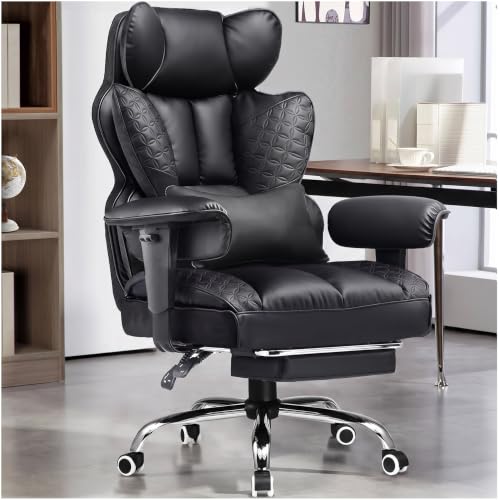
GTPLAYER builds this chair around a simple observation: many players do not sit upright for an entire evening. They queue, they watch a teammate’s stream, they lean back with a controller while a download finishes. The slide-out footrest answers that pattern directly. It pulls from beneath the seat on a metal rail, flips into position, and gives your calves somewhere to rest while the backrest reclines. Used that way, as a leg rest during low-intensity moments, it is genuinely pleasant. Used as a load-bearing extension you push against, it will remind you quickly that it was engineered for calves, not for climbing.
The seat itself is a wide, flat-ish cushion that suits sprawlers better than the deeply bucketed designs elsewhere in this roundup. Lumbar support arrives as a pillow you position yourself, paired with a headrest pillow on elastic straps. Pillows are the flexible option: they can be moved, removed or replaced, but they also wander during a session and need the occasional tug back into place. The 360-degree swivel is smooth, the height adjustment covers a sensible range for standard desks, and the recline runs deep enough for a between-matches slump without the chair feeling like it wants to tip.
- Frame: steel internal frame with a padded high back
- Upholstery: polyurethane leather over sponge padding
- Extras: retractable footrest, lumbar pillow, headrest pillow
- Movement: full swivel, height-adjustable lift, deep recline with lock
Strengths
- The footrest converts downtime into actual rest without dragging a separate ottoman into the room.
- A broad, comparatively flat cushion welcomes cross-legged sitting that bucket seats actively punish.
- Both support pillows detach in seconds when you want a cleaner, office-appropriate silhouette.
Trade-offs
- The footrest rail is the lightest-built component here and deserves gentle treatment every single time.
- Strap-mounted pillows migrate downward during long sessions and need periodic repositioning by hand.
- Its PU surface shares the cracking risk common to this whole class after extended heat exposure.
Best for: players whose evenings mix upright matches with laid-back spectating and video watching. Not suited for: anyone expecting the footrest to behave like a recliner’s solid leg support.
See the current listing for the GTPLAYER with footrest on Amazon to confirm which colourways are shipping this week.

Homall Gaming Chair White — Best proven design
Homall’s white racing chair has been on sale so long that its weaknesses are public knowledge, which is an odd kind of virtue in a market full of anonymous newcomers. The listing states a 300 lb capacity, a recline running from 90 to 155 degrees, a rocking function, and the familiar pairing of headrest and lumbar pillows. Nothing about the formula is novel. What you are buying is a known quantity: a high-back seat with firm bolsters, a linkage between seat and back that has survived years of daily use in dorm rooms and first apartments, and a white finish that makes a small gaming corner look larger instead of moodier.
The firmness deserves emphasis. This chair’s padding reads as supportive rather than plush, and lighter sitters sometimes describe the first week as sitting on the chair rather than in it. That character suits players who prefer an upright, braced posture for shooters and racing titles. It suits lounging less. The rocking mode helps, letting you lean against spring tension rather than locking a fixed angle, and the recline lever covers everything from desk posture to an almost-flat sprawl for watching a film.
- Capacity: manufacturer-stated 300 lb
- Recline: 90 to 155 degrees with a rocking function
- Upholstery: faux leather in a bright white finish
- Support: separate headrest pillow and lumbar pillow included
Strengths
- A long sales history means spare-part knowledge and assembly advice are easy to find online.
- The white shell resists the cave-like look that black racing chairs impose on small bedrooms.
- Firm bolsters hold a competitive posture steady during fast, twitchy gameplay sessions.
Trade-offs
- White polyurethane shows denim dye transfer and scuffs far sooner than darker finishes do.
- The cushion’s firmness can feel unforgiving to lighter players during the first weeks of use.
- Its armrests offer little of the adjustability that taller or broader sitters tend to want.
Best for: buyers who value a thoroughly documented design and a bright, clean gaming setup. Not suited for: players chasing a soft, sink-in cushion or a chair that hides marks gracefully.
Open the Homall listing on Amazon to check the white finish against the darker variants before deciding.

PayLessHere Gaming Chair — Best simple starter
The PayLessHere chair is what remains when you strip the racing formula to its essentials: a black PU leather shell, a high back, a lumbar support arrangement, height adjustment, a headrest, and armrests that do their job without theatrical padding. For a first gaming chair — the upgrade from a kitchen chair or a hand-me-down office seat — that restraint is the point. Every part of it is understandable at a glance, assembly is a one-person job with the included hardware, and there are no powered extras to fail or cables to route.
Its ergonomics rely on shape rather than mechanisms. The backrest is tall enough to support shoulders, the seat carries the standard contoured profile of the genre, and the recline and swivel cover everyday needs without promising extremes. Players who move between a desk and a console in the same room will appreciate how unremarkable it is to live with: it rolls, it turns, it leans, and it stays out of the way of the games. Where it cannot compete is in refinement. The padding is thinner than the GTPLAYER’s, the armrests are basic, and the whole chair communicates utility rather than occasion.
- Colour: black polyurethane leather racing shell
- Support: lumbar support plus a separate headrest
- Adjustment: height lift, recline, full swivel
- Armrests: padded fixed-style arms in the racing layout
Strengths
- Nothing on this chair is complicated, so nothing on it is complicated to maintain either.
- The all-black finish pairs with any desk, monitor arm or RGB habit without clashing.
- It makes a sensible first gaming chair for a teenager graduating from a dining chair.
Trade-offs
- Thinner seat padding shows its limits sooner during marathon weekend sessions.
- Basic armrests will not satisfy players who rest heavy forearms while aiming.
- The plain specification gives heavy daily users less long-term headroom than rivals here.
Best for: first-time gaming-chair buyers who want the essentials done competently. Not suited for: very heavy daily use or sitters who already know they need advanced adjustment.
Look over the PayLessHere chair on Amazon if a no-drama starter seat is what your setup needs.

BestOffice Gaming Chair — Best for smaller rooms
BestOffice sells this high-back chair in several colourways, and its enduring appeal is proportion. The footprint is modest, the backrest is tall without being enormous, and the whole thing reads as a desk chair that games rather than a racing seat that happens to be indoors. In a bedroom where the chair must also serve homework, video calls and the occasional guest, that dual identity is worth real money. The ergonomic shaping is conventional — lumbar padding built into the backrest’s curve, a headrest zone up top, and a seat that encourages an upright working posture.
Because it is aimed at both men and women working at ordinary desks, the fit range leans toward average builds. Very tall players will find the backrest’s top edge arriving at the shoulders rather than behind the head, and broad players will feel the bolsters sooner than on the wider cushions elsewhere in this guide. Within its intended range, though, it is a tidy piece of furniture: it swivels cleanly, rolls on casters suited to hard floors and low carpet, and its executive styling survives being seen on camera.
- Style: high-back racing-executive hybrid in multiple colours
- Fit: sized for average builds at standard desk heights
- Movement: swivel seat with rolling casters and recline
- Upholstery: faux leather over padded foam
Strengths
- Compact dimensions leave floor space for a PC tower, pedals or a second screen stand.
- The restrained look passes in a study or shared living room without explanation.
- Colour choice lets you match an existing setup instead of defaulting to black and red.
Trade-offs
- Tall players run out of backrest height and lose proper head support at full recline.
- Bolstered sides feel confining to anyone who sits with knees spread wide.
- Its foam is tuned for mixed work and play rather than eight-hour gaming blocks.
Best for: smaller rooms, shared spaces and average-sized players wanting one chair for everything. Not suited for: very tall or broad sitters, who should start with the wider seats in this roundup.
Browse the BestOffice listing on Amazon to compare its colourways against your room before ordering.

HapGIFT Gaming Chair — Best linked armrests
The detail that defines the HapGIFT is easy to miss in photographs: its armrests are linked to the backrest. On a conventional budget chair the arms are bolted to the seat, so when you recline, your elbows stay at desk height while your torso travels backwards and your forearms end up unsupported in mid-air. HapGIFT’s linkage arms move with the back, keeping the pads roughly where your arms actually are at 100, 120 or 140 degrees. Anyone who plays with a controller in a leaned-back posture will feel the benefit within the first evening.
The rest of the chair is a competent PU leather racing design sized for adults and older teens, with height adjustment, a high back and the usual lumbar arrangement. The linkage design does impose one discipline: the armrests are not independently adjustable, so your elbow height is whatever the geometry gives you at a given recline angle. Upright at a desk, that geometry is conventional. Deep in a recline, it is noticeably better than fixed arms. Players who split time between keyboard work and controller lounging get the best of the compromise.
- Armrests: linkage design that follows the backrest angle
- Upholstery: PU leather racing shell
- Adjustment: height lift, recline, swivel
- Audience: adults and teens in mixed desk-and-console rooms
Strengths
- Forearms stay supported through the whole recline arc instead of dangling at steeper angles.
- The mechanism is purely mechanical, with no motors or cables to introduce failure modes.
- It suits controller play, handheld consoles and film watching better than fixed-arm rivals.
Trade-offs
- Armrest height cannot be dialled in separately for precise desk ergonomics.
- The moving linkage adds joints that should be checked for tightness after assembly.
- Keyboard-first players gain less from the design than lean-back players do.
Best for: mixed-posture players who recline often and play on a controller. Not suited for: desk workers who need independently height-set armrests for typing posture.
Visit the HapGIFT chair’s Amazon page to study the linkage arms in the product photographs.

Auto Dynasty Gaming Chair — Best office crossover
Auto Dynasty pitches its chair at the boundary between the gaming room and the home office, and the styling is the giveaway: a high back in subdued trim, linkage armrests, a headrest and lumbar support, all presented without the aggressive colour blocking that makes some gaming chairs embarrassing on a client call. Under the skin it is the same species as the others here — a steel-framed, PU-covered seat with a lift, swivel and recline — but the presentation lets one purchase cover two rooms’ worth of duties.
The linkage armrests echo the HapGIFT’s trick, travelling with the backrest so a leaned-back phone call or a relaxed strategy session keeps your elbows planted. At a desk the chair behaves like a conventional executive seat, and its proportions suit the average adult frame. What it does not offer is any specialist feature: no footrest, no pocket springs, no unusually wide cushion. Its case rests on versatility and on looking appropriate everywhere, which for a work-from-home player is often the deciding factor in the whole purchase.
- Style: executive high-back with gaming internals
- Armrests: adjustable linkage arms with padding
- Support: headrest plus lumbar support included
- Movement: height adjustment, recline and swivel
Strengths
- One chair covers weekday meetings and weekend sessions without a visual costume change.
- Linked arms keep support under your elbows when you lean back to think or watch.
- The understated finish ages better socially than loud two-tone racing schemes.
Trade-offs
- Players wanting a footrest or extra-wide seat must look at other picks in this guide.
- Its middle-of-the-road specification wins no single category outright.
- The executive look may feel too plain for a dedicated RGB gaming den.
Best for: work-from-home players who need one respectable chair for both lives. Not suited for: anyone shopping for a specialist feature like a footrest or oversized cushion.
Check the Auto Dynasty listing on Amazon if your chair has to survive video calls as well as ranked nights.
Which of these six fits your desk, your body and your games?
Work through three questions in order. First, posture: if you lean back with a controller for half your play time, the linked-armrest chairs and the GTPLAYER’s footrest earn their keep, while upright keyboard players should weight seat firmness and bolster fit instead. Second, body: measure your current chair’s internal seat width and backrest height, then discard any pick that shrinks either dimension. Third, room: a white Homall in a sunlit box room and a black BestOffice in a shared study are decisions about light, space and other people’s patience as much as about comfort.
Then set expectations for the class. Every chair here uses polyurethane upholstery and sponge-style padding, so none will feel like the moulded-foam seats costing twice as much. What the best of them offer is a sound frame, honest mechanics and a shape matched to how you sit. Buy the skeleton, tolerate the cosmetics, and a sub-200 chair stops being a gamble and becomes a reasonable tool with a known lifespan.
How should you assemble and settle a new chair in its first week?
Build it on carpet or a blanket so the base cannot skate while you work, and keep every bolt finger-tight until the backrest, seat and mechanism are all aligned; only then torque them down in a cross pattern. Budget chairs ship with tolerances that punish anyone who fully tightens the first corner. Sit in the finished chair and set the lift so your feet rest flat with knees near a right angle, then adjust tilt tension until you can lean back with gentle pressure rather than a shove. During the first week, re-check the armrest and backrest bolts once — new hardware settles into painted metal and loosens slightly. Keep the Allen key in a desk drawer rather than the box in the attic, because the month-three creak is usually a two-minute tightening job.
Why does the base matter more than the brochure suggests?
Every photograph in this price class is taken from the front, at seat height, where the racing shell does all the talking. Turn the chair over and the story changes. The five-point base carries every load path in the product: your weight travels from cushion to mechanism to lift to base to casters, and a base that flexes adds a wobble that no amount of backrest padding can disguise. Nylon bases dominate this budget because they are cheap to mould and light to ship. A good nylon base, with thick ribs and a wide stance, is perfectly serviceable for average-weight sitters. A thin one announces itself within months through a rocking looseness that feels like sitting on a boat.
Casters deserve the same scrutiny. The small hard wheels fitted as standard roll beautifully on tile and laminate, dig into deep carpet, and can mark softer wooden floors over time. If your gaming room has real wood flooring, budget for a chair mat or a set of softer rollerblade-style casters later; both cost less than refinishing a floor. Players on thick carpet should expect any of these six chairs to feel reluctant when pushed, because the supplied wheels are simply not shaped for pile. None of this appears in headline specifications, yet the base and wheels decide how the chair feels every time you sit down, stand up or roll to grab a drink.
The lift cylinder completes the underside picture. Its class rating governs how much load it can raise smoothly and how long its seals survive. Listings in this bracket rarely advertise the class, which is itself information: makers who fit a heavier cylinder tend to say so. When a listing is silent, assume the ordinary and keep your expectations — and your position within the stated capacity — accordingly.
What should tall and short players check before anything else?
Height fit fails in two opposite directions, and both are miserable. A tall player in a short-backed chair loses head support exactly when reclining, because the backrest top edge lands between the shoulder blades and the recline pivots the head backwards into empty air. The fix is arithmetic, not optimism: compare the backrest height in the listing with the measurement from your seat to the top of your head while sitting. If the chair’s back is shorter, no pillow arrangement will rescue a deep recline.
A short player faces the mirror problem at the seat. If the cushion’s lowest height still leaves feet dangling, pressure concentrates behind the knees and the sitter slides forward into a slouch that the lumbar pillow then fights all evening. A footrest under the desk solves it cheaply, and the GTPLAYER’s built-in rest solves it elegantly, but the cleanest solution is choosing a chair whose lift range genuinely reaches your leg length. Armrest height interacts with both cases: fixed arms set for an average torso will shrug a tall player’s shoulders or float uselessly below a short player’s elbows. Linked arms move with recline but do not adjust vertically, so desk players at either extreme should weight that limitation heavily.
Desk clearance is the forgotten third check. Measure the height of your desk’s underside, including any drawer unit or cable tray, then compare it with the chair’s armrest height at your preferred seat setting. A chair that cannot roll under the desk will live a metre away from it, colonising the room and collecting collisions. In small bedrooms — where most sub-200 chairs will live — that single measurement decides whether the room still works as a bedroom.
How do you keep a PU chair looking decent for years?
Treat the surface like skin rather than plastic. A weekly wipe with a barely damp microfibre cloth lifts the sweat and dust that otherwise grind into the coating. Once a month, a conditioner made for polyurethane — not leather balm, which is formulated for a porous material this is not — keeps the skin flexible. Keep coloured throws and new dark denim off a light-coloured seat for the first months, because dye transfer onto white PU is effectively permanent. If a seam begins to lift at a bolster edge, a dab of flexible fabric adhesive pressed flat will buy time; once the skin starts flaking in sheets, covers and seat pads are the honest remedies, and they can make a mechanically sound chair look presentable again for very little money.
Mechanical care is quicker. Every few months, flip the chair and snug the mechanism bolts, check the caster stems for hair and carpet fibre wound around the axles, and give the lift a full raise-and-lower cycle. A chair maintained this way ages gracefully: the frame stays silent, the wheels roll true, and only the upholstery tells the chair’s age. That is the realistic best case at this budget, and it is a perfectly respectable one.
Which sitting style gains most from each design here?
Consider how a real week of play distributes itself. A competitive shooter player sits forward, elbows tucked, weight over the front half of the cushion, making dozens of small posture corrections per match. For that player the Homall’s firm bolsters and upright default are features, and a footrest is dead weight. A story-game player sinks back, feet up where possible, controller loose in the hands, attention on a screen metres away; that player’s evening is built around recline depth and arm support at angle, which is precisely the GTPLAYER and HapGIFT brief. A strategy or simulation player lives somewhere between, leaning in for menus and back for long automated stretches, and needs a tilt lock that engages at several honest angles rather than two extremes.
Work bleeds into all three patterns for most households. The chair that hosts a morning of spreadsheets must hold an upright, feet-flat posture without the bolsters herding your shoulders forward. Auto Dynasty and BestOffice were shaped with that double life in mind, which is why their backs are less aggressively winged. None of this makes one chair better in the abstract. It makes each chair better for a recognisable human routine, and matching the routine is a more reliable route to satisfaction than chasing the longest specification list in the group.
Households sharing one chair between two players should also think about adjustment speed. A lift and a recline lever can be reset in seconds when a taller partner hands over to a shorter one. Pillow positions take longer to re-dial and are usually left wrong, which quietly degrades the second player’s comfort. In shared setups, favour the chairs whose support is built into the backrest’s shape over those depending on loose cushions.
What does the warranty and returns picture look like at this level?
Budget gaming chairs are generally sold with short, parts-focused cover rather than the decade-long frame warranties of premium brands. Read the listing’s terms for what is actually promised: commonly the mechanism and lift for a limited period, with upholstery treated as wear. The practical protection is the marketplace returns window, so keep the box and packaging until you have sat in the chair for several full sessions. A chair that feels fine for twenty minutes can reveal a pressure point at hour three, and returning an assembled chair without its box is a miserable exercise in improvisation.
Photograph the unboxing if any part arrives damaged, and test the lift and recline on day one rather than after a month of use. Keep the order details with the manual. When something does fail later — a caster stem, a lift, an armrest cap — these are commodity parts shared across many budget models, and replacements are cheap and widely stocked. That repairability is an underappreciated strength of the whole class: the chairs are simple machines, and simple machines can be kept alive.
How much assembly effort should you expect on delivery day?
Set aside the better part of an hour and a clear patch of floor. The sequence is standard across all six: casters into the base, lift into the base, mechanism onto the seat, backrest onto the mechanism or seat brackets, then armrests and pillows. The backrest step is the awkward one for a solo builder, because the back is heavy, springy and determined to lean away from its bolt holes. Resting it against a sofa while starting the first two bolts by hand turns the job from wrestling into routine. An electric screwdriver speeds the work but should never deliver the final torque on mechanism bolts; hand-tight with the supplied key gives better feel for when a bolt is seated rather than stripping.
Once assembled, sit and test methodically: raise and lower the lift twice, recline to the lock and back, spin a full circle, and roll in each direction. Small faults — a caster not fully seated, a mechanism plate reversed — announce themselves immediately and are trivial to correct on day one. Then play a full session before deciding anything. First impressions of firm foam are unreliable witnesses, and several owners who nearly returned a chair in week one end up rating it highly by month two.
Does a gaming chair in this bracket suit work-from-home days too?
For most people, yes, with one caveat about posture discipline. These chairs encourage a relaxed, slightly reclined default that is wonderful for play and less ideal for eight hours of typing, where a more upright seat with feet flat serves your concentration better. The remedy is behavioural rather than financial: use the tilt lock. Set the backrest near vertical for work blocks, keep the lumbar pillow at belt height rather than mid-back, and let the chair’s gaming personality out only when the workday ends. Players who follow that pattern report the dual use works well; players who work all day in a deep recline tend to blame the chair for an ache that posture created.
Appearance on camera is the other work consideration. The Homall in white and the Auto Dynasty in its executive trim both read as deliberate furniture on a video call. The more theatrical colourways elsewhere in the group are honest gaming chairs and look it. If your chair will be visible to clients or a manager, that social fact belongs in the buying decision alongside foam and frames, because you will sit in the decision for years.
When is it smarter to save longer instead of buying now?
Three situations justify waiting. If you are near the top of these chairs’ stated capacities, the heavier frames and wider seats in the big-and-tall class will serve you better and safer than squeezing into this bracket. If your sessions regularly exceed six hours, moulded foam and genuine lumbar mechanisms in the next price tier repay their cost in comfort that sponge cannot match. And if your current chair is merely ugly rather than broken, time is on your side: this segment refreshes constantly, and patience often buys a better frame at the same ceiling. Conversely, if you are gaming from a dining chair tonight, the difference any of these six makes is immediate and large, and waiting for perfection means months of the worst seat in the house. Buy for the life you are actually living this season.
How does room temperature change the way these seats feel?
Polyurethane leather is a thermal conductor compared with fabric, and it borrows the temperature of the room. In a cold bedroom the first contact each morning is a small shock through a t-shirt; in a summer room without air conditioning the same surface turns tacky against bare arms and the back of your legs. Players in hot climates feel this most during long sessions, when a PU seat traps warmth that a woven cover would let escape. Shorter sessions barely register the effect, which is why climate rarely appears in quick reviews and dominates ownership reports from warmer regions.
There are workable mitigations short of replacing the chair. A breathable seat cover or a simple cotton throw over the cushion breaks the skin-to-plastic contact, and a small desk fan aimed low changes the microclimate more than players expect. If your room is routinely warm and your sessions routinely long, let that fact steer you toward the fabric models covered in the companion guide on this page rather than fighting the material every evening. If your room is cool and your sessions are short, PU’s wipe-clean convenience may suit you better than fabric’s warmth. Material choice is climate choice, and the listings will never tell you so.
What separates a good sample from a bad one in the same model?
Budget manufacturing runs on tolerances, and two chairs from the same production line can differ in small but perceptible ways: a bolster stitched slightly tighter, a mechanism plate drilled a fraction off-centre, foam poured a touch denser in one seat than the next. This is why owner reports for every model in this guide contradict each other at the margins. The practical response is to buy through a channel with a painless returns process, inspect your specific chair carefully during the first sessions, and treat a wobble, a torn seam or a lift that will not hold height as a defect to exchange rather than a character trait to tolerate. A good sample of any of these six will feel solid and silent; anything less is not the chair this guide assessed, and you are entitled to the one that is.
It also means the first chair you sit in should not decide your opinion of the whole class. If a friend’s budget seat creaks and cracks, that is evidence about that sample and its care history, not a verdict on every steel frame under two hundred dollars. Judge the design by its structure and the sample by its condition, and your expectations will land where this market can actually meet them.
Should you add accessories to a chair in this class?
Resist accessorising for the first month. A new owner cannot yet know which discomfort is a passing adjustment to firmer foam and which is a genuine gap the chair will never fill, and money spent in week one often treats the wrong problem. After a month of real sessions, the useful additions rank themselves. A memory-foam lumbar pillow helps players whose stock pillow keeps sliding. Softer casters help floors, not backs. A seat pad helps only when the original foam has genuinely packed down, which on a new chair it has not. The one accessory worth buying immediately is a chair mat for soft wooden floors, because floor damage is the one harm that cannot be undone later. Everything else can wait until your body files its report.
How do you read a listing’s capacity figure sensibly?
A stated capacity is a ceiling the maker is willing to print, not a promise that the chair will feel good at that weight. Comfort usually fades before safety does: foam compresses faster, the lift works harder, and the tilt spring lives near its limit. If your weight sits within the last fifth of a chair’s stated range, treat that model as a short-term answer and look seriously at the reinforced designs in the big-and-tall roundup instead. If you sit comfortably in the middle of the range, the figure has done its job and you can return your attention to fit and frame, where it belongs.
Comparison Table
| Chair | Defining feature | Armrests | Best matched player |
|---|---|---|---|
| GTPLAYER with Footrest | Slide-out leg rest | Padded, seat-mounted | Lounger between matches |
| Homall White | 155-degree recline, rocking | Fixed racing style | Upright posture purist |
| PayLessHere | Stripped-back essentials | Basic padded | First-chair buyer |
| BestOffice | Compact footprint | Standard padded | Small-room multitasker |
| HapGIFT | Arms follow recline | Linkage | Controller player |
| Auto Dynasty | Executive styling | Linkage | Work-from-home player |
What mistakes do buyers in this price band keep repeating?
The commonest error is shopping by photograph and discovering the scale only when the box arrives; internal seat width and backrest height are printed in most listings and take thirty seconds to compare against your own body. A second error is treating the stated recline maximum as a comfort feature rather than a party trick — what matters is whether the chair locks securely at the two or three angles you will actually use. Third, buyers overload footrests and armrests with their full weight while standing up, which bends light hardware that was designed for resting limbs. Fourth, chairs get parked against radiators or in direct sun, quietly cooking the PU skin until it cracks a year early. Finally, many people assemble the chair, feel the firmness of new foam, and judge it within an hour; budget foam needs a fortnight of sitting before its true character shows.
Final Recommendation
If your evenings lean back as much as they lean in, take the GTPLAYER and treat its footrest kindly. If you want the known quantity with years of ownership reports behind it, the Homall is the sober purchase, provided you can keep white upholstery clean. HapGIFT and Auto Dynasty split the linked-armrest idea between gaming-first and office-first personalities, while BestOffice and PayLessHere cover small rooms and first setups without fuss. Choose by frame, fit and posture — at this budget those three decisions are the whole game, and the chair that gets them right for your body is the one that will still feel like money well spent when the next console generation arrives and your back has logged another thousand hours in it. One last discipline before ordering: read the dimensions in the listing you actually buy, because colour variants occasionally differ in cushion cut, and a two-centimetre difference at the bolster is the difference between a chair you forget about and a chair you negotiate with every evening. Get that check done, pick the skeleton you trust, and then stop shopping — the best seat in this bracket is the one that disappears beneath a good game.
Frequently Asked Questions
How long should a gaming chair in this class realistically last?
With daily use, expect the frame and lift to outlast the upholstery: the PU skin typically shows cracking within a few years, while a sound steel frame keeps working well beyond that point.
Can these chairs handle a heavier player safely?
Stay within each maker’s stated capacity and favour the models whose listings emphasise frame construction; those figures are manufacturer claims, so leave yourself margin rather than sitting exactly at the limit every day.
Is a footrest on a budget chair worth having?
It earns its place if you watch streams, films or teammates in the same seat, because resting your calves changes how a long evening feels; it adds little for purely upright desk play.
What desk height suits this group of chairs?
Standard desks around seventy to seventy-five centimetres pair well with most of them, but confirm the seat-height range in the listing against your own desk before ordering.
How do I slow down cracking in PU leather?
Keep the chair out of direct sunlight and away from radiators, wipe spills promptly with a damp cloth, and avoid solvent cleaners that strip the surface coating. A polyurethane conditioner used monthly keeps the skin supple, and rotating where you sit — rather than perching on the same front edge daily — spreads the flexing that starts cracks.
Are the pillows on these chairs actually useful?
They are useful precisely because they move. A loose lumbar pillow can be placed at the exact height of your belt line, removed for upright work, or swapped later for a memory-foam upgrade, while the headrest pillow fills the gap behind your neck when you recline. Their weakness is discipline: they drift, and a pillow that has slid to mid-back does nothing at all.
Do these chairs suit a teenager’s first gaming setup?
They suit it well, because growing players benefit from the height adjustment and the forgiving price when the chair inevitably gets outgrown or redecorated around. Choose the plainer finishes for a room that will change themes yearly, and expect the upholstery to show the honest wear of homework, snacks and daily swivelling long before the frame complains.
Will a chair this size fit through a normal bedroom door?
The boxes are bulky but pass through standard doorways without drama, and the assembled chairs roll through on their casters if you tilt the backrest. Apartments with narrow halls should still measure the tightest corner, because a high-back chair is an awkward object to pivot in a confined landing.
Related Guides
Players weighing fabric against leatherette should read Best SoftWeave Fabric Gaming Chairs next, while bigger sitters will find a better fit in Best Gaming Chairs for Large Guys. Anyone whose sessions stretch past dinner might also compare notes with Best Chairs for Long PC Gaming Sessions.