What's inside
- Key Takeaways
- Quick Picks
- How We Chose These Picks
- How Did Autofocus Actually Change What Photographers Could Do?
- Canon EF or Nikon F — Which System Should a Film Buyer Join Today?
- What Kills an Autofocus Film Body — and What Merely Ages One?
- Which Autofocus Generation Matches Which Subjects?
- What Does It Cost to Feed a Flagship Versus a People’s Camera?
- How Should You Test an Autofocus Body’s Focus Accuracy?
- Common Mistakes
- Why Do These Bodies Still Matter in a Digital Century?
- Final Recommendation
- Frequently Asked Questions
- Related Guides
As an Amazon Associate I earn from qualifying purchases. This post may contain affiliate links at no extra cost to you.
widgetverdict.com is reader-supported. When you buy through links on our site, we may earn an affiliate commission.
Ranking the best autofocus 35mm film cameras of all time means telling the story of a revolution in the order it actually happened: autofocus began as a professional luxury, proved itself in the flagship wars between Canon and Nikon, filtered down through the enthusiast bodies, and ended the film era as something a family camera was simply expected to have. This guide follows that arc with six linked picks and one prose-only entry. At the summit stand the Canon EOS-1V and the Nikon F100, the last great professional autofocus bodies of the film age. The Nikon F4S represents the transitional generation that carried autofocus into the professional mainstream. The Nikon N80 holds the enthusiast middle. And the two Canon Rebel kits — the Rebel 2000 and the Rebel G — mark the revolution’s democratic endpoint, when accurate autofocus cost less than the film a family shot in a year.
Every body in this ranking is a vintage electronic instrument, and the guide’s condition framing applies from the flagship down: no new stock, no maker’s warranty implied by any listing, and an inspection discipline — seals, shutter, battery system, lens contacts — that matters more than the badge hierarchy the ranking itself describes. An all-time list that ignored condition would be nostalgia, not advice. The prose-only entry, Nikon’s N65, closes the arc at its budget end; its Amazon listing is a renewed one, so it is honoured in words and checked like any renewed body, without a purchase link.
A word about the ranking’s logic, since “of all time” invites argument. These bodies were not chosen for specification supremacy alone — the flagships win that contest trivially — but for their place in the technology’s descent from the press pool to the kitchen drawer. Autofocus changed photography by changing who could be trusted with a camera: grandparents, children, one-handed parents at birthday parties. A list that crowned only the flagships would miss the revolution’s point, which is why the Rebels stand in this company without apology, and why the F4S — outclassed on paper by everything around it — earns its place as the bridge the whole era walked across. Readers who lived through the period will notice the absences, and the guide acknowledges them in advance: other makers built honourable autofocus bodies, and the flagship shelves of both Canon and Nikon hold further candidates with passionate advocates. An all-time list is an argument, not a census, and this one argues that significance — the distance a body moved the technology toward everyone — outranks specification wherever the two diverge.
Key Takeaways
- The EOS-1V and Nikon F100 are the twin summits — Canon’s final film flagship and Nikon’s beloved professional workhorse.
- The Nikon F4S is the transitional generation: autofocus arriving in a professional body built like a bank vault.
- Borrowing flagship thinking, the Nikon N80 is a body-only enthusiast body priced and built well below flagship level.
- The Rebel 2000 and Rebel G kits are the revolution’s endpoint — autofocus for everyone, lens included.
- The Nikon N65 is covered prose-only because its Amazon listing is renewed stock.
- All seven bodies are vintage electronics; condition inspection outranks badge prestige in every purchase.
Quick Picks
| Pick | Badge | Why it made the cut |
|---|---|---|
| Canon EOS-1V 35mm SLR Camera Body | Best flagship | The final Canon film flagship — the autofocus era’s highest summit. |
| Nikon F100 35mm SLR Camera Body | Best professional all-rounder | Flagship autofocus and metering in a body working photographers adored. |
| Nikon F4S Autofocus Camera Body with MB-21 | Best transitional classic | The generation that carried autofocus into the professional mainstream, grip included. |
| Nikon N80 35mm SLR Film Camera (Body Only) | Best enthusiast body — BODY ONLY | Near-flagship features in a light body; no lens included in this listing. |
| Canon EOS Rebel 2000 Film SLR Kit with 28-80mm Lens | Best people’s camera | The refined Rebel kit that made autofocus an everyday expectation. |
| Canon EOS Rebel G Film SLR Kit with 35-80mm Lens | Best entry kit | The original people’s EOS formula: body, lens, autofocus, go. |
| Nikon N65 / F65 | Prose-only: the budget pioneer | Real autofocus for beginners; renewed listing, so described without a link. |
How We Chose These Picks
An all-time ranking needs criteria that survive argument, so ours are stated openly. Historical weight counted first: did this body change what photographers expected, or merely refine what they had? The F4S qualifies on that test despite its age, because professional autofocus scepticism died on its watch. Capability counted second, measured against the body’s own era rather than against today’s flagships — the only fair court for vintage equipment. Third came the ownership reality of 2026: surviving supply, surviving knowledge, and lenses still plentiful in the body’s mount, because an all-time great that cannot be bought, fed or repaired is a museum label, not a recommendation.
Brand balance was checked rather than assumed, and the result reflects the era honestly: Canon and Nikon divided the autofocus film world between them, and every other maker’s story, however honourable, runs through their duopoly. Within that duopoly the picks alternate deliberately, so a reader can feel the two design philosophies — Canon’s fully electronic mount and motor-in-lens purity, Nikon’s long mount continuity and mechanical sympathy — arguing with each other across the table, which is the argument that defined the period.
Condition honesty binds the whole list. These are bodies between roughly twenty and thirty-five years old, electronic to their cores. The reviews below therefore give each model its historical due and its inspection due in the same breath, and the prose-only N65 demonstrates the guide’s renewed rule in action: a listing whose refurbishment cannot be spoken for gets scholarship instead of a link.

Canon EOS-1V 35mm SLR Camera Body — Best flagship
The EOS-1V is the last word of Canon’s film era, and it reads like a summary written by engineers who knew the book was closing. The listing offers the professional body — Canon’s part number rides along in the title — and professional here denotes an entire philosophy: a sealed metal chassis, a shutter and transport built for volume, customisation deep enough to reshape the camera around one photographer’s reflexes, and an autofocus system that was, at the film era’s end, the fastest and most confident ever fitted to a 35mm body. Press photographers trusted it in rain, dust and deadline panic; its reputation was not manufactured by advertising but accumulated in the field, one delivered assignment at a time.
What lifts the 1V above its rivals in an all-time ranking is the completeness of the statement. Earlier flagships excelled in patches — a great meter here, a tough shell there — while the 1V’s generation integrated everything: multi-point autofocus that tracked rather than hunted, evaluative metering that understood backlight, and electronics fast enough that the camera’s decisions vanished into the photographer’s intentions. Shooting one today, the modernity is startling; the gap between this body and a current digital flagship feels smaller, in the hands, than the gap between the 1V and the manual cameras twenty years its senior.
Ownership, though, is a vintage transaction, and flagship stakes apply. Professional bodies lived professional lives in many cases, so the listing’s account of shutter health and service history is the purchase; cosmetic wear matters little beside a tired high-speed shutter or perished seals. Run the full inspection — shutter across its range, mirror damper, mount contacts, battery system — and shoot the test roll before the return window closes. A sound 1V is not merely the best autofocus film camera Canon made; it is a plausible candidate for the best 35mm SLR of any kind, and the rest of this ranking is, in a sense, the story of everything that led to it and everything it made possible below.
- Format: 35mm professional SLR body, EF mount
- Lens included: None — body only, per the listing title
- Build: Professional construction (general model knowledge)
- Focusing: Multi-point autofocus (general model knowledge)
- Condition: Vintage professional stock — shutter and service history are the purchase
- Warranty: Not stated in the listing title — verify with the seller
Strengths
- The most complete autofocus system of the film era, in the toughest Canon shell.
- Customisation depth that still feels contemporary in the hands.
- Every EF lens across three decades performs to its design on this body.
Trade-offs
- Professional pasts include genuinely hard professional use — examples vary enormously.
- Mass and complexity dwarf a casual shooter’s actual needs.
- Flagship servicing, when needed, is priced accordingly.
Best for: the serious film photographer who wants the era’s definitive autofocus body as a working instrument.
Not suited for: travel-light shooting — the flagship’s weight budget consumes the allowance a lens needed.
Buy the described, shutter-tested example and ignore cosmetic scuffs entirely. Check price on Amazon with the service history in view, because on a 1V the history is the specification that matters.

Nikon F100 35mm SLR Camera Body — Best professional all-rounder
If the 1V is the summit, the F100 is the mountain the most professionals actually lived on. Nikon’s listing offers the body alone, and the body in question became the working photographer’s default for a decade: flagship-grade autofocus and metering inherited from the F5, professional build without the flagship’s full armour, and an interface that respected the photographer’s existing habits. Wedding, editorial and documentary shooters adopted it in droves because it delivered the decisive technologies — fast, confident focus tracking and a meter that handled mixed light with eerie calm — in a body that could be carried all day and replaced, if disaster struck, without a flagship’s grief.
The F100’s all-time case rests on balance. Canon’s flagship out-specified it; Nikon’s own F5 out-built it; yet the F100 is the body former professionals name with the most affection, because it asked the least and delivered the most per unit of burden. Its autofocus generation was the one where Nikon’s system matured — cross-type sensors, dynamic tracking that followed subjects across the frame — and its metering database was drawn from an enormous library of real scenes, which is why F100 exposures on slide film, the era’s unforgiving test, hold up so well in photographers’ archives today.
As a purchase now, the F100 rewards the same diligence as its Canon rival, with Nikon-specific notes. Check the body’s command dials for positive, clicky action, since worn dials are a known ageing point on heavily used examples; confirm the autofocus with a lens mounted, at centre and off-centre points; inspect seals and the mirror box foam; and ask after the shutter with the same directness you would apply to the 1V. The F100’s deep surviving supply is the buyer’s friend — patience finds serviced, low-wear examples — and a good one remains, dollar for capability, one of the strongest arguments in this entire ranking.
- Format: 35mm SLR body, Nikon F mount
- Lens included: None — body only, per the listing title
- Focusing: Multi-point autofocus with tracking (general model knowledge)
- Condition: Vintage professional stock — check dials, AF points, seals and shutter
- Warranty: Not stated in the listing title — verify with the seller
Strengths
- Flagship autofocus and metering in an all-day, carryable body.
- The working professional’s favourite — deep supply, deep knowledge base.
- Metering that flatters even unforgiving slide film.
Trade-offs
- Body only — the lens decision and budget start immediately.
- Heavily used examples hide wear in dials and AF behaviour, not cosmetics.
- Below the true flagships in sealing and drive robustness.
Best for: the experienced shooter who wants professional autofocus performance without flagship mass or ceremony.
Not suited for: a first film camera with no Nikon lens in hand — the body-only purchase assumes a lens plan.
Favour listings that discuss dial feel and autofocus testing in plain language. Check price on Amazon, mount a lens on arrival day, and let a test roll through real faces in real light deliver the verdict.
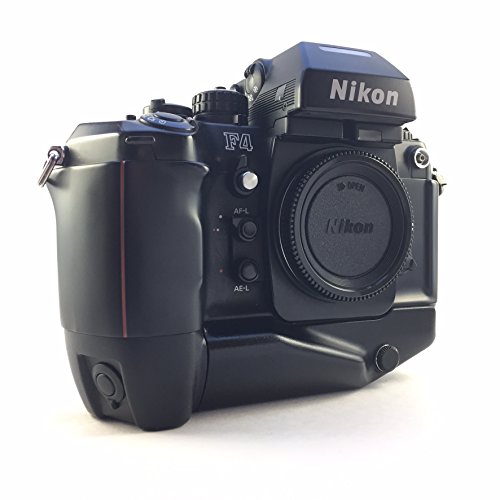
Nikon F4S Autofocus Camera Body with MB-21 — Best transitional classic
The F4S is this ranking’s historian’s pick: the body that carried autofocus across the professional Rubicon. When the F4 generation arrived, working photographers were openly sceptical that a machine could focus better than their own hands, and Nikon’s answer was a flagship built like a piece of industrial equipment — modular, dense, unapologetically mechanical in feel — with autofocus serious enough to convert the sceptics one assignment at a time. The listing pairs the body with the MB-21 motor drive, the “S” configuration’s defining grip, which adds the vertical handling and the power reserves that made the F4S the press-pool regular of its years.
Judged against its successors, the F4S’s autofocus is the transitional article: single central sensing of real ability, outclassed in coverage and tracking by the F100 and the 1V, yet revolutionary in context because it proved the concept at the level where proof mattered. Its metering, offered in multiple patterns including a matrix system that was advanced for its day, and its compatibility across an unusually wide span of Nikon lenses — the F4 generation famously accommodated glass from several eras — make it the most forgiving flagship a collector-photographer can feed. Photographers who shoot older Nikon lenses alongside autofocus ones often find the F4S is the body that refuses the fewest of them.
Age is the F4S’s honest tax. It is the oldest flagship here, and its inspection list is the longest: shutter across the full range with attention to the slow speeds, the MB-21’s contacts and battery tray for corrosion, seals and damper foam, the condition of the interchangeable finder and its contacts, and autofocus behaviour with both screw-drive and later lenses. LCD displays of this generation can fade or bleed, so check the viewfinder and top-panel readouts in bright light. None of this is a deterrent to the right buyer — the F4S’s mechanical solidity means a serviced example has decades left — but it is a deterrent to the casual one, and the ranking says so plainly.
- Format: 35mm SLR body, Nikon F mount
- Included drive: MB-21 motor drive, per the listing title
- Focusing: Autofocus, transitional generation (general model knowledge)
- Condition: Oldest flagship here — full inspection including finder, LCDs and drive contacts
- Warranty: Not stated in the listing title — verify with the seller
Strengths
- The bridge body of the autofocus revolution, built to an industrial standard.
- Exceptionally wide Nikon lens compatibility across eras.
- Modular professional system — finders, backs and drives interchange.
Trade-offs
- Autofocus coverage and tracking are a generation behind the F100.
- Age makes its inspection list the longest in this guide.
- With the MB-21 fitted, it is the heaviest carry in the ranking.
Best for: the Nikon loyalist or historian-photographer who shoots lenses from several eras on one body.
Not suited for: fast modern action work — its autofocus generation was a beginning, not a culmination.
Buy serviced, and let the MB-21’s battery tray be the first thing you open. Check price on Amazon against the service description rather than the photograph; with an F4S, the description is the camera.

Nikon N80 35mm SLR Film Camera (Body Only) — Best enthusiast body — BODY ONLY
The N80 — the F80 in other markets — is the enthusiast’s dividend from the flagship wars: a light, quiet, thoroughly modern film body that inherited the autofocus and metering thinking of the F100 generation at a fraction of the size and commitment. The listing is body only, and the words matter exactly as they did in the Canon guide’s Rebel 2000 Date: no lens is included, so this purchase addresses a buyer with Nikon glass in hand or a lens chosen alongside. For that buyer, the N80 is close to irresistible — a body that feels like a modern camera because, in design terms, it nearly is one, with on-demand grid lines, custom settings and a control layout that taught a generation habits they carried into digital.
In the all-time narrative, the N80 marks the moment autofocus stopped being a feature and became the water the fish swam in. Its five-point autofocus and scene-analysed metering handled the overwhelming majority of real photography without drama, and its quiet manners — a damped, civilised mirror and transport — made it the body enthusiasts chose for ceremonies, travel and family life where the flagships’ industrial presence would have been a social cost. Many photographers’ finest film work was made on N80-class bodies precisely because the camera was present, carried and unintimidating in a way no flagship has ever managed.
Condition checks for the N80 emphasise its generation’s materials. The body’s rubberised coatings of this era can turn tacky with age and storage, so handle the grip critically in the listing’s description and on arrival — a sticky body is a cosmetic misery and a hint about storage conditions generally. Then the familiar liturgy: shutter, seals, battery compartment, autofocus across its points with a lens mounted, and the pop-up flash where fitted, fired repeatedly. A clean N80 is the ranking’s easiest recommendation to a Nikon lens owner who wants film’s pleasures in a body that behaves like it was designed yesterday — because relative to the F4S, it practically was.
- Format: 35mm SLR body, Nikon F mount
- Lens included: NONE — BODY ONLY, per the listing title
- Focusing: Multi-point autofocus (general model knowledge)
- Condition: Vintage stock — check grip coating, shutter, seals and AF points
- Warranty: Not stated in the listing title — verify with the seller
Strengths
- Near-flagship autofocus and metering thinking in a light, quiet body.
- Modern control layout and custom settings feel immediately familiar.
- The enthusiast sweet spot of Nikon’s film autofocus line.
Trade-offs
- No lens included — the purchase presumes Nikon glass or a lens budget.
- Era coatings can turn tacky; grip condition needs scrutiny.
- Below the F100 in build, sealing and drive authority.
Best for: a Nikon lens owner who wants an unintimidating, capable film body for everyday photography.
Not suited for: a lens-less first purchase — body-only economics punish buyers who forget the glass.
Read the listing for grip and autofocus language before the price registers. Check price on Amazon, then mount your sharpest Nikon lens for the test roll and judge the body at the centre and edges of its focus array.

Canon EOS Rebel 2000 Film SLR Kit with 28-80mm Lens — Best people’s camera
Every revolution needs its moment of arrival in ordinary homes, and for autofocus that moment looked like the Rebel 2000 kit: a complete camera — body plus a 28-80mm lens, per the listing title — with autofocus accurate enough for a toddler’s birthday, exposure automatic enough for a grandparent, and a price that put it in the same shopping trip as the week’s groceries. Ranking it beside the flagships is this guide’s thesis in action. The 1V proved what autofocus could do at the limit; the Rebel 2000 proved what it meant at scale, which historically is the larger claim.
The kit’s virtues compound quietly. The 28mm wide end covered rooms and groups without the photographer retreating through furniture. The autofocus, a multi-point array in a body of this class, handled the centre-weighted chaos of family life — subjects who move, lean and leave — with a reliability that manual-focus generations would have considered sorcery. And the EF mount meant the family’s second lens, bought years later, fit the flagship bodies too, so the Rebel functioned as the ground floor of a system rather than a cul-de-sac. Millions of people’s entire photographic inheritance — the albums, the framed enlargements — passed through Rebel-class cameras, and the scans hold up because the technology underneath was genuinely good.
Buying one now is the familiar vintage exercise at its gentlest stakes. Battery door integrity, shutter behaviour, seals, the kit lens’s motor and aperture — the Rebel checklist from the Canon guide applies unchanged — and a test roll through the subjects the camera will actually serve. Supply is deep and prices are sane, so choosiness costs nothing. The Rebel 2000’s place in an all-time list will always draw a purist’s raised eyebrow; let it. The history of autofocus is incomplete without the camera that finished democratising it, and this kit is that camera in its most complete form.
- Format: 35mm SLR kit, EF mount
- Included lens: 28-80mm, per the listing title (kit)
- Focusing: Multi-point autofocus (general model knowledge)
- Condition: Vintage stock — check battery door, shutter, seals and lens motor
- Warranty: Not stated in the listing title — verify with the seller
Strengths
- A complete, working autofocus system in a single purchase.
- 28-80mm range covers family and travel life without a lens change.
- The democratic endpoint of the autofocus story — capable far beyond its class.
Trade-offs
- Consumer build and materials age less gracefully than the pro bodies.
- Kit lens aperture limits dim-room work without flash.
- Ubiquity includes many neglected examples among the good ones.
Best for: anyone who wants the autofocus era’s people’s camera as a complete, shootable kit.
Not suited for: deliberate professional volume — the Rebel’s shutter and build were specified for family life.
Choose the listing that describes a tested shutter and a clean lens, then shoot the first roll at the next family gathering. Check price on Amazon and let the camera do the job it was democratised to do.

Canon EOS Rebel G Film SLR Kit with 35-80mm Lens — Best entry kit
The Rebel G kit is where the people’s autofocus story begins in this ranking: body and 35-80mm lens together, per the listing title, in the mid-nineties form that taught North America what an SLR had become. Against its younger sibling above, the G is the slightly simpler instrument — a 35mm starting focal length instead of 28mm, an earlier autofocus implementation — and its historical role is correspondingly earlier: this was the kit that normalised the idea that a family camera focused itself, exposed itself and still let a curious parent take the controls away from the automation one mode at a time.
As a working purchase today, the G kit’s argument is completeness at the lowest commitment in the ranking. Everything needed to shoot arrives in one box; the exposure ladder from full-auto to manual is intact; the EF mount opens the same three-decade lens pool as the 1V at the table’s other end. A photographer who learns on a Rebel G and graduates loses nothing in the transition — the lenses, the habits and even the control logic carry upward — which is a systems elegance none of the manual-focus generations could offer a beginner, and a large part of why the autofocus era, once begun, never looked back.
The inspection liturgy is the Rebel standard, repeated without embarrassment because it is the purchase: battery door and latch, shutter speeds fired and heard, seals and mirror foam, lens motor quietness and aperture snap, then a test roll judged for leaks, exposure consistency and focus at family distances. The G sold in vast numbers to careful and careless owners alike, so the used pool’s variance is the story — the difference between the best and worst Rebel G listing is larger than the difference between the G and the 2000 as models. Buy the example, as always, and the earliest chapter of the people’s autofocus era is yours to keep shooting.
- Format: 35mm SLR kit, EF mount
- Included lens: 35-80mm, per the listing title (kit)
- Focusing: Autofocus with manual override (general model knowledge)
- Condition: Vintage stock — full Rebel checklist applies
- Warranty: Not stated in the listing title — verify with the seller
Strengths
- The original people’s EOS kit — complete, capable and welcoming.
- Full exposure-mode ladder teaches while it automates.
- EF lenses bought for it serve every Canon body in this ranking.
Trade-offs
- Earlier autofocus generation than the Rebel 2000’s.
- 35mm wide end is tighter for interiors than the 2000’s 28mm.
- Example variance in the used pool is the widest in the guide.
Best for: a beginner or returning shooter who wants the classic entry kit, complete in one box.
Not suited for: wide-angle interior work as a speciality — the 35mm starting point will feel like a corridor.
Let the listing’s specifics — shutter tested, lens clean, seals described — make the decision. Check price on Amazon, and spend the savings over the 2000 on the film the camera exists to expose.
Nikon N65 / F65 — Prose-only: the budget pioneer
The arc this guide traces ends, fittingly, with the camera that brought genuine autofocus to the tightest budgets: Nikon’s N65, the F65 outside North America. It was the beginner’s real SLR — not a fixed-lens compromise but an interchangeable-lens Nikon with autofocus, auto exposure and the scene modes that taught newcomers by doing — and it converted more compact-camera owners into system photographers than any specification can capture. Its Amazon listing is a renewed one, and under this guide’s standing rule that means scholarship without a link: a renewed body’s value is its refurbisher’s work, and no ranking can certify an individual refurbishment sight unseen.
Buying an N65 renewed is a learnable discipline, and the checks mirror the beginner cameras in our companion guide. Light seals first — inspect the film door channels for foam that has crumbled or turned sticky, and favour listings that state seals were replaced. Battery second — open the compartment, reject corrosion, and confirm the camera powers and meters on a fresh set. Meter and autofocus third — mount a lens if the listing is body-only, point the camera between bright and dark scenes, and demand sensible responses from both systems. Shutter and advance complete the round: fire the speeds, feel the transport, and put a cheap test roll through the camera inside the return window before trusting it with a journey.
As the budget end of the all-time arc, the N65’s lesson is the ranking’s lesson in miniature. Autofocus won photography not at the flagship tier, where it was a marvel, but at this tier, where it became an assumption — the thing a modest camera was simply expected to do well enough that a beginner never had to think about it. A renewed N65, checked with care, still does that job, and still hands its owner the keys to Nikon’s lens system. That is a remarkable amount of history to hold for the price of a modest dinner, provided the seals, the battery bay and the meter pass their examinations. Treat the renewed N65 as this ranking’s final examination question: a buyer who can inspect it properly — who has absorbed the discipline this guide applies from the flagship down — no longer needs an all-time list to tell them what to buy, because they have learned to judge the instrument in front of them, which was the point of the ranking all along.
- Format: 35mm SLR, Nikon F mount
- Availability: Renewed listing on Amazon — no link in this guide
- Pre-purchase checks: Light seals, battery compartment, meter and AF response, shutter speeds, test roll
Strengths
- Real interchangeable-lens autofocus at the era’s friendliest commitment.
- Scene modes teach by doing — a beginner’s camera that instructs.
- Full entry into Nikon’s lens system.
Trade-offs
- Renewed condition depends entirely on the individual refurbishment.
- Consumer materials and shutter were never built for volume.
- Feature depth is the shallowest in this ranking by design.
Best for: a budget-minded beginner who wants the autofocus era’s ground floor, checked with open eyes.
Without inspection or a return path, a renewed purchase here leaves any hidden faults entirely on your shoulders with no recourse.
How Did Autofocus Actually Change What Photographers Could Do?
Before autofocus, sharpness at a family gathering was a skill rationed among the practised; after it, sharpness became a default and the photographer’s attention moved to timing and composition, where it belonged. The professional consequences arrived first and were the loudest: sports and wildlife photography’s keeper rates transformed when tracking autofocus followed a subject across the frame, and photojournalism’s candid register — the unposed frame grabbed at arm’s length — became a standard assignment rather than a lucky accident. The F4S proved it to sceptics, the F100 and 1V industrialised it, and by the time the Rebels and the N65 carried it into kitchens, the question had inverted: a camera that could not focus itself was the eccentric purchase, defended on aesthetic grounds by people who, notably, already owned autofocus bodies for work.
The subtler change was demographic. Autofocus quietly handed photography to everyone the manual era had excluded by difficulty — grandparents with unsteady hands, parents holding a child in the other arm, travellers who wanted the picture more than the process. The enormous family archives of the nineties and two-thousands, imperfect and irreplaceable, are autofocus’s true monument, and they are why this ranking insists on seating the people’s cameras beside the flagships rather than beneath them. There is a practical inheritance too: the archives exist because the cameras were trusted, and they were trusted because the technology, by its mature generation, had stopped being a claim in an advertisement and become a fact of photographic life — a fact these seven bodies, at their seven altitudes, each helped to establish.
Canon EF or Nikon F — Which System Should a Film Buyer Join Today?
The honest answer is that both systems reward commitment and punish dabbling, and the differences are philosophical rather than decisive. Canon’s EF mount is the purist autofocus design: fully electronic, motors in every lens, a clean break that bought total compatibility within the system at the cost of abandoning the manual-focus FD generation entirely. Nikon’s F mount is the long-continuity design: one mount carried from the manual era through autofocus, with compatibility that is broad, occasionally conditional and deeply rewarding to owners of older glass — the F4S’s famously catholic lens appetite being the film era’s fullest expression of that philosophy.
Choose by the lenses you already own, the bodies your hands prefer, and the local supply you can inspect in person. A buyer starting from zero might weigh that Canon’s film bodies and EF lenses form the tidiest closed system, while Nikon’s pool offers unmatched depth in used glass at every era and price. Either way, commit for a season before judging: mount-hopping in the first year buys adapters and doubt, while a single system, learned properly, buys photographs. The flagships at this table’s head will still be arguing the point long after your first ten rolls have settled it for you personally.
What Kills an Autofocus Film Body — and What Merely Ages One?
Sort the faults before shopping and the vintage market loses its terror. The mortal faults are electronic and proprietary: a failed main board, a dead autofocus module, a shutter control system that no surviving parts bin can feed. Bodies exhibiting those belong to parts donors, whatever the listing’s optimism. The ageing faults are mechanical and serviceable: foam seals and mirror dampers perish on a schedule and are replaced in an afternoon; shutter mechanisms gum at their slow speeds and respond to cleaning; battery doors crack and can be sourced; rubber coatings turn tacky and offend the hand without touching the photographs. A serviced body with fresh foam and a tested shutter is not a gamble but a maintained instrument, and listings that document that maintenance are selling a categorically different product from untested attic stock.
The buyer’s routine follows from the taxonomy: ask about the serviceable items by name, test for the mortal ones inside the return window, and price accordingly. Fire every shutter speed. Mount a lens and make the autofocus work at centre and edge points, near and far. Fire the flash where one is built in. Then the test roll — the only examination that interrogates seals, meter, focus and transport simultaneously, on your film, at your lab. Twenty-four frames is a trivial tuition for a verdict on a body you may shoot for a decade.
Which Autofocus Generation Matches Which Subjects?
Autofocus generations are easiest to understand as answers to subject speeds. The transitional generation, embodied by the F4S, answers the walking subject: portraits, reportage, ceremonies — subjects whose movement is human and unhurried, tracked by a single confident sensor at the frame’s centre. The mature generation, the F100 and 1V, answers the running subject: multiple sensors, predictive tracking that models a subject’s velocity, and drive speeds that turn a sprint or a serve into a sequence of individually focused frames. The people’s generation, in the Rebels and the N65, answers the unpredictable subject — the toddler, the dog, the birthday lunge for the cake — not with tracking sophistication but with forgiveness: focus that is right often enough, at distances family life happens at, that the album fills with keepers.
Matching generation to subject saves both money and disappointment. A portraitist who buys a 1V for its tracking is purchasing a Formula One car for the school run; a sports shooter who asks a Rebel to follow a winger down the touchline is asking the school-run car to race. The bodies in this ranking were each, in their moment, the correct answer to a real question, and the all-time framing lets a buyer in 2026 do something no buyer in 1998 could: choose across generations, with the whole story visible, and pick the answer their own subjects are asking for.
What Does It Cost to Feed a Flagship Versus a People’s Camera?
The bodies’ price gap narrows surprisingly over a two-year ownership, and the arithmetic deserves a place in an all-time guide because it reverses the obvious conclusion. Film and developing — the dominant cost of any film photography — are identical whichever body exposes the roll, with one systematic exception: the flagships’ motor drives make frames cheaper to spend psychologically, and high-volume shooters genuinely finish more rolls through a 1V or an F100 than through a Rebel, because the machine invites the sequence. Batteries differ too: professional bodies and their drives consume power at professional rates, while the people’s cameras sip. Servicing, when it comes, is priced by tier — a flagship’s shutter service costs flagship money, a Rebel’s replacement often costs less than its repair, which is its own bleak form of economy.
None of this argues against the flagships; it argues for buying them with open eyes, as instruments whose running costs match their capabilities. The photographer who shoots two hundred rolls a year amortises a 1V into irrelevance. The photographer who shoots twelve should let the Rebel kit or the N80 carry eleven of them and save the flagship money for the film, the lenses and the lab — the parts of the system that touch every single frame.
How Should You Test an Autofocus Body’s Focus Accuracy?
Autofocus faults hide from casual firing, so test deliberately. Mount the fastest lens you own, open it up to shrink the depth of field that forgives errors, and photograph a row of distinct targets at a measured distance — books on a shelf serve perfectly — focusing on the middle one at centre point, then repeat using an off-centre point where the body offers one. Move the exercise outdoors for a distant subject at infinity, then indoors for a face at portrait distance under room light, because autofocus systems age unevenly across their range and a body can be honest at three metres and a liar at thirty centimetres. Note the frame numbers; the scans will show, frame by frame, exactly where focus fell.
Carry the same rigour to the meter while the targets are set up: photograph an evenly lit wall at the meter’s recommendation, then a deliberately backlit subject, and confirm from the scans that the body exposes like a sane instrument rather than a pessimist or an optimist with a grudge. A camera whose meter leans consistently can be compensated for and lived with; a camera whose meter wanders cannot, and the test roll is where the difference announces itself.
Judge the pattern, not the single frame. One miss among twenty is photography; a consistent lean toward front-focus or back-focus at a particular distance is a diagnosis, and on a body inside its return window it is a return. A body that passes a structured focus test, a shutter-speed sweep and a seal inspection has given you everything a vintage purchase can give: not a guarantee, but evidence — and evidence, in this market, is the only currency that has never been debased.
Common Mistakes
Ranking worship is the first error this guide exists to correct: buying the flagship badge when the photography in your life is family, travel and daylight, where a Rebel kit or an N80 will match the 1V frame for frame and be carried three times as often. The second error is its mirror — dismissing the people’s cameras as unworthy of an all-time list, when their historical claim is arguably the strongest at the table. The third is condition blindness in its purest form: comparing listings by price and photograph while ignoring the service language that distinguishes a maintained instrument from a parts donor wearing a flagship’s badge.
Two practical errors close the set. Buying a body-only listing — the N80 here, like the Rebel 2000 Date in the Canon guide — without a lens in hand or in the same order converts an exciting delivery into an inert object lesson. And skipping the test roll on a body that “seems to work” merely defers every discovery — the leak, the capping shutter, the lazy focus point — to the first roll whose loss actually hurts. The inspection sequence costs an afternoon; its absence costs the photographs the camera was bought to make.
Why Do These Bodies Still Matter in a Digital Century?
Because they are the hinge the whole history swings on. Every digital camera a reader owns descends from the arguments these bodies settled: that a machine can be trusted with focus, that metering can learn from a library of scenes, that a lens mount is an ecosystem rather than a fitting. Shooting one is therefore partly an act of historical literacy — the 1V’s viewfinder teaches what its digital grandchildren inherited — and partly a practical pleasure that has not expired, because film’s discipline and the flagships’ competence compose a shooting experience no software update has replicated. The people’s cameras matter for the opposite reason: they are proof that a technology’s triumph is measured at the kitchen table, not the press pool, and the family albums they filled are still being scanned, framed and wept over by people who never knew or cared which generation of autofocus exposed them.
Final Recommendation
Crown your own summit according to your subjects. The photographer who shoots movement for keeps should climb to the EOS-1V or the F100 and buy the serviced example, because their autofocus systems remain astonishing and their meters forgive almost nothing because they miss almost nothing. The Nikon loyalist with lenses from several eras belongs on the F4S, grip and all, where history and compatibility shake hands. Lens owners seeking an everyday film body should take the N80 and its modern manners. And everyone else — the beginners, the returners, the family archivists — should start where the revolution finished: with a Rebel kit, complete in its box, or a carefully checked renewed N65, and discover that the people’s autofocus cameras earned their place in this ranking the same way the flagships did, by making photographs that mattered to the people who took them. Whichever rung of the ladder you start on, start with a test roll and a return window, and let the evidence — not the badge, not the ranking, not this guide — have the final word on the body in your hands.
Frequently Asked Questions
Which is better, the Canon EOS-1V or the Nikon F100?
As instruments, the 1V is the higher summit — Canon’s flagship, with the era’s most complete autofocus and the toughest build — while the F100 is the professional all-rounder that most working photographers preferred to carry. As purchases, both are vintage bodies whose individual condition outweighs the model comparison: a serviced F100 will out-shoot a tired 1V every day of the week. Choose by your lens system first and by the specific example second; the badge argument comes a distant third.
Why does the Nikon F4S belong on an all-time list?
Because it is the bridge the profession crossed. The F4 generation took autofocus into the flagship tier when professional opinion was still sceptical, and its combination of industrial build, modular system design and unusually wide Nikon lens compatibility made it the press camera of its years. Its autofocus is a generation behind the F100’s — the ranking says so in its review — but historical weight is a criterion here, and few bodies carry more.
Is the N80 listing really body only?
Yes. The listing title states “(Body Only)”, and the point is repeated in this guide’s Quick Picks row, the N80’s review and its specification box: no lens is included. It is an excellent purchase for a Nikon lens owner and a frustrating one for anyone expecting to shoot on delivery day. If you own no Nikon glass, price a lens into the same order or choose one of the Rebel kits, which arrive complete.
Why is the Nikon N65 covered without a purchase link?
Its Amazon listing is a renewed one — refurbished by a third party — so its condition is the refurbisher’s work rather than a uniform standard this guide can point to. The N65 is therefore described in full, as the budget end of the autofocus arc, together with the checks a renewed buyer should run: light seals, battery compartment, meter and autofocus response, shutter speeds, and a test roll inside the return window.
Do autofocus film cameras work with modern lenses in their mounts?
Largely yes within each system’s film-era mount logic, with era-specific caveats a buyer should verify per lens: Canon EF lenses were designed for these bodies, while Nikon’s long F-mount continuity spans many lens generations whose feature support varies by combination — the F4S being famously accommodating, later bodies sometimes less so with the oldest glass. Check the specific body-and-lens pairing in the manual or a compatibility chart before buying a lens for a body you have not tested it on.
Can I still get these bodies serviced?
In most cases, yes — independent repairers sustain the popular film bodies, and the models in this ranking sold in numbers large enough to support a genuine service culture: seals, dampers, shutter cleaning and many mechanical repairs are routine work. The honest boundary is proprietary electronics, where a failed board may require a donor body, which is why the pre-purchase inspection weights electronic behaviour — autofocus response, metering sanity, display health — so heavily. Buy a body whose electronics demonstrably work today, maintain its serviceable parts, and the arrangement can run for years; buy one hoping a dead circuit will heal, and it will not. Ask the seller directly what has been serviced and when, and treat a precise answer — seals in a named year, shutter tested across its range — as the strongest single signal a vintage listing can send.
How much should condition affect what I pay?
More than the model name does. A serviced, shutter-tested example of a mid-tier body is worth more — in photographs delivered per unit of money — than an untested flagship, because the flagship’s potential repairs are priced at flagship rates. Pay for documented maintenance and honest descriptions; discount heavily for silence about seals, shutters and battery compartments; and never let a low price talk you out of the test roll that verifies the bargain, because the test roll is the one part of a vintage purchase whose value is guaranteed in advance, whatever verdict it returns on the body it examines, in either direction, without exception or favour.
Related Guides
For the instant branch of photography, where autofocus’s immediacy shrinks the wait for a photograph to minutes, our roundup of Fujifilm Instax cameras from the Mini 12 to the Wide 400 covers the modern heirs of point-and-shoot pleasure. The youngest beneficiaries of automatic everything — children, whose first camera should survive being dropped and print without a lab — are served by our honestly split guide to instant cameras for kids across film, Zink and thermal printing. And readers curious about where autofocus went after film — into mirrorless bodies with eye-tracking the F4S generation could not have imagined — will find the current state of the art in our test of mirrorless cameras for sports, judged on bursts and tracking.


