What's inside
- Key Takeaways
- Quick Picks
- How We Chose These Picks
- Mini or Wide — Which Instax Format Fits Your Subjects?
- How Much Does Instax Photography Cost to Run, Honestly?
- How Do You Get Better Instax Photographs?
- What Accessories Actually Earn Their Place in an Instax Kit?
- Instax at Events — How Do You Run a Guest Table or a Photo Wall?
- Why Has Instant Photography Outlived Every Prediction of Its Death?
- Common Mistakes
- Which Instax Suits Which Photographer? A Personality Map
- Final Recommendation
- Frequently Asked Questions
- Related Guides
As an Amazon Associate I earn from qualifying purchases. This post may contain affiliate links at no extra cost to you.
widgetverdict.com is reader-supported. When you buy through links on our site, we may earn an affiliate commission.
The best fuji instant cameras all belong to one family — Fujifilm’s Instax line — and that is precisely what makes choosing among them interesting: the film system is a given, the prints share the same cheerful chemistry, and the decision narrows to format, automation and how much control you want between pressing the shutter and holding the photograph. Every pick in this guide is a current Fujifilm product, sold new, which frees the comparison from the condition anxieties that haunt second-hand instant cameras. What remains is a clean set of trade-offs among six cameras: the Mini 12 in two forms, the newer Mini 13, the hybrid Mini EVO, the accessory-rich Mini 41 bundle, and the Wide 400, the family’s large-format statement.
Start with the fork that matters most. Five of the six picks are pure instant cameras: light enters, chemistry decides, a photograph emerges, and the frame you get is the frame you took — no review, no delete, no second chance. The Mini EVO is the exception, a hybrid that captures digitally and prints on demand, so the photograph exists as a file before it exists as an object and only the keepers cost film. Purists call that cheating; parents call it the first instant camera that makes economic sense. Both are describing the same machine accurately, and this guide treats the fork as a temperament question rather than a moral one.
Format is the second fork. The Mini cameras print the small, wallet-and-scrapbook-sized Instax Mini frame that has become the default social currency of instant photography — cheap to feed, easy to share, charming at arm’s length. The Wide 400 prints frames roughly twice the width, big enough for group photographs to breathe and for landscapes to register as landscapes. Wide film costs more per shot and the camera is a handful rather than a pocketful, so the format decision is really a subject decision: faces and parties, or gatherings and places. Everything else in this guide — selfie mirrors, automatic exposure, bundles and accessories — is refinement on those two choices. A final comfort for the deliberating reader: because all six cameras share Fujifilm’s film chemistry within their formats, there is no bad print quality hiding anywhere in this guide. The differences are in size, selectivity, styling and supply — in how the photograph is decided and kept, not in whether it will charm the person it is handed to. Instant photography is one of the few product categories where the entry model and the flagship produce output of the same fundamental character, which is why the recommendations below are organised by life and habit rather than by hierarchy.
Key Takeaways
- All six picks are current Fujifilm products — no vintage condition lottery anywhere in this guide.
- The Mini 12’s automatic exposure and selfie mirror, per its listing, make it the default recommendation for most buyers.
- The Mini EVO is the hybrid: digital capture, print only the keepers, and film spend falls dramatically.
- The Mini 41 bundle includes a 40-sheet film value pack plus case and album, per its listing title.
- The Wide 400 is the large-format pick — group shots and landscapes at twice the Mini width.
- The Mini 12 Holiday Bundle and the standard Mini 12 are the same camera heart in different boxes; buy the box that suits the occasion.
Quick Picks
| Pick | Badge | Why it made the cut |
|---|---|---|
| Fujifilm Instax Mini 12 | Best for most people | Automatic exposure and a selfie mirror in the classic Pastel Blue. |
| Fujifilm Instax Mini 13 | Best newest entry | The latest Mini generation in Dreamy Purple. |
| Fujifilm Instax Mini EVO Instant Camera | Best hybrid | Digital capture with print-on-demand — shoot freely, print selectively. |
| Fujifilm Instax Mini 41 Instant Camera Bundle | Best bundle | Camera plus 40-sheet film value pack, case and album in one purchase. |
| Fujifilm Instax Wide 400 Instant Camera (Black) | Best large format | Wide prints for groups, gatherings and scenery. |
| Fujifilm Instax Mini 12 Holiday Bundle (Blossom Pink) | Best gift version | The Mini 12 with selfie mirror, close-up mode and automatic exposure, dressed for giving. |
How We Chose These Picks
With the film system held constant, the selection criteria became behavioural. First, exposure forgiveness: instant film has a narrow tolerance for error and no delete key, so automatic exposure — named in the Mini 12’s listing as a headline feature — weighs heavily, because a camera that meters well wastes fewer of the frames its owner paid for. Second, the selfie question, which is not frivolous: a large share of Instax photography is arm’s-length self-portraiture, and the selfie mirror and close-up provisions a listing names are the difference between a charming frame and a forehead with scenery. Third, the honest arithmetic of bundles, because film is the recurring cost and a bundle that includes forty sheets is making a quantifiable argument that a bare camera is not.
Differentiation governed the final cut. Two Mini 12 listings appear because they answer different purchases — the standard camera for the self-buyer, the Holiday Bundle for the gift-buyer — and pretending one of them does not exist would not help either reader. The Mini 13 earns its place as the newest step in the line, the EVO as the hybrid alternative, the Mini 41 bundle as the accessory-complete route, and the Wide 400 as the format alternative. Six cameras, six distinct decisions: that is the shape a single-system guide should have.
A note on evidence discipline, because instant cameras attract folklore. This guide separates the Mini 12 and Mini 13 using only what their listings state — colour, generation and named features — rather than importing specification sheets from elsewhere. Where a listing is silent about a feature a buyer might assume, the specification boxes say so, and the running-cost discussion stays qualitative and comparative, because per-print prices drift with multi-pack offers and seasons in ways that would date any printed figure.

Fujifilm Instax Mini 12 — Best for most people
The Mini 12 is the camera the Instax system would design if it could design only one: its listing leads with automatic exposure and a selfie mirror, aimed at photography, scrapbooking and gifting, and that trio of uses is exactly the life the camera leads in the wild. Automatic exposure is the feature that matters most and photographs least — the Mini 12 reads the light and sets itself, so the bright beach frame and the dim café frame both land within the film’s narrow tolerance, and the owner’s failures become compositional rather than chemical. For a product whose every frame costs money, exposure reliability is not a convenience; it is the running-cost feature.
The selfie mirror earns its place beside it. A small mirror beside the lens lets an arm’s-length photographer compose the group, check the edges and confirm that nobody’s head has been amputated by the frame — the unglamorous difference between the selfies that get kept and the ones that get quietly discarded. Around those two features the Mini 12 wraps the line’s familiar ritual: twist to wake, point, press, and withdraw the emerging print into a pocket or a palm while the image assembles itself. Pastel Blue is the classic finish, the colour in which the camera appears in a decade of party photographs, and its cheerfulness is functional — people smile at this camera before it fires, which is half of portraiture.
Who should skip it? The photographer who already knows they resent surrendering control — the EVO below exists for them — and the group-shot specialist, for whom the Wide 400’s frame is the honest tool. Everyone else, and especially the first-time instant buyer, should start here without overthinking: the Mini 12 is the system’s centre of gravity, its film is the easiest to find and the kindest to feed, and its learning curve is measured in frames rather than weekends. Check price on Amazon, add a twin pack of Mini film to the order, and the camera’s first party is fully provisioned.
- Format: Instax Mini instant film
- Exposure: Automatic exposure, per the listing title
- Selfie aids: Selfie mirror, per the listing title
- Stated uses: Photography, scrapbooking and gifting, per the listing title
- Finish: Pastel Blue
- Film: Instax Mini — sold separately unless a bundle states otherwise
Strengths
- Automatic exposure protects the film budget by landing frames reliably.
- Selfie mirror fixes the genre’s most common framing failure.
- The system’s most popular camera — film and accessories are everywhere.
Trade-offs
- No review or reprint choice — every frame is spent as taken.
- Mini format is small for group photographs and scenery.
- Control is minimal by design; tinkerers will chafe.
Best for: first-time instant buyers, party hosts and scrapbookers who want the camera to handle exposure entirely.
Not suited for: wide group photographs at events — the Mini frame crowds more than a handful of faces.
The default exists for a reason, and here the reason is exposure you can trust with film you paid for. Check price on Amazon and let the first pack of film be the start of the habit rather than the whole supply.

Fujifilm Instax Mini 13 — Best newest entry
The Mini 13 is the line’s newest step, arriving in Dreamy Purple, and this guide treats it with a discipline the instant market rarely receives: it is separated from the Mini 12 using only what its listing states. The title names the model, its generation position in the family and its colour — and does not enumerate exposure or selfie features. So the honest description is this: the Mini 13 is Fujifilm’s latest entry Mini camera, the current-generation answer to the same brief the Mini 12 defined, offered in a finish chosen to be looked at. Buyers deciding between the 12 and the 13 on features should compare the manufacturers’ current documentation for both, because this guide will not invent a specification gap — in either direction — that the listings do not support.
What can be said without invention is still substantial. A newest-generation entry camera inherits the system’s accumulated lessons: the Instax Mini film it feeds on is identical, the ritual of shooting is identical, and the ownership ecosystem — cases, albums, film availability on every continent — is the same deep pool the Mini 12 swims in. Newest also means longest runway: accessories and support centre on current models, and a buyer who keeps cameras for years starts with the generation that will be current longest. Dreamy Purple is not a trivial detail in a product category where the camera is deliberately visible — carried in hands, set on tables, photographed photographing — and colour is one of the few specifications a listing can state with complete authority.
The Mini 13 therefore suits the buyer who values currency itself: the newest model, in a distinctive finish, inside the world’s most available instant system. It does not ask the Mini 12’s owner to upgrade on the evidence of these listings, and no honest guide would claim a leap the listings cannot show. It asks the new buyer a simpler question — when two cameras share a film, a ritual and a maker, do you take the proven centre of the line or its newest expression? There is no wrong answer, and the photographs will not reveal which one you chose. Compare both listings side by side before ordering, and let availability and the colour in your hand settle what specifications cannot.
- Format: Instax Mini instant film
- Generation: Latest Mini entry model at time of listing
- Exposure: Not stated in the listing title — verify with the manufacturer documentation
- Selfie aids: Not stated in the listing title — verify with the manufacturer documentation
- Finish: Dreamy Purple
- Film: Instax Mini — sold separately unless a bundle states otherwise
Strengths
- The current generation — longest accessory and support runway in the line.
- Shares the Mini film ecosystem, the deepest in instant photography.
- Dreamy Purple finish makes the camera part of the outfit, deliberately.
Trade-offs
- Listing states few features — spec hunters must consult Fujifilm’s documentation.
- Same film costs and format limits as every Mini camera.
- Newness carries no discount; the Mini 12 may undercut it on the day.
Best for: a new buyer who wants the latest Mini generation in a finish with personality.
Not suited for: a Mini 12 owner seeking a documented feature leap — these listings do not establish one.
Choose it the way you would choose the newest phone colour: happily, and for your own reasons. Check price on Amazon alongside the Mini 12, and let the day’s numbers and the purple decide together.

Fujifilm Instax Mini EVO Instant Camera — Best hybrid
The Mini EVO breaks the instant covenant on purpose, and the break is its brilliance: it captures photographs digitally, lets the photographer review them, and prints only the frames chosen — on genuine Instax Mini film, so the printed object is a real instant photograph with the chemistry and feel of the pure cameras’ output. The economics transform immediately. A pure Instax camera spends film on every blink, sneeze and accidental pocket exposure; the EVO spends film only on keepers, which means its owner’s cost per printed photograph can be a fraction of the analogue route even though the film itself is identical. For parents documenting children — the fastest-moving, highest-waste subjects in photography — that is not a marginal difference but the difference between a hobby that feels profligate and one that feels sustainable.
The hybrid design also changes the creative sequence. Effects, frames and lens simulations can be auditioned on screen before committing a print; a photograph can be printed twice for two grandparents; a frame taken last month can become a print today. Purists object that this dissolves instant photography’s essence — the unrepeatable frame, decided by chemistry in the moment — and the objection is coherent, which is why this guide presents the EVO as a fork rather than a victor. What the EVO indisputably offers is a bridge: digital shooting habits on one side, physical photographs on the other, and a generation raised on screens crosses that bridge in the direction of print, carrying its archives with it.
Practical notes follow from the architecture. A digital camera needs charging where a pure Instax needs batteries only for its flash and motor, so the EVO joins the household’s stable of devices that want a cable the night before a wedding. Its prints, being Instax Mini, share the format’s size limits for groups. And its listing title is terse — the model name and little more — so buyers comparing hybrid features in depth should read Fujifilm’s documentation for the current specification rather than trusting any guide’s summary, including this one. None of that dents the core proposition: shoot freely, print selectively, and let the film budget buy only photographs you already love. Check price on Amazon with a clear conscience about which side of the fork you live on.
- Format: Instax Mini instant film, printed from digital capture
- Capture: Digital with review-before-print (hybrid design)
- Exposure: Not stated in the listing title — verify with the manufacturer documentation
- Power: Rechargeable class device — confirm charging details in the manufacturer documentation
- Film: Instax Mini — sold separately unless a bundle states otherwise
Strengths
- Print only the keepers — film spend falls to the frames that deserve it.
- Reprints and delayed prints turn a camera into a pocket print studio.
- Real Instax film output — the printed object is a genuine instant photograph.
Trade-offs
- The unrepeatable-frame magic of pure instant is traded away by design.
- Needs charging like a phone — a dead EVO at an event prints nothing.
- Mini format limits apply to its prints as to every Mini camera’s.
Best for: parents, travellers and high-volume shooters who want instant prints without instant waste.
Not suited for: purists who value the single, unreviewable frame as the entire point of the medium.
If your camera roll holds forty attempts at every moment, the EVO is the instant camera your habits have been waiting for. Check price on Amazon, and count your savings in unprinted blink frames.

Fujifilm Instax Mini 41 Instant Camera Bundle — Best bundle
Bundles are usually packaging theatre; this one is arithmetic. The Mini 41 bundle pairs the camera — in Vintage Black — with a Fujifilm value pack of 40 sheets of film, a compatible carrying case in a vintage style, and a 64-pocket photo album, per its listing title, alongside shutter accessories. Read that list as a solution to the four disappointments of instant ownership: the camera with no film, the film with nowhere to live, the camera unprotected in a bag, and the prints with nowhere to go. Forty sheets is the meaningful figure — enough film for a wedding, a holiday or a school term’s worth of Fridays — because it converts the purchase from a camera into a season of photography, with the album waiting to receive the results in order.
The Mini 41 itself is the line’s retro-styled branch, and Vintage Black is a deliberate aesthetic statement: where the Mini 12’s pastels announce play, the 41’s dress suggests the camera as an object with a past, an accessory that belongs with film-era leather and brass rather than with beach bags. Style is a legitimate specification in a category where the camera is worn as much as used. The bundle’s case extends the theme while doing the unglamorous work of keeping the camera alive between outings, and the album imposes the habit that separates instant photographers from instant shooters — the prints get kept, sequenced and looked at again, which is the entire reason they exist.
Price each component individually before judging this bundle, because bundle value is a comparison rather than a property: price the camera, a 40-sheet film supply, a case and an album individually, and let the arithmetic speak. Where the bundle wins, it also wins on coherence — everything arrives together, sized for each other, ready for the first event. Where a buyer already owns an album and a case from an earlier Instax, the bare-camera route may serve better. The shutter accessories named in the title are the garnish; the film is the meal. Check price on Amazon with the four components itemised in your head, and the bundle’s honesty — or otherwise — will be plain.
- Format: Instax Mini instant film
- Included film: Fujifilm Value Pack, 40 sheets, per the listing title
- Included accessories: Carrying case and 64-pocket photo album, per the listing title; shutter accessories
- Exposure: Not stated in the listing title — verify with the manufacturer documentation
- Finish: Vintage Black
Strengths
- Forty sheets of film included — a season of shooting in the box.
- Case and album solve protection and print-keeping from day one.
- Vintage styling suits buyers who want the camera to look like an heirloom.
Trade-offs
- Owners with existing cases and albums pay for duplicates.
- Separate listings set the benchmark that any bundle price has to beat.
- The retro dress is a taste commitment — it will not pass unnoticed.
Best for: a gift with substance, or a new owner who wants camera, film, case and album settled in one decision.
Not suited for: an upgrader already equipped with Instax accessories from a previous camera.
Price the parts, then price the bundle, and let subtraction do the talking. Check price on Amazon with the 40-sheet film pack valued first — it is the component you would have bought next anyway.

Fujifilm Instax Wide 400 Instant Camera (Black) — Best large format
The Wide 400 is the family’s answer to the Mini frame’s one structural limit: size. Its listing names an instant film camera in black, and the Wide format it shoots produces prints with roughly twice the Mini’s width — enough for a table of wedding guests to be individuals rather than a crowd texture, for a landscape to hold a horizon and a foreground in conversation, and for a group portrait to be framed on a wall without a magnifying glass. Every instant system eventually confronts the photograph that does not fit its default frame; the Wide 400 is Fujifilm’s standing solution, a camera bought for the photographs the Minis cannot take.
The format’s costs are as structural as its benefits. Wide film costs more per frame than Mini film and is stocked by fewer shops, so the Wide owner plans film the way the Mini owner does not have to. The camera itself is a two-handed object — the price of the larger film gate — and it will not vanish into a clutch bag or a jacket pocket. Its shooting ritual remains Instax-simple, automatic and forgiving, but its carrying life is deliberate: this is the camera you bring because the event deserves it, the designated photographer role made physical. Weddings, reunions, team photographs, the annual gathering that gets one frame on the mantel — the Wide 400 is the mantelpiece camera of the Instax family.
Buyers should also understand what the Wide format does to their archive: Wide prints need Wide albums and frames, a parallel ecosystem to the Mini’s, and mixing formats in one book is a charm some owners love and others find untidy. None of this argues against the camera; it argues for choosing it as what it is, a format commitment rather than a feature upgrade. If your instant photography is faces at arm’s length, stay Mini and spend the difference on film. If your photographs keep failing at the edges — the cousin cropped out, the valley squeezed — the Wide 400 is not an indulgence but the correct tool, and it has no rival inside this guide. Check price on Amazon, and order Wide film in depth rather than in hope.
- Format: Instax Wide instant film — the large-format branch
- Exposure: Not stated in the listing title — verify with the manufacturer documentation
- Finish: Black
- Film: Instax Wide — sold separately; stock fewer outlets than Mini film
- Carry: Two-handed body — plan a bag rather than a pocket
Strengths
- Prints big enough for groups, gatherings and real landscapes.
- The mantelpiece format — Wide frames earn wall and album pride of place.
- Same forgiving Instax ritual, scaled up.
Trade-offs
- Wide film costs more per frame and is stocked less widely.
- The body is a deliberate carry, not a pocket camera.
- Albums and frames form a separate ecosystem from Mini accessories.
Best for: designated event photographers — weddings, reunions, teams — whose groups overflow the Mini frame.
Not suited for: pocket carry and spontaneous daily snapshots, where its size will leave it at home.
Bring it to the gathering everyone will want proof of. Check price on Amazon, and let the film order be generous; a Wide camera rationing frames at a reunion is a tragedy in two acts.
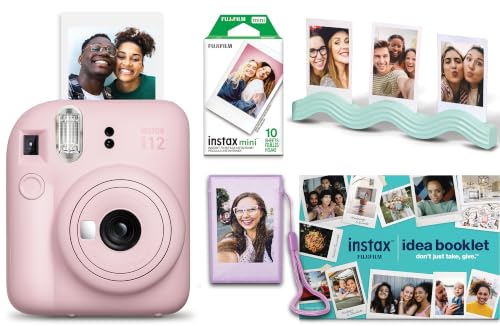
Fujifilm Instax Mini 12 Holiday Bundle (Blossom Pink) — Best gift version
This listing is the Mini 12 dressed for the giving season: a Holiday Bundle in Blossom Pink whose title spells out the camera’s credentials — selfie mirror, close-up mode and automatic exposure — in a package assembled to be handed over. The camera underneath is the Mini 12 of the first review, the system’s centre of gravity, and the bundle framing changes the purchase rather than the photography: this is the version bought by someone who will not be the photographer, for someone who will be, on an occasion with a date attached. Everything kind about the Mini 12 as a gift applies — it cannot be used wrong in any way that matters, its exposure system forgives the brand-new, and its first frame can be exposed within minutes of the wrapping paper coming off.
Close-up mode, named in this listing’s title, deserves its sentence because it answers the Mini system’s most common disappointment: the arm’s-length photograph that lands softer than hoped. A dedicated close-up provision, paired with the selfie mirror, is the camera coaching its owner toward the distance at which faces render best — which is why the Holiday Bundle’s specification reads like a checklist of what a recipient actually needs, rather than a spec-sheet ornament. Blossom Pink completes the presentation: a finish chosen for the unwrapping photograph as much as for the photographs that follow.
Gift-buyers should still perform the one diligence that separates a delightful present from a near miss: film. Read the bundle contents list carefully before ordering, and if film is not in the box, add a pack to the same order — a camera that cannot shoot until a second delivery arrives is a promise, not a present. With that single check done, the Holiday Bundle is the lowest-risk gift in this guide: current product, forgiving automation, a colour that photographs beautifully in the recipient’s hands. Check price on Amazon early in the season rather than late, because giftable bundles are precisely the listings that thin out as the holidays approach.
- Format: Instax Mini instant film
- Exposure: Automatic exposure, per the listing title
- Selfie aids: Selfie mirror and close-up mode, per the listing title
- Bundle: Holiday Bundle presentation, per the listing title
- Finish: Blossom Pink
- Film: Verify the pack count in the listing details; add a pack if the bundle is camera-only
Strengths
- The proven Mini 12 in a package designed to be given.
- Close-up mode plus selfie mirror target the recipient’s actual first photographs.
- Automatic exposure means the gift cannot be operated wrongly.
Trade-offs
- Seasonal packaging may command a premium over the standard Mini 12.
- Film inclusion must be verified rather than assumed.
- Blossom Pink is a confident colour choice to make on someone else’s behalf.
Best for: gift buyers who want the recipient shooting within minutes of unwrapping.
Not suited for: a self-purchase in a hurry — the standard Mini 12 may be the plainer, cheaper route to the same camera.
Verify the film, then relax — this is the guide’s easiest present. Check price on Amazon while the season’s stock is deep, and let Blossom Pink do the rest.
Mini or Wide — Which Instax Format Fits Your Subjects?
Format first, because it outlives every other decision: film bought for one format fits no camera in the other, and albums, cases and frames follow the same divide. Mini is the social format — faces, pairs, small groups, the photograph as a token handed across a table or taped into a journal. Its film is the cheapest true instant film to feed and the most widely stocked, which is why the format dominates weddings’ guest tables and students’ walls alike. Wide is the documentary format — the whole table, the whole team, the valley with its river — bought by the person appointed, or self-appointed, to record the gathering rather than merely attend it. The Wide 400’s prints ask more of a wall and give more to it.
The practical test is your last hundred photographs on your phone. Count how many frames hold more than four people, or a landscape whose edges matter. If the count is small, Mini’s economy and portability will serve you for years and the Wide camera would spend its life in a cupboard being correct. If the count is large — if you are the family’s designated rememberer — the Wide format stops being a luxury and becomes the honest tool, and its higher film cost is simply the price of the photographs you actually take. Photographers with both impulses exist, and the two-format household is a legitimate endpoint; but buy the Mini first, because its film discipline teaches the habits the Wide’s pricier frames will reward.
How Much Does Instax Photography Cost to Run, Honestly?
Instant photography’s running cost is per-frame and perpetual, and the honest way to hold it is as a subscription to physical photographs: every print costs a frame of film, forever, at prices that drift with pack sizes and seasons — which is why this guide compares systems qualitatively instead of printing figures that would stale. Within the Instax family the ordering is stable. Mini film is the economy standard. Wide film costs more per frame, proportionate to its larger chemistry. The hybrid EVO breaks the pattern by spending film only on chosen prints, so its cost per printed photograph can undercut every pure camera in this guide while its cost per photograph taken approaches zero — the distinction between those two sentences is the entire hybrid argument.
Budget habits matter more than pack arithmetic. Buy film in multi-packs rather than singles, because the per-frame difference compounds over a year of birthdays. Keep a reserve pack so a great evening never ends at frame ten of ten. And count honestly: the photographer who shoots four packs a year should optimise for the camera they enjoy; the one who shoots forty should let running cost lead the decision, which usually means Mini film, an EVO’s selectivity, or both. The camera body, as in every film system covered on this site, is the smallest cheque you will write — the film is the hobby’s rent, and it is due monthly.
How Do You Get Better Instax Photographs?
Closer, brighter, simpler — the genre’s whole technique fits in three words, and each maps to a failure the cameras in this guide are designed to forgive. Closer, because instant lenses and small prints punish distance: fill the frame with the people, use the close-up mode where a listing names one, and let the selfie mirror confirm the composition before the frame is spent. Brighter, because instant film’s exposure latitude is narrow and its happiest results live in good light — automatic exposure systems like the Mini 12’s widen the margin considerably, but no metering rescues a face lit by a single bulb across a dark room, so move subjects toward windows and lamps with the shamelessness of a portraitist. Simpler, because a small print cannot hold a complicated scene: one subject, one background, one idea per frame is the composition rule that separates the shoebox of keepers from the drawer of disappointments.
Then handle the prints like the chemical objects they are. Let them develop shielded from bright light, resist the cinematic urge to shake them — it does the chemistry no good — and write the date and names on the border before the evening ends, because the photograph you cannot identify in ten years is a riddle you set yourself. Store the keepers in an album rather than a drawer; the Mini 41 bundle’s inclusion of a 64-pocket album is the manufacturer quietly teaching the same lesson. Instant photography’s skill is not hidden in settings menus. It is in proximity, light and keeping — and every camera in this guide is a slightly different invitation to practise exactly those three. One more habit separates the owners who improve from the owners who plateau: review the finished prints in a batch, weekly, and name the failure in each disappointing frame out loud — too far, too dark, too busy are the only three verdicts most prints will ever need, and hearing yourself deliver them rewires the next roll more effectively than any tutorial. The cameras automate exposure; they cannot automate honesty, and honesty, applied a pack at a time, is the whole of the craft.
What Accessories Actually Earn Their Place in an Instax Kit?
Very few, which is the genre’s charm — but the few are specific. A case is first, because instant cameras live in bags among keys and bottles, and the Mini 41 bundle’s inclusion of one acknowledges that the camera most likely to be damaged is the camera most often carried. Film storage is second and unglamorous: a cool drawer, packs kept sealed until use, and a reserve pack treated as part of the camera rather than an optional extra. Albums are third, and their value compounds — the 64-pocket album in the Mini 41 bundle holds the prints in the order memory will want them, and a filled album is the difference between an instant habit and an instant archive. Beyond those three, the accessory market offers straps, coloured lenses and decorative frames in cheerful abundance; buy them as pleasures, not as equipment, and never let an accessory order displace the film budget it decorates.
One accessory deserves a warning disguised as advice: the spare camera. Instax owners accumulate second bodies the way guitarists accumulate pedals, and the honest test is film throughput — a household finishing a pack a week can justify a Mini for the bag and a Wide for events, while a household finishing a pack a season owns, functionally, one camera and one sculpture. The bundles in this guide are the disciplined alternative to accumulation: everything matched, everything used, nothing duplicated by accident.
Instax at Events — How Do You Run a Guest Table or a Photo Wall?
The instant camera’s finest social hour is the event where it is shared, and running one well is a small logistics art. Provision film at a rate that assumes enthusiasm: guests shoot more freely than owners predict, and a table that runs dry at the evening’s midpoint teaches the host a permanent lesson. Assign the camera a home — a table, a basket, a labelled spot — because a shared Instax with no home migrates into handbags and coat pockets and is found at midnight in neither. Pair it with a pen and a guestbook or a length of string and clips for a photo wall, and the prints acquire their second life immediately: the photograph taken at eight is decorating the room by nine, which no other photographic system at any price can do.
Choose the camera for the crowd, not the connoisseur. Automatic exposure matters most here — the Mini 12’s system forgives the guest who has never held the camera — and a selfie mirror prevents the evening’s most common waste. The Wide 400 plays a different event role: stationed, deliberate, operated by one person for the group portraits that anchor the record. Hosts who confuse the roles end up with either a flagship queue or a hundred identical table shots; hosts who separate them end the night with both the joy and the evidence, and an album’s worth of film spent exactly where the memories were. A small sign beside the camera — “take one, leave one” — turns guests into contributors to the record rather than consumers of it, and the duplicate prints it generates, one for the guest and one for the wall, are the cheapest goodwill an event can buy. By the end of the evening the wall itself becomes the entertainment — guests drift back to it between courses and dances, finding themselves and each other — and the host owns an archive that no hired photographer’s gallery link will ever quite replicate for warmth.
Why Has Instant Photography Outlived Every Prediction of Its Death?
Because it sells the one thing digital photography made scarce: a photograph that exists once, in one place, as an object. The Instax print cannot be edited, filtered, backed up or lost in a dead phone’s storage; it can only be given away, pinned up, written on or kept, and each of those verbs is a social act the file never performs. Fujifilm understood earlier than its rivals that the print was not the output of the photography but the point of it, and the system’s survival through the smartphone era — when every obituary for the dedicated camera was being drafted — is the market agreeing. The cameras in this guide are therefore best understood not as retro novelties but as the current models of a living medium, which is why this guide has compared them with the same seriousness it would give any current product line: because their owners will use them this weekend, at real events, on film bought this month.
Common Mistakes
Buying the camera and no film is the genre’s founding blunder, repeated every holiday season: several listings in this guide sell the camera alone, and an Instax without a film pack is a sculpture until the second order lands. Read each listing for what it includes — the Mini 41 bundle’s 40 sheets are stated in its title; the bare cameras’ silence on film means exactly what it says — and provision accordingly. The second mistake is format regret in both directions: the Wide bought for pocket spontaneity that never leaves home, and the Mini asked to document a forty-person reunion one cropped cousin at a time. Format is a subject decision, and the guide’s phone-gallery test takes two minutes.
Two technique mistakes follow owners home. Shooting everything at the same distance — the arm’s-length group, forever — wastes the cameras’ close-up provisions and produces an archive of identical framings; vary the distance deliberately and the prints start to breathe. And treating the EVO like a pure camera, printing every frame out of habit, dissolves the hybrid’s entire economic argument in a single weekend. The EVO’s discipline is the review screen: use it, or admit you wanted the Mini 12’s beautiful thoughtlessness all along — which is, this guide notes without judgement, a perfectly good thing to want.
Which Instax Suits Which Photographer? A Personality Map
The scrapbooker, whose photographs are raw material for a physical book, belongs with the Mini 12 and a standing film order — the format was practically designed for the journal page, and automatic exposure keeps the supply of usable frames high. The social host, whose camera works other people’s parties, needs the same camera for a different reason: it survives being handed to strangers, and its selfie mirror rescues the frames strangers take of each other. The archivist-parent belongs with the EVO, because childhood generates a hundred frames a week and only a hybrid keeps the film bill sane while still producing the prints the grandparents actually want. The stylist, for whom the camera is part of the outfit and the room, is the Mini 41 bundle’s natural owner, Vintage Black and all. The rememberer-in-chief, appointed by every family whether they applied or not, carries the Wide 400 and accepts the film cost as a duty roster. And the gift-buyer, who is purchasing somebody else’s hobby sight unseen, should buy the bundle whose box contains the most photography — film included, occasion considered — because a camera gift succeeds in proportion to how soon it is used, and everything in this paragraph is downstream of that single fact.
Final Recommendation
Most buyers should buy the Mini 12 and stop deliberating: automatic exposure, a selfie mirror, the deepest film availability in instant photography, and a decade of parties proving the formula. New-generation shoppers who want the line’s latest expression take the Mini 13 in its Dreamy Purple, understanding that the listings separate the two cameras by generation and finish rather than by documented features. High-volume shooters and parents take the EVO and its print-only-the-keepers economics. Gift-givers split by ambition: the Holiday Bundle for the present that shoots at the party, the Mini 41 bundle for the present that arrives as a whole season of photography. And the family’s designated rememberer takes the Wide 400, feeds it generously, and produces the frames that end up framed. Six cameras, one chemistry, and a decision that is finally about nothing more technical than the size of your gatherings and the honesty of your shooting habits. Buy the camera whose format fits your subjects, provision its film like you mean it, write on the borders while the day is still in your head, and the little prints will do what they have done for every owner before you — they will outlast the phone they were nearly taken on, and be found, decades from now, in the album or the shoebox, still telling the truth about an afternoon, in handwriting, which no file format has yet learned to imitate convincingly, and which your grandchildren will thank you for without ever knowing your name for the habit that put the pen in your hand on that particular day, in that particular light, among those particular people.
Frequently Asked Questions
What is the difference between the Instax Mini 12 and the Mini 13?
On the evidence of their listings: generation and finish. The Mini 12’s listing names automatic exposure and a selfie mirror and offers the camera in Pastel Blue; the Mini 13 is the newer model, listed in Dreamy Purple without an enumerated feature list. This guide deliberately separates them only on stated facts, so buyers for whom a specific feature is decisive should compare Fujifilm’s current documentation for both models rather than rely on any retailer’s summary — including ours.
Is the Mini EVO a real instant camera if it captures digitally?
Its prints are real instant photographs — genuine Instax Mini film, developed by the same chemistry as the pure cameras’ output. What changes is the path: the image is captured digitally, reviewed, and printed on demand, so film is spent only on chosen frames. Whether that makes the camera “real” is a philosophy question; the prints on the fridge are identical either way, and the film bill is considerably smaller.
Which Instax camera is best for weddings?
It depends on the role. For guest tables and a guestbook of faces, the Mini 12 — its film is the most affordable to supply in quantity and its automation survives being handed to any guest. For the designated photographer’s group portraits, the Wide 400, whose frames hold a whole wedding party legibly. Many weddings quietly use both: Minis scattered for joy, one Wide working for the record.
How many photos are in a pack of Instax film?
Instax film is sold in packs whose sheet counts are stated on the packaging, and bundles in this guide state their inclusions in their titles — the Mini 41 bundle, for instance, includes a 40-sheet value pack. Because pack configurations and bundle contents are set by the seller’s listing at the time of purchase, read the specific listing’s film count before ordering rather than assuming a standard, especially when provisioning for an event. The same caution applies to expiry: film is a dated product, so buy from listings and sellers with healthy turnover, check the date printed on the pack when it arrives, and shoot the oldest stock first — a habit that costs nothing and quietly protects every frame you will ever expose.
Can I use Mini film in the Wide 400, or Wide film in a Mini camera?
No. The formats are physically different sizes, and each camera accepts only its own film — Mini cameras take Instax Mini film, the Wide 400 takes Instax Wide film. The formats also have separate albums, cases and frames. This is why the format decision in this guide is treated as the first decision: it commits your film shelf, not just your camera bag.
Which camera should a complete beginner to photography buy?
The Mini 12, without a deliberation phase. Its automatic exposure removes the only technical variable instant film cannot forgive, its selfie mirror removes the most common framing error, and its film is the easiest and kindest to buy. A beginner’s real curriculum is seeing — noticing light, proximity and moment — and the Mini 12 is engineered to leave exactly that curriculum and nothing else on the student’s desk. Graduate to the EVO’s control or the Wide’s format later, when your finished albums tell you which direction your photography is pulling.
Do Instax prints fade or need special storage?
Instant prints are chemical photographs and reward ordinary archival kindness: keep them in an album or a box, out of prolonged direct sunlight and away from heat and humidity, and they will hold their colours for years of ordinary looking. The border is designed for captions — date and names written on the day will be the most valuable feature of the print in a decade, long after the camera model is forgotten.
Related Guides
Instant photography for the youngest shooters — with the crucial distinction between real film, Zink paper and thermal printing spelled out — is covered in our guide to instant cameras for kids, chosen by age and mess tolerance. Readers whose appetite for automation runs toward fast-moving subjects will find the modern flagship story in our roundup of mirrorless cameras for sports, judged on bursts and subject tracking. And the bird photographers of the family — who need reach the Instax system never promised — are served by our field guide to mirrorless cameras for bird photography and the lens question that decides everything.



[…] where autofocus’s immediacy shrinks the wait for a photograph to minutes, our roundup of Fujifilm Instax cameras from the Mini 12 to the Wide 400 covers the modern heirs of point-and-shoot pleasure. The youngest beneficiaries of automatic […]