What's inside
- Key Takeaways
- Quick Picks
- How We Chose These Picks
- How Does a STARVIS 2 Sensor See in the Dark?
- Which of These Cameras Fits Your Driving?
- What Does Parking Mode Really Require?
- How Should You Set a Dash Cam Up for Night?
- Why Do Cards Fail More Often Than Cameras?
- How Do You Retrieve Footage After an Incident?
- What About Heat, Frost and the Windscreen Itself?
- Should Passengers and Other Drivers Know the Camera Is There?
- Misunderstandings That Cost Drivers Their Evidence
- Final Recommendation
- Frequently Asked Questions
- Related Guides
As an Amazon Associate I earn from qualifying purchases. This post may contain affiliate links at no extra cost to you.
widgetverdict.com is reader-supported. When you buy through links on our site, we may earn an affiliate commission.
First, a correction the whole category needs: when dash cam makers say night vision, they do not mean infrared. There is no invisible light being thrown down the road. The best dash cameras with night vision earn the label through low-light sensors — overwhelmingly Sony’s STARVIS 2 family in the models below — that gather the little light a night street offers and turn it into footage where number plates stay readable and a pedestrian’s jacket keeps its colour. Judging these cameras means judging sensors, HDR behaviour and honest exposure, not hunting for an IR lamp that does not exist.
Why it matters is not cinematic. Night is when the serious incidents happen — the unlit cyclist, the deer at the verge, the hit-and-run in a dark car park — and it is precisely when a cheap sensor dissolves into smeared headlights and guesswork. A camera that holds a plate legible at forty feet on an unlit road is evidence; a camera that records a bright blur is a souvenir of the worst evening of your year.
Six linked cameras compete here, five of them from VIOFO, whose grip on the enthusiast end of this market the listings make plain, plus REDTIGER’s value challenger. Two further names — Garmin’s compact 67W and Vantrue’s three-channel N4 Pro — appear in prose only, because no verified listing for either was available; they are included because any honest map of this territory has to mark where they stand.
Key Takeaways
- Dash-cam “night vision” means a sensitive STARVIS 2 sensor plus HDR — not infrared illumination.
- The VIOFO A229 Pro pairs a 4K front camera on the IMX678 sensor with a 2K rear on the IMX675.
- The A229 Ultra pushes both channels to 4K, the strongest paper specification in this guide.
- VIOFO’s A119M Pro miniaturises the same IMX678 night sensor for drivers who dislike visible hardware.
- REDTIGER’s F7NP is the budget route to a STARVIS-sensored front-and-rear kit, with a card included.
- Parking-mode recording needs a hardwire kit on these models — it is not in the box unless a listing says so.
Quick Picks
| Pick | Badge | Why it made the cut |
|---|---|---|
| VIOFO A229 Pro 4K Dash Cam | Best night footage overall | Dual STARVIS 2 sensors, 4K front and 2K rear. |
| VIOFO A229 Plus Dash Cam | Best balanced dual channel | Matched 1440P cameras front and rear with HDR. |
| VIOFO A229 Ultra Dash Cam | Best maximum specification | Dual 4K HDR with Night Vision 2.0 branding. |
| VIOFO A119M Pro 4K Mini Dash Cam | Best discreet single channel | IMX678 night sensor in a mini body with Wi-Fi 6. |
| VIOFO A119 Mini 2 Dash Cam | Best proven mini | 2K 60fps recording and HDR night mode in the A119 line. |
| REDTIGER F7NP 4K Dash Cam | Best value kit | 4K front and rear with a free card in the box. |
How We Chose These Picks
Sensor identity led the selection, because at night the sensor is the camera. Listings that name their STARVIS 2 silicon — IMX678 and IMX675 in the VIOFO flagships — were favoured over listings that merely promise night performance in adjectives, because a named sensor is a checkable fact and an adjective is not. HDR support counted alongside, since night roads are a contrast problem — black tarmac against headlight glare — as much as a brightness problem.
Channel count came second. Front-only cameras serve drivers whose risk is ahead of them; front-and-rear kits serve anyone who has been rear-ended at a junction and watched the other car leave. This guide leans dual-channel because night incidents so often involve the vehicle behind, but keeps two single-channel minis for drivers who value discretion over coverage.
Power design was read carefully. Supercapacitors — named in several listings — tolerate cabin heat that swells lithium batteries, a reliability point that matters in parked cars through summer. Parking modes were noted wherever listed, with the standing caution this guide repeats in every relevant review: buffered parking recording runs through a hardwire kit, an accessory, not a box content, unless a listing states otherwise.
Connectivity and control finished the picture: 5GHz Wi-Fi for pulling clips to a phone without removing the card, GPS for speed and location evidence, and voice control for drivers who would rather speak than fumble at a screen in traffic.
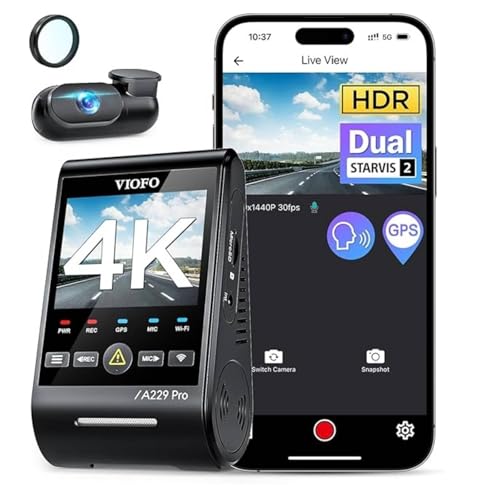
VIOFO A229 Pro 4K Dash Cam — Best night footage overall
The A229 Pro is the camera the night-vision conversation in this class revolves around, and its listing explains why in sensor language: dual STARVIS 2 sensors, an IMX678 up front recording 4K HDR and an IMX675 behind at 2K. That pairing is a deliberate allocation — the flagship sensor where plates approach fastest, a still-serious sensor watching the rear — and it reflects how night incidents actually distribute their evidence.
Night Vision 2.0 is VIOFO’s branding for the processing wrapped around that silicon, and the honest way to read the phrase is as a claim about the whole pipeline: sensor sensitivity, HDR merging of exposures, and tuning that protects highlights from headlight bloom while lifting shadow detail off the tarmac. Any single element is beatable; the combination, in this generation of dash cams, is what rivals benchmark against.
Resolution allocation deserves the buyer’s attention. A 4K front camera earns its keep in plate legibility — the difference between a character read and a character guessed at the distance an incident actually happens. The 2K rear is the pragmatic compromise: rear incidents unfold closer and slower, and the storage and heat budgets saved there are real. Drivers whose threat model is the tailgater rather than the oncoming lane may weigh it differently, and the A229 Ultra below exists for them.
Supporting systems are fully dressed: 5GHz Wi-Fi for fast clip transfer, GPS for the evidence trail, voice control for hands-on-wheel adjustments, and buffered 24-hour parking mode that captures the moments around an impact rather than starting after it. That parking mode carries the guide’s standing asterisk — buffered parking recording runs on a hardwire kit, sold separately, and the listing does not present the kit as included.
Ownership character is enthusiast-grade. The A229 Pro rewards a driver who formats cards on schedule, updates firmware, and reviews footage after anything unusual — a camera as an instrument rather than an appliance. Its wedge body hides behind a mirror well, its screen serves setup more than daily use, and its menus assume a reader. In exchange it returns the most defensible night footage this guide can point to, which is the entire transaction a dash cam exists to complete.
Heat is the quiet design question in any 4K dual-channel unit, and the Pro’s supercapacitor-based design language — shared across the VIOFO line — is the maker’s answer for cabins that bake through summer afternoons. A camera that survives August on the windscreen is worth more than a marginally sharper one that wilts, because evidence cameras are judged on the day everything else went wrong.
- Front: 4K HDR on STARVIS 2 IMX678 sensor
- Rear: 2K on STARVIS 2 IMX675 sensor
- Night Vision 2.0 processing
- 5GHz Wi-Fi and GPS
- Voice control
- Buffered 24H parking mode — hardwire kit required, not listed as included
Installation counsel for a dual-channel flagship: route the rear cable along the headlining with patience and slack at the hatch hinge, because the rear camera’s view is the one you will curse if it sags. Set the front unit’s exposure for the road rather than the sky, and test at night on your own street before trusting the setup — one evening’s review teaches more about aim and exposure than a month of specification reading.
Strengths
- Strongest front-sensor specification in this guide
- Rear channel uses a genuine STARVIS 2 sensor, not a token
- Buffered parking capture protects the moments before impact
Trade-offs
- Parking mode needs a hardwire kit bought separately
- Rear resolution is 2K where the Ultra offers 4K
- Enthusiast menus assume an engaged owner
Best for: drivers who want the most defensible night evidence front and rear
Not suited for: a leased car you cannot hardwire, since buffered parking mode depends on that kit

VIOFO A229 Plus Dash Cam — Best balanced dual channel
Symmetry is the A229 Plus’s idea: dual STARVIS 2 sensors with HDR, recording 1440P at the front and 1440P at the rear. Where the Pro concentrates its budget in the front sensor, the Plus spreads its capability evenly, and a surprising number of drivers — anyone whose night risk is a roundabout as much as a motorway — will find the even spread the more rational allocation.
1440P deserves defending against the 4K reflex. At dash-cam distances and lighting, a well-exposed 1440P frame from a sensitive sensor routinely out-reads a noisy 4K frame from a lesser one, and the Plus’s files are smaller, cooler-running and kinder to cards. Night footage is a chain of compromises among sensitivity, heat and storage, and this camera chooses its links with unusual honesty about which ones matter after dark.
The supporting cast mirrors the flagship’s: 5GHz Wi-Fi, smart voice control, ultra-precise GPS in the listing’s phrase, 24-hour parking modes, and a built-in supercapacitor — the heat-tolerance point again, stated outright in this listing. The supercapacitor is worth pausing on for buyers in hot climates: it is the component that decides whether a parked car’s camera is alive in September, and its explicit mention here is a specification, not a courtesy.
Positioning within the family is the review’s remaining task. The Plus is not the Pro with pieces missing; it is the same platform philosophy tuned for balance, and the price distance between them buys the Pro’s front-sensor ceiling. A buyer who reviews their actual night driving — urban, lit, moderate speeds — may honestly conclude the ceiling is headroom they will never use, and that the Plus’s evenness serves their evidence better.
Voice control earns a practical paragraph. Adjusting a dash cam by touch at night is a distraction dressed as a feature; speaking a command to lock a clip or toggle a function keeps eyes where they belong. Combined with the app over 5GHz Wi-Fi for the parked-up review work, the Plus covers both halves of the control problem — in motion and at rest — with the right tool for each.
Long-term running costs are gentle. Matched 1440P channels sip card capacity compared with dual-4K setups, extending the useful life of a quality endurance card and lengthening the loop before old footage overwrites. For a camera whose job is to be forgotten until needed, that quiet economy compounds across years of uneventful commuting — the exact service these devices are bought for.
- Dual STARVIS 2 sensors with HDR
- 1440P front and 1440P rear recording
- 5GHz Wi-Fi and smart voice control
- Ultra-precise GPS per the listing
- Built-in supercapacitor
- 24H parking modes — hardwire kit required, not listed as included
A fitting ritual for the Plus’s even temperament: match its card to its appetite. Because both channels write at moderate rates, a mid-size endurance card holds a generous loop of commuting, and the owner who formats monthly will likely never think about storage again — the highest compliment a balanced design can earn, since balance, properly achieved, feels like nothing at all.
Strengths
- Even front-rear capability suits mixed urban risk
- Supercapacitor stated outright for hot cabins
- Gentler storage and heat budgets than dual-4K kits
Trade-offs
- Front plate reach trails the 4K models here
- Parking modes still depend on a separate hardwire kit
- Shares the flagship’s enthusiast-style setup depth
Best for: commuters whose night risk arrives from every direction equally
Not suited for: motorway driving where maximum front plate legibility at distance is the whole point, since the Pro’s 4K front exists for exactly that

VIOFO A229 Ultra Dash Cam — Best maximum specification
The A229 Ultra answers the buyer who read the Pro’s 2K rear channel and said: both. Dual 4K is the listing’s headline — front and rear recording at 4K HDR, on dual Starvis sensors, with Night Vision 2.0 processing — and it makes this the maximum-specification camera in the guide by a clear margin. If evidence quality is the only metric and budgets bend, the conversation ends here.
Rear 4K is not vanity. The classic night incident — struck from behind at lights, the other car reversing and leaving — plays out at exactly the distances where rear resolution decides whether a plate survives the footage. A 2K rear usually suffices; 4K suffices with headroom, and headroom is what evidence wants, because incidents never arrange themselves at the distance your camera prefers.
The rest of the listing keeps flagship pace: faster 5GHz Wi-Fi — worth more here than anywhere, since dual-4K clips are heavy files — precise GPS, smart voice control and parking mode. Every supporting system scales with the main specification, which is the mark of a range-topper designed as a whole rather than a sensor swap in a familiar shell.
Costs of the maximum are physical, and the review should itemise them honestly. Dual 4K writes enormous files: cards fill faster, loops shorten, and the endurance rating of your memory card stops being a detail. Heat follows resolution in a sealed cabin. None of this disqualifies the Ultra — it defines its owner: the driver who accepts maintenance as the price of the strongest possible record, and who will actually buy the big, fast card the camera deserves.
Parking mode carries the family asterisk once more — the listing names parking mode without presenting a hardwire kit as included, so budget and installation planning should assume the kit is a separate purchase. On a camera at this level, that is a footnote rather than a complaint, but footnotes are where installations succeed or stall, and the guide prints it in every relevant review rather than once.
Who is the Ultra really for? The professional driver whose livelihood rides on footage; the owner of a car that attracts the wrong attention parked; the enthusiast who simply wants the ceiling. Everyone else is better served spending the difference on the Pro or Plus and a first-rate card — a judgement this guide makes precisely because the Ultra needs no inflation to justify its existence to its true audience.
- Dual 4K HDR recording, front and rear
- Dual Starvis sensors per the listing
- Night Vision 2.0 processing
- Faster 5GHz Wi-Fi and precise GPS
- Smart voice control
- Parking mode — hardwire kit required, not listed as included
Set the Ultra up like the instrument it is: the largest endurance card you can justify, loop settings reviewed after the first week, and a calendar note for monthly card care. Maximum-specification hardware forgives nothing about consumables, and the owner who respects that contract gets, in return, footage that ends arguments — which, on the worst night of the driving year, is the only specification that matters.
Strengths
- Dual 4K is the strongest evidence specification here
- Rear plate legibility gets flagship headroom
- Supporting systems scale with the headline spec
Trade-offs
- File sizes demand big, fast, endurance-rated cards
- Heat and power budgets are the family’s highest
- Capability exceeds what most commuting can use
Best for: professional drivers and owners who want the evidence ceiling
Not suited for: fit-and-forget ownership, since dual 4K punishes neglected cards and casual setup

VIOFO A119M Pro 4K Mini Dash Cam — Best discreet single channel
Shrink the flagship sensor, keep the night performance: that is the A119M Pro’s entire proposition, and the listing states it cleanly — a STARVIS 2 IMX678 sensor, true 4K HDR, in a mini body. The same silicon that fronts the A229 Pro here serves alone, which makes this the guide’s purest test of a theory: that one great front camera beats two ordinary ones for most drivers’ actual risk.
Discretion is the mini format’s home advantage. A small wedge behind the mirror all but disappears from inside and out — no screen glowing, no bulk advertising that the car carries a camera worth stealing or worth behaving for. Some drivers want a camera’s presence known; more, in our judgement, benefit from evidence gathered by hardware nobody noticed, and the A119 line has been the connoisseur’s discreet choice for years.
Connectivity jumps a generation here: Wi-Fi 6 is listed, the only camera in this guide to name it, alongside quad-mode GPS and voice control. Faster Wi-Fi matters disproportionately on a screen-minimal camera, because the phone becomes the screen — setup, review and clip retrieval all happen through the app, and a quicker radio turns that from a chore into a habit owners actually keep.
Parking protection follows the family pattern: buffered 24-hour parking mode, which again presumes the hardwire kit the listing does not include, plus a supercapacitor for heat resilience. Buffered capture is the meaningful word — the camera holds the seconds around an event, so a car-park nudge is recorded with its approach, not merely its aftermath, provided the hardwire gives it power to watch with.
Single-channel honesty requires the obvious sentence: nothing behind you is recorded. The rear-end shunt, the classic dash-cam vindication story, is outside this camera’s witness. Buyers should choose the format with their eyes open — the A119M Pro is the finest front-only night camera here, and front-only is a boundary, not a flaw, provided your risk assessment agrees with it.
Installation is the mini’s other gift. One unit, one cable, no rear run through the headlining: a careful owner finishes in half an hour, and a leased or frequently changed car suffers no invasive routing. For drivers who swap vehicles, drive several, or simply refuse a weekend of trim removal, the A119M Pro’s simplicity is a specification as real as its sensor.
- STARVIS 2 IMX678 sensor — the flagship front silicon
- True 4K HDR recording
- Wi-Fi 6 and quad-mode GPS
- Voice control
- Buffered 24H parking mode — hardwire kit required, not listed as included
- Supercapacitor design
A mini camera rewards one setup habit above others: check the app view before the first night drive and set the lens line on the horizon’s lower third, because a small body is easily knocked a degree off during cleaning and just as easily corrected by an owner who reviews a clip weekly. Discretion outside, diligence inside — that is the A119 ownership style in one sentence.
Strengths
- Flagship night sensor in the most discreet body here
- Wi-Fi 6 leads the guide’s connectivity
- Simplest installation of any pick in this list
Trade-offs
- No rear channel at all
- Phone-dependent for review and setup
- Parking mode still needs the separate hardwire kit
Best for: drivers who want maximum front night quality with minimum visible hardware
Not suited for: anyone whose nightmare scenario is being hit from behind, since no rear witness exists

VIOFO A119 Mini 2 Dash Cam — Best proven mini
The A119 Mini 2 is the elder of the two minis — a STARVIS 2 sensor recording 1440P at the front, with a feature the bigger cameras might envy: 60 frames per second at its full resolution, plus HDR at 30fps for night work. That frame-rate pairing shows a maker thinking clearly about the two halves of a dash cam’s life, because motion clarity and night sensitivity are different problems and this camera assigns each its own mode.
Daylight motion is the 60fps argument. At speed, frames per second decide whether a crossing plate is caught between blur beats; doubling the frame rate doubles the chances one frame lands sharp. Commuters whose incidents happen at motorway pace rather than in dark lanes will feel this specification working for them more often than an extra tier of resolution would.
Night mode flips the priority: HDR at 30fps, trading frames for exposure intelligence, merging brightness levels so headlight glare and shadowed verges coexist in one readable frame. The listing’s phrasing — HDR 30fps Night Vision — is admirably specific about the exchange, and the review repeats it because buyers comparing headline numbers across brands rarely notice that night performance is usually a mode with settings, not a permanent state.
The supporting systems are complete for the format: voice control, 5GHz Wi-Fi, GPS, buffered 24-hour parking mode with the standing hardwire caveat, and a supercapacitor. Nothing essential was left behind when the A119 line shrank, which is why the Mini 2 reads as a mature product rather than a budget amputation — the smaller sibling that kept the family silver.
Against its newer brother, the A119M Pro, the Mini 2 concedes the 4K ceiling and the IMX678’s ultimate night sensitivity, and answers with the 60fps daylight mode and a design whose behaviour owners have documented across far more miles. Maturity is a specification too. A buyer choosing between them is choosing between the newest sensor and the most understood camera, and reasonable drivers land on both sides of that line.
Value completes the case. The minis occupy the sensible floor of serious dash cams — real STARVIS 2 hardware, real parking protection, none of the multi-channel cost — and the Mini 2 is where that floor has been longest established. First-time dash-cam buyers who intend to learn what they actually need before committing to a flagship system could not pick a better tutor.
- STARVIS 2 sensor, 1440P front recording
- 60fps at full resolution for motion clarity
- HDR 30fps night vision mode
- Voice control, 5GHz Wi-Fi and GPS
- Buffered 24H parking mode — hardwire kit required, not listed as included
- Supercapacitor design
Mode discipline is the ownership skill this camera teaches: leave the 60fps setting for bright high-speed work, let the HDR night mode carry the dark hours, and review a clip from each after the first week to confirm both are doing what their names promise. Owners who learn that two-mode thinking on the Mini 2 graduate to any flagship later with the concepts already in their hands.
Strengths
- 60fps daylight mode sharpens fast-motion evidence
- Dedicated HDR night mode with honest specifications
- The most documented, mature mini design here
Trade-offs
- 1440P ceiling trails the 4K minis and flagships
- Front channel only, like its brother
- Night sensitivity sits below the IMX678 models
Best for: high-speed commuters and first-time buyers learning the category
Not suited for: unlit rural driving as the main use, where the IMX678 cameras hold plates farther into the dark

REDTIGER F7NP 4K Dash Cam — Best value kit
REDTIGER’s F7NP is the populist in a VIOFO-heavy room: a 4K front-and-rear kit on a STARVIS 2 sensor, with WDR night vision, a G-sensor for incident detection, and — the detail that tells you who it is for — a free card included in the box. Where the enthusiast brands assume an owner who enjoys specifying accessories, REDTIGER ships a kit a newcomer can install on Saturday and trust on Monday.
The listing’s connectivity figures need a careful reader’s eye: 5.8GHz WiFi with a stated 20MB/s download speed. Fast local transfer matters on a camera whose clips are its whole purpose, and a named download rate is a more useful promise than a vague “fast Wi-Fi” — the review credits the specificity while noting the figure is the maker’s, to be experienced rather than litigated.
Night language here is WDR — wide dynamic range — rather than the HDR branding of the VIOFO range, and the honest summary is that both describe exposure-merging approaches to the same night problem: hold the headlight glare, lift the shadows. The STARVIS 2 sensor underneath is the substantive point; the F7NP’s night credentials rest on genuine silicon, which separates it from the anonymous budget cameras whose night claims rest on nothing checkable at all.
Parking mode arrives with the guide’s most explicit caveat, printed in REDTIGER’s own listing: 24-hour parking mode, hardwire kit needed. We thank the listing for saying in its title what others leave to footnotes, and repeat it here in the same spirit — plan the kit into the purchase if parked protection is part of your reason for buying, because without it the camera sleeps when the engine does.
Wide-angle coverage and the G-sensor’s automatic incident locking round out a specification written for the mainstream driver: the camera watches broadly, locks the important clips against overwriting, and asks little expertise in return. Enthusiasts will find the tuning shallower than VIOFO’s; the F7NP’s intended owner will find that a relief disguised as a limitation.
Every guide benefits from a control against flagship gravity, and the F7NP is this one’s: proof that the STARVIS 2 night revolution has reached the value shelf, in a box that includes the card. Drivers whose alternative was no camera at all — the real comparison for most households — should read its compromises as the smallest ones on this page.
- 4K front and rear recording
- STARVIS 2 sensor
- WDR night vision and wide angle view
- 5.8GHz WiFi with stated 20MB/s download
- G-sensor incident detection
- Free card included
- 24H parking mode — hardwire kit needed, per the listing itself
Newcomer counsel for the F7NP: use the included card to learn, then graduate to a larger endurance card once your loop habits settle, and test the G-sensor’s sensitivity on a quiet road so a pothole does not lock clips while a real nudge goes unprotected. Value hardware rewards the same calibration as flagship hardware; it simply forgives you while you learn it.
Strengths
- Genuine STARVIS 2 night hardware at the value end
- Card included — the kit is complete on day one
- Hardwire requirement stated honestly in the listing
Trade-offs
- Tuning depth trails the enthusiast VIOFO models
- WDR branding rather than the HDR pipeline of rivals
- Included card is a starter, not a long-term loop
Best for: first-time buyers who want front-and-rear night cover without enthusiast homework
Not suited for: owners set on deep footage tuning, since this kit’s shallower controls will chafe within a season
Garmin Dash Cam 67W — Prose-only: the compact big-brand alternative
No verified Garmin listing was available for this guide, so the 67W stands here without a link — present because a dash-cam conversation that omitted Garmin would be dodging a brand many buyers trust from their sat-nav years. Its design philosophy is the opposite pole from VIOFO’s: a tiny, screen-bearing unit from a mainstream name, built around voice control as the primary interface and a companion app that treats the camera as one citizen in a connected-car ecosystem.
Voice control is the 67W’s signature idea, and it deserves respect as an interface philosophy: save a clip, start a recording, take a snapshot — spoken, hands on the wheel, eyes ahead. VIOFO’s listings claim voice control too, but Garmin built the product’s identity around it, and drivers who interact with their camera daily rather than ignoring it for months will feel the difference in philosophy within a week.
The compactness argument mirrors the minis above with a mainstream accent: small body, magnetic-style mounting convenience in the line’s character, and a screen that makes the camera self-explanatory to a non-enthusiast. For the buyer who wants a known badge, a simple box and a camera their partner will also understand, the Garmin answers a brief none of the linked six quite addresses.
Why prose-only, stated plainly: the listings available to this guide did not include a verifiable 67W entry, and a guide that links only what it can verify must sometimes describe what it cannot link. Shoppers who prefer the Garmin route should buy it from a listing they can inspect with the same sensor questions this guide teaches — what silicon, what HDR behaviour, what parking requirements — because brand trust is a starting point, not a specification.
- Compact big-brand design philosophy
- Voice-control-led interface
- Screen-bearing, beginner-legible hardware
- No verified listing available — no link in this guide
Consider the 67W the guide’s reminder that ecosystems are products too. A driver already living in Garmin’s world gains continuity money cannot easily buy elsewhere; a driver outside it should let the sensor evidence in the linked reviews arbitrate. Either way, the name belongs in your comparison, and its prose-only status here is a listings fact, not a quality verdict.
Strengths
- Mainstream brand with a voice-first interface
- Compact, approachable hardware for non-enthusiasts
- Ecosystem continuity for existing Garmin users
Trade-offs
- No verified listing for this guide to link
- Night specification needs checking on the seller’s page
- Compact format limits channel expansion
Best for: Garmin loyalists and drivers who value a spoken interface
Not suited for: readers set on buying through a verified listing inside this guide, since the 67W has none here
Vantrue N4 Pro — Prose-only: the three-channel reference point
The second prose-only guest earns its place by defining a category the linked six do not enter: three channels. The Vantrue N4 Pro’s design adds a cabin camera to the front-and-rear pairing, watching the driver and passengers as faithfully as the road — a configuration rideshare and taxi drivers regard not as a luxury but as the entire point, because their evidentiary risks sit inside the car as often as outside it.
Cabin coverage reframes the night-vision question in an interesting way. An interior camera faces darkness of a different kind — a cabin lit by streetlight spill and dashboard glow — and the three-channel design treats that space as a third scene to be evidenced: who was carried, what was said by gesture if not by audio, how an incident inside unfolded. For a private motorist this can feel like surveillance of their own family; for a professional driver it is protection with a lens.
No verified listing for the N4 Pro was available to this guide, so — as with the Garmin — the description stays at the level of the design’s known character, and the buying advice is procedural: if three-channel coverage is your requirement, take the questions this guide teaches (sensor identity per channel, HDR behaviour, parking power requirements, card appetite across three streams) to the listing you eventually buy from, and let the answers, not the brand, close the sale.
Three channels also triple the mundane burdens, and a balanced review should say so even in prose: more footage to store, more heat to shed, more installation to route, and a cabin lens whose privacy settings deserve a household conversation before the first passenger is carried. The N4 Pro’s design accepts those costs on behalf of drivers whose work justifies them, which is exactly the definition of a professional tool.
Its role in this guide, finally, is calibration. The linked six represent what verified listings offer today in one- and two-channel night cameras; the N4 Pro marks the direction a buyer should look when two channels stop being enough. Knowing the reference point exists — and what it costs in complexity — sharpens the decision even for buyers who correctly conclude they do not need it.
- Three-channel design: front, cabin and rear coverage
- Built for rideshare and professional driving risks
- Cabin camera reframes night evidence around occupants
- No verified listing available — no link in this guide
Professional drivers evaluating the three-channel route should trial the cabin view with their regular passengers’ knowledge and consent, set the interior recording rules before the first fare, and confirm how their platform’s policies treat cabin footage. The camera is the easy part of three-channel ownership; the etiquette and administration around it are the real installation.
Strengths
- Only design here that evidences the cabin
- Matches rideshare and taxi risk profiles directly
- Sets the reference point for channel expansion
Trade-offs
- No verified listing for this guide to link
- Three streams multiply storage and installation work
- Cabin recording needs a privacy conversation first
Best for: rideshare and taxi drivers whose evidence includes their passengers
Not suited for: private motorists who find a cabin camera an intrusion too far
How Does a STARVIS 2 Sensor See in the Dark?
Start with the correction from the introduction, deepened. A STARVIS 2 sensor does not emit anything; it listens better. Its pixels are engineered for sensitivity in low light and into the near-infrared edge of ambient light, so the streetlight, headlight spill and shopfront glow already present in a night scene yield a usable exposure where an ordinary sensor returns noise. HDR then merges exposure variants so the headlight does not blow out while the verge stays black — the two failures of cheap night footage, answered by sensitivity and contrast handling together.
This is why sensor names dominate this guide’s reviews. Two cameras can both claim 4K and night vision while standing a generation apart in the dark, because resolution counts pixels and sensitivity decides what those pixels contain at midnight. When a listing names its silicon, believe the name over the adjectives; when it does not, you have learned something about the listing.
Which of These Cameras Fits Your Driving?
| Pick | Channels | Night hardware named in the listing | Suits |
|---|---|---|---|
| VIOFO A229 Pro | Front and rear | STARVIS 2 IMX678 front, IMX675 rear, Night Vision 2.0 | Maximum front evidence |
| VIOFO A229 Plus | Front and rear | Dual STARVIS 2 with HDR | Balanced commuting risk |
| VIOFO A229 Ultra | Front and rear, dual 4K | Dual Starvis with Night Vision 2.0 | Evidence ceiling seekers |
| VIOFO A119M Pro | Front only | STARVIS 2 IMX678, true 4K HDR | Discreet single channel |
| VIOFO A119 Mini 2 | Front only | STARVIS 2, HDR 30fps night mode | Fast daylight, proven mini |
| REDTIGER F7NP | Front and rear | STARVIS 2 sensor, WDR | Value kit with card included |
| Garmin Dash Cam 67W (prose-only) | Front | Verify on the seller’s listing | Voice-led mainstream buyers |
| Vantrue N4 Pro (prose-only) | Front, cabin and rear | Verify on the seller’s listing | Professional and rideshare drivers |
Read the table by threat, not by rank. The driver rear-ended twice in a year needs channels behind; the rural night driver needs the front sensor’s reach; the rideshare driver needs the cabin neither linked flagship offers. Specifications are answers, and the table is organised so your question — what actually happens to my car after dark — selects its own row.
What Does Parking Mode Really Require?
A hardwire kit, in almost every case here, and the guide has repeated that sentence in review after review because the misunderstanding is the category’s most common buyer’s remorse. A camera powered from a socket that dies with the ignition cannot watch a parked car; parking mode means the camera is wired to permanent power with a voltage guard that stops it draining the battery flat, and that wiring is an accessory and an installation, not a menu toggle.
Buffered recording raises the value of doing it properly. The VIOFO listings’ buffered parking modes keep the seconds before an impact, converting a recording of consequences into a recording of causes — the difference, often, between a settled claim and an argument. If parking protection is half your reason for buying, budget the kit and its fitting into the purchase from the start, and treat any camera whose listing implies otherwise as a listing to re-read slowly.
How Should You Set a Dash Cam Up for Night?
Exposure first: aim the lens so the road fills the lower two-thirds and the sky stops dominating the metering, because a camera exposing for a bright sky will drown your road in darkness. Then the unglamorous essentials — a clean windscreen inside and out, since a smeared screen turns headlights into haloes that no sensor can undo, and the polarising filter if your model offers one, fitted and rotated in daylight rather than guessed at midnight.
Review discipline completes the setup. Watch one night clip a week for the first month: check the plate legibility at your real speeds, confirm the timestamp and GPS agree with reality, and confirm the loop is overwriting as intended. A dash cam is a witness you employ; witnesses should be supervised lightly and regularly, or their testimony surprises you on the one day it matters.
Why Do Cards Fail More Often Than Cameras?
Because a dash cam writes like no other household device: continuously, in heat, overwriting itself for years. Ordinary cards die under that regime, sometimes within months, and the failure is silent — the camera appears to record while writing nothing recoverable. Endurance-rated cards exist precisely for this workload, and every camera in this guide deserves one, sized to its appetite: dual-4K models at the generous end, the minis at the modest end.
Format the card in the camera monthly, replace it on a schedule rather than on a failure, and treat any recording gap as a card obituary until proven otherwise. It is the least glamorous paragraph in this guide and the one most likely to save your evidence, which is a fair summary of dash-cam ownership as a whole.
How Do You Retrieve Footage After an Incident?
Calmly, and in the right order. Lock the clip first — by voice command where the camera offers it, or the event button — so the loop cannot overwrite the evidence while you exchange details. At home, copy the file from the card or over Wi-Fi before editing or sharing anything, and keep the original untouched: insurers and police work from originals, and a trimmed social-media version is a copy, never the master.
Speed of transfer is where the connectivity specifications in these listings stop being conveniences. A 5GHz or Wi-Fi 6 link moves a dual-channel clip to your phone at the roadside in the time a 2.4GHz link spends thinking about it, and more than one dispute has been settled on a phone screen at the scene rather than in correspondence over the following month. Retrieval is part of evidence quality, and the cameras here were chosen partly because none of them makes it painful.
What About Heat, Frost and the Windscreen Itself?
A dash cam lives in the harshest seat in the car: behind glass, in sun, cycling between summer cabin temperatures that soften adhesives and winter nights that embrittle them. The supercapacitors named across these listings exist because lithium cells dislike that life; a camera so equipped is making a durability claim as much as an electrical one, and drivers in hot regions should weight it accordingly.
Mounting deserves the same realism. Clean the glass properly before the adhesive pad goes on, mount in mild weather so the bond cures kindly, and give the cable slack for the mirror’s adjustment range. In frost, let the demister clear the camera’s patch of screen before judging its footage — a fogged windscreen photographs as a fogged world, and no sensor roadmap will fix weather on the wrong side of the glass.
Should Passengers and Other Drivers Know the Camera Is There?
Households settle this differently, and the guide’s role is to make the choice conscious rather than defaulted. A small windscreen notice satisfies most courtesy and, in many places, legal expectations for recording in a car that carries others; professional drivers should treat notification as non-negotiable, since their footage may be requested by platforms, insurers or authorities who will ask how it was gathered.
There is also a behavioural dividend some owners prize: a visible camera moderates the driving around it, from the tailgater who drops back to the passenger who buckles up without being asked. Drivers who prefer that dividend mount visibly and say so; drivers who prefer pure witness mount discreetly like the minis above. Neither is the correct philosophy — but drifting into one by accident, without having chosen, is the only wrong answer on offer.
Misunderstandings That Cost Drivers Their Evidence
Believing the box’s night-vision language without asking which sensor sits inside is the founding error. Adjectives are free; silicon is not, and the listings that name STARVIS 2 hardware are making a checkable promise the adjective-only listings decline to make. Let that distinction steer your money and you have learned the guide’s central lesson.
Assuming parking mode works from the lighter socket is the second error, and the more expensive one, because it is discovered after the car-park incident it was bought for. Wire the kit or strike parking protection from your reasons for buying — there is no third state, whatever a headline implies.
Neglecting the card is the quiet third. Owners who would never skip a tyre check run a two-year-old bargain card in a 4K camera and call the resulting gaps bad luck. The camera’s memory is a consumable with a service life; treat it like brake pads, not like furniture.
Final Recommendation
The VIOFO A229 Pro is this guide’s answer for most drivers who take night evidence seriously: flagship front sensor, genuine STARVIS 2 rear, and a supporting cast without a weak member. The A229 Ultra raises the ceiling for those who need it, the Plus balances the same platform for everyday risk, and the two A119 minis serve drivers who want the front covered superbly and nothing else in the car. REDTIGER’s F7NP brings the same sensor revolution to a complete, card-included kit, while Garmin and Vantrue wait in prose for the buyers whose needs — voice-led simplicity, three-channel coverage — the linked six do not claim to meet.
Buy the sensor, wire the parking mode properly, feed the camera a card worthy of it, and then forget the whole apparatus until the night it earns back every penny in eleven seconds of clear, plate-legible footage. That is the bargain this category offers, and on the evidence of these listings, it has never been better kept.
Frequently Asked Questions
Do any of these cameras use infrared lights?
No. Dash-cam night vision is low-light sensitivity, not infrared illumination — the cameras here rely on STARVIS 2 sensors and HDR processing to use the light already in a night scene. Any dash cam marketing that implies an IR beam lighting the road ahead should be read as a warning about that listing.
Is 4K necessary for reading number plates at night?
It helps at distance, but sensor quality matters more than pixel count after dark. A sensitive STARVIS 2 sensor at 1440P will out-read a poor 4K sensor every night of the week; the flagships here are compelling because they combine both resolution and the named silicon.
Will parking mode drain my car battery?
A properly fitted hardwire kit includes a voltage cut-off that stops the camera before the battery is endangered. Parking mode without that kit generally does not run at all — the camera loses power with the ignition — which is why the kit is treated throughout this guide as a requirement, not an accessory.
Front-only or front-and-rear: which should a first-time buyer choose?
Front-and-rear if the budget stretches, because rear impacts are common and otherwise unwitnessed; front-only if discretion, simplicity or a lease forbids the rear cable run. The two minis in this guide make front-only a respectable choice rather than a compromise, provided the decision is made knowingly.
How often should I replace the memory card?
Treat an endurance card as a one-to-two-year consumable under daily dual-channel recording, sooner for dual-4K use, and replace at the first sign of gaps or errors. Format monthly in the camera, and keep the retired card as an emergency spare rather than a primary.
Can I move one camera between two cars?
The minis make it plausible: a single-channel camera on a neat mount can travel with a second power lead in the other car, and several two-car households run exactly that arrangement. Dual-channel kits resist relocation — the rear cable run is a semi-permanent installation — so households with two regular cars usually end up with a kit in the main car and a mini in the second, which is a sensible hierarchy rather than a compromise.
Does GPS matter for insurance evidence?
It strengthens it: location and speed embedded with the footage answer the where and how-fast questions before they are asked. Every linked camera here lists GPS, and enabling it costs nothing — one of the few free upgrades in the entire category.
One closing thought belongs to the drivers still deciding whether any of this is worth the windscreen space. A dash cam is the rare purchase whose value is realised entirely on days you hope never come, which makes it easy to defer and hard to regret having bought. Fit the best sensor your budget allows, maintain it like the witness it is, and let the uneventful years — mile after quiet mile of nothing going wrong at all — be the return on investment, gladly paid and quietly enjoyed.
Related Guides
From sensors that see in the dark to sensors that simply see more — and from the evidence a driver gathers passively to the photographs a photographer makes deliberately — the trail continues through the best bridge cameras with a large sensor, narrows to pocketable seriousness in the best APS-C compact cameras, and arrives at the largest sensors in consumer photography with the best medium format digital cameras.



[…] is a theme that runs through this whole corner of the catalogue: see how vehicles handle it in the best dash cameras with night vision, step up in sensor size with the best bridge cameras with a large sensor, and finish with the […]