What's inside
- Key Takeaways
- Quick Picks
- How We Chose These Picks
- How Does a Cellular Trail Camera Actually Deliver a Photograph?
- Which Carrier Arrangement Suits Your Land?
- What Should a Data Plan Conversation Include?
- Where Should a Cellular Camera Hang?
- How Do You Keep a Fleet Affordable Across a Season?
- How Should You Manage Batteries Across a Whole Fleet?
- What Changes When Winter Arrives?
- How Do You Read Delivered Photographs Like a Scout?
- What If a Camera Stops Transmitting?
- How Far Can You Trust a Battery-Life Claim?
- Who Else Should See the Photographs?
- When Does a Conventional Card Camera Still Win?
- Mistakes That Quietly Ruin a Cellular Setup
- Final Recommendation
- Frequently Asked Questions
- Related Guides
As an Amazon Associate I earn from qualifying purchases. This post may contain affiliate links at no extra cost to you.
widgetverdict.com is reader-supported. When you buy through links on our site, we may earn an affiliate commission.
Hunters who run cameras three hours from home learn the same lesson by October: the photograph you never see might as well not exist. That is the whole argument behind the best cell trail cameras — a scouting camera that radios its pictures to your phone over an LTE network, so a buck photographed at dawn is on your screen before breakfast instead of sitting on a memory card until your next visit. Every camera below sends images remotely; they differ in how they send, what the sending costs you in plan commitments, and how the hardware behaves bolted to a tree through a wet autumn.
One obligation comes with every model here, and it deserves stating before any brand names: each cellular camera needs its own data plan. A household running six cameras carries six subscriptions, one per unit, because the plan attaches to the camera’s connection rather than to the owner. Manufacturers structure those plans differently — some bundle a small free tier, others sell photo allowances by the month — so the running cost of a fleet is a genuine part of the purchase decision, weighed qualitatively in each review below without quoting figures that shift with promotions.
Connectivity, not concealment, organises this guide. Several cameras here also carry no-glow flash, and where a listing says so we note it, but flash stealth belongs to a different conversation. Here the questions are delivery speed, network flexibility, battery endurance between visits, and how gracefully each maker’s app handles a dozen cameras spread across three properties.
Key Takeaways
- Tactacam’s REVEAL X 3.0 removes the memory-card chore entirely, storing nothing you must physically collect.
- The REVEAL Pro 3.0 adds GPS and a no-glow flash for cameras placed where theft or spooked game worries you.
- Spartan’s GoCam2 ties itself to Verizon through the Areus variant listed here, with app control as its centrepiece.
- Bushnell’s CelluCORE Live streams images in real time rather than batching them, a different rhythm of scouting.
- SPYPOINT’s Flex-Dark includes a free plan tier, softening the per-camera subscription burden for beginners.
- Budget for one data plan per camera, whichever badge you choose — the fleet cost is the hidden second purchase.
Quick Picks
| Pick | Badge | Why it made the cut |
|---|---|---|
| Tactacam REVEAL X 3.0 Cellular Trail Camera | Best all-round cellular pick | Multi-carrier auto-connect and no SD card to manage. |
| Tactacam REVEAL Pro 3.0 Cellular Trail Camera | Best for stealth and tracking | GPS, no-glow flash and solar compatibility in one unit. |
| Spartan GoCam2 Cellular Trail Camera | Best app-led Verizon pick | App control and no-glow night work on a named carrier. |
| Bushnell CelluCORE Live Cellular Trail Camera | Best for live viewing | Real-time image streaming with a fast trigger. |
| SPYPOINT Flex-Dark Cellular Trail Camera | Best starter with a free tier | Multi-network LTE, GPS and a free plan included. |
| Stealth Cam Deceptor Cellular Trail Camera | Best resolution-led pick | 40MP stills and 1440P video across two carriers. |
How We Chose These Picks
Signal reality governed the shortlist. A cellular camera lives or dies by the mast it can reach from a hollow where your phone shows one bar, so multi-carrier designs and named-carrier variants both earned places: flexibility helps the traveller, while a committed carrier model can suit the owner whose land sits squarely inside one network’s strong coverage.
Delivery style came next. Some cameras transmit each photograph as it is taken; others, like the Bushnell here, stream a live view. Those are different scouting temperaments — the patient pattern-reader versus the watcher who wants to see the food plot right now — and a useful guide should offer both rather than crown one philosophy.
Power arrangements shaped the final cut. Battery claims in the listings range from months of service to solar compatibility, and because a cellular radio spends energy every time it transmits, endurance under a busy game trail matters more than endurance on a quiet one. Cameras that reduce visits — no card to pull, panels to top up — scored accordingly.
Night behaviour still counted, within limits. Listings that promise night vision or no-glow flash were read carefully, and each review below reports exactly what its listing claims, nothing embroidered. Where a camera’s night specification is thin on paper, the review says so and points you toward the manufacturer’s documentation.

Tactacam REVEAL X 3.0 Cellular Trail Camera — Best all-round cellular pick
Convenience defines the REVEAL X 3.0 from the moment you read its listing: no SD card needed. That single design choice deletes the oldest chore in trail-camera ownership, the swap-and-format ritual at the tree, because photographs travel straight from camera to phone over LTE. For an owner whose cameras hang on leased land a county away, that deletion alone justifies the shortlist position.
Auto-connect multi-carrier LTE is the second pillar. Rather than demanding you predict which network reaches a particular ridge, the camera selects among carriers itself, a meaningful mercy when signal maps lie and hollows shadow the mast you counted on. Hunters who move cameras between properties through a season will feel this benefit repeatedly, since each new tree no longer begins with a carrier gamble.
Picture credentials read strongly on paper: 4K photo capture alongside 1080p video, with night vision for the hours when mature deer prefer to move. Treat the 4K figure as a stills resolution claim from the listing rather than a promise about video, which the same listing pegs at 1080p — a distinction worth keeping straight when comparing against rivals whose headline numbers blur the two.
Endurance claims reach six months and beyond on a set of batteries, and the housing carries an IP66 waterproof rating, the listing’s assurance that driven rain and dust are accounted for. Long battery life matters doubly in a cellular design, because every transmission spends charge that a card camera saves; a camera that lasts the season spares you the mid-autumn ladder work of swapping cells at height.
Plan economics deserve a paragraph of their own. The REVEAL ecosystem runs on Tactacam’s subscription structure, so the camera’s purchase is really an enrolment: photographs arrive through the maker’s service, and heavier use draws on larger plan allowances. Owners running one camera behind the barn barely notice; owners running ten across a lease should model the fleet’s appetite before the second unit goes up.
Mounting temperament is agreeable. The waterproof shell and straightforward setup suit the hang-it-and-leave-it style most cellular buyers actually practise, and because nothing needs collecting, you can place the camera deeper into bedding cover than a card camera would tolerate — fewer visits means less scent, less disturbance, and deer that keep using the trail you are watching.
- Cellular delivery over auto-connect multi-carrier LTE
- 4K photo and 1080p video per the listing
- Night vision stated in the listing title
- No SD card required
- Battery life listed at 6+ months
- IP66 waterproof rating
Fieldcraft notes round out the picture. Aim the camera along the trail rather than across it where terrain allows, giving the sensor a longer window on a walking animal; the phone delivery then shows you a sequence instead of a rump disappearing at frame edge. Cellular feedback shortens the learning loop — you see the framing mistake the same evening and correct it on your next visit, rather than discovering a month of badly angled photographs in November.
Strengths
- Nothing to collect: images arrive without a card swap
- Carrier flexibility suits cameras moved between properties
- Long listed battery life reduces mid-season visits
Trade-offs
- Plan subscription is unavoidable and scales per camera
- Video resolution trails the stills headline figure
- No GPS mentioned for theft recovery in the listing
Best for: owners with distant leases who want photographs delivered with zero card chores
Not suited for: a woodlot where LTE signal is absent entirely, since delivery is the entire design

Tactacam REVEAL Pro 3.0 Cellular Trail Camera — Best for stealth and tracking
Sibling rivalry sharpens the REVEAL Pro 3.0. It shares the family surname and the 4G LTE delivery, then adds the two features that matter when a camera sits somewhere vulnerable: GPS, so a stolen or storm-shifted unit can be located, and a no-glow IR flash, so the camera’s night work stays invisible to animal and human eyes alike.
Photography specifications mirror the flagship pattern — 4K HD photo capture is the listing’s headline — while the flash specification is where this model pulls ahead of its brother. No-glow illumination emits nothing visible at the lens, which matters at scrapes and feeders where a faint red shimmer from lesser flash arrays can educate a wary buck inside a week.
Storage philosophy flips here: an optional SD card slot appears in the listing, giving owners a local archive alongside the transmitted images. High-traffic placements generate more photographs than any plan digests gracefully, and a card quietly holding the overflow means the camera keeps working when the month’s transmissions run hot. It is a belt-and-braces arrangement the X 3.0 deliberately refuses, and neither answer is wrong — they serve different anxieties.
Solar compatibility extends the same thinking to power. A panel-friendly camera on a field edge can run indefinitely through a season, converting the battery question from a schedule into an installation detail. Combined with the listing’s promise of extended battery life, the Pro is the Tactacam you hang in March and greet again in January.
GPS deserves its honest framing. It locates the camera; it does not prevent the theft, and a determined thief with the unit in hand has already won the exchange that matters. What GPS genuinely buys is recovery chances, insurance evidence, and the quieter benefit of mapping your own fleet across a big property when memory of exactly which oak holds camera nine begins to blur.
Choosing between the two Tactacams is therefore a placement question. Cameras near roads, boundaries and public access earn the Pro’s stealth and tracking. Cameras deep inside private ground, checked by delivery alone, can save the difference with the X. Either way the plan structure is the family’s, so a mixed fleet consolidates billing under one roof — a small administrative grace that grows on you by the third camera.
- 4G LTE cellular delivery
- 4K HD photo per the listing
- No-glow IR flash
- GPS included in the listing title
- Optional SD card slot
- Solar compatible, extended battery life
Placement craft for a no-glow unit rewards patience. Because the flash betrays nothing, you can hang the Pro closer to a scrape or mineral site than a glowing camera dares, and the photographs arrive with animals looking at the lens rather than away from it. Pair that proximity with the GPS pin and you have the most placeable camera in this line-up — the one that goes where the sign is best instead of where the risk feels lowest.
Strengths
- No-glow flash keeps night placements genuinely discreet
- GPS answers the theft anxiety every owner carries
- Solar option stretches service intervals toward a full season
Trade-offs
- Card slot reintroduces a chore its sibling eliminated
- Video specification is not detailed in the listing title
- Premium positioning within the Tactacam family
Best for: boundary and roadside placements where concealment and recovery both matter
Not suited for: interior deep-woods posts where no-glow flash and GPS solve problems you do not have
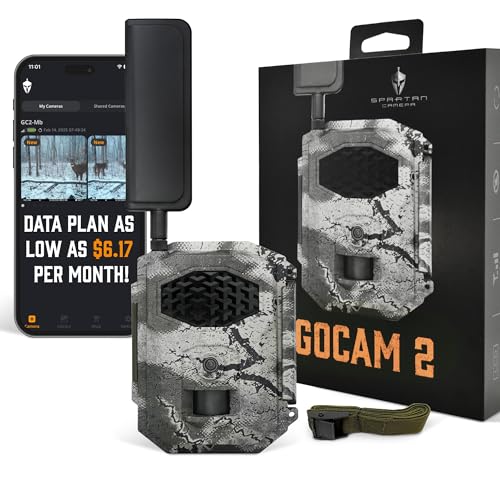
Spartan GoCam2 Cellular Trail Camera — Best app-led Verizon pick
Spartan built its reputation on the app, and the GoCam2 listing leads with exactly that: APP Control, capitalised by the manufacturer as if to underline where this camera expects to be managed. Settings, requests and image flow run through the phone in your pocket, which suits owners who treat their camera fleet as a system to be administered rather than a set of boxes to be visited.
Carrier identity is explicit here — the listed variant is the Spartan Areus on Verizon — and that explicitness is a virtue. You know precisely which network the camera will court before money changes hands, so a property bathed in Verizon signal becomes a straightforward yes, and a Verizon dead zone becomes an equally straightforward pass to a multi-carrier rival above.
Imaging claims settle at 1080P video with FHD photos, modest beside the 4K headlines elsewhere in this guide, and this review will not inflate it into one. Resolution, though, is not the whole of a scouting photograph: a correctly exposed, well-framed FHD frame identifies a buck’s rack perfectly well, and Spartan’s following among serious hunters rests on delivery reliability rather than pixel counts.
Night specification reads No Glow alongside Night Vision and motion activation, so the camera works dark hours without advertising itself. The housing carries an IP65 water-resistance rating — a step below the Tactacam X’s IP66 on paper, the difference being finer jets of water in the test language, and in practice both ratings describe cameras built to live outdoors through a season’s weather.
Plan structure follows the per-camera rule that governs this entire category. Spartan’s service carries the images from its network partner to your app, and the cost conversation is the same fleet arithmetic described in the introduction: one camera, one plan, multiplied by however many trees you intend to instrument this year.
Ownership character is the GoCam2’s quiet appeal. The ecosystem feels engineered for the methodical — the hunter who names cameras by location, audits settings after a storm, and wants the app to behave like a control panel. If your scouting style is a spreadsheet with antlers, this is your temperament in hardware form, provided Verizon’s map smiles on your ground.
- 4G LTE cellular on Verizon (Areus variant as listed)
- App control headline feature
- 1080P video and FHD photos
- No Glow flash with night vision
- Motion activated capture
- IP65 water resistant housing
One practical ritual suits this camera: after any major storm, use the app to confirm each unit still reports, rather than discovering a wind-turned camera a fortnight later from a stream of sky photographs. App-led ownership rewards small habits like that, and the GoCam2’s design assumes an owner willing to form them in exchange for never wondering what a camera is doing three ridges away.
Strengths
- App-first management suits multi-camera systems
- Named carrier removes the coverage guessing game
- No-glow flash keeps night placements discreet
Trade-offs
- Photo resolution is FHD where rivals claim 4K
- Single-carrier commitment is wrong for mixed-signal land
- IP65 rating trails the IP66 listed for the Tactacam X
Best for: system-minded owners whose land sits in strong Verizon coverage
Not suited for: properties where Verizon is the weak network, since the listed variant cannot shop elsewhere

Stealth Cam Deceptor Cellular Trail Camera — Best resolution-led pick
Resolution headlines the Deceptor’s listing in a way no other camera here attempts: 40MP stills with 1440P HD video, numbers that promise detail when a photograph must be enlarged — counting points on a distant rack, reading a collar tag, identifying which of two similar bucks crossed the plot. Buyers who crop their scouting images hard will understand the appeal immediately.
Flash wording in the listing names an 80ft IR range with a “No” prefix attached to its glow description, and we report the listing’s own framing rather than tidying it: the Deceptor presents itself as a low-visibility infrared camera with reach measured at eighty feet. Night identification at that distance is the use case; a camera watching a wide food plot needs illumination that arrives where the deer actually stand.
Carrier choice is refreshingly plural. The listing states availability on AT&T and Verizon, so the buyer selects the network that covers the ground instead of inheriting the manufacturer’s single allegiance. Between the Spartan’s named commitment and Tactacam’s automatic selection, the Deceptor occupies the deliberate middle: your decision, made once, with both major options open.
Stealth Cam’s long history in card cameras shows in the Deceptor’s positioning as a bridge product — cellular delivery grafted onto a conventional trail-camera philosophy, with the megapixel emphasis that brand has always used to court detail-hungry buyers. Nothing in the listing discusses GPS or solar, and a careful shopper should register those silences as boundaries rather than oversights to be assumed away.
Plan membership follows the category rule once more. The Deceptor’s images travel through Stealth Cam’s service arrangement tied to whichever carrier you activated, and each additional Deceptor on the property adds its own plan to the household ledger. The resolution appetite has a subtle consequence here: larger files are the ones you will most want transmitted in full, so heavy users should think about allowance sizes in the maker’s tiers.
Where does it fit a fleet? As the designated detail camera — the unit on the primary scrape, the gate camera reading plates and faces, the one post where the question is never “was something there” but “exactly what was it”. Surround it with cheaper scouts if you like; the Deceptor earns its keep at the position where pixels convert directly into decisions.
- 40MP stills and 1440P HD video per the listing
- IR range stated at 80ft
- Available on AT&T and Verizon
- Cellular delivery to phone
- Night specification: Not stated in the listing title — verify with the manufacturer documentation
Cropping discipline unlocks this camera’s value. A 40MP frame tolerates the digital enlargement that turns a plot-edge deer into an identifiable individual, but only when the original is sharp — which circles back to mounting solidity. Strap the Deceptor to a tree that does not sway, because megapixels magnify camera shake exactly as faithfully as they magnify antlers, and a season of slightly blurred detail shots is the one outcome its specification exists to prevent.
Strengths
- Highest stills resolution claimed in this guide
- Choice of two major carriers at activation
- Long stated infrared reach for wide plots
Trade-offs
- No GPS or solar mentioned in the listing
- Large files reward generous plan allowances
- Night wording in the listing is less explicit than rivals
Best for: the designated detail post — scrapes, gates and plots where identification matters most
Not suited for: owners who need theft tracking, since the listing names no GPS function

Bushnell CelluCORE Live Cellular Trail Camera — Best for live viewing
Live is the operative word in Bushnell’s listing, and it changes the emotional register of scouting. Real-time image streaming means the camera behaves less like a correspondent mailing letters and more like a window: open the app and look at the clearing now. Property owners checking a remote cabin approach, farmers watching a calving pasture, and hunters curious about this evening’s plot traffic all feel the pull of that immediacy.
Supporting numbers hold up respectably: 32MP images, 1080p HD video, and a 0.3-second trigger speed that the listing states plainly. Trigger speed is the specification that decides whether a crossing deer is centred or clipped, and three-tenths of a second is brisk company in any trail-camera conversation, cellular or otherwise.
The Tree Bark Camo finish named in the listing is a small honesty about where these cameras live — pressed against bark, at animal eye height, for months. Weather-resistant construction is claimed without an IP number, so the review records the claim in the maker’s own terms and suggests the documentation for anyone whose placements face genuinely violent weather.
Live streaming spends power and data differently from snapshot delivery, and prospective owners should think in those terms. A camera streaming frequently is a camera transmitting frequently, so battery changes and plan allowances both deserve headroom. Bushnell’s design clearly accepts that bargain, betting that immediacy is worth a shorter leash on service intervals — a bet that lands well with the security-minded buyer and less well with the set-and-forget traditionalist.
Bushnell’s heritage in optics and trail cameras lends the CelluCORE line a mainstream familiarity the specialist brands cannot match; this is the cellular camera a gift-buyer can choose with confidence for a landowning parent, because the brand on the box is one they already trust from binoculars and scopes.
Placement advice for a live camera differs subtly from the scouts around it. Put it where events unfold rather than where animals pass: the feeder clearing, the cabin drive, the gate. A passing deer gives a stream little to show; a lingering scene — turkeys working a plot at dusk — is exactly the broadcast this hardware was built to send you.
- Real-time image streaming
- 32MP images and 1080p HD video
- Trigger speed stated at 0.3 seconds
- Tree Bark Camo finish
- Weather-resistant design per the listing
- Night specification: Not stated in the listing title — verify with the manufacturer documentation
Households discover a second audience for this camera quickly: the family group chat. A live view of deer under the feeder becomes shared entertainment in a way a folder of timestamped stills never quite achieves, and more than one owner has reported the camera justifying itself as a window on land they love but cannot visit weekly. Scouting tool, security device and fireside broadcast, in that order or any other.
Strengths
- Live streaming is a genuinely different scouting rhythm
- Fast stated trigger speed for crossing game
- Mainstream brand familiarity eases gift and first purchases
Trade-offs
- Streaming appetite shortens service intervals
- No IP rating number given in the listing
- Night performance is not specified in the listing title
Best for: cabin, gate and pasture watching where seeing now beats reviewing later
Not suited for: a remote post you can service only twice a year, since streaming rewards reachable placements

SPYPOINT Flex-Dark Cellular Trail Camera — Best starter with a free tier
SPYPOINT’s listing reads like a checklist written by someone who interviewed first-time cellular buyers: a free plan to start, multi-network LTE so coverage questions soften, GPS for peace of mind, and no-glow night vision reaching a stated 100 feet. The Flex-Dark is the camera designed to lower every barrier between a curious landowner and their first delivered photograph.
That free plan deserves precise framing. It exists — the listing says so — and it makes the Flex-Dark the only camera here whose running cost can begin at zero. What the listing does not do is promise unlimited free transmission, and experienced owners will assume the free tier is a starting allowance that heavy traffic outgrows. Even so, a camera that scouts a quiet crossing on a free tier while its siblings need paid plans from day one has a real economic personality.
Imaging figures are ambitious: 40MP photo and 1080P video with sound, the audio being a small differentiator — turkey talk, deer vocalisations and the general dawn chorus add context a silent frame cannot. Trigger speed is stated at 0.4 seconds, a whisker behind the Bushnell’s figure, and the housing is described as waterproof without an IP numeral attached.
Multi-network behaviour echoes the Tactacam X’s flexibility: the camera works across cell networks rather than pledging to one, which suits the buyer whose land sits between coverage areas or who simply refuses to research carrier maps before a purchase. Combined with GPS, the Flex-Dark covers the two anxieties — signal and theft — that most often stall a first cellular purchase entirely.
No-glow specification paired with the 100Ft night-vision motion-detection claim makes this a legitimately discreet camera, not merely a connected one. On small properties where deer encounter human pressure weekly, invisible flash protects the very behaviour you installed the camera to observe, and SPYPOINT’s dark-flash lineage is the brand’s home turf.
Fleet economics may be its deepest appeal. A beginner can start with one Flex-Dark on the free tier, learn their land’s traffic patterns, and expand knowing exactly which posts justify a paid plan’s volume. That graduated on-ramp is rare in a category that usually demands full commitment at the first checkout, and it earns the camera its closing position here rather than an earlier, louder one.
- Free plan stated in the listing
- Multi-network LTE connectivity
- No-glow night vision, 100Ft detection claim
- 40MP photo and 1080P video with sound
- Trigger speed stated at 0.4 seconds
- GPS and waterproof construction
Sound recording suggests a placement refinement: hang the Flex-Dark where audio tells a story — near a creek crossing where splashes precede the frame, or below a roost tree where wings announce arrivals the sensor has not yet caught. Owners who review with headphones once a week report learning their property faster than a season of silent stills ever taught them, which is a pleasant dividend from a camera bought for its price of admission.
Strengths
- Free tier makes it the gentlest entry into cellular scouting
- Multi-network flexibility plus GPS covers both starter anxieties
- Video with sound adds context rivals omit
Trade-offs
- Free plan is a starting allowance, not unlimited service
- Trigger speed trails the fastest camera here
- Waterproof claim carries no IP number in the listing
Best for: first-time cellular buyers and quiet crossings that suit a free tier
Not suited for: a high-traffic feeder expected to transmit hundreds of frames monthly on the free allowance
Moultrie Edge Cellular Camera Family — Prose-only: the ecosystem to compare before buying
Regulars in this category will notice an absence, and honesty requires addressing it directly: Moultrie’s Edge family is a major cellular trail-camera line, yet no linked listing for it appears in this guide. That is a gap in available listings at the time of writing, not a judgement on the cameras, and any buyer comparing ecosystems should hold the Edge family in mind while reading the six linked reviews above.
The Edge line’s reputation rests on its app and plan model. Moultrie built its cellular offering around a single subscription relationship that can serve multiple cameras under one account structure, an arrangement fleet owners praise because it softens the one-plan-per-camera arithmetic that governs most of this category. Photographs flow into one gallery, cameras are managed as a group, and the administrative texture differs noticeably from the per-unit billing described elsewhere in this guide.
Hardware positioning, described in general terms, targets the same buyer as the Tactacam and SPYPOINT entries: cellular delivery, night capture for dark hours, and placements that run for months between visits. Shoppers cross-shopping the Edge against the REVEAL X 3.0 are really choosing between ecosystems — whose app they prefer living in, whose plan structure fits their camera count, whose customer service their hunting partners recommend.
Why include a camera we cannot link? Because a buying guide that silently omits a major line misleads by tidiness. The Edge family exists, your hunting partners may run it happily, and the correct response to its absence here is to compare it deliberately — read its plan terms against the per-camera commitments above, then decide whether the linked cameras’ specific strengths outweigh an ecosystem preference.
Practical counsel for that comparison: price the whole fleet, not the first camera. Model two seasons of plans for the number of units you genuinely intend to run, add the cost of your time visiting card cameras if you stay conventional, and let that honest total — not a headline camera price — arbitrate between Moultrie and every linked name in this guide.
- Cellular trail camera family from Moultrie
- Known for an app-centred, multi-camera plan model
- Listed here without a link — no listing was available to verify
- Compare its plan structure against the linked cameras before buying
Owners migrating from Moultrie’s older card cameras often ask whether the Edge is the natural upgrade, and the answer the ecosystem gives is yes by design: one account, familiar brand, cameras that report home. Loyalty is a legitimate input to a purchase. Just let it be an informed loyalty, measured against the GPS, no-glow and live-streaming specialities the linked six bring to their particular trees.
Strengths
- Plan model designed around multi-camera accounts
- Established brand with a deep trail-camera catalogue
- App experience frequently praised by fleet owners
Trade-offs
- No verified listing available for this guide to link
- Ecosystem strengths require buying into one maker’s service
- Specific model specifications need checking on the manufacturer’s pages
Best for: existing Moultrie owners expanding into cellular under one account
Not suited for: anyone set on buying through a verified listing today, since this family has none here
How Does a Cellular Trail Camera Actually Deliver a Photograph?
The journey is worth understanding because every strength and bill in this category follows from it. A passive infrared sensor notices a warm body moving against cooler background; the camera wakes, exposes a frame, and then — the cellular difference — a radio module negotiates with the nearest compatible tower and uploads the image to the maker’s servers, which push it to your app. Each stage spends battery, and the upload is the expensive one, which is why transmission frequency dominates real-world endurance far more than standby figures suggest.
Signal quality quietly edits your results. A camera at the fringe of coverage retries uploads, burning charge on failed handshakes, and may deliver in batches when a stronger window opens. This is why multi-carrier models and honest carrier research matter more than any megapixel figure: the best photograph in this guide is worthless on a card you cannot reach and a network the camera cannot hear.
Which Carrier Arrangement Suits Your Land?
| Pick | Carrier arrangement | Delivery style | Standout trait |
|---|---|---|---|
| Tactacam REVEAL X 3.0 | Auto-connect multi-carrier LTE | Transmitted photos and video | No SD card to service |
| Tactacam REVEAL Pro 3.0 | 4G LTE | Transmitted photos | GPS plus no-glow flash |
| Spartan GoCam2 | Verizon (Areus variant) | App-managed delivery | App control as the centrepiece |
| Stealth Cam Deceptor | AT&T or Verizon | Transmitted photos and video | 40MP stills resolution |
| Bushnell CelluCORE Live | Cellular network | Real-time image streaming | Live view of the clearing |
| SPYPOINT Flex-Dark | Multi-network LTE | Transmitted photos and video | Free plan tier included |
| Moultrie Edge family (prose-only) | Maker’s cellular service | App gallery delivery | Multi-camera account model |
Read the carrier column as a map question, not a brand question. Stand where the camera will hang, look at your phone, and let that screen arbitrate: strong Verizon points to the Spartan or a Deceptor activated accordingly; mixed or shifting coverage argues for the auto-connect and multi-network designs; a property you visit mainly through a screen argues for the Bushnell’s live window regardless of carrier loyalties.
What Should a Data Plan Conversation Include?
Every camera in this guide needs its own plan, and the shopping conversation should happen at fleet scale. Ask how many images a tier carries, whether video transmissions count differently from stills, and what happens at the limit — throttling, pausing or overage. Ask whether plans can pause in the off-season, because a camera guarding a cabin in January and a camera scouting in October have different working years, and a pausable plan respects that rhythm.
Also ask where your photographs live. Images pass through the maker’s servers to reach the app, so account security, sharing controls and export options are part of the purchase. Owners who share a lease often give partners view access; owners watching a home site may want the opposite. The plan is a relationship, and reading its terms once, in daylight, at the kitchen table, prevents the small resentments that sour good hardware.
Where Should a Cellular Camera Hang?
Height and angle decide more photographs than sensor size ever will. Chest height on a deer trail, angled slightly downward, catches bodies rather than ears; on a crossing, a quartering angle stretches the detection window so the trigger fires with the animal inside the frame instead of leaving it. Cellular delivery turns placement into an experiment with fast feedback — hang, review the evening’s frames on your phone, adjust by a hand’s width next visit.
Face the camera north where you can. A lens staring into sunrise or sunset collects false triggers from shifting light and delivers silhouettes when it fires for real. Under canopy, watch for the sapling that sways through the detection zone on windy afternoons; a busy camera is not merely annoying, it is a battery and plan allowance being spent on vegetation.
How Do You Keep a Fleet Affordable Across a Season?
Assign roles. Not every post needs the flagship treatment: a live-streaming camera at the gate, a high-resolution unit on the main scrape, free-tier or modest-plan cameras on quiet crossings. Role-based fleets spend where information is valuable and economise where a weekly photograph answers the question. The linked six were chosen partly because they let an owner build exactly that kind of mixed, deliberate system.
Retirement is part of fleet economics too. An ageing camera with a weakening radio does not become free when its plan lapses; it becomes a temptation to keep paying for diminishing returns. Move veterans to near-home posts where a card check costs nothing, promote a newer unit to the distant ridge, and let each generation serve where its remaining strengths matter. Fleets managed this way age gracefully instead of expiring all at once in the same expensive October.
Transmission discipline helps more than any discount. Set quiet posts to photograph with delays between triggers, reserve video for the positions where behaviour matters, and review monthly which camera earned its plan. A unit that produced four useful frames all autumn is telling you something — about its tree, its trail, or its necessity — and the app makes that audit painless enough to actually perform.
How Should You Manage Batteries Across a Whole Fleet?
Battery bookkeeping separates calm owners from frustrated ones. Keep a simple log — in the app notes or a notebook in the truck — recording which camera received fresh cells and when, because a fleet’s failures otherwise blur into a general suspicion that everything is dying at once. Cellular cameras also report their charge through the app, and a weekly glance at those figures turns battery changes into planned stops on a route you were driving anyway, instead of emergency expeditions after a camera falls silent mid-rut.
Lithium cells earn their premium in this role. They tolerate cold that saps alkaline batteries, hold voltage steadier across their life, and suit the burst demands of a radio transmitting photographs at dawn. Whatever chemistry you choose, standardise it across the fleet: one battery type in the truck box, one behaviour to learn, no mid-season experiments conducted on the camera watching your best stand.
Solar changes the arithmetic where sunlight reaches. A panel on a field-edge post can hold a camera near full charge indefinitely, converting battery management into a twice-yearly inspection. Shaded timber posts gain little, which is why the REVEAL Pro’s solar compatibility should be read as a field-edge feature rather than a universal answer — placement decides whether the panel is a solution or a decoration screwed hopefully to a dark trunk.
What Changes When Winter Arrives?
Cold is the cellular camera’s honest examiner. Batteries deliver less, uploads take longer, and snow load can tilt a strap-mounted camera toward the ground one degree at a time until its world becomes a white slope. Winterised owners check mounts after storms, clear the lens and sensor window with a gloved thumb, and accept that a camera’s January photographs may arrive in batches when the radio finds its moment between weather systems.
Winter is also when cellular delivery proves itself most warmly. The landowner who once snowshoed in monthly to pull cards now watches the yard, the woodpile and the deer yarding area from the kitchen table. Security value peaks exactly when visiting is hardest, and several owners in this category quietly admit the cameras earn their plans in February more than in October.
How Do You Read Delivered Photographs Like a Scout?
A stream of timestamped images is data, and data rewards method. Note wind direction against deer movement across a week and patterns emerge that single visits never revealed: the crossing used on north winds, the scrape visited only after rain, the buck whose appearances cluster within an hour of legal light’s end. The camera’s gift is not any single photograph but the accumulation, and owners who review with a notebook — or the app’s tagging tools — convert pictures into a hunting plan by season’s end.
Resist the highlight-reel trap. A gallery sorted by excitement hides the ordinary frames that carry the information: does feeding at noon in a cold snap, the empty Tuesdays, the neighbour’s dog every Sunday. Pattern hunting is mostly the study of boring photographs, and cellular delivery’s real revolution is that it finally gives you enough boring photographs to study.
What If a Camera Stops Transmitting?
Work the problem in the order the system is built. First the app: is the plan active, the allowance unspent, the account in good standing? Then the reports: when did the camera last check in, and what battery figure did it send? Then the environment: storms, fallen limbs and curious cattle explain more silences than electronics do. Only after those three should you suspect hardware, and by then the drive out is a diagnosis rather than a guess.
Carry a small resurrection kit on that drive — fresh batteries, a spare strap, a cloth, and the patience to re-aim properly once the camera wakes. Most silent cameras return to duty with power and a cleared sensor window; the minority that do not have at least failed informatively, with a last photograph and a timestamp that tell you when the story ended.
How Far Can You Trust a Battery-Life Claim?
Treat every endurance figure in these listings as a fair-weather promise. A claim like six months of battery life is measured under the maker’s assumptions — moderate temperatures, a modest number of photographs, a strong signal that lets the radio finish each upload quickly. Your hollow in January offers none of those courtesies. The honest way to read such claims is comparatively: a camera promising six-plus months will, all else equal, outlast one promising a season, because both were flattered by the same laboratory optimism.
Transmission count is the variable you control. A camera over a busy feeder may send more photographs in a weekend than a crossing camera sends in a month, and its batteries will live the shorter life regardless of what the box promised. When a unit disappoints, audit its trigger count before blaming its cells — the log usually shows a camera that worked heroically, not one that failed early.
Who Else Should See the Photographs?
Sharing settings deserve the same deliberation as placement. Hunting partners benefit from shared access to a lease’s cameras, and a landowner who lets the farmer see gate activity builds goodwill that outlasts any single season. Family members, meanwhile, often become the most faithful audience of all — the evening’s deer photographs circulating like a small newspaper from land that several generations feel attached to.
Draw the boundary consciously, though. A camera watching a home site or a cabin approach produces images with a different sensitivity from a scrape camera’s output, and broad sharing granted in October’s enthusiasm can feel careless by March. Review who holds access when the season ends, trim the list to the people with a continuing reason, and treat the gallery’s privacy settings as part of the annual shutdown ritual alongside fresh batteries and a wiped lens.
When Does a Conventional Card Camera Still Win?
Loyalty to the new should not blind anyone to the old tool’s remaining virtues. A card camera asks nothing monthly, works in the signal-free basins where cellular radios starve, and can be left for a full year by owners whose scouting is a single annual ritual. Properties beyond coverage — and they exist in every state — are not failed cellular properties; they are simply places where the older technology remains the correct one.
Hybrid ownership is the grown-up answer for many. Run cellular units on the posts you check obsessively and the ground you cannot reach in winter; keep dependable card cameras on the near woodlot you walk weekly anyway. The fleet then costs what the information is worth, post by post, and no camera carries a plan merely because its siblings do. Several of the most satisfied owners in this category arrived at exactly that mixture after a first season of running everything on subscriptions and auditing which deliveries they actually opened.
Mistakes That Quietly Ruin a Cellular Setup
Mounting at the first convenient tree is the beginner’s tax. Ten extra minutes walking the trail for the right trunk — straight, shaded, quartering the crossing — returns a season of centred photographs, while the convenient tree by the path collects your own visits in glorious resolution and deer at the frame’s edge.
Forgetting the plan in the purchase maths is the second tax. A camera bought in a sale weekend glow becomes a subscription by the following weekend, and owners who did not expect it feel cheated by a product doing exactly what it promised. Read the introduction of this guide again if needed: one camera, one plan, always.
Ignoring firmware and app housekeeping is the slow third tax. Cellular cameras are small computers nailed to trees; updates fix delivery bugs, and an owner who never opens the app between September and November owns a fleet they are not really managing. A monthly ten-minute audit — battery, signal, last transmission — is the entire maintenance liturgy, and it works.
One last habit separates satisfied cellular owners from the rest: they photograph their own installations. A phone snapshot of each mounted camera — tree, angle, surrounding landmarks — turns spring’s re-hanging into a five-minute task per post and gives you a record if a unit ever does walk away. Small clerical kindnesses to your future self compound across a fleet exactly as subscriptions do, except in your favour.
Final Recommendation
The natural starting point is the Tactacam REVEAL X 3.0: its carrier flexibility, card-free design and long listed battery life remove the three frictions that discourage beginners, and its photographs arrive with the least ceremony. Step up to the REVEAL Pro 3.0 where theft or educated deer make GPS and no-glow flash worth having. Verizon-loyal system builders belong with the Spartan GoCam2, detail hunters with the Stealth Cam Deceptor, live watchers with the Bushnell CelluCORE Live, and cautious newcomers with the SPYPOINT Flex-Dark and its free first step — while Moultrie loyalists should compare the Edge family’s account model against all six before deciding.
A cellular camera changes scouting from archaeology into correspondence: the land writes to you daily, and you answer with better placements, better timing and eventually better hunting. Choose the correspondent whose habits match your property, fund its plan with open eyes, and let the photographs accumulate into knowledge no single visit could have given you.
Frequently Asked Questions
Does every cellular trail camera really need its own data plan?
Yes — the plan attaches to each camera’s connection, so a fleet of five cameras carries five plans. Structures differ by maker, from the Flex-Dark’s free starting tier to allowance-based subscriptions, but the per-camera principle holds across every brand in this guide.
Will a cellular camera work where my phone has no signal?
Generally no. The camera needs LTE coverage at its tree, though multi-carrier models widen the odds by choosing among networks. Check signal standing at the exact post before screwing in the mount, and favour the auto-connect designs where coverage is patchy.
Do cellular cameras also save photographs on a card?
Some do and some deliberately do not. The REVEAL X 3.0 needs no SD card at all, while the REVEAL Pro 3.0 lists an optional card slot for local overflow. Decide which philosophy suits your traffic levels before choosing between them.
Is no-glow flash the same thing as cellular delivery?
No — they are separate features that sometimes share a camera. Cellular describes how photographs reach you; no-glow describes an infrared flash invisible to animals and people. This guide is organised around delivery, and notes flash type where a listing states it.
Can I pause a plan outside hunting season?
Many services allow seasonal pauses or tier changes, but terms belong to each maker and change over time. Read the current plan documentation for the brand you choose, especially if your cameras work a short autumn and rest the rest of the year.
What happens to my photographs if I cancel a plan?
Images already delivered to your app or exported to your phone remain yours; the camera simply stops transmitting new ones until service resumes. Export anything precious before cancelling, and remember a cancelled cellular camera reverts to being, at best, a conventional card camera — if it has a card slot at all.
Related Guides
Stealth raises its own questions once delivery is solved, and our companion coverage follows naturally from here: begin with the best blackout trail cameras for a full treatment of no-glow flash and invisible night work, then see how darkness is handled on the road in the best dash cameras with night vision, and finish with a change of scale entirely in the best bridge cameras with a large sensor.


