What's inside
- Key Takeaways
- Quick Picks
- What does a wedding day actually ask of a camera?
- Comparison Table
- Why do professionals carry two bodies instead of one better body?
- How should lens money be divided across a wedding kit?
- How does a photographer survive the reception’s light?
- What should a second shooter expect from the lead’s kit?
- How do contracts and clients change the camera decision?
- What does weather sealing actually promise on a rainy Saturday?
- How long should a wedding body stay in service?
- Why does the editing workflow belong in a camera review?
- What role does silent shooting play in a ceremony?
- How should a photographer practise for a first season?
- What separates wedding specialists from generalists with good cameras?
- How do you choose between the three systems as a new professional?
- What does a sensible first-year buying order look like?
- Why do venues matter as much as cameras?
- How should a photographer handle the group-photo hour?
- What does the couple actually see when they judge your work?
- How do you brief a venue about photography before the day?
- Common Mistakes
- Final Recommendation
- Frequently Asked Questions
- Related Guides
As an Amazon Associate I earn from qualifying purchases. This post may contain affiliate links at no extra cost to you.
widgetverdict.com is reader-supported. When you buy through links on our site, we may earn an affiliate commission.
Wedding photographers do not get second takes, which is why the best cameras for wedding photography are judged by a harsher standard than any other category in photography. A landscape camera can wait for better light. A wedding body must produce a clean file of a first kiss in a candlelit barn, track a bride walking toward it down a bright aisle without losing focus at the crucial step, and still be working — battery, cards, shutter, photographer — at the last dance twelve hours later. The six full-frame bodies below, from Nikon, Sony and Canon, are the cameras working professionals actually build businesses on, and this guide treats them the way a second shooter would: not by their launch headlines, but by how they behave at hour nine.
Notice what this guide does not do. It does not invent card-slot counts, buffer depths or battery figures that the listings do not state; wedding folklore is full of such numbers, and they change with firmware and configuration. What it does instead is reason carefully about the things a buyer can verify: sensor class, system depth, autofocus philosophy, video capability as listed, and the lived reality of a twelve-hour day. Every body here is full-frame, because the low-light ceremonies and cavernous reception halls of real weddings reward the largest sensors a photographer can carry all day — and because the professional lens systems behind these mounts are the deepest in photography.
Key Takeaways
- All six picks are full-frame bodies from the three professional systems — Nikon Z, Sony E and Canon RF — because wedding low light, forbidden flash and lens depth demand exactly that combination.
- The Nikon Z 6II is the balanced working pro’s body; the Z 7II trades some speed of handling for ultra-high resolution for albums, wall prints and confident cropping of distant ceremony frames.
- Sony’s Alpha 7 IV is the hybrid all-rounder of its line, aimed at photographers who also deliver serious video within packages that increasingly bundle the two crafts together.
- Canon’s R6 Mark II is the value-conscious professional Canon body, while the R5 Mark II and R5 bring 45-megapixel files and 8K video to the top of the RF range, at flagship storage and workflow costs.
- Reliability across a long day is a system property — lenses, batteries, cards, backups and a second body — not a single camera specification, and it is planned in the week before, not improvised on the morning.
- Choose the mount by the lenses and the second-hand market around you; the bodies are closer in capability than their communities admit, and the photographer’s anticipation matters more than any of them.
Quick Picks
| Pick | Badge | Why it earns a place |
|---|---|---|
| Nikon Z 6II | The working pro’s balance | Nikon’s versatile full-frame stills and video hybrid, the body wedding shooters build a two-body kit around. |
| Nikon Z 7II | Resolution for albums | An ultra-high resolution full-frame stills and video body for photographers whose deliverables are large prints. |
| Sony Alpha 7 IV | Sony’s hybrid centre | A full-frame mirrorless interchangeable-lens camera positioned as the all-round hybrid of Sony’s range. |
| Canon EOS R6 Mark II | Canon’s pro value | A 24.2-megapixel full-frame body with photo and video capability for working Canon wedding shooters. |
| Canon EOS R5 Mark II | Flagship hybrid ceiling | A new full-frame body that records RAW video at 8K and 4K (S-RAW), for photo-video teams at the top end. |
| Canon EOS R5 | 45MP proven flagship | A full-frame hybrid with 8K video, a 45-megapixel CMOS sensor, DIGIC X processor and up to 12 FPS. |
What does a wedding day actually ask of a camera?
Picture the day in acts. Morning preparation happens in mixed window light and hotel lamps, with details — rings, shoes, invitations — that demand close focus and honest colour. The ceremony may be a noon garden or a dim church where flash is forbidden and the only light is whatever the architecture provides. Portraits compress into twenty frantic minutes of golden light. The reception is a dark hall punctured by DJ lights, sparklers and phone screens. A wedding body must be fluent in all four dialects in a single day, switched between them in seconds, by a photographer whose attention belongs on people rather than menus.
That fluency has three ingredients. First, clean files at the sensitivities dim venues force, because a grainy first dance is a deliverable problem, not an aesthetic choice. Second, autofocus that finds eyes in bad light and holds them through movement, because the processional, the first dance and the confetti throw are all moving subjects in poor illumination. Third, the unphotogenic virtues: weather resistance for the garden ceremony that rains anyway, controls that work with cold fingers, and a system of batteries and cards that never becomes the day’s bottleneck. The reviews below weigh each body against those three ingredients, and against the system of lenses standing behind it.

Nikon Z 6II — The working pro’s balance
If one body in this guide deserves the phrase “wedding photographer’s default”, it is the Z 6II. Nikon positions it as a versatile full-frame stills and video hybrid, and versatility is the precise virtue a wedding day rewards. Its resolution class suits the deliverables weddings actually produce — online galleries, albums, prints at sane sizes — while keeping files manageable across a day that can produce several thousand frames. Two Z 6II bodies, one with a wide zoom and one with a fast prime or telephoto, is the kit configuration a whole generation of Nikon wedding shooters settled on, because matched files from matched bodies make editing a coherent gallery dramatically easier.
The low-light case writes itself: full-frame files at reception sensitivities stay clean enough for album printing, and Nikon’s colour has a long-standing reputation among wedding shooters for skin tones that need little rescue. Skin is the subject of nearly every wedding frame, and a body whose files treat faces kindly at high sensitivity under mixed DJ lighting saves its owner hours every single week. The hybrid video side covers the growing expectation that a photographer can capture a clean ceremony clip or a first-dance minute when asked, without pretending to be a videography team.
Handling on a long day is where balanced bodies quietly win. The Z 6II is substantial enough to balance professional zooms and light enough that hour ten does not feel like a punishment; its controls sit where a Nikonian’s fingers already know. Pair it with the Z system’s fast primes for the ceremony and its workhorse zooms for the reception, and the kit covers the day’s four acts without a lens-change panic.
Who should walk past it? Photographers whose clients demand very large prints or aggressive cropping — the Z 7II below exists for them — and Canon or Sony loyalists whose lens drawers already voted. For a photographer building a Nikon wedding business from the body outward, this is the reference point.
Second shooters deserve a sentence in this body’s story, because the Z 6II is the body lead photographers most happily hand to an associate: its files match the lead’s, its handling teaches quickly, and its price tier means a studio can own three without theatrics. A wedding business is a small fleet, and fleet thinking — shared batteries, shared menus, shared colour — quietly favours bodies in this class over flagships that a studio can only afford singly.
- Sensor: full-frame
- Positioning per listing: versatile stills/video hybrid
- Model status: Nikon USA model
- Resolution: Not stated in listing title
- Form: mirrorless interchangeable-lens body
- Typical wedding role: primary body in a matched two-body kit
Strengths
- The most balanced file size, low-light behaviour and handling for all-day wedding work.
- Skin-tone-friendly files that reduce editing time across huge galleries.
- A matched pair forms a coherent two-body system with identical output.
Trade-offs
- Clients demanding very large prints may want the Z 7II’s resolution instead.
- Video is a supporting skill here, not a cinema speciality.
- The Z lens investment, while deep, is younger than Canon’s EF back catalogue.
Best for: working wedding photographers building a Nikon two-body kit for full-day coverage. Not suited for: print-first photographers whose albums and wall pieces demand maximum resolution from every frame.

Nikon Z 7II — Resolution for albums
The Z 7II is Nikon’s ultra-high resolution full-frame stills and video body, and its wedding case is about what happens after the wedding. Albums printed large, wall portraits above a mantel, and the freedom to crop a loose ceremony frame into a tight, emotional one — resolution buys all three. A photographer who shoots a processional wide for safety and crops to the couple’s faces in post is spending resolution as insurance, and the Z 7II holds the largest insurance policy in Nikon’s half of this guide.
That policy has premiums. Bigger files slow every stage after the shutter: cards fill sooner, backups take longer, and an editing machine feels the weight of a four-thousand-frame day. On the day itself, the resolution also disciplines technique — camera shake and missed focus are more visible at this pixel density, so the Z 7II rewards photographers whose craft is already steady. Many professionals therefore run it as the portrait and details body beside a Z 6II for the reception’s chaos, a pairing that plays each sensor to its strength.
Low-light behaviour remains full-frame civilised, though the resolution-first design philosophy means this body’s happiest territory is the day’s brighter acts: preparations, ceremonies with decent light, portraits and the detail work that fills album spreads. In the darkest reception halls, its sibling’s balance can feel more forgiving — a nuance, not a disqualification.
Choose the Z 7II when your product is print and your clients’ walls are large. It is a deliberate, craftsman’s body, and wedding photographers who sell albums rather than only galleries will feel its resolution earning money on every spread.
There is a creative dividend to resolution that pricing discussions miss: it licenses looser, more observational framing. A photographer carrying the Z 7II can hang back during a ceremony, shoot the scene whole, and trust the crop to find the exchange of glances afterwards — a documentary discretion that couples increasingly ask for by name. Resolution, used this way, is not about printing bigger; it is about intruding less.
- Sensor: full-frame, ultra-high resolution per listing
- Positioning per listing: stills/video camera
- Model status: Nikon USA model
- Resolution figure: Not stated in listing title
- Form: mirrorless interchangeable-lens body
- Typical wedding role: portraits, details and print-led coverage
Strengths
- Resolution that supports large prints and confident cropping of ceremony frames.
- Detail work — rings, lace, stationery — renders with album-ready fineness.
- Pairs naturally with a Z 6II in a two-body division of labour.
Trade-offs
- Large files tax cards, backups and editing machines across a long day.
- High pixel density exposes shaky technique more honestly.
- Its strengths matter least in the darkest reception conditions.
Best for: print-led wedding photographers selling large albums and wall portraits. Not suited for: high-volume shooters who prize fast turnaround over maximum file size.

Sony Alpha 7 IV — Sony’s hybrid centre
Sony’s Alpha 7 IV sits at the centre of the most aggressively developed lens system in mirrorless photography, and its wedding argument begins there. The listing describes a full-frame mirrorless interchangeable-lens camera; the reputation it carries into this guide is that of the hybrid all-rounder — the body Sony aimed at creators who shoot stills and video as one practice. Weddings increasingly ask exactly that of photographers, as couples add highlight films and ceremony coverage to packages that were stills-only five years ago.
Sony’s autofocus culture is the other pillar. The company’s eye-tracking systems earned their following in precisely the conditions weddings manufacture: subjects moving toward the camera, faces half-turned, veils and confetti interfering, light failing. A body from the system that made real-time eye autofocus an industry expectation carries a presumption of competence into the processional that a wedding shooter can feel in their shoulders — the shots that used to be prayers become routines.
The E-mount lens catalogue completes the case. Every focal length a wedding needs exists in multiple price tiers, from Sony’s own fast primes and zooms to a deep bench of third-party glass, and the used market is the largest in mirrorless. A second shooter can be equipped cheaply, a rental house anywhere stocks the mount, and a broken lens on a Saturday has replacements within reach — logistics that matter to a business more than to a hobby.
Against the Nikons, the Sony’s trade is character: some photographers find its menus denser and its colour a starting point rather than a destination, and wedding editors develop presets accordingly. Against the Canons below, it trades the RF system’s flagship video ceilings for the deepest lens bench. As the centre of a hybrid wedding business, it is a thoroughly rational body.
Wedding filmmakers who began as photographers often describe the Alpha 7 IV class as the bridge their business crossed: one body on a gimbal for the film, the same model on a strap for stills, identical colour and batteries across the team. That operational sameness is a deliverable in itself on a day when the schedule allows no troubleshooting, and it is a large part of why this body anchors so many two-person wedding companies.
- Sensor: full-frame
- Form: mirrorless interchangeable-lens camera
- Resolution: Not stated in listing title
- Video: hybrid stills/video positioning
- Mount: Sony E
- Typical wedding role: hybrid photo-video primary body
Strengths
- The deepest lens ecosystem in mirrorless, with glass at every price tier.
- Autofocus culture built for moving faces in poor light.
- A genuine hybrid skill set for packages mixing stills and film.
Trade-offs
- Menus and colour reward an investment in presets and practice.
- Top-end video ceilings live higher in Sony’s range than this body.
- Photographers loyal to Nikon or Canon ergonomics face a relearning curve.
Best for: hybrid wedding creators delivering stills and video from one Sony kit. Not suited for: photographers whose existing lens investment sits in another mount.

Canon EOS R6 Mark II — Canon’s pro value
Canon’s R6 Mark II is the body this guide expects to photograph the most weddings per pound spent in the RF system. Its listing states a 24.2-megapixel full-frame CMOS sensor with photo and video capability, body only — and that resolution is a considered wedding choice, not a compromise. Twenty-four megapixels print albums beautifully, crop sensibly, and keep a three-thousand-frame day light on cards, drives and editing time. Reception files at high sensitivity stay clean, and the sensor size that looks modest on a comparison chart turns out to be the working photographer’s friend across a whole season.
Canon’s autofocus lineage — Dual Pixel systems refined over a decade — shows in the moments weddings are made of: a face emerging from shadow at the church door, a couple spinning under string lights, a father’s expression during speeches. Canon colour, particularly for skin, has a devotional following among wedding photographers for a reason: files that flatter people under mixed light are worth money when the gallery runs to eight hundred images.
The RF system behind it offers Canon’s superb professional zooms and fast primes, plus the enormous EF back catalogue through adapters — a genuine wedding-business asset, since a second-hand EF workhorse lens can equip a second shooter for very little. The R6 Mark II is also the natural upgrade for the large population of Canon DSLR wedding shooters whose muscle memory and lens drawers are already Canon-shaped.
Its ceiling is defined by its siblings below: photographers who need 45-megapixel files or 8K video step up to the R5 line and pay accordingly. For the great majority of wedding deliverables, this body is not the budget option — it is the correctly sized one.
Reception specialists hold a particular affection for bodies in this class, because the reception is where wedding photography becomes endurance sport: hours of low light, moving dancers, speeches under a single spotlight. A body whose files stay clean, whose autofocus keeps finding faces in the murk and whose weight does not punish the eleventh hour is not a compromise at that point in the day — it is the correct professional instrument, and the R6 Mark II’s specification reads as if Canon interviewed reception photographers before finalising it.
- Sensor: full-frame CMOS, 24.2 megapixels
- Form: mirrorless body only — lens required
- Capability per listing: photo and video
- Mount: Canon RF (EF via adapter)
- Video ceiling: below the R5 line’s 8K
- Typical wedding role: primary body for working Canon pros
Strengths
- A resolution tuned to real wedding deliverables and fast turnaround.
- Canon skin tones and mature autofocus for the day’s decisive moments.
- Access to both RF glass and the vast used EF catalogue.
Trade-offs
- No 8K video and no 45MP files — those live in the R5 line.
- Body-only purchase assumes lenses are already owned or budgeted.
- Heavy cropping of distant ceremony frames reaches its limit sooner.
Best for: working Canon wedding photographers who value turnaround speed and skin tones over maximum resolution. Not suited for: photographers whose packages promise 8K film or very large fine-art prints.

Canon EOS R5 Mark II — Flagship hybrid ceiling
The R5 Mark II is Canon’s statement body in this guide: a new full-frame camera whose listing leads with video power — RAW video recording at 8K and at 4K in S-RAW — signalling that this is the body for photo-video teams operating at the top of the wedding market. When a couple books a combined team and the film deliverable must match cinema expectations while the stills hold flagship standards, this is the class of body that carries both halves of the contract.
For stills-led photographers, the honest question is whether the flagship ceiling changes their deliverables. Wedding films at 8K are a specialist product; most couples watch on phones and televisions where the R6 Mark II’s video is already beyond sufficient. Where the R5 Mark II earns its premium in stills terms is the flagship build, the newest processing and autofocus generation, and the professional expectation that the body will handle whatever a venue invents — heat, rain, chaos — without becoming the story of the day.
Teams should budget the whole ecosystem honestly: bodies at this level pair with the fastest cards, the largest drives and the most capable editing machines, and a two-body flagship kit multiplies all of it. That is not a criticism — it is the cost structure of the market tier this camera serves, where clients pay for the ceiling rather than the average.
As a single-body purchase for a stills photographer, it is aspirational; as the anchor of a premium hybrid team, it is the rational flagship. Know which business you are in, and the R5 Mark II’s place resolves itself.
Venue-proofing is the unglamorous flagship trait worth paying for at this tier. Destination weddings add beach humidity, mountain cold and venues with power that cannot be trusted; a flagship body is bought partly as insurance that the camera will not be the fragile element in an unfamiliar place. Teams working internationally also value a body that rental houses in major cities can replace like-for-like within a day, and flagships enjoy that network in a way mid-tier bodies do not.
- Sensor: full-frame, new generation per listing
- Video per listing: RAW at 8K, 4K (S-RAW)
- Form: mirrorless body, black
- Resolution: Not stated in listing title
- Mount: Canon RF
- Typical wedding role: flagship of a premium hybrid team
Strengths
- The highest hybrid ceiling in this guide, with 8K RAW video for film-led packages.
- Flagship build and the newest Canon processing generation.
- One body can anchor both stills and cinema-grade film deliverables.
Trade-offs
- Its video ceiling exceeds what most wedding clients will ever view.
- Flagship files demand flagship cards, storage and editing hardware.
- Stills-only photographers pay for film capability they may never sell.
Best for: premium photo-video wedding teams selling film as a headline deliverable. Not suited for: stills-only photographers, whose money works harder in lenses at the R6 Mark II level.
Canon EOS R5 — 45MP proven flagship
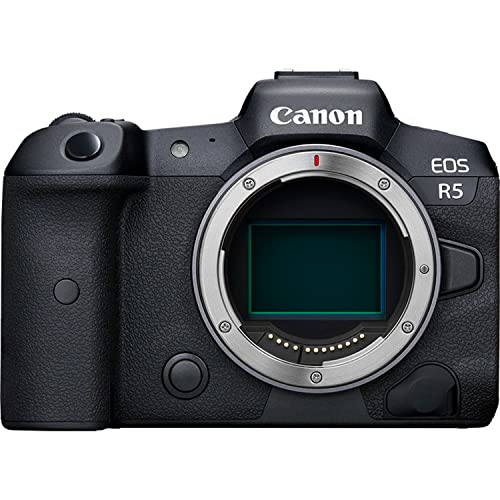
The original R5 remains in this guide because its listed specification reads like a wedding flagship checklist: a full-frame hybrid camera with 8K video, a 45-megapixel CMOS sensor, the DIGIC X image processor and continuous shooting up to 12 frames per second, on the RF mount. That combination — resolution for albums and cropping, burst speed for confetti throws and bouquet tosses, and video credibility for hybrid packages — made it the body that moved a generation of Canon professionals from DSLRs, and weddings were a large part of that migration.
The 45-megapixel file is the centre of its wedding personality. It crops a ceremony shot from the back of a long church into a frameable portrait, renders a dress’s lace and a table’s styling at album quality, and gives the editor freedom that 24-megapixel files ration. The cost, as with the Z 7II, is paid in storage and processing across a long day — a known, manageable tax that high-end studios build into their workflow and their pricing.
Beside its Mark II successor, the R5’s case is maturity and value: a proven body whose behaviour across thousands of real weddings is documented in exhaustive detail, available at a friendlier point in its life cycle — check price on Amazon for the current relationship between the two. Teams standardising on one Canon flagship can choose either with confidence; the deciding factors are budget and how much the newer generation’s refinements matter to their film work.
For a Canon photographer whose deliverables are print-led and whose packages include serious video, the R5 remains a complete answer rather than a historical footnote.
Studio economics complete the R5’s case. A body bought at this point in its life, worked hard for three seasons and sold into a deep used market, costs its owner less per wedding than its launch price suggested — while delivering flagship files throughout. Wedding photography is a business of per-event margins, and the R5’s position in its life cycle is, for many studios, precisely its charm.
- Sensor: full-frame CMOS, 45 megapixels
- Processor per listing: DIGIC X
- Video per listing: 8K
- Burst per listing: up to 12 FPS
- Mount: Canon RF
- Form: mirrorless body only
Strengths
- 45MP files for cropping freedom and fine album detail.
- 8K video keeps hybrid packages credible at a high tier.
- A proven professional record across many wedding seasons.
Trade-offs
- Large files raise card, storage and editing costs across a full day.
- Its successor refines the formula for film-led teams.
- Resolution this high rewards disciplined technique at the shutter.
Best for: Canon professionals whose wedding products are print-led with serious video on the side. Not suited for: high-volume studios optimising for same-week turnaround above file size.
Comparison Table
| Camera | System | Sensor as listed | Video as listed | Wedding role |
|---|---|---|---|---|
| Nikon Z 6II | Nikon Z | Full-frame | Stills/video hybrid | Balanced primary body |
| Nikon Z 7II | Nikon Z | Full-frame, ultra-high resolution | Stills/video | Print and portrait body |
| Sony Alpha 7 IV | Sony E | Full-frame | Hybrid positioning | Hybrid all-rounder |
| Canon EOS R6 Mark II | Canon RF | Full-frame CMOS, 24.2MP | Photo and video | Working pro value |
| Canon EOS R5 Mark II | Canon RF | Full-frame, new generation | 8K RAW, 4K S-RAW | Premium hybrid flagship |
| Canon EOS R5 | Canon RF | Full-frame CMOS, 45MP | 8K | Print-led flagship |
Why do professionals carry two bodies instead of one better body?
Redundancy is the wedding industry’s first commandment, and it is about the couple, not the photographer’s pride. A body that fails at 2 p.m. cannot be replaced by a better body that also fails; two good bodies mean the day continues while one is sidelined. The second body also carries the second lens, so the photographer switches framings by switching shoulders instead of changing glass during the thirty seconds the moment allows. Every body in this guide is therefore best understood as half of a pair — matched where possible, complementary where resolution or video roles divide the labour, as in the Z 6II and Z 7II pairing.
Insurance, contracts and backups extend the same logic beyond the camera bag, but the body pairing is where it starts. A solo shooter with one body from this page and a borrowed backup of any full-frame class is better insured than a shooter with a flagship and nothing behind it.
How should lens money be divided across a wedding kit?
The classic allocation puts a fast standard zoom and a fast telephoto zoom at the centre, primes for the ceremony’s darkness, and a macro-capable option for details. Bodies in this guide are interchangeable across that plan because all three systems offer the same architecture of glass; what differs is price and the used market’s depth in your area. A sensible rule is that the lens kit should outvalue the bodies it serves — glass holds value across body generations, and the couple sees the lens’s contribution in every frame while the body’s contribution is mostly reliability.
Rent before committing to exotic glass. Wedding work reveals quickly which focal lengths your style actually uses, and they are rarely the ones a forum predicted. The bodies above will wait patiently while the lens drawer sorts itself out.
How does a photographer survive the reception’s light?
The reception is where wedding cameras earn their fee. The light is low, coloured and moving; the subjects dance, spin and dip; and the couple will judge the whole gallery partly by whether the first dance looks like the memory feels. Technique carries most of the load — dragging the shutter to keep ambient warmth while a flash freezes the subject, bouncing light off whatever ceiling the venue provides — but the body’s contribution is real: clean high-sensitivity files give the technique room to work, and autofocus that keeps an eye through a spin turns a hopeful burst into a sequence the editor can choose from.
Every body in this guide has the sensor class for that work. What separates results is the photographer’s rehearsal: shoot a dark hall before the season starts, learn your body’s behaviour at the sensitivities you will actually use, and set your limits while the stakes are low. The reception will not pause while you experiment.
What should a second shooter expect from the lead’s kit?
Second shooting is the wedding industry’s apprenticeship, and it runs on compatibility. A lead photographer handing a second a body from the same system — ideally the same model — is buying matched colour, shared batteries and lenses that swap without adapters or thought. This fleet logic is a genuine argument for the mid-tier bodies in this guide: a studio can field three Z 6IIs or R6 Mark IIs, brief the team in minutes, and merge three cards into one gallery that grades as a single photographer’s work.
Seconds also learn the day’s geography faster on a familiar body. The kindest thing a lead can hand an associate is not the flagship but the camera whose menus the associate already knows — one more reason the balanced bodies outsell flagships inside working studios, whatever launch coverage suggests.
How do contracts and clients change the camera decision?
Clients rarely name a camera, but their products do. A couple buying a large fine-art album has, without knowing it, specified a resolution class; a couple buying a highlight film has specified a video class; a venue with a no-flash ceremony rule has specified a low-light class. Reading the booking backwards into equipment is the professional skill underneath this entire guide, and it explains why no single body here is “the wedding camera”: the six divide the space of real contracts among them.
It also explains upgrade timing. Studios buy bodies when their bookings change — when albums get larger, when film joins the packages, when a second team forms — and not when a launch event tells them to. A camera bought against a signed contract pays for itself on a schedule; a camera bought against a headline is a hobby expense wearing a business costume.
What does weather sealing actually promise on a rainy Saturday?
Professional bodies in this class are built to keep working through the weather a wedding cannot reschedule: the garden ceremony in drizzle, the sparkler exit in November cold, the beach portrait in wind-blown sand. Sealing is not waterproofing — no body here is promised a swim — but it is the difference between sheltering the camera under a jacket between shots and abandoning coverage. Lenses must match the body’s sealing for the system to hold, which is one more argument for professional glass over bargain alternatives.
Cold deserves its own sentence, because winter weddings drain batteries at a pace that surprises photographers raised on summer work. The professional habit is boring and total: batteries rotate from an inside pocket, cards are swapped before they are full, and the backup body lives somewhere warm. Bodies do not fail winter weddings; logistics do.
How long should a wedding body stay in service?
Studios typically work a primary body for three to five seasons, then demote it to backup or second-shooter duty as shutters age and newer autofocus generations arrive. That life cycle favours bodies with strong used markets — every pick here qualifies — because the demoted body retains value as a spare, a rental or a sale. It also favours buying the correctly sized body now over the flagship on credit: a body that is paid for earns from its first wedding, and its replacement is funded by work rather than by hope.
Shutter counts and service networks belong in that calculation too. Professional service programmes exist for all three systems in this guide, and a studio that joins one is buying turnaround time during the season — the only currency a wedding photographer cannot print.
Why does the editing workflow belong in a camera review?
Because a wedding is not finished when the dancing ends, and the body chosen determines the shape of the week after. A photographer delivering eight hundred edited images lives inside the consequences of file size, colour character and autofocus accuracy long after the event: accurate focus means fewer culled frames, kind colour means faster grading, sensible resolution means the export finishes before the client meeting. Studios evaluate bodies on that total cost of ownership, which is why the balanced bodies in this guide — the Z 6II and R6 Mark II — dominate working kits despite the flagships’ higher ceilings.
New photographers should weight this section heavily. The camera you will love in month six is the one whose files you enjoy editing at midnight in month two, and that preference is personal enough that handling a rental for one real wedding teaches more than a month of comparison charts.
What role does silent shooting play in a ceremony?
A shutter’s sound is a presence in a quiet church, and mirrorless bodies removed it — one of the genuine revolutions this generation brought to wedding work. Silent electronic capture lets a photographer work through vows without becoming part of the soundtrack, and officiants who once restricted photography now tolerate a silent camera at a respectful distance. The bodies here all belong to that silent generation, though photographers learn each venue’s light the hard way: some LED and fluorescent sources band under electronic shutters, and the professional habit is to test during the rehearsal or the empty-venue visit, not during the vows.
Discretion extends beyond silence. A smaller body with a compact prime draws less attention than a flagship with a long zoom, and documentary couples increasingly choose photographers whose equipment disappears. The kit is part of the manner, and the manner is part of the product.
How should a photographer practise for a first season?
Rehearse the day’s four acts separately before combining them. Shoot details in mixed window light until exposure is instinctive. Shoot a friend’s evening event in a dark hall until reception settings are memorised rather than looked up. Shoot portraits against the clock — twenty minutes, changing light — until posing and camera operation share your attention peacefully. Then second-shoot a real wedding on any body in this guide and discover which of your rehearsed skills survived contact with the schedule.
Equipment practice is the smallest part: know where every control sits without lowering the camera, change a card one-handed, swap a battery in the dark. The bodies here reward that fluency identically; the photographer supplies it.
What separates wedding specialists from generalists with good cameras?
Anticipation. The specialist knows the ceremony’s geography before the processional starts, has stood where the light will be at the portrait hour, and carries the day’s timeline in their head alongside the couple’s family politics. Cameras record what anticipation positions them to see. This is said not to diminish the equipment question — the six bodies here are the professional tools for a reason — but to place it: buy the body that fits your system and your contracts, then invest the larger half of your development in the seeing.
It is also why this guide resists crowning one winner. A specialist’s Z 6II kit and a specialist’s R5 kit produce indistinguishable client joy; the differences live in workflow, product and preference, which is exactly where the reviews above concentrated.
How do you choose between the three systems as a new professional?
Handle all three, in a shop or at a rental counter, with the lenses you would actually buy mounted. Ergonomics decide more weddings than specifications do, because the body lives in your hands for twelve hours and its dials are operated by memory while your eyes stay on the couple. Then price the whole three-year kit — two bodies, three lenses, flashes, cards — in each system, because the body is the cheapest line in that spreadsheet and the systems diverge mostly in glass and used-market depth where you live.
Local community is the third factor, and it is underrated: the system your city’s wedding photographers shoot is the system you can borrow from at midnight before a wedding, staff with second shooters who know the menus, and service through the nearest professional desk. All three systems in this guide can claim that community somewhere; choose the one that claims it where you work.
What does a sensible first-year buying order look like?
One body from this guide, the standard zoom, one fast prime, a flash and a lighting modifier — then a season of weddings. The second body comes before the second zoom, because redundancy outranks range; the telephoto zoom comes before the exotic prime, because receptions reward reach; and the flagship upgrade comes last, if the contracts ever ask for it. Photographers who buy in that order own a business at every stage. Photographers who reverse it own impressive equipment and an anxious diary.
Rentals bridge every gap in that order honourably. A rented telephoto for the one cathedral wedding of the season is better business than a purchased one gathering dust, and every body in this guide is stocked by rental houses precisely because professionals built that habit.
Why do venues matter as much as cameras?
Every venue teaches a camera a different lesson. The dark barn rewards sensitivity and flash craft. The white marquee at noon punishes dynamic range and rewards a photographer who exposes for the dress. The city hotel ballroom mixes tungsten, LED and daylight in a single frame and tests colour discipline. A body chosen from this guide handles all three competently; the photographer’s venue homework — visiting at the ceremony hour, noting where the light falls, asking the coordinator about restrictions — decides whether competence becomes excellence.
Build a venue notebook across a season and it becomes a business asset no competitor can copy: light maps, coordinator names, the socket that works, the corner where the dress hangs best. Cameras are bought; venue knowledge is earned, and clients feel the difference in the calm of the day.
How should a photographer handle the group-photo hour?
Group photographs are logistics wearing a camera’s clothes. The bodies here all resolve a twenty-person line-up easily; the photographer’s real tools are a list agreed with the couple beforehand, a loud friendly voice, a helper who gathers relatives, and light chosen before the crowd assembles. Resolution from the Z 7II or R5 helps when a face in the back row becomes the framed print a family orders, but organisation is what finishes the groups in the twenty minutes the schedule allows, leaving the couple their evening.
Choose the spot during the venue visit, not during the drinks reception, and shoot the largest group first while patience and light are both fresh. The camera’s contribution is to be ready instantly, focused surely, every time — which is to say, any body in this guide, in practised hands.
What does the couple actually see when they judge your work?
Not pixels. Couples judge whether their people look like themselves on the best day of their lives, whether the gallery tells the day in order, and whether the moments they missed — a father’s face during the vows, friends laughing at the back of the church — were caught anyway. Every technical choice in this guide serves those judgements indirectly: autofocus for the missed moments, low-light cleanliness for the church, resolution for the album on the coffee table, reliability for the simple fact of the gallery existing at all.
Hold that hierarchy while shopping and the decision clarifies. The body is the tool that must never be thought about again after purchase, so the couple can be thought about exclusively on the day. All six bodies here pass that test in professional hands; the reviews above exist to match them to the hands, systems and contracts in front of you.
How do you brief a venue about photography before the day?
A short conversation with the venue’s coordinator prevents the classic wedding-day collisions: the house lights killed mid-ceremony for ambience, the registrar who bans photography from the aisle, the DJ whose haze machine fogs every frame of the first dance. Ask about restrictions, power, and where previous photographers stood; venues appreciate being asked, and the answers reshape your lens and lighting plan more than any camera upgrade could. The bodies in this guide adapt to whatever the answers are — that adaptability, across a career of unpredictable rooms, is the professional constant.
Common Mistakes
Buying resolution for its own sake tops the professional error list. A 45-megapixel workflow imposed on a studio whose clients view galleries on phones converts directly into slower delivery and larger storage bills, with no visible benefit to anyone. Match file size to deliverables, as the R6 Mark II’s 24.2 megapixels remind us — and remember that resolution bought for a product you might sell someday is a loan taken against weddings you have already booked.
Arriving with one body is the unforgivable one. Equipment fails rarely and weddings happen once; the arithmetic is not subtle, and no client’s understanding should ever be the backup plan. Even a borrowed, older full-frame body in the car transforms the risk profile of the day from catastrophic to merely inconvenient.
Underinvesting in light follows. A small, well-used flash system — or mastery of venue light where flash is banned — shapes wedding images more than the gap between any two bodies in this guide. Photographers who blame their camera for reception files are usually describing a lighting education they have not finished, and the kindest fix is a winter of practice events before the next season’s bookings depend on it.
Neglecting the backup workflow completes the pattern: cards that live in a camera bag for a week, a single copy of the day’s files, a laptop as the only archive. The bodies here record faithfully; what happens to the files afterwards is a discipline, and studios are remembered for the wedding they lost, not the hundred they delivered. The professional standard is unglamorous and absolute — the day’s images exist in at least two places before the photographer sleeps, and in three before the cards are formatted for the next wedding.
Final Recommendation
Build from the business you actually run. Nikon shooters: the Z 6II is the default primary body, with the Z 7II joining when print products justify it. Sony shooters: the Alpha 7 IV is the hybrid centre of the deepest system, and its autofocus culture suits the day’s movement. Canon shooters have the widest spread: the R6 Mark II for correctly sized professional work, the R5 for print-led resolution with 8K credibility, and the R5 Mark II when film becomes a headline product. Across all three systems, the second body and the lens kit deserve budget before any flagship premium does.
A wedding camera’s real specification is trust — the couple’s, earned across twelve hours when nothing can be repeated. Every body here has earned that trust at scale; choose the one whose system you will enjoy feeding with lenses for a decade.
And then stop shopping. The photographers whose work improves fastest are the ones who freeze their kit for a season and spend their attention on light, timing and people, because a wedding rewards the prepared eye far more than the newest body. Buy well from this page, insure it, back it up, and go and learn a season’s worth of Saturdays.
Frequently Asked Questions
Is full-frame necessary for wedding photography?
For the low-light ceremonies and receptions that define the work, full-frame is the professional standard this guide follows, because larger sensors hold cleaner files at high sensitivities and the professional lens systems are built around them. Skilled photographers shoot fine weddings on smaller formats, but the market, the rentals and the second-shooter pool all assume full-frame — and assumptions, in a business built on referrals and reliability, are a kind of specification in themselves.
Which is better for weddings, 24 or 45 megapixels?
It depends on the product. Albums at normal sizes, online galleries and fast turnaround favour the 24-megapixel class of the R6 Mark II. Large prints, aggressive cropping and fine-art deliverables favour 45 megapixels from the R5 or the Z 7II’s ultra-high resolution. Neither figure is a quality score, and a photographer who cannot say which product their clients buy has a business question to answer before a camera question.
Do wedding photographers need 8K video?
Most do not. The R5 and R5 Mark II offer it for hybrid teams selling film at a premium tier, where the ceiling is part of the product and the clients’ venues and budgets match it. A stills-led photographer will not lose a booking over video resolution, and the money usually works harder in a second body or a lens.
How important is a second body, really?
It is the difference between a mishap and a catastrophe. Bodies fail, get dropped and get drinks spilled on them at receptions. Professionals carry two as a condition of the contract’s spirit, and clients are entitled to assume it without ever having to ask.
Can one of these bodies serve a beginner’s first wedding?
Yes, with humility about scope: second-shoot for an established photographer first, learn the day’s rhythm, carry the backup body without being asked, and let the camera — any of these six — be the least of your worries. The craft being purchased by the couple is anticipation, not equipment.
Should a wedding photographer worry about shutter lifespan?
A working body can record several hundred thousand frames across a few seasons, and professional service programmes exist for all three systems here to keep bodies in the field. Treat shutter life as a maintenance schedule rather than a countdown: service the body between seasons, demote it to backup duty as it ages, keep its firmware and its sensor clean, and let it retire as a second shooter’s camera with honour.
Are these bodies suitable for engagement and portrait sessions too?
Entirely — engagement sessions are where many photographers develop the couple relationship that books the wedding, and the same bodies serve both. The resolution-led picks, the Z 7II and the R5 pair, shine on portrait days when light is controlled and prints are the product; the balanced bodies shine when the session roams a city at dusk and the light changes every street.
Related Guides
Photographers speccing a first full-frame purchase for gentler work than weddings should start with the best beginner full-frame cameras. Detail specialists will enjoy the best close-up macro cameras for ring and stationery shots, and those who add wildlife or sports work to a wedding business can compare reach in the best cameras to shoot wildlife.


