What's inside
As an Amazon Associate I earn from qualifying purchases. This post may contain affiliate links at no extra cost to you.
widgetverdict.com is reader-supported. When you buy through links on our site, we may earn an affiliate commission.
Nobody remembers the camera in a great interview. They remember the pause before the answer, the laugh that arrived uninvited, the sentence a subject finally said at minute fifty because the room felt safe. That is the uncomfortable truth this guide to the best interview cameras is built on: the camera ranks third in an interview’s hierarchy, behind the audio that carries the words and the reliability that lets the conversation run unbroken. A body that calls attention to itself — by stopping, hunting for focus, or demanding the operator’s worry — taxes the very thing an interview exists to capture.
So the six tools below were judged as conversation furniture first and cameras second. Five are full-frame or Micro Four Thirds bodies with the autofocus, recording depth and ecosystem support that talking-head work quietly depends on. The sixth is a pocket gimbal camera, included honestly in its proper role: a B-camera and roaming second angle, never the main body an interview should rest on. Anyone who tells you a pocket camera replaces a proper interview body is selling you the pocket camera.
Read the sections with your format in mind. A corporate two-camera setup, a solo YouTuber’s studio corner and a documentary’s location interviews are three different jobs wearing one name, and this guide separates them rather than averaging them into a single false winner.
Formats deserve naming before bodies, because the word interview hides at least four productions. The studio podcast, with its regular chair and returning host. The corporate conversation, filmed in a borrowed office against a diary. The journalistic encounter, unrepeatable and slightly adversarial. The oral history, where the subject’s stamina, not the schedule, sets the length. Each format stresses a different virtue — streaming, discretion, stamina, invisibility — and the picks below are assigned to formats as much as ranked against each other. A reader who identifies their format first will find their camera waiting in the matching section, and will understand why a different format’s winner is not theirs.
Key Takeaways
- Interview quality is audio first, reliability second, camera third — every ranking below follows that order.
- Sony’s a7 IV is the default recommendation: a full-frame hybrid built for exactly this kind of dependable, face-focused work.
- Canon’s EOS R5 brings 45 megapixels and 8K video for productions that also need flagship stills and maximum reframing room.
- Panasonic’s S5IIX is the streaming-and-recording specialist: 5.8K ProRes, RAW over HDMI and IP streaming, as its listing states.
- Sony’s FX3 serves cinema-crew interviews where a Cinema Line body and full-frame look anchor a larger production.
- The DJI Osmo Pocket 3 is a B-camera and gimbal pick — brilliant as a second angle, never the main interview body.
Quick Picks
| Pick | Badge | Why it made the cut |
|---|---|---|
| Sony Alpha a7 IV | Best all-round interview body | The full-frame hybrid the industry treats as its talking-head default. |
| Canon EOS R5 | Best flagship hybrid | 8K video, 45MP stills and up to 12fps in a full-frame RF body, per the listing. |
| Panasonic Lumix S5IIX | Best for streaming and ProRes workflows | 5.8K ProRes, RAW over HDMI and IP streaming stated in the listing. |
| Sony Alpha FX3 Cinema Line Camera | Best cinema-crew interview body | A compact full-frame Cinema Line camera for produced interview setups. |
| Panasonic Lumix GH6 | Best endurance pick | Unlimited 4:2:2 10-bit recording and 7.5-stop stabilisation, as listed. |
| DJI Osmo Pocket 3 | Best B-camera and gimbal angle | A 1-inch CMOS pocket gimbal with 4K/120fps and 3-axis stabilisation, per the listing. |
How We Chose These Picks
Selection began with the interview’s true failure list. Interviews fail when the recording stops early, when focus drifts off an eye during the important answer, when the subject’s voice is captured thinly or not at all, and when the operator’s visible anxiety leaks into the room. Cameras were scored against those failures: recording depth and honesty where listings state it, autofocus reputation for faces, ecosystem support for serious audio, and the kind of operational calm that lets an interviewer stay in the conversation instead of babysitting a body.
The second filter was format fit. A solo creator filming themselves needs flip-screen confidence and autofocus that forgives the absence of an operator. A corporate crew needs bodies that match on a two-camera edit and behave identically at hour three. A documentary unit needs stamina and discretion. Rather than crown one camera for all three jobs, this guide assigns each pick to the format it serves and says so in its verdict lines.
Specification discipline matched the documentary guide’s rule: where a listing states a recording feature — unlimited recording, ProRes, streaming — it is analysed as a stated promise; where titles are silent about record limits or thermal behaviour, no claim is made in either direction, and the FAQ advises the only honest procedure, which is to test your own body before an irreplaceable conversation.
Finally, the pocket camera was included under a strict framing that its section enforces: it is recommended as a second angle, a walk-and-talk tool and a travel B-camera. Its presence is a service to real productions, which constantly need exactly that — provided nobody mistakes it for the anchor body of a serious interview setup.

Sony Alpha a7 IV — Best all-round interview body
The a7 IV’s listing could hardly be plainer — a full-frame mirrorless interchangeable-lens camera — and the plainness is appropriate, because this body’s interview case rests on accumulated trust rather than a single headline figure. The a7 line became the default talking-head camera of the creator and corporate era by doing the interview fundamentals without drama: autofocus that finds and holds an eye, colour that treats skin kindly, and an ecosystem in which every microphone, lens and cage a production might need already exists.
Eye-focused autofocus is the interview feature that matters most after audio, and it deserves explanation rather than a bullet point. A seated subject leans, gestures, laughs forward, rocks back — and each movement is a small focus problem that an operator riding manual focus must solve continuously, dividing attention that belongs to the conversation. A body that quietly owns that problem returns the interviewer to interviewing. Solo creators gain even more: they are both subject and operator, and reliable eye focus is the difference between a studio that works and one that needs a second person.
Sony’s lens and accessory ecosystem compounds the reliability argument. Interview lighting is usually soft and frontal, which forgives many lenses, but the audio chain is where productions actually differentiate: the E-mount world’s depth of compatible microphones, adapters and recorders means an interview kit can be assembled at any budget and repaired from any large city’s rental shelf. Reliability, in the real world, is often just the local availability of a replacement cable.
Full-frame rendering gives the interview its familiar professional grammar — the subject crisp, the room behind them suggested rather than itemised — at apertures moderate enough to keep a swaying subject in focus. That balance, neither razor-thin nor documentary-deep, is the look clients mean when they say they want it to look like television. The a7 IV delivers it as a default rather than an achievement.
Because the listing states no recording limits or video specifications, this guide asserts none; the professional habit of testing your own body’s long-take behaviour at home applies here as everywhere. For the broad centre of interview work — corporate, creator, educational, documentary-adjacent — this remains the body to beat. Producers standardising a kit can check the Sony a7 IV on Amazon and build the audio chain around it with confidence.
- Sensor: full-frame, per the listing title
- Type: mirrorless interchangeable-lens camera, per the listing title
- Mount: Sony E-mount system
- Video specification: Not stated in the listing title — verify with the manufacturer documentation
- Record limit: Not stated in the listing title — verify with the manufacturer documentation
- Stabilisation: Not stated in the listing title — verify with the manufacturer documentation
Strengths
- The talking-head default: trusted autofocus behaviour for faces and eyes.
- Full-frame look at working apertures that keep subjects safely in focus.
- Deepest accessory and audio ecosystem for assembling an interview kit.
Trade-offs
- Listing states no video figures — codec and limit homework falls to the buyer.
- Hybrid design means cinema crews may prefer the FX3’s production ergonomics.
- Body only; the lens and microphone budget is a second, essential line.
Best for: corporate, creator and educational interview producers who need one dependable anchor body.
Not suited for: a streaming-first production that needs the S5IIX’s stated IP streaming built in.
A studio-corner scenario shows the a7 IV’s virtues compounding. The creator sits, the camera wakes already configured, eye focus settles before the first sentence ends, and the recording runs while its owner thinks about the guest instead of the gear. Multiply that calm by two hundred episodes and the body’s true specification emerges: it is the camera least likely to insert itself into the work. Interview equipment should be judged on a season, not a shoot, and on a season this body has very few rivals at its tier.
There is also a hiring argument. Producers who rent operators, editors and second shooters will find the a7 ecosystem is the one freelancers already know — menus memorised, colour expected, accessories owned. A kit built on the default body rents its crew’s familiarity for free, which is a real, if unglamorous, form of reliability.
Canon EOS R5 — Best flagship hybrid
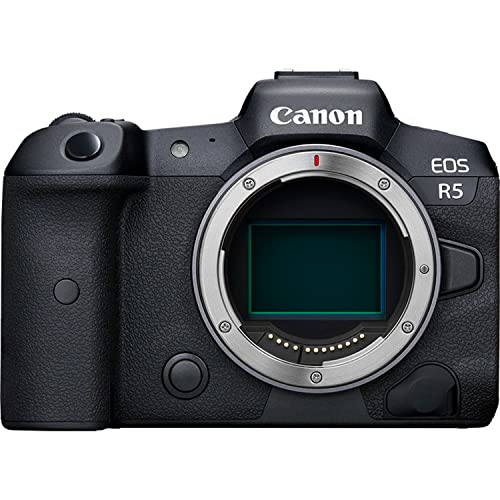
Canon’s listing for the R5 reads like a specification flex: a full-frame hybrid camera with 8K video, a 45 megapixel CMOS sensor, the DIGIC X processor, up to 12 frames per second and the RF mount. For interview work specifically, two of those claims matter and the rest is gravy. The 45 megapixels serve the production that also needs the subject’s portrait — the book author, the executive, the artist — shot at exhibition quality in the same session. The 8K video serves a subtler interview purpose: reframing.
Reframing is the flagship’s real interview argument. An 8K master lets an editor punch into a tighter composition in post — turning one locked camera into a wide and a close-up — which is how small crews fake a second angle and how editors rescue a moment when the subject leaned out of the intended frame. Solo interviewers filming themselves gain the same mercy. It is not a reason to shoot carelessly, but it is a genuine production insurance that lower-resolution bodies cannot sell.
The stills side, at 45 megapixels and up to 12fps as stated, makes the R5 the pick for interview-adjacent productions: podcasts that publish gallery stills, magazines filming their cover subjects, corporate teams whose leadership session must yield both the video and the annual-report portrait. One body on the tripod, two deliverables in the can — the economics explain the flagship’s price better than any single specification.
Canon colour is the third, quieter argument. Skin under office lighting is unforgiving, and Canon’s rendering has a long professional reputation with faces. Interviewers grade faces more than any other subject in media; starting closer to kind is a daily, compounding saving for small teams without a colourist.
Costs and cautions scale with the flagship class: RF lenses are a serious second investment, and 8K workflows consume storage and editing patience at a rate small teams must plan for rather than discover. The listing states no record limits, so — as this guide repeats deliberately — test long takes at home before a testimony depends on them. Productions that will use the headroom can see the EOS R5 on Amazon; productions that will not should save the difference toward microphones.
- Sensor: 45 megapixel full-frame CMOS, per the listing title
- Video: 8K, per the listing title
- Processor: DIGIC X, per the listing title
- Stills speed: up to 12 FPS, per the listing title
- Mount: Canon RF, per the listing title
- Record limit: Not stated in the listing title — verify with the manufacturer documentation
Strengths
- 8K masters allow post reframing — one camera, two compositions.
- 45MP stills cover the portrait deliverable in the same session.
- Canon skin rendering flatters interview subjects under office light.
Trade-offs
- 8K workflow costs in storage and editing time are substantial.
- Flagship body plus RF lenses is the priciest route in this guide.
- Interview-only buyers pay for stills power they may never use.
Best for: productions pairing interviews with flagship stills — magazines, book tours, executive media.
Not suited for: a lean podcast studio whose budget belongs to audio and a second angle.
Consider the magazine format that films its cover stars. The subject gives forty minutes. In that window the R5 must capture the conversation, the portrait set and the social cutdowns’ raw material — and its stated specification is precisely a forty-minute insurance policy across all three. Lesser bodies force a triage among deliverables; the flagship’s argument is that the triage is the false economy, because the session, not the camera, is the irreplaceable asset.
Heat and workflow management belong to flagship ownership generally, and the honest guidance is procedural rather than technical: know your settings, test your long takes, and do not debut an untested configuration on a chief executive. This guide makes no thermal claims for any body whose listing is silent, and the R5’s listing is silent — so the home test, as ever, is the professional’s answer.

Panasonic Lumix S5IIX — Best for streaming and ProRes workflows
The S5IIX listing is the most production-literate in this guide: a 24.2MP full-frame camera with phase hybrid autofocus, Active I.S. technology, 5.8K ProRes, RAW over HDMI and IP streaming. Each clause maps to an interview format the other picks serve less directly. IP streaming is the live interview — the remote panel, the streamed podcast, the broadcast hit — where the camera joins the network rather than merely recording for later. ProRes is the post-production interview, where an editor wants a codec that behaves beautifully under grading and archiving. RAW over HDMI is the recorder-based studio, where capture leaves the body entirely.
Streaming deserves the headline treatment. Live and live-to-tape interviews have become the default format for podcasts, corporate town halls and remote journalism, and a body that streams natively removes a layer of capture hardware and failure points between the subject and the audience. Fewer boxes, fewer cables, fewer apologies — reliability, this guide’s second commandment, expressed as a feature list.
Phase hybrid autofocus, carried over from its S5II sibling and stated here too, handles the seated subject’s choreography without the hunting that plagued older Panasonic video. Active I.S. matters less on a tripod — where interviews live — and more for the walk-to-the-set and location-establishing material that surrounds modern interview content. Judge the stabilisation as a supporting feature and the recording architecture as the main event.
The 24.2MP full-frame sensor keeps stills entirely respectable, so hybrid producers are not exiled from portrait work the way 12MP specialists’ owners are. The X variant’s professional lean is about data pathways rather than image quality: where your footage goes, in what form, and how directly. Studios should choose it on exactly that basis.
For a podcast or production studio building around streaming and a serious edit pipeline, this is the most forward-looking body in the list. Such studios can check the Lumix S5IIX on Amazon and plan their network and recorder chain around its stated outputs.
- Sensor: 24.2MP full-frame, per the listing title
- Autofocus: phase hybrid AF, per the listing title
- Recording: 5.8K ProRes, RAW over HDMI, per the listing title
- Streaming: IP streaming, per the listing title
- Stabilisation: Active I.S. technology, per the listing title
- Record limit: Not stated in the listing title — verify with the manufacturer documentation
Strengths
- IP streaming built in — the live interview without extra capture hardware.
- ProRes and RAW-over-HDMI serve serious post and recorder workflows.
- Phase hybrid AF keeps seated subjects locked without hunting.
Trade-offs
- Its advantages are workflow features — simple record-and-post users pay for unused depth.
- ProRes files are large; storage planning is mandatory.
- L-mount lens investment is a second budget line, as with all bodies here.
Best for: podcast and production studios streaming interviews or running a ProRes pipeline.
Not suited for: a hobbyist interviewer who records to card and posts with minimal editing.
The streamed town hall is this camera’s home fixture. A chief executive takes questions from three remote offices; the S5IIX feeds the stream directly, records a ProRes master for the archive, and holds focus as she turns between the room and the camera. One body doing the work of a small broadcast chain is not a convenience at that moment — it is the difference between a production a two-person team can run and one it cannot. Feature lists rarely survive contact with a real fixture list; this one was evidently written from one.
Archival thinking seals the studio case. Interviews appreciate in value — the founder’s early conversation, the artist before fame — and ProRes masters age gracefully through future edits, formats and restorations. A studio choosing the S5IIX is buying its archive’s future as much as its next episode, which is the kind of unglamorous reasoning that separates production companies from channels.

Sony Alpha FX3 Cinema Line Camera — Best cinema-crew interview body
Some interviews are productions: a rented location, a lighting package, a subject whose hour costs more than the camera. The FX3 — Sony’s compact full-frame Cinema Line body, per its listing — is the interview camera for that tier. Cinema Line design means the body expects to be rigged with a monitor, professional audio and a crew’s hands; it behaves like a small cinema camera that happens to be excellent at faces, rather than a stills camera moonlighting in video.
The full-frame look at this level is about control rather than novelty. A cinema crew lights an interview to a chosen depth of field, holds it across a two-camera setup, and matches the FX3’s image to its Cinema Line siblings — the FX30 appears in this guide’s other lists for exactly such pairing. Consistency across bodies is a production value invisible to viewers and priceless to editors, and it is the deepest reason professional units standardise on a line.
Low-light grace matters to location interviews more than studio ones. Real offices, real workshops and real homes — the places documentary and branded interviews increasingly film — offer light that cannot always be rebuilt. A full-frame cinema sensor’s sensitivity gives the crew options: embrace the location’s light with modest support instead of replacing it wholesale, keeping the subject in a room that still resembles their life.
The trade-offs are the cinema class’s usual ones, stated plainly: the body expects rigging and crew, its stills are not the point, and the listing’s brevity means recording details belong to Sony’s documentation rather than this page. A solo creator will find the a7 IV friendlier; a one-person band will find the FX3 over-built. Neither reaction indicts the camera — it indicts the match.
For produced interviews with crew, lighting and a grade in their future, the FX3 is the professional anchor of this list. Production buyers can look at the Sony FX3 on Amazon as the A-camera of a Cinema Line interview kit.
- Line: Sony Cinema Line, per the listing title
- Sensor: full-frame, per the listing title
- Model: ILME-FX3, per the listing title
- Recording formats: Not stated in the listing title — verify with the manufacturer documentation
- Record limit: Not stated in the listing title — verify with the manufacturer documentation
- Stabilisation: Not stated in the listing title — verify with the manufacturer documentation
Strengths
- Cinema Line rigging and behaviour for produced, crewed interviews.
- Full-frame sensitivity keeps real locations usable with modest lighting.
- Matches FX30 and Cinema Line siblings for two-camera consistency.
Trade-offs
- Expects a rig and a crew — solo creators are better served above.
- Stills are secondary in a cinema-first design.
- Brief listing leaves specification homework to the buyer.
Best for: branded, documentary and broadcast interview productions with a crew and a grade.
Not suited for: a solo YouTuber filming themselves in a home studio corner.
Picture the branded interview done properly. The subject — a chef, a founder, a craftsperson — is filmed in their own space at the end of their working day. The FX3 rig is compact enough to live in a corner of a real kitchen; the lighting is two soft sources and the room’s own practicals; the conversation runs an hour without a battery drama or a focus incident, and the footage grades into the campaign’s film without apology. That unobtrusive competence, repeated across a series, is what clients are actually purchasing when they hire the crew that carries this body.
Multi-body shoots extend the logic. An FX3 on the subject, an FX30 on the wide, one colour pipeline, one lens bag, one media workflow — the interview series becomes a system rather than a series of improvisations. Productions that film people for a living standardise for exactly this compounding calm, and the FX3 is the natural anchor body of the Sony version of that system.
Panasonic Lumix GH6 — Best endurance pick
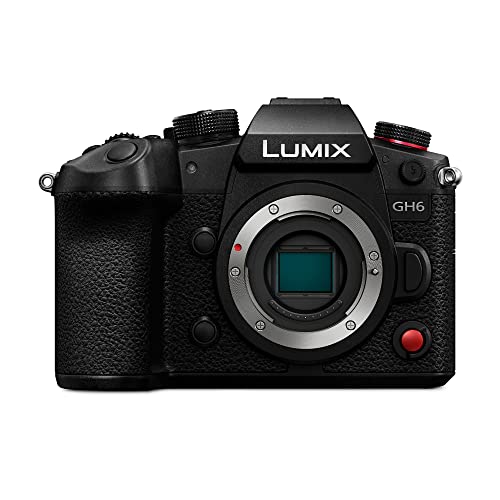
The GH6 returns from the documentary list wearing the same stated credentials, and they translate directly: a 25.2MP Micro Four Thirds camera with unlimited C4K/4K 4:2:2 10-bit recording and a 7.5-stop 5-axis stabiliser. For interviews, unlimited is the word that matters most in this entire guide. It is the only recording promise of its kind printed in any listing here, and it answers the interviewer’s primal fear — the camera stopping mid-testimony — with a specification instead of a hope.
Think about who needs that promise most. Oral historians recording ninety-year-olds. Journalists interviewing sources who will say it once. Corporate teams filming a retiring founder’s single available hour. In each case the conversation cannot be restarted, and a camera whose maker prints unlimited in the title earns its place on the tripod before any other virtue is weighed. This guide does not claim the other bodies stop early — their titles simply do not say — but planning an irreplaceable interview around an unstated limit is a gamble the GH6 removes.
The 4:2:2 10-bit recording, also stated, serves the interview’s post-production reality: mixed room light on skin, corrected later by someone with limited time. Ten-bit colour survives those corrections with grace, keeping faces human when a window’s daylight and a room’s tungsten disagree. Small crews without lighting control — most interview crews — live on that forgiveness.
Micro Four Thirds brings the format’s familiar dividends: smaller lenses, a discreet kit and depth of field that keeps a gesturing subject in focus more forgivingly than full-frame at the same framing. Interview subjects are not actors hitting marks; forgiveness is a feature. The stabilisation, stated at 7.5 stops, covers the walk-and-talk and location material around the seated core.
The format’s costs are the known ones — low-light ceiling below the full-frame picks, less background melt — and for seated interviews under controlled light they rarely bind. Endurance buyers can check the Lumix GH6 on Amazon and schedule their longest conversations without a clock in the room.
- Sensor: 25.2MP Micro Four Thirds, per the listing title
- Recording: unlimited C4K/4K 4:2:2 10-bit video, per the listing title
- Stabilisation: 7.5-stop 5-axis dual image stabiliser, per the listing title
- Model: DC-GH6BODY — body only, per the listing title
- Autofocus type: Not stated in the listing title — verify with the manufacturer documentation
- Audio inputs: Not stated in the listing title — verify with the manufacturer documentation
Strengths
- Unlimited recording, stated in the listing — the interviewer’s core anxiety answered.
- 10-bit 4:2:2 colour forgives mixed room light in the grade.
- Forgiving depth of field keeps gesturing subjects in focus.
Trade-offs
- Low-light ceiling sits below the full-frame bodies here.
- Backgrounds stay more present — context over melt.
- Body only; MFT lenses are a further purchase.
Best for: oral history, journalism and long-form interviews that cannot be repeated.
Not suited for: a producer chasing the shallowest full-frame look for a beauty-lit studio show.
The oral-history scenario deserves one more telling, because it converts the specification into stakes. A granddaughter interviews her grandfather about a war, a migration, a trade learned at fourteen. He will tell it fully exactly once. The GH6’s stated unlimited recording means the camera’s stamina never enters the room as a worry; the operator can let silences breathe, let the story detour, let the ending arrive when it arrives. Every other anxiety in interviewing can be managed with kindness and preparation. The clock is the one anxiety only equipment can remove — and here, the equipment’s own listing removes it.
Field journalists will recognise the same mathematics in press terms: the source who talks for two hours because nobody interrupted, the community meeting that runs long into its most honest hour. Endurance is not a specification for its own sake; it is respect for how long truth takes to say.

DJI Osmo Pocket 3 — Best B-camera and gimbal angle
Now the pocket camera, in its proper place: last, and framed exactly as the brief for this guide demands — a B-camera and gimbal pick, never the main body. Its listing is rich: a vlogging camera with a 1-inch CMOS sensor, 4K/120fps video, 3-axis stabilisation, fast focusing, a spotlight follow feature and a 2-inch rotatable touchscreen. Every one of those features serves motion and spontaneity. An interview’s A-camera needs the opposite virtues — stillness, depth, professional audio architecture — and confusing the two toolkits is how productions end up with charming footage of an unusable interview.
What the Pocket 3 does brilliantly is everything around the interview. The walk-in: subject leading you through their workshop, the gimbal smoothing the follow. The cutaway angle: a small second camera on the interviewer’s side for reaction shots, its 1-inch sensor — large for its class, as the listing implies — holding up respectably beside the main body’s footage. The travel day: a crew member filming behind-the-scenes and social clips without touching the A-camera’s setup. Productions constantly need this device; they just need it in its lane.
The stated 4K/120fps opens slow-motion B-roll — hands at work, tools, the subject’s craft — that enriches an interview edit immeasurably, and the rotatable screen and fast focusing suit a solo operator grabbing those moments between the seated takes. Spotlight follow, named in the listing, tracks a moving subject for the walking segments. As a one-person crew’s second set of hands, it is close to ideal.
The limits define the lane. A pocket gimbal is not built around the professional audio chain an interview’s first commandment requires; its fixed lens frames a room as it finds it; and its presence as a main camera signals an amateur production to subjects whose trust is the whole enterprise. Use it as the second angle and the roaming eye, anchor the conversation on a real body from the five above, and the combination outperforms either alone.
Crews who already own their anchor body and feel the missing second angle on every shoot can check the Osmo Pocket 3 on Amazon — as a complement, which is the highest honest praise this guide gives it.
- Sensor: 1-inch CMOS, per the listing title
- Video: 4K/120fps, per the listing title
- Stabilisation: 3-axis (gimbal), per the listing title
- Features: fast focusing, spotlight follow, per the listing title
- Screen: 2-inch rotatable touchscreen, per the listing title
- Role in this guide: B-camera / second angle — not a main interview body
Strengths
- Gimbal-smooth roaming footage for walk-ins and behind-the-scenes.
- 1-inch sensor makes its B-camera footage cut in respectably.
- 4K/120fps B-roll of hands and craft enriches any interview edit.
Trade-offs
- Not an anchor body: audio architecture and presence are not interview-grade.
- Fixed lens frames the room as found — no compositional choice of glass.
- Pocket format can under-signal professionalism to important subjects.
Best for: a second angle, roaming B-roll and travel-day coverage beside a real interview body.
Not suited for: anchoring a serious interview as the only camera in the room.
A travel production shows the pocket camera earning its keep honestly. The crew flies in with the anchor body and lights; the Pocket 3 rides in a jacket and spends the trip gathering the journey — the subject’s street, their doorway, their hands opening the workshop — in gimbal-smooth clips that give the edit its breathing spaces. Back home, nobody wishes the Pocket had been the interview camera, and everybody is glad it was along. That is the correct emotional register for a B-camera: gratitude without promotion.
Its second career is the solo creator’s rehearsal tool: framing tests, lighting walkthroughs and social teasers shot on the pocket camera before the main rig is built. Used that way it saves the anchor body’s setup from a dozen small experiments. Versatility in support roles is a genuine professional virtue — provided the support role is never confused with the lead.
Comparison
| Camera | Format (as listed) | Stated headline | Defining strength |
|---|---|---|---|
| Sony a7 IV | Full-frame | Hybrid interchangeable-lens body | The dependable talking-head default |
| Canon EOS R5 | Full-frame | 8K video, 45MP, up to 12 FPS | Reframing room plus flagship stills |
| Panasonic Lumix S5IIX | 24.2MP full-frame | 5.8K ProRes, RAW over HDMI, IP streaming | Streaming and post-pipeline architecture |
| Sony FX3 | Full-frame Cinema Line | Compact cinema body | Produced interviews with crew and grade |
| Panasonic Lumix GH6 | Micro Four Thirds | Unlimited 4:2:2 10-bit, 7.5-stop stabiliser | Endurance for unrepeatable conversations |
| DJI Osmo Pocket 3 | 1-inch CMOS gimbal | 4K/120fps, 3-axis stabilisation | B-camera roaming angle — not the anchor |
Why Does Audio Outrank the Camera in Every Interview?
Because audiences experience interviews as voices with pictures attached. A viewer will watch a slightly soft image for an hour if the voice is close, clear and intimate; the same viewer abandons a razor-sharp image with echoing, distant sound in ninety seconds. This is not a taste claim — it is the observed behaviour of everyone who has ever clicked away from a badly recorded conversation, which is everyone. The camera budget conversation should therefore start only after the microphone, its placement and the room have been funded.
Practically, that means a microphone near the subject — lavalier or a boom just out of frame — headphones on whoever is responsible, and a thirty-second room test listened to before the subject sits down. Every body in this guide can sit at the centre of such a chain; none of them substitutes for it. The camera’s job in the hierarchy is to not interrupt: to keep recording, keep focus and keep quiet, so the audio chain and the conversation can do the work the audience came for.
It also means the second camera question outranks the first camera’s brand. Two angles cut an interview’s mistakes invisibly — the cough, the interruption, the restarted sentence — and a modest B-camera, including the Pocket 3 in its proper role, contributes more to a finished interview than a flagship upgrade to the A-body. Spend in the order the audience perceives: voice, continuity, then image.
Lighting for interviews follows the same hierarchy of modesty. One large, soft source near the camera’s axis, a room whose practical lights are either embraced or extinguished, and a background kept a stop or two darker than the face — that recipe has carried more great interviews than any lighting package. Its virtue is repeatability: a small crew can rebuild it in any office in twenty minutes, and the subject sits down in light that flatters without announcing itself. Cameras differ in how they render that light on skin; the light itself is the senior partner, and it costs less than every body in this guide.
The subject’s comfort is a technical parameter, not a courtesy extra. A chair that does not swivel silently ends a category of focus problems. Water within reach extends conversations. A room at a humane temperature keeps faces from shining through the second hour. Interviewers who manage these details get better footage from any camera here than technicians with flagship bodies and miserable subjects — a sentence worth taping to the tripod.
How Do You Set Up a Two-Camera Interview on a Small Crew?
Anchor the A-camera on the subject at a flattering, slightly angled position, framed medium-close, and leave it alone for the whole conversation. Its stillness is the edit’s foundation. Place the B-camera wider or on the interviewer for reactions and cutaways; if the second body is a gimbal pocket camera, give it the roaming jobs before and after the seated conversation rather than asking it to hover during it.
Match the bodies as far as the production allows — same colour profile family, same frame rate, white balance set manually to the same value — because the edit punishes mismatched cameras with hours of correction. Bodies from the same line, like the Sonys here, ease this; mixed systems demand a colour chart and discipline. Test the full chain the day before: record five minutes, sync it, cut it, watch it. The interview day itself should contain no firsts.
Sound stays single-sourced: one good microphone on the subject feeding the A-chain or a dedicated recorder, with the B-camera’s audio serving only as sync reference. Small crews fail interviews by distributing responsibility; assign the audio to one named human with headphones, and let everyone else forget it exists.
Editing begins during the conversation, in the interviewer’s notebook. Mark the timecode of the sentence that matters, the laugh, the long pause — not afterwards from memory. Those marks cost nothing, require no equipment, and save the edit’s most expensive hours. They also complete the hierarchy this guide opened with: the audience will remember the words, the words survive on the audio, and the notebook is how the words are found again. Camera choice is the visible decision; this invisible one is the craft.
Backup discipline closes the production loop. Interview footage is definitionally irreplaceable — the subject will never say it that way again — so it is copied twice before anyone leaves the location, and the cards are not formatted until both copies verify. Every body in this guide records onto media that can fail; the productions that endure are the ones that assume it will.
Room selection is the audio chain’s silent first component. A small, soft-furnished room forgives almost any microphone placed in it; a glass-walled boardroom defeats almost all of them. When a production can choose where an interview happens, that single choice is worth more than the difference between any two cameras in this entire guide — and when it cannot choose, curtains, cushions and a microphone moved properly closer are the working substitutes. Interviewers who scout rooms with their ears first, not their eyes, produce the conversations audiences actually finish.
There is a matching visual discipline: background governance. A foot of separation between subject and wall, a background cleared of bright rectangles and other people’s movement, a single considered object rather than a shelf of distractions — these cost nothing and read as production value. The cameras here will render whatever room they are given with complete and unforgiving fidelity, which is precisely why the room deserves a producer’s full attention before the record button earns any.
Common Mistakes
Spending the audio budget on the camera. It is the genre’s original sin, repeated by every new production company once. The microphone, its placement and a quiet room will decide whether strangers finish your interview; the sensor will decide whether other camera owners admire it. Choose the audience.
Trusting an unstated record limit with an unrepeatable subject. This guide claims limits only where listings state them — unlimited, in the GH6’s case. For every other body, the professional answer is a home test at your exact settings across a full-length session. An interview is the worst possible laboratory for discovering your camera’s stamina.
Letting autofocus make creative decisions. Eye focus is a gift, but a system that leaps between the subject’s eye, their glasses and a bright background object will ruin more answers than manual focus ever did. Learn your body’s behaviour with your actual subjects and lighting before the day, and lock what needs locking.
Anchoring on a pocket camera. The Osmo Pocket 3 is in this guide as a B-camera because that is what it is for. A production that rests its main interview on it has mistaken mobility for capability, and the audio chain is usually where the mistake becomes audible.
Recording the room instead of the voice. A microphone left on the camera, metres from the subject, captures the room’s echo with a voice inside it. The fix costs less than any camera in this guide — move the microphone to the person — and the refusal to make it is responsible for more abandoned interviews than every equipment failure in this article combined.
Interviewing the camera instead of the person. Operators who fiddle — reframing mid-answer, checking the screen theatrically, adjusting lights between questions — teach the subject to perform for a machine. Set the frame, trust the preparation, and be a human being in the room; the camera’s invisibility is a directing achievement.
Final Recommendation
Fund the hierarchy in its proper order — voice first, reliability second, then camera — and the choice below very nearly makes itself. The a7 IV is the default anchor for corporate, creator and educational work of almost every scale; the EOS R5 serves productions that publish flagship stills beside the film and want 8K reframing insurance in post. Streamers and ProRes studios belong to the S5IIX, crewed cinema interviews to the FX3, and unrepeatable long conversations — the ones that matter most — to the GH6 and its stated unlimited recording. Add the Pocket 3 when a second, roaming angle is the thing your edits keep missing most — and never, whatever its charms, ask it to carry the conversation itself. The best interview camera is, in the end, the one the subject forgets soonest; choose the body your particular format forgets fastest, fund its voice properly, and then go and have the conversation.
One buying sequence deserves to be stated as a rule, because it prevents the commonest misallocation in this entire category. First the microphone and its placement hardware. Second, the light. Third, the anchor body — chosen from the five full bodies above by format fit. Fourth, the second angle, where the Pocket 3 or a sibling body enters. Buyers who follow that sequence own an interview studio; buyers who reverse it own an impressive camera and an unusable archive of echoing conversations. The order is the advice; the products are interchangeable within it.
And a word for the interviewer reading this with a body already owned: it is almost certainly enough. The cameras in this guide differ at the margins of stamina, streaming and stills — real margins, worth money when a format demands them — but an owned body with a funded audio chain will out-produce a new body with a neglected one every single week. Upgrade when a named failure, not a launch announcement, tells you to.
Frequently Asked Questions
What is the single most important interview accessory?
The microphone, and it is not close. A decent microphone placed near the subject, monitored on headphones by someone whose only job in that moment is listening, will improve a finished interview more than any camera upgrade in this entire guide. Buy the audio chain first — microphone, then recorder or interface, then a soft light — and let the camera body be the fourth purchase your budget makes, chosen calmly from the anchors above.
How long can these cameras record an interview?
Only one listing here states its stamina outright: the GH6, with unlimited C4K/4K recording printed in its own title. The other titles are silent on limits, so this guide claims nothing for them in either direction. The professional procedure — unglamorous, non-negotiable — is to test your exact body, card, battery and settings at home over a full-length dummy session before any interview that cannot be repeated is allowed to depend on them.
Is the DJI Osmo Pocket 3 enough for a YouTube interview channel?
As a second angle and B-roll camera, it is genuinely excellent — its 1-inch sensor, 3-axis gimbal stabilisation and 4K/120fps video are listed plainly. As the only camera, it leaves the production without a professional audio architecture, without a second composition, and it under-signals seriousness to the guests a channel most wants to impress. Channels that grow end up anchoring on a body like the a7 IV and keeping the Pocket 3 in its ideal supporting role, where it earns its place on every single shoot.
Can I film interviews alone with these bodies?
Yes — that is the a7 IV’s home scenario and a designed use of the GH6 and S5IIX as well: set the frame carefully, trust eye autofocus to hold the subject, monitor audio on headphones you actually wear throughout, keep a notebook for timecodes on your knee, and interview from beside the lens so the subject’s eyeline stays near camera and the conversation, not the equipment, holds their attention. The cinema-rig FX3 and the manual disciplines it implies are the awkward solo tools here; the hybrids were built for exactly the one-person production, and their menus, screens and autofocus behaviour all assume a single pair of hands that also has a conversation to conduct.
Do I need two cameras for interviews?
Not for every format — a solo creator’s single locked angle is a legitimate, even intimate style — but two angles transform editing at a fundamental level: mistakes vanish invisibly, pace tightens at will, long answers stay watchable, and a cough or a restarted sentence stops being a scar on the finished piece. If budget forces a sequence, buy the anchor body first, fund the audio properly, then add the second angle before upgrading anything else at all.
Full-frame or Micro Four Thirds for talking heads?
Full-frame gives the shallower, more televisual separation and the better low-light headroom in dim rooms; Micro Four Thirds — the GH6 here — gives forgiving focus depth for moving subjects, smaller and more discreet kits and, in this listing uniquely, unlimited recording stated outright. Interviews are won on audio, trust and stamina far more than on background blur, so choose by your format’s real constraints and your subjects’ comfort rather than by format prestige or specification envy.
Which of these suits a streamed podcast best?
The S5IIX, on its listing’s own words: IP streaming is stated, alongside 5.8K ProRes for the archived master and RAW over HDMI for recorder-based setups. A streamed show lives or dies on chain reliability, and a body that removes the capture-hardware layer removes its commonest failure points. The a7 IV remains the safer default for recorded-only shows, and the GH6 remains the endurance answer when the stream is also a marathon. Choose by the failure you fear most — a dropped stream chain or a stopped recording — because the two bodies insure against different disasters, and a professional names their disaster before they shop.
What frame rate and settings should an interview use?
Match the delivery standard of your region and platform, keep shutter and white balance manual and consistent across cameras, expose for the face rather than the room, and prioritise a frame that flatters at a moderate, forgiving aperture over exotic settings chosen for their own sake. Consistency between the A and B cameras matters more to the finished piece than any individual specification on either body — test the pair together, on a stand-in, before the real subject ever arrives.
A final calibration on expectations: no camera in this guide will make a guarded subject candid, a dull question interesting or a noisy room quiet. Those are the interviewer’s arts, and they are learnable — which is the genuinely hopeful news buried in a camera guide. Buy the body that removes technical worry from the room, fund the voice first, and then spend your real budget — attention — on the person in the chair. The equipment sections above exist to clear the stage for that transaction, and they should be read, and bought, in that spirit.
Related Guides
For the long-form cousin of the interview, where conversations run for hours in real places, our documentary camera guide covers endurance and access in depth. The stills for a subject’s own product table, shot on the same visit, are handled by our point-and-shoot product photography recommendations, and creators printing their own branded materials, artwork and merchandise will find our UV printer guide a useful next stop for the studio’s quieter, printable side projects.


