What's inside
As an Amazon Associate I earn from qualifying purchases. This post may contain affiliate links at no extra cost to you.
widgetverdict.com is reader-supported. When you buy through links on our site, we may earn an affiliate commission.
Documentary filming is mostly waiting. Waiting for the fisherman to mend the net again because the first take had a plane overhead; waiting for the light in the workshop to turn; waiting for a subject who agreed to be filmed to forget the camera exists. The best documentary cameras are therefore not the ones with the most dramatic specification sheets — they are the ones still recording, still in focus and still welcome in the room at hour six. Everything in this guide was judged against that long, unglamorous day.
The six tools below split into two families that beginners constantly confuse. Five are interchangeable-lens bodies — cinema-line cameras and video-strong hybrids — that you build into a rig around a story. One, Panasonic’s HC-X2100, is a fixed-lens pro camcorder, a different species entirely: no lens decisions, no rig-building, just a long zoom, long recording and a grab-and-shoot workflow refined over decades of news and events. Neither family is better. They answer different productions, and this guide teaches the split rather than pretending it away.
Two honesty anchors hold the whole list steady. Blackmagic’s Pocket Cinema Camera 6K Pro — a favourite of independent filmmakers — has no continuous autofocus and no in-body stabilisation, and both facts are stated in its section in plain words, because a documentary buyer who discovers them on location has been genuinely misled. And wherever a listing title is silent about record limits or thermal behaviour, this guide stays silent too, rather than laundering rumour into fact.
Budget honesty runs through every section that follows, because documentary money is always finite and always contested. The camera is the purchase filmmakers enjoy researching; the film is paid for by everything else — travel to the subject, time away from paid work, translation, transcription, an editor’s patience. A guide that pushed every reader toward the flagship would be stealing from those line items. So the recommendations below are scaled deliberately: each pick is the right answer for a defined production at a defined scale, and the most expensive body here is recommended only where its specific gifts — flagship stills, internal RAW — are genuinely load-bearing for the film being made.
Renting deserves its sentence too. For a single defined production, renting a flagship for the interview weeks and owning a dependable mid-tier body for the observational months can beat owning either extreme. The picks below are framed as purchases because that is the question most readers bring, but the method-first logic applies identically to a rental list: define the shoot, then let the shoot choose the tool.
Key Takeaways
- Sony’s FX30 is the purest documentary starter here: a Cinema Line Super 35 body built for rigs, long interviews and solo crews.
- Canon’s EOS R5 C is the hybrid flagship — a 45 megapixel stills camera and an 8K/60p internal RAW cinema camera in one RF-mount body.
- Panasonic’s HC-X2100 bundle is the fixed-lens camcorder route: 24x zoom and a full accessory package for run-and-gun work.
- The Blackmagic Pocket Cinema Camera 6K Pro has NO continuous autofocus and NO in-body stabilisation — plan manual focus and support accordingly.
- Panasonic’s GH6 states unlimited C4K/4K 4:2:2 10-bit recording and a 7.5-stop stabiliser — the endurance pick for small crews.
- Sony’s FX3 brings full-frame Cinema Line pedigree for low-light documentary work where APS-C and MFT struggle.
Quick Picks
| Pick | Badge | Why it made the cut |
|---|---|---|
| Sony FX30 | Best cinema-line starter | A Super 35 Cinema Line body with a 20.1MP effective movie sensor, made to be rigged and rolled all day. |
| Canon EOS R5 C | Best hybrid cinema flagship | 45 megapixels for stills plus 8K/60p internal RAW video in a full-frame RF body. |
| Panasonic HC-X2100 4K Pro Camcorder Bundle | Best fixed-lens camcorder kit | A 24x zoom pro camcorder bundled with card, light, microphone, grip and filters. |
| Blackmagic Pocket Cinema Camera 6K Pro | Best image-first cinema body | A beloved independent-film camera — manual focus and external stabilisation are the deal. |
| Panasonic Lumix GH6 | Best endurance hybrid | Unlimited 4:2:2 10-bit recording and 7.5-stop stabilisation, as its listing states. |
| Sony Alpha FX3 Cinema Line Camera | Best full-frame low-light cinema body | Sony’s compact full-frame Cinema Line camera for night shoots and small crews. |
How We Chose These Picks
Documentary selection starts with failure modes, because documentaries fail in the field, not in the studio. The first question asked of every candidate was what ends a take: a record limit, an overheating body, a dead battery, a missed focus pull, a subject who stops trusting the person behind the camera. Cameras earned their places by having good answers — stated in their listings where limits are concerned — to the failures their owners will actually meet.
The second lens was crew size. A solo filmmaker needs autofocus they can trust and a body one person can rig, carry and troubleshoot; a two-person crew can trade that convenience for the image purity of a manual-focus cinema camera. This list deliberately contains both philosophies and labels them, because recommending the Blackmagic to a solo vérité shooter — or the FX30 to a patient, tripod-based essayist — would each be a disservice dressed as a ranking.
Audio architecture influenced ordering more than resolution did. Documentaries are watched with the sound on and remembered for their voices; cameras were credited for belonging to ecosystems with serious audio accessories and for camcorder-style workflows where sound is a first-class citizen. The HC-X2100 bundle’s included microphone is a small symbol of that priority.
Finally, mounts and media were weighed as ten-year decisions. A documentary body is rarely the expensive part of the system it anchors; lenses, rigs and habits accumulate around it. Sony E-mount, Canon RF, Micro Four Thirds and the Pocket Cinema’s mount each imply a different decade of purchases, and the sections below speak to those ecosystems rather than treating bodies as isolated gadgets.

Sony FX30 — Best cinema-line starter
The FX30’s listing is admirably plain: a Sony Cinema Line Super 35 camera in grey, with a 20.1MP Exmor R APS-C image sensor effective for movies. That last phrase is the tell — this sensor and body were specified for filmmaking first, with stills as an afterthought, and documentary shooters are the natural beneficiaries. Cinema Line membership means the body is designed to live on rigs, accept the accessories film crews standardise on, and behave predictably across a twelve-hour day of interviews and vérité.
Super 35 is a documentary-native format. It is the size generations of documentary lenses were designed around, it keeps depth of field manageable for solo operators who must hold focus on a moving subject, and it makes the whole system — body, lenses, support — smaller and cheaper than full-frame equivalents. A one-person crew walking a fishing village at dawn feels that size saving in every decision about what to carry.
The E-mount ecosystem completes the argument. No mount offers a wider spread of documentary-suitable glass, from compact primes for discreet work to proper cinema zooms, at every budget a production might have. A young filmmaker can start with one affordable prime and grow for a decade without abandoning the mount, and the FX30 body will not be the reason any of those lenses disappoint.
Working style matters too: cinema bodies invite deliberate operation — external monitors, follow focus, considered framing — and documentary subjects respond to that deliberateness. A camera that looks like a film camera also signals professionalism to contributors and gatekeepers, easing access in institutional settings where a toy-like body invites doubt. Access is a documentary currency, and this body spends well.
Set against that, stills photographers should look elsewhere in this list, and run-and-gun shooters who need a camera ready in one hand should study the camcorder below. For the filmmaker building a first serious documentary rig, though, the FX30 is the reference point. Crews ready to build can check the Sony FX30 on Amazon and start pricing the lens and audio kit it deserves.
- Line: Sony Cinema Line, per the listing title
- Sensor: Super 35 / APS-C Exmor R, 20.1MP effective for movies, per the listing title
- Mount: Sony E-mount (Cinema Line standard)
- Colour: grey finish, per the listing title
- Record limit: Not stated in the listing title — verify with the manufacturer documentation
- In-body stabilisation: Not stated in the listing title — verify with the manufacturer documentation
Strengths
- Purpose-built cinema body at the friendliest entry point in Sony’s Cinema Line.
- Super 35 format keeps solo-crew focus and kit size manageable.
- E-mount lens choice is unmatched for a decade of growth.
Trade-offs
- Stills are an afterthought — hybrid shooters should look at the R5 C or GH6.
- Cinema ergonomics expect a rig; it is not a grab-and-go camcorder.
- APS-C low-light ceiling sits below the full-frame FX3 in this list.
Best for: an emerging documentary filmmaker building a first Cinema Line rig for interviews and vérité.
Not suited for: an events shooter who needs a camera ready to roll the second it leaves the bag.
A typical FX30 documentary day explains the loyalty. Morning: an interview on a small rig, monitor up, the body behaving like the shrunken cinema camera it is. Midday: stripped down to a compact prime for observational walking shots, light enough that the operator’s arms survive until evening. Night: back on the rig for a second interview, same media, same menus, same colour pipeline as the morning. Consistency across a day is an invisible feature that never appears in a listing title, yet it is what a working filmmaker actually buys.
Growth economics seal the case. Documentary careers are built over years on borrowed, rented and gradually owned kit, and a body that shares its mount and accessories with a whole professional line never becomes a dead end. The FX30 can start as the only camera, become the B-camera when an FX3 arrives, and still earn its place on multi-camera interviews a decade later. Few purchases in a young filmmaker’s life amortise that gracefully.

Canon EOS R5 C — Best hybrid cinema flagship
Some documentaries are also photography projects — the book, the exhibition, the magazine feature alongside the film. The R5 C is built for exactly that dual life, and its listing states the dual specification without blushing: a 45 megapixel CMOS sensor, hybrid full-frame cinema camera design, 8K/60p internal RAW recording and the RF mount. Read it as two professional tools sharing one body, and judge it by whether your production genuinely needs both.
The cinema half is serious. Internal RAW recording at 8K/60p, as stated, gives colourists the deepest possible material — the grade can rescue mixed lighting in a subject’s kitchen and hold highlight detail in a window-lit interview that lesser codecs surrender. For archive-driven or broadcast-leaning documentaries, that headroom is not vanity; it is insurance purchased at the moment of capture, when insurance is cheapest.
The stills half is equally real: 45 megapixels is exhibition-grade resolution, enough for large prints of the people and places the film visits. Productions increasingly monetise the stills — posters, books, press kits — and a body that captures them at full quality during the same trip saves an entire second expedition. Hybrid is an overused word; here it is simply accurate.
Costs accompany the power, and they should be faced before purchase. RAW workflows eat storage and editing time; 8K material demands computing patience; and a flagship body deserves flagship lenses to justify either half of its design. Documentary budgets are famously thin, and money spent here is money not spent on travel, translators or time — the things documentaries actually run on. Buy the R5 C when the production’s deliverables demand it, not because the specification dazzles.
For the filmmaker-photographer whose work genuinely spans both media at the highest level, no other pick in this guide substitutes. Those productions can see the EOS R5 C on Amazon and plan the storage budget in the same sitting.
- Sensor: 45 megapixel full-frame CMOS, per the listing title
- Video: 8K/60p internal RAW recording, per the listing title
- Type: hybrid full-frame cinema camera, per the listing title
- Mount: Canon RF, per the listing title
- Configuration: body only, per the listing title
- Record limit: Not stated in the listing title — verify with the manufacturer documentation
Strengths
- One body serves exhibition stills and RAW cinema at flagship level.
- Internal RAW protects difficult documentary lighting in the grade.
- RF mount anchors a premium long-term lens system.
Trade-offs
- RAW workflow costs — storage, computing, time — are substantial and ongoing.
- Flagship pricing competes with travel and access money in a doc budget.
- Body only: lenses are a second, significant purchase.
Best for: a filmmaker-photographer whose documentary also produces a book, exhibition or press stills at full quality.
Not suited for: a lean solo production where budget belongs to travel and time rather than resolution.
There is also a distribution argument for the hybrid flagship that older documentary economics did not face. A modern production lives as a film, a trailer, a poster, a crowdfunding page and a press kit simultaneously, and every one of those surfaces wants stills and motion of matching quality. The R5 C is the only pick here that can feed all of them from a single expedition without compromise in either medium. For a self-funded filmmaker who is also the publicist, that consolidation is not luxury; it is staffing.
Handle the file discipline before the first shoot, not after the first card fills. A RAW documentary generates data at a rate that punishes improvisation: name files by day and subject, offload nightly to two destinations, and let the edit’s folder structure mirror the production’s. The filmmakers who thrive with cameras like this are the ones who treat data as rushes — irreplaceable, logged and respected — rather than as footage that will somehow organise itself.

Panasonic HC-X2100 4K Pro Camcorder Bundle — Best fixed-lens camcorder kit
Now for the different species. The HC-X2100 is a professional camcorder — UHD 4K, 3G-SDI and HDMI outputs, a fixed 24x zoom — sold here as a 24-item bundle with a 64GB memory card, LED video light, microphone, U-grip, filters and software. No lens mount, no lens decisions, no rig architecture. You charge it, extend the zoom, and film the thing that is happening in front of you, which describes a large and honourable share of all documentary work ever made.
The camcorder workflow deserves a defence, because mirrorless fashion has unfairly demoted it. A fixed 24x zoom covers a speaker at a podium and the audience’s reaction without a lens change; professional outputs like the stated 3G-SDI feed broadcast and streaming setups directly; and camcorder ergonomics — built for one hand, long records and immediate readiness — suit the observational shooter who follows events rather than staging them. For community documentaries, oral-history projects, event films and local journalism, this is not the compromise option. It is the correct tool.
The bundle’s contents map onto real documentary needs with unusual accuracy. The microphone addresses the genre’s first priority — voices. The LED light rescues the community-hall interview. The U-grip steadies low angles. The card removes the last excuse to delay the first shoot. Bundles often pad; this one reads like a kit list written by someone who has filmed a town-hall meeting.
The trade-offs are the mirror image of the mirrorless picks: no interchangeable lenses means no fast prime for candlelit interiors and no cinema glass character; the smaller camcorder format renders deeper depth of field, so backgrounds stay informative rather than dissolving — which many documentary traditions actually prefer, since the environment is evidence. Know which aesthetic your film wants before choosing sides in this split.
For productions that value readiness, reach and a complete box over lens artistry, this bundle is the guide’s most practical recommendation. Oral historians and community filmmakers can check the HC-X2100 bundle on Amazon and be filming within days of its arrival.
- Type: UHD 4K pro camcorder, fixed lens, per the listing title
- Zoom: 24x, per the listing title
- Outputs: 3G-SDI and HDMI, per the listing title
- Bundle: 64GB card, LED light, microphone, U-grip, filters, software — 24 items, per the listing title
- Lens mount: none — fixed-lens camcorder
- Sensor size: Not stated in the listing title — verify with the manufacturer documentation
Strengths
- Complete working kit in one box, including the microphone documentary work needs first.
- 24x fixed zoom covers events without lens changes or missed moments.
- Pro outputs (3G-SDI/HDMI) suit broadcast and streaming workflows directly.
Trade-offs
- No interchangeable lenses — no fast primes, no cinema-glass character.
- Deep depth of field keeps backgrounds busy rather than dissolved.
- Camcorder aesthetic differs from the cinema look many filmmakers chase.
Best for: oral-history, community, event and local-journalism documentaries that prize readiness and reach.
Not suited for: a cinematic essayist whose visual language depends on fast prime lenses and shallow focus.
Consider the oral-history case in detail, because it is where camcorders quietly outperform glamorous rigs. An elderly subject, a kitchen table, two hours of memory. The camcorder sits at a respectful distance, its 24x zoom framing a close-up without the operator looming; the included microphone captures a frail voice cleanly; the session runs without card anxiety or rig adjustments breaking the spell. A cinema rig could record the same conversation, but its size, crew and interruptions would change the conversation itself. Documentary ethics begin with not disturbing the testimony, and this tool disturbs least.
The outputs named in the listing open a second career for the same camera: live and streamed events. Community documentaries increasingly premiere as streams, memorial services and council meetings are filmed for remote audiences, and a camcorder with professional outputs walks between recorded and live work without adapters or anxiety. A body that earns on weekdays and documents on weekends is a rational purchase for the semi-professional this guide quietly serves.

Blackmagic Pocket Cinema Camera 6K Pro — Best image-first cinema body
Begin with the two facts this camera’s fans sometimes bury, stated as plainly as the brief for this guide demands: the Pocket Cinema Camera 6K Pro has NO continuous autofocus, and NO in-body stabilisation. Focus is a manual discipline, and steady images come from tripods, gimbals, rigs and technique. A documentary shooter who needs a camera to track a walking subject alone, handheld, should stop reading this section and choose the FX30 or GH6. Everyone still here can now hear why this camera inspires devotion anyway.
The devotion is about the image and the workflow around it. Blackmagic built its reputation on cinema colour and on recording formats that treat the footage as raw material for a serious grade, and independent documentary makers adopted the Pocket line as the affordable way into that world. Films shot patiently — interviews on sticks, landscapes, interiors, observational scenes where the camera can be placed rather than chased — carry a richness that belies the body’s price class.
Manual focus, reframed honestly, is also a documentary method. It forces the operator to decide what matters in the frame before rolling, to rehearse the pull between two subjects in conversation, to be present as a filmmaker rather than supervising an algorithm. Vérité purists may chafe, but the essay-film and portrait-documentary traditions were built on exactly this deliberateness, and their makers often prefer it.
Stabilisation follows the same logic: the camera expects support, and support slows a shoot down in ways that frequently improve it. A tripod interview is a different, often better conversation than a handheld one; a gimbal walk-through is planned rather than grabbed. The cost is spontaneity — the unfolding moment across the street will be missed while you set up — and productions built on spontaneity should weigh that cost at full value.
The listing title itself is minimal — the camera’s name and model code — so this guide claims no resolution figures, mounts or recording details beyond the product’s identity, and buyers should study Blackmagic’s documentation for the full specification. What can be said without invention is the verdict: for patient filmmakers who grade seriously and focus manually, this remains a singular instrument. Those filmmakers can look at the Pocket Cinema Camera 6K Pro on Amazon with both limitations understood and accepted.
- Model: Blackmagic Design Pocket Cinema Camera 6K Pro (CINECAMPOCHDEF06P), per the listing title
- Autofocus: NO continuous autofocus — manual focus workflow
- Stabilisation: NO in-body stabilisation — external support required
- Recording formats: Not stated in the listing title — verify with the manufacturer documentation
- Mount: Not stated in the listing title — verify with the manufacturer documentation
- Sensor specification: Not stated in the listing title — verify with the manufacturer documentation
Strengths
- Cinema colour and grading-first workflow beloved by independent filmmakers.
- Manual operation enforces a deliberate, considered shooting method.
- Image quality per dollar is the camera’s enduring reputation.
Trade-offs
- No continuous autofocus: solo vérité tracking shots are genuinely hard.
- No in-body stabilisation: tripod, gimbal or rig is mandatory kit.
- Spontaneous moments are lost while support is set up.
Best for: a patient essay or portrait documentarian who grades seriously and focuses by hand.
Not suited for: a solo run-and-gun shooter who needs autofocus and stabilisation to follow unfolding action.
The Pocket line’s working method deserves one more honest sketch. An interview setup: camera on a tripod at a considered distance, focus marked for the subject’s chair, the operator free to conduct the conversation with full attention because nothing needs supervising. A landscape sequence: the camera placed, framed and left to record long, meditative takes that a stabilised body would tempt its owner to keep adjusting. In both cases the absence of automation is not endured but used — the camera’s stillness becomes the film’s stillness, and viewers feel the patience as tone.
Budget the support properly when pricing this body. A tripod that pans smoothly, a gimbal or shoulder rig for the moving shots your film cannot avoid, and lenses suited to manual work are not accessories to this purchase — they are the second half of it. Buyers who price the body alone are reading only half the invoice, and the disappointment that follows is a budgeting error wearing a camera’s face.
Panasonic Lumix GH6 — Best endurance hybrid
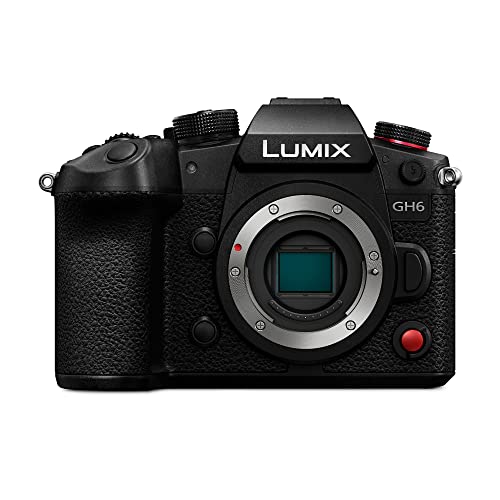
Documentary interviews die in two ways: the camera stops, or the subject stops trusting it. The GH6’s listing attacks the first death directly — a 25.2MP Micro Four Thirds mirrorless camera with unlimited C4K/4K 4:2:2 10-bit video recording and a 7.5-stop 5-axis dual image stabiliser. Unlimited is the operative word and it is stated in the title: an interview can run to its natural end, a ceremony can unfold whole, and the camera’s stamina stops being a character in the production.
The 4:2:2 10-bit specification, also stated, is the colourist’s version of the same promise. Documentary light is found light — mixed, ugly, unrepeatable — and 10-bit 4:2:2 material survives the corrections found light demands far better than thinner codecs. Skin tones under a subject’s own lamps can be pulled back to humanity in the grade instead of being abandoned. For small crews without lighting control, that forgiveness is worth more than resolution.
Stabilisation at a stated 7.5 stops changes handheld documentary practice. Walking shots through a market, following a subject through their workplace, the gentle drift of an observational handheld frame — all become usable without a gimbal’s footprint and setup. Micro Four Thirds compounds the advantage: lenses are small, the whole kit fits in a bag that does not announce a film crew, and discreet filming in sensitive places gets easier. Documentary access is often a function of how little equipment frightens people.
The format’s honest cost is low light and depth of field. A smaller sensor gathers less light than the full-frame FX3 below, and night interiors will show it; backgrounds dissolve less readily, keeping context sharp — a flaw for portraiture, arguably a virtue for a genre whose creed is context. Productions choose their compromises; the GH6’s are at least chosen in daylight, with the endurance benefits stated in its own listing.
For the small crew that films long, travels light and grades honestly, this is the guide’s endurance champion. Such crews can check the Lumix GH6 on Amazon and note how much of its promise is printed in its own title.
- Sensor: 25.2MP Micro Four Thirds, per the listing title
- Recording: unlimited C4K/4K 4:2:2 10-bit video, per the listing title
- Stabilisation: 7.5-stop 5-axis dual image stabiliser, per the listing title
- Model: DC-GH6BODY — body only, per the listing title
- Autofocus type: Not stated in the listing title — verify with the manufacturer documentation
- Weather sealing: Not stated in the listing title — verify with the manufacturer documentation
Strengths
- Unlimited recording, as stated, removes the interviewer’s clock anxiety.
- 10-bit 4:2:2 footage forgives the mixed light documentaries live in.
- Strong stated stabilisation plus small MFT lenses suit discreet solo work.
Trade-offs
- Smaller sensor trails full-frame in the darkest interiors.
- Deep depth of field keeps backgrounds present rather than melted.
- Body only — the lens kit is a further purchase.
Best for: a small documentary crew filming long interviews and observational days on foot.
Not suited for: a night-heavy production needing the cleanest possible low-light files.
Discretion deserves a fuller treatment, because it decides entire strands of documentary practice. A GH6 kit — small body, compact lenses — fits in an ordinary shoulder bag, draws no crowd at a border or a doorway, and lets a filmmaker work in places where a cinema rig would require permits, explanations and escorts. Social documentaries about workplaces, clinics, schools and streets are filmed inside that discretion or not filmed at all. The format’s modest appearance is a professional credential of a peculiar kind: proof that the filmmaker intends to observe rather than to stage.
Weather and stamina of the operator matter too. Long observational days are physical work, and a lighter kit extends the hours an operator can hold concentration — which is when the unrepeatable moment usually happens, late, after the scheduled events end. The GH6’s endurance story is therefore double: the stated unlimited recording for the camera, and the sustainable load for the human carrying it.

Sony Alpha FX3 Cinema Line Camera — Best full-frame low-light cinema body
The FX3 closes the list at the opposite pole from the camcorder: a full-frame Cinema Line camera, per its listing, in Sony’s compact cinema form. Its documentary territory is the dark — the night-shift ward, the fishing boat before dawn, the bar where the story lives — places where smaller sensors surrender detail to noise and where a full-frame cinema body keeps faces legible and shadows textured. Productions are increasingly shot where life actually happens at night, and this is the tool in the guide built for that shift.
Cinema Line membership carries the same implications as with its smaller FX30 sibling: a body designed for rigs, monitors and professional audio ecosystems, behaving like a film tool rather than a stills camera with a record button. The compact form matters on location — the FX3-based rig stays small enough for a two-person crew to move through real spaces without turning every doorway into a negotiation.
Full-frame depth of field is the aesthetic signature and the operational tax. At wide apertures the background falls away beautifully, isolating a subject in a crowded night market; but focus becomes a razor’s edge on moving subjects, and solo operators must work for their sharpness in a way APS-C and MFT shooters do not. Crews with a dedicated focus puller, or patient subjects, harvest the look; vérité shooters chasing chaos may find the GH6’s forgiveness kinder.
The listing title is brief — the camera’s name and its Cinema Line identity — so this guide asserts no sensitivity figures, recording formats or limits beyond that identity, and buyers should confirm the detailed specification in Sony’s documentation. What the title does establish, combined with the line it belongs to, is enough for the recommendation: this is the full-frame cinema option for documentary crews whose stories happen after dark.
Pairing logic completes the picture: many working documentary units run an FX3 as the A-camera beside an FX30 for tighter or riskier angles, sharing the E-mount lens bag between them. Readers building toward that professional pattern can see the Sony FX3 on Amazon as the long-term anchor of such a kit.
- Line: Sony Cinema Line, per the listing title
- Sensor: full-frame, per the listing title
- Model: ILME-FX3, per the listing title
- Recording formats: Not stated in the listing title — verify with the manufacturer documentation
- Record limit: Not stated in the listing title — verify with the manufacturer documentation
- Stabilisation: Not stated in the listing title — verify with the manufacturer documentation
Strengths
- Full-frame cinema sensor for the night and interior stories docs increasingly tell.
- Compact Cinema Line body rigs professionally without bulk.
- Shares the E-mount ecosystem with the FX30 for two-camera units.
Trade-offs
- Razor-thin focus at wide apertures taxes solo operators.
- Premium body pricing before a single lens is bought.
- Brief listing means detailed specifications need documentation homework.
Best for: a documentary crew filming night and low-light subjects with cinema production values.
Not suited for: a daytime, deep-focus observational project better served by the GH6 or the camcorder.
Night work also changes the ethics and craft of access. Subjects filmed after dark — night-shift nurses, bakers, security staff, musicians — are often filmed during their working hours by crews who must move quietly and light minimally, because the workplace cannot stop for a film. A camera that sees in the available dark without demanding a lighting rig is not merely convenient in those settings; it is the difference between being tolerated and being refused. The FX3’s full-frame identity, stated in its listing, is the foundation of that tolerance.
Two-camera documentary units deserve a final practical note. Matching colour between bodies of the same line is a solved, menu-level exercise; matching across brands is a colourist’s recurring chore. Crews planning to grow from one body to two within a few years should weigh that future matching cost now — it is one more reason the FX30-and-FX3 pairing recurs in working documentary kits, and one more argument for choosing an ecosystem rather than a gadget.
Comparison
| Camera | Format (as listed) | Stated headline | Defining strength |
|---|---|---|---|
| Sony FX30 | Super 35 / APS-C | 20.1MP effective for movies | Cinema Line starter for rig-based solo crews |
| Canon EOS R5 C | Full-frame | 8K/60p internal RAW, 45MP stills | Hybrid flagship for film-plus-stills productions |
| Panasonic HC-X2100 | Fixed-lens camcorder | 24x zoom, 3G-SDI/HDMI, 24-item bundle | Ready-to-film event and community workflow |
| Blackmagic Pocket 6K Pro | Cinema body | No continuous AF, no in-body stabilisation | Image-first manual cinema for patient filmmakers |
| Panasonic Lumix GH6 | Micro Four Thirds | Unlimited 4:2:2 10-bit, 7.5-stop stabiliser | Endurance and discretion for small crews |
| Sony FX3 | Full-frame | Cinema Line compact body | Low-light cinema for night stories |
Camcorder or Mirrorless: Which Documentary Tool Is Actually Yours?
The split running through this list deserves a direct answer. Choose the camcorder route — the HC-X2100 — when the work is events, institutions, oral history and community stories; when one operator must be ready instantly; when the audience values clarity and completeness over cinematic gloss; and when the budget must arrive as a finished kit rather than a body awaiting lenses. Generations of respected documentaries were made exactly this way, and their makers were not compromising — they were matching tool to task.
Choose an interchangeable-lens body when the film’s visual language is part of its argument: shallow focus portraiture, night cinematography, a graded look that distinguishes the work. Then choose within the family by crew and method — FX30 for the building solo filmmaker, GH6 for endurance and discretion, Pocket 6K Pro for manual-focus purists with support gear, R5 C for film-and-stills productions, FX3 for the dark. The wrong choice is rarely the camera; it is the mismatch between camera and method.
Hybrid productions can also stage the decision: many units own a camcorder for access and events and rent or buy one cinema body for interviews and beauty work. There is no rule that a documentary must be shot on one tool, only a rule that the tools must not fight the schedule.
Access and consent form the invisible half of camera choice. A modest camera in a sensitive place — a clinic, a place of worship, a family kitchen — asks less of the people inside it, and experienced documentarians choose bodies partly for the temperature they bring into a room. The GH6 and the camcorder read as tools; a large cinema rig reads as an event. Neither reading is wrong, but they produce different behaviour from subjects, and therefore different films. When you choose from this list, you are also choosing the version of your subjects you will meet.
Preparation rituals separate finished documentaries from abandoned ones more reliably than any specification. Charge everything the night before. Format cards in the camera that will use them. Record a test minute and listen to it on headphones — actually listen — because the fault found at home costs nothing and the same fault found on location costs the day. Pack the microphone before the spare lens. These habits are unglamorous, unphotogenic and decisive, and every camera in this guide rewards them equally.
How Do You Keep an Interview Recording Until the Story Lands?
Long-form interviewing is an endurance discipline disguised as a conversation. Prepare the camera so it disappears: media with room to spare, power solved for hours rather than minutes, and a position that lets the subject forget the lens. Where a listing states unlimited recording — the GH6 — the camera’s stamina is documented; where titles are silent, test your own body at home for a full afternoon before trusting it with an irreplaceable testimony. Never let a subject’s best sentence be the one the camera missed while stopping.
Sound outranks image in the interview hierarchy, a truth this guide repeats because productions keep relearning it expensively. A microphone near the subject, headphones on the operator, and a quiet room will lift an interview further than any sensor upgrade. Audiences forgive a soft frame; they abandon muddy voices. Budget and attention should follow that order — microphone before lens, lens before body, a sequence the HC-X2100 bundle quietly endorses by including the microphone in the box.
Focus strategy completes the triangle. Seated subjects sway; autofocus systems that track an eye calmly are a gift to solo interviewers, while manual-focus cameras demand a smaller aperture, a marked focus point and an operator who watches rather than chats. Choose the method your crew can actually sustain for ninety minutes, because the interview’s best material usually arrives after the first hour, when the subject stops performing.
Editing begins in the field, and camera choice shapes it. Formats that grade deeply — the R5 C’s stated internal RAW, the GH6’s stated 4:2:2 10-bit — give the editor rescue options when a day’s light misbehaved, but they also multiply storage and processing in direct proportion to their mercy. A production should decide its post-production reality before choosing its capture format: the finest codec in this guide is a liability to a filmmaker editing on an ageing laptop with a festival deadline. Match the chain end to end, camera to timeline, and the documentary survives its own ambition.
There is a final, unfashionable selection criterion: repair and rental geography. A camera that can be serviced, borrowed or replaced near where you film is worth real money to a production far from home. Working documentarians quietly favour systems with deep local ecosystems for exactly this reason. The brands in this list all travel well by that measure, but the specific mount and model you choose should still be checked against the places your film will actually take you.
Common Mistakes
Buying resolution instead of reliability. A documentary is a hundred hours of ordinary light and ten minutes of magic; a camera that overheats, stops or frightens subjects loses the magic while winning the specification sheet. Stamina and trust are the genre’s true specifications, and they are the ones this guide ranked.
Discovering the Pocket 6K Pro’s limits on location. No continuous autofocus and no in-body stabilisation are printed in its section here because productions have genuinely been ambushed by them. If your method needs either feature, choose another pick and let the Blackmagic serve the patient filmmakers it was designed for.
Treating audio as a post-production problem. It is not fixable there. The interview recorded through a distant camera microphone in a tiled room stays muddy forever, whatever the sensor’s pedigree. Solve sound at the scene or accept that the scene is lost.
Neglecting releases and permissions until the edit. A flawless interview that cannot legally be shown is an expensive private screening. Camera choice cannot fix paperwork, but the discipline that surrounds a well-run shoot — consent confirmed, locations agreed, names spelled correctly in the log — travels with the same productions that choose their tools carefully. Method, again, is the through-line.
Rigging beyond your crew. A beautiful twelve-accessory rig that takes forty minutes to rebuild between locations will be left assembled, then left behind, then left at home. Build the smallest rig your method needs; documentaries are filmed by the equipment that actually travels.
Skipping the location sound check. Rooms lie: a kitchen that looks quiet hums with a refrigerator, a hall that feels calm rings with echo. Record thirty seconds of the empty room, listen on headphones, and move the interview before the subject arrives rather than after. Every camera here records what the room gives it; the room is chosen, or at least auditioned, by you.
Ignoring the second camera. Interviews cut better with two angles, and even a modest B-camera saves edits when a take is interrupted. Several pairings inside this list — FX3 with FX30, GH6 beside the camcorder — exist because working units discovered this years ago.
Final Recommendation
Decide by method, not by specification. The solo filmmaker building a serious practice should start with the FX30 and grow into its mount; the small crew filming long and discreetly should take the GH6 and its stated unlimited recording; event, community and oral-history work belongs to the HC-X2100 bundle, ready out of its box. The Pocket Cinema 6K Pro rewards the patient manual filmmaker with a singular image, the R5 C serves productions that publish stills beside the film, and the FX3 owns the night. Pick the camera your shooting method would pick for itself, and the waiting — the long, necessary waiting of documentary work — will be spent watching the subject instead of the battery icon.
One question outranks the camcorder-versus-mirrorless debate and should be asked before either is settled: how does the film get finished? A documentary shot beautifully and edited never is a hard drive, not a film. Camera budgets that consume the money reserved for editing time, music licensing, subtitling and festival fees are the commonest structural error in independent documentary — and no body in this guide, however capable, can edit itself. Protect the finishing budget first, then buy the most honest camera the remainder allows. That ordering has saved more films than any sensor.
With that protected, let the shooting method arbitrate the rest. Write down, in plain sentences, how your film is actually made: who operates, where, for how long at a stretch, in what light, with what sound. Then read the six sections above against those sentences. The correct camera will feel almost obvious — because for a defined method, it usually is — and the specification sheet will shrink to its proper role as confirmation rather than temptation.
Frequently Asked Questions
Which of these is best for a one-person documentary crew?
The FX30 and the GH6 divide that particular honour between them by style and by ecosystem. The FX30 suits a rig-building filmmaker working inside Sony’s ecosystem; the GH6 suits a travelling solo operator who needs stated unlimited recording, strong stabilisation and a small, discreet kit. Solo shooters working alone should avoid building their entire practice around the Pocket 6K Pro, whose manual focus and absent stabilisation assume support and assistance.
Is a camcorder like the HC-X2100 still a serious documentary tool?
Entirely, without qualification. Fixed-lens professional camcorders remain the working standard for events, oral history, community film and local journalism because they are ready almost instantly, zoom far without any lens changes at all and arrive — in this bundle’s case — with the microphone and light the work needs. Cinema aesthetics are one proud documentary tradition among several, not the whole genre by any means.
Why does the guide stress the Pocket 6K Pro’s missing autofocus?
Because it changes how the camera must be used, every day, on every shot. No continuous autofocus means focus is pulled manually or set and held; no in-body stabilisation means support gear is mandatory. Filmmakers who accept both facts love this camera. Filmmakers who discover them mid-production feel deceived — and this guide refuses to let that happen.
Do I need 8K for a documentary, like the R5 C offers?
Rarely for delivery alone — most documentaries still finish at 4K or below in practice — but the R5 C’s stated 8K/60p internal RAW is about grading headroom and reframing insurance, not screen size. Buy it if your production genuinely exploits that headroom or truly needs its 45 megapixel stills for print; otherwise the same money usually serves a real documentary far better as travel, access, translation and time.
Should a beginner start with the camcorder or a mirrorless body?
Start with the tool that matches the films you will make this year, not the filmmaker you hope to become in five. Community, school, family-history and event films point to the HC-X2100 bundle, which arrives complete and forgives beginners. A beginner already committed to cinematic language and willing to learn rigs points to the FX30. Both are honest, respectable beginnings for serious work; the only real mistake is buying the other person’s camera for the other person’s film.
Which camera handles long interviews most safely?
The GH6, on the evidence of its own listing: unlimited C4K/4K recording is stated in the title. For the other bodies, whose titles do not state record limits, the professional practice is to test your exact camera and settings at home across a full-length session before an irreplaceable interview. Never, under any circumstances, learn a record limit the hard way from a subject’s irreplaceable testimony.
How important is stabilisation for documentary work?
It depends on how the film moves. Interview and tripod traditions barely need it; walking, following, observational styles lean on it constantly. That is why the GH6’s stated 7.5-stop stabiliser matters to its buyers, and why the Pocket 6K Pro’s lack of in-body stabilisation is a defining condition rather than a footnote — it commits its owner to tripods, gimbals and rigs. Neither answer is superior; they are different films waiting to be made.
What should I buy after the camera?
A proper microphone, then a small light, then dependable support — in that deliberate order, for almost every documentary production at almost every budget level. Voices carry the entire genre, a small LED rescues dim interiors daily, and a sturdy tripod you actually carry everywhere beats a sophisticated gimbal you leave behind at home. Lenses come fourth in that queue, which surprises stills photographers considerably and surprises no working documentarian at all.
Transcription and logging, the least glamorous documentary disciplines, close this guide’s advice because they decide whether shot material becomes a film or an archive of regrets. Log each day’s interviews the same evening, even roughly; mark the sentences that made you look up from the monitor; back the cards up before sleep. The camera’s work ends at the card slot — the filmmaker’s continues — and productions that respect that handover finish. Productions that treat filming as the whole job own very expensive beginnings.
And keep the subjects in the finished film’s life. A documentary camera is also a promise: that the hours people gave will become something they can watch with pride. The bodies above differ in format, mount and philosophy, but they share that obligation. Choose the one whose working method lets you keep the promise — steadily, audibly, in focus, and for as long as the story needs.
Related Guides
The same bodies reappear under stage lighting in our guide to cameras for shooting music videos, where low light matters more than endurance. Talking heads get their own treatment in the interview camera recommendations, and the stills side of location work is covered by our product-photography point-and-shoot picks for makers who sell what they make.


