What's inside
- Key Takeaways
- Quick Picks
- How We Chose These Picks
- Which Focal Length Matches How You Already See?
- Why Does One Lens Make Photographers Better?
- How Should You Carry a Camera This Small?
- What About Video, Screens and the Modern Checklist?
- How Does Colour Character Shape the Choice?
- What Is Snap Focus, and Why Do GR Owners Swear by It?
- How Well Do These Files Print?
- What Should You Check in Variant and Import Listings?
- How Well Do These Cameras Age?
- What Does a Year With One Lens Do to a Portfolio?
- Can These Cameras Handle Low Light Honestly?
- Why Do Phones Not Simply Replace These Cameras?
- Habits That Waste a Fixed-Lens Compact
- Final Recommendation
- Frequently Asked Questions
- Related Guides
As an Amazon Associate I earn from qualifying purchases. This post may contain affiliate links at no extra cost to you.
widgetverdict.com is reader-supported. When you buy through links on our site, we may earn an affiliate commission.
A fixed lens is a promise a camera makes to its owner: I will never ask you to choose. The best aps c compact cameras take that promise seriously by bolting one excellent lens to a genuinely large APS-C sensor and shrinking everything else until the result fits a coat pocket — no system to build, no bag to carry, no decision fatigue between you and the photograph. Six cameras define the current shelf, and they divide neatly into two philosophies: Fujifilm’s X100 line, which treats the compact as a crafted object with a photographer’s controls, and Ricoh’s GR line, which treats it as an invisible snapshot instrument — plus a Canon that answers both with a zoom.
The constraint that creates the category is also its discipline. One focal length, or in Canon’s case one modest zoom, means the photographer’s feet and eye do the composing that lens-swapping does elsewhere. Owners of these cameras talk about them the way musicians talk about a single beloved instrument — not as a compromise accepted, but as a practice chosen.
Specification honesty matters doubly here because two of the listings below — the Fujifilm pair — state almost nothing in their titles beyond the model name and colour. This guide reviews each camera on what its own listing establishes, marks the silences plainly in the spec boxes, and discusses design philosophy at the level the listings and the lines’ public standing support. Where a Ricoh or Canon title speaks in detail, the review happily follows it into the numbers.
Key Takeaways
- Fujifilm’s X100VI and X100V, both in silver listings here, are the craft-object flagships of the fixed-lens world.
- Ricoh’s GR IIIx states its brief openly: 24MP APS-C sensor, 40mm-equivalent F2.8 lens, in-body stabilisation.
- The GR IIIx HDF swaps in a built-in highlight diffusion filter for a softer, film-like rendering.
- The GR IV moves the line to a 28mm-equivalent lens and a 25.7MP APS-C sensor with a new GR engine.
- Canon’s PowerShot G1 X Mark III is the zoom answer: 24.2MP APS-C sensor and Dual Pixel AF in a compact body.
- One focal length is the category’s discipline — choose the length that matches how you already see.
Quick Picks
| Pick | Badge | Why it made the cut |
|---|---|---|
| Fujifilm X100VI Digital Camera (Silver) | Best current flagship | The sixth X100 generation, in its silver listing. |
| Fujifilm X100V Digital Camera (Silver) | Best proven X100 | The generation that made the line a phenomenon. |
| Ricoh GR IIIx Digital Compact Camera | Best snapshot instrument | 40mm-equivalent lens and 24MP APS-C sensor, stated plainly. |
| Ricoh GR IIIx HDF Compact Camera | Best for a softer look | Built-in highlight diffusion filter over the IIIx formula. |
| Ricoh GR IV Premium Compact Camera | Best wide snapshot camera | 28mm-equivalent lens and 25.7MP sensor with a new engine. |
| Canon PowerShot G1 X Mark III Camera | Best zoom compact | 24.2MP APS-C sensor, Dual Pixel AF and a 3x zoom — sold here as a bundle with card and bag per its listing. |
How We Chose These Picks
Sensor size was the entry ticket, as the keyword demands: APS-C, the format these six share, large enough for genuine low-light work and subject separation while small enough to keep a fixed-lens body pocketable. Cameras with smaller sensors — however beloved — were excluded, because the category’s entire argument is that the big sensor is the point.
Focal-length spread was the second criterion, and it structured the list deliberately. The Ricoh pair at 40mm-equivalent, the GR IV at 28mm-equivalent, the X100 line’s classic fixed framing and Canon’s zoom give a reader the real decision in this category — not which camera is best, but which single view of the world they want to carry. A guide that listed six cameras at one focal length would be a ranking; this one is a map.
Listing honesty shaped the order of presentation. The Ricoh and Canon titles state their sensors and lenses outright, so their reviews can argue from facts. The Fujifilm titles state model and colour only, so their reviews argue from the line’s design philosophy and standing, with spec boxes that decline to invent the missing numbers — a discipline this guide applies even to the most famous camera on the page.
Finally, availability realism: the X100 line’s listings include import and Japan variants in the wider marketplace, and each pick here is reviewed from its own title as listed — a silver camera, of a named generation — without borrowing specifications from sibling listings. Buyers should apply the same rule at checkout and read the exact listing in front of them.

Fujifilm X100VI Digital Camera (Silver) — Best current flagship
The listing for the X100VI says only this: FUJIFILM X100VI Digital Camera — Silver. In a guide that has disciplined itself to review from titles, that terseness is almost a flex, because no camera in this category needs its specification less. The X100 line’s sixth generation is the most demanded fixed-lens camera of its era, the one with waiting lists and a resale market that behaves like a ticket exchange, and the listing’s confidence in the name alone mirrors the market’s.
What the name carries, for readers new to it, is a design philosophy Fujifilm has refined across six generations: an APS-C fixed-lens compact built like a classic rangefinder, with physical dials for the exposure decisions and a hybrid viewing experience that owners describe as the reason they shoot more. The VI is the current statement of that philosophy — the generation a buyer chooses when they want the line’s latest thinking rather than its history.
Silver is not a trivial detail in this line. The X100’s two finishes divide its owners into quiet camps — silver for the classic camera-object aesthetic, black for discretion — and this listing is the silver one. Choose deliberately: the camera will be seen, handled and photographed itself more than any other in this guide, because being a beautiful object is part of its function in its owners’ lives.
Specification restraint governs the rest of this review. The listing title does not state the VI’s sensor resolution, lens figures or stabilisation arrangements, so the spec box below marks those as matters for Fujifilm’s documentation rather than borrowing them from the line’s publicity. That restraint costs the review nothing essential: the X100VI is bought for the totality of its design — the fixed lens as discipline, the controls as invitation, the files’ colour character as house style — and those qualities are matters of standing and testimony, which this review can honestly report.
Ownership testimony is unusually consistent for this line: X100 owners shoot more. The camera goes where systems stay home — the school run, the work trip’s spare hour, the evening walk — and its fixed lens converts hesitation into composition, because the frame is always the same question and the only variable is where you stand. The VI inherits that testimony wholesale, being the same promise in its newest form.
Buying counsel is mostly about patience and provenance. Demand for this line has made its listings a thicket of variants, regions and markups; read the exact listing, confirm the generation numeral and the finish, and be suspicious of any offer that seems to have escaped the market’s gravity. The camera rewards the deliberate buyer in kind: it is itself the product of a maker refusing to hurry a design that was already right.
- X100 line, sixth generation
- Silver finish per this listing
- Fixed-lens APS-C compact design philosophy
- Sensor resolution: Not stated in the listing title — verify with the manufacturer documentation
- Lens specification: Not stated in the listing title — verify with the manufacturer documentation
- Stabilisation: Not stated in the listing title — verify with the manufacturer documentation
Treat the first month with the VI as an apprenticeship in one focal length. Photographers arriving from zooms feel the constraint as loss for a fortnight and then, almost uniformly, as relief: the world starts arriving pre-framed, feet start moving before the camera rises, and the photographs acquire the coherence of a single sustained viewpoint. That transformation is the product. The silver box is merely how it is delivered.
Strengths
- The current generation of the category’s defining line
- Design and controls that make owners shoot more
- Silver finish with genuine classic-camera presence
Trade-offs
- Listing states no specifications to compare on paper
- Demand makes listings a thicket of variants and markups
- Fixed lens is a discipline some buyers will chafe against
Best for: photographers who want the flagship fixed-lens experience in its current form
Not suited for: zoom flexibility, since the fixed lens is the entire design

Fujifilm X100V Digital Camera (Silver) — Best proven X100
The X100V’s listing is a twin of its successor’s — Fujifilm X100V Digital Camera — Silver — and the generation it names needs no more introduction than that, because the V is the model that carried the X100 line from cult object to cultural phenomenon. When this camera’s generation arrived, the fixed-lens compact stopped being a niche taste and became the camera a generation of photographers aspired to own, carry and be seen carrying.
Understanding the V means understanding what it consolidated. Across its predecessors the line had gathered its identity piece by piece — the hybrid viewing concept, the dial-led controls, the film-simulation colour character — and the V was widely received as the generation where the recipe completed itself, the one owners of earlier models described as the camera the line had always been trying to be. That standing, not any single figure, is the V’s specification in this review.
Its relationship to the VI above is the buyer’s real question, and it resolves the way such questions usually do: the newer generation for those who want the line’s current platform and longest future, the V for those who value the most documented, most accessorised, most understood version of the idea. Neither answer embarrasses the other, and the used and remaining-stock market for the V is deep precisely because so many owners upgraded within the family and sold carefully kept cameras onward.
Silver again, in this listing, with the same counsel as its successor: the finish is part of the ownership experience in this line, chosen by people who enjoy the camera as an object in the hand and in the photograph of the holiday table. Black-finish listings exist elsewhere in the marketplace for the discretion-minded; the guide reviews the listing it has, and this one gleams.
Specification discipline matches the VI’s review exactly. The title states model and colour; sensor, lens and stabilisation figures belong to Fujifilm’s documentation for the model, and the spec box says so in the guide’s standard form. A buyer comparing the two Fujifilms on numbers should pull both manufacturer sheets and compare them directly — the honest method, since neither listing here offers the figures to compare within this page.
What the V offers that no specification conveys is community: a decade-deep well of settings wisdom, film-simulation recipes, cases, straps and shared experience, accumulated by the largest fixed-lens ownership of the modern era. Buying into the V is buying into that library. For a first serious compact, there are worse foundations than standing where the most photographers have already stood and left maps.
- X100 line, fifth generation
- Silver finish per this listing
- Fixed-lens APS-C compact design philosophy
- Sensor resolution: Not stated in the listing title — verify with the manufacturer documentation
- Lens specification: Not stated in the listing title — verify with the manufacturer documentation
- Stabilisation: Not stated in the listing title — verify with the manufacturer documentation
Shopping diligence for the V mirrors the VI’s with one addition: because the model has been sold across years and regions, confirm the exact generation and the listing’s origin terms before paying — the marketplace for this line includes import variants, and the wise buyer reads the fine print of the specific offer rather than assuming the line’s uniformity. The camera itself, in any legitimate variant, remains the same beloved instrument.
Strengths
- The generation that defined the modern fixed-lens phenomenon
- Deepest owner community and accessory ecosystem here
- Proven, documented behaviour across years of use
Trade-offs
- Succeeded by the VI as the current platform
- Listing states no specifications
- Marketplace variants demand careful reading
Best for: the phenomenon in its most understood and documented form, with the deepest bench of owner wisdom behind it
Not suited for: the line’s newest platform and longest support horizon, both of which belong to the VI above

Ricoh GR IIIx Digital Compact Camera — Best snapshot instrument
After the Fujifilms’ reticence, the Ricoh GR IIIx’s listing is a deep breath of specification air: a premium digital compact camera with a 40mm focal length, a 24MP APS-C size CMOS sensor, a 40mm F2.8 GR lens in 35mm format terms, in-body SR — Ricoh’s shake reduction — and the self-awarded title of ultimate snapshot camera. Every important fact a buyer needs is in that sentence, and the review can therefore do what reviews prefer: argue from evidence.
The 40mm-equivalent lens is the IIIx’s defining choice. Wider than the classic 50, tighter than the 35 and 28mm street standards, 40mm sits at the focal length many photographers describe as closest to natural attention — the frame your eye composes before the camera rises. On a snapshot camera, whose entire purpose is to catch life at the speed it happens, that naturalism is a feature with daily dividends: photographs that look like being there felt.
Snapshot is a philosophy, not a marketing word, in the GR line. The camera is built to be operated by feel, fired from the hip or the chest, carried in a pocket rather than a bag, and ignored until the moment arrives. In-body stabilisation serves that philosophy directly — a camera grabbed and fired in poor light needs its SR the way a tripod camera never will — and its presence in the listing is one of the specifications that separates the GR from decorative compacts.
The 24MP APS-C sensor completes the seriousness. This is the format the keyword promises, with the low-light and cropping behaviour that follows from it, in a body smaller than most phones are thick-across. Owners of the GR line speak of it as the camera that is simply always there — the one that has taken more of their favourite photographs than the expensive system at home, by the unanswerable logic of attendance.
Against the X100 pair, the GR IIIx is the introvert’s answer: no dials performing for an audience, no silver gleam, a black instrument that photographs its owner never. Photographers who find the Fujifilm theatre delightful will not be converted, and photographers who find it exhausting will wonder why they waited. The category is big enough for both temperaments, and this guide ranks neither above the other in spirit — only in fit.
Practical counsel for the snapshot life: set the camera up once, thoroughly — your snap focus distances, your preferred exposure behaviour — and then stop visiting the menus. The GR rewards the owner who turns it into a reflex, and punishes, with missed moments, the owner who treats it like a system camera that happens to be small. Its listing calls it the ultimate snapshot camera; the owner’s discipline is what makes the claim true.
- 24MP APS-C size CMOS sensor
- 40mm F2.8 GR lens (35mm-format equivalent)
- In-body SR shake reduction
- Premium digital compact, snapshot design philosophy
A note on buying the correct GR: the line includes a Renewed listing for a IIIx variant in the wider marketplace, and it is not this pick. The ASIN attached to this review is the listed camera described above; let it arbitrate, as with the Fujifilms, any confusion a search page creates among near-identical names and conditions.
Strengths
- Complete, honest specification in its own listing
- 40mm-equivalent lens matches natural attention
- In-body stabilisation serves grab-and-fire shooting
Trade-offs
- Fixed 40mm framing excludes wide-scene lovers
- Understated design gives no viewfinder theatre
- Snapshot philosophy demands setup discipline upfront
Best for: street and everyday photographers who shoot by reflex
Not suited for: wide-angle devotees, since 40mm cannot stretch to their way of seeing

Ricoh GR IIIx HDF Compact Camera — Best for a softer look
The GR IIIx HDF takes the camera above and changes one ingredient with outsized consequences: a built-in Highlight Diffusion Filter, named in the listing as the model’s reason to exist. The rest of the formula carries over — 24MP APS-C CMOS sensor, 40mm f/2.8 lens — so the HDF is best understood as the IIIx rendered in a different emotional register, and this review’s job is to explain what that filter does to a photograph and who it is for.
Highlight diffusion softens the bright parts of an image — streetlights bloom gently, skin highlights glow rather than glare, specular edges melt a degree toward the look photographers associate with film and with certain beloved older lenses. It is a rendering choice baked into the hardware, available at the moment of exposure rather than negotiated afterwards in software, and for photographers who chase that softness it converts the camera from a recorder into an interpreter.
The honest trade is micro-contrast. Diffusion is, by design, a controlled surrender of clinical sharpness in the highlights, and the photographer who measures a camera by its eyelash resolution at pixel level will find the HDF’s character a defect wearing a feature’s clothes. Neither reaction is wrong; they are the two temperaments of photography itself, and Ricoh, unusually, sells a camera for each — the standard IIIx for the documentarian, this one for the romantic.
Everything else in the snapshot inheritance holds: the pocketable body, the grab-and-fire ergonomics, the APS-C seriousness underneath the softness. That combination is rarer than it sounds. Soft-rendering cameras are often toys; the HDF is a photographer’s instrument that happens to dream a little, and its owners’ work — night streets with halation around the lamps, portraits with a forgiving glow — has given it a following out of proportion to its niche.
Choosing between the two IIIx models is therefore a question about your highlights. Shoot architecture, product detail or anything whose truth lives in hard edges, and the standard model’s clarity serves you. Shoot people, nights and atmosphere, and the diffusion filter will feel less like an effect than like the camera finally agreeing with you about what the scene felt like.
One practical note: a built-in filter is a commitment. Unlike a screw-on accessory, the HDF’s character is the camera’s character, present as the default rendering its owners build their style around. Buy it as you would buy a lens with a famous rendering — because you want that signature on everything — rather than as a feature to sample occasionally.
- Built-in Highlight Diffusion Filter
- 24MP APS-C CMOS sensor
- 40mm f/2.8 lens
- GR IIIx snapshot platform
Night street photography is this camera’s home fixture, and a first owner’s month is best spent there: wet pavements, neon, bus windows, faces under lamps. Review the highlights rather than the shadows when judging your early frames, because the highlights are where this camera writes its signature — and if that signature pleases you in month one, it will please you for the camera’s whole life.
Strengths
- Diffusion rendering available at the moment of exposure
- Full GR snapshot seriousness underneath the softness
- A genuine stylistic alternative within one camera line
Trade-offs
- Highlight softness is a permanent character, not a garnish
- Clinical-sharpness seekers will read its charm as loss
- Shares the fixed 40mm framing of its sibling
Best for: night, portrait and atmosphere photographers who shoot for feeling
Not suited for: detail absolutists whose work lives on hard edges and micro-contrast
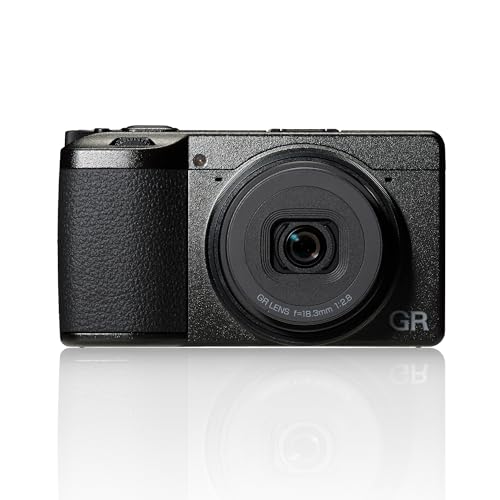
Ricoh GR IV Premium Compact Camera — Best wide snapshot camera
The GR IV’s listing announces a generational step in the line’s own vocabulary: a 25.7MP APS-C size CMOS sensor, a 28mm F2.8 GR lens in 35mm-format terms, in-body SR, and a new GR engine — with the family motto, ultimate snap shooter, carried forward. Where the IIIx models argue for 40mm, the IV returns the GR line to its wide heritage at 28mm, and that single decision reframes who this camera is for.
Twenty-eight millimetres is the classic street and travel width: whole scenes, context included, the subject inside its world rather than extracted from it. Photographers who shoot this way think in environments — the market stall with its crowd, the traveller small against the station — and the GR IV is their instrument in this guide, the wide eye paired with the IIIx’s tighter gaze across a two-camera philosophy a single brand unusually offers.
The new GR engine is the listing’s forward-looking claim. Engine generations in the GR line govern the unglamorous essentials — responsiveness, processing character, the feel of the camera’s reactions — and a new engine in a snapshot camera is a promise about speed of life: wake faster, focus surer, keep up. This review reports the claim as the listing states it and notes that engines prove themselves in owners’ hands across seasons, not in launch vocabulary.
Resolution rises modestly to 25.7MP, and the honest reading of that figure is continuity rather than revolution: the APS-C snapshot formula refined, not reinvented. In-body SR remains, serving the same grab-and-fire doctrine as in the IIIx — a wide camera fired one-handed in a crowd is a camera that needs stabilisation as a core system, not a bullet point.
Choosing within the GR family is now a genuine three-way conversation: 40mm clarity, 40mm softness, or 28mm breadth on the newest platform. Photographers who already know their focal length will find the decision made for them by their own archives; photographers who do not should audit their phone photographs — the focal length you have been unconsciously shooting at is the one your GR should carry.
As the newest model, the IV also carries the newest-model caveats: a thinner owner literature than the IIIx’s deep well, and a market still settling around it. Early adopters of GR generations have historically been rewarded — the line evolves by refinement rather than rupture — but the buyer who values documented behaviour above platform novelty has the IIIx waiting in this same guide, and neither choice needs defending.
- 25.7MP APS-C size CMOS sensor
- 28mm F2.8 GR lens (35mm-format equivalent)
- In-body SR shake reduction
- New GR engine per the listing
- Premium compact, snapshot design philosophy
Wide-angle discipline is the IV owner’s apprenticeship: at 28mm the frame includes more than you noticed, and the craft is in the excluding — a step closer, a tilt refused, an edge checked before the shutter. Give the wide eye a month of deliberate seeing and it returns the most honest travel diary of any camera here, because nothing in the scene was allowed to hide outside the frame.
Strengths
- 28mm width captures whole scenes and their context
- Newest platform with a new engine generation
- Full snapshot inheritance: SR, pocket body, reflex handling
Trade-offs
- Wide framing includes clutter the 40mm excludes
- Newest model means the thinnest owner literature
- Modest resolution step over the IIIx models
Best for: street and travel photographers who compose in environments
Not suited for: subject-isolation shooters, since 28mm keeps the world in the frame whether invited or not

Canon PowerShot G1 X Mark III Camera — Best zoom compact
Canon enters this fixed-lens conversation carrying the one thing the other five refused: a zoom. The G1 X Mark III’s listing states a 24.2MP APS-C sensor, Dual Pixel AF and a 3x zoom, in a compact camera positioned for travel and everyday photography — and this particular listing bundles the camera with a 64GB card and a shoulder bag, a kit detail the review notes because it is part of what this specific offer is.
The zoom reframes the category’s founding discipline. Where Fujifilm and Ricoh ask the photographer to move, Canon offers a modest range of framings from one standpoint — wide for the scene, short telephoto for the face — and for travel photography that flexibility is not decadence but practicality: the viewpoint across the river, the detail on the tower, the portrait at the café table, all without a step that circumstances may not permit.
Dual Pixel AF is the listing’s second substantive claim, and it is a name with a pedigree in Canon’s system cameras: an autofocus architecture built for smooth, confident tracking in both stills and video. In a compact aimed at everyday and travel use, autofocus temperament decides how the camera feels at family speed — children, dogs, street moments — and Canon chose to compete on exactly that ground rather than on minimalism.
The 24.2MP APS-C sensor keeps the keyword’s promise in full. This is no small-sensor compact wearing a big name; the G1 X line has always been Canon’s statement that a compact can carry the company’s serious format, and the Mark III is that statement’s mature form — the camera for the Canon household that wants one body, no lenses, and image quality that does not apologise at dinner-party enlargements.
Against the fixed-lens five, the Canon trades the discipline for the flexibility and accepts the design consequences: a zoom mechanism to engineer around the large sensor, a body that serves two masters. Photographers formed by primes may find the zoom an invitation to laziness; photographers formed by travel will find it the difference between the photograph taken and the photograph described wistfully at dinner. Both are describing the same camera accurately.
The bundle in this listing deserves its practical sentence: a card and a bag in the box make the offer a complete starting kit, kind to gift-buyers and first-time owners, and redundant for the equipped — the same calculus as any camera sold as a complete starter kit, and judged by the same honesty. The camera is the purchase; the bundle is a convenience whose value depends on the emptiness of your drawer.
- 24.2MP APS-C sensor
- Dual Pixel AF
- 3x zoom lens
- Compact format for travel and everyday photography
- This listing bundles a 64GB card and shoulder bag (model 2208C001)
Zoom discipline, for the Canon owner, inverts the fixed-lens lesson: because the framing can change without your feet, make your feet move anyway and let the zoom solve only what position cannot. Owners who hold that rule get the best of both philosophies — the compact that behaves like a prime when you are virtuous and like a zoom when the river is in the way.
Strengths
- The only zoom in the guide — framing flexibility the others refuse
- Dual Pixel AF brings system-camera focus manners
- Full APS-C quality in Canon’s colour and handling tradition
Trade-offs
- Zoom flexibility dilutes the fixed-lens discipline
- Bundle items duplicate what equipped owners own
- 3x range is modest beside travel-zoom cameras
Best for: travellers and Canon households wanting one flexible compact
Not suited for: prime-lens purists who want the constraint itself as their teacher
Which Focal Length Matches How You Already See?
| Pick | Framing per its listing | Sensor per its listing | Temperament |
|---|---|---|---|
| Fujifilm X100VI | Fixed lens — figures not stated in the listing title | Not stated in the listing title | Crafted object, dial-led |
| Fujifilm X100V | Fixed lens — figures not stated in the listing title | Not stated in the listing title | The proven phenomenon |
| Ricoh GR IIIx | 40mm F2.8 equivalent | 24MP APS-C CMOS | Natural-attention snapshot |
| Ricoh GR IIIx HDF | 40mm f/2.8 with highlight diffusion | 24MP APS-C CMOS | Romantic snapshot |
| Ricoh GR IV | 28mm F2.8 equivalent | 25.7MP APS-C CMOS | Wide-scene snapshot |
| Canon PowerShot G1 X Mark III | 3x zoom | 24.2MP APS-C | Flexible travel compact |
Audit your own archive before answering. The photographs on your phone cluster at the lengths your eye prefers — most people’s do, measurably — and the fixed-lens camera that matches that cluster will feel like an extension while the one that fights it will feel like homework. The table’s real message is that this category offers no wrong focal length, only mismatched ones, and the mismatch is diagnosable from evidence you already own.
Why Does One Lens Make Photographers Better?
Because it removes the alibi. With a zoom or a lens bag, a weak photograph can blame its equipment — wrong lens mounted, wrong range chosen — and the lesson evaporates. With one lens, every failure is compositional: you stood in the wrong place, waited for the wrong second, saw the wrong frame. That accountability, repeated daily, is a complete photographic education wearing the disguise of a limitation, and it is why so many system owners keep a fixed-lens compact as their practice instrument.
Consistency compounds the effect. A body of work shot at one focal length acquires a visual accent — a recognisable way of seeing — that mixed-lens archives rarely achieve by accident. Photographers who publish, exhibit or simply print their year into a book feel that coherence as the category’s deepest reward, worth more than any single photograph the constraint cost them.
How Should You Carry a Camera This Small?
On your person, not in your luggage — the entire design assumes it. A wrist strap and a jacket pocket for the GRs, a small crossbody for the X100s, the Canon in its bundled bag or a coat: the rule is that the camera crosses the threshold with you on unremarkable days, because unremarkable days are where its photographs live. Owners who carry only on occasions own a very expensive occasional camera; owners who carry daily own a diary.
Protection should match the philosophy: a soft wrap rather than a padded fortress, a lens cloth in the same pocket, and an acceptance that a carried camera gathers honourable wear. These are instruments meant to age alongside their owners’ archives, and the mint-condition compact in a drawer is the category’s only true failure state.
What About Video, Screens and the Modern Checklist?
These cameras are stills instruments first, and a buyer whose primary need is video should weight that honestly — hybrid shooters have other shelves in this catalogue built for them. What the fixed-lens compacts offer instead is immediacy: the photograph as a complete act, made with dials and feet rather than menus and rigs. Judging them by a video checklist is judging a fountain pen by its typing speed.
Connectivity and screens follow the same philosophy across the lines — present, serviceable, and deliberately not the point. The point is upstream of the file: the seeing. A reader who finds that sentence pretentious should buy the Canon and enjoy its flexibility without a flicker of guilt; a reader who finds it obvious has understood why the other five cameras exist.
How Does Colour Character Shape the Choice?
Beyond sensors and focal lengths, these lines compete on how a photograph feels straight out of the camera. Fujifilm’s ownership culture revolves around its film-simulation heritage — colour renderings named for beloved film stocks, shared as recipes across a vast community — and for JPEG shooters that culture is a genuine feature: photographs that arrive finished, with a house style, rather than as raw material awaiting an evening in software.
Ricoh’s character runs the other way: a more neutral, documentary rendering that owners bend through the camera’s image controls toward their own ends, with certain GR colour modes acquiring cult followings of their own. Canon brings the colour familiarity of the world’s largest camera household — skin tones and skies that match the family albums of anyone raised on the brand. None of these is objectively finest; each is a dialect, and photographers reliably prefer the dialect their eye grew up speaking.
The practical advice is to look at photographs, not charts. Spend an evening with owner galleries from each line — the communities publish abundantly — and notice which images make you lean forward. That involuntary response predicts your satisfaction with a camera’s files more accurately than any resolution figure, because you will live inside that rendering for every photograph the camera ever makes for you.
What Is Snap Focus, and Why Do GR Owners Swear by It?
Snap focus is the GR line’s signature technique made into a feature: the lens pre-focused to a chosen distance, so the photograph happens the instant the shutter fires with no autofocus negotiation in between. Street photographers have zone-focused since long before autofocus existed; the GR builds the practice into the camera’s operating system, complete with distance presets a thumb can select by feel.
The technique suits the snapshot philosophy perfectly because it trades a species of precision for a species of certainty. At a chosen distance and a modest aperture, a band of the world stands sharp; the photographer’s whole craft becomes placing that band where life is about to happen — the doorway, the crossing, the café’s pool of light — and firing as it does. Owners describe the resulting photographs as having a different honesty: nothing in them waited to be focused on.
New GR owners should rehearse the distances at home until the band’s edges are known by heart — where it starts, where it dissolves — because the technique’s failures are all failures of that knowledge. A month of practice converts snap focus from a feature in a listing into the fastest photographic reflex most people will ever own, and it is available on no other line in this guide in quite this form.
How Well Do These Files Print?
Beautifully, at the sizes domestic walls actually hold — and printing is where the APS-C advantage over smaller compacts stops being theoretical. A file from a 24MP-class APS-C sensor, exposed well at a sane sensitivity, carries a large print with its textures intact; the same scene from a small-sensor compact at dusk arrives at the printer already apologising. Owners who print their year into books consistently report the format’s headroom as the difference between a souvenir and a photograph.
Technique at capture still governs the ceiling. The fixed lens’s single aperture behaviour, the stabilisation in the Ricohs, and plain exposure discipline decide how much of the sensor’s promise survives into the file — a truth the category’s discipline reinforces, since a photographer with one lens learns its rendering at printing sizes faster than a system owner learns any of theirs.
What Should You Check in Variant and Import Listings?
This category’s desirability has made its marketplace unusually intricate, and the X100 line in particular circulates in import and Japan-market variants alongside domestic listings. The checks are unglamorous and decisive: confirm the exact generation in the title, the finish, the seller’s warranty terms and the region the unit was built for, and read the listing you are actually buying rather than the review of a sibling. A camera this dependent on long-term support needs a provenance you can state in one sentence.
The same diligence applies in miniature to the Ricohs, where a Renewed IIIx listing circulates that is not among this guide’s picks. Renewed is not a synonym for ruined — inspected, warranted refurbished units serve many owners well — but it is a different purchase from a new one, and the buyer should make it knowingly, with the condition terms read, rather than discovering the word in the paperwork after delivery.
How Well Do These Cameras Age?
Gracefully, because their value was never concentrated in the parts that date fastest. A fixed-lens compact has no mount to orphan, no lens roadmap to discontinue, and a specification centred on a sensor size and a focal length — two facts that remain respectable long after processors and screens have moved on. The X100V’s standing years after its generation closed, documented earlier in this guide, is the category’s Exhibit A: a camera can be succeeded and remain, in every way that matters to its owner, current.
Resale behaviour tells the same story from the market’s side. Desirable fixed-lens compacts hold value with unusual stubbornness, because the used buyer is purchasing the same complete instrument the first owner did — nothing essential is missing, superseded or awaiting a companion purchase. For the photographer who rotates equipment, that stubbornness softens experimentation; for the photographer who keeps, it is simply the market agreeing the camera was worth what it cost.
Physical ageing is the honest caveat. A camera carried daily — as this category demands — gathers the wear of its service: bright edges on the Fujifilms’ silver, polished corners on the Ricohs’ black. Owners divide into those who read that wear as damage and those who read it as a diary, and the second group is happier in this category, because the first group’s camera will spend its life being protected from its purpose.
What Does a Year With One Lens Do to a Portfolio?
It gives it a voice. Twelve months at one focal length produces an archive with a consistent spatial grammar — the same distance from subjects, the same relationship between figure and ground — and that consistency reads, to anyone viewing the year’s work together, as intention. Photographers who print annual books describe the effect as the difference between a pile of photographs and a body of work, and they credit the constraint, not their own growth alone, because the constraint is what made the growth visible.
The year’s other gift is a map of your own attention. With equipment held constant, the archive’s subjects are a pure record of what you actually noticed — the recurring corner, the light you always stop for, the people who fill the frames. Many owners report that the fixed-lens year taught them more about their photography’s real subject than a decade of varied gear had, because there was nothing left to attribute the patterns to except themselves.
Can These Cameras Handle Low Light Honestly?
Yes — within the physics their format grants, which is generous. An APS-C sensor behind an f/2.8-class fixed lens is a working low-light instrument: cafés, evening streets, window-lit interiors all sit inside its competence, and the Ricohs’ in-body stabilisation extends handheld shutter speeds further still. This is the practical meaning of the category’s premise — the low-light behaviour of a serious camera, in a body that was actually present when the light got interesting.
The boundary is equally honest. A fixed-lens compact will not match a fast prime on a full-frame body in a dark venue, and the buyer whose work lives there should buy that system instead. What the compact offers is the far more common case: light that is merely low, life that is merely evening, and a camera small enough to have come along. Most photographers’ favourite low-light photographs were taken in exactly those conditions, by exactly the camera that happened to be there.
Why Do Phones Not Simply Replace These Cameras?
Because the phone’s convenience and the compact’s intention pull in opposite directions, and photographers feel the difference in their archives. A phone photograph is taken between other acts — messages waiting, the moment already half-shared before it is fully seen — while a dedicated compact asks for the photograph and nothing else: the dial turned, the frame considered, the shutter pressed as a complete gesture. Owners who carry both consistently report that the compact’s fewer photographs are, disproportionately, the ones they print.
The optical argument rides along quietly. A fixed lens designed for one focal length on a large sensor renders with a character computational photography imitates rather than reproduces — natural falloff, honest highlights, depth that comes from glass rather than segmentation. The HDF’s whole existence is a monument to that difference. Phones win on reach, on sharing, on being forgotten in a pocket; the compact wins the hour you actually went out to photograph, which is the hour this entire guide is about.
Habits That Waste a Fixed-Lens Compact
Leaving it at home on ordinary days is the cardinal waste, and it masquerades as care. The camera was engineered to be carried into the unphotogenic middle of life; protecting it from that life in a drawer converts a practice into a possession. Buy the strap, accept the scratches, and let the archive justify the wear.
Pixel-peeping the fixed lens against a bag of primes is the second waste. The comparison misses the product: the lens is not competing with your system, it is replacing the occasions the system misses. Judge the compact by the photographs that exist because it was present, a ledger in which it beats every sharper camera that stayed home.
Churning through settings recipes is the third. These cameras reward a settled configuration owned deeply over a borrowed configuration admired briefly. Set the camera to your hand once, then spend the year on seeing — the only upgrade this category has ever offered.
Final Recommendation
Choose the Fujifilm X100VI for the flagship experience in its current generation, or the X100V for the same phenomenon in its most documented form — and read either listing’s fine print as carefully as this guide read its title. Choose the Ricoh GR IIIx for the snapshot life at a natural 40mm, the HDF variant if your heart is in the highlights, and the GR IV if your eye composes wide at 28mm on the newest platform. Choose the Canon G1 X Mark III if flexibility outranks discipline in your honest self-assessment — it is the only camera here that will meet your indecision halfway.
Every camera in this guide asks the same beautiful question: what would you photograph if the camera were simply always with you, and always the same? Pick the one whose version of that question matches your eye, carry it daily for a year, and the archive you build will answer questions about your seeing that no equipment discussion ever could.
One encouragement, from the accumulated testimony of this category’s owners, for the reader hesitating at the constraint: nobody’s first month with a fixed lens feels like freedom, and almost everybody’s sixth month does. The adjustment is the tuition every one of these six cameras charges, and the archive at the end of the first year — coherent, personal, honestly seen — is the receipt that persuades most owners the tuition was the best money in their photography — better spent, many insist, than the lens they did not have to buy next, or the bag to carry it in, either, frankly.
Frequently Asked Questions
Is APS-C noticeably better than a 1-inch sensor in a compact?
Yes, in the ways that matter after dark and in print: cleaner high-sensitivity files, gentler background separation, more cropping freedom. The 1-inch compacts in the bridge guide are excellent travellers, but the APS-C format is a class above in light gathering — which is precisely why this category exists as its own shelf.
Why do the Fujifilm listings state so few specifications?
Because those particular listings are titled by model and colour alone. This guide reviews what each listing states and directs readers to Fujifilm’s documentation for the figures, rather than borrowing numbers from other listings or the line’s publicity — the same discipline applied to every camera in this guide.
What is the difference between the GR IIIx and the GR IIIx HDF?
One ingredient: the HDF adds a built-in highlight diffusion filter, softening bright areas for a film-like glow, over the same stated platform of 24MP APS-C sensor and 40mm f/2.8 lens. Choose the standard model for clarity, the HDF for atmosphere.
Should I choose 28mm or 40mm for street photography?
Choose by your archive: 28mm if your photographs include the scene around the subject, 40mm if they isolate the subject within it. Both are honourable street lengths with long traditions; the mismatch to avoid is buying the one your eye does not already prefer.
Can a fixed-lens compact be my only camera?
For a great many photographers it already is. The honest exceptions are work needing long telephoto reach, specialised lenses or heavy video — for everything else, one lens carried daily outproduces a system carried occasionally, and this category’s owners have the archives to prove it.
Is the Canon’s zoom a betrayal of the fixed-lens idea?
No — it is a different answer to the same question. The G1 X Mark III keeps the one-body, no-system promise and trades only the single-focal-length constraint for framing flexibility, which for travel photographers is often the trade that matters most.
Related Guides
The sensor only grows from here: continue to the best medium format digital cameras for the largest format in this catalogue, then put the photographs to work with the best all-in-one printers, and finish at the workbench — among the gloves, the resin and the patient hobbyist’s small, perfect objects — with the best resin printers for miniatures and D&D.



[…] the camera and keep the ambition with the best APS-C compact cameras, grow the sensor beyond full-frame habits in the best medium format digital cameras, and then […]