What's inside
- Key Takeaways
- Quick Picks
- How We Chose These Picks
- Comparison: The Six 10x-Plus Zooms Side by Side
- What Makes the Best 10x Optical Zoom Cameras Different From Digital Zoom?
- How Far Can a 10x, 30x or 125x Zoom Actually Reach?
- How Do You Get Sharp Photos at Full Zoom?
- Which Sensor Size Should You Choose in a Zoom Camera?
- How Do You Carry and Power a Superzoom All Day?
- What Should You Check Before Buying a Used Superzoom?
- How Does Weather Affect Long-Zoom Photography?
- Which Focus Settings Work Best at Long Focal Lengths?
- Which Accessories Are Worth Buying With a Zoom Camera?
- How Should You Look After a Zoom Lens Mechanism?
- What Can You Realistically Print From These Cameras?
- Common Mistakes When Buying a Long-Zoom Camera
- Final Recommendation
- Frequently Asked Questions
- Related Guides
As an Amazon Associate I earn from qualifying purchases. This post may contain affiliate links at no extra cost to you.
widgetverdict.com is reader-supported. When you buy through links on our site, we may earn an affiliate commission.
Where to buy: five of the six cameras below are current listings on Amazon — check price on Amazon on each product page — and the sixth, a pocket Sony, is covered prose-only because we could not verify a clean listing for it. Anyone comparing the best 10x optical zoom cameras quickly discovers that the number ten is a floor, not a ceiling: every camera in this guide starts at ten times optical zoom and most go far beyond it, because the honest dividing line in this category is not the zoom ratio printed on the box but whether that reach comes from real glass or from cropping pixels.
Optical zoom moves lens elements to change focal length, so a 10x optical zoom delivers full sensor resolution at every step of its range. Digital zoom does the opposite: it enlarges the middle of the image and throws the rest away, which is why a phone boasting huge digital magnification produces watercolour mush at the long end. Every pick here was chosen for genuine optical reach first, and where a camera also offers a digital extension we say so plainly and treat it as a bonus for snapshots, never as part of the headline figure.
The six cameras split into three camps. Two Panasonics and a slim Canon serve travellers who want reach in a coat pocket. Canon’s bridge model adds a viewfinder and a hot shoe for people who shoot outdoors in glare. Nikon’s giant stands alone at the extreme, trading portability for a 3,000mm equivalent that turns distant birds into frame-filling subjects. Sensor size separates them just as sharply: one pick carries a 1-inch sensor that behaves respectably after sunset, while the rest use small sensors that reward daylight and punish dusk.
Read the reviews in that spirit. Each pick is judged first on the honesty and usefulness of its optical range, then on the sensor behind it, the handling around it and the compromises it asks in return. Badges summarise the verdicts for hurried readers, the comparison table lines the numbers up side by side, and the guide sections after the reviews deal with the questions that decide long-term satisfaction: sensor size, focus technique, weather, power and the used market. If you only remember one sentence, make it this one — a modest optical zoom on a good sensor beats a spectacular digital claim every day of the week.
Key Takeaways
- Optical zoom is the only zoom that counts here — every pick reaches at least 10x with real glass, from the ZS300’s 15x to the P1100’s 125x.
- The Panasonic ZS300 is the balanced choice: a 1-inch sensor, 15x reach and a viewfinder in a travel-friendly body.
- Small-sensor superzooms such as the SX740 HS and ZS99 are daylight instruments; expect noise once the light fades.
- Nikon’s P1100 reaches 3,000mm equivalent, a figure no interchangeable-lens kit matches without a second mortgage.
- Stabilisation matters more than megapixels at long focal lengths — technique and shutter speed decide sharpness past 500mm.
- The Sony HX99 is covered prose-only; its 30x lens is real, but we could not verify a current listing to link.
Quick Picks
| Pick | Badge | Why it made the cut |
|---|---|---|
| Panasonic Lumix ZS300 | Best all-round 10x-plus zoom | 1-inch sensor, 15x lens and a viewfinder — the complete travel package. |
| Panasonic Lumix ZS99 | Best pocket reach | 30x optical zoom in a body that genuinely disappears into a pocket. |
| Canon PowerShot SX740 HS | Best slim 40x | 960mm equivalent reach, 4K video and a tilting selfie screen. |
| Canon PowerShot SX70 HS | Best bridge for bright days | 65x zoom, electronic viewfinder and a proper grip for long sessions. |
| Nikon COOLPIX P1100 | Best extreme reach | 125x optical zoom reaching 3,000mm equivalent for birds and the Moon. |
| Sony Cyber-shot HX99 | Prose-only: the tiny alternative | 30x zoom and a pop-up viewfinder in the smallest body here. |
How We Chose These Picks
Our first filter was mechanical honesty. A camera only qualified if its manufacturer specifies an optical zoom of at least 10x, verified against the lens’s real focal-length range rather than marketing totals that blend in digital cropping. Models whose headline reach depends on “zoom plus” or “clear image” multipliers were either excluded or, in the HX99’s case, discussed with the optical figure stated first and the digital extension labelled for what it is.
Sensor size came second. We weighted the 1-inch sensor in the ZS300 heavily because it changes what the camera can do at the ends of the day, and we were equally deliberate about flagging the 1/2.3-inch sensors in the other picks. Small sensors are not a scandal — they are the reason a 125x lens can exist at a sane size and cost — but buyers deserve to know that the bargain is struck against low-light quality.
Handling evidence shaped the final order. We looked at whether each camera gives the photographer a viewfinder or only a rear screen, how its stabilisation is rated, whether raw capture is available for rescue work in editing, and how the zoom behaves during video. Battery endurance per charge and the presence of USB charging mattered for travel use, and we favoured cameras whose menus a returning photographer can relearn in an evening over models that bury basics.
Availability closed the list. Five picks hold verified listings in our product pool, each checked against the manufacturer’s own model naming so that a travel zoom is never confused with an accessory kit or a predecessor. The HX99 remains widely sold through camera retailers yet lacked a listing we could verify to the same standard, so it appears prose-only rather than wearing a link we could not stand behind.
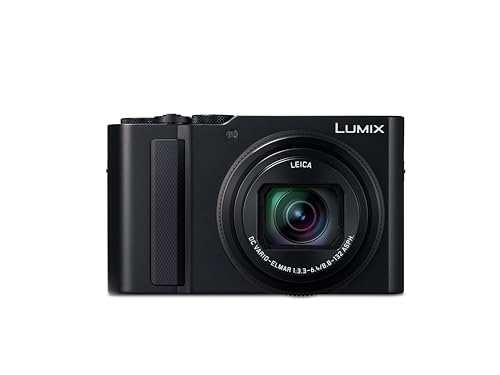
Panasonic Lumix ZS300 — Best all-round 10x-plus zoom
The ZS300 inherits a formula Panasonic refined over several generations: a 1-inch sensor behind a Leica-branded 15x lens covering 24–360mm equivalent. That combination remains the sweet spot of this entire category. The wide end frames hotel courtyards and narrow old-town streets without stitching panoramas, while 360mm pulls a lighthouse, a nesting stork or a surfer well beyond phone territory. Because the sensor is physically larger than those in the other picks, evening shots at the long end hold together with visibly cleaner shadows and more honest colour.
Panasonic’s depth-from-defocus autofocus locks quickly on faces and moving subjects, and the five-axis hybrid stabilisation earns its keep during handheld video at full stretch. A small electronic viewfinder sits beside the tilting touchscreen, which matters more than its size suggests: on a bright ferry deck the screen washes out, and the viewfinder keeps composition possible. The lens control ring can drive zoom or manual focus, a tactile pleasure missing from most rivals. Raw capture is included, so a backlit harbour scene can be recovered in editing instead of discarded. Video tops out at 4K with the familiar crop of this class, and the stereo microphones handle street ambience without a separate recorder for casual clips.
Trade-offs are real but proportionate. The lens slows considerably toward 360mm, so the 1-inch sensor’s advantage narrows in dim interiors at full zoom. The viewfinder is small, and spectacle wearers may prefer the rear screen in shade. Battery life suits a day of sightseeing rather than a dawn-to-dusk safari, so a spare cell is sensible luggage. None of this undermines the central fact: among cameras that pass the 10x test, this one asks the fewest compromises everywhere else.
Owners upgrading from a phone notice the ZS300’s depth first. At the wide end the lens opens wide enough to soften a background behind a portrait, something small-sensor zooms cannot fake, and colours hold a natural gradation in skin and sky that survives gentle editing. The camera also starts quickly and its zoom traverses the full range without the laggy stepping that makes reframing a chore. For travellers who print — a framed 360mm shot of a fishing boat at dawn is a realistic ambition here — the combination of resolution, sensor area and raw support makes this the only pick whose files reward a large print without apology.
- Sensor: 1-inch, approx. 20MP
- Lens: 15x optical zoom, 24–360mm equivalent
- Video: 4K/30p
- Viewfinder: electronic, plus tilting touchscreen
- Raw capture: yes
Strengths
- Largest sensor in this guide, and it shows at dusk
- 15x range covers nearly every travel subject
- Viewfinder, raw files and lens ring reward keen photographers
Trade-offs
- Lens aperture narrows a lot at the telephoto end
- Viewfinder is cramped behind glasses
- One battery rarely lasts a very long shooting day
Best for: travellers who shoot from breakfast markets to blue-hour skylines and want one camera to do all of it credibly.
Not suited for: bird photographers who need reach measured in thousands of millimetres, or anyone who mostly shoots indoors at the long end.

Panasonic Lumix ZS99 — Best pocket reach
Slip the ZS99 into a jacket and its party trick is easy to forget until a distant bell tower or a shy deer appears: 30x optical zoom, stretching from 24mm to 720mm equivalent, in a body smaller than many phones are thick. Panasonic builds this camera around a 1/2.3-inch sensor, and the review should be upfront about the exchange. In sunshine the results are crisp and colourful, with the stabilisation doing heroic work at 720mm. Under heavy cloud or indoors, the small sensor’s limits arrive quickly, and fine detail gives way to the painterly smoothing typical of the class.
What lifts the ZS99 above bargain superzooms is the completeness of the package around that lens. The tilting screen flips up for selfies and low-angle pet portraits. USB charging means a power bank tops it up on a train. Panasonic’s 4K Photo modes extract stills from short 4K bursts, a genuinely useful trick for a child’s fleeting expression or a dog mid-leap, and post-focus stacking lets beginners rescue shots where the camera chose the wrong subject. The zoom returns smoothly rather than in steps, which keeps video pans civilised, and the grip, though small, is shaped rather than slab-sided.
There is no viewfinder, so bright beaches test the screen’s brightness, and no raw mode, which caps editing rescue. The lens is at its best stopped down by daylight; at 720mm on a grey afternoon, shutter speeds sag and the stabiliser cannot freeze a moving subject for you. Judged as a daylight reach machine that costs little pocket space, though, the ZS99 is the easiest camera here to recommend to casual photographers who simply want to get closer.
Families will appreciate how forgiving the ZS99 is of haste. Face detection finds children reliably, the scene modes behave predictably, and the camera’s compactness means it gets carried on the days a bigger camera would be left behind — which is when the unrepeatable photographs happen. Its macro mode focuses close enough for flowers and market details, extending the same holiday roll from telephoto wildlife to tabletop still life. Video stabilisation at moderate focal lengths is smooth enough for walking shots, and the microphone copes with narration recorded at arm’s length, making the ZS99 a quiet contender for casual travel diaries as well as stills.
- Sensor: 1/2.3-inch, approx. 20MP
- Lens: 30x optical zoom, 24–720mm equivalent
- Video: 4K/30p, plus 4K Photo burst modes
- Screen: tilting, selfie-friendly
- Charging: USB in-camera
Strengths
- Genuine 720mm reach from a truly pocketable body
- 4K Photo modes rescue fleeting moments
- USB charging suits travel light
Trade-offs
- Small sensor struggles once light drops
- No viewfinder for glare-filled days
- No raw files for serious editing
Best for: holidaymakers and families who want distant subjects filled in bright light without carrying a camera bag.
Not suited for: evening concerts, indoor sports, or photographers who edit raw files as a matter of habit.

Canon PowerShot SX740 HS — Best slim 40x
Canon’s SX740 HS pushes the pocket formula further than Panasonic dares: 40x optical zoom, 24–960mm equivalent, inside a body that still qualifies as slim. That extra reach changes the subjects on the menu. At 960mm a safari elephant stops being a grey punctuation mark, a distant footballer becomes recognisable, and architectural details on a cathedral’s upper reaches fill the frame. Canon’s DIGIC processing gives the JPEGs the company’s familiar warm colour, which many buyers prefer straight from the camera, and the image stabiliser is well tuned for the long end where this camera will spend its life.
Video is a headline feature rather than an afterthought. The SX740 records 4K, unusual among slim superzooms of its generation, and the flip-up screen serves vloggers who narrate their trips. Wi-Fi and Bluetooth keep a phone connected for quick transfers, and Canon’s auto-transfer habits suit people who share the same evening. Zoom framing assist deserves special mention: press a button and the lens pulls back so a lost subject can be found again, then returns to the previous magnification. At 960mm, where a subject can vanish from the frame with a tremor, that button earns its place.
The compromises mirror the ZS99’s, with interest. The 1/2.3-inch sensor is a daylight device; the lens is slow at full stretch; and there is neither a viewfinder nor raw support. The 4K mode carries a crop and contrast-detection focus that hunts in poor light. Yet for travellers whose holidays are sunny and whose subjects are far away, the SX740’s blend of 960mm reach, pocketable depth and Canon colour is a persuasive one-camera answer.
- Sensor: 1/2.3-inch, approx. 20MP
- Lens: 40x optical zoom, 24–960mm equivalent
- Video: 4K/30p
- Screen: tilts up 180 degrees
- Extras: zoom framing assist, Bluetooth
Strengths
- 960mm reach in a genuinely slim body
- 4K video plus a selfie-ready screen
- Framing assist rescues lost telephoto subjects
Trade-offs
- Low-light quality falls off quickly
- No viewfinder and no raw capture
- 4K focus can hunt when light fades
Best for: sunny-holiday photographers and casual vloggers who want maximum reach with minimum bulk.
Not suited for: anyone shooting evening events, or enthusiasts who need a viewfinder and editable raw files.

Canon PowerShot SX70 HS — Best bridge for bright days
The SX70 HS abandons the pocket brief entirely and is better for it. Built like a shrunken DSLR, with a deep grip, an electronic viewfinder and a fully articulating screen, it carries a 65x lens spanning 21–1365mm equivalent. That 21mm wide end is the broadest here, swallowing grand interiors and group shots, while the long end reaches subjects the SX740’s 960mm can only wave at. A hot shoe on top accepts an external flash, a rarity in this class and a genuine help for indoor events where the small sensor needs assistance.
Canon’s viewfinder changes the shooting experience outdoors. Braced against the face, the camera steadies, glare disappears, and composition at 1365mm becomes a calm activity rather than a squinting gamble. The articulating screen handles the opposite situations: held overhead at a parade, or flipped for a piece to camera. Raw support arrives in this model, giving editors room to tame the harsh contrast of midday telephoto work, and the burst rate handles a heron taking flight without embarrassing itself. Video reaches 4K, and the microphone input — another rarity here — lets creators add a proper mic for narration.
Size is the obvious cost: this is a neck-strap camera, not a pocket one. The sensor remains 1/2.3-inch, so the low-light ceiling is the same as its slim sibling’s despite the bigger body, and the lens is slow at the far end. Autofocus in video is contrast-based and deliberate. Buyers who accept those terms get the most complete bridge camera in this guide, and the one best suited to long, bright days spent entirely at high magnification.
Wildlife volunteers and reserve wardens are natural SX70 owners, because the camera documents without disturbing: a nest monitored from a respectful distance, a licence plate across a car park, a ring on a bird’s leg read at 1365mm. The silent electronic shutter option helps in hides and churches alike. Custom settings can be stored so the camera wakes configured for birds rather than for landscapes, and the deep grip tolerates one-handed operation while the other hand holds binoculars. It is the pick that behaves most like a system camera while demanding none of a system’s budget or baggage.
- Sensor: 1/2.3-inch, approx. 20MP
- Lens: 65x optical zoom, 21–1365mm equivalent
- Video: 4K/30p, microphone input
- Viewfinder: electronic, plus vari-angle screen
- Raw capture: yes; hot shoe fitted
Strengths
- Widest and longest lens range in this guide
- Viewfinder and grip transform long-zoom handling
- Raw files, hot shoe and mic input add real flexibility
Trade-offs
- Too large for any pocket
- Small sensor caps evening performance
- Video autofocus is slow by modern standards
Best for: birders, airshow fans and outdoor photographers who shoot all day in good light and live at the long end.
Not suited for: travellers counting grams, or anyone whose photography happens mostly after dark.

Nikon COOLPIX P1100 — Best extreme reach
Numbers first, because the P1100 is a numbers camera: 125x optical zoom, 24–3000mm equivalent, from a lens that extends like a telescope and a body that makes no apology for its size. Three thousand millimetres is territory interchangeable-lens photographers simply cannot buy their way into at any reasonable cost. It frames the Moon’s craters, isolates a lighthouse keeper’s window across a bay, and turns a wary eagle on a distant crag into a portrait subject. Nikon’s Dual Detect optical vibration reduction is rated generously, and it needs to be: at 3000mm, the photographer’s heartbeat is a compositional force.
Nikon equips the P1100 for its specialist missions. A bird-watching mode optimises settings for small, distant, moving subjects. Moon mode does the same for lunar work. The vari-angle screen and electronic viewfinder give two ways to aim, the viewfinder being essential at full stretch in daylight. Raw capture is supported, 4K video is on board, and a snap-back zoom button widens the view momentarily so a bird that slipped the frame can be reacquired — at 3000mm, losing the subject is the default state and reacquiring it is the skill. An accessory shoe and optional remote support round out a package aimed squarely at reach obsessives.
The physics bill arrives in image quality. The 16MP 1/2.3-inch sensor is modest, atmospheric haze softens most subjects long before the lens does, and autofocus at the extreme end is patient rather than eager. This is a fair-weather, tripod-friendly instrument whose magic is real but conditional. For the photographer who understands that the alternative to a soft 3000mm shot is no shot at all, the P1100 stands alone — literally, since nothing else in this guide comes within 1,600mm of it.
Patience is the P1100’s operating system, and its owners tend to be methodical people: lunar photographers who plan around the Moon’s phase, seawatchers logging migrating birds, parents filming a distant sailing regatta from the harbour wall. The camera rewards that temperament with images no other device at its size can attempt. A tripod socket placed under the lens’s centre of gravity, a remote-release option and focus peaking for manual tweaks all signal that Nikon understands the ritual. Even its weight becomes a virtue on a breezy headland, where a lighter camera would tremble more.
- Sensor: 1/2.3-inch, 16MP
- Lens: 125x optical zoom, 24–3000mm equivalent
- Video: 4K/30p
- Modes: dedicated bird-watching and Moon settings
- Raw capture: yes
Strengths
- 3000mm equivalent reach, unmatched in this guide
- Specialist modes genuinely help at extreme range
- Strong stabilisation for such long focal lengths
Trade-offs
- Big, heavy and unapologetically single-purpose
- Haze and heat shimmer limit real-world sharpness
- Modest sensor resolution by current standards
Best for: bird photographers, Moon shooters and anyone whose subjects refuse to come closer.
Not suited for: general travel, low-light work, or photographers who value pocketability over reach.
Sony Cyber-shot HX99 — Prose-only: the tiny alternative
Sony’s HX99 asks a different question: how much zoom can fit in a body barely larger than a deck of cards? The answer is a 30x Zeiss-branded lens running 24–720mm equivalent, a pop-up electronic viewfinder, raw support and 4K video — a specification that reads like a misprint next to its dimensions. The pop-up finder is the feature owners praise most, because it rescues bright-day shooting in a class where screens usually stand alone, and the control ring around the lens gives manual adjustments a physical home.
The camera’s imaging character follows the small-sensor script: a 1/2.3-inch chip that sparkles in daylight and negotiates with noise after dark. Touch focus on the tilting screen is responsive, the autofocus tracks faces reliably, and Sony’s JPEG colour is cooler and crisper than Canon’s warmth, which suits architecture and landscape work. Battery life is respectable for the size, and the whole package vanishes into a handbag or a cycling jersey in a way no other pick here attempts.
Why prose-only? Our verification pool holds no listing for the HX99 that we could confirm as the correct current model rather than a grey import or an accessory bundle, so it carries no purchase link in this guide. It remains easy to find through camera specialists, and buyers who prize the smallest possible 30x body should audition it there. Its presence also disciplines the rest of the list: any camera larger than the HX99 must justify its bulk, and the five linked picks above each do so in a different currency — sensor size, reach, handling or price of admission.
The HX99 also carries a loyal following among concertgoers at seated venues, where its small size passes bag checks that stop larger cameras and its 720mm end reaches the stage from the balcony. Eye autofocus, inherited from Sony’s larger models, keeps performers’ faces pinned even as they move through stage lighting. Its fans accept the small sensor because the alternative at those venues is a phone’s digital crop, and the comparison is not close. If Sony’s listing situation in our pool changes, this is the first prose-only camera we would revisit.
- Sensor: 1/2.3-inch, approx. 18MP
- Lens: 30x optical zoom, 24–720mm equivalent
- Video: 4K/30p
- Viewfinder: pop-up electronic
- Raw capture: yes
Strengths
- Smallest body here, yet still 30x with a viewfinder
- Raw files and 4K video in a card-sized camera
- Control ring makes manual tweaks pleasant
Trade-offs
- No verified listing, hence no link in this guide
- Small sensor, familiar low-light limits
- Tiny controls frustrate gloved or large hands
Best for: minimalists who want real zoom and a viewfinder in the smallest possible package.
Not suited for: buyers who want the reassurance of a verified listing here, or photographers with larger hands.
Comparison: The Six 10x-Plus Zooms Side by Side
| Camera | Optical zoom | Range (equiv.) | Sensor | Viewfinder |
|---|---|---|---|---|
| Panasonic ZS300 | 15x | 24–360mm | 1-inch | Yes |
| Panasonic ZS99 | 30x | 24–720mm | 1/2.3-inch | No |
| Canon SX740 HS | 40x | 24–960mm | 1/2.3-inch | No |
| Canon SX70 HS | 65x | 21–1365mm | 1/2.3-inch | Yes |
| Nikon P1100 | 125x | 24–3000mm | 1/2.3-inch | Yes |
| Sony HX99 | 30x | 24–720mm | 1/2.3-inch | Pop-up |
Read the table as a map of bargains. The ZS300 trades reach for sensor quality and wins the evenings. The middle three trade sensor quality for reach in escalating amounts while staying carryable. The P1100 abandons subtlety altogether. Notice that zoom ratio alone misleads: the SX70’s 65x starts wider, at 21mm, so its advantage over the SX740 is split between both ends of the range, while the ZS300’s modest 15x sits in front of a sensor roughly four times the area of its rivals’ — a difference that matters every single time the sun drops.
What Makes the Best 10x Optical Zoom Cameras Different From Digital Zoom?
The distinction is physical, and it decides whether a distant subject is photographed or merely enlarged. Optical zoom reconfigures the lens so the subject genuinely occupies more of the sensor; every pixel in the file describes the subject. Digital zoom crops the sensor’s output and interpolates the result back up to full size, so a “40x digital” frame contains the real information of a much smaller image wearing a larger costume. Manufacturers often quote a combined figure, and some add branded extensions — Canon’s ZoomPlus, Sony’s Clear Image Zoom — that use smarter processing to soften the damage. These extensions are fine for sharing a snapshot of a distant sign, but they are not optical zoom, and this guide’s headline figures never include them.
A practical test exposes the difference in seconds. Photograph a detailed subject — a brick wall with a notice pinned to it — at maximum optical zoom, then again using the digital extension, and compare the notice’s lettering at full size on a computer. The optical frame keeps edges and texture; the digital frame smears them into guesswork. Buyers comparing specifications should always hunt for the lens’s real focal-length range, usually printed as something like 4.3–129mm, and divide the long number by the short one. That quotient is the true optical ratio, immune to marketing arithmetic.
There is a historical reason this category starts at ten. The first travel zooms of the 2000s advertised exactly that figure, and 10x became the shorthand for “far more reach than a standard compact” in the same way that a 24mm wide end became the mark of a serious travel lens. Today’s cameras have stretched the ceiling enormously — the 125x at the top of this guide would have read as science fiction then — yet the floor still matters, because below roughly 10x a fixed-lens camera competes directly with the better phones, and its case becomes harder to argue. Above it, the camera offers something no phone honestly can: full-resolution reach, gathered by glass, ready for printing. That is the threshold this guide defends, and every pick clears it with room to spare.
How Far Can a 10x, 30x or 125x Zoom Actually Reach?
Equivalent focal length translates zoom ratios into something a photographer can picture. A 10x lens starting at 24mm ends at 240mm, enough to isolate a street performer across a square. Thirty times reach, ending near 720mm, frames a footballer’s upper body from the far stand. At 960mm and beyond, individual birds, distant lighthouses and aircraft on final approach become realistic subjects. The P1100’s 3000mm is a different discipline: the field of view is so narrow that finding the subject is the first challenge, and the atmosphere itself — haze, heat shimmer, dust — becomes the resolution limit on most days.
Reach also interacts with shutter speed. The old reciprocal rule suggests 1/500s or faster at 500mm to defeat handshake, and while modern stabilisation relaxes that demand by several stops for still subjects, it cannot freeze a moving one. Long-zoom owners learn to raise ISO on overcast days, brace against walls and railings, and burst-shoot sequences from which one sharp frame can be rescued. None of this is a defect of the cameras; it is the physics every long lens obeys, from a pocket compact to a professional telephoto costing many times more.
How Do You Get Sharp Photos at Full Zoom?
Technique, in a word. Start by using the viewfinder where one exists, because the three-point brace of two hands and a face steadies the camera far better than arms extended toward a screen. Where there is no viewfinder, tuck the elbows into the ribs and exhale before pressing the shutter. Use the camera’s framing-assist or snap-back zoom if fitted, since half of telephoto failure is simply losing the subject and waving the lens. Choose shutter-priority mode on dull days and set a floor of 1/500s for perched birds, 1/1000s or faster for anything in flight.
Support helps more than settings. A monopod under a bridge camera, a beanbag on a car window for safari work, or even a taut neck strap pulled against the chest all remove shake that stabilisation alone cannot. Shoot bursts: at extreme focal lengths the sharpest of five frames is usually obvious and the other four cost nothing. Finally, respect the air. Early morning, before heat shimmer builds, is when a 125x lens produces its astonishing frames; by midday the same lens is photographing soup.
Which Sensor Size Should You Choose in a Zoom Camera?
Sensor area is the quiet specification that governs everything else, because it sets how much light each pixel receives. The 1-inch sensor in the ZS300 has roughly four times the surface of the 1/2.3-inch chips in the other five picks. In practice that buys cleaner files at higher ISO settings, gentler highlight roll-off in contrasty scenes and more convincing background separation at the wide end. A photographer who shoots markets at noon will barely notice the difference; the same photographer at a dusk viewpoint will notice nothing else.
The small sensors answer with physics of their own. A 125x lens covering a large sensor would be the size of a telescope and priced like one, so extreme reach exists only because the P1100’s sensor is tiny. Small chips also deliver enormous depth of field, which keeps both a perched bird and its branch sharp and makes macro work forgiving. The honest summary is that sensor size and zoom range pull against each other, and every camera in this guide is a negotiated settlement between them. Choose the settlement that matches your subjects: generalists should buy sensor, specialists should buy reach.
One more subtlety deserves attention — pixel count on a small sensor is not the prize it appears. Twenty megapixels on a 1/2.3-inch chip means very small photosites, which is why these cameras perform best at their base ISO in good light and why their files dislike aggressive cropping. The P1100’s modest 16MP count is arguably the more honest engineering choice for its chip. When comparing specifications, treat megapixels as a printing-size question, not a quality ranking.
How Do You Carry and Power a Superzoom All Day?
Logistics decide whether a camera gets used. The pocket trio — ZS99, SX740 HS and HX99 — ride in a jacket with a wrist strap and ask nothing more, though a slim case protects the lens cover blades that all pocket zooms depend on. The SX70 HS wants a padded neck strap and a small shoulder bag with room for its lens hood. The P1100 travels like a small telescope: a proper camera bag, ideally with the tripod it will so often sit on. Buying the bag at the same time as the camera is not upselling; it is how the camera survives its first year.
Power planning separates happy owners from frustrated ones. Compact zooms typically deliver a few hundred shots per charge, and heavy reviewing, video and cold weather all tax that figure. The USB-charging models in this guide can sip from a power bank during a café stop, which suits travellers already carrying one for a phone. Cameras charged only in a separate cradle demand a spare battery instead — one in the camera, one in the bag, rotated nightly. Memory cards are the easy part: a single fast card outlasts a day of stills, but 4K video drinkers should pack a second, and everyone should offload each evening so a lost camera never means a lost holiday.
What Should You Check Before Buying a Used Superzoom?
Several picks in this category have predecessors that circulate widely second-hand, and the used route is legitimate — provided the inspection is mechanical. Zoom lenses live hard lives. Extend the lens fully and listen: grinding suggests grit inside the mechanism, a common souvenir of beach holidays. Check the lens surface for the hairline scratches that pocket carry inflicts, and photograph a plain wall at full zoom to reveal dust spots on the sensor, which appear as soft grey blobs that repeat in every frame.
Operate every control. The zoom rocker should run smoothly in both directions without dead spots, the screen hinge should hold its angle, and the battery door latch — a known wear point on older compacts — should click shut positively. Ask for the shutter count if the seller can show it, and confirm the camera charges and transfers files over its cable, because a worn port turns a bargain into a paperweight. Finally, factor in a new battery: lithium cells age whether used or not, and a fresh one restores both endurance and peace of mind. Bought carefully, a used ZS-series or SX-series camera is the cheapest honest route into real optical reach.
How Does Weather Affect Long-Zoom Photography?
Long focal lengths magnify the air itself. Heat rising off tarmac or sand sets distant subjects wobbling, humidity hazes them pale, and wind finds every gram of a camera held at 1000mm. Experienced superzoom owners plan around the atmosphere the way sailors plan around tides: dawn and the hour after rain give the clearest air, overcast days flatten contrast but steady the shimmer, and a lens hood — standard on the SX70, an accessory thought for the P1100 — keeps stray light and drizzle off the front element.
None of the cameras in this guide claims full weather sealing, so rain discipline matters. A simple rain sleeve or even a freezer bag with a hole for the lens keeps a bridge camera working through showers, and silica gel sachets in the camera bag fight the condensation that forms when cold gear meets a warm car. Cold itself drains batteries faster, which is why winter birders carry the spare in an inside pocket. Respect these limits and a superzoom will shoot in far worse weather than its specification sheet implies; ignore them and the failures will look like the camera’s fault when they were the forecast’s.
Which Focus Settings Work Best at Long Focal Lengths?
Autofocus behaviour changes character as focal length grows. At wide angles every camera here focuses without drama, but past 500mm the depth of field shrinks to centimetres and the camera must choose its subject precisely. A small, movable focus point beats a wide zone for perched birds and distant details, because a zone will happily select a nearer branch. Face and eye detection, where fitted, should be left on for people and animals at moderate range, then overridden with the single point when branches intervene. Several picks allow the focus point to be dragged on the touchscreen while the eye stays at the viewfinder — a technique worth practising at home before it is needed at a nest.
Continuous focus earns its place for moving subjects, paired with burst shooting and a shutter speed chosen for the subject rather than the lens. For a bird in flight at 1000mm, 1/2000s is a realistic starting point, and owners should not fear the ISO that bright requirement implies on a small sensor: a slightly grainy sharp frame beats a clean blurred one every time. Manual focus, aided by peaking on the Panasonic and Nikon models, remains the fallback for subjects behind glass, mesh or reeds, where autofocus hunts between layers. Knowing when to take over from the camera is the mark of a superzoom owner who has stopped fighting the tool.
Which Accessories Are Worth Buying With a Zoom Camera?
Three accessories justify themselves for almost every owner. A spare battery comes first, for the reasons already covered. A quality case or wrap comes second, because pocket zooms die by grit and bridge cameras by knocks. Third, a mini tripod or monopod matched to the camera’s size transforms dawn and dusk shooting at long focal lengths, and doubles as a handle for steadier video. Beyond that core, value becomes personal. A circular polariser in the right thread size deepens skies and cuts water glare for the bridge models that accept filters, though it costs light the small sensors can ill spare.
Some purchases can wait or be skipped entirely. Expensive strap systems matter less than a strap actually worn. Giant memory cards concentrate risk in one failure point where two medium cards spread it. Cleaning, by contrast, is underpriced insurance: a blower, a lens pen and microfibre cloths keep the front element — the one part of a fixed-lens camera that can never be swapped — in the condition the optics deserve. Buy the short list, master the camera, and let a month of real shooting reveal which accessory, if any, is genuinely missing. Experience, patiently accumulated outing by outing, remains the cheapest upgrade any photographer will ever make to a camera they already own and understand well.
How Should You Look After a Zoom Lens Mechanism?
A fixed zoom lens is a sealed promise: the optics inside are aligned at the factory and the owner never swaps them, which makes the extending barrel the camera’s most vulnerable component. Sand is the chief enemy. A single beach session with the lens extended can introduce grains that announce themselves as a grinding zoom for the rest of the camera’s life, so wipe the barrel before retracting it after any dusty outing, and never force a zoom that resists. A blower removes loose grit without contact; canned air, held too close, can drive particles deeper and should be kept at a respectful distance.
Storage habits matter quietly. Keep the camera in its case rather than loose in a bag where keys and coins patrol, retract the lens before storing so the barrel is protected by the body, and let a cold camera warm up inside a sealed bag when coming indoors so condensation forms on the bag instead of the glass. Once a season, run the zoom through its full range a few times and take test frames at both ends; mechanisms that sit unused for a year can stiffen, and a fault discovered at home is a repair, while the same fault discovered on safari is a tragedy. Treated this way, the lens mechanisms in these cameras routinely outlast the batteries and memory cards around them.
What Can You Realistically Print From These Cameras?
Printing is where specifications meet honesty. A clean daylight file from any pick here prints beautifully at the sizes family albums and wall frames actually use, because viewing distance forgives what pixel-peeping condemns. The ZS300’s 1-inch files go further, holding fine texture at larger sizes and tolerating the gentle cropping that turns a good frame into the intended one. Small-sensor files shot at the long end in flat light should be printed smaller and viewed as the records of reach they are: a recognisable, well-composed 3000mm portrait of a distant bird is a success at modest size and a disappointment blown up beyond its evidence.
Sharing online reverses none of this. Social platforms compress everything to a common denominator, which is why small-sensor superzooms look so strong on screens — their daylight files arrive with more real detail than the platform will keep. Owners who shoot for both print and screen should simply expose carefully, keep ISO low when the light allows, and save the aggressive cropping for the 1-inch files. The camera you choose sets the ceiling; your exposure discipline decides how close to it each photograph lands.
Common Mistakes When Buying a Long-Zoom Camera
The commonest mistake is shopping by the biggest number on the box, which rewards combined optical-plus-digital figures and punishes honesty. A genuine 15x on a 1-inch sensor, like the ZS300’s, will out-photograph a padded 50x claim in most real light. The second mistake is ignoring the wide end: a zoom that starts at 28mm rather than 24mm frustrates indoors and in narrow streets, and the SX70’s 21mm start is a quiet superpower. Third comes forgetting the screen-versus-viewfinder question until the first sunny day, when an owner of a screen-only camera discovers glare the hard way.
Buyers also underestimate size honesty. A bridge camera bought for travel that then stays home because it needs its own bag has failed its only job; the pocketable picks exist precisely for photographers who know their habits. Finally, many shoppers never check whether the camera shoots raw or charges by USB, two small specifications that decide how forgiving the camera is of a badly exposed sunset and how easily it travels with a power bank. Both questions take a minute to answer before purchase and years to regret afterwards.
Final Recommendation
Match the camera to the light you actually shoot in. If your photography spans whole days and evenings, the Panasonic ZS300’s 1-inch sensor and 15x lens form the most complete answer here, and it is our default recommendation. If reach per pocket is the priority and your subjects live in daylight, the ZS99 and SX740 HS divide the honours — Panasonic for its photo modes, Canon for 960mm and 4K. For committed outdoor telephoto work, the SX70 HS’s handling and range make it the enthusiast’s bridge, while the P1100 remains a glorious specialist for birds and the Moon. The HX99, sought out through a camera dealer, is the minimalist’s 30x. Whichever you choose, you are buying real glass doing real work — and that, not the number on the box, is what a zoom is for.
One last word on expectations. No camera in this guide will match a large-sensor system at midnight, and none needs to: they exist to be present, ready and long-armed in the daylight hours when travel, wildlife and family life actually happen. Buy the one whose compromises sit furthest from your favourite subjects, learn its focus habits on a quiet afternoon at home, and it will repay you in photographs your phone simply could not have taken.
Frequently Asked Questions
Beyond the individual verdicts, notice the pattern the six picks trace. Zoom range has become cheap; what remains scarce is the supporting cast — a viewfinder for bright days, stabilisation strong enough for the long end, raw files for difficult light, and a sensor sized for the hours when travel photography turns golden. The cameras above earn their places by balancing those supporting elements differently, and your shortlist should start from whichever balance matches the trips you actually take, not the safari you might take once.
Is 10x optical zoom enough for travel photography?
For most travel subjects, yes. A 10x range ending near 240–360mm covers portraits, distant landmarks, wildlife in parks and stage performances from mid-hall seats. Photographers who chase birds, surfing or aircraft will want the 30x-to-125x reaches represented by the other picks, but they pay for that reach with smaller sensors or larger bodies.
Why do small-sensor superzooms struggle at night?
Their sensors gather far less light per pixel, and their lenses are slow at the long end, so the camera raises ISO and noise follows. The ZS300’s 1-inch sensor is the exception in this guide. For evening events, a bright-lens compact or a phone’s night mode will usually beat a small-sensor superzoom despite its shorter reach.
Does digital zoom have any legitimate use?
Yes, narrowly. For a quick identification shot — reading a distant sign, checking which bird just landed — a digital extension is harmless and sometimes convenient. It becomes a problem only when it is sold as equivalent to optical reach or used for photographs the owner hopes to print or crop later.
Should I buy a bridge camera or a pocket superzoom?
Decide by carry, not by specification. If the camera must live in a coat pocket to be taken at all, choose the ZS99 or SX740 HS. If you happily wear a neck strap all day and shoot outdoors, the SX70 HS’s viewfinder, grip and range repay their bulk every hour.
Can these cameras replace a phone entirely?
For zoom work, they already outclass phones, whose long-range images rely heavily on cropping. For everything else the contest is closer: phones win on instant sharing and computational night modes, cameras win on control, battery endurance and any subject beyond 200mm. Most owners end up carrying both, each doing what it does best.
Are these cameras good for children’s sports?
For outdoor daytime matches, yes — the SX740 HS and SX70 HS were practically designed for the touchline, with reach that turns the far goal into a front-row seat. Use burst mode, a fast shutter speed and continuous focus, and expect to delete freely. Indoor sports are the hard case: dim halls, fast movement and slow telephoto lenses defeat small sensors, so shoot at the wide end near the action or accept that this is the one assignment where a different camera earns its fee.
How long do superzoom batteries last on a day out?
Expect a few hundred stills per charge from the pocket models, fewer if 4K video and constant reviewing join the mix, and plan accordingly: a spare battery for cradle-charged cameras, or a power bank for the USB-charging ones. Cold weather shortens every figure in this paragraph, so winter shooters should treat the spare as mandatory rather than cautious.
Related Guides
Reach is a spectrum, and our neighbouring guides cover its extremes and its neighbours: start with the longest-reach superzooms beyond 60x if the P1100’s numbers started an itch, detour through instant cameras for prints in your hand for a slower kind of photography, and finish with 20x camcorders built for video reach when moving pictures matter more than stills.


