What's inside
- Where to Buy
- Introduction
- Key Takeaways
- Quick Picks
- How We Chose These Picks
- Comparison Table
- How to Choose Your Route Into the Water
- What Does an Underwater Housing Actually Add to a Mirrorless Kit?
- Why Does Underwater Photography Need Its Own Light?
- How Should Sealed Cameras Be Cared for After Salt Water?
- How Does a Two-Camera Water Kit Divide the Work on a Real Trip?
- Common Mistakes When Taking Cameras Into the Water
- Final Recommendation
- Frequently Asked Questions
- Related Guides
As an Amazon Associate I earn from qualifying purchases. This post may contain affiliate links at no extra cost to you.
[SITE_DOMAIN] is reader-supported. When you buy through links on our site, we may earn an affiliate commission.
Where to Buy
Underwater purchases punish assumptions more than any other camera category, so read each of these listings for exactly what it sells. The OM System Tough TG-7 in red is a sealed compact whose title prints the word waterproof outright. SeaLife’s Micro 3.0 is a permanently sealed underwater camera with 64GB of internal storage, a case and a wrist strap in the listing. Its sibling, the Micro 3.0 Pro 3000 set, adds a light to the same sealed concept and packs it in a Sea Dragon travel case. The OM System OM-1 Mark II is a true mirrorless camera sold with a 12–40mm professional lens, its title claiming IP53 weather sealing — a splash rating, not a diving one. Panasonic’s Lumix G9 II is a Micro Four Thirds flagship body, and Fujifilm’s X-T5 is a 40 megapixel APS-C body; both are weather-sealed cameras for wet environments, and neither is sold as a camera that swims.
Introduction
This guide to the best underwater mirrorless cameras has to begin by correcting its own keyword, because the correction is the most valuable thing on the page. No mirrorless camera body in this set — no interchangeable-lens mirrorless body anywhere in these listings — can be taken underwater bare. The three true mirrorless cameras below divide into one splashproof body, the OM-1 Mark II, whose title claims an IP53 weather-sealed rating that defends against spray and rain, and two weather-sealed bodies, Panasonic’s G9 II and Fujifilm’s X-T5, built to survive wet, dusty, splashy environments rather than immersion. Sealing against weather is a defence against water arriving as weather. Submersion is a different physical event, with pressure behind it, and it defeats every one of those bodies unless a dedicated underwater housing stands between the camera and the sea.
The cameras in this guide that genuinely dive without a housing are not mirrorless at all, and this page will not pretend otherwise. The Olympus Tough TG-7 is a sealed compact whose title prints waterproof as its headline property, and the two SeaLife Micro 3.0 models are purpose-built underwater cameras, permanently sealed instruments designed from the first sketch for immersion. They earn their places here honestly — as the correct answer for most readers who typed this keyword — under their correct description: compact underwater cameras, not mirrorless ones.
So the guide resolves into the three real routes to underwater photographs. Route one is the sealed compact: buy the TG-7 or a SeaLife, swim, shoot, rinse, repeat, accepting a fixed lens and a compact sensor as the price of a camera that needs no preparation. Route two is the mirrorless body in a housing: the expensive, deliberate path to interchangeable lenses, large sensors and full control beneath the surface, in which the housing — a major purchase in its own right, specific to the exact body model — does the waterproofing and the camera does the imaging. Route three is the weather-sealed mirrorless used honestly at the water’s edge: kayaking, sailing, beach and boat work, rain and spray, where the danger is splashes rather than depth. Every review below is assigned to its route, and no review blurs the boundaries, because underwater, a blurred boundary is a flooded camera.
Depth and pressure ratings deserve the same strictness. The only water claims this guide repeats are the ones printed in the titles — waterproof on the TG-7 and the SeaLife models’ underwater purpose, IP53 on the OM-1 Mark II — and no depth figure is quoted for any camera here, because no title states one. A buyer planning dives to a specific depth must take the rated figure for their exact camera or housing from the manufacturer’s documentation and dive inside it with margin, the way divers plan every other part of the descent.
Key Takeaways
- No mirrorless body here can be submerged bare; the mirrorless route underwater runs through a model-specific housing, bought separately.
- The OM-1 Mark II’s title claims IP53 weather sealing — splashproof, for rain and spray — which is not an immersion rating of any kind.
- The G9 II and X-T5 are weather-sealed bodies for wet environments; sealing resists weather, not pressure at depth.
- The two cameras that dive without a housing are sealed compacts, not mirrorless: the Olympus Tough TG-7 and the SeaLife Micro 3.0 line.
- The SeaLife Pro 3000 set adds a dedicated light, and underwater, light is the scarcest resource after air.
- No title in this set states a depth rating, so working depths must come from manufacturer documentation for the exact camera or housing.
- The TG-7’s title adds freeze proofing and a macro emphasis — the profile of a camera built for expeditions and close-up reef life.
Quick Picks
| Pick | Badge | Why it earns a place |
|---|---|---|
| OM System Tough TG-7 | The dive-ready compact | Sealed compact titled waterproof and freeze proof, with 4K video and a macro emphasis for reef and expedition work. |
| SeaLife Micro 3.0 64GB | The purpose-built diver | 16MP, 4K sealed underwater camera with wireless transfer, case and wrist strap included. |
| SeaLife Micro 3.0 Pro 3000 set | The lit kit | The sealed Micro 3.0 concept with a dedicated light set and Sea Dragon travel case for colour at depth. |
| OM System OM-1 Mark II kit | The splashproof mirrorless | 20.4MP mirrorless with 12–40mm PRO lens, 5-axis stabilisation and a stated IP53 weather-sealed rating. |
| Panasonic Lumix G9 II | The wet-weather flagship | 25.2MP Micro Four Thirds flagship with Phase Hybrid AF and powerful stabilisation for boats, coasts and rain. |
| Fujifilm X-T5 | The high-resolution shore body | 40MP APS-C body with 7-stop stabilisation for coastal and travel work in hard weather. |
How We Chose These Picks
The first decision was editorial rather than photographic: this guide would answer the keyword honestly instead of conveniently. A conventional roundup would have listed six mirrorless bodies, used the word underwater loosely around their weather sealing, and left a reader somewhere to flood a camera on the strength of it. The set below is therefore organised by route — sealed compacts that dive, mirrorless bodies that dive only inside housings, and sealed mirrorless bodies for the water’s edge — and every pick is labelled with the route it actually serves. A reader who finishes this page knowing precisely which cameras may be submerged, and precisely which may not, has been served better than one handed a tidier fiction.
Within the sealed compacts, the selection favours instruments over toys. The TG-7 comes from a long expedition-camera line and prints a cluster of field properties — waterproof, freeze proof, a bright high-resolution pitch, 4K video and a macro emphasis — that describe a working tool for snorkellers, divers and field scientists. The SeaLife models come from a manufacturer that builds only for the underwater world, and the Pro set’s inclusion of a light acknowledges the physics every underwater photographer learns on the first dive: water eats light and colour by the metre, and the camera is only half the imaging system.
The mirrorless three were chosen for the two honest mirrorless routes. For the housing route, all three are current flagship-class bodies in systems with serious lens ranges — the OM-1 Mark II with a professional standard zoom already in its kit listing, the G9 II as Panasonic’s Micro Four Thirds flagship, the X-T5 as Fujifilm’s high-resolution APS-C body — because a housing investment only makes sense around a body worth housing. For the water’s-edge route, the same three bring sealing philosophies and stabilisation claims suited to boats, coasts and weather, with the OM-1 Mark II’s printed IP53 rating giving this guide its one citable sealing figure.
Finally, depth discipline governed every sentence. No depth rating appears anywhere in this guide, because none is printed in any title, and the reviews repeatedly route depth questions to manufacturer documentation — for the sealed compacts’ rated limits as much as for housings. Underwater photography’s first safety rule is knowing your equipment’s limits before you are beneath the surface with it, and a buying guide is the right place to start practising it.

OM System Tough TG-7 — The dive-ready compact
The TG-7 is the camera most readers of this keyword actually need, and its title is admirably blunt about what it is: an underwater camera, waterproof, freeze proof, with high resolution and a bright lens pitch, 4K video and a macro emphasis — in red, a colour that is easier to spot on a boat deck and, not incidentally, in the water. What it is not is a mirrorless camera. The Tough line is a sealed compact with a fixed lens, and this review recommends it precisely as that: the instrument that goes snorkelling, reef diving within its rated limits, kayaking, skiing and building-site duty without preparation, permission or a housing.
The cluster of properties in the title describes an expedition tool rather than a beach toy. Freeze proofing speaks to the same sealed construction that keeps water out — a body built as a pressure-resistant shell rather than as a camera with gaskets added. The macro emphasis matters underwater more than on land, because the reef’s most cooperative subjects — shrimps, nudibranchs, coral polyps, the small architecture of the shallows — are close subjects, and a camera that focuses close with a bright lens turns a snorkel over a reef flat into a productive session rather than a scenic swim. The 4K video claim completes the brief for the traveller who films the turtle pass and photographs the octopus on the same descent.
Suits snorkellers, recreational divers working inside the camera’s documented depth rating, expedition and field-work photographers, and families whose holidays involve water in every direction. It also suits, quietly, the mirrorless owner who wants a second camera for the days when the flagship stays dry — the kayak deck, the zodiac ride, the waterfall hike — where the cost of a loss is a compact’s price rather than a system’s.
Its boundaries are the compact’s eternal ones. The fixed lens fixes the framing vocabulary; the compact sensor concedes the low-light and shallow-focus rendering of the larger formats, and at depth, where light is already rationed, that concession is felt. The title states no depth figure, so the rated limit must be read in OM System’s documentation and respected with margin — waterproof is a property, not a number, and every sealed camera has a depth at which the property expires. Seals, finally, are maintenance: rinsing, inspection and care after salt water are part of the ownership this camera asks for.
The TG-7’s Amazon figure should be compared against the true alternative for its buyer, which is not another compact but a housing for a mirrorless body — an assembly costing several times more before the camera inside it is counted. Against that arithmetic, a sealed instrument that dives the day it arrives is one of the clearest values in underwater photography.
- Type: Sealed compact underwater camera, red
- Water claim in title: Waterproof
- Other field claim in title: Freeze proof
- Video: 4K video
- Emphasis in title: High resolution, bright lens, macro shooting
- Depth rating: Not stated in the listing title — verify with the manufacturer documentation
Strengths
- Dives without a housing, preparation or a second purchase.
- Freeze proofing signals a genuinely sealed expedition construction.
- Macro emphasis suits the reef’s small, close, cooperative subjects.
Trade-offs
- A fixed lens fixes the framing; no interchangeable-lens path exists.
- The compact sensor concedes depth’s scarce light to larger formats.
- No depth figure is printed, so rated limits are a documentation read.
Best for: a snorkeller or recreational diver who wants a sealed camera that photographs and films underwater on the day it arrives. Not suited for: a photographer who needs interchangeable lenses beneath the surface, because the TG-7’s fixed-lens compact design offers no lens mount at any price.
SeaLife Micro 3.0 64GB — The purpose-built diver
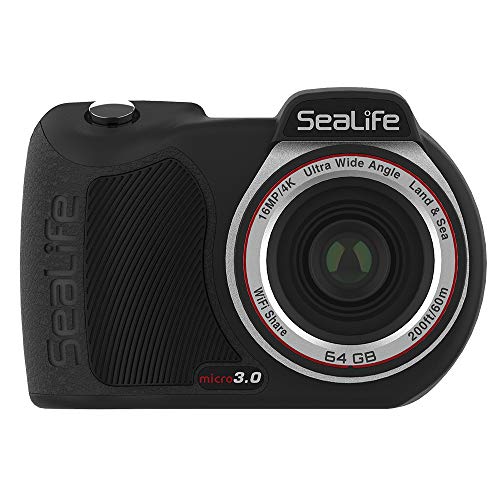
SeaLife builds nothing but underwater cameras, and the Micro 3.0 shows what that specialisation produces: a permanently sealed 16 megapixel camera with 4K video, 64GB of internal storage, wireless transfer, and a case and wrist strap in the listing. Permanently sealed is the design’s founding idea. A camera with no opening doors has no door seals to fail, no tray to load wrongly, no moment on the boat when a grain of sand compromises an O-ring — the entire category of flooding-by-preparation-error is designed out, at the cost of a fixed lens and internal memory that cannot be swapped.
The 64GB internal storage deserves a diver’s reading. Underwater, a memory card is not a convenience but a dive-plan constraint: a sealed camera’s capacity is the session’s capacity, and 64GB inside a 16 megapixel, 4K-shooting body is a generous allowance for recreational profiles — with the discipline that the day’s footage must be transferred, via the wireless link the title prints, before the next day’s diving rather than accumulated across a trip. The wrist strap in the box is a similarly practical inclusion; underwater, dropped equipment does not fall at your feet, and a camera that leaves the hand should stay attached to the diver.
Suits recreational divers and snorkellers who want the simplest possible underwater instrument — no housing, no preparation ritual, no accessory list — and dive schools, resorts and tour operators who issue cameras to guests, where a sealed, simple body survives handling that would flood or confuse a housed system. The easy set-up the title claims is, for that rental-and-teaching world, the headline feature.
The trade-offs are the design’s own logic carried through. A fixed lens and a permanently sealed body mean the camera is the camera: no upgrade path, no lens choice, and a sensor and specification sized for recreational delivery rather than for publication-grade stills. The title states no depth rating, so the working limit belongs to SeaLife’s documentation, to be read before the first dive and planned inside. Buyers whose ambitions run to manual control and interchangeable glass should read on to the housing route below; buyers whose ambition is to come back from every dive with pictures will recognise this instrument as designed for exactly them.
Its Amazon figure buys completeness — camera, storage, case, strap — in a category where the rival concept, the housing, multiplies costs at every step. For the recreational diver, that completeness is not a compromise position; it is the correct engineering answer to the problem of taking pictures where cameras do not naturally live.
- Type: Sealed underwater camera, permanently sealed design
- Sensor as titled: 16MP
- Video: 4K underwater photography and video
- Storage: 64GB internal
- Transfer: Wireless transfer
- Included: Case, wrist strap; depth rating: Not stated in the listing title — verify with the manufacturer documentation
Strengths
- A permanently sealed body removes the door-seal failure class entirely.
- 64GB internal storage and wireless transfer simplify the dive-day routine.
- Case and wrist strap included — the retention detail divers actually need.
Trade-offs
- Fixed lens and internal memory: nothing about the imaging chain can be changed.
- Recreational specification rather than publication-grade stills capacity.
- No depth figure is printed for dive planning.
Best for: a recreational diver or dive operator wanting a sealed, guest-proof underwater camera with its storage and case settled. Not suited for: a photographer planning interchangeable-lens work at depth, because the Micro 3.0’s permanently sealed compact design has no mount and no housing path.
SeaLife Micro 3.0 Pro 3000 set — The lit kit
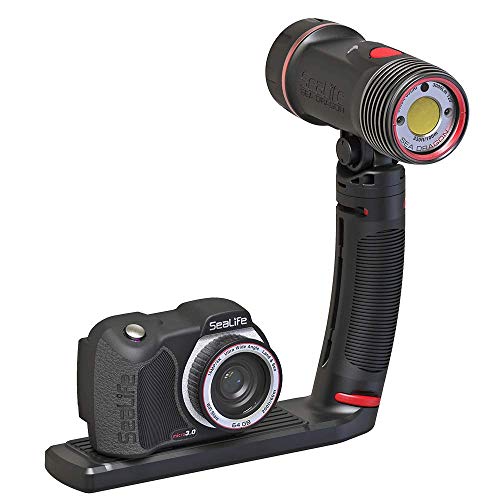
The Pro 3000 set takes the Micro 3.0’s sealed-camera concept and adds the component underwater photography is actually about: light. The listing pairs the camera with a dedicated light set and a Sea Dragon travel case, and that pairing reflects the physics every diver-photographer learns. Water absorbs colour in order — reds first, within the first few metres — so unlit underwater photographs drift toward blue-green monochrome no matter how good the camera is. A light carried with the camera restores the reef’s actual colours at working distance, and it is worth more to the final image than any specification the camera itself could print.
Read the set as a system purchase rather than a camera with an accessory. The light changes what subjects are available: the shaded overhang, the wreck interior, the night dive, the close portrait of a fish that unlit photography renders as a silhouette. It also changes the diver’s technique — working distance shortens, subjects must be approached calmly, and the discipline of getting close, which underwater photographers preach above all others, becomes the price of the colour the light provides. A set that bundles camera and light teaches that discipline from the first dive instead of the fifth.
Suits divers who have made their first unlit trips and felt the colour ceiling: reef photographers working at recreational depths, night divers, and travellers who want one case — the Sea Dragon travel case in the listing — to contain the whole imaging system. Dive photographers who teach will recognise the set as a student kit that removes the two classic beginner frustrations, flooding anxiety and blue photographs, in a single purchase.
The set inherits the Micro platform’s fixed nature — a sealed body, a fixed lens — and adds the light’s own logistics: charging, mounting and the buoyancy and bulk a lit rig brings to the dive. The title states no light output figure and no depth rating for either component, so both belong to SeaLife’s documentation before the set is planned into a dive. And a light is not a licence to approach carelessly; marine life and fragile reef structures set the working distance before the lamp does, a seamanship point this guide makes because the equipment now allows getting close enough to matter.
Compare its Amazon figure against assembling the same system separately — sealed camera, light, case — and against the unlit alternative’s true cost, which is measured in the colours of every photograph taken without it. For the diver committed to the sealed-camera route, the lit set is the route’s complete form.
- Type: Sealed underwater camera and light set
- Contents as titled: Underwater camera, light set, Sea Dragon travel case
- Use as titled: Photography and video, easy set-up
- Transfer: Wireless transfer
- Light output figure: Not stated in the listing title — verify with the manufacturer documentation
- Depth rating: Not stated in the listing title — verify with the manufacturer documentation
Strengths
- A dedicated light restores the colours water removes, the single biggest image gain underwater.
- Camera, light and travel case arrive as one planned system.
- The sealed body keeps the no-preparation, no-door-seal virtues of the Micro line.
Trade-offs
- The lit rig adds bulk, charging and buoyancy management to the dive.
- Fixed lens and sealed body: the system cannot grow into interchangeable glass.
- No light output or depth figure is printed for planning.
Best for: a recreational diver ready to photograph with light — reefs, night dives, shaded subjects — inside one cased, sealed system. Not suited for: a minimalist snorkeller who travels with hand luggage only, because the light set and travel case make this the bulkiest sealed option in the guide.

OM System OM-1 Mark II kit — The splashproof mirrorless
The OM-1 Mark II is this guide’s clearest case study in reading a water claim precisely. Its title describes a mirrorless camera with a professional 12–40mm lens, a 20.4 megapixel sensor, 4K video, 5-axis image stabilisation and an IP53 weather-sealed rating. IP53 is a defined, citable claim: the 5 addresses dust ingress, the 3 addresses water sprayed at angles — rain, splashes, spray, the water of weather. It is a genuinely useful rating for a camera that works on boats, in rain and at the surf’s edge, and it is not, in any reading, permission to submerge the camera. The review’s job is to honour both halves of that sentence with equal emphasis.
As a water’s-edge and housing-route body, the package is compelling. The kit lens in the listing is the system’s professional standard zoom, so the body arrives ready for the coastal, sailing and expedition-stills work its sealing invites, on a Micro Four Thirds platform whose compact lenses suit travel to wet places. The 5-axis stabilisation printed in the title serves the boat deck and the handheld shoreline, where footing moves and light falls early. Photographers whose water is weather — sea kayaking with the camera in a dry bag between shots, sailing photography, waterfall and storm work — are this body’s natural owners, and for them IP53 is not a consolation but the correct specification.
Suits expedition, sailing, kayaking and coastal photographers who need a sealed mirrorless for spray and rain, and Micro Four Thirds owners considering the housing route, for whom this flagship-class body with its professional zoom is the sensible core of a housed system — with the housing itself, model-specific and separately purchased, supplying the immersion rating the body does not claim.
The boundary must be stated once more, plainly, because this is the camera in the guide most likely to be misread: IP53 does not survive a dunking, a wave over the deck that immerses rather than splashes, or a swim. Owners who take this body to the water’s edge should plan the near-miss — the dry bag, the float strap, the rinse routine for salt spray — with the same care as the photography. The title states no depth rating and no housing information, so the housed route begins in OM System’s and the housing makers’ documentation, where the exact model’s housing availability is confirmed before the body is bought for that purpose.
Its Amazon kit figure, lens included, is best judged as an expedition system price. For the wet-weather photographer it may be the most precisely specified purchase in this guide — the one claim here with a standard’s number attached — provided the number is read for what it says and not for what the keyword wishes it said.
- Type: Mirrorless camera with M.Zuiko Digital ED 12–40mm F2.8 PRO II lens
- Sensor: 20.4MP
- Video: 4K video
- Stabilisation: 5-axis image stabilisation
- Sealing as titled: IP53 weather-sealed (spray and rain protection, not immersion)
- Depth rating: Not stated in the listing title — verify with the manufacturer documentation
Strengths
- The only citable sealing figure in the guide: IP53, printed in the title.
- A professional 12–40mm zoom in the box makes the kit expedition-ready.
- 5-axis stabilisation suits decks, shorelines and moving platforms.
Trade-offs
- IP53 is spray protection; immersion floods this camera like any mirrorless.
- The housing route adds a major, model-specific purchase before diving.
- Micro Four Thirds sensor concedes low-light extremes at depth’s edge.
Best for: a sailing, kayaking or coastal photographer who needs a mirrorless with a stated IP53 spray rating and a professional zoom in the box. Not suited for: a diver planning to submerge the body bare, because IP53 weather sealing resists sprayed water only and the camera requires a housing for any immersion.

Panasonic Lumix G9 II — The wet-weather flagship
The G9 II enters this guide as Panasonic’s flagship of the G series: a Micro Four Thirds body with a 25.2 megapixel sensor, Phase Hybrid AF, powerful image stabilisation and a high-speed performance and mobility brief, in the title’s own words. Its water story must be told in the guide’s established terms: this is a weather-sealed flagship built for hard outdoor use — rain, coast, spray, the deck of a boat — and it is not a submersible camera. Within those terms, it is a formidable instrument for the places where water and photography meet above the surface.
The specification suits expedition work. Phase Hybrid AF, printed in the title, is the focusing system a wildlife photographer on a pitching boat or a coastal bird photographer in sea mist will lean on; the 25.2 megapixel Micro Four Thirds sensor behind the system’s long, light telephotos is the reach-and-mobility combination that expedition stills work is built on; and powerful stabilisation, as the title phrases it, is the quality that keeps a shoreline session productive when the light goes and the wind rises. A photographer whose water arrives as weather will find this body’s titled evidence aimed at their calendar with unusual precision.
Suits wildlife, coastal, sailing and expedition photographers in the Micro Four Thirds system, and housing-route buyers who want a current flagship stills body at the centre of a housed system — again with the housing, its availability and its depth rating to be confirmed for this exact model in manufacturer documentation before the plan is priced.
The title prints no sealing standard and no depth figure, so this guide credits the G9 II with weather sealing as its class and brief state, and with nothing more. That restraint has a practical edge: a buyer comparing the OM-1 Mark II’s printed IP53 against this body’s unstated sealing should treat the difference as a paperwork difference — one claim citable from a listing, the other to be established in Panasonic’s documentation — and make the enquiry before a wet season rather than after a wet camera. Salt water in particular forgives nothing; the rinse and drying routine for any sealed body used at the coast is part of the purchase, whichever badge it wears.
Its Amazon body figure is a flagship figure inside the most travel-friendly serious system here. For the expedition photographer whose diving is done by the sealed compacts above and whose surface work demands a flagship, the G9 II completes a two-camera water practice: TG-7 or SeaLife below the surface, G9 II everywhere the weather is.
- Format: Micro Four Thirds mirrorless camera
- Sensor: 25.2MP with Phase Hybrid AF
- Stabilisation as titled: Powerful image stabilisation
- Positioning in title: Flagship model of G series, high-speed performance and mobility
- Model: DC-G9M2BODY
- Sealing standard: Not stated in the listing title — verify with the manufacturer documentation
Strengths
- Phase Hybrid AF is printed — a working claim for wildlife in mist and spray.
- Flagship stills brief with the reach economics of Micro Four Thirds telephotos.
- Powerful stabilisation is claimed for shoreline and deck work.
Trade-offs
- Weather sealing is not immersion protection; a housing is required to dive.
- No sealing standard or figure is printed to compare against IP53.
- Body-only listing: the expedition lens wardrobe is a separate budget.
Best for: a coastal and wildlife expedition photographer who needs a flagship Micro Four Thirds body for weather, boats and spray. Not suited for: a purchase whose paperwork must cite a sealing rating from the listing, because this title prints no IP figure and the standard must be established in Panasonic’s documentation.

Fujifilm X-T5 — The high-resolution shore body
Fujifilm’s X-T5 closes the mirrorless three with the guide’s highest printed resolution: a 40 megapixel APS-C X-Trans CMOS 5 HR BSI sensor, with in-body image stabilisation the title rates at 7 stops, in a black mirrorless body. Its water classification follows the rule this page has kept throughout: a weather-sealed body for coasts, boats, rain and travel in hard conditions — and not a camera that can be submerged without a housing. What it brings to the water’s edge is resolution and stabilisation in a comparatively compact APS-C form, a combination aimed at the travelling photographer whose subjects are shorelines, harbours, surf and storm light.
Forty megapixels at the coast is a working luxury with a specific use: cropping. Coastal photography is full of subjects that cannot be approached — the lighthouse rock, the seal colony, the breaker line — and a sensor that lets a frame be tightened severely in the edit substitutes for metres of dangerous or forbidden approach. The printed 7-stop stabilisation serves the same locations from the other end, holding slow shutter speeds steady on headlands and decks where tripods are impractical, for the long-exposure seascapes that are the coast’s signature genre. A backside-illuminated sensor design, named in the title, completes a specification that reads as if assembled for exactly this shoreline brief.
Suits travel, coastal and landscape photographers in the Fujifilm system whose work courts bad weather for its light, and housing-route buyers who want a high-resolution APS-C core — with housing availability and rating for this model to be confirmed in documentation, as with every body here. It also suits the photographer whose underwater work is done by a sealed compact, and who wants the dry-side flagship to share the trip’s luggage rather than its risks.
The title’s sealing silence has been noted; its depth silence is total, as it is for every mirrorless here. Fujifilm’s documentation carries the sealing specification, and the buyer for whom sealing is the deciding factor should extract it before choosing between this body and the IP53-printing OM-1 Mark II above. The 40 megapixel files bring the familiar workflow costs — card, storage and editing capacity — which expedition photographers feel keenly when the archive must live on a laptop in a cabin.
Its Amazon figure buys the highest-resolution dry-side body in this guide. Judged as a coastal photographer’s flagship — with a TG-7 handling the swims — it is a coherent, honest allocation: resolution and stabilisation where they can be used, sealing where it is claimed, and no pretence that the surf is a studio.
- Sensor: 40MP APS-C X-Trans CMOS 5 HR BSI
- Stabilisation as titled: 7-stop in-body image stabilisation
- Format: Mirrorless digital camera body, black
- Mount: Fujifilm X system
- Sealing standard: Not stated in the listing title — verify with the manufacturer documentation
- Depth rating: Not stated in the listing title — verify with the manufacturer documentation
Strengths
- A stated 40MP sensor gives coastal subjects real cropping reach.
- 7-stop stabilisation is printed, serving long-exposure shoreline work.
- BSI sensor design in a compact APS-C travel body.
Trade-offs
- Weather sealing is not immersion protection; diving requires a housing.
- No sealing standard is printed beside the OM-1 Mark II’s IP53.
- 40MP files tax cards, storage and field laptops on expeditions.
Best for: a coastal and travel photographer who crops hard and shoots long exposures in bad weather, pairing the body with a sealed compact for actual swims. Not suited for: a diver expecting to submerge the body on its sealing, because weather sealing resists rain and spray only and immersion requires a model-specific housing.
Comparison Table
| Camera | Type | Water claim as titled | Sensor as titled | Dives without housing |
|---|---|---|---|---|
| OM System Tough TG-7 | Sealed compact | Waterproof, freeze proof | Not stated in the listing title | Yes — within documented rating |
| SeaLife Micro 3.0 64GB | Sealed underwater camera | Underwater camera by design | 16MP | Yes — within documented rating |
| SeaLife Micro 3.0 Pro 3000 set | Sealed camera and light set | Underwater camera by design | Not stated in the listing title | Yes — within documented rating |
| OM System OM-1 Mark II | Mirrorless, Micro Four Thirds | IP53 weather-sealed | 20.4MP | No — housing required |
| Panasonic Lumix G9 II | Mirrorless, Micro Four Thirds | Not stated in the listing title | 25.2MP | No — housing required |
| Fujifilm X-T5 | Mirrorless, APS-C | Not stated in the listing title | 40MP | No — housing required |
How to Choose Your Route Into the Water
Decide first where the camera will actually get wet, because the three routes serve three different waters. If the camera will be submerged — snorkelling, recreational diving, pool and surf play — the choice is between the sealed compacts that dive as bought and a housed mirrorless system, and nothing else on this page is a candidate at all. If the camera will be splashed — boats, kayaks, beaches, rain — the sealed mirrorless bodies are the correct and sufficient tools, and their sealing should be verified in documentation and maintained like the safety equipment it is. Confusing those two waters is the one expensive error this category offers, and it is made at the buying desk, not at the dive site.
Within the submerged choice, let ambition and budget divide honestly. The sealed compacts deliver underwater photography immediately, at compact image quality, with zero preparation — the right answer for most recreational divers, snorkellers and travelling families, with the Pro 3000’s light marking the point where the compact route becomes a photographic system rather than a souvenir tool. The housed mirrorless route multiplies cost several times over — housing, ports for each lens, the lighting that larger sensors justify — and repays it with interchangeable lenses, large-sensor rendering and full manual control at depth. It is the professional and the serious enthusiast’s road, and it should be priced whole, housing first, before the body inside it is chosen.
Depth discipline governs both routes. Every camera and housing has a rated limit in its manufacturer’s documentation; find it, write it into the dive plan, and keep a margin inside it the way divers keep margins on air and time. No title in this guide states a depth, and no photograph is worth discovering a rating experimentally.
Finally, plan the care. Salt water is corrosive even to equipment built for it: rinsing in fresh water, drying, seal inspection and the occasional professional service are the recurring costs of every route here, sealed compacts included. The photographer who budgets that care owns a camera for a decade of trips; the one who treats waterproof as maintenance-proof owns a story about a flood.
What Does an Underwater Housing Actually Add to a Mirrorless Kit?
Everything except the photograph. A housing is a pressure vessel built for one exact body model, with controls that reach every function the photographer needs through the shell, and ports that adapt it to specific lenses — which means the housing decision locks the body decision, and often the lens decision, for the life of the system. That lock-in is the route’s true cost structure: not merely the housing’s price, but the commitment it represents, and it is why this guide insists the housing be researched first and the body chosen inside it, reversing the order land photographers are used to.
What the housed route buys with that commitment is the full mirrorless proposition at depth: large sensors gathering the scarce light, fast lenses, the complete lens wardrobe from fisheye to macro, and files that serve publication and print. For professional underwater work — editorial, commercial, scientific — there is no substitute, and the three mirrorless bodies in this guide are the class of instrument the route is built around. For recreational work, the honest comparison is against the sealed compacts’ immediacy, and many experienced divers own both: the housed system for the planned photographic dives, the compact for every other time the water is entered.
Why Does Underwater Photography Need Its Own Light?
Because water is a filter that deepens with every metre. Sunlight entering the sea loses its colours in sequence — red within the first few metres, orange and yellow after — so a photograph taken at recreational depth with ambient light alone records a blue-green world regardless of the reef’s actual colours, and no white balance in any camera fully restores what never reached the sensor. A light carried by the photographer puts the full spectrum back at working distance, which is why the Pro 3000 set’s lamp is a photographic instrument rather than an accessory, and why housed systems budget serious lighting before they budget lenses.
Light discipline follows from the same physics. The lamp’s useful range is short, so underwater photography rewards getting close — calmly, without touching or crowding the subject — and composing for the metres the light can serve. Photographers who internalise that discipline find their unlit photographs improving too, because the habit of closeness is the genre’s first technique, with or without a lamp in the hand.
How Should Sealed Cameras Be Cared for After Salt Water?
Rinse, soak briefly in fresh water as the manufacturer directs, work the controls during the rinse so salt does not dry inside them, and dry the camera fully before opening anything or charging. Inspect seals and sealing surfaces under good light for sand, hair and salt crystals — the three assassins of waterproof integrity — and never force a door or a cap against resistance, which is usually a contaminant announcing itself. Store the camera dry, out of sealed bags that trap humidity, and treat any fogging inside a lens or screen as a service call rather than a nuisance.
The same routine, shortened, serves the weather-sealed mirrorless bodies after coastal work: salt spray is salt water in dilute form, and it accumulates in dials, mounts and seams across a season. A photographer who rinses a compact and wipes down a flagship with equal religion will be rewarded by both, because in this category maintenance is not housekeeping — it is the difference between equipment that is waterproof and equipment that used to be.
How Does a Two-Camera Water Kit Divide the Work on a Real Trip?
Most experienced water photographers travel with the division this guide is built on: one camera that swims and one that does everything else. The sealed compact owns the water entries — the snorkel before breakfast, the reef dive, the kayak roll risk, the waterfall pool — while the mirrorless flagship owns the shore: the dawn landscape, the harbour portraits, the storm light, the village at night. Each camera works inside the protection it actually has, neither is asked to impersonate the other, and the loss of either, while unwelcome, leaves the trip with a working camera rather than a memory card full of intentions.
The division also disciplines the budget. A traveller who accepts it stops asking a single body to be simultaneously submersible and a flagship — a combination that does not exist at any price without a housing — and instead buys two honest tools whose combined cost is often below the housed system’s entry point. The pairings write themselves from this page: TG-7 with the OM-1 Mark II for the Micro Four Thirds traveller who wants one menu logic across both; SeaLife Pro set with the X-T5 for the diver who crops coastlines at 40 megapixels in the evenings; Micro 3.0 with the G9 II for the expedition whose surface half is wildlife. Accessories follow the same split — the compact’s kit is a strap and a rinse bucket, the flagship’s is the lens wardrobe — and the packing list stays sane.
There is a creative dividend, too. A camera that can be risked gets used in the places photography is usually timid: at water level in the surf, under the waterfall, in the rain that empties the viewpoint. The sealed compact’s modest image quality is routinely outweighed by the positions it can occupy, and many travellers return with their favourite frames of the trip made by the cheaper camera — a lesson in where pictures actually come from that this category teaches better than any other.
Common Mistakes When Taking Cameras Into the Water
Reading weather sealing as waterproofing. IP53 and its kin defend against rain and spray. Immersion is pressure, and only a sealed underwater camera or a housing is built for it.
Diving a rating you never read. No title here states a depth. The rated limit for your exact camera or housing lives in its documentation, and the dive plan should sit inside it with margin.
Skipping the rinse. Salt left to dry in seals and controls is how waterproof cameras become former waterproof cameras. Fresh water after every salt session is the rule.
Buying the body before the housing. Housings are model-specific and define the system. The housed route is researched housing-first, or it is researched twice.
Photographing without light and blaming the camera. Water removes colour by depth. Below the first metres, the lamp is the image quality.
Final Recommendation
Start from the water you will actually enter. Snorkellers and recreational divers should buy the sealed route without a backward glance: the Tough TG-7 for the expedition-minded, with its freeze proofing and macro emphasis, the SeaLife Micro 3.0 for the simplest possible dive instrument, and the Pro 3000 set when colour at depth becomes the ambition — as it should, quickly. Photographers whose water is weather — sailors, kayakers, coastal and expedition shooters — should choose among the sealed mirrorless bodies on their photographic merits: the OM-1 Mark II for its citable IP53 rating and professional kit zoom, the G9 II for flagship Micro Four Thirds wildlife work, the X-T5 for 40 megapixel coastal cropping. And photographers committed to interchangeable lenses beneath the surface should price the housing first and let it choose the body, in full knowledge of the commitment that route honestly is.
The sea does not grade on intention, and neither does a flooded camera — so let the purchase be as honest as this page has tried to be, and the photographs from your first dive will be the beginning of a practice rather than the end of a camera.
Frequently Asked Questions
Can any mirrorless camera be used underwater without a housing?
No. None of the mirrorless bodies here — and no interchangeable-lens body in these listings — is submersible bare. Weather sealing, including the OM-1 Mark II’s stated IP53, protects against rain and spray only; immersion requires a model-specific housing.
Which cameras in this guide can actually dive as bought?
The three sealed compacts: the Olympus Tough TG-7, the SeaLife Micro 3.0 and the Micro 3.0 Pro 3000 set. They are not mirrorless cameras, and this guide labels them as compacts deliberately — they are the correct tools for most underwater readers.
How deep can these cameras go?
No title in this set states a depth rating, so this guide quotes none. Take the rated limit for your exact camera or housing from the manufacturer’s documentation and plan dives inside it with margin.
What does IP53 actually protect against?
As printed on the OM-1 Mark II’s listing, IP53 weather sealing addresses dust ingress and water sprayed at angles — rain, splashes and spray. It is a weather rating, not an immersion rating of any depth.
Why does the Pro 3000 set include a light?
Because water absorbs colour with depth, red first, leaving unlit photographs blue-green. A dedicated light restores the full spectrum at working distance and is the largest single image-quality gain available underwater.
Is a housed mirrorless always better than a sealed compact?
Better at image quality, worse at everything logistical: cost, bulk, preparation, and the number of dives on which it will actually be taken along. For planned photographic dives the housed system is the professional answer; for a holiday’s worth of opportunistic water entries, the compact that is always in the bag photographs more of the trip.
Should I rinse a weather-sealed mirrorless body after beach use?
Care for it as its documentation directs — typically a wipe-down with a damp cloth rather than a rinse — and never let salt accumulate in dials and seams. Sealed compacts built for immersion take a full fresh-water rinse; mirrorless bodies get the gentler routine their manuals specify.
Related Guides
The dry-side half of a water photographer’s kit is covered by the best low-light mirrorless cameras, for the dawn and dusk sessions coastal trips are made of. Subjects that move at the surface — surfers, swimmers, wildlife — are the brief of the best mirrorless cameras with continuous autofocus for subjects that never hold still. And the camera you hand to a client or a streaming audience from the boat is planned in the best mirrorless cameras to use for HDMI out, with the output questions stated honestly.


