What's inside
- Key Takeaways
- Quick Picks
- How We Chose These Picks
- Comparison Table
- How to Choose Between the Landscape Half and the Wildlife Half
- Landscape Half: What Does a Viewpoint Photographer Actually Need?
- Wildlife Half: How Much Reach Is Enough Reach?
- Should a Travelling Photographer Choose Crop or Full Frame?
- What Should an Outdoor Photographer Pack Around the Camera?
- Common Mistakes in Outdoor Camera Buying
- Final Recommendation
- Frequently Asked Questions
- Related Guides
As an Amazon Associate I earn from qualifying purchases. This post may contain affiliate links at no extra cost to you.
[SITE_DOMAIN] is reader-supported. When you buy through links on our site, we may earn an affiliate commission.
Where to buy — the six cameras below are sold on Amazon as bodies, as a two-lens bundle and as a kitted package with a case and spare battery, and the differences between those configurations are half the story in outdoor photography. Each review states plainly what its listing includes, and the heading links land on those exact configurations.
Landscape and wildlife photography pull a camera in opposite directions, and any honest guide to the best mirrorless cameras for landscape & wildlife photography has to hold both truths at once. The landscape photographer wants deliberation: a tripod, a wide lens, time to watch light move across a valley. The wildlife photographer wants the opposite: reach, speed of handling and a camera that is ready in the second a heron decides to move. This guide is therefore built in two halves, and the six picks are placed according to which half of the outdoor life they serve — several, honourably, serve both.
Three full-frame Nikon and Sony bodies anchor the serious end, a Canon two-lens bundle answers the reach question with glass instead of promises, Nikon’s Z50 II bundle pairs two zooms for the travelling wildlife shooter, and Fujifilm’s X-T30 III kit represents the light, deliberate landscape walk. Sensor formats span full-frame and APS-C, because outdoors the crop-versus-full-frame argument is genuinely two-sided: reach and weight pull one way, light gathering and depth the other.
As throughout this series, claims follow the listing titles. Where a title names a recording format — the Z6 III’s 6K/60p internal RAW is the striking example — it is discussed. Where a title is silent about resolution or focusing, the spec box records the silence. Outdoor photographers plan expeditions around equipment; they deserve facts that survive the planning.
Key Takeaways
- Nikon’s Z 8 is the professional full-frame hybrid for shooters whose wildlife work funds serious bodies.
- The Z6 III adds a stated 6K/60p internal RAW recording claim for landscape filmmakers who also shoot stills.
- Canon’s R10 bundle builds its wildlife case on the included 75-300mm telephoto, beside an 18-150mm everyday zoom.
- Nikon’s Z50 II dual-lens bundle pairs 16-50mm and 50-250mm zooms with a 128GB card and a bag.
- Fujifilm’s X-T30 III with the XC 13-33mm kit is the light, wide option for deliberate landscape walking.
- Sony’s a7 IV bundle is the 33MP full-frame kit with a case, a 128GB card, a mini tripod, a spare battery and a dual charger.
Quick Picks
| Pick | Badge | Why it made the cut |
|---|---|---|
| Nikon Z 8 Body | Professional outdoor hybrid | Nikon’s professional full-frame stills and video body for serious field work. |
| Nikon Z6 III Body | RAW-video landscape hybrid | Full-frame stills with a stated 6K/60p internal RAW recording mode. |
| Canon EOS R10 Two-Lens Bundle | Reach in the box | An 18-150mm zoom plus a 75-300mm telephoto, a card and a bag. |
| Nikon Z50 II Dual Lens Bundle | Travelling wildlife kit | 16-50mm and 50-250mm zooms with a 128GB card and a bag included. |
| Fujifilm X-T30 III with XC 13-33mm Kit | Light landscape walker | A compact body-and-wide-zoom pairing for deliberate, on-foot photography. |
| Sony a7 IV Bundle | 33MP kitted full-frame | A 33MP body with case, card, mini tripod, spare battery and dual charger. |
How We Chose These Picks
The selection was split from the start into the guide’s two halves. For landscapes, the criteria were deliberation-friendly qualities: full-frame light gathering for dawn and dusk, kits that include the small infrastructure of fieldwork, and bodies a photographer can carry to the viewpoint rather than photograph from the car park. For wildlife, the criteria were reach and readiness: telephoto glass included or clearly planned, APS-C crop advantages where they genuinely help, and bundles that put cards and bags into the same delivery.
Bundle contents were read as field equipment, not garnish. The a7 IV bundle’s spare battery and dual charger answer the outdoor photographer’s oldest enemy — a dead camera at the day’s best light — while the R10 and Z50 II bundles answer the second-oldest: arriving at a reserve with the wrong lens at home. A body-only professional like the Z 8 was judged by the opposite standard, since its buyers own infrastructure already.
Claims discipline shaped the middle of the table. The Z6 III’s title states a recording specification most landscape filmmakers will care about, so it is foregrounded; the X-T30 III’s title states almost nothing beyond body, lens and finish, so its review is built on the honest virtues of size and the wide kit zoom rather than on borrowed figures. A guide that inflates quiet listings teaches readers to distrust loud ones too.
One further criterion separated close calls: how a kit behaves in its second year. Outdoor photographers accumulate scar tissue — a battery that froze, a card that filled at the wrong estuary, a lens left behind because the bag held one body and no more. Picks whose bundles anticipate those scars, or whose systems offer an obvious next purchase that solves them, ranked above picks of equal specification whose growth path was a shrug. Field equipment is bought for the photographer you will be after three hard seasons, not only for the one reading this page today.
Finally, every pick had to survive the walk test in imagination: carried for six hours, in weather that changes its mind, by a photographer whose subjects do not pose. Weight, lens changes in wind and the number of batteries in the bag all entered the judging, because outdoor photography is an endurance sport wearing a creative costume.

Nikon Z 8 Body — Professional outdoor hybrid
Nikon’s title for the Z 8 is four words of positioning and a format: a professional full-frame mirrorless stills and video hybrid, USA model. For the landscape half of this guide, the professional designation means a body built to be trusted at the end of a long walk, in the cold hour before sunrise, when the light finally does the thing you hiked for. For the wildlife half, it means the body tier that working field photographers choose when a missed frame is a missed fee.
Full-frame format serves both halves differently, and the distinction is worth drawing. The landscape photographer uses the larger sensor for the edges of the day — dawn alpenglow, dusk over water — where light is scarce and files are pushed hard in the edit. The wildlife photographer uses it for subject separation and for cropping room when even a long lens leaves the bird small in the frame. Same sensor, two philosophies, one body that refuses to make either user feel like a guest.
Body-only is the correct configuration at this altitude. A Z 8 buyer owns Z-mount glass or has a specific lens plan — a wide zoom for the valleys, a long telephoto for the hides — and a bundled kit lens would be a toll, not a gift. The professional tier also assumes infrastructure: batteries, cards, support. This listing sells the summit of the system and leaves the mountain equipment to the climber, which is exactly how professionals prefer to buy.
The USA model designation in the title matters to field photographers more than to most buyers, because warranty and service geography decide how a body is repaired after a season of hard use. A camera that works for a living should be bought in the configuration its maker’s regional support recognises, and the title’s clarity on that point is a small, professional kindness.
Restraint governs the rest of this review: the title states no megapixel figure and no recording specification, so none is printed. A buyer at this level will read Nikon’s documentation for the full account, and this guide’s contribution is placement — the Z 8 is the professional pole of these six picks, the body against which the others’ compromises are measured.
There is a patience argument for the Z 8 that specifications miss. Professional bodies are built to be operated by muscle memory under pressure — gloves on, light failing, subject moving — and that operational depth is what the premium buys outdoors. A photographer who has served an apprenticeship on lesser bodies feels the difference in the first hide session; a photographer still learning exposure will not, which is why this guide places the Z 8 as a destination rather than a starting point.
- Format: full-frame mirrorless, Nikon Z mount
- Brief per title: professional stills and video hybrid
- Configuration: body only
- Market: Nikon USA model
- Sensor resolution: Not stated in the listing title — verify with the manufacturer documentation
Strengths
- Professional-tier body trusted for paid landscape and wildlife work
- Full-frame sensor serves both dawn landscapes and cropped wildlife frames
- USA model status keeps warranty and service geography straightforward
Trade-offs
- Body only, so the working cost includes lenses and field infrastructure
- Professional size and weight punish long approaches on foot
- Title omits resolution and recording figures for documentation to supply
Best for: a professional seeking a full-frame Nikon body for paid landscape and wildlife assignments
Not suited for: ultralight backpacking photography, where a professional body and full-frame glass dominate the pack
On the Z 8’s page, confirm the USA model wording in the listing before ordering, since regional configuration is the one detail in this pick’s title that affects ownership long after the first expedition.

Nikon Z6 III Body — RAW-video landscape hybrid
The Z6 III’s title carries the most distinctive technical claim in this guide: a full-frame mirrorless stills and video camera with 6K/60p internal RAW recording, in black, a USA model. For the landscape half of this guide, that claim reframes the camera. A landscape photographer who also films — mountain light for a channel, a river valley for a tourism client — gains RAW video recorded inside the body, with no external recorder to rig, power or protect from weather.
Internal recording is a field virtue before it is a specification. Every external device on a mountain shoot is another battery, another cable, another failure point in wind and drizzle. A body that captures its most flexible video format internally keeps the kit to camera, lens and tripod, which is the configuration landscape filmmakers actually carry beyond the trailhead. The stills half of the brief rides on the same full-frame sensor that serves dawn and dusk photography.
For wildlife, the Z6 III plays a different role from its Z 8 sibling: it is the lighter full-frame Nikon for the photographer whose animals are encountered on foot, across distance, where a flagship’s mass compounds over a day. The title’s hybrid framing covers both crafts without privileging either, and a shooter whose work is sixty percent landscape, forty percent wildlife will find the balance familiar.
RAW video deserves one honest caution in an outdoor context: it is the most storage-hungry way to film, and a remote shoot cannot pop home for another drive. Card capacity and a field backup habit belong in the same budget conversation as the body. That is not a flaw in the camera; it is the physics of the format its title proudly states, and planning for it separates the landscape filmmaker from the landscape tourist.
As with the Z 8, the title offers no megapixel figure, and this review prints none. The Z6 III’s case rests on its format, its stated recording claim and its position as the versatile middle of Nikon’s full-frame field line — the body a serious outdoor hybrid shooter grows into and, very often, simply keeps.
Expedition photographers working from a basecamp will read the Z6 III differently again: as the body that films the journey in its most flexible format while remaining a full-frame stills camera for the summit dawn. One body doing both crafts, with no recorder to rig in a tent doorway at altitude, is a logistics argument as much as a photographic one, and logistics is where expeditions are actually won.
- Format: full-frame mirrorless, Nikon Z mount
- Video claim per title: 6K/60p internal RAW recording
- Brief: stills and video camera
- Finish: black
- Market: USA model
- Sensor resolution: Not stated in the listing title — verify with the manufacturer documentation
Strengths
- Internal RAW recording removes external recorders from field video kits
- Full-frame sensor serves dawn and dusk landscape stills
- Lighter professional alternative to the flagship for on-foot work
Trade-offs
- RAW video consumes storage at expedition-unfriendly rates
- Body only, so lenses and media are separate purchases
- Resolution figure absent from the title for stills planners to verify
Best for: a landscape filmmaker seeking full-frame stills plus internal RAW video without an external recorder
Not suited for: storage-light travel, since RAW recording fills cards and drives faster than any compressed format
Check the Z6 III listing for the black finish and USA model wording, and price a set of high-capacity cards in the same sitting — the internal RAW capability that defines this pick is only usable with media that can hold it.

Canon EOS R10 Two-Lens Bundle — Reach in the box
Wildlife photography has a gatekeeper, and it is focal length. This R10 bundle walks straight through the gate: an 18-150mm standard zoom for the landscape half of a day and a 75-300mm telephoto for the wildlife half, on a 24.2MP APS-C body with 4K video, plus a 64GB card and a camera bag. The listing’s own framing is travel and photography-and-video, but any field photographer will read the lens pairing first, because the 75-300mm is the reason this bundle exists in an outdoor guide.
The APS-C format quietly multiplies the telephoto’s gift. A crop sensor frames a given focal length more tightly than full frame, so the 75-300mm behaves, in framing terms, like a considerably longer lens on the bigger format — the standard crop-factor guidance every wildlife beginner learns, offered here as general photographic knowledge rather than as a listing claim. The practical result: birds, deer and distant shorebirds fill more of the frame without a professional telephoto’s price or shoulder toll.
The two-lens division of labour maps beautifully onto an outdoor day. Morning landscapes and the walk in belong to the 18-150mm, whose span covers valleys, waterfalls and the environmental portraits of companions. When the path reaches the hide, the shoreline or the meadow’s edge, the 75-300mm mounts and the day changes character. A bundle that teaches this rhythm — wide lens for place, long lens for inhabitants — teaches the structure of outdoor photography itself.
Included card and bag matter more outdoors than in any studio guide. The 64GB card means the kit photographs on its first morning; the bag means both lenses travel protected rather than one of them staying home, which is where un-bagged second lenses always end up. Bundle completeness is a field virtue, and this one is complete in the ways that decide whether the telephoto gets used at all.
The honest limits are light and technique. Long focal lengths magnify camera shake, so the telephoto rewards braced positions, fence posts and patience; neither zoom is a fast lens, so dawn wildlife in deep shade will push the sensor. Within those truths, this is the most accessible wildlife starting point in the guide — reach included, crop advantage included, no second purchase standing between the buyer and the birds.
School and club photographers will find a second constituency for this bundle: the touchline and the nature table are the same problem at different scales, a subject too far away and too quick for a standard zoom. A parent who buys the R10 bundle for a child’s football season discovers the garden birds in the off months, and the telephoto earns its keep across both calendars. Equipment that serves two seasons of a household’s life is rarely regretted.
- Sensor: 24.2MP APS-C
- Lenses: 18-150mm and 75-300mm zooms included
- Video: 4K, as stated in the listing title
- Extras: 64GB memory card and camera bag
- Positioning per title: travel compact, for photography and video
Strengths
- 75-300mm telephoto included, answering wildlife reach on day one
- APS-C crop tightens telephoto framing beyond the printed focal length
- Card and bag make the two-lens system field-ready on arrival
Trade-offs
- Long focal lengths demand steady technique to avoid blurred frames
- Neither zoom gathers light like a fast prime at dawn
- Two lenses mean one is always carried as spare weight
Best for: a beginning wildlife photographer seeking included telephoto reach for birds, deer and shoreline subjects
Not suited for: pre-dawn shooting in deep shade, where the bundle’s zooms cannot match a fast lens for light
Verify the bundle’s contents line before checkout — both zooms, the 64GB card and the bag — since the entire wildlife case for this R10 rests on the 75-300mm arriving in the same box as the body.

Nikon Z50 II Dual Lens Bundle — Travelling wildlife kit
Nikon’s Z50 II bundle takes the same two-lens philosophy as the Canon above and gives it a traveller’s polish: a 16-50mm standard zoom and a 50-250mm telephoto, a 128GB memory card and a camera bag, framed for photography and video. The card is twice the Canon bundle’s capacity, the telephoto reaches its subjects through the APS-C crop, and the whole assembly stays in the size class a photographer can carry onto a small aircraft without negotiation.
The lens pairing divides an outdoor trip cleanly. The 16-50mm is the lens of towns, viewpoints and camp life — compact enough that the camera rides ready rather than packed. The 50-250mm is the lens of the estuary, the safari track and the garden feeder, and on an APS-C body its framing reaches well into wildlife territory while the lens itself remains a fraction of a full-frame telephoto’s bulk. Travelling wildlife photography is mostly the art of being present when animals appear; a kit this portable is present far more often.
Crop-sensor framing deserves its plain statement here, as general guidance: the Z50 II’s APS-C sensor records the central portion of the image a full-frame sensor would see, which magnifies the apparent reach of any mounted lens and lets a modest telephoto do work that would otherwise demand heavier glass. For travelling wildlife shooters that trade — reach and lightness against the full-frame low-light advantage — is frequently the correct one, and this bundle is built squarely on it.
The 128GB card is a thoughtful inclusion for the bundle’s stated purpose. Wildlife days are volume days: long sequences of a feeding bird, a playing fox, a sky full of geese. A card that holds a trip’s shooting without a nightly offload ritual suits the travelling pattern, and the bag keeps the second lens in the field rather than in the hotel room, which is the entire point of owning it.
The title withholds a megapixel figure, and this review follows it into silence on that point. What the bundle states — two zooms, a large card, a bag, a photography-and-video brief — is sufficient to place it: the most travel-shaped wildlife kit in this guide, for the photographer whose animals live at the end of journeys rather than at the end of the garden.
Safari travellers are this Nikon’s most flattering audience. Vehicle-based wildlife work rewards a kit that can be ready in seconds from a lap, with the telephoto mounted and the standard zoom one swap away when the landscape behind the animals deserves its own frame. The bundle’s bag-sized totality — two zooms, a large card, no infrastructure left to improvise — matches the rhythm of a game drive better than any body-only purchase possibly could.
- Format: APS-C mirrorless (crop framing discussed as general guidance)
- Lenses: 16-50mm and 50-250mm zooms included
- Extras: 128GB memory card and camera bag
- Brief per title: photography and video
- Sensor resolution: Not stated in the listing title — verify with the manufacturer documentation
Strengths
- Two-zoom span covers town, viewpoint and wildlife in one bag
- 128GB card suits high-volume wildlife days without nightly offloads
- APS-C telephoto framing reaches wildlife subjects with light glass
Trade-offs
- APS-C low-light ceiling sits below the full-frame picks at dusk
- Resolution figure is not stated in the bundle’s title
- Telephoto technique still demands bracing and patience outdoors
Best for: a travelling wildlife photographer seeking two zooms, a large card and crop-sensor reach in one light kit
Not suited for: twilight wildlife work as a speciality, where full-frame light gathering holds the advantage
On the Z50 II bundle page, match the contents against this review — both zooms, the 128GB card and the bag — because the travel value argued here is a property of the complete bundle, not of the body alone.
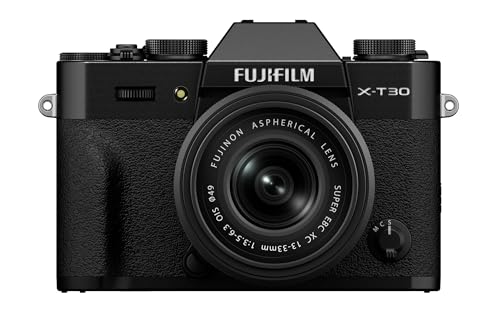
Fujifilm X-T30 III with XC 13-33mm Kit — Light landscape walker
Fujifilm’s listing is the quietest in this guide: a mirrorless camera body with the XC 13-33mm lens kit, in black. No resolution, no recording claims, no bundle extras. In a landscape context, that quietness can be read as the point. The X-T30 III kit represents the deliberate, lightweight end of outdoor photography — a small body and a wide-leaning zoom for the photographer who walks far, composes slowly and believes the best landscape camera is the one that never felt like a burden by the third valley.
The 13-33mm kit lens frames the landscape half of this guide naturally. Wide focal lengths are the landscape photographer’s home territory: foreground interest leading into layered distance, skies given their share of the frame, rivers and paths drawing the eye through the scene. A kit that starts wide encourages that grammar from the first walk, and its compactness keeps the camera in a jacket-adjacent bag rather than a dedicated backpack, which changes how often it comes along on ordinary days.
Fujifilm’s X-series carries a handling philosophy that landscape photographers have valued for years — direct, dial-led control that suits gloved, deliberate, tripod-paced work — but this guide’s discipline requires care: the title states none of that, so it is offered here as the line’s general character, not as a specification of this listing. What the listing guarantees is the pairing itself: this body, this wide kit lens, this finish. For many walkers, that guarantee plus the system’s lens shelf is the whole decision.
Wildlife is not this kit’s errand, and pretending otherwise would waste the reader’s trust. A 13-33mm zoom frames animals as elements of a landscape rather than as portraits, which is a legitimate and beautiful genre — the deer small in the vast meadow is a classic composition — but the photographer whose heart is set on feather detail should choose the R10 or Z50 II bundles above, whose telephotos exist precisely for that desire.
The spec box below is therefore short and honest, with the mandated gaps recorded. Shoppers needing this body’s figures should take them from Fujifilm’s documentation. Shoppers needing a light, wide, walk-all-day landscape kit have their answer in the pairing itself, and in a system whose lens range lets the kit grow toward longer or faster glass when the walker’s taste evolves.
City-break photographers should not overlook this little Fujifilm either. Architecture, river walks and museum-quarter streets reward exactly the wide, light, unobtrusive recipe the kit describes, and a camera that draws no attention in a crowd gathers candid frames a flagship would scatter. Landscapes are not only made in mountains; some of the finest are made of skylines, and this is the guide’s most portable way to make them.
- Configuration: camera body with XC 13-33mm lens kit
- Finish: black
- Format detail: Not stated in the listing title — verify with the manufacturer documentation
- Sensor resolution: Not stated in the listing title — verify with the manufacturer documentation
- Video specification: Not stated in the listing title — verify with the manufacturer documentation
Strengths
- Wide kit zoom matches landscape composition grammar from the first walk
- Compact pairing encourages daily carrying on ordinary walks
- Fujifilm’s X system offers a deep lens shelf for later growth
Trade-offs
- 13-33mm range cannot frame wildlife portraits at any distance
- Title states almost no specifications, so research falls to Fujifilm documentation
- No bundle extras — card and bag are separate purchases
Best for: a walking landscape photographer seeking a light body with a wide kit zoom for deliberate compositions
Not suited for: close-framed wildlife photography, since the kit zoom’s longest setting is 33mm
Confirm on the X-T30 III page that the configuration is the XC 13-33mm kit in black, and budget a memory card in the same order — unlike the bundles above, this listing’s title promises no card in the box.

Sony a7 IV Bundle — 33MP kitted full-frame
Sony’s bundle listing for the a7 IV is the most completely itemised in this guide: a full-frame 33MP Alpha interchangeable-lens camera, body ILCE-7M4/B, an official Sony USA partner model, bundled with a case, a 128GB card, a mini tripod, an extra battery and a dual charger. Read that contents list as an outdoor photographer’s packing list and its intelligence becomes obvious — nearly every extra answers a specific field failure that landscape and wildlife shooters know by heart.
The extra battery and dual charger answer the coldest one. Outdoor days are long, dawn and dusk are the working hours, and a single battery turns a two-session day into a rationing exercise. A spare in the bag plus a charger that refills both overnight converts power from a worry into a routine. The mini tripod answers the landscape half directly: a low, stable platform for the stream-level composition and the dawn exposure that handheld shooting cannot hold, light enough to actually be carried.
The 33MP full-frame sensor, stated plainly in the title, is this pick’s stills core. For landscapes, that resolution class supports generous prints and the cropping freedom that viewpoint photography constantly demands — the composition refined at home because the ridge allowed only one standing position. For wildlife, the same file depth lets a distant subject be cropped toward the frame’s centre while retaining detail, which is how many field photographers actually work when even a long lens leaves the animal small.
Note what this bundle does not include: a lens. The case, card, tripod, battery and charger surround a body-only core, so the buyer must bring E-mount glass or order it alongside. That structure suits the upgrader — a Sony shooter whose lenses exist and whose field infrastructure was the gap — better than the first-time buyer, and the distinction is the difference between a delighted and a stranded customer.
The official partner model wording closes the listing’s argument: provenance. A body bought for years of outdoor service should come through the channel its maker recognises, and the title states that status rather than leaving it to inference. Taken together — stated resolution, full frame, field infrastructure, clear provenance — this is the most expedition-ready single delivery in the guide, once a lens joins it.
Households with an existing E-mount lens or two should read this bundle as the missing middle of a kit they already half own: the body and the field infrastructure arrive together, the glass is already on the shelf, and the first dawn session can happen the weekend after delivery. Few listings in this guide reward prior ownership so directly, and upgraders are right to value that.
- Sensor: 33MP full-frame
- Model: ILCE-7M4/B body
- Bundle includes: case, 128GB card, mini tripod
- Power: extra battery and dual charger included
- Provenance per title: official Sony USA partner model
- Lens: none included in this bundle
Strengths
- Spare battery and dual charger solve the two-session outdoor day
- 33MP full-frame files support large prints and deep crops
- Mini tripod and case make the bundle field-ready around a lens
Trade-offs
- No lens included, so E-mount glass is a separate, essential purchase
- Bundle cost assumes the buyer values infrastructure over glass
- Full-frame system weight exceeds the APS-C bundles on long walks
Best for: an E-mount photographer seeking a 33MP full-frame body with field power and support already bundled
Not suited for: a first-camera purchase, since the bundle contains no lens to shoot with on arrival
When checking this bundle, run your eye down the contents for the extra battery and dual charger specifically — they are the items that separate this field kit from an ordinary body listing, and they should both be named before you pay.
Comparison Table
| Pick | Format | Glass included | Landscape strength | Wildlife strength |
|---|---|---|---|---|
| Nikon Z 8 | Full-frame | None — body only | Professional dawn and dusk work | Professional field assignments |
| Nikon Z6 III | Full-frame | None — body only | Stated 6K/60p internal RAW video | Lighter full-frame field body |
| Canon EOS R10 bundle | APS-C, 24.2MP | 18-150mm plus 75-300mm | Everyday zoom for scenes | Included telephoto reach |
| Nikon Z50 II bundle | APS-C | 16-50mm plus 50-250mm | Compact travel coverage | Crop-framed telephoto in a light kit |
| Fujifilm X-T30 III kit | Not stated in the listing title | XC 13-33mm | Wide, light walking kit | Animals within scenery only |
| Sony a7 IV bundle | Full-frame, 33MP | None — infrastructure instead | Mini tripod and spare power included | Deep files for cropping reach |
How to Choose Between the Landscape Half and the Wildlife Half
Count your last twenty outdoor photographs, or the twenty you wish existed. If most are places — ridges, coasts, forests, city overlooks at dawn — you are a landscape photographer for purchasing purposes, and the full-frame bodies plus the Fujifilm’s wide kit are your shortlist. If most are inhabitants — birds, mammals, the heron at the pond — reach decides, and the two-lens bundles were built for you. Mixed archives are the norm, which is why the hybrid bodies and the a7 IV bundle exist; but let the majority rule the budget, because the minority interest can borrow, crop or wait.
Then price the lens, not the body. Wildlife is a lens purchase wearing a camera: the R10 and Z50 II bundles are honest because they put the telephoto in the box, while the body-only picks assume a lens plan with real money behind it. Landscape is a patience purchase: the sensor and the tripod matter, and the a7 IV bundle’s inclusion of support and spare power recognises that the landscape photographer’s failures are usually logistical, not optical.
Weight deserves a veto. A full-frame professional kit that gets left in the car at the third trailhead photographs nothing, and the history of outdoor photography is littered with superior systems abandoned for lighter ones. Be honest about your carrying pattern over distance and gradient, and let the Z50 II bundle or the X-T30 III kit win whenever honesty says the big bodies would stay home.
Seasons should steer the final decision more than they usually do. A photographer buying in autumn for a winter of estuary birds needs the telephoto bundles now and can let landscape refinements wait for spring; a photographer buying for a summer of alpine dawns needs the sensor and the support first. Equipment bought against a real, dated season gets used with an urgency that generic purchases never find, and urgency — measured in alarms set and weather watched — is the true currency of outdoor photography. Let the calendar, not the catalogue, have the last word on which half of this guide you fund first.
Finally, plan power and storage as first-class equipment. The dawn session and the dusk session are separated by a day of standby; the wildlife day produces sequences by the hundred. Spare batteries, a charger that handles the rotation and cards sized for your worst day are not accessories to the choice — for outdoor work they are part of the camera, and the bundles that include them should be credited accordingly.
Landscape Half: What Does a Viewpoint Photographer Actually Need?
Less than the industry suggests, and more patience than any specification can sell. The landscape essentials visible in this guide are a sensor that behaves at the day’s edges — the full-frame picks’ home ground — a wide lens for the foreground-to-distance grammar, and support: the a7 IV bundle’s mini tripod is the only stabilisation hardware any listing here includes, and landscape photographers will notice. Beyond that, the craft is weather, timing and returning to the same viewpoint until the light agrees to perform.
Resolution plays a quieter role than marketing claims. It buys cropping freedom and print size, both real, and the a7 IV bundle’s stated 33MP is the landscape half’s clearest figure. But a well-composed frame from any pick here will out-print a careless frame from the largest sensor, which is why this guide spends its landscape words on carrying, support and light rather than on a resolution league table the titles mostly decline to provide.
Wildlife Half: How Much Reach Is Enough Reach?
Enough is defined by your subjects’ comfort distance, not by a number. Garden birds at a feeder forgive modest telephotos; waders on an estuary and deer in open country demand everything a lens can give. The bundles here answer with included glass — 75-300mm on the Canon, 50-250mm on the Nikon — each tightened further by APS-C crop framing, which as general guidance effectively extends reach by the crop factor. For most beginning and travelling wildlife work, that combination crosses the threshold from frustrating to fruitful.
Beyond the threshold, technique outruns equipment again: fieldcraft, hides, feeding stations and dawn timing bring subjects closer more cheaply than any longer lens. The professional answer — the Z 8 with serious telephoto glass — exists in this guide for the photographer whose fieldcraft is already strong and whose remaining limitation genuinely is the equipment. Everyone else should buy the bundle, learn the craft, and let close encounters accumulate.
Should a Travelling Photographer Choose Crop or Full Frame?
Choose crop when the journey is the subject. The Z50 II bundle’s two zooms, large card and light total weight describe a kit that can live in a small bag through flights, buses and long walks, framing wildlife tightly through its crop while covering towns and viewpoints with the standard zoom. The X-T30 III kit serves the same travel logic from the landscape side, lighter still, with width instead of reach.
Choose full frame when the destination is the subject: a booked hide, a basecamp, a landscape expedition where the kit travels by vehicle and the light at the day’s edges is the entire commission. The Z 8, Z6 III and a7 IV bundle were picked for those journeys. The error is mixing the logics — hauling a professional full-frame system on a backpacking trip, or asking a travel kit to perform a flagship’s dusk assignment — and this guide’s two-halves structure exists to make that error visible before money moves.
What Should an Outdoor Photographer Pack Around the Camera?
The camera is the glamorous third of a field kit. The other two thirds are power and protection, and they decide more photographs than any sensor. Power means batteries counted against the coldest, longest day — cold drains cells faster, and dawn-plus-dusk schedules double a day’s shooting — plus a charger that can restore the whole rotation overnight. The a7 IV bundle’s spare battery and dual charger are in this guide because they solve that arithmetic inside the box; every other pick’s buyer must solve it at the same time as the body, not after the first ruined morning.
Protection means a bag that closes one-handed in wind, a strap that cannot slip a wet glove, and a plan for rain that does not involve optimism. None of the six listing titles claims weather sealing, so this guide assumes none: the outdoor photographer’s defence is covers, towels, dry bags and the discipline to use them before the squall arrives rather than after. Photographers who build those habits keep any of these bodies working for years in country that destroys careless equipment in a season.
The final layer is support and storage, sized honestly. A tripod or mini tripod that matches the kit’s weight — the a7 IV bundle includes one — plus cards that hold a worst-case wildlife day with room to spare, and a nightly offload habit that means no photograph exists in only one place. None of this photographs anything by itself. All of it decides whether the camera is ready, powered and empty when the light and the animal finally agree, which is the only moment that matters outdoors.
Common Mistakes in Outdoor Camera Buying
Buying the body and postponing the telephoto
Wildlife beginners routinely spend the whole budget on a body and discover that the kit zoom frames a bird as a punctuation mark. The bundles in this guide exist to break that pattern: reach is included, so the first season is spent learning fieldcraft instead of saving for glass. If you choose a body-only pick for wildlife, write the telephoto into the same budget line, with the same ink, or the purchase is unfinished.
Judging a landscape kit by its midday performance
Landscapes are made at the edges of the day, and a kit that charms at noon may struggle at the blue hour when the real photograph happens. Sensor size, support and power — the unglamorous trio — decide those minutes. The a7 IV bundle’s spare battery and mini tripod look like padding in a midday comparison and like wisdom at 5am on a ridge, which is the only comparison a landscape photographer should trust.
Carrying a system heavier than the walk
Ambition loads the bag; honesty should unload it. A professional full-frame body and its glass can double the weight of the APS-C bundles here, and weight is paid in viewpoints not climbed and evenings not attempted. Match the kit to the longest walk you genuinely take with a camera, not to the expedition you describe at parties, and the photographs will multiply accordingly.
Ignoring the card-and-battery arithmetic of a field day
Wildlife sequences and RAW landscape video consume storage and power at rates that surprise studio photographers. The bundles that include a 128GB card or a spare battery are solving a real equation, and body-only buyers must solve it themselves: cards for the worst day, batteries for the longest one, and a charger that resets the system overnight. Running out of either, once, at the decisive moment, teaches the lesson permanently.
Final Recommendation
Split the verdict the way the guide was built. For landscapes, the a7 IV bundle is the most complete single delivery — a stated 33MP full-frame sensor with the tripod, spare battery, charger, card and case that viewpoint work actually consumes — while the Z6 III is the landscape filmmaker’s choice on the strength of its stated internal RAW recording, and the X-T30 III kit serves the walker who prizes lightness and width above all. For wildlife, the R10 bundle is the beginner’s honest starting point, with telephoto reach in the box, and the Z50 II bundle is its travelling counterpart with the larger card. The Z 8 stands above both halves as the professional’s body, bought with lenses and infrastructure planned. Decide which half of the outdoors owns your heart, and the shortlist makes itself.
One more field habit separates satisfied outdoor photographers from frustrated ones: the pre-dawn check. Batteries seated, cards formatted the night before, lenses cleaned while the kettle boils, the bag packed by the door in shooting order. It takes four minutes and it rescues more photographs than any feature in this guide, because the decisive outdoor moments — the mist lifting, the fox crossing — allow no assembly time. Choose your pick, then build the ritual around it, and the equipment will repay you in the only currency that matters: frames that exist.
Frequently Asked Questions
Which pick is best for birds specifically?
The R10 bundle for a beginner, because its included 75-300mm telephoto — tightened further by APS-C crop framing — reaches feeder and shoreline distances without a second purchase. The Z50 II bundle is the travelling alternative with its 50-250mm zoom and larger card. Serious bird photographers with fieldcraft already learned are the Z 8’s audience, paired with professional telephoto glass bought separately.
Why does the guide keep separating landscape and wildlife?
Because the two crafts reward opposite equipment instincts: landscapes reward deliberation, width and support, while wildlife rewards reach, readiness and volume. A camera can serve both — the hybrid bodies here do — but a budget cannot maximise both at once, and pretending otherwise produces kits that are mediocre at everything. Naming your dominant half is the single most valuable step in the whole purchase.
Is the Z50 II a full-frame camera?
No, and this guide treats it accordingly: the Z50 II bundle is an APS-C kit, which is precisely why its 50-250mm zoom frames wildlife so tightly for its size. It does not belong in full-frame comparisons, and readers shopping the Nikon full-frame line should look at the Z 8, Z6 III and their siblings instead. Its crop format is a considered advantage for travelling wildlife work, not a deficiency to apologise for.
What does crop framing actually do for wildlife reach?
As general photographic guidance, an APS-C sensor records the central portion of the scene a full-frame sensor would capture, so a lens of a given focal length fills the frame with a tighter view — the effect photographers describe as extra reach. No glass changes and no quality is invented; the framing is simply narrower. Both two-lens bundles in this guide exploit that effect, which is why their modest telephotos perform wildlife duties that their printed focal lengths understate.
Which pick should a landscape photographer who films choose?
The Z6 III, on the evidence of its title: the stated 6K/60p internal RAW recording gives landscape filmmakers their most flexible format without an external recorder in the field kit, while the full-frame sensor serves dawn and dusk stills. Pair that plan with generous card capacity, since RAW recording consumes storage quickly, and with the same patience every landscape discipline demands.
Do I need a tripod for the landscape picks?
For the dawn and dusk work that defines serious landscape photography, support is close to essential, because the light that makes the photograph is the light that forces slow exposures. The a7 IV bundle is the only pick whose title includes support — its mini tripod — and every other landscape buyer should budget a tripod alongside the body rather than after the first blurred sunrise. Wildlife shooters can often work handheld or braced, but even they benefit from a monopod on long hide days.
Whichever half claims you, remember that the outdoors pays its photographers in proportion to their presence: the dawns attended, the hides sat in, the ridges revisited in worse weather — so choose the kit you will genuinely carry into all of it, and let a hundred ordinary mornings, rather than one perfect specification, build the portfolio you are imagining.
And if the first expedition disappoints — flat light, absent animals, a viewpoint fenced for repairs — treat it as the tuition every outdoor photographer pays, change one variable next time, and go again: the second visit to any location is worth three first visits anywhere else.
The outdoors keeps its own ledger, and it pays interest slowly: return to one valley, one shoreline, one hide across a full year of weathers, and the place will eventually hand you the photograph that no new location and no newer camera could have given you sooner.
Presence, repeated across seasons, is the whole method — the gear merely has to deserve the invitation.
Bring that same second-year thinking to the order itself: whatever you choose, add the unglamorous items in the same week — the spare card, the second battery, the bag that fits the grown kit — because the first season’s photographs are the ones that decide whether there is a second season at all.
Then set the alarm for tomorrow’s dawn, whichever you chose — the landscape will not wait, and neither will the heron.
The first alarm is the hardest; the tenth is a habit, and habits are what portfolios are built from.
Go and earn the second visit.
Start tonight.
Start tonight, and start close to home.
Related Guides
Budget-conscious field photographers should read used mirrorless cameras under a modest ceiling, Nikon loyalists can compare the best Nikon full-frame mirrorless cameras, and indoor presenters may prefer affordable conference room projectors.
Related guides
- Best Thermal Imaging Cameras Hunting: Six Handheld Thermal Monoculars for Night Observation
- Best Mirrorless Cameras for Bird Photography: Crop Reach, Fast Bursts and the Lens Question Answered First
- Best 4K Cameras Travel Shooters Actually Carry
- Best 1080 Webcams: Six Full HD Cameras Judged on Light, Focus and Voice


