What's inside
- Key Takeaways
- Quick Picks
- How We Chose These Picks
- Comparison Table
- How to Choose and Inspect a Used Mirrorless Camera
- What Does Shutter Count Tell You, and What Does It Hide?
- Used, Renewed or Nearly New: Which Route Fits Your Household?
- How Can You Spot a Mislabelled or Problem Listing?
- What Should the First Week With a Used Camera Involve?
- Common Mistakes in the Second-Hand Camera Market
- Final Recommendation
- Frequently Asked Questions
- Related Guides
As an Amazon Associate I earn from qualifying purchases. This post may contain affiliate links at no extra cost to you.
[SITE_DOMAIN] is reader-supported. When you buy through links on our site, we may earn an affiliate commission.
Where to buy — this is a second-hand hunting guide, so the five Amazon links below point to the reference listings for each model: the exact configurations a used buyer should learn to recognise, price against and inspect. The sixth pick, a renewed a6000 listing, is covered without a link and with its condition stated in plain words, because renewed and used are neighbouring but different markets.
The smart way to shop for the best used mirrorless cameras under 500 — the figure in this guide’s title is a budget ceiling, not a price quoted for any camera here — is to choose the model first and the individual unit second. Models age predictably; units age according to their owners. This guide therefore spends its length on five reference models worth hunting on the second-hand market, what each listing title confirms about the configuration, and how to inspect whichever used example you actually find, because the inspection is where used buying is won or lost.
Three Sony bodies form the spine: the a6000 in kit form, the same a6000 body-only, and the smaller a5000. A Fujifilm X-T30 II bundle and Canon’s EOS R100 complete the five linked references, spanning three mounts and two sensor philosophies. The sixth entry discusses the a6000’s renewed channel in prose only, with a clear disclosure of what renewed means, because a refurbished unit with a seller’s refurbishment process behind it is a different purchase from a stranger’s used camera and should never be blurred into one.
No prices appear anywhere in this guide, deliberately. Used prices move weekly, vary by country and condition, and printing one would mislead within a month. The budget figure in the title is the frame for the hunt: every model below is the class of camera that circulates beneath that ceiling on the second-hand market, and the buyer’s job is to find the honest unit, not the cheapest listing.
Key Takeaways
- The a6000 with its 16-50mm power zoom is the reference used kit: 24.3MP, a 3.0-inch LCD and a lens included.
- The body-only a6000 listing is the same 24.3MP camera for buyers who already own E-mount glass.
- The a5000 is the smallest, simplest entry: 20.1MP in a white finish, for the lightest possible start.
- Fujifilm’s X-T30 II bundle adds a 15-45mm lens, a 64GB card, a sling backpack and a variable ND filter.
- Canon’s EOS R100 is the modern reference: 24.1MP APS-C, 4K video and Wi-Fi with Bluetooth in its kit.
- The renewed a6000 is prose-only, and its review discloses the renewed condition explicitly before anything else.
Quick Picks
| Pick | Badge | Why it made the cut |
|---|---|---|
| Sony Alpha a6000 with 16-50mm Kit | The reference used kit | A 24.3MP body with the power zoom included — the configuration to hunt. |
| Sony Alpha a6000 Body | For existing E-mount owners | The same camera without a lens, for buyers whose glass shelf is stocked. |
| Sony Alpha a5000 | Lightest entry point | A 20.1MP body in white for the smallest, simplest second-hand start. |
| FUJIFILM X-T30 II Bundle | Accessorised Fujifilm kit | A 15-45mm lens with a card, a backpack and a variable ND filter included. |
| Canon EOS R100 Kit | The modern reference | Canon’s current entry kit, the benchmark used prices must beat. |
| Sony Alpha a6000 (Renewed listing) | Prose-only renewed route | A refurbished channel for the same model, disclosed in full in its review. |
How We Chose These Picks
Used-market selection inverts new-camera logic. A model earns its place here not by being current but by being abundant, durable and understood: abundant because a deep second-hand supply means choice among units and honest pricing pressure; durable because a used buyer inherits whatever the design’s weak points turn out to be; understood because a model with a decade of owner knowledge behind it holds no surprises that a forum search cannot answer.
The a6000 appears twice because it dominates this market segment so completely that any honest guide must address both its common configurations. The kit is the default recommendation; the body-only listing serves the substantial population who already own E-mount lenses from a later Sony body and want the a6000’s compactness as a second camera or a travel spare. Treating them as separate picks is not padding — they are different purchases answering different shelves.
Condition risk was weighed as a feature. Models with simple constructions, vast parts availability and long production runs forgive used buying; delicate, short-lived or rare models punish it. The renewed a6000’s prose-only inclusion applies the same logic from the other direction: a refurbished channel exists for this model precisely because its volume justifies one, and a shopper clear on the difference between renewed and used gains a genuine third option.
Marketplaces have seasons, and the used buyer who learns them hunts better. Supplies swell after holidays, when gifts replace older bodies, and after major launches, when upgraders sell in waves; prices soften in those weeks for exactly the models in this guide. A buyer with a month of patience can set alerts for the reference configurations, watch a dozen listings pass to learn the honest range for each condition, and strike when a careful owner’s example appears inside it. That watching period is not delay — it is the market research that separates a hunter from a shopper.
Finally, each linked listing was treated as a reference configuration rather than as the unit you will buy. Its title defines the genuine article — the correct lens pairing, the correct model naming — against which second-hand listings on any marketplace can be checked. Sellers mislabel cameras constantly, innocently and otherwise; the reference titles in this guide are the antidote.

Sony Alpha a6000 with 16-50mm Power Zoom Kit — The reference used kit
The a6000 kit is the used mirrorless purchase against which all others in this budget class are measured. Sony’s listing describes a 24.3MP mirrorless digital camera with a 3.0-inch LCD, in black, with the 16-50mm power zoom lens. That configuration — body plus the compact power zoom — is the one to hunt, because the little zoom’s collapsing design is what made the a6000 the camera a generation of travellers actually carried, and a used example with its kit lens intact is a complete photographic system in one small bag.
Why does this model, of all cameras, anchor the second-hand market? Longevity of relevance. Its 24.3 megapixel files remain entirely respectable for prints and screens, its E-mount accepts the enormous lens catalogue Sony and third parties built since, and its size threads the needle between phone convenience and system ambition. A used buyer is purchasing all three of those durabilities, plus a model so widely owned that every question about it has been asked and answered publicly many times over.
The power zoom deserves a used buyer’s specific attention during inspection. Power zooms extend and retract electrically, so a healthy example should zoom smoothly and quietly through its range without grinding, hesitation or error messages; a lens that stutters is telling you its history. Check also that the lens in a used listing is genuinely the 16-50mm power zoom the reference title names — sellers pair bodies with whatever glass is nearest, and the kit’s value story depends on that particular small zoom.
Body inspection follows the used checklist this guide details later: shutter count where the seller can provide it, sensor examined for spots by photographing a bright plain surface, mount contacts clean, screen and dials responsive. The a6000’s popularity helps here too, because typical shutter-life expectations and common wear points for this model are extensively documented by its owner community.
As a photographic tool today, the kit suits travel, family documentation and the learner who wants a real system without new-system money. Its files teach editing, its mount teaches lens choice, and its size teaches the habit that matters most: carrying the camera. A used a6000 kit in honest condition is not a compromise purchase. For a great many photographers it is simply the correct one.
Grandparents deserve a mention in this model’s story, because the a6000 kit became the camera a generation of them bought to photograph grandchildren properly — light enough for a handbag or a jacket, serious enough for the school play. Used examples from that ownership pattern are often the market’s sweetest units: lightly used, carefully stored, sold when the grandchildren grew. Recognising the pattern explains why supply of honest examples never quite dries up.
- Sensor: 24.3MP
- Screen: 3.0-inch LCD
- Kit lens: 16-50mm power zoom
- Finish: black
- Mount family: Sony E-mount
Strengths
- Enormous used supply means real choice among units and conditions
- 24.3MP files and the E-mount keep the camera fully useful today
- Collapsing power zoom preserves the compactness that made it famous
Trade-offs
- Power zoom mechanism must be tested carefully on any used unit
- Age means batteries in used kits may be tired and need replacing
- No video figures are stated in the title for filming-led buyers
Best for: a second-hand buyer seeking the complete kit configuration — body and power zoom — as a first system camera
Not suited for: a buyer unwilling to inspect a used unit, since condition varies entirely from one example to the next
Use the reference listing to memorise the exact kit wording — 24.3MP, 3.0-inch LCD, 16-50mm power zoom, black — before browsing used examples anywhere, because that wording is your template for spotting mislabelled or incomplete kits.

Sony Alpha a6000 Body Only — For existing E-mount owners
The body-only a6000 listing is the same camera wearing a different intention: a 24.3 MP body with the 3.0-inch LCD, in black, with no lens in the box. On the new market that configuration serves upgraders; on the used market it serves a specific and numerous tribe — photographers who already own E-mount lenses, from an a6400, an a7-series body or an earlier APS-C Sony, and who want the a6000’s size and simplicity as a second body, a travel spare or a camera to lend without anxiety.
Second bodies earn their keep in ways specification sheets never mention. The lens stays mounted on the main camera while the spare carries the other focal length at a wedding or on a trail; the expensive body stays home on the trip where luggage gets lost; the teenager borrows the a6000 and returns it with sand in the bag, and nobody’s season is ruined. A used body-only a6000, bought for a fraction of its system’s value, performs all of those duties with the same 24.3 megapixel competence as the kit.
The configuration also suits the deliberate minimalist: the photographer who shoots one prime lens — a fast 30mm or a compact 20mm — and wants the smallest body that mounts it. Body-only used listings are where that buyer hunts, and the a6000’s depth of supply means patience is rewarded with genuinely clean examples rather than whatever the market happens to hold this week.
Inspection priorities shift slightly without a lens in the deal. The sensor is exposed in every photograph of the listing, so examine those images for the body’s general honesty, and in person, check the mount’s contact pins and the sensor cover glass with particular care, since a body sold without a lens has often been stored without one too. A body cap’s presence in the listing is a small, telling sign of a careful previous owner.
What this pick is not is a first camera for a lens-less beginner, however attractive a body-only price looks beside the kit’s. The arithmetic only works when the lens already exists. Beginners should buy the kit above and let the body-only listings serve the tribe they were listed for.
Students are the body-only listing’s second tribe. A photography student who owns one good E-mount lens from a course kit can put a used a6000 body under it and own a complete working camera for coursework, field trips and the riskier shoots — festivals, weather, travel — where a borrowed or expensive body would be a worry. Education is full of such calculations, and this listing exists in the guide partly for the student reading it at midnight before term starts.
- Sensor: 24.3 MP
- Screen: 3.0-inch LCD
- Configuration: body only — no lens included
- Finish: black
- Mount family: Sony E-mount
Strengths
- Same 24.3MP competence as the kit at a body-only commitment
- Ideal second body for owners already holding E-mount lenses
- Deep used supply rewards patient hunting for clean examples
Trade-offs
- Useless on arrival without a separately owned or purchased lens
- Sensor and mount need closer inspection on lens-less listings
- Battery condition in used examples varies and adds hidden cost
Best for: an E-mount owner seeking a compact second body for travel, lending or a permanently mounted second lens
Not suited for: a first purchase without lenses, since the body alone cannot take a photograph
Before bidding on any body-only example, compare its photographs against this reference listing’s presentation — black finish, body-only contents — and ask the seller directly about the body cap and battery, the two small items that reveal how the camera was stored.

Sony Alpha a5000 — Lightest entry point
The a5000’s listing is the briefest of the linked five: a 20.1MP camera in white. Brevity suits it. The a5000 was Sony’s smallest, simplest interchangeable-lens proposition — the camera aimed at the photographer stepping up from a phone or a compact who wanted lens choice without system bulk — and on the used market that simplicity becomes its whole argument. Fewer features mean fewer things for a previous owner to have worn out, and a lower ceiling of expectation means honest examples satisfy completely.
The 20.1 megapixel sensor sets the honest terms. For screen sharing, social publication and modest prints, twenty megapixels is not a limitation anyone will meet in ordinary life; the photographer who outgrows it will do so through ambition, not through the files failing. What the a5000 offers in exchange is the E-mount’s front door at the market’s gentlest level of commitment — a body so inexpensive used that it functions as an audition for the entire Sony system.
The white finish, stated in the title, is more than a cosmetic footnote for a used buyer. Light-coloured bodies show their history honestly: scuffs, discolouration and grip wear are visible in listing photographs in a way black bodies conceal. A white a5000 that photographs cleanly is very likely a genuinely clean camera, and a shabby one cannot pretend otherwise. Used buyers should learn to love finishes that cannot lie.
Configuration questions matter with this model. The reference title names the camera alone, so a used buyer must establish what, if anything, accompanies any particular example — the kit lens it was commonly sold with, a battery, a charger — because the difference between a body with its small kit zoom and a bare body is the difference between a camera and a project. Ask, in writing, before paying.
Who is this for, in a guide that also offers the a6000? The photographer whose priority is the lightest possible real camera: the walker, the minimalist traveller, the parent who wants a dedicated family camera that lives in a coat pocket’s neighbourhood. The a6000 is the better system investment; the a5000 is the smaller daily companion, and used prices let some households reasonably own the logic of both.
There is a colour-therapy argument for this little camera that sounds frivolous and is not. Photography is a habit before it is an art, and a white camera that looks friendly on a kitchen table gets picked up by household members who would never touch a black professional-looking body. Family archives are built by whoever holds the camera, and the a5000’s unthreatening design quietly recruits more holders.
- Sensor: 20.1MP
- Finish: white
- Mount family: Sony E-mount
- Kit contents: not itemised in the listing title — confirm with the seller of any used unit
- Video specification: Not stated in the listing title — verify with the manufacturer documentation
Strengths
- Smallest, simplest entry into interchangeable-lens photography here
- White finish reveals wear honestly in listing photographs
- E-mount access lets the audition grow into a full system
Trade-offs
- 20.1MP files leave less cropping room than the 24MP-class picks
- Title does not itemise kit contents, so every used unit needs questions
- Entry positioning means fewer controls for an advancing photographer
Best for: a minimalist seeking the lightest used system camera for walking, travel and family duty
Not suited for: heavy cropping and large prints, where the 24-megapixel-class picks hold more file in reserve
When you find a used a5000, let the white finish do your first inspection in the listing photographs, then confirm in messages exactly which lens, battery and charger accompany it — this model’s value lives entirely in those answers.
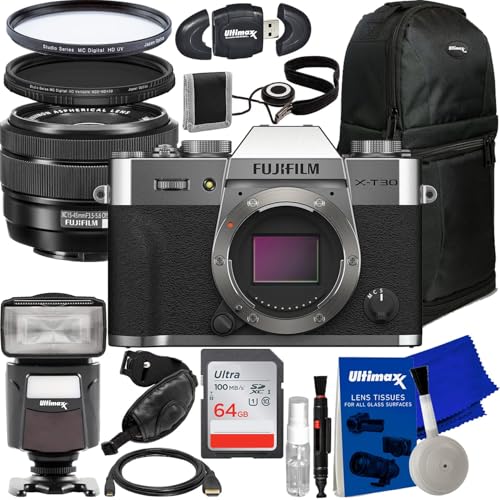
FUJIFILM X-T30 II Bundle with XC 15-45mm — Accessorised Fujifilm kit
Fujifilm’s entry arrives as a working bundle: an X-T30 II mirrorless camera with the XC 15-45mm OIS PZ lens in silver, accompanied by a 64GB Ultra SDXC memory card, a sling backpack, a variable neutral density filter spanning ND2 to ND400, and further items making a 23-piece bundle. For a used buyer, this listing’s role is double: it is both a model worth hunting and a lesson in what a complete Fujifilm kit looks like when one surfaces second-hand with its accessories intact.
The X-T30 II represents the other great APS-C philosophy in this guide. Where the Sonys pursue compact automation, Fujifilm’s X-series pursues tactile, dial-led photography and a colour character its owners describe with unusual loyalty. A used buyer choosing between an a6000 and an X-T30 II is really choosing a handling religion, and the healthiest advice is to pick the one whose controls you will enjoy touching for years, because both systems’ files will satisfy.
The bundled lens, the XC 15-45mm with its power zoom and OIS stabilisation in the name, covers the wide-to-everyday span in a collapsing package that keeps the X-T30 II’s small body small. The variable ND filter is the bundle’s most interesting extra for a thinking photographer: it dims light across a wide range, which serves long-exposure water and cloud work in daylight and lets video shooters hold wide apertures in sun. On the used market, a bundle whose filter and backpack survive with the camera signals an owner who bought deliberately and, usually, stored carefully.
Used inspection for this model adds Fujifilm-specific notes to the general checklist: the dials should click with definition rather than spin loosely, the kit lens’s power zoom should extend smoothly, and the bundle’s small items — filter threads clean, card genuine, backpack zips sound — deserve the same scrutiny as the body, because a 23-piece bundle’s value leaks away one missing piece at a time.
The title omits a megapixel figure, and the spec box records that silence; a buyer for whom resolution is decisive should take the number from Fujifilm’s documentation. The case for the X-T30 II here rests on system character, kit completeness and the used market’s habit of pricing Fujifilm’s tactile cameras kindly once their successors arrive.
There is also a learning-curve dividend to Fujifilm’s approach that used buyers underrate. Dials that show their settings at a glance teach exposure by touch: a student of photography absorbs the relationship between aperture, shutter and sensitivity from handling the camera in a way menu-driven bodies postpone. A used X-T30 II bought partly as a teacher — of oneself, or of a teenager in the household — repays that tuition for years, and the bundle’s completeness means the teaching starts the day the box opens rather than after an accessory order.
- Lens: XC 15-45mm OIS PZ, silver finish camera
- Media: 64GB Ultra SDXC memory card included
- Filter: variable neutral density, ND2-ND400
- Carrying: sling backpack included
- Bundle size: 23 pieces per title
- Sensor resolution: Not stated in the listing title — verify with the manufacturer documentation
Strengths
- Complete working bundle with media, bag and a creative filter included
- Fujifilm’s dial-led handling suits photographers who shoot deliberately
- Stabilised power-zoom kit lens keeps the small body genuinely small
Trade-offs
- Bundle value depends on all small pieces surviving in a used example
- Resolution figure absent from the title for documentation to supply
- Third-party bundle items vary in quality beside the camera itself
Best for: a deliberate photographer seeking Fujifilm handling with lens, card, bag and ND filter in one kit
Not suited for: a buyer seeking the deepest used supply, since the Sony picks circulate in far greater numbers
For this bundle, count the pieces against the listing before paying — lens, 64GB card, backpack and the ND2-ND400 filter at minimum — because a used bundle missing its named extras is just a camera wearing a bundle’s price.

Canon EOS R100 with RF-S 18-45mm Kit — The modern reference
The R100 is the new camera in a used guide, present for a strategic reason: it is the benchmark every used price must beat. Canon’s listing describes a mirrorless camera with the RF-S 18-45mm F4.5-6.3 IS STM lens kit, a 24.1 megapixel CMOS APS-C sensor, 4K video, Wi-Fi and Bluetooth, aimed at beginner photographers and creators. A used buyer should know this configuration intimately, because the day a used a6000 kit approaches the street price of a new R100 kit, the used purchase must justify itself on size, mount or character rather than on savings.
As a used target in its own right, the R100 is beginning to circulate as first owners upgrade, and its youth is its used-market virtue: examples are young, shutter counts are low, and the model’s current status means Canon support and RF-S lens development stand fully behind it. A nearly-new R100 kit, bought with the discipline this guide teaches, can be the shrewdest purchase in the entire budget class.
The kit’s stated connectivity deserves emphasis for the used buyer comparing eras. Wi-Fi and Bluetooth in the title mean photographs move to a phone without cables or readers — the habit-forming convenience that older used bodies often lack or implement clumsily. A learner whose pictures reach their audience quickly shoots more, and the R100’s modern sharing is a genuine photographic feature, not a gadget extra.
Its mount is the strategic counterweight. RF-S is Canon’s young APS-C line in the RF system, and a used buyer choosing the R100 is choosing Canon’s future direction over Sony’s deeper present catalogue. Neither answer is wrong; they are different bets, and this guide’s role is to make the bet visible. The 4K video stated in the title also gives the R100 a filming dimension the older Sonys’ titles do not claim.
Inspection of a used R100 follows the same checklist as every pick here, with one addition: because the model is current, verify the kit is the genuine RF-S 18-45mm pairing and that the body has not been a heavily used rental or classroom unit. Youth is the premium being paid for; make sure the individual unit actually possesses it.
Households buying a camera as a shared gift should weigh the R100’s newness as a social feature: a current model with simple sharing is the one relatives actually adopt, and a used example that still feels modern will be picked up by more hands, more often, than a technically deeper but older-feeling body. Photographs multiply with holders.
- Sensor: 24.1 megapixel CMOS, APS-C
- Kit lens: RF-S 18-45mm F4.5-6.3 IS STM
- Video: 4K, as stated in the listing title
- Connectivity: Wi-Fi and Bluetooth
- Audience per title: beginner photographers and creators
Strengths
- Current model, so used examples are young with low wear
- Stated Wi-Fi and Bluetooth make phone sharing effortless
- 4K video and a complete kit lens in the reference configuration
Trade-offs
- Used supply is thinner than the long-running Sony models
- RF-S lens catalogue is younger than Sony’s E-mount depth
- Kit zoom’s slow aperture range limits dim indoor work
Best for: a used buyer seeking the youngest possible kit with modern sharing and a current Canon mount
Not suited for: a lens collector, since the RF-S catalogue is still shallower than the E-mount shelves
Hold every used R100 listing against this reference — 24.1 megapixel sensor, RF-S 18-45mm kit, 4K and wireless in the description — and walk away from any example whose seller cannot confirm the kit lens, because that pairing is the benchmark’s whole point.
Sony Alpha a6000 (Renewed Listing) — Prose-only renewed route
Disclosure first, in plain terms: this pick concerns a renewed a6000 — a refurbished unit sold through a renewed programme rather than a new camera or a private used sale. Renewed means the camera has been inspected, tested and restored to working order by the seller or its programme, typically with a defined returns route behind it, and it also means the unit had a previous life. This guide includes the renewed route without a link, and without pretending it is the same purchase as either of the a6000 listings above.
The distinction deserves a full paragraph because buyers blur it constantly. A used a6000 from a private seller is exactly as honest as that seller. A renewed a6000 carries a refurbishment process and a programme’s reputation instead, which trades the private sale’s possible bargains for standardised testing and an easier return if the unit disappoints. Neither is automatically better; they are different risk shapes, and a buyer should choose between them deliberately, eyes open, rather than discovering after delivery which one they bought.
Who should consider the renewed route? The buyer who wants the a6000’s proven 24.3-megapixel-class competence — the model documented in the two reviews above — but who is not equipped, or not inclined, to inspect a stranger’s camera in a car park. The renewed channel’s testing substitutes for that inspection, and its returns process substitutes for the negotiation a used buyer must conduct alone. For a first system camera bought by a cautious household, that substitution can be worth more than the difference in price.
The cautions are equally specific. Renewed condition grades vary in what they promise cosmetically, accessories in renewed boxes are not always the original kit items, and the exact refurbishment and warranty terms belong to the programme selling the unit — read them on that programme’s own pages before relying on any summary, including this one. A renewed camera should arrive working perfectly; whether it arrives looking new is a separate question with a separate answer in the fine print.
This guide’s treatment is deliberately conservative: the renewed a6000 is discussed, its condition is disclosed in this section’s first lines rather than buried, and no link is offered, so that no reader can mistake the recommendation’s nature. Judge the route on its terms — tested, refurbished, returnable — and it earns its place as the cautious buyer’s path to the most proven model in this guide.
A note on the renewed route’s paperwork: keep the programme’s condition grade and returns terms from the day of purchase, screenshotted or printed, because the value of the renewed promise lies in being able to invoke it precisely. Buyers of new cameras keep receipts by habit; buyers of renewed cameras should keep the terms with the same care, since the terms — not the box — are what distinguishes their purchase from a private sale.
- Condition: renewed — refurbished and tested under a seller programme, not new
- Link status in this guide: prose-only, no Amazon link
- Model reference: the a6000 documented in the two linked reviews above
- Terms: refurbishment scope and returns are defined by the selling programme — read them at the source
Strengths
- Programme testing substitutes for a private-sale inspection
- Defined returns route lowers the risk for cautious buyers
- Access to the guide’s most proven model through a standardised channel
Trade-offs
- The unit has a previous life; cosmetic condition varies by grade
- Bundled accessories may not be the original kit items
- Terms differ by programme and must be read at the source
Best for: a cautious buyer seeking the a6000 through a tested, returnable refurbished channel rather than a private sale
Not suited for: a buyer expecting a new camera, since renewed units are refurbished and previously owned by definition
Because this pick carries no link here, the action is reading rather than clicking: find the renewed programme’s own condition and returns pages for the a6000, compare them against the used listings above, and choose the risk shape that fits your household.
Comparison Table
| Pick | Sensor per title | Lens position | Condition route | Hunting note |
|---|---|---|---|---|
| Sony a6000 kit | 24.3MP | 16-50mm power zoom included | Used, via reference listing | Test the power zoom’s action |
| Sony a6000 body | 24.3 MP | None — body only | Used, via reference listing | Check mount contacts and body cap |
| Sony a5000 | 20.1MP | Confirm per used unit | Used, via reference listing | White finish shows wear honestly |
| Fujifilm X-T30 II bundle | Not stated in the listing title | XC 15-45mm OIS PZ included | Used, via reference listing | Count all 23 bundle pieces |
| Canon EOS R100 | 24.1MP APS-C | RF-S 18-45mm kit included | Used or nearly new | Verify the genuine kit pairing |
| Sony a6000 renewed | Model reference above | Varies by programme | Renewed — prose-only, disclosed | Read the programme’s own terms |
How to Choose and Inspect a Used Mirrorless Camera
Choose the model by system and size, using the reviews above; then switch your brain entirely from photography to inspection, because from that moment you are no longer buying a camera model — you are buying one specific unit with one specific history. The model decision takes an evening. The unit decision takes a checklist, a bright room and the willingness to walk away, and it is worth more money than any other step in this guide.
Start with the shutter count, the used camera’s odometer. Sellers of enthusiast models can often report it from the camera’s files or menus, and a count should be judged against the model’s expected shutter life as documented by its maker and its owner community. A low count on an old body suggests a drawer-kept camera, which carries its own risks of stiff mechanisms; a high count on a young body suggests professional use, which often means professional care. Neither extreme is automatic — both are questions to ask, not verdicts to assume.
Inspect the sensor by photographing a bright, plain surface — a white wall, a clear sky — at a narrow aperture, then examine the frame for spots. Dust is cleanable and negotiable; scratches and fungus are neither. Check the lens mount’s contacts for corrosion, the kit lens’s zoom and focus action for smoothness, every dial and button for response, and the screen for dead areas. On power-zoom kits like the a6000’s, run the zoom repeatedly: hesitation is history speaking.
Accessories deserve a budget line of their own in any used purchase, because the headline saving evaporates if the camera arrives needing a battery, a charger, a card and a bag bought separately at new prices. Price the whole working kit when comparing listings — a slightly dearer unit with two healthy batteries and its charger included is frequently the cheaper camera by the end of the first week. Sellers who include the small things are also, experience suggests, the sellers who maintained the big thing.
Finish with the transaction’s shape. Buy through channels with returns where possible, meet with the ability to test rather than to glance, and keep the first day’s shooting gentle and thorough — a full card of varied subjects, indoors and out — while the return window is open. A used camera that survives that first day under scrutiny will usually serve for years; one that fails it has failed cheaply, which is the entire point of inspecting.
What Does Shutter Count Tell You, and What Does It Hide?
It tells you how much mechanical life a body has spent, in the only currency its shutter understands. Set beside the model’s documented expectations, a count helps price a unit fairly: the low-count body deserves its premium, the high-count body its discount. For the models in this guide, owner communities have published years of accumulated experience about typical counts and failure patterns, and a half hour in those archives is the best money a used buyer never spends.
It hides everything electronic and optical. A low shutter count says nothing about a dropped body, a damp year in a garage, a sensor cleaned with enthusiasm and a shirt cuff, or a lens mount loosened by a heavy telephoto. That is why the count opens the inspection rather than closing it, and why this guide’s checklist moves from the count to the sensor, the mount, the controls and the transaction in that order. Numbers reassure; only handling verifies.
Used, Renewed or Nearly New: Which Route Fits Your Household?
Private used buying offers the deepest supply and the sharpest prices, at the cost of personal inspection and negotiation — the route for the confident, the patient and the technically curious. The renewed route, represented here by the prose-only a6000, exchanges some of that sharpness for programme testing and a defined returns path — the route for the cautious, the gift-buyer and anyone purchasing for a household member who cannot inspect a camera themselves.
Nearly-new current models — the R100 is this guide’s example — occupy the third corner: young units, modern features, maker support in full force, at used prices that must still justify themselves against the new street price. The right route is the one whose risks you are genuinely equipped to carry. Misjudging that, not the model choice, is how used purchases go wrong.
How Can You Spot a Mislabelled or Problem Listing?
Compare it against the reference titles in this guide, word by word. Mislabelled listings usually betray themselves in the configuration: a kit lens that does not match the model’s genuine pairing, a finish that does not match the title, a bundle whose named pieces quietly shrink in the description. The a6000 kit’s exact wording — sensor, screen, power zoom, colour — exists in this guide precisely so a buyer can hold any marketplace listing against it in thirty seconds.
Photographs are the second witness. Stock images in a used listing are a warning; the specific unit should appear, from several angles, with its serial-area details and honest wear visible. A seller who photographs a white a5000 in good light is telling you something good about themselves as well as about the camera. A seller who will not add a photograph on request has also answered your question.
What Should the First Week With a Used Camera Involve?
Testing, in a deliberate order, while the return window stands open. Day one: charge the battery fully and note how it behaves, because a tired battery is the commonest used-camera disappointment and the cheapest to fix when identified early. Photograph the bright wall for the sensor record, then shoot a deliberately varied card — portraits, a landscape, indoor frames in poor light, a sequence of a moving subject — and review every frame at full size that evening. Faults hide from casual use and reveal themselves to variety.
Midweek belongs to the controls you have not yet touched. Work every dial, button and menu family once, not to master them but to confirm they answer; a control that misbehaves on day four is a warranty or returns conversation, while the same discovery in month four is an expense. Test the kit lens across its whole zoom range at several distances, listen to its motors, and confirm the camera writes to your card without errors across a long sequence.
By the week’s end, shoot something that matters — a family visit, a walk you love — because a used camera should be judged finally as a companion, not only as a specimen. If it has passed the tests and joined the outing happily, close the inspection chapter and simply own it. Cameras that survive a rigorous first week and a joyful one rarely surprise their owners later, and the confidence that follows is worth the week’s discipline.
Common Mistakes in the Second-Hand Camera Market
Skipping the sensor photograph test
Every other check can pass while the sensor carries spots that appear in every sky you will ever photograph. The bright-surface test takes ninety seconds and requires nothing but a wall and a narrow aperture, yet buyers skip it constantly because the camera looks clean. Looks are not the test. Make the frame, zoom into its corners, and let the sensor show you its own history before money changes hands.
Paying a kit price for a body-only unit
Listings blur configurations, and the difference between an a6000 with its power zoom and the same body bare is the difference between a camera and a down payment. Hold the reference titles beside any listing and confirm the lens line explicitly — in the description, in the photographs and in a message the seller answers in writing. Configuration confusion is the used market’s most common and most preventable disappointment.
Treating renewed and used as the same word
They describe different purchases with different protections, as the prose-only review above discloses in full. Ordering a renewed unit while expecting a private-sale bargain, or a used unit while expecting programme testing, misreads the transaction’s basic shape. Read the condition language of whatever channel you use with the same care you give the camera’s specification, because in second-hand buying the condition language is half the product.
Falling for the lowest listing in the search results
The cheapest example of any model in this guide is cheap for a reason that the listing will not state: a count, a fault, a missing lens, a history. Used buying rewards the middle of the market — the honest unit from the careful owner at a fair figure — far more reliably than it rewards the bargain at the bottom. Budget for the good example, inspect it properly, and let someone else win the auction you were right to lose.
Final Recommendation
For most used buyers, hunt the a6000 kit: the deepest supply, a proven 24.3MP sensor, the collapsing power zoom that makes the system pocketable, and a decade of owner knowledge behind every question you will ask. E-mount owners should take the body-only listing as their second-body route, minimalists the a5000, and deliberate photographers the X-T30 II bundle when a complete one surfaces. The R100 is the modern benchmark and the nearly-new alternative, while the renewed a6000 — disclosed, unlinked, programme-tested — is the cautious route to the same proven model. Whichever you choose, the inspection checklist above is not optional garnish; in the second-hand market, the checklist is the purchase.
One more inspection belongs to the digital age: the file counter and the file numbering in a sample image can corroborate a seller’s story about usage, and a camera whose sample files show numbering wildly beyond the claimed history deserves a polite question. Sellers of enthusiast cameras expect informed buyers and usually respect them; the questions in this guide are the ordinary ones careful owners answer happily. Hesitation, vagueness or offence at ordinary questions is itself inspection data, and it is free.
Frequently Asked Questions
Are the linked listings the actual used cameras I would buy?
They are the reference listings for each model: the configurations this guide verified, whose titles define the genuine kit, lens pairing and finish. On the wider second-hand market you will find individual units from many sellers, and those references exist so you can judge each unit against the correct template. Wherever you buy, the model facts in the reference title — sensor, screen, lens — are the facts to match.
What is the difference between the renewed a6000 and a used one?
A used a6000 is sold as it stands by its previous owner or a dealer, with honesty varying by seller. A renewed a6000 has passed through a programme’s inspection and refurbishment process and is sold with that programme’s condition grading and returns terms. This guide covers the renewed route in prose only, with the condition disclosed at the top of its review, and links neither to it nor confuses it with the two linked a6000 listings.
How many shutter actuations is too many?
There is no universal figure, because shutter designs differ and makers document expectations per model. Judge a count against the specific model’s documented life and its owner community’s experience, then weigh the whole unit: a high-count body that was professionally maintained can be a better purchase than a low-count body stored in a damp drawer. The count opens the conversation with the seller; the inspection closes it.
Why are there no prices in a guide about a budget?
Because used prices are perishable. They move with season, country, condition and the week’s listings, and a printed figure would be wrong for most readers within a short time — while also tempting buyers to chase a number instead of a good unit. The budget in the title frames which class of models to hunt. The right price for the right example is the one your local market shows across several honest listings this week.
Should a beginner buy used at all?
Yes, with the checklist. A beginner gains a real system camera, a deep owner community and money left for a second lens — the purchase that actually advances photography. The risks of used buying are almost all inspection-shaped, and inspection is learnable in an evening. Beginners who are unwilling to inspect should choose the renewed route described above or buy the current R100 new, rather than buying used carelessly.
Which of these models holds its value best?
Value retention on the used market follows supply, demand and system health, and by those measures the a6000 family is the segment’s blue chip: enormous demand from new entrants keeps honest examples liquid, so a buyer today can usually sell onward tomorrow at a kind figure. The X-T30 II holds a loyal niche premium, and the R100, being current, depreciates like a new camera rather than like a used one — which is precisely why its used examples must be priced against the new street figure before they make sense.
The second-hand market rewards a particular temperament — patient in the hunt, brisk in the inspection, willing to walk away from the wrong unit at the right price — and if you bring that temperament to any of the models above, you will end up with a camera that takes photographs far beyond its cost, which is, after all, the entire romance of buying used.
And when the right unit finally sits in your hands — shutter honest, sensor clean, lens smooth — resist the urge to keep browsing the listings out of habit: the hunt is over, the photographs are waiting, and every hour spent re-checking prices is an hour the camera could have been making the pictures you bought it for.
Keep the listing alerts running for one accessory only — the second lens your first season nominates — and let the camera itself graduate from purchase to companion.
That graduation — from hunted bargain to trusted tool — is the used market’s real product, and it is delivered not by the seller but by your own first month of shooting.
Shoot it daily, and the bargain becomes a biography.
Every photograph it takes from here is pure profit on a wise and patient hunt, honestly inspected and happily concluded.
Bring a printed copy of the checklist, too — sellers respect a buyer whose questions are visibly prepared, and the conversation stays friendly and factual.
Preparation, in this market, is kindness to both sides of the table.
Now go and find your unit.
It is out there, waiting to be checked.
It is out there, waiting to be checked, tested and carried home.
Related Guides
Next, compare the full-frame Nikon line in the best Nikon full-frame mirrorless cameras, set up a meeting room with affordable conference room projectors, or present anywhere with affordable presentation projectors.


