What's inside
- Key Takeaways
- Quick Picks
- How These Chargers Were Chosen
- The Six Chargers in Detail
- Side-by-Side Comparison
- How Do You Choose the Right Onboard Charger?
- Onboard Versus Portable: Why Mounting Changes Behaviour
- Shore Power Habits That Make Any of These Chargers Work Better
- Reading Charge Time Honestly: Amps, Capacity and the Overnight Test
- Common Mistakes When Buying and Fitting a Marine Charger
- Frequently Asked Questions
- Final Recommendation
- Related Guides
As an Amazon Associate I earn from qualifying purchases. This post may contain affiliate links at no extra cost to you.
widgetverdict.com is reader-supported. When you buy through links on our site, we may earn an affiliate commission.
Where to buy: every charger in this guide links to a checked Amazon listing, starting with the NOCO GEN5X1, the single-bank unit that anchors the small-boat end of the range. Five of the six picks below carry live links; all six were chosen from listings whose titles state their bank count, output and chemistry support in plain terms.
A trolling motor is only as dependable as the battery feeding it, and that battery is only as healthy as the charger bolted beside it. The best trolling motor battery chargers solve a specific marine problem: a boat may carry one deep-cycle battery or four, those batteries may be flooded lead-acid, AGM or lithium iron phosphate, and the charger has to live permanently in a damp compartment, survive spray and vibration, and bring every bank back to full without cooking any of them. A garage charger dragged down to the dock can do the charging part. It cannot do the living-there part, and that difference is what this guide is really about.
The six picks split into three families. NOCO’s GEN and GENPRO lines cover one, two and three banks with fully sealed IP68 housings. Minn Kota’s Precision PCL chargers bring two and four banks at a stated ten amps per bank, aimed squarely at multi-battery fishing boats. The LiTime unit closes the list as the lithium specialist: a two-bank charger built only for LiFePO4, including the 24-volt series setups that a single 12-volt charger cannot touch. Read with your own battery compartment in mind — bank count first, chemistry second, amperage third — because buying the wrong one of those three is the expensive mistake, not buying a slightly slower charger.
Key Takeaways
- Bank count is the first filter: one charger bank per battery, wired individually, is what keeps a weak battery from dragging its neighbours down.
- All three NOCO picks are IP68 sealed and carry temperature compensation plus overcharge protection, and all three accept both lead-acid and lithium chemistries.
- The Minn Kota Precision chargers state ten amps per bank in their titles, so the four-bank MK-440PCL delivers its full rate to every battery at once.
- The LiTime two-bank charger is the only pick here that handles a 24-volt LiFePO4 bank, because its title lists both 12.8V and 25.6V support.
- Lithium-only chargers and dual-chemistry chargers are not interchangeable; match the charger to the battery chemistry you actually own today.
- Onboard mounting is the point of this category: a charger that lives on the boat gets used after every trip, and batteries that get charged after every trip last longer.
Quick Picks
| Pick | Badge | Why it earns its place |
|---|---|---|
| NOCO GEN5X1 12V 5A 1-Bank OnBoard Marine Battery Charger & Maintainer | The single-battery answer | Five amps, one bank, IP68 sealed, with temperature compensation for a lone trolling or cranking battery. |
| NOCO GEN5X2 12V 10A 2-Bank OnBoard Marine Battery Charger & Maintainer | The classic two-battery setup | Two banks and ten amps total in the same sealed NOCO housing, for the trolling-plus-cranking pairing most bass boats run. |
| NOCO GENPRO10X3 12V 30A 3-Bank OnBoard Marine Battery Charger | The three-bank workhorse | Thirty amps across three banks for 24V and 36V trolling systems that pair two or three batteries in series. |
| Minn Kota Precision MK-220PCL 2-Bank Charger | Full rate, both banks | The title states ten amps each across two banks, so neither battery waits for the other to finish. |
| Minn Kota Precision MK-440PCL 4-Bank Charger | The tournament-boat choice | Four banks at ten amps each covers a 36V trolling set plus a cranking battery in one mounted unit. |
| LiTime 2-Bank 12V/24V Lithium Battery Charger | The lithium specialist | Built only for LiFePO4 at 12.8V or 25.6V, with adjustable voltage and an IP65 housing for lithium-converted boats. |
How These Chargers Were Chosen
Selection started with the battery compartment, not the spec sheet. Every pick had to be an onboard or marine-intended charger rather than a bench unit with a marine sticker, and every pick’s listing title had to state the facts a buyer needs before purchase: how many banks, what total output, which chemistries, and what sealing. Titles that hid any of those behind vague language were passed over, because a charger is a ten-year fixture on a boat and the wrong one is a wiring job done twice.
Bank count drove the spread. A guide that only listed two-bank chargers would fail the jon-boat owner with a single battery and the tournament angler with four, so the six picks cover one, two, three and four banks. Chemistry drove the second cut: dual-chemistry units from NOCO and Minn Kota serve the majority still running lead-acid or AGM, while the LiTime pick exists because lithium conversions are now common enough that a lithium-only, 24-volt-capable charger deserves its own slot rather than a footnote. Sealing ratings were taken only where the title states them — IP68 on the NOCO units, IP65 on the LiTime — and where a title stays silent, the review says so instead of guessing.
Amperage was judged against battery size rather than in the abstract. Five amps is a sensible overnight rate for a single modest deep-cycle battery; ten amps per bank matters when a boat comes off the water at dusk with three depleted batteries and launches again at dawn. Finally, each charger had to make sense as a maintainer as well as a charger, because trolling batteries spend more of their lives sitting between trips than they spend being charged, and the weeks of sitting are where neglect does its damage.
The Six Chargers in Detail
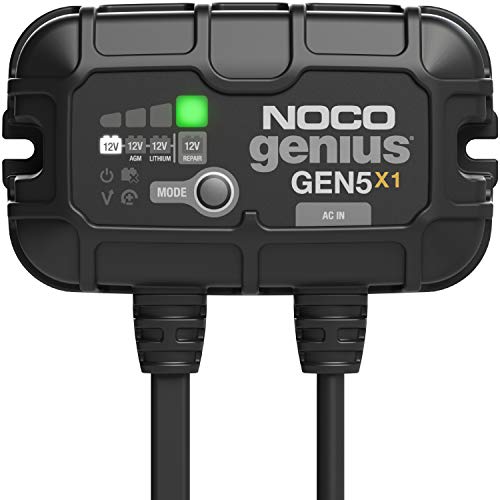
NOCO GEN5X1 12V 5A 1-Bank OnBoard Marine Battery Charger & Maintainer
The GEN5X1 is the charger for the simplest electrical system on the water: one 12-volt battery doing one job. That describes a lot of real boats — a jon boat with a transom-mount motor, a kayak with a small trolling setup, a skiff whose single deep-cycle battery runs the motor and nothing else, or any boat where the trolling battery stands alone and the cranking battery is the engine’s own concern. For those owners, a multi-bank charger is money spent on leads that will never be connected, and the GEN5X1’s appeal is that it refuses to sell you banks you do not have.
Five amps is the honest rate for this role. It will not refill a large, deeply drained battery in an hour, and it is not meant to. Plugged in when the boat comes off the trailer, it restores a typical day’s trolling draw overnight with room to spare, then settles into its maintainer role and holds the battery at full through the week. The title’s temperature compensation matters more than it might appear to: a battery in an unheated garage in January and the same battery in a sun-baked compartment in August do not want identical charging voltage, and compensation adjusts for that instead of applying one fixed number in all weather. Overcharge protection, also in the title, is the safeguard that lets you leave it plugged in without a mental note to go and unplug it.
The IP68 rating is the strongest sealing claim in this guide, and for a charger that will live in a bilge-adjacent compartment, get hosed down, and sit in humid air for years, sealing is not a garnish — it is the product. The dual-chemistry support in the title, lead-acid and lithium, gives the GEN5X1 a second life if the boat’s battery is later swapped for a LiFePO4 unit, which is a realistic upgrade path for exactly the small boats this charger suits.
Consider how this charger behaves across a full calendar, because single-battery boats are often the ones stored longest between outings. In spring it wakes a battery that sat through winter and brings it back gently rather than forcing a fast charge into a cold, rested cell. Through summer it works in short overnight sessions after each trip. In autumn it becomes the reason the battery enters storage full instead of half-discharged, which is the state that quietly shortens a lead-acid battery’s life over a single winter. That year-round maintainer role, backed by the temperature compensation in the title, is where a small charger like this earns back its cost — not in any single charge, but in the second and third season a well-kept battery delivers before replacement. Owners of cart-based battery systems will recognise the same logic from golf cart charging: small banks, kept full, outlast big banks left hungry.
Strengths
- IP68 waterproofing is stated in the title, the highest sealing figure among these six picks.
- Temperature compensation and overcharge protection are both named, supporting true fit-and-forget maintaining.
- Lead-acid and lithium support means a later battery upgrade does not orphan the charger.
Trade-offs
- One bank means one battery; adding a second battery later means replacing this unit, not extending it.
- Five amps is an overnight pace, so a big battery drained hard will still be charging at breakfast.
- The title states no charge-profile details beyond its protection list, so exotic battery types need a manual check first.
| Spec | From the listing title |
|---|---|
| Banks | 1 |
| Output | 12V, 5A |
| Sealing | IP68 waterproof |
| Chemistries | Lead-acid and lithium |
| Protections named | Overcharge protection, temperature compensation |
| Supported battery sizes | The listing title does not give a capacity range; confirm against NOCO’s own documentation for your battery |
Best for: a single-battery boat — jon boat, kayak or skiff — where the charger mounts once and maintains one 12-volt battery between trips.
Not suited for: a two-battery rig, because the second battery would need its own separate charger and its own outlet.
If one battery is your whole system, check the current price of the GEN5X1 on Amazon and measure your compartment before ordering.
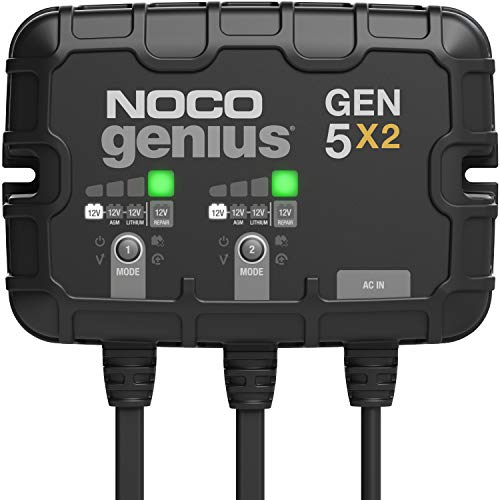
NOCO GEN5X2 12V 10A 2-Bank OnBoard Marine Battery Charger & Maintainer
Two batteries is the most common arrangement in recreational fishing: one deep-cycle battery for the trolling motor and one cranking battery for the outboard, or a pair of trolling batteries feeding a 24-volt motor. The GEN5X2 exists for that arrangement. Its two banks charge each battery on its own lead and its own programme, which matters because the two batteries live different lives — the trolling battery comes home deeply discharged while the cranking battery barely notices the day — and a single-output charger with a splitter would treat them as one battery and serve both badly.
The title gives ten amps total across the two banks, and the practical reading of that figure is an overnight charger rather than a pit-stop charger. Plugged in at the dock or in the driveway after a trip, it has the whole evening to undo the day’s draw on both batteries, and for the rhythm of weekend fishing that is the right pace. Like its single-bank sibling, it carries IP68 sealing, overcharge protection and temperature compensation, and it accepts both lead-acid and lithium batteries. That chemistry flexibility is worth pausing on for two-battery boats in transition: plenty of owners now run a lithium trolling battery beside a lead-acid cranking battery, because the cranking battery’s job suits lead-acid and the trolling battery’s weight suits lithium. A dual-chemistry two-bank charger is precisely the tool that mixed setup needs.
Mounting is the other half of the value. An onboard charger turns charging into a single plug at the stern instead of a ritual of opening compartments and clipping leads in the dark. Over a season, the charger that gets used after every trip — because using it costs ten seconds — preserves batteries that a better charger in a garage cupboard would not, simply because the cupboard charger gets skipped on tired evenings.
There is also a diagnostic benefit to two independent banks that rarely gets mentioned. When one battery in a pair starts failing — holding less charge, finishing its charge cycle suspiciously fast, running the trolling motor flat by midday — a two-bank charger makes the culprit visible, because each bank reports its own battery’s behaviour separately. With a single shared charger, both batteries blur into one average and the weak one hides until it strands you. Anglers who fish the same water weekly learn their batteries’ normal rhythms through the charger’s indicators: this bank is always done by midnight, that one runs an hour longer after windy days. When the rhythm changes, the battery is telling you something months before it fails outright, and catching that message early is the difference between replacing a battery in the driveway and losing a morning on the water.
Strengths
- Two independent banks suit the trolling-plus-cranking pairing that dominates small and mid-size fishing boats.
- Dual lead-acid and lithium support handles mixed-chemistry setups without a second charger.
- IP68 sealing, temperature compensation and overcharge protection all appear in the title.
Trade-offs
- Ten amps shared across two banks is an overnight rate, not a between-heats recovery rate.
- Boats that later move to a 36-volt trolling system will outgrow two banks entirely.
- The title does not break out a per-bank amp figure, so plan around the ten-amp total.
| Spec | From the listing title |
|---|---|
| Banks | 2 |
| Output | 12V, 10A total |
| Sealing | IP68 waterproof |
| Chemistries | Lead-acid and lithium |
| Protections named | Overcharge protection, temperature compensation |
| Per-bank output | The listing title gives only the combined figure; NOCO’s documentation is the place to confirm the split |
Best for: a two-battery fishing boat, including mixed setups with a lithium trolling battery beside a lead-acid cranking battery.
Not suited for: a 36-volt trolling system, which wires three batteries in series and needs a bank for each one.
Two-battery boats are this unit’s home ground — see the GEN5X2 listing on Amazon to confirm lead lengths against your compartment layout.
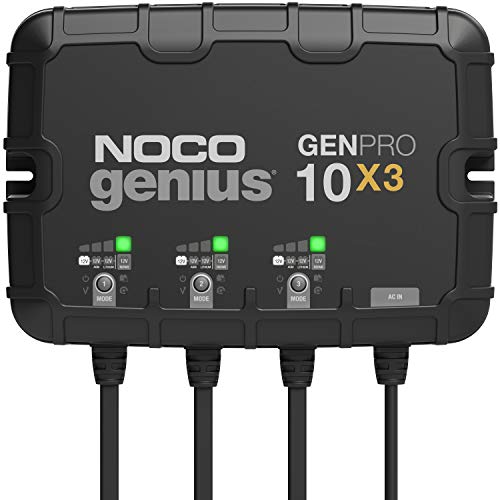
NOCO GENPRO10X3 12V 30A 3-Bank OnBoard Marine Battery Charger
The GENPRO10X3 is where this guide stops being about convenience and starts being about turnaround. Thirty amps across three banks is the configuration behind serious trolling systems: two batteries in series for a 24-volt motor plus a cranking battery, or three in series for a 36-volt motor with the cranking battery handled by the alternator. Either way, the boat comes home with multiple deeply worked batteries, and the angler’s question is not whether they will be full eventually but whether they will be full by tomorrow’s launch. That is the question the GENPRO’s output answers.
The name and the title together describe a ten-amp-class charger per bank scaled to three banks, and the supporting features carry over from the smaller NOCO units: IP68 sealing, overcharge protection, temperature compensation, and support for both lead-acid and lithium batteries. Consistency across the NOCO line is itself a practical benefit — an owner stepping up from a GEN5X2 to a GENPRO10X3 after a motor upgrade meets the same mounting logic, the same indicator language and the same maintenance behaviour, just with a third lead set and three times the total output.
Three banks also change the failure maths. On a multi-battery boat, the battery that gets undercharged is the battery that dies young, and it usually dies mid-season, taking a fishing day with it. A charger that gives every battery its own bank and its own full programme removes the quiet inequality of shared charging, where one battery’s appetite starves another. For a 36-volt system especially, where the three batteries must age together to perform together, equal and complete charging is not fussiness; it is how the set survives.
Owners comparing across brands at this size should also read our guide to Best Golf Cart Battery Chargers, because multi-bank charging logic transfers directly between big trolling systems and cart battery packs. And if the same household charges an electric car from the driveway where the boat parks, the Best Portable Level 2 Chargers guide covers the other end of that outlet.
Installation deserves a paragraph of its own at this size, because thirty amps of charging capacity arrives with three lead sets that all need sensible homes. Each bank’s leads should reach its battery without strain, without crossing hot or sharp surfaces, and without slack cable coiled in the bilge where it can chafe. Serious boats often dedicate a rigging tube or a loom path to exactly this, and the GENPRO rewards that planning every single trip: plug in one cord at the stern and three batteries begin their own programmes. Owners upgrading from a smaller charger sometimes ask whether the third bank can simply be left unwired on a two-battery boat; it can sit unused, but that is an argument for buying the two-bank model and spending the difference on batteries, not for carrying dormant capacity around the lake.
Strengths
- Thirty amps across three banks is the strongest total output in the NOCO half of this guide.
- Every battery in a 24V or 36V series set gets its own bank and its own complete charge cycle.
- IP68 sealing plus temperature compensation and overcharge protection carry over from the smaller GEN units.
Trade-offs
- A boat with only two batteries pays for a third bank that will sit capped and unused.
- Thirty-amp charging assumes the shore outlet and wiring at the dock are in decent shape.
- The title lists no dedicated lithium-only profile detail, so owners of large lithium banks should read the full listing closely.
| Spec | From the listing title |
|---|---|
| Banks | 3 |
| Output | 12V, 30A total |
| Sealing | IP68 waterproof |
| Chemistries | Lead-acid and lithium |
| Protections named | Overcharge protection, temperature compensation |
| Mounting hardware detail | The listing title does not describe the mounting kit; check NOCO’s documentation before planning the install |
Best for: a 24-volt or 36-volt trolling system whose batteries must all be full again by the next morning.
Not suited for: a simple one- or two-battery boat, where the third bank and the thirty-amp appetite are pure surplus.
For three-battery rigs that fish consecutive days, look at the GENPRO10X3 on Amazon and check the physical footprint against your battery compartment.

Minn Kota Precision MK-220PCL 2-Bank Charger
Minn Kota builds trolling motors, so its Precision chargers arrive with a maker’s understanding of how trolling batteries are actually treated: run hard for hours, charged overnight, and expected to do it again tomorrow. The MK-220PCL’s headline fact is stated plainly in its title — two banks, ten amps each. That “each” is the distinction worth paying for. Where a total-output figure leaves you wondering how the charger divides its attention, ten amps per bank means the deeply drained trolling battery and the lightly used cranking battery each receive the full rate simultaneously, and the pair finishes together instead of in sequence.
For a two-battery boat that fishes long days, that per-bank rate changes the evening arithmetic. A big deep-cycle battery that gave up most of its charge to a windy day on the water has a genuine refill job ahead of it, and ten amps is a meaningfully faster refill than the five-amp class. The Precision name also signals the charger’s intent: these are built as permanent onboard fixtures for fishing boats, sized and styled to live beside the batteries they serve, in the same ecosystem as the motors Minn Kota sells. Owners already running a Minn Kota motor often prefer the charger’s indicators and behaviour to speak the same design language as the rest of their boat, and there is a real, if unglamorous, value in one brand’s documentation covering the whole electrical corner of the boat.
What the title does not state is equally worth noting. It names no waterproof rating and no chemistry list, so this review does not invent either. Minn Kota’s own documentation is where a buyer confirms sealing and battery-type support before purchase, and the honest summary is that the MK-220PCL’s title sells one thing loudly — per-bank power — and leaves the supporting details to the product page.
Think about who fishes a two-battery boat hardest: the weekend angler who launches before dawn, fishes through a windy afternoon that keeps the trolling motor working against the current, and trailers home at dusk with both batteries genuinely tired. That pattern is the MK-220PCL’s design centre. The cranking battery has started the outboard a dozen times and fed the fishfinder all day; the trolling battery has given up the deep part of its charge. Ten amps into each, starting the moment the shore cord connects, means both are honestly full by the small hours — not nearly full, not full-enough, but rested at a complete charge, which is the state lead-acid batteries need to live long. Repeat that cycle across a season and the per-bank rate stops looking like a luxury and starts looking like battery insurance bought once.
Strengths
- Ten amps per bank, stated in the title, means both batteries charge at full rate at the same time.
- Comes from a trolling-motor maker, so its design assumptions match how fishing boats are actually used.
- Two banks fit the standard trolling-plus-cranking layout without paying for unused capacity.
Trade-offs
- The title states no waterproof rating, so sealing must be confirmed on the full listing before a wet-compartment install.
- The title names no supported chemistries, which matters if a lithium conversion is on your horizon.
- Two banks cap the boat at two batteries; a future 36-volt upgrade replaces this charger outright.
| Spec | From the listing title |
|---|---|
| Banks | 2 |
| Output | 10 amps per bank |
| Brand line | Minn Kota Precision, on-board marine charger |
| Sealing | The listing title gives no IP rating; Minn Kota’s product documentation is the place to verify it |
| Chemistries | Not spelled out in the listing title — check the full product page against your battery type |
| Total output | 20A combined, derived from the stated two banks at ten amps each |
Best for: a two-battery fishing boat that fishes long days and needs both batteries genuinely refilled overnight, not merely topped up.
Not suited for: a lithium-only refit planned this season, unless the full listing confirms lithium support in writing first.
If per-bank pace is your priority in a two-bank hull, read the MK-220PCL details on Amazon before deciding.

Minn Kota Precision MK-440PCL 4-Bank Charger
Four banks is the top of this guide, and it serves a specific, recognisable boat: a 36-volt trolling motor drawing on three batteries in series, plus a cranking battery that also runs the electronics, livewell pumps and lights. That is the standard electrical layout of a serious bass or walleye boat, and it is a layout that punishes partial charging. Three series batteries must stay in balance to deliver their rated performance, and the fourth battery lives a completely different life from the other three. The MK-440PCL gives each of them its own bank at a title-stated ten amps each, which is the correct answer to that layout in a single mounted box.
Forty combined amps reframes what overnight means. A tournament angler who pre-fishes Friday, competes Saturday and competes again Sunday is asking four batteries to empty and refill twice in one weekend, and the charger is the pacing item in that schedule. Ten amps per bank, delivered simultaneously rather than shared, is what makes the schedule boring — and boring is exactly what you want from charging during a tournament weekend. The Precision line’s onboard format also matters at this scale: hand-carrying a four-bank charging job with portable units and clip leads, four times a weekend, is how connections get rushed, reversed or left off entirely.
The same title silences noted for its two-bank sibling apply here: no waterproof rating and no chemistry list appear in the title, so both belong on the buyer’s confirm-before-ordering list, checked against Minn Kota’s documentation and the batteries actually installed. At this end of the market the charger is also a semi-permanent installation decision — four lead sets to route, four batteries to reach — so an hour spent measuring the compartment and planning cable runs pays for itself the first season.
Balance deserves emphasis for the three series batteries, because a series string is only as strong as its weakest member at any moment. If one battery in the string habitually receives a slightly lesser charge — because it shared a bank, or because its connections corroded first — the whole string’s usable capacity shrinks toward that battery’s level, and the trolling motor’s top-end performance fades in a way owners often blame on the motor. A dedicated bank per battery, each running a complete programme, is the structural fix: every member of the string starts each day from the same full line. The fourth bank then handles the cranking battery’s separate rhythm without borrowing attention from the string. That is the engineering story behind the MK-440PCL’s spec sheet, and it is why four-bank chargers exist as a category rather than as two two-bank chargers bolted together.
Strengths
- Four banks at a stated ten amps each cover a 36V trolling set and a cranking battery in one unit.
- Simultaneous full-rate charging keeps series batteries balanced and tournament weekends on schedule.
- One mounted charger replaces the clip-lead ritual across four batteries after every trip.
Trade-offs
- It is the largest commitment in this guide: boats with fewer than four batteries waste banks and money.
- No sealing or chemistry figures appear in the title, so both need confirming for your exact installation.
- Four lead sets demand a roomy, well-planned battery compartment; tight compartments make routing a chore.
| Spec | From the listing title |
|---|---|
| Banks | 4 |
| Output | 10 amps per bank |
| Brand line | Minn Kota Precision, on-board marine charger |
| Sealing | The listing title lists no IP figure; verify the rating in Minn Kota’s documentation for your compartment |
| Chemistries | The listing title stays silent here — confirm support for your installed batteries on the product page |
| Total output | 40A combined, from the stated four banks at ten amps each |
Best for: a four-battery tournament or guide boat running a 36-volt trolling motor plus a house and cranking load.
Not suited for: a two-battery boat, where half this charger’s banks would never be connected to anything.
Four-battery owners comparing flagships can examine the MK-440PCL listing on Amazon for dimensions and lead configuration.
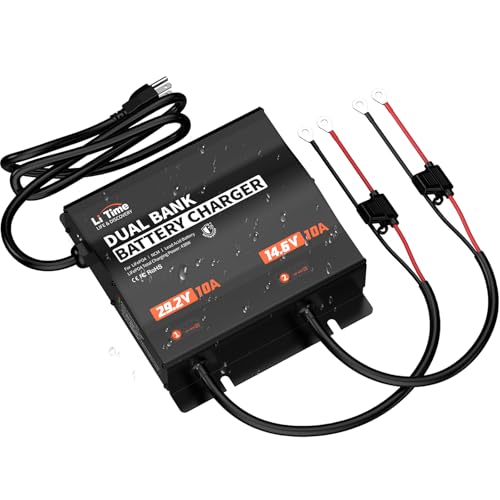
LiTime 2-Bank 12V/24V Lithium Battery Charger
Every other pick in this guide treats lithium as one chemistry among several. The LiTime charger treats it as the only chemistry that exists, and for a boat that has already converted to LiFePO4, that focus is the point. Its title is unusually specific: a two-bank charger for 12.8-volt and 25.6-volt lithium iron phosphate batteries, with adjustable voltage and an LED indicator, sealed to IP65. The 25.6-volt figure is the headline. A 24-volt trolling system built from lithium batteries wired in series presents the charger with a single higher-voltage bank, and most 12-volt onboard chargers simply cannot address it. This one can, which makes it the only pick in the guide suited to a series-wired lithium trolling setup as a whole-bank charge.
The two-bank structure pairs naturally with the common lithium layouts: a 12.8-volt cranking or house battery on one bank and a 25.6-volt trolling bank on the other, or two independent 12-volt lithium batteries charged separately. Adjustable voltage, named in the title, is the control that lets the charger match those different configurations instead of forcing one profile on both. The LED indicator covers the everyday question — is it charging, is it done — without an app or a screen, which on a boat is a virtue. IP65 sealing sits a step below the NOCO units’ IP68 on paper: resistant to water jets and spray rather than rated for immersion, adequate for a mounted position in a typical battery compartment that sees spray and washdowns rather than standing water.
The discipline this charger demands is honesty about your batteries. It is a lithium-only tool. The lead-acid cranking battery still fitted to many partly converted boats is outside its brief, and owners mid-conversion — lithium for trolling, lead-acid for cranking — are better served by a dual-chemistry pick from the NOCO or Minn Kota sections above. Owners whose conversion is complete, though, get a charger whose entire design, voltage range and charging behaviour assume exactly the batteries they own, and the smart charging behaviour the title mentions is tuned for LiFePO4 rather than adapted to it.
Charging topics travel together in a household: the same reader refitting a boat often maintains yard equipment on battery platforms, which is why our Best Outdoor Power Tool Battery Packs and Chargers guide sits alongside this one.
Weight is the quiet reason lithium conversions happen on trolling boats, and it shapes how this charger gets used. A LiFePO4 battery can weigh half what the lead-acid battery it replaces weighed, which tempts owners to carry a spare or to upsize capacity. Bigger lithium banks hold more energy and therefore ask more of the charger across a full refill; ten amps into a large bank is a long, steady session rather than a quick top-up. That is acceptable in the overnight rhythm most trailer boats live by, and lithium’s tolerance for partial charging softens the rest — a lithium bank does not demand to be filled completely after every outing the way lead-acid does. The LiTime’s smart charging and adjustable voltage suit that relaxed pattern: set the bank configuration correctly once, then let each session run as long as the boat sits plugged in.
Strengths
- Charges both 12.8V and 25.6V LiFePO4 banks, covering series-wired 24V lithium trolling systems.
- Adjustable voltage lets the two banks be configured for different lithium layouts.
- IP65 sealing and an LED charge indicator suit a permanently mounted position in a working boat.
Trade-offs
- Lithium only: lead-acid or AGM batteries anywhere in the system need a different charger.
- IP65 is a spray rating, a step below the IP68 immersion rating on the NOCO picks.
- Ten amps total is a moderate pace for very large lithium banks drained to empty.
| Spec | From the listing title |
|---|---|
| Banks | 2 |
| Output | 10A, AC-DC |
| Voltages | 12V and 24V systems; 12.8V / 25.6V LiFePO4 |
| Sealing | IP65 waterproof |
| Controls named | Adjustable voltage, LED indicator, smart charging |
| Lead-acid support | The listing title describes a lithium charger only; treat lead-acid as out of scope unless LiTime’s documentation says otherwise |
Best for: a fully lithium-converted boat, especially one running a 24-volt series LiFePO4 trolling bank.
Not suited for: a mixed boat still cranking on lead-acid, because that battery falls outside this charger’s chemistry entirely.
Lithium converts can check the LiTime two-bank charger on Amazon and match its voltage settings against their bank configuration.
Side-by-Side Comparison
| Charger | Banks | Output | Sealing | Chemistry | Best matched boat |
|---|---|---|---|---|---|
| NOCO GEN5X1 | 1 | 12V, 5A | IP68 | Lead-acid and lithium | Single-battery jon boat or kayak |
| NOCO GEN5X2 | 2 | 12V, 10A total | IP68 | Lead-acid and lithium | Two-battery fishing boat |
| NOCO GENPRO10X3 | 3 | 12V, 30A total | IP68 | Lead-acid and lithium | 24V or 36V trolling system |
| Minn Kota MK-220PCL | 2 | 10A per bank | Not stated in title | Not stated in title | Long-day two-battery boat |
| Minn Kota MK-440PCL | 4 | 10A per bank | Not stated in title | Not stated in title | Four-battery tournament boat |
| LiTime 2-Bank | 2 | 10A | IP65 | LiFePO4 only, 12.8V / 25.6V | Lithium-converted boat |
How Do You Choose the Right Onboard Charger?
Start by counting batteries, not by reading amp numbers. Every battery in the boat that you expect the charger to maintain needs its own bank, so a three-battery boat with a two-bank charger has a problem that no amount of amperage fixes: one battery gets rotated, neglected or paralleled into a compromise. Count the trolling batteries, add the cranking battery if you want it maintained too — and you should, because cranking batteries die of neglect as reliably as trolling batteries die of use — and let that total pick your bank count from the table above.
Next, settle the chemistry question honestly. If every battery is lead-acid or AGM today and a lithium swap is years away, any dual-chemistry pick serves you. If a lithium trolling battery is already in the boat or arriving this season, dual-chemistry support stops being a bonus and becomes the requirement — or, if the whole boat has converted, the LiTime’s lithium-only focus and 24-volt reach become the more precise tool. What you must not do is charge a lithium battery on a charger whose title never mentions lithium and hope the voltages happen to agree.
Then judge amperage against your calendar rather than your battery size alone. A boat that fishes Saturdays and sits all week can thrive on five amps per battery; the week does the work. A boat that fishes consecutive days, or a guide boat that fishes daily, needs the per-bank pace of the Minn Kota units or the GENPRO’s thirty-amp total, because its batteries must be full by a fixed hour tomorrow. Finally, look at the compartment the charger will live in. A wet, cramped, washdown-exposed space argues for the IP68 NOCO housings; a dry, covered compartment relaxes that demand. Measure the mounting footprint and lead reach before ordering — onboard chargers fail to fit more often than they fail to charge.
Onboard Versus Portable: Why Mounting Changes Behaviour
The technical case for onboard chargers is sealing, per-bank wiring and correct profiles. The behavioural case is stronger. A portable charger lives in the garage, and using it means fetching it, opening compartments, clipping leads onto the right terminals in the right order, and remembering to remove it before trailering. Each step is a small tax, and taxes get skipped on the evenings when the angler is tired, the weather is turning or the boat came off the water late. The skipped sessions accumulate into chronically undercharged batteries, and chronic undercharging is the leading cause of premature deep-cycle battery death — not age, not brand, not luck.
An onboard charger reduces the ritual to plugging in one cord. That single change converts charging from a project into a habit, and habits are what batteries actually live on. It also removes the portable unit’s worst failure mode, the reversed or slipping clip on a battery terminal in a dark compartment. The trade is real: an onboard charger serves one boat, costs more than a basic portable, and asks for an hour of installation. For a trailer boat used weekly, the trade favours mounting almost every time. The portable charger still earns its place for winter storage in a removed-battery garage setup, for a second boat, or for the owner whose boat lives on a lift without power nearby — situations where the charging happens somewhere the boat is not.
Shore Power Habits That Make Any of These Chargers Work Better
The charger is only the middle of the chain; the outlet and the cord complete it. Boats kept on trailers at home have the easiest version of this — a garage outlet, a short run, a dry connection. Boats in marina slips inherit whatever the dock provides, and dock power deserves a sceptical look before a thirty-amp charger gets plugged into it: corroded pedestal outlets, long shared runs and tripped breakers all turn a capable charger into an idle one. Whatever the setting, the connection point between the boat’s inlet and the shore cord is the spot weather attacks first, so keep it clean, dry and strain-relieved, and glance at the charger’s indicators when you plug in rather than assuming the session started. That ten-second glance is the cheapest diagnostic in boating: a charger that never began charging looks exactly like a charger that finished, right up until the morning the motor runs weak an hour into the day.
Routine matters at the battery end too. Terminals grow corrosion in marine air whether the boat is used or not, and a charger pushing current through a furred, loose connection wastes its effort as heat and reads the battery’s state through a fog. A wire brush, tightened clamps and a smear of protection once or twice a season keep every pick in this guide honest. None of this is glamorous, and all of it decides whether the spec sheet you paid for shows up on the water.
Reading Charge Time Honestly: Amps, Capacity and the Overnight Test
Charge time questions cause more disappointment in this category than any defect does, usually because the arithmetic gets done with hope instead of numbers. The plain version: a battery that gave up sixty amp-hours to a day of trolling needs at least sixty amp-hours returned, plus a margin for charging inefficiency, before it is full. At five amps that is an overnight project; at ten amps per bank it is an evening. Neither figure is a flaw. The flaw is buying the five-amp charger for a calendar that only allows four hours between trips, then blaming the charger when the battery fades by the second morning.
Two habits make the arithmetic kinder. First, charge immediately after the trip rather than the night before the next one; batteries restored promptly and then maintained age far better than batteries left discharged for days, and the charger gets the maximum hours to work with. Second, respect the taper: every smart charger slows its delivery as the battery approaches full, so the last portion of a charge always takes disproportionately long. A battery that reads nearly full at bedtime is not being cheated by its charger; it is in the careful final stage that protects it. Plan around the taper by plugging in early, and the overnight test — everything full, rested and ready at launch time — passes without drama on any pick in this guide sized correctly to its boat.
Common Mistakes When Buying and Fitting a Marine Charger
Buying by total amps without asking how they divide is the most frequent error. A headline figure shared across banks behaves very differently from the same figure delivered per bank, and the two Minn Kota titles in this guide state “per bank” precisely because the distinction decides whether your batteries finish together. Read every multi-bank listing for that phrase before comparing prices across brands.
Under-buying banks is the second error, and it usually comes from optimism: the cranking battery gets left off the charger because the alternator “handles it.” Alternators replace starting charge; they do not maintain a battery through weeks of sitting with pumps, electronics and parasitic draws nibbling at it. If the boat has four batteries, the charger should have four banks, or the fourth battery should have its own maintainer — one of the two, but never nothing.
Third, owners mount chargers where they fit rather than where they breathe. Chargers shed heat while working, and a sealed compartment in summer sun is already a hard place to shed it. Follow the maker’s clearance guidance, keep leads routed away from fuel lines and sharp edges, and never let a charger’s leads cross a bilge full of standing water on their way to the batteries. Fourth, mixing chemistries on a charger that does not support both — or setting a dual-chemistry charger to the wrong profile — quietly shortens battery life in ways that only show up a season later. Set the profile per bank where the charger allows it, and re-check it after any battery swap.
Frequently Asked Questions
Can one charger maintain both my trolling and cranking batteries?
Yes, provided it has at least two banks. Each bank wires to one battery and runs its own charge programme, so the deeply discharged trolling battery and the lightly used cranking battery each get what they need. The GEN5X2, MK-220PCL and LiTime in this guide are all two-bank answers to exactly that question, differing in chemistry support and pace.
Is five amps enough for a trolling motor battery?
For a single battery charged overnight between weekend trips, yes. Five amps restores a typical day’s trolling draw across an evening and a night, then maintains the battery for the rest of the week. It becomes the wrong answer when the battery is very large, deeply drained, or needed again within a few hours — the situations the ten-amp-per-bank picks exist for.
Do I need a special charger for lithium boat batteries?
You need a charger whose title or documentation explicitly supports lithium, because LiFePO4 batteries want a different charge profile from lead-acid. The NOCO picks here list lithium support in their titles; the LiTime is lithium-only and additionally covers 24-volt series banks. Charging lithium on a lead-acid-only charger is the expensive shortcut this category most regrets.
What does the IP rating on a marine charger actually tell me?
It describes the housing’s resistance to dust and water as tested. IP68, claimed by the NOCO picks, is the stronger rating and covers immersion; IP65, claimed by the LiTime, covers water jets and spray. Neither rating excuses mounting a charger in standing bilge water, but for compartments that see spray, washdowns and humid air, a stated rating beats an unstated one.
Can I leave an onboard charger plugged in all winter?
That is what the maintainer function and overcharge protection are for, and the NOCO titles name overcharge protection explicitly. A battery held at full charge through storage, with temperature compensation adjusting for a cold garage, comes out of winter in far better shape than one left to self-discharge for four months. Check on it occasionally, keep the compartment ventilated, and confirm the charger is set to the right chemistry before the long plug-in.
Why does my series-wired 24V lithium bank need a 24V-capable charger?
Because wired in series, the two batteries present themselves to the charger as one 25.6-volt bank. A 12-volt charger connected across the whole bank cannot charge it correctly; the alternatives are charging each battery separately with a per-battery bank, or using a charger — like the LiTime pick — whose title lists 25.6V support and can address the bank as a whole.
Should I replace a working portable charger with an onboard one?
If the boat fishes weekly and the portable routine gets skipped even occasionally, yes — the skipped sessions cost more battery life than the onboard unit costs money. If the boat fishes a few times a year and the batteries come home for storage anyway, a portable charger used faithfully does the same chemistry. The honest dividing line is your own follow-through, not the chargers.
Final Recommendation
Match banks to batteries, chemistry to chemistry, and amps to your calendar, and every charger in this guide will do its job for years. For most two-battery fishing boats, the NOCO GEN5X2 is the balanced default: sealed, dual-chemistry, and sized for overnight rhythm. Boats that fish consecutive days should step up to the Minn Kota MK-220PCL’s ten amps per bank, four-battery rigs to the MK-440PCL, and 36-volt NOCO loyalists to the GENPRO10X3. Single-battery boats lose nothing with the GEN5X1, and fully converted lithium boats — especially 24-volt ones — are the LiTime’s clear home. Buy the charger your next battery upgrade still fits, not merely the one today’s batteries accept, and the compartment you wire this spring will still be right three seasons from now.
Related Guides
- Best Portable Level 2 Chargers
- Best Outdoor Power Tool Battery Packs and Chargers
- Best Golf Cart Battery Chargers


