What's inside
- Key Takeaways
- Quick Picks
- How These Power Banks Were Chosen
- The Six Power Banks in Detail
- Side-by-Side Comparison
- What Does 5,000mAh Actually Deliver? Reading Capacity Honestly
- Magnetic Versus Cable: Choosing Your Ritual
- The Case Question: What Your Phone Wears Changes What Your Bank Can Do
- Where Slim Banks Live: A Placement Strategy
- Common Mistakes When Buying a Slim Power Bank
- Frequently Asked Questions
- Final Recommendation
- Related Guides
As an Amazon Associate I earn from qualifying purchases. This post may contain affiliate links at no extra cost to you.
widgetverdict.com is reader-supported. When you buy through links on our site, we may earn an affiliate commission.
Where to buy: all six power banks below link to checked Amazon listings, starting with the Anker Nano Magnetic Power Bank 5000mAh Qi2, the thinnest pick in this guide at a stated 0.34 inches. Four picks are Anker units spanning both capacity classes, joined by a two-pack value option and a credit-card-sized bank with its cable built in.
The best slim portable chargers are bought for a specific failure of ordinary power banks: the brick that stays home. A standard 10,000mAh bank is a fine object until it has to share a trouser pocket with a phone, ride in a jacket through an evening, or disappear into a small bag already full of the day’s necessities. Slim changes the carrying equation rather than the charging one — a bank thin enough to be forgotten is a bank that is actually there at 4 p.m. when the phone hits its last fifth of battery, in the airport, at the conference, on the walk home. That is the whole thesis of this category: capacity you carry beats capacity you own.
The six picks split along the two decisions that define a slim bank. The first is attachment: three Anker picks are magnetic, snapping to the back of a MagSafe-compatible iPhone and charging wirelessly at Qi2 speeds, while the other three charge by cable — one with the cable built into the body, eliminating the category’s most-forgotten accessory. The second decision is capacity: 5,000mAh banks are the true pocket class, sized for a rescue rather than a weekend, while the 10,000mAh picks trade a little thickness for the ability to refill a phone completely and still have something left. Every pick here stays inside the slim brief — none is a rugged brick, a laptop bank or a camping reservoir — and the reviews judge them on that brief: thinness, carry, and honest delivery of the capacity printed on the box.
Key Takeaways
- Three Anker magnetic picks charge at Qi2 15W where stated — the wireless speed that finally matches a cable for top-ups.
- The Anker Nano is the thinnest bank here at a stated 0.34 inches, with a 5,000mAh capacity sized for daily rescue.
- 10,000mAh is the full-refill class: the MagGo Qi2, the Anker 30W wired bank and the Miady two-pack all live there.
- The TNTOR’s built-in cable removes the forgotten-cable failure entirely, in a body its title calls credit card size.
- The Miady two-pack — one black, one white, 37Wh and flight-safe per its title — is the household and travel value play.
- Magnetic banks suit iPhone owners; cable banks serve everyone, including Android phones without magnetic rings.
Quick Picks
| Pick | Badge | Why it earns its place |
|---|---|---|
| Anker Nano Magnetic Power Bank 5000mAh Qi2 | The slimmest snap-on | Qi2-certified 15W magnetic charging in a 0.34-inch body — the bank that vanishes against the phone. |
| Anker 621 MagGo Power Bank 5000mAh | The magnetic classic | The established MagGo snap-on bank for iPhone 12 through 16, with a USB-C cable in the box. |
| Anker MagGo Power Bank Qi2 10000mAh | The magnetic full refill | 10,000mAh with Qi2 15W in a slim ergonomic body — a complete phone refill without a cable. |
| Anker Power Bank 10,000mAh 30W (USB-C) | The wired all-rounder | 30W over USB-C in and out, serving iPhones and Galaxy phones alike at cable speed. |
| Miady 2-Pack Portable Charger, Slim 10000mAh Power Bank | The two-pack value | Two slim 10,000mAh banks — black and white — with three outputs and flight-safe 37Wh sizing. |
| TNTOR Thin USB-C Portable Charger with Built-in Cable | The wallet-sized rescue | Credit-card-size body with the cable built in — the bank that needs nothing else in the pocket. |
How These Power Banks Were Chosen
Slimness was the entry ticket, judged by each title’s own language: a stated thickness figure, a slim or thin designation, a credit-card comparison. Banks that were merely ordinary were excluded however good their specifications, because this guide’s promise is carry. Within the slim field, the picks were spread across the category’s real variety — magnetic and wired, 5,000 and 10,000mAh, single banks and a two-pack, a bank with its cable built in — so that the comparison answers the questions buyers actually bring: snap or plug, rescue or refill, one or two.
Specification honesty shaped the second cut. Qi2 certification is stated for two Anker picks and means something precise — the magnetic wireless standard that delivers 15W to compatible iPhones — so those picks are described in those terms, while the older magnetic pick, whose title predates the Qi2 language, is described as magnetic without a wattage this guide cannot source from its title. Wired output is quoted where stated: 30W on the Anker wired bank. Capacity is quoted as printed, and the reviews discuss what those milliamp-hour figures mean in delivered phone charges without inventing test results. Where a title is silent — the TNTOR states no capacity figure at all — the review says so plainly and judges the pick on the attribute its title does state: the built-in cable in a credit-card body.
Finally, the set was checked for household logic. Slim banks are bought in multiples and scattered — one in a work bag, one in a car, one in a partner’s coat — and the Miady two-pack’s presence acknowledges that pattern directly. The Anker concentration reflects the brand’s grip on this category’s magnetic end; the TNTOR and Miady picks keep the guide honest at the value end, where slim banks are bought as infrastructure rather than as objects of desire.
The Six Power Banks in Detail

Anker Nano Magnetic Power Bank 5000mAh Qi2
The Nano is the purest expression of this guide’s thesis: a magnetic power bank whose title leads with its thinness — 0.34 inches — and pairs it with Qi2-certified 15W wireless charging and a 5,000mAh capacity. A third of an inch is the dimension that changes behaviour. Snapped to the back of a compatible iPhone, the Nano reads as a slightly thicker phone rather than a phone with luggage; in a pocket, the combined unit still slides; in a small bag, it takes the space of a card wallet. Banks thicker than this get carried deliberately. This one gets carried by default, which is the entire game in the rescue-charger category.
Qi2 certification is the second half of the proposition, and it is worth understanding what it buys. Qi2 is the magnetic wireless charging standard built with the alignment discipline of Apple’s MagSafe ecosystem, and its 15W delivery is double the trickle that made early magnetic banks feel like emergency-only devices. At 15W, a snapped-on top-up during a commute or a coffee genuinely moves the battery needle rather than merely slowing its fall — the difference between a bank that rescues an evening and a bank that extends it by an hour of anxiety. The title names compatibility with the iPhone Pro Max series at the top of Apple’s range, the largest and hungriest phones, which tells you the bank was specced against serious appetites rather than small ones.
Capacity is where expectations must be set honestly. Five thousand milliamp-hours printed on a wireless bank delivers meaningfully less than that into the phone — wireless charging spends energy on the transfer itself, and conversion losses apply to every bank in this guide. The Nano’s honest job description is one substantial rescue: taking a fading phone back to comfort, not refilling it from empty twice. Owners who understand that job buy the perfect tool; owners who expect a weekend from 5,000mAh should step up to the 10,000mAh picks below and accept their extra thickness as the price of the second refill.
The Nano also represents the category’s direction of travel. As phones themselves resist getting thinner batteries, the accessory that restores carry-ability is the one that adds the least — and a Qi2 bank at a third of an inch is close to the physical floor of the idea. If your daily failure mode is a phone dying at dinner rather than on a hike, this is the pick the guide was written around.
Consider the Nano against the clothing it was designed for. Summer is the slim bank’s true season: no coat pockets, no bag by default, a phone and a bank sharing the pocket of shorts or a light dress’s clutch. Every other pick in this guide asks something of summer clothing; the Nano asks the least, and for owners whose social and working lives peak in the warm months — festivals, weddings, long evenings outside — that least-ness is the deciding specification. It is also the bank most likely to be lent and lost, being small, black and universally useful, so owners with form for generosity should buy it with a household rule attached: the Nano lives in one named pocket, and lending it happens at the table, not across the room.
Strengths
- 0.34-inch thickness stated in the title — the slimmest bank here, disappearing against the phone or in a pocket.
- Qi2-certified 15W magnetic charging doubles the pace of older magnetic banks.
- Specced in its title against Apple’s largest Pro Max phones, not just compact models.
Trade-offs
- 5,000mAh is a rescue capacity: one substantial top-up, not a full weekend of refills.
- Magnetic wireless charging serves MagSafe-compatible iPhones; Android owners should look at the wired picks.
- Wireless transfer loses energy as heat, so delivered capacity trails the printed figure, as with all wireless banks.
| Spec | From the listing title |
|---|---|
| Capacity | 5,000mAh |
| Thickness | 0.34 in |
| Charging | Qi2-certified 15W magnetic wireless, MagSafe-compatible |
| Compatibility | iPhone Pro Max series and more, per the title |
| Colour | Black |
| Wired output | The listing title leads with wireless; the product page details any wired port behaviour |
Best for: an iPhone owner whose phone fades by evening and whose pockets refuse to carry a brick.
Not suited for: a multi-day trip away from outlets, where 5,000mAh of rescue capacity runs out on the first evening.
Pocket-first buyers can check the Anker Nano Qi2 bank on Amazon and compare its thickness against the phone it will ride on.
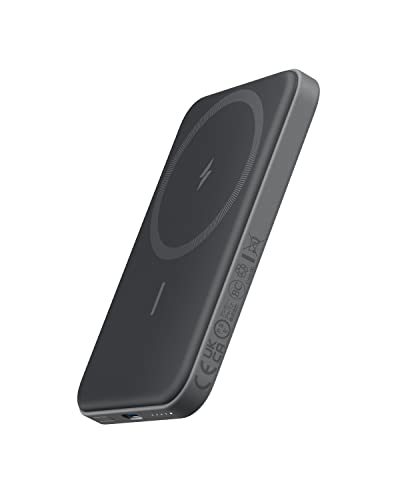
Anker 621 MagGo Power Bank 5000mAh
The 621 MagGo is the magnetic bank that taught the market the snap-on habit, and its title reflects its elder-statesman status: a 5,000mAh magnetic portable charger in black, described as a travel essential, supplied with a USB-C cable, and compatible with the iPhone 12 through 16 series. That compatibility span is the review in miniature — five generations of iPhones magnetically served by one small bank — and it explains why this model remains the default recommendation for households whose phones span several years of Apple’s range. A family with a 13 in one pocket and a 16 in another carries one bank for both.
What the title does not state is a wireless wattage, and this review will not assign one. The 621 predates the Qi2 language that the newer Anker picks carry, and the honest positioning follows from that: this is the established magnetic bank, bought for its snap, its size and its provenance, while buyers for whom wireless pace is the headline should compare it directly against the Qi2-certified Nano above and MagGo 10,000 below, whose titles state their 15W figures in writing. There is no shame in the older bank’s position — magnetic charging’s core convenience, the cable-free snap, is fully present — but this guide prices claims by what titles state, and the 621’s title states compatibility and capacity rather than speed.
The included USB-C cable covers the bank’s own refilling and gives the unit a wired life as well — charging the bank from a wall adapter, and serving as the household’s spare cable in a pinch. As a travel essential, which is the title’s own phrase, the 621’s virtues compound: it is small enough to be the bank that lives in the carry-on’s front pocket, familiar enough that family members borrow it without instructions, and proven enough that its behaviour at 30,000 feet and in foreign hotel rooms is a known quantity. Slim-bank buyers rarely need novelty; they need the bank that is simply there, and the 621 is the category’s most travelled answer to that need.
Owners assembling a full travel-charging kit — banks, wall chargers and the cables between — will find the boat-and-battery side of portable power in our Best Trolling Motor Battery Chargers guide, where the same carry-versus-capacity trade governs much larger batteries.
The 621 also quietly serves as the category’s hand-me-down champion. Magnetic banks pass between family members as phones upgrade — the bank that served a parent’s 12 serves a teenager’s 14 two years later — and a model whose compatibility spans five iPhone generations is built for exactly that circulation. Its lack of a stated wattage matters less with each hand it passes through, because the job it inherits is always the same modest rescue, and its proven design means the second and third owners inherit reliability rather than novelty. In a guide that prices claims carefully, there is room to honour a pick whose claim is simply that it has been doing this, successfully, longer than the others.
Strengths
- Compatibility across iPhone 12–16 series makes it the one bank for multi-generation households.
- The established MagGo design — the snap-on format’s reference unit, with a USB-C cable included.
- 5,000mAh in a travel-essential format that lives in a carry-on pocket permanently.
Trade-offs
- No wireless wattage is stated in the title, so pace-focused buyers should compare the Qi2 picks.
- 5,000mAh is rescue capacity, with the same one-top-up honesty as the Nano.
- Magnetic alignment serves iPhones with MagSafe; cased or non-magnetic phones need the wired picks.
| Spec | From the listing title |
|---|---|
| Capacity | 5,000mAh |
| Charging | Magnetic wireless; wattage not stated in the title |
| Compatibility | iPhone 16 / 15 / 14 / 13 / 12 series |
| Included | USB-C cable |
| Colour | Black |
| Wireless standard | The listing title does not claim Qi2; Anker’s product page carries the charging specification in full |
Best for: a household with iPhones from several generations that wants one proven magnetic bank to share.
Not suited for: a pocket where certified 15W wireless pace is the first priority, which the Qi2-stated picks claim in writing.
For the classic snap-on, see the Anker 621 MagGo on Amazon and check your iPhone’s generation against its list.

Anker MagGo Power Bank Qi2 10000mAh
This MagGo is the magnetic line grown up: 10,000mAh of capacity, Qi2-certified 15W charging, a slim body with an ergonomic design per its title, and compatibility across the iPhone 14 through 17 series. The combination resolves the magnetic category’s founding compromise. The 5,000mAh banks are slim enough to forget but sized for rescue; this bank doubles the reservoir while keeping the snap-on, cable-free ritual and a body its maker still describes as slim — the full-refill magnetic bank, able to return a depleted iPhone to full and still hold a margin for the evening.
Ergonomics is the title word that separates this pick from a spec-sheet exercise. A 10,000mAh magnetic bank spends its working life attached to a phone that is itself being held, texted on and photographed with, and its shape decides whether that combined unit is a pleasure or a slab. Anker’s ergonomic framing acknowledges the hand’s verdict: edges, weight distribution and grip matter at this capacity, because the bank that feels wrong gets detached, and a detached wireless bank is just a battery in a bag. Buyers comparing magnetic banks at this size should weigh the in-hand hour, not just the milliamp-hours — the review’s judgement is that this pick was designed by people who understood the assignment.
The Qi2 15W figure, stated as certified, keeps the refill honest at wireless speeds that respect the capacity: a big reservoir behind a slow tap is a frustration, and 15W is the tap size that makes 10,000mAh usable across a day of top-ups rather than only overnight. For travel, this is the magnetic bank that replaces both the rescue bank and the wired bank in the carry-on — one object, snapped on for the flight, the conference and the walk back to the hotel, refilling itself from any USB-C source at night. It is the least compromising pick in this guide for an iPhone owner, and its position as the third of three Anker magnetic options reflects a genuine ladder: thinner, cheaper, older at one end; this complete article at the other.
Think of this MagGo as the conference bank, because conferences are where its specification converges: a day of photographs, messages, badge-scanning apps and venue Wi-Fi that drains phones by mid-afternoon, in rooms where wall outlets are guarded like parking spaces. A magnetic full refill, snapped on during the lunch queue and carried in a hand or a blazer pocket, returns the phone to the evening’s networking with no cable trailing to a wall and no negotiation for outlet custody. Road warriors and event staff live this pattern weekly, and for them the difference between 5,000 and 10,000mAh is the difference between rationing the rescue and spending it freely. That freedom, attached magnetically, is the product.
Strengths
- 10,000mAh with Qi2-certified 15W — the full-refill capacity at full magnetic speed.
- Ergonomic design named in the title, addressing the in-hand reality of a larger snap-on bank.
- Compatibility across iPhone 14–17 keeps it current for recent and incoming phones.
Trade-offs
- Doubling capacity adds presence: slimmer than a brick, but not the vanish-against-the-phone trick of the Nano.
- Magnetic wireless remains an iPhone-centred story; Android households belong with the wired picks.
- Wireless losses mean the delivered refill, while complete for most phones, trails the printed capacity.
| Spec | From the listing title |
|---|---|
| Capacity | 10,000mAh |
| Charging | Qi2-certified 15W magnetic wireless, MagSafe-compatible |
| Design | Slim, ergonomic design |
| Compatibility | iPhone 17 / 16 / 15 / 14 series and more |
| Colour | Black |
| Wired behaviour | The listing title centres wireless charging; the product page sets out its port and pass-through details |
Best for: an iPhone traveller who wants one magnetic bank that refills the phone completely, more than once across a long day.
Not suited for: a pocket-carry minimalist, for whom the Nano’s third-of-an-inch profile is the entire point.
For the complete magnetic package, look at the MagGo Qi2 10,000mAh on Amazon and weigh it against your longest day away from a wall.

Anker Power Bank 10,000mAh 30W (USB-C)
The wired Anker is the ecumenical pick: a 10,000mAh bank delivering 30W over USB-C in both directions, compatible per its title with iPhone 17 and 16, Galaxy phones and more. Thirty watts is the figure that organises the review. Over a cable, 30W is fast-charge territory for phones — the pace that turns a twenty-minute airport layover into a meaningful refill and an hour at a desk into a full battery — and it flows the other way as well, refilling the bank itself at speed so the bank spends its life ready rather than recovering. In a guide where wireless picks trade pace for elegance, this bank is the reminder that a cable remains the fastest, most efficient road between two batteries.
Universality is its second argument. Magnetic banks are an Apple-ecosystem story; this bank serves the mixed household — an iPhone on one side of the sofa, a Galaxy on the other, a tablet and a pair of earbuds rotating through — with a single USB-C conversation every modern device understands. Its slim designation in Anker’s travel-essential framing keeps it inside this guide’s brief: it is the wired bank you carry when the magnetic ritual does not apply to your phone, or when it does but the day demands cable pace. Students, field workers and commuters with mixed devices will recognise it as the default object in the bag’s tech pocket.
What the wired route asks in return is the cable itself, carried separately and remembered separately — the small tax the TNTOR pick below exists to abolish. And 30W, while ample for phones, is not a laptop figure; owners hoping to feed a hungry notebook from the same bank should treat this as a phone-and-tablet tool. Within that honest brief, it is the most broadly useful pick in the guide: the bank recommended to the buyer who cannot say which phone they will own next year, because it will serve that phone too.
The cells inside every pick here are lithium, and readers who maintain rechargeable cells beyond phones — torches, tools, boat batteries — will find the charging discipline in our Best Lithium Battery Chargers guide.
There is a fairness argument for this bank in shared spaces that magnetic picks cannot make. A wired bank on a train table or a library desk can serve the stranger opposite whose phone is dying, whatever brand it is, with a cable and a nod; the magnetic bank can only watch. Universality sounds abstract until it is practised, and owners who travel in groups — colleagues, students, families with mixed phones — find the wired all-rounder becomes the group’s bank by acclamation. Its 30W pace means the generosity costs little time: a quarter-hour lent is a quarter of a phone restored, and the bank returns to its owner’s bag with most of its reservoir intact.
Strengths
- 30W USB-C in and out: fast phone charging and fast self-refilling from the same port class.
- Serves iPhone and Galaxy alike — the pick for mixed-device households and unknown future phones.
- 10,000mAh is the full-refill class, in a body Anker positions as a slim travel essential.
Trade-offs
- A cable must be carried and remembered; nothing snaps on here.
- 30W is phone pace, not laptop pace — big notebooks need a different class of bank.
- No magnetic alignment, so the phone-plus-bank pocket carries as two objects, not one.
| Spec | From the listing title |
|---|---|
| Capacity | 10,000mAh |
| Output | 30W, USB-C input and output |
| Compatibility | iPhone 17 / 16, Galaxy and more |
| Colour | Black |
| Cable included | The listing title does not itemise box contents; the product page lists what ships with the bank |
| Display | Not described in the listing title — check the listing for its charge-level indication method |
Best for: a mixed-device household or a commuter who wants cable-speed refills for any phone they own now or next.
Not suited for: a MagSafe loyalist who wants the bank to ride attached to the phone with no cable in the pocket.
For wired pace in a slim body, view the Anker 30W bank on Amazon and confirm the port layout against your devices.

Miady 2-Pack Portable Charger, Slim 10000mAh Power Bank
The Miady listing is the value engine of this guide: two slim 10,000mAh banks in one purchase — one black, one white — each with three outputs and two inputs per the title, sized at 37Wh and described as flight-safe, and aimed at backpacks, travel and camping. The two-pack format deserves to be taken seriously as a design decision rather than a discount. Slim banks live scattered lives, and a pair bought together colonises two locations at once: his bag and hers, the car and the carry-on, the kitchen drawer and the work locker. The black-and-white pairing even provides the household’s oldest organisational technology — colour-coding by owner — without a label maker.
The port count is the second story. Three outputs and two inputs is generous plumbing for a slim bank, and it serves the two situations value banks actually meet: charging more than one device in a family scramble — a phone and a tablet and a pair of earbuds across an airport delay — and refilling the bank itself through whichever input cable the hotel room happens to offer. Two input options quietly solve the forgotten-cable problem from the other side: whatever cord is in the bag, the bank can probably drink from it. For families and for travellers in groups, that flexibility outranks elegance every day of the trip.
The 37Wh figure, stated in the title alongside its flight-safe claim, places each bank comfortably within cabin-baggage norms for spare lithium batteries — the reason the title bothers printing it. Buyers should still follow the universal rule that power banks travel in the cabin, never the hold. What the Miady pair does not claim is magnetic charging, Qi2 certification or a headline wattage, and the review assigns it none: these are wired, workmanlike banks bought for coverage and capacity per purchase. In a guide with three Anker magnetic picks, the Miady pair is the reminder that most of the world’s phone rescues are performed by exactly this kind of unglamorous, correctly sized, sensibly doubled equipment.
The two-pack also solves the teenager problem, which every parent in this category eventually meets: a household’s good bank migrates into a school bag and achieves escape velocity. A pair bought for coverage absorbs that migration — one bank is expected to live elsewhere, and the household’s own supply survives the loss. Fleet operators of every scale learn the same lesson, from parents to site managers kitting out crews: buy coverage in pairs, assign colours, and the charging infrastructure stops being a recurring emergency. The Miady listing is the only pick in this guide that sells that lesson in a single box.
Strengths
- Two 10,000mAh banks in one purchase — coverage for two bags, two people or two locations at once.
- Three outputs and two inputs per bank serve family scrambles and whatever-cable refilling.
- 37Wh and flight-safe are stated in the title, sized for cabin travel.
Trade-offs
- No magnetic or Qi2 claims: this is wired charging, with cables to carry.
- No headline wattage is stated, so pace expectations should be set from the product page.
- Value-tier provenance means the finish and finesse trail the Anker picks.
| Spec | From the listing title |
|---|---|
| Pack contents | 2 banks, black and white |
| Capacity | 10,000mAh each; 37Wh |
| Ports | 3 outputs, 2 inputs |
| Travel | Flight-safe, per the title; slim, for backpack, travel and camping |
| Compatibility | iPhone, Android and more, per the title |
| Charging pace | The listing title states no wattage; Miady’s product page carries the output figures |
Best for: a couple, family or two-bag traveller who wants a slim full-size bank in each location without buying twice.
Not suited for: an iPhone owner set on magnetic snap-on charging, which this wired pair does not attempt.
Double coverage in one box — check the Miady two-pack on Amazon before the next family trip.

TNTOR Thin USB-C Portable Charger with Built-in Cable
The TNTOR attacks the slim category from the opposite end: not thinner charging, but fewer objects. Its title describes a thin USB-C portable charger with a built-in cable, credit-card-sized, shaped for a wallet, and compatible with the iPhone 15 through 18 series, Samsung and Android phones. Every clause serves the same idea — the bank and its cable are one thing, so the pocket kit is one thing, and the failure mode that strands more phone owners than any dead battery, the cable left in another bag, is designed out of existence. You cannot forget a cable that is part of the bank.
The wallet framing deserves both respect and a caveat. Respect, because a bank genuinely shaped like a credit card changes which clothing can carry it: the inside pocket of a jacket, the card sleeve of a small bag, the pocket of trousers that would reject every other pick in this guide. The caveat is that wallets are sat on, bent and crowded, and a lithium bank deserves a slightly more respectful post than the back pocket of jeans — the card slots of a bag or the breast pocket of a jacket are its natural stations. Judged as the bank for formal evenings, light jackets and minimal carry, its shape is a real capability, not a gimmick.
The title’s silence is its capacity: no milliamp-hour figure appears, and this review prints none. That omission moves the TNTOR’s evaluation onto different ground — it should be bought as an emergency ration of unknown-but-modest size, the bank whose job is the taxi ride, the delayed train, the evening that outlasts the phone, rather than as a measured refill station. Buyers who plan around numbers should choose among the stated-capacity picks above. Buyers whose recurring disaster is having no bank at all — because the bank and its cable live in different places — will find this pick answers the disaster precisely, and its cross-platform USB-C compatibility means the same rescue serves the household’s Android phones too.
Readers who want to remove cables from the equation entirely at the wall end as well should see our guide to Best Portable Chargers That Dont Require A Cable, the natural companion to this pick.
The TNTOR’s design also reframes what a spare bank is for. Most banks in this guide aspire to be the bank — carried daily, relied on nightly. The TNTOR aspires to be the understudy: the bank that lives in the glovebox, the desk drawer, the overnight bag’s permanent pocket, waiting for the day the main bank is forgotten, flat or lent. Understudies are judged by readiness, not brilliance, and a built-in cable is readiness engineered into the object itself — no companion pieces to scatter. Households that already own a favourite daily bank may find this pick is the correct second purchase precisely because it refuses to compete with the first.
Strengths
- The built-in cable abolishes the forgotten-cable failure — bank and cord are a single object.
- Credit-card sizing fits pockets and card slots that reject every other bank here.
- USB-C compatibility spans recent iPhones and Android phones alike.
Trade-offs
- No capacity figure appears in the title, so it must be bought as an emergency ration, not a planned refill.
- A built-in cable that wears out cannot be swapped like a separate cord.
- Wallet carry invites sitting and bending; a bag’s card slot is the kinder post for it.
| Spec | From the listing title |
|---|---|
| Form | Thin, credit card size, for wallet carry |
| Cable | Built-in USB-C cable |
| Compatibility | iPhone 15 / 16 / 17 / 18 series, Samsung and Android phones |
| Capacity | The listing title states no capacity figure; the product page is where that number lives |
| Output pace | Not stated in the listing title — verify on the full listing if pace matters to you |
| Extra ports | Not described in the listing title beyond the built-in cable |
Best for: a light-carry owner — jacket pocket, small bag, evening out — whose recurring failure is the bank left behind or the cable forgotten.
Not suited for: a traveller planning full phone refills by the numbers, who needs a stated capacity to plan around.
One object, nothing to forget — view the TNTOR thin charger on Amazon and check its stated capacity on the product page.
Side-by-Side Comparison
| Bank | Capacity | Method | Pace stated | Carry character |
|---|---|---|---|---|
| Anker Nano Qi2 | 5,000mAh | Magnetic wireless | Qi2 15W | 0.34 in — rides on the phone |
| Anker 621 MagGo | 5,000mAh | Magnetic wireless | Not stated in title | Travel-essential snap-on |
| Anker MagGo Qi2 | 10,000mAh | Magnetic wireless | Qi2 15W | Slim ergonomic full refill |
| Anker 30W USB-C | 10,000mAh | Wired USB-C | 30W in and out | Slim wired all-rounder |
| Miady 2-Pack | 10,000mAh each | Wired, 3 outputs / 2 inputs | Not stated in title | Two slim banks, black and white |
| TNTOR Built-in Cable | Not stated in title | Wired, built-in cable | Not stated in title | Credit-card size, wallet carry |
What Does 5,000mAh Actually Deliver? Reading Capacity Honestly
The milliamp-hour figure on a power bank describes the reservoir inside the bank, not the amount that arrives in your phone. Between the two sit conversion steps — the bank’s cells sit at one voltage, the phone charges at another, and wireless transfer spends a further share as heat — so every bank in this guide delivers meaningfully less than its printed number, and wireless banks deliver less than wired ones. This is not deception; it is physics with a marketing accent. The practical translation buyers should carry: a 5,000mAh bank is a rescue, sized to take a fading phone back to safety; a 10,000mAh bank is a refill, sized to restore a phone fully with something held in reserve. Judge any bank by that delivered job, and the printed figures become honest.
Two habits make the delivered amount go further. First, top up early rather than from empty: a phone rescued at a quarter charge asks less of the bank than a phone resurrected from shutdown, and the bank’s own efficiency is kinder in the middle of its range. Second, let the phone rest while it drinks — a phone navigating, streaming and hotspot-ing while charging can spend nearly as fast as a slim bank supplies, and the owner concludes the bank is weak when the phone was simply thirsty and drinking through a straw of its own making. Slim banks reward the owner who treats charging as a pause rather than a background process.
Magnetic Versus Cable: Choosing Your Ritual
The snap and the plug are genuinely different daily rituals, and the choice between them is the largest fork in this guide. Magnetic charging removes friction: the bank lives on the phone, the pair travels as one object, top-ups happen in pockets and palms without a cable’s choreography. Its costs are pace and universality — wireless transfer is slower and lossier than a cable, and the ritual belongs to phones with magnetic alignment. Cable charging keeps the crown for speed, efficiency and cross-device service, at the price of carrying and remembering the cable — unless the cable is built in, as the TNTOR demonstrates, in which case the cable ritual collapses into something nearly as thoughtless as the snap.
Most households end up owning both rituals, assigned to different posts: a magnetic bank married to the daily phone, a wired bank in the travel kit where tablets and partners’ phones join the queue. That is not indecision; it is the correct mapping of tools to jobs. Buy your first slim bank for the failure you actually experience — the evening fade, the travel drain, the forgotten cable — and let the second ritual arrive when a new failure teaches you its name.
The Case Question: What Your Phone Wears Changes What Your Bank Can Do
Magnetic buyers must reckon with the layer between the bank and the phone. A case built with a magnetic ring preserves the snap and the alignment that Qi2 pace depends on; a thick wallet case, a metal plate for a car mount, or a plain case of unusual depth can weaken the hold, misalign the coils, and turn a 15W promise into a warm trickle. The diagnostic is simple and should be run on arrival day: snap the bank on through your everyday case, confirm the phone reports charging, and use the pair in a pocket for an hour to see whether the bank stays married to the phone or files for separation in your trouser pocket. If the case defeats the bank, the honest fixes are a magnetic case or a move to the wired picks — not hope.
Wired buyers face a smaller version of the same question at the port: a case whose opening shrouds the USB-C socket can reject chunkier cable ends, which is one more argument for the TNTOR’s integrated approach, where the cable end was designed alongside the bank’s intended use. Either way, the case is part of the charging system, and the buyers who treat it as such stop having mysterious charging failures.
Where Slim Banks Live: A Placement Strategy
A slim bank’s value is realised at a location, so placement deserves the same deliberation as purchase. The daily bank belongs wherever the phone’s day ends — the work bag’s tech pocket, the jacket that goes everywhere — and it should be refilled at a fixed station, ideally the same charger that feeds the phone at night, so the morning ritual loads both. The second bank belongs to the journey infrastructure: the carry-on that never fully unpacks, the car’s centre console, the partner’s bag. The spare — and households with teenagers should budget for a spare — belongs to the drawer by the door, checked monthly, the household’s fire extinguisher of charge.
Placement also protects the banks themselves. Slim bodies are not armour; they dislike the bottom of tool bags, the company of keys and coins in loose pockets, and the heat of a car dashboard in July. A pouch or a dedicated pocket is not fussiness but the difference between a bank that serves for years and one whose ports fill with lint and whose shell cracks in a season. Assign each bank a home, a station and a rhythm, and the slim category delivers exactly what it promised: power that is present, which is the only power that counts. Presence, maintained by habit, is the entire engineering of peace of mind in this corner of the charging world.
Common Mistakes When Buying a Slim Power Bank
Expecting printed capacity to equal delivered charge is the founding mistake, covered above: buy the job — rescue or refill — not the number. The second mistake is buying thickness by photograph. Slim is a measurement, not a mood; where a title states a figure, as the Nano’s 0.34 inches, compare figures, and where it does not, treat the product page’s dimensions as part of the purchase. A bank that is slim in a render and ordinary in a pocket has failed the only test this category sets.
Third, magnetic buyers forget the case question: a thick or non-magnetic case can weaken or defeat the snap, and the bank that slides off in a bag charges the bag. Check your case’s magnetic compatibility before choosing a snap-on pick. Fourth, owners store slim banks empty. A rescue bank that lives in a drawer should be checked and topped up on a rhythm — monthly is a kind habit — because a bank that has sat flat for a season may greet its moment of need with nothing to give. The bank you forget to maintain becomes the brick you stopped carrying, one quiet failure at a time.
Frequently Asked Questions
Is a 5,000mAh bank enough for daily use?
For the daily pattern it was designed for — a phone that fades by late afternoon and needs rescuing until bedtime — yes. It is not enough for a full day of heavy use away from walls, a camping weekend, or sharing between two phones. Match the bank to the failure: evening fade, 5,000mAh; full refill insurance, 10,000mAh.
What is Qi2, and do I need it?
Qi2 is the magnetic wireless charging standard that aligns the coils magnetically and delivers up to 15W to compatible phones — the two Anker picks that state it are the Nano and the 10,000mAh MagGo. You need it if wireless pace matters to you; the older magnetic pattern charges more slowly. If you charge overnight or by cable, Qi2 is a pleasure rather than a necessity.
Can these banks charge Android phones?
The wired picks can — the Anker 30W names Galaxy compatibility, the Miady pair and the TNTOR name Android support in their titles. The magnetic picks are an iPhone story, built around Apple’s magnetic alignment; an Android phone without a magnetic ring or case will not hold the snap, whatever the bank’s quality.
Are slim power banks allowed on flights?
Power banks belong in cabin baggage, and capacity limits apply to the watt-hour figure: the Miady title states 37Wh and calls itself flight-safe, comfortably inside the usual cabin allowance. Check your airline’s current rules for the total number of spare batteries, and never pack a power bank in checked luggage, slim or otherwise.
Why does my wireless bank get warm?
Because wireless transfer converts part of its energy to heat — the physics tax described in the capacity section. Warmth during a magnetic charge is normal; a bank or phone that becomes uncomfortably hot should be separated, allowed to cool, and checked for a misaligned snap or a case interfering with alignment. Persistent excessive heat is a reason to retire the unit, not to endure it.
Should I buy one good bank or a two-pack?
Buy one good bank when it will live in one place — your daily bag — and its ritual matters to you, as with the magnetic picks. Buy the two-pack when the need is coverage: several bags, several people, several rooms. The Miady pair exists because for many households the second bank’s location is worth more than the first bank’s refinement.
Does a slim bank charge more slowly than a thick one?
Only where thinness forces the trade. The wired Anker here delivers a stated 30W, which is full phone pace by any measure, and the Qi2 magnetic picks state the same 15W as their thicker cousins — thinness in this guide was bought with reservoir size and ruggedness, not with charging speed. Where a title states no wattage, assume nothing either way and let the product page speak; pace is a stated-figure question, not a shape question.
How long will a slim bank hold its charge in a drawer?
Weeks to months, with gradual self-discharge — which is why the maintenance rhythm in this guide suggests a monthly glance at any bank stored as a spare. A bank checked and topped up monthly is a bank that performs on the day it is needed; a bank ignored for a year may need a long, patient first charge before it behaves, and should be tested before being trusted with a trip.
Can a slim bank charge a tablet or a laptop?
A tablet, generally yes — slowly for the wireless picks, respectably from the 30W wired Anker. A laptop is a different class of appetite: phone banks can sometimes add a trickle to a sleeping notebook, but none of these six titles claims laptop duty, and buyers needing one bank for phone and laptop alike should shop the larger, higher-wattage category rather than asking a slim bank to impersonate it.
Final Recommendation
Choose the ritual first, the capacity second, and the brand last. iPhone owners who live the evening fade should start with the Anker Nano — the thinnest bank here, with Qi2 pace — and step up to the 10,000mAh MagGo Qi2 when the day demands a full refill without a cable; the 621 MagGo remains the proven middle for households spanning several iPhone generations. Everyone else, and every mixed household, should look to the wired side: the Anker 30W for cable speed and universality, the Miady two-pack for coverage across bags and people, and the TNTOR when the forgotten cable is the true enemy and a credit-card profile fits the carry. A slim bank’s success is measured in the moments it is present for, so buy the one your pockets will actually accept — presence, in this category, is the whole specification. And once it arrives, do the unglamorous thing that separates owners from shoppers: charge it fully, place it where it will live, and set the monthly reminder to check it. The best slim charger is not the one with the finest specification in this guide; it is the one that is charged, carried and within reach on the ordinary Tuesday when the phone fades at the ordinary hour — which is to say, the one you bought with your real life, rather than your ideal one, in mind. Carry it tomorrow, and the category has already justified itself completely, quietly, and for good.
Related Guides
- Best Lithium Battery Chargers
- Best Trolling Motor Battery Chargers
- Best Portable Chargers That Dont Require A Cable


