What's inside
- Key Takeaways
- Quick Picks
- How These Chargers Were Chosen
- The Six Chargers in Detail
- Side-by-Side Comparison
- Why Does the Dock Care Which Charger You Use?
- One Charger Per Dock, One for the Bag: Setting Up a Switch Household
- Handheld, Tabletop and Docked: Three Modes, Three Appetites
- The Dock Test: Verifying Any New Charger in Five Minutes
- Common Mistakes When Buying a Switch Charger
- Frequently Asked Questions
- Final Recommendation
- Related Guides
As an Amazon Associate I earn from qualifying purchases. This post may contain affiliate links at no extra cost to you.
widgetverdict.com is reader-supported. When you buy through links on our site, we may earn an affiliate commission.
Where to buy: all six chargers below link to checked Amazon listings, beginning with the Nintendo Switch AC Adapter, Nintendo’s own unit and the reference every other pick is measured against. Two picks are Nintendo’s official adapters — one for each console generation — and four are third-party chargers whose titles state the dock specification in numbers.
The best Nintendo Switch chargers solve a problem that looks trivial and is not. A Switch is not a phone: in its dock, feeding a television, the console asks for a specific power profile — 15 volts at 2.6 amps, the figure repeated across the third-party titles in this guide — and a charger that cannot deliver that profile may still charge the console slowly in handheld mode while failing, flickering or refusing outright when the dock enters the circuit. Owners discover this at the worst moment, travel charger in hand, when the dock stays dark. The result is a category where the specification matters more than the brand, and where the right question is never “does it have a USB-C plug” but “does it speak the dock’s voltage.”
The six picks divide by generation and by role. Nintendo’s own AC Adapter for the original Switch family is the benchmark: the unit the dock was designed around. Three 45-watt third-party chargers — from MARSDOCK, an unbranded listing, and YCCSKY — state the 15V/2.6A-class profile in their titles and add five-foot cables, cross-device ambitions and travel-friendly positioning. Then the generation turns: the Switch 2 raises the requirement, and the final two picks serve it — a 60W third-party charger built to what its title calls OEM spec at 20V/3A, and Nintendo’s official Switch 2 AC Adapter. Read your console’s generation first, because the two families overlap in plugs and differ in appetite.
Key Takeaways
- The dock is the strict customer: Switch TV mode wants the 15V/2.6A profile stated across the third-party titles here.
- Nintendo’s official AC Adapter is the zero-risk benchmark for the original Switch, Switch Lite and OLED models.
- All three 45W third-party picks include five-foot USB-C cables and claim Steam Deck compatibility alongside the Switch family.
- The Switch 2 generation hungrier: the third-party pick for it states 60W at 20V/3A and 4K dock support.
- Handheld-only charging forgives almost any USB-C charger; docked play is where underspecified chargers get found out.
- Buy the charger for the console you own today and the dock you actually use, not for the plug shape alone.
Quick Picks
| Pick | Badge | Why it earns its place |
|---|---|---|
| Nintendo Switch AC Adapter | The official benchmark | Nintendo’s own adapter for the original Switch family — the specification the dock was built around. |
| MARSDOCK 45W Switch Charger | The named-brand alternative | 45W at 15V/2.6A with a five-foot cord, covering Switch, Lite, OLED and Steam Deck with TV mode support. |
| 45W Charger for Nintendo Switch | The cross-device charger | A PD charger stating 15V/2.6A, reaching beyond the Switch to Steam Deck and console controllers. |
| YCCSKY 45W Switch Charger | The travel wall charger | 45W with a five-foot USB-C cable, positioned for travel and dock-station duty in black. |
| Switch 2 Charger 60W | The next-generation pick | 60W at 20V/3A to OEM spec per its title, with 4K dock support for the Switch 2. |
| Nintendo Switch 2 AC Adapter (Official) | The official successor | Nintendo’s own adapter for the Switch 2 — the reference unit for the new generation. |
How These Chargers Were Chosen
The first filter was the dock specification, because it is the category’s only unforgiving requirement. For the original Switch family, a pick’s title had to state the 15V/2.6A-class profile — or be Nintendo’s own adapter, whose compatibility needs no title to argue for it. Chargers that promised Switch compatibility in vague wattage language without the voltage figure were passed over: wattage alone conceals the profile, and the profile is what the dock negotiates. For the Switch 2, the equivalent test was the 20V/3A figure stated in the third-party pick’s title, again with Nintendo’s official adapter admitted on its own authority.
The second filter was role coverage. Switch owners buy chargers for distinct jobs — a second adapter married to the dock, a travel unit for bags and hotel rooms, a desk charger shared with a Steam Deck or a controller — and the picks were spread across those jobs rather than duplicated at one price posture. Cable length was treated as a stated fact to compare: five feet appears in every third-party title here, a length that reaches from a hotel outlet to a nightstand and from a media console to the dock without strain. Where a title stayed silent — the official adapters state almost nothing — the review says so and leans on the maker’s identity instead of inventing specifications.
Finally, cross-device claims were read carefully. Several titles name the Steam Deck, one names console controllers, and the Switch 2 pick names the older Switch models and the Wii in its compatibility string. Those claims are reported as the titles make them, and the reviews distinguish between a charger that can power a device and a charger that matches a dock — the distinction this whole category turns on.
The Six Chargers in Detail
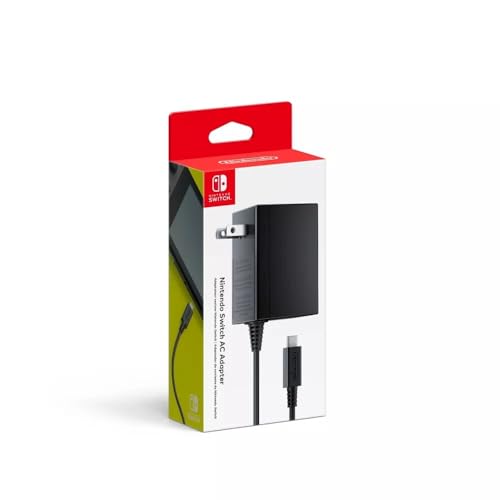
Nintendo Switch AC Adapter
Every category has a reference product, and this is it: the adapter Nintendo designed for the Switch, sold separately for the owners who need a second one. Its title is three words long and states no wattage, no voltage and no cable length, which would be a failing grade for any other listing in this guide. For Nintendo’s own unit it is beside the point. The dock in your living room was engineered alongside this adapter; the console’s charging behaviour was tuned against it; when a third-party charger misbehaves, the diagnostic question is always whether the official adapter works, because if it does, the fault is the charger’s and if it does not, the fault is the dock’s.
The practical case for owning one is duplication. A Switch that travels between a living-room dock and a bedroom dock, or between home and a grandparent’s house, wants an adapter living at each dock rather than a cable fished behind furniture twice a week. The same logic serves the bag: an official adapter in the travel case means the home dock never gets unplugged, and the single most common cause of “the dock stopped working” — an adapter left in another city — disappears. Owners of the Switch Lite, which has no dock but shares the family’s charging expectations, also default to this unit when a second charger is needed for a school bag or a car console.
What the official adapter does not offer is ambition beyond its console. It is a Switch charger, full stop: no cross-device claims appear in its title because Nintendo makes none. Owners building one charging setup for a Switch, a Steam Deck, a phone and a controller will find the third-party picks below more accommodating. Owners who want the dock question permanently closed — for a child’s console, a shared family system, a setup that must simply always work — will find that the benchmark’s premium buys exactly that closure. In a category haunted by almost-compatible chargers, the adapter that defines compatible has a permanent place.
It is also the safest gift in this guide. A third-party charger given to a Switch owner carries a small burden of verification; the official adapter carries none, which matters when the recipient is a nephew whose parents will plug it in without reading anything. Buy it once, and the charging chapter of that console’s life is finished.
Longevity is the official adapter’s quietest argument. The Switch family has been in homes for years, and its official adapters have accumulated a track record no newer listing can claim: they are the units that shipped in millions of console boxes and have been running docks through entire childhoods of play. A replacement bought today is the same reference design, which means its behaviour in your dock is the most predictable quantity in this entire guide. Predictability sounds dull until the alternative is a television that flickers during a boss fight — at which point dull becomes the most exciting property a charger can have.
Strengths
- Nintendo’s own unit — the adapter the dock and console were designed around, with compatibility beyond argument.
- The reference charger for troubleshooting: if the official adapter works, the dock is healthy.
- Ideal second adapter for a two-dock household or a permanently packed travel case.
Trade-offs
- The title states no specifications, so comparison shoppers get nothing to compare — its case rests on provenance.
- No cross-device ambitions are claimed; it is a Switch-family charger and nothing else.
- Official accessories rarely win on price posture against the third-party picks below.
| Spec | From the listing title |
|---|---|
| Maker | Nintendo |
| Product | Switch AC Adapter |
| Output | The listing title states no wattage or voltage; Nintendo’s own product documentation carries the figures |
| Cable | Not described in the listing title — the product page shows what is in the box |
| Compatibility | Nintendo Switch family, as the maker’s own adapter |
| Dock support | The reference adapter for the Switch dock |
Best for: a Switch household adding a second dock location or a travel adapter, where compatibility must be beyond discussion.
Not suited for: a desk that must charge a Switch, a Steam Deck and controllers from one unit, because this adapter’s brief is the Switch alone.
When only the original will do, get the official Nintendo Switch AC Adapter on Amazon and close the question for good.

MARSDOCK 45W Switch Charger
MARSDOCK builds its identity around the dock — the brand name is a promise — and this charger’s title backs the promise with the numbers that matter: 45 watts, 15 volts at 2.6 amps, a five-foot USB-C cord, compatibility spanning the Switch, Switch Lite and OLED models plus the Steam Deck, and explicit support for TV mode. That last phrase is the one to underline. TV mode is the docked state, the demanding state, the state that exposes chargers whose titles only ever promised handheld charging. A title that names TV mode is a title that has understood the assignment.
The 45W headline deserves translation, because the dock’s profile is 15V at 2.6A — just under forty watts — and the charger’s 45W rating describes its overall capability rather than a force-feeding of the console. A charger does not push power into a device; the device draws what its profile allows. The headroom simply means the charger is not straining at the dock’s requirement, and the same unit can serve the Steam Deck, whose own appetite is in the same class, without either device meeting a charger at its limit. For the growing number of households where a Switch and a Steam Deck share a sofa, a television and a charging corner, that shared competence is the purchase.
The five-foot cord is the travel-friendly length: long enough to reach from a media-unit outlet up to the dock, long enough for a hotel nightstand, short enough to coil into a case without swallowing it. MARSDOCK’s positioning, read from its title, is the dedicated alternative — a charger bought specifically for the Switch ecosystem rather than borrowed from a laptop bag — and its natural home is the second dock, the travel kit, or the desk of an owner whose official adapter has been claimed by the family television.
Owners comparing the whole third-party field should also read our companion guide to Best Alternative Nintendo Switch Chargers, which ranges wider across the replacement market this pick competes in.
There is a household pattern the MARSDOCK fits particularly well: the borrowed-console shuffle. A Switch that spends term-time at university and holidays at the family home, or weekends split between two parents’ houses, effectively lives in two docks — and the second household rarely owns a spare adapter with the right profile. A named-brand third-party unit with the figures printed in its title is the charger a careful owner buys for the second house: verifiable before purchase, testable on arrival, and cheap enough to leave there permanently. The official adapter could do the same job, but leaving the benchmark behind in another postcode is how docks end up orphaned; the MARSDOCK’s tier is the leave-behind tier.
Strengths
- The title states the dock profile directly — 15V/2.6A — and names TV mode support outright.
- Compatibility spans Switch, Lite, OLED and Steam Deck, covering the two handheld families of the moment.
- A five-foot USB-C cord suits both dock duty and travel without excess bulk.
Trade-offs
- Third-party provenance means the troubleshooting benchmark remains Nintendo’s own adapter.
- The title names no certification marks, so buyers who require them should check the product page.
- One cable, one device at a time — multi-device households will still queue at it.
| Spec | From the listing title |
|---|---|
| Output | 45W; 15V 2.6A |
| Cable | 5 ft USB-C cord |
| Compatibility | Switch, Switch Lite, OLED, Steam Deck |
| TV mode | Supported, per the title |
| Certification | The listing title names no certification mark; the full listing is where to verify it |
| Connector | USB-C |
Best for: a Switch owner adding a second dock or a travel charger who wants the dock profile stated in writing.
Not suited for: a Switch 2 owner, whose console generation asks for the higher profile covered by the final two picks.
Dock-first buyers can check the MARSDOCK 45W on Amazon and compare its cord against their media unit’s layout.
45W Charger for Nintendo Switch
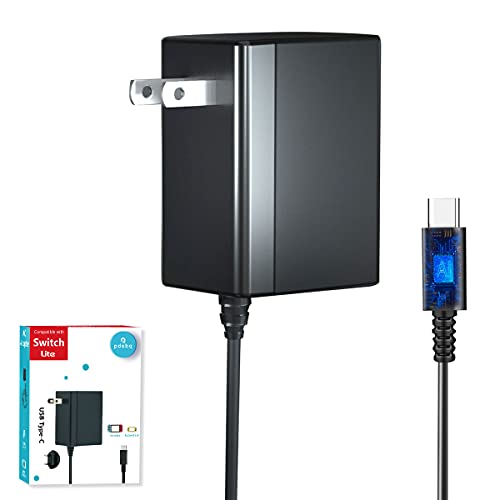
The unbranded pick in this guide earns its place by stating the widest compatibility in the category. Its title describes a 45W PD charger with a five-foot cable, delivering 15V at 2.6A, and names its territory: Nintendo Switch, Lite and OLED, the Steam Deck, and — unusually — the PlayStation 5 and Xbox Elite 2 controllers. That controller detail reveals the charger’s intended home: not the dock alone, but the whole gaming shelf, where a Switch, a handheld PC and two premium controllers all drink from USB-C and all resent waiting for the single good charger. As a shelf charger, its specification is exactly right; the dock profile is present for the Switch, and the PD designation means it negotiates properly with the other devices rather than forcing one voltage at everything.
PD — USB Power Delivery — is worth a sentence of respect here, because it is the mechanism that makes one charger safe across devices with different appetites. A PD charger and a PD device agree on a voltage before current flows, so the controller sips what it wants and the Switch draws its dock profile from the same brick on different evenings. The 15V/2.6A figure in the title is the Switch-relevant line of that negotiation, and its presence is what separates this listing from the crowd of chargers that print a wattage and hope. Where the MARSDOCK pick speaks the language of the dock, this one speaks the language of the shelf — and backs it with the same numbers.
The honest caveats are provenance and proof. An unbranded listing asks the buyer to lean entirely on the stated specification and the platform’s return protections, and its title names no certification marks. That posture suits the buyer who reads titles the way this guide does — as contracts — and verifies the delivered unit against them on arrival: plug it into the dock, confirm TV mode, and keep the packaging until the shelf has run on it for a week. Judged that way, this is the flexible pick of the original-Switch group, and for controller-heavy households it may be the most useful one.
Think about the charging shelf as an ecosystem and this charger’s breadth becomes a strategy rather than a spec list. Controllers are the forgotten drinkers of the gaming shelf: a PS5 or Elite controller that dies mid-session gets plugged into whatever is free, and what is free is usually the weakest charger in the house. A PD unit that states both its dock profile and its controller compatibility gives the shelf one competent citizen that everything can rotate through — Switch on Monday, Deck on Tuesday, controllers whenever they complain. The queue is real, but a queue at a capable charger beats a shelf of single-purpose bricks each guarding one device. Households with several gamers will feel this difference weekly.
Strengths
- The dock profile — 15V/2.6A — is stated, alongside PD negotiation for cross-device safety.
- The widest compatibility here: Switch family, Steam Deck, and PS5 and Xbox Elite 2 controllers.
- Five-foot cable suits a media shelf where several devices take turns.
Trade-offs
- Unbranded: no maker’s reputation stands behind the title, so verify the unit against its claims on arrival.
- No certification marks are named in the title.
- A shared shelf charger is a queue by definition; heavy households may need two.
| Spec | From the listing title |
|---|---|
| Output | 45W PD; 15V 2.6A |
| Cable | 5 ft charging cable |
| Compatibility | Switch / Lite / OLED, Steam Deck, PlayStation 5 and Xbox Elite 2 controllers |
| Dock mode | Supports TV dock mode, per the title |
| Brand | Unbranded listing |
| Certification | The listing title states none; check the product page and the delivered unit’s markings |
Best for: a gaming shelf where a Switch, a Steam Deck and premium controllers share one charging point in rotation.
Not suited for: a child’s console where a maker’s name and a support channel behind the charger are part of the requirement.
Shelf-builders can view this 45W PD charger’s listing on Amazon and confirm the compatibility list matches their shelf.

YCCSKY 45W Switch Charger
YCCSKY’s charger is the travel-styled entry in the 45W group: its title calls it a fast travel wall charger, specifies a five-foot USB-C cable, supports TV mode and dock station use, and finishes in black. The electrical headline needs a careful read, because the title pairs its 45W rating with a 15V/3A figure — a slightly different statement from the 15V/2.6A line in the MARSDOCK and unbranded titles. The dock’s requirement is 2.6 amps at 15 volts; a charger able to offer 3 amps at that voltage covers the requirement with headroom, since the console draws what it needs rather than accepting everything offered. Read that way, the YCCSKY’s figures describe capacity above the dock’s ask, which is the safe direction for a discrepancy to lean.
The travel framing is more than colour. A travel charger lives a harder life than a dock charger: it is coiled nightly, plugged into unfamiliar outlets, asked to charge a Switch in a hotel room where the only socket is behind the bed, and expected to run a dock in a rental apartment’s living room on holiday. Five feet of cable is the length that makes those rooms work, and a wall-charger format — brick and cable as one travelling unit — is the format that survives being packed a hundred times. The title’s dock-station support matters here precisely because travel docks and dock substitutes are where marginal chargers get exposed; a charger that states dock support is claiming the hard job, not the easy one.
YCCSKY’s title also contains the category’s most human detail: it misspells the console’s name in its compatibility line. That typo is reported here not as mockery but as calibration — this is a value-tier listing from a small brand, and the buyer’s posture should match: verify the dock test on arrival, keep the return window in mind, and judge the unit on the television lighting up. Small-brand Switch chargers live in a market where the specification is standardised enough for the honest ones to work perfectly, and this one’s stated figures are the honest shape.
Chargers for the bag pair naturally with power banks for the journey; our Best Slim Portable Chargers guide covers the pocketable half of a Switch travel kit.
The YCCSKY also makes sense as the household’s sacrificial charger — the one assigned to the environments where chargers go to die. Children’s bedrooms with outlets behind bunk beds, a den where the cable crosses a walkway, the bag that gets thrown into car boots: every household has charging posts where survival is measured in school terms rather than years. A value-tier unit with the correct stated profile is the rational garrison for those posts, reserving the official adapter for the main dock where its longevity compounds. This is not faint praise; matching the tier of the tool to the harshness of the post is how sensible households equip everything from chargers to screwdrivers.
Strengths
- Stated output covers the dock’s requirement with headroom — 15V with up to 3A available.
- Travel format with a five-foot cable suits hotels, rentals and second homes.
- TV mode and dock-station support are claimed explicitly in the title.
Trade-offs
- The title’s figures differ in shape from the 15V/2.6A standard line, so the arrival dock test matters.
- Small-brand listing with no certification marks named in the title.
- Black is the stated finish — a trivial point until a household is colour-coding chargers by owner.
| Spec | From the listing title |
|---|---|
| Output | 45W; 15V/3A as stated |
| Cable | 5 ft USB-C cable |
| Compatibility | Nintendo Switch family, per the title |
| Dock support | Supports TV mode and dock station |
| Finish | Black |
| Certification | The listing title names none; verify on the product page if a mark is required |
Best for: a travelling Switch whose owner wants one wall charger that covers handheld charging and a travel dock alike.
Not suited for: a Switch 2 setup, where the console’s higher power profile belongs to the next two picks.
Travellers can see the YCCSKY 45W charger on Amazon — and should run the dock test the day it arrives.

Switch 2 Charger 60W
The Switch 2 changed the power conversation, and this charger is the third-party answer written in the new language. Its title states 60 watts to what it calls OEM spec, delivered at 20 volts and 3 amps, with a five-foot cable, compatibility spanning the Switch 2 alongside the OLED, Lite and Steam Deck, support for a 4K TV dock, and positioning as a replacement for the original Switch 2 charger. Each clause of that title does work. The 20V/3A profile is the new generation’s dock requirement, a step up from the original family’s 15V line. The 4K dock mention reflects the newer console’s television ambitions. And “replacement for the original” is the honest job description: this unit exists to be the second adapter, the travel adapter, the one that lives at the other television.
Backward compatibility is the clause to read twice. A charger that serves the Switch 2’s 20V profile and also lists the OLED and Lite is claiming proper negotiation — stepping down to what the older consoles ask for — which is how a two-generation household ends up with one travel charger for both consoles. That household is common already and will be commoner: a Switch 2 in the living room, an inherited original Switch in a child’s room, a Lite in a school bag. One well-negotiated 60W charger in the travel case covers the fleet, provided its claims hold in the dock test on both consoles.
The title’s reach extends one step too far in its final compatibility flourish, where the Wii appears in the string. The Wii is a console of a different era with a different power arrangement entirely, and its presence in the list reads as keyword enthusiasm rather than engineering. It does not invalidate the Switch 2 claims — the voltage, wattage and dock language are the substantive parts — but it is a reminder to weight a title’s numbers over its name-drops. Buy this charger for the 20V/3A specification and the 4K dock support, test it in your dock, and let the rest of the string go.
Battery care for the wider shelf — the cells inside controllers, handhelds and spares — is covered in our Best Lithium Battery Chargers guide for readers who maintain more than consoles.
Early-generation accessories always carry a timing question, and it is fair to address it: is it wiser to wait for the third-party market around a new console to mature? The counter-argument sits in the title’s own discipline. This listing does not promise magic; it states the console’s known profile — 20 volts, 3 amps, 60 watts — and the dock behaviour that profile enables. A charger is an electrical negotiation, not a software ecosystem, and a unit that states the right numbers on day one does not become more correct in year two. What matures over time is choice and price posture, not correctness. Owners who need a second Switch 2 adapter now are buying a specification, and the specification is already fully written.
Strengths
- States the Switch 2 profile directly: 60W at 20V/3A, described as OEM spec.
- 4K TV dock support matches the new generation’s television output.
- Backward compatibility with OLED and Lite makes it a one-charger answer for two-generation households.
Trade-offs
- The compatibility string overreaches — a Wii mention that should be ignored in favour of the stated electrical figures.
- Third-party unit for a new console generation; the official adapter remains the reference.
- Owners of only the original Switch gain nothing here over the cheaper 45W picks.
| Spec | From the listing title |
|---|---|
| Output | 60W; 20V/3A, OEM spec per the title |
| Cable | 5 ft / 1.5 m |
| Compatibility | Switch 2, OLED, Lite, Steam Deck, per the title |
| Dock support | 4K TV dock support |
| Role | Replacement for the original Switch 2 charger |
| Certification | The listing title names no certification mark; the product page is the place to confirm one |
Best for: a Switch 2 household needing a second or travel adapter, especially one still running an original Switch or Lite beside it.
Not suited for: an original-Switch-only household, where the 45W picks deliver the dock profile at a lower tier.
New-generation owners can examine the 60W Switch 2 charger on Amazon and match its figures against their dock’s requirements.

Nintendo Switch 2 AC Adapter (Official)
The guide closes where it opened, one generation later: with Nintendo’s own adapter, now for the Switch 2. The title is again nearly empty — the console’s name, a trademark symbol, and the words AC Adapter — and again the emptiness is the message. This is the unit the Switch 2’s dock was designed around, the adapter against which the new console’s charging and television behaviour was tuned, and the purchase that ends all specification questions for the new generation. Where the third-party 60W pick argues its case in numbers, the official adapter simply is the case.
The buying logic mirrors the original adapter’s, transposed to a newer and more expensive console ecosystem. A Switch 2 that migrates between two televisions wants an adapter at each dock. A Switch 2 that travels wants its home dock left wired and a second adapter in the case. And a household troubleshooting a dock that will not light up wants the reference unit on hand to divide the world into charger problems and dock problems. In each scenario the official adapter is not the extravagant choice; it is the diagnostic and logistical foundation the rest of the setup leans on.
Its limits are the same as its predecessor’s, and they are worth stating plainly. Nintendo claims nothing in this title about other devices, other consoles or cross-compatibility, and a buyer should not project any onto it: this is the Switch 2’s adapter, offered for the Switch 2’s work. Owners whose charging corner must serve a Steam Deck, controllers and two console generations from one brick should look at the negotiating third-party picks above. Owners whose priority is that the new console’s dock works every single time, in the family room, without a paragraph of verification — this is the entire point of the official unit, and it is a point worth paying for exactly once per dock.
There is also a warranty-shaped calm to the official unit that matters more on a new console than an old one. A Switch 2 is a recent, significant purchase, often with extended protection or a retailer’s goodwill attached to its early life. Feeding its dock with Nintendo’s own adapter keeps every part of that story simple if anything ever misbehaves: no third variable enters the conversation between the owner, the retailer and the maker. That simplicity has a real if unglamorous value during a console’s first year, and it fades as the console ages — which is why this guide’s own advice tilts official for new machines and relaxes toward the stated-profile third-party picks as a platform settles in.
Strengths
- Nintendo’s own adapter for the Switch 2 — compatibility and dock behaviour by definition.
- The troubleshooting reference for the new generation’s dock problems.
- The zero-verification gift or second-dock purchase for a new console.
Trade-offs
- No specifications or cross-device claims appear in the title; its authority is its maker.
- It serves the Switch 2’s ecosystem rather than a whole shelf of devices.
- Official accessories sit at the premium end of their category as a rule.
| Spec | From the listing title |
|---|---|
| Maker | Nintendo |
| Product | Switch 2 AC Adapter |
| Output | The listing title prints no figures; Nintendo’s product documentation carries the specification |
| Cable | Not described in the listing title — consult the product page for box contents |
| Compatibility | Nintendo Switch 2, as the maker’s own adapter |
| Dock support | The reference adapter for the Switch 2 dock |
Best for: a Switch 2 household adding a second dock location or a travel adapter with zero specification risk.
Not suited for: a mixed shelf that needs one charger to negotiate with several brands of device.
For the definitive article, order the official Switch 2 AC Adapter on Amazon and leave the dock question behind.
Side-by-Side Comparison
| Charger | Generation | Output stated | Cable | Also serves |
|---|---|---|---|---|
| Nintendo Switch AC Adapter | Switch family | Not stated in title | Not stated in title | Nothing claimed beyond the Switch family |
| MARSDOCK 45W | Switch family | 45W, 15V/2.6A | 5 ft | Steam Deck |
| 45W Charger (unbranded) | Switch family | 45W PD, 15V/2.6A | 5 ft | Steam Deck, PS5 and Xbox Elite 2 controllers |
| YCCSKY 45W | Switch family | 45W, 15V/3A | 5 ft | Travel and dock-station use |
| Switch 2 Charger 60W | Switch 2 | 60W, 20V/3A | 5 ft | OLED, Lite, Steam Deck per title |
| Nintendo Switch 2 AC Adapter | Switch 2 | Not stated in title | Not stated in title | Nothing claimed beyond the Switch 2 |
Why Does the Dock Care Which Charger You Use?
Because docked play is a different electrical job from handheld charging. In your hands, the console charges its battery and runs its screen, and almost any USB-C source can contribute something toward that modest load. In the dock, the console runs at full tilt, outputs video to a television, powers connected accessories through the dock, and charges its battery simultaneously — a combined demand the system meets only when the adapter offers the profile the dock was designed to request. The original Switch family’s profile is the 15V/2.6A figure repeated through this guide; the Switch 2 raises the ceiling with its 20V/3A profile. An adapter that cannot offer the requested profile leaves the dock to refuse, flicker or fall back to handheld behaviour on a television-sized screen.
This is also why wattage headlines mislead when read alone. A big laptop charger may carry an impressive wattage yet organise its profiles around different voltages; a modest charger with the correct 15V line serves the dock better. The number that matters is not the largest on the box but the specific voltage-and-current pair the console asks for — which is why every review above leads with that pair where the title states it, and why the official adapters, which state nothing, are trusted on provenance instead. Learn to read charger titles for the pair, and this entire category becomes simple.
One Charger Per Dock, One for the Bag: Setting Up a Switch Household
The households that never think about Switch charging share a layout: an adapter lives at each dock permanently, and a travel charger lives in the console case permanently. Nothing gets unplugged, nothing gets borrowed, and the dock behind the television — the least accessible socket in most homes — is disturbed only when the furniture moves. The cost of that peace is one extra adapter per location, which is why the second-adapter picks dominate this guide: the official units for zero-risk locations, the stated-profile third-party units for travel and secondary rooms.
The bag charger earns its own selection criteria. It should be the charger whose loss would annoy rather than strand — which argues for a third-party pick in the case and the official adapter at home — and it should be tested in a dock before the trip, not during it. Hotel rooms add one more wrinkle: outlets hide behind beds and desks, which is where the five-foot cables in this guide prove their worth against the short cords bundled with phone chargers. Set the household up this way once, and charging stops being a topic the family discusses at all, which is the highest state a charging setup can reach.
A label maker finishes the system. Mark each adapter with its post — LIVING ROOM DOCK, TRAVEL, BEDROOM — in the unglamorous certainty that unlabelled identical bricks migrate, and migration is how a Switch 2 adapter ends up feeding an original Switch’s dock while the correct unit tours the country in a suitcase. The consoles will negotiate their way out of most swaps, but the household that labels never has to rely on negotiation. Two minutes with a label maker is the cheapest reliability upgrade in this entire guide, and it pairs with the dock test as the twin habits of households that have solved Switch charging permanently.
Handheld, Tabletop and Docked: Three Modes, Three Appetites
It helps to picture the Switch as three devices sharing one battery. Handheld mode is the modest one: screen lit, controls attached, charging needs gentle enough that the console was designed to sip from a wide world of USB-C sources. Tabletop mode — kickstand up, controllers detached, perhaps on a train tray or a kitchen counter — draws a little more and often happens far from the good charger, which is why travel picks earn their place even for owners who never use a travel dock. Docked mode is the glutton described earlier: full performance, television output, accessories fed, battery charging on top. Most charger disappointment is a mode mismatch — a charger bought for the first mode’s manners being judged by the third mode’s demands.
Owners can use the three modes as a purchasing map. A charger destined only for a school bag or a bedside, where the console charges overnight in handheld mode, has the easiest job in the category and the widest field of acceptable candidates. A charger destined for a dock — main or travel — has the hardest job and the narrowest field: the stated-profile picks and the official adapters. Naming the mode before shopping prevents the classic error of buying a bag charger, promoting it to dock duty in a pinch, and concluding from the flicker that third-party chargers cannot be trusted. They can — in the mode they were specified for.
The Dock Test: Verifying Any New Charger in Five Minutes
Every third-party pick in this guide should pass the same home examination, and it takes less time than unboxing a game. Seat the console in its dock with the new charger connected, wake the system, and confirm the television receives the picture. Then play — actually play, for a few minutes, in a demanding scene — because a marginal charger often lights the dock and then falters under sustained load, dropping the picture or the charge. Check that the battery indicator is rising while docked and playing, since a dock that displays but does not charge is only half passing. Finally, leave the console docked and asleep for an hour and confirm it wakes cleanly; sleep-state negotiation is the other place weak chargers confess.
Run that sequence on arrival day and the category’s entire risk collapses into a return label. The chargers that pass — and the honest stated-profile units in this guide are bought to pass — tend to keep passing for years, because a charger’s electrical character does not drift the way a battery’s capacity does. Verification is a one-time toll. Pay it once, at the door, and the dock becomes boring again — boring in the way all good infrastructure is boring, present every day and discussed never, while the games it feeds get all the attention they deserve.
Common Mistakes When Buying a Switch Charger
Buying by plug shape is the founding error of this category. USB-C is a connector, not a capability, and the graveyard of Switch accessories is full of phone chargers that fit the port and failed the dock. The fix is the habit this guide models: read for the voltage-and-current pair, or buy the maker’s own adapter and skip the reading.
The second mistake is cross-generational assumption. A charger that served the original Switch perfectly may not meet the Switch 2’s higher profile in its dock, and a Switch 2 charger is wasted money in a home running only the original console. Consoles in this family now span two power generations that share a plug; the generation check takes five seconds and prevents the most modern version of the dock problem. Third, owners lend the dock’s adapter to the travel bag and forget it there, then diagnose a dead dock — keep locations sacred, as the setup section above advises. Fourth, bargain-hunting below the specification: a charger that shaves the profile to shave cost will be discovered by the dock at the least convenient moment, usually involving a television, guests and a saved game that matters.
Frequently Asked Questions
Can I charge my Switch with a phone charger?
In handheld mode, generally yes — slowly, and the console may still drain during demanding play if the charger is weak. In the dock, generally no: TV mode asks for the 15V/2.6A profile that phone chargers rarely offer. Treat phone chargers as handheld-only emergency equipment and keep a stated-profile charger or the official adapter for dock duty.
What does 15V/2.6A actually mean, in plain terms?
It is the electrical profile the Switch requests when docked: fifteen volts, with up to two point six amps available. A charger listing that pair is claiming it can hold that conversation with the dock. The console draws what it needs up to that ceiling; a charger offering more headroom at the same voltage, like the YCCSKY’s stated 3A, is not forcing extra power in.
Does the Switch 2 need a different charger from the original Switch?
For docked play at full capability, yes — the Switch 2’s profile rises to the 20V/3A figure stated in the 60W pick’s title, and Nintendo sells a dedicated official adapter for the new console. Handheld charging remains more forgiving, and the third-party Switch 2 charger here claims backward compatibility with the older models, but the dock is where generations must be matched.
Is a third-party charger safe for my console?
A third-party charger that states the correct profile and delivers it honestly is a normal, widely used accessory — four of this guide’s six picks are third-party. The safety habit is verification: run the dock test when the charger arrives, confirm TV mode is stable, and buy through channels with straightforward returns. The chargers to avoid are the ones whose titles will not state a profile at all.
How long a cable do I need?
Five feet, the length in every third-party title here, covers a media unit, a desk and most hotel nightstands. Measure any unusual run — a dock on a high shelf, an outlet across a room — before assuming, and remember that the official adapters’ cable details live on their product pages rather than their titles.
Why does my dock work with one charger and not another that also fits?
Because fitting is mechanical and working is electrical. The dock negotiates for its profile; a charger that cannot offer it gets declined, whatever its plug shape or headline wattage. That behaviour is the console protecting itself, and it is the single most useful diagnostic in this category: swap in the official adapter, and the answer divides charger faults from dock faults immediately.
My Switch charges in the dock but the battery still drains while I play. What is happening?
That is the signature of a charger that nearly meets the profile: it can run the dock or charge the battery, but not both at full demand, so play draws the difference from the battery. The fix is a charger that states the full profile — or the official adapter — rather than a different dock or a different console. Treat the symptom as a specification report, because that is exactly what it is.
Should the travel charger match the home charger’s brand?
No — it should match the console’s specification. Brands do not negotiate with docks; profiles do. A mixed household of official at home and stated-profile third-party in the bag is the arrangement this guide recommends most often, because it puts the benchmark where it works hardest and the verifiable alternative where loss and wear are likeliest.
Can one of these chargers damage my console?
A correctly specified USB-C PD charger negotiates before it delivers, which is the system’s built-in protection, and the Switch family’s own behaviour adds a second layer: the dock declines profiles it does not want. The realistic risks in this category are disappointment — flicker, refusal, slow charging — rather than damage, and they concentrate in chargers whose titles refuse to state a profile. Buy the stated figures, run the dock test, and the risk left is small.
Final Recommendation
Match the generation, respect the dock, and this category stops being confusing. Original Switch, Lite and OLED owners who want certainty buy Nintendo’s own AC Adapter once per dock; owners who want a second unit with the profile in writing choose among the MARSDOCK for its dock-first clarity, the unbranded PD charger for a shelf shared with a Steam Deck and controllers, and the YCCSKY for travel. Switch 2 owners start from the new profile: Nintendo’s official adapter for the reference setup, the 60W third-party unit for a second location or a two-generation household. Whichever you choose, run the dock test on arrival day, while returns are painless — and after that, let the television light up and forget this entire topic until the next console arrives. One last allocation tip for households buying two at once: put the official adapter at the dock that hosts other people’s children, parties and long sessions — the high-consequence post — and the third-party unit at the quieter second location, where a rare flicker costs nothing but a reseated cable. Risk, like charging, should be distributed according to appetite, and households assigning their adapters that way will never think about any of this again. That, in the end, is the true product being bought in this category — not watts, not volts, but the permanent absence of a small recurring problem from family life. Buy the profile, test the dock, label the brick — and the next time the family gathers around the television, the only thing anyone will discuss is the game itself, which is precisely as it should always be.


