What's inside
- Key Takeaways
- Quick Picks
- How We Chose These Picks
- Comparison Table
- How many phone charges do the best 20 dollar portable chargers really give?
- What should you check before buying any budget power bank?
- How do you keep a budget power bank healthy?
- Is a two-pack or one better bank the smarter buy?
- What do output wattage numbers mean for your phone?
- When should you spend above this budget instead?
- Common Mistakes
- Final Recommendation
- Frequently Asked Questions
- Related Guides
As an Amazon Associate I earn from qualifying purchases. This post may contain affiliate links at no extra cost to you.
widgetverdict.com is reader-supported. When you buy through links on our site, we may earn an affiliate commission.
Hunting the best 20 dollar portable chargers means shopping in the most contested corner of the accessory world, where a modest budget meets enormous marketing confidence. Twenty dollars is the price of a cinema ticket, and for that sum you are promised — depending on the listing — enough stored energy to refill a phone several times over, fast charging, wireless charging, and a body slim enough to forget in a pocket. Some of those promises are honest. The six power banks reviewed below separate the honest ones from the theatre: five carry checked listings, one appears as a prose-only benchmark because we could not verify a current listing for it, and every capacity and speed claim in these sections is written the way the physics, rather than the packaging, supports.
Where to buy: the linked picks lead to checked Amazon listings; the prose-only pick is named for comparison and carries no link, for reasons its section explains in plain words. A note on the budget itself: twenty dollars is this guide’s theme and its yardstick, not a price tag we are pinning on individual products, because prices in this category swing weekly with sales and coupons. Two of the picks — the Anker models — live above the strict budget line at their regular positioning and drop into it during the sale periods this category is famous for; we flag that openly in their sections rather than pretending otherwise. Check price on Amazon at the moment you shop, and judge any pick by whether its current figure sits inside your budget on that day.
One more framing before the rankings: capacity honesty. A power bank’s printed milliamp-hour figure describes its internal cells at their own voltage, not what arrives in your phone; conversion losses and voltage stepping mean a 10000mAh bank typically delivers something like one and a half to two full charges of a modern phone, not the three or four the arithmetic on the box implies. Every pick below is a 10000mAh-class unit, the size this budget buys honestly, and the sections judge them on output speed, port selection, build and behaviour — the things that actually differ — rather than on inflated capacity theatre.
Key Takeaways
- At this budget, 10000mAh is the honest capacity class; claims far beyond it at this price deserve suspicion, not excitement.
- The Miady two-pack solves a household problem — a charged bank in two bags at once — that a single better bank cannot.
- VEEKTOMX’s mini bank is the pick for people who will only carry a charger if it disappears into a pocket or small bag.
- Anker’s two entries are the step-up options: faster output and magnetic wireless charging when a sale brings them into budget.
- Built-in cables sound like a gimmick until the day a borrowed cable is the difference between a working phone and a dead one.
- Recharge speed of the bank itself matters: a slow-refilling bank is always the one that is empty when you grab it.
Quick Picks
| Pick | Badge | Why it makes the cut |
|---|---|---|
| Miady 10000mAh Power Bank 2-Pack | Best household value | Two complete banks in one purchase, so two bags or two family members are covered at once. |
| VEEKTOMX 10000mAh Mini Power Bank | Smallest carry | A genuinely pocketable body with a built-in connector approach for minimalists. |
| Anker Power Bank 10000mAh 30W | Best all-round quality | Anker’s build and safety systems with 30W output for phones and small tablets. |
| Anker Nano Power Bank 10000mAh 45W | Fastest output | 45W charging and a built-in USB-C cable that doubles as a carry strap. |
| Anker MagGo Power Bank 10000mAh Qi2 | Best wireless option | Magnetic snap-on Qi2 wireless charging plus wired output in one bank. |
| Charmast 10000mAh Mini Power Bank | Prose-only benchmark | A long-running mini design assessed for context in its own section below. |
How We Chose These Picks
We started with the safety screen, and in this category it eliminates more products than any other test. Cheap power banks are the accessory most likely to be built down to a price with cells of unknown origin and protection circuitry of unknown competence, and the failure mode of a lithium bank is not a shrug — it is heat, swelling and fire risk. Every linked pick here comes from a maker with a traceable record, documented protection systems and listings we could verify. We also applied an absolute exclusion: no recalled models appear in this guide, and certain widely sold budget brands are absent entirely because specific models have been subject to safety recalls; a cheap bank is never cheap enough to gamble on.
The second screen was honesty of specification. We favoured banks whose capacity class, output wattage and port counts could be stated plainly and matched to the maker’s own documentation, and we discounted listings built on impossible arithmetic — huge capacities in tiny bodies, charge counts no conversion physics allows. In this guide, a 10000mAh bank that admits it is a 10000mAh bank beats a fictional 26800mAh bank in the same shell every time, because the honest maker is telling you something about every other claim on the page.
Third came the lived experience of carrying the thing. A portable charger earns its name in pockets, coat linings, gym bags and the bottom of a tote, so we weighed size and weight, edge finishing, port layout, the presence or absence of a cable you must separately remember, and how the bank recharges itself — a bank that takes all night to refill will be empty the one morning you need it. Finally, we spread the six across the real shapes of demand: the household that needs two, the minimalist who needs small, the commuter who needs fast, and the iPhone owner who wants magnetic wireless without leaving the budget’s neighbourhood.
We excluded banks with proprietary-only charging quirks, models whose listings could not be verified, and any product from a line touched by recall. One respected mini design remains in the guide as a prose-only comparison point because readers will encounter it everywhere and deserve an assessment — but it carries no purchase link, and its section explains why in ordinary sentences rather than fine print.

Miady 10000mAh Power Bank 2-Pack — Best household value
The Miady two-pack starts from an insight the single-bank listings miss: the power bank problem in most households is not capacity, it is location. One bank, however good, lives in one bag, and the family member whose phone dies is reliably the one carrying the other bag. Two complete 10000mAh banks in a single purchase — one for the work bag, one for the gym bag; one for you, one for your partner; one charged, one charging — dissolve that problem at a stroke, and at this guide’s budget the pair is the most practical purchase on the page.
Each bank is a straightforward modern unit: USB-C input for its own refills, USB-A and USB-C output for devices, a simple charge indicator, and a slim body that rides in a pocket without ceremony. Output is in the standard fast-enough class for phones rather than the headline speeds of the Anker picks, which is the honest trade a two-pack makes: you are buying coverage, not velocity. For the school run, the commute, the festival day and the long flight, standard output into a phone over an hour of carrying is precisely what most people actually consume from a power bank.
The pair arrangement also builds in redundancy that single-bank owners envy after their first failure. A bank lost to the back of a taxi, left in a hotel room or lent to a teenager is an inconvenience rather than a crisis when its twin is in the kitchen drawer. The compromises are the class compromises: no wireless charging, no built-in cables, no laptop-grade output, and a finish that is functional rather than delightful. Households buying their first power banks, or replacing a drawer of dead ones, should start here and discover whether their needs are ordinary — most are — before spending the same money on one faster bank.
There is a gifting pattern worth noting, too: the two-pack is the rare tech purchase that divides gracefully. Parents equipping two teenagers, couples who travel separately for work, and anyone setting up a household emergency drawer all find that two adequate banks outperform one excellent bank in the only metric that matters at 11 p.m. in a power cut — whether a charged bank is within reach of the person holding the dead phone.
- Capacity: 10000mAh per bank, two banks included
- Ports: USB-C and USB-A output; USB-C input
- Indicator: LED charge level display
- Body: slim pocketable format, sold as a pair
- Extras: none — no wireless, no built-in cable
Durability expectations should be set fairly for the pair: these are working banks, not heirlooms, and their natural life is a few years of family service — school bags, gloveboxes, the kitchen drawer — after which their capacity will have faded to the point where replacement is sensible. That is not a criticism; it is the honest economics of the class, and a two-pack that serves a household for years before fading has repaid its modest cost many times over in rescued evenings, completed journeys and un-stranded teenagers. Buy the pair expecting service, not permanence, and it will exceed the expectation.
Strengths
- Two banks cover two bags, two people or one spare, in a single purchase.
- Simple, standard ports work with every phone in the house.
- Redundancy softens loss, lending and forgetting.
Trade-offs
- Standard output speeds rather than high-wattage fast charging.
- No built-in cable; carry one for each bank.
- Plain finish and feature set.
Best for: families and couples who need a charged bank reachable in more than one place, and first-time buyers covering a whole household at once. Not suited for: users wanting the fastest single-phone charging, wireless charging, or a bank that can feed a laptop.
VEEKTOMX 10000mAh Mini Power Bank — Smallest carry
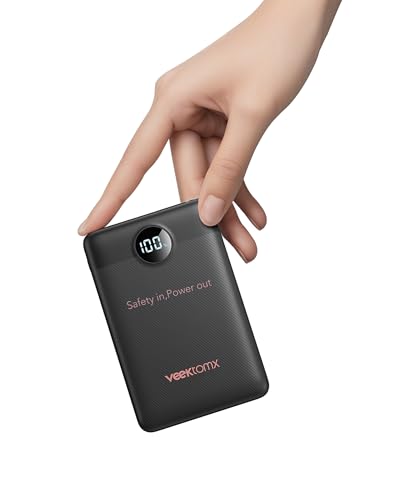
The VEEKTOMX mini exists for the large population that has bought power banks before and left them at home, because a brick that doubles a phone’s weight and fills a pocket is a brick that gets carried twice and then retired to a drawer. This bank is built small — genuinely small, closer to a lipstick case scaled up than to the usual slab — while still holding a 10000mAh-class store of energy, and it leans on a built-in connector approach so the whole system is one object: no cable to forget, nothing to untangle, nothing dangling.
Small bodies impose physics, and the VEEKTOMX’s compromises are the honest ones. Heat has less room to escape, so sustained maximum output is not its party trick; it is a top-up and rescue device, ideal for the phone at twenty percent during the last hours of a day out, rather than a station for charging two devices from empty. Port selection is minimal by design. What it returns for those compromises is carry-ability of a different order: it fits the small bag, the jacket pocket, the clutch, the running belt — the places its bigger rivals simply do not go, which means it is present for the emergencies that actually happen.
Owners consistently describe the same conversion: the mini bank is the first charger they have carried daily, because carrying it costs nothing. That behavioural fact outweighs spec-sheet defeats. A 10000mAh bank in your pocket at the moment a phone fades beats a faster, larger bank at home by exactly the margin that matters. Buyers whose days involve one phone and long hours away from sockets — nurses, teachers, couriers, event staff, parents at all-day tournaments — will recognise their pattern in this pick immediately.
One caution belongs in this section rather than the small print: mini banks with built-in connectors live or die by that connector’s treatment. Keep the connector capped or retracted as the design intends, avoid carrying the bank loose against keys that can worry the connector, and the design will serve for years; treat it roughly and the connector, not the battery, becomes the failure point. It is the single maintenance note this pick asks of its owner.
- Capacity: 10000mAh class in a mini body
- Connector: built-in, cable-free charging design
- Ports: minimal by design; USB-C for refilling
- Body: among the smallest in this guide
- Indicator: compact LED level display
The mini format also changes who the bank is for in a way the spec sheet cannot show. Larger banks are bought by the household’s designated tech person and then borrowed; a mini bank is bought by the person who will carry it, for their own bag, and it stays personal property — charged by its owner, kept by its owner, present for its owner. Gifts of mini banks therefore land unusually well with people who would never buy themselves a charger: the nurse on long shifts, the grandparent whose phone dies on days out, the friend whose battery anxiety is a running joke. It is the most giftable object in this guide precisely because it asks nothing of its recipient.
Strengths
- Small enough to be carried daily, which is the whole point.
- Built-in connector removes the forgotten-cable failure.
- Full 10000mAh-class capacity despite the size.
Trade-offs
- Not built for sustained maximum-output or multi-device charging.
- Minimal ports; one device at a time is the realistic pattern.
- Built-in connector needs gentle treatment.
Best for: daily carriers with small bags and pockets who need one phone rescued reliably, not a charging station. Not suited for: charging tablets and phones together, or users who are hard on connectors and cables.

Anker Power Bank 10000mAh 30W — Best all-round quality
Anker’s 10000mAh bank with 30W output is what the budget looks like when a major maker decides to compete in it seriously. The essentials are all a class above the no-name field: 30W USB-C output that fast-charges modern phones at their full appetite and handles small tablets respectably, USB-C input that refills the bank itself at a civilised pace, a second port for a companion device, and Anker’s multi-layer protection system watching temperature and output continuously. It is the pick for the reader who wants one bank, bought once, from a name they can hold responsible.
On the budget question, honesty: this bank’s regular positioning sits above this guide’s twenty-dollar theme, and it joins the list because this category’s sale rhythm brings it into budget territory regularly — and because readers comparing budget banks deserve to see what the step up buys. What it buys is refinement in the details that cheap banks fumble: ports that grip cables properly, a shell that shrugs off bag life, an indicator that tells the truth, and charging behaviour that stays cool and consistent across the bank’s whole discharge rather than fading as it empties.
Against the Miady pair it offers quality instead of quantity; against its Nano sibling it offers simplicity instead of maximum speed and a built-in cable. The buyer it suits is the single-bank owner — the commuter whose phone must fast-charge during a forty-minute train ride, the traveller who wants one bank for phone and earbuds with no drama. In a guide defined by a tight budget, it is the control sample: the bank that shows exactly which corners the cheaper picks are cutting, and lets you decide whether those corners matter to you.
Its resale and hand-me-down behaviour is a quiet footnote in its favour. Banks from established makers hold their usefulness — and their safety record — across years of being passed between family members, demoted to the car, then to the emergency drawer. A bank bought for a season of festivals becomes a bank trusted in a power cut five years later, and that longevity is part of what its modest step-up in price is actually purchasing.
- Capacity: 10000mAh
- Output: 30W USB-C, plus a second port for sharing
- Input: USB-C fast refill
- Protection: multi-point temperature and output monitoring
- Body: compact slab format
There is a confidence dividend to a bank from a maker of this scale that rarely appears in reviews: documentation, warranty handling and support that exist in the real world. When a budget anonymous bank misbehaves, the buyer’s recourse is a shrug; when an Anker bank misbehaves, there is a company with a name, a support channel and a safety reputation it demonstrably protects. For an object containing a lithium cell that lives in your pocket and charges beside your bed, that accountability is not a luxury feature — for many buyers it is the feature, and it justifies waiting for the sale that brings this pick into the budget’s reach.
Strengths
- 30W output fast-charges modern phones properly.
- Established maker’s protection systems and build quality.
- Refills itself quickly by budget-class standards.
Trade-offs
- Regular positioning sits above the strict budget; buy it on sale.
- No built-in cable or wireless charging.
- One bank, one location — no pair coverage.
Best for: single-bank buyers who want fast phone charging and a maker’s safety record, and can time the purchase to a sale. Not suited for: strict-budget buyers shopping outside sale periods, or households needing several banks at once.

Anker Nano Power Bank 10000mAh 45W — Fastest output
The Nano takes the budget category’s compromises and declines most of them. Its 45W output is the fastest in this guide — enough to fast-charge the hungriest phones at full speed and to give many USB-C laptops a meaningful emergency top-up, something no other pick here attempts — and its built-in USB-C cable is the well-executed version of the idea: it tucks away as a loop that doubles as a carrying strap, deploys in a second, and removes the cable from the list of things to remember. A small display reports remaining charge in numbers rather than in the usual four ambiguous dots.
Like its sibling above, this bank’s home is above the strict budget line, entering this guide on the strength of the category’s perpetual sale cycle and of being the most capable 10000mAh bank a budget shopper can reasonably aspire to. What the step up buys is time: a phone taken from flat to comfortably charged during a coffee stop, a bank that refills itself quickly between outings, and the built-in cable’s quiet convenience compounding daily. Heavy phone users — the ones whose screen-on time eats a battery by mid-afternoon — feel that speed difference every single day, not just on travel days.
The compromises are few and specific. The built-in cable is USB-C only, so Lightning-era iPhone owners need a separate cable for the second port; the bank’s talents are wasted on users whose phones charge slowly whatever feeds them; and its price discipline depends on buying it when the sales align. None of that dents its position as this guide’s performance pick. If the budget is a target rather than a wall, and one bank must do everything a phone can ask, the Nano is the one.
It also future-proofs a budget purchase better than anything else here. Phones are migrating to faster charging with each generation, and a bank bought at 45W today will still be feeding a new phone at full speed three years from now, while a minimum-spec bank becomes the bottleneck the day the phone is upgraded. Buying the headroom once, on sale, is the cheapest way to own it.
- Capacity: 10000mAh
- Output: 45W USB-C — fastest in this guide
- Cable: built-in USB-C cable doubling as a carry loop
- Display: numeric percentage readout
- Ports: built-in cable plus additional port
Commuters give the Nano its most persuasive testimony, because the built-in cable changes the micro-geography of a train journey: no cable to extract from a bag’s depths, no borrowed-cable negotiations, just the loop unhooked and the phone drinking at full speed for exactly the length of the ride. Multiplied across two hundred commutes a year, the seconds and the friction saved become the product. Accessories earn loyalty at that level of daily detail or not at all, and the Nano’s design is a study in removing daily details rather than adding features.
Strengths
- 45W output covers fast phones and emergency laptop top-ups.
- Built-in cable ends the forgotten-cable problem completely.
- Numeric display replaces guesswork indicators.
Trade-offs
- Above the strict budget outside sale periods.
- Built-in cable is USB-C; Lightning devices need their own cable.
- Speed is wasted on slow-charging phones.
Best for: heavy phone users and frequent travellers who want one fast, cable-free bank and can buy during a sale. Not suited for: buyers whose budget is a hard ceiling today, or households needing several banks.

Anker MagGo Power Bank 10000mAh Qi2 — Best wireless option
Magnetic wireless charging changes the physical relationship between phone and bank: the MagGo snaps onto the back of a MagSafe-compatible iPhone and stays there, in a pocket, in a hand, on a train table, delivering Qi2 wireless charging at the standard’s proper speed while the phone remains fully usable. No cable dangles, nothing slides apart in a bag, and the pair behaves like a single thicker phone. A wired USB-C port covers Android devices, older iPhones and faster wired top-ups, so the bank is not a one-ecosystem purchase.
Qi2 is the detail that separates this bank from the older magnetic generation. The newer standard aligns the coils magnetically and negotiates faster wireless charging than the loose 7.5-watt experience that gave magnetic banks a lukewarm reputation; the MagGo delivers wireless speeds that make the cable genuinely optional for top-ups and overnight-style charging alike. A fold-out stand on many configurations turns the pairing into a bedside or desk clock-and-charge arrangement, the kind of secondary feature that ends up used daily.
Budget honesty applies here as with the other Anker picks: its regular positioning is above this guide’s theme, and it belongs in a twenty-dollar guide because sale pricing in this category periodically brings even magnetic Qi2 hardware within reach of the budget — and because a reader set on wireless deserves to know the good implementation from the bad. The compromises are wireless’s own: some energy is lost as heat compared with a cable, the bank is thicker than the slimmest wired picks, and Android owners get the wired half of its personality only. For the MagSafe household, it is the most delightful object in this guide, and delight, in an accessory carried daily, is a legitimate specification.
Case compatibility is the one practical check before buying: the magnetic snap assumes a MagSafe-compatible case or a bare phone, and thick wallet cases or metal plates defeat the alignment that makes Qi2 work. Owners already inside the magnetic ecosystem will have this sorted; owners arriving fresh should budget their case choice as part of the system, because the bank’s whole charm depends on that click.
- Capacity: 10000mAh
- Wireless: Qi2 magnetic snap-on charging for compatible iPhones
- Wired: USB-C port for other devices and faster top-ups
- Extras: kickstand-style stand on the body
- Body: thicker slab, sized to a phone’s back
Bedside duty is where magnetic banks quietly become indispensable. The phone snaps onto the bank at whatever hour you get in, charges through the night at wireless pace, and in the morning the pair separates with the phone full and the bank still holding a reserve for the day — a rhythm no cable replicates, because the cable version involves a connector, an alignment and a small nightly decision that the magnet simply deletes. Owners who travel for work describe the same ritual in hotel rooms, where the bank replaces the charger brick they used to pack, and the suitcase gets simpler by one object.
Strengths
- Magnetic alignment makes wireless charging effortless and reliable.
- Qi2 speed fixes the old magnetic banks’ slowness.
- Wired port keeps Android and legacy devices covered.
Trade-offs
- Above the strict budget outside sale periods.
- Wireless charging wastes some energy as heat versus a cable.
- Needs a MagSafe-compatible case for the magnetic magic.
Best for: iPhone owners inside the MagSafe ecosystem who want cable-free top-ups and can buy when the price dips into budget range. Not suited for: Android-only households, or buyers who need maximum charges per refill rather than convenience.
Charmast 10000mAh Mini Power Bank — Prose-only benchmark
The Charmast mini has been a fixture of the small-bank niche for years: a compact 10000mAh-class unit, sold in cheerful colours, built around built-in charging connectors so the bank and its cable are a single pocketable object. Owners praise the same things our VEEKTOMX section praises — the size that actually gets carried, the absence of cable faff — and the design’s longevity in the market says the formula works. We include it because readers researching mini banks will meet it immediately, and an honest guide should assess the fixture rather than pretend the niche began yesterday.
It appears here without a purchase link, and the reason is procedural rather than damning: our verified pool for this guide contains only models whose current listings we could check end-to-end for this article, and the Charmast was not among them, so it would be wrong to send readers to a listing we had not verified. Readers who seek it out independently should apply this guide’s own screens — confirm the exact model’s current listing, check its protection documentation, and buy from the maker’s own storefront where possible. The design deserves its reputation; our linking discipline simply does not stretch to unverified listings, whatever the product.
As a benchmark, it sharpens the choice between the linked minis. Against the VEEKTOMX it trades blows on size and concept; the VEEKTOMX wins this guide’s recommendation on the single ground that we could verify its listing completely. That is a narrower victory than a spec-sheet contest, and we state it as such. If your research leads you to the Charmast through a channel you trust, you are buying a proven mini design; if you want the verified route, the link above this section is waiting.
- Capacity: 10000mAh class
- Design: mini body with built-in charging connectors
- Colours: multiple finishes offered
- Role in this guide: comparison benchmark for mini banks
- Purchase route: none provided — see the explanation above
Its presence in this guide also serves readers who already own one. Charmast mini owners wondering whether to replace theirs with a linked pick can take the honest answer from these sections: if the bank still holds its charge, stays cool and its connectors are sound, there is little to gain by swapping within the same class; replace on condition, not on novelty. That advice costs this guide a sale and is offered anyway, because a buying guide that only ever recommends buying is a catalogue wearing a guide’s clothes.
Strengths
- Long-running mini design with a deep base of owner experience.
- Built-in connectors keep the carry system to one object.
- Colour choice makes it easy to spot in a bag.
Trade-offs
- Discussed without a link because our checks for this guide did not cover its current listing.
- Mini format shares the class limits on sustained output.
- Buyers must do their own listing checks before purchasing elsewhere.
Best for: readers comparing mini-bank designs who want the full picture of the niche before choosing the verified option above. Not suited for: anyone who wants to buy directly from this guide — use the VEEKTOMX link for the verified mini route.
Comparison Table
| Pick | Capacity | Max output | Signature feature | Link status |
|---|---|---|---|---|
| Miady 2-Pack | 10000mAh ×2 | Standard fast charge | Two banks in one purchase | Linked |
| VEEKTOMX Mini | 10000mAh | Standard fast charge | Smallest body, built-in connector | Linked |
| Anker 10000 30W | 10000mAh | 30W | Maker quality and protection | Linked |
| Anker Nano 45W | 10000mAh | 45W | Built-in cable, numeric display | Linked |
| Anker MagGo Qi2 | 10000mAh | Qi2 wireless + wired | Magnetic snap-on charging | Linked |
| Charmast Mini | 10000mAh | Standard | Long-running mini design | Prose-only |
How many phone charges do the best 20 dollar portable chargers really give?
Fewer than the box arithmetic suggests, and knowing the real figure prevents the commonest disappointment in this category. The 10000mAh figure describes the bank’s internal cells at their native voltage, around 3.7 volts. Your phone charges at 5 volts and above, so the bank’s electronics step the voltage up, and every conversion keeps a toll. After conversion and cable losses, a healthy 10000mAh bank typically delivers the equivalent of roughly 6000 to 7000mAh at phone voltage. Against modern phone batteries — commonly in the 4000 to 5000mAh region — that works out to about one and a half full charges, or two partial top-ups with something left for earbuds.
That is not a scam; it is physics shared by every bank at every price, and the honest way to compare banks is by this delivered figure, sometimes printed in listings as rated capacity. Where the dishonesty enters is marketing that divides 10000 by a phone’s battery size and prints the quotient as the charge count. When you shop beyond this guide, do the delivered-capacity sum yourself, and treat any bank promising three or four full charges of a modern phone from a 10000mAh body as a bank whose other claims deserve the same scepticism.
Practically, one and a half charges is the right size for this budget’s jobs: a full rescue plus tomorrow’s top-up, a long travel day, a festival weekend with overnight recharging of the bank itself. Buyers who genuinely need three or four phone charges between sockets need a bigger bank from a bigger budget — our guide to high-capacity models covers that class — and will be happier than buyers who believed a small bank’s box and planned a trip around the fiction.
What should you check before buying any budget power bank?
Run four checks, in this order. First, the maker: can you find the brand’s own presence, documentation and protection claims, or is the listing a word-salad from a name invented last quarter? Second, the safety record: search the model and brand for recalls before you buy, and treat any recall history on a power bank as an absolute stop — this guide excludes recalled models and certain recalled lines entirely, and your shopping should too. Third, the delivered-capacity honesty described above. Fourth, the ports and protocols your phone actually uses: a bank’s wattage only fast-charges your phone if the phone and the bank share a fast-charging language, so match the bank’s stated protocol support to your handset’s.
Then check the bank’s own refill speed, the specification buyers forget. A 10000mAh bank that refills slowly — five or six hours on a weak input — spends its life half empty, because life does not leave it plugged in long enough. Every pick in this guide refills at a respectable pace for its class, and the Anker models are notably quick. If you are comparing a bank outside this list, find its input wattage; a bank that cannot state it is telling you something.
There is one more environmental check that budget shoppers skip because it sounds like a premium concern: operating temperature behaviour. A bank that becomes noticeably hot while charging a single phone at standard speed is a bank whose protection or cell quality is marginal, whatever its paperwork claims, and heat during ordinary use is the most reliable early-warning sign this category offers. The picks in this guide were chosen partly on their thermal manners — cool, boring operation is the sound of a protection system with nothing to prove — and any bank you audition outside this list should be held to the same standard during its returns window.
Finally, buy from a channel with returns, and test the bank on arrival: charge it fully, charge a phone from it, note whether it grows more than warm, and confirm the indicator behaves sanely. Budget banks vary unit to unit more than premium ones, and the returns window is your quality control. A bank that arrives swollen, rattling, or hot in normal use goes back the same day, no debate.
How do you keep a budget power bank healthy?
Lithium banks age by cycles, heat and time spent at extremes of charge, and a few habits slow all three. Keep the bank out of hot cars and sunny windowsills; heat is the fastest ageing agent it will ever meet. For a bank stored as an emergency spare, leave it around half to two-thirds charged rather than brimful, and cycle it every few months — use it for a day, refill it to its storage level — so it never sits for a year in one state. The emergency bank that gets this minimal attention will work in the emergency; the one filled and forgotten for three years often will not.
Treat the ports and cables as the wear items they are. A bank dropped by its cable, or charged through a fraying lead, fails at the connector long before its cells fade. Retire any bank that swells, cracks, smells sweet or chemical, or becomes hot during ordinary charging — swelling in particular is a stop sign, not a quirk — and recycle it through an electronics or battery recycling point rather than household waste. Budget banks are consumables with a service life of a few years of regular use; recognising the end of that life is part of owning one safely.
Is a two-pack or one better bank the smarter buy?
It depends on whether your failures have been about energy or about location. Track your own history honestly: if your phone has died while a perfectly good power bank sat charged in another bag, another room or another person’s possession, your problem is distribution, and the Miady pair is the correct purchase — no single bank, at any speed, fixes geography. If your phone has died with a bank in your hand because the bank was slow, empty or feeble, your problem is the bank itself, and one of the Anker picks is the answer.
Households with both failure patterns — most families, once they look — often end up sequencing the purchases: the pair first, because it covers the most people immediately, then a premium bank later for the heaviest user, bought calmly during a sale rather than desperately during a trip. That sequence also reveals actual usage: a month with two standard banks teaches a household exactly who needs speed, who needs wireless, and who needed only a bank that was present. Buying in that order wastes the least money on imagined requirements, which at this budget is the whole game.
What do output wattage numbers mean for your phone?
A phone draws what it is designed to draw, and no more: a bank offering 45W does not force 45W into a phone that accepts 15W, it simply has the headroom to serve that phone’s full appetite and a hungrier device tomorrow. This is why the wattage ladder in this guide — standard output, 30W, 45W — should be read against your handset’s own specification. Owners of recent flagship phones will feel the difference between the standard picks and the Anker models in minutes saved at every top-up; owners of modest phones will feel almost none, and should spend accordingly.
Two subtleties complete the picture. Shared output divides: a bank advertising a big total wattage may split it between two connected devices, so the fast figure applies to one device at a time — fine for most patterns, worth knowing for couples charging together. And the cable is part of the circuit: a high-wattage bank on a thin, tired cable performs like a standard bank, which is one more argument for the Nano’s built-in cable, whose rating is guaranteed by the maker rather than by the contents of your drawer. Wattage is a system property, and the picks here were judged as systems, not as headline numbers.
When should you spend above this budget instead?
Three requirements outgrow the twenty-dollar class honestly, and recognising them saves a wasted purchase. The first is multi-day independence: a camping weekend, a festival, a long-haul itinerary with no reliable sockets needs two or three times this capacity, and stacking two small banks is a worse answer than one large one — heavier, slower to manage, easier to lose. The second is laptop dependence: if a dead laptop is a work emergency rather than an inconvenience, you need a high-output, high-capacity bank, and the Nano’s emergency trickle is a bridge, not a solution. The third is professional screen time — delivery and rideshare drivers, field engineers, anyone whose phone is an eight-hour tool — where the bank works as hard as the phone and deserves to be bought as equipment, not as an accessory.
Everyone else should resist the upsell gravity of this category, which constantly suggests that the next tier up is the responsible choice. For the school run, the commute, the day trip and the overnight bag, the picks in this guide are not the cheap version of the right thing; they are the right thing, at the size the job actually is. Our high-capacity guide exists for the three cases above, and it will still be there if your life grows into one of them.
Common Mistakes
The defining mistake of this category is buying capacity fiction: the bank advertising a five-figure capacity in a body too small to hold it, at a price too low to fund it. The cells inside such banks are whatever was cheapest, the protection is whatever was skippable, and the purchase saves money the way a cardboard helmet saves money. Every pick in this guide was chosen to be the opposite trade — honest numbers from accountable makers.
Second is forgetting the bank’s own refill. Buyers compare output speeds endlessly and input speeds never, then wonder why their bank is always empty. A bank is a bucket with two taps; the inlet tap decides whether it is full when grabbed. Third is leaving a bank in a hot car as a permanent emergency kit — the single most ageing environment available, and the reason so many glovebox banks are found swollen during the emergency they were stored for. Rotate a car bank seasonally, or store the emergency bank in the house and accept the walk.
Fourth is lending without a system. Budget banks evaporate into friends’ bags, teenagers’ rooms and hotel rooms at a rate no household budget survives. The Miady two-pack is partly an answer; a household rule — banks live in one drawer, charged — is the rest of it. The cheapest power bank is the one you do not have to replace.
Final Recommendation
Decide what your twenty dollars is really buying. If it is buying coverage for a household, the Miady two-pack is the smartest money in this guide: two honest banks, two locations, problem dissolved. If it is buying the charger you will actually carry every day, the VEEKTOMX mini’s size is the feature that matters, and its verified link is the route to it. If the budget can flex with the sale calendar, the Anker trio divides the premium territory cleanly — the 30W bank for all-round quality, the Nano for speed and its built-in cable, the MagGo for the magnetic life. And let the Charmast’s prose-only presence stand as the guide’s method in miniature: we would rather show you a respected product without a link than send you to a listing we could not stand behind. Whichever route you take, buy the bank before the day you need it, charge it the evening it arrives, and put it where your future self — tired, late, watching a battery icon turn red — will actually find it. That placement decision, made once and made well, is worth more than any single specification compared anywhere in this guide, because a power bank’s value is only ever realised in the thirty seconds when it is needed most, usually far from home and short on options.
Frequently Asked Questions
Are budget power banks safe?
The verified ones from accountable makers, yes — banks like the five linked picks here carry layered protection against overcharge, overheating and short circuits, and their makers have reputations to lose. The risk in this category concentrates in anonymous listings with impossible specifications. Apply the checks in this guide — maker, recall search, honest capacity, reputable channel — and the budget end of the market is a reasonable place to shop. Never buy a bank whose brand you cannot trace.
Can a 10000mAh bank charge a tablet or laptop?
Tablets, yes, partially: a 10000mAh bank will give a small tablet a substantial top-up and a large tablet a useful fraction, at standard speeds or better from the 30W and 45W picks. Laptops are mostly beyond this class, with one exception in spirit — the Nano’s 45W output can slow-charge or extend many USB-C laptops in an emergency, though it will not refill one. Buyers who need real laptop charging need a high-capacity, high-output bank from a larger budget.
Why does my bank charge my phone slower than my wall charger?
Because fast charging is a negotiation. Your wall charger and phone share a protocol and a wattage; a bank joins that conversation only if it speaks the same protocol at similar power. A standard-output bank charges at the polite default rate whatever the phone could accept. Match the bank’s stated output and protocol support to your phone when you buy — the Anker picks in this guide cover the common fast standards — and use a cable rated for the speed, since a thin bargain cable can throttle an otherwise fast pairing.
Do budget banks work in cold weather?
Mostly, with reduced enthusiasm. Lithium cells deliver less of their capacity in the cold and accept charge more reluctantly, so a bank carried in an outer pocket on a winter hike will give a phone a smaller drink than the same bank in July, and a bank left in a freezing car overnight starts the morning sluggish. The field fix is body heat: carry the bank in an inside pocket for half an hour before use and it recovers most of its manners. None of this is a defect of budget banks specifically — premium banks obey the same chemistry — but travellers in cold climates should size their expectations, and occasionally their capacity, accordingly.
How long does a budget bank take to recharge itself?
For a 10000mAh bank, expect a few hours on a decent USB-C input — quicker for the Anker models, slower for banks with modest input ratings — and much longer from an old low-power phone adapter. The adapter matters as much as the bank: feed any of these picks from a modern USB-C wall charger and the refill becomes an evening’s background task rather than an overnight sentence. Check the input specification when comparing banks; it is printed less prominently than output and matters just as much.
Can I take a 10000mAh power bank on a plane?
Yes. Banks of this size sit comfortably within the capacity limits airlines apply to spare lithium batteries in cabin baggage, which is one reason 10000mAh is the travel class. The rules that matter: the bank travels in your hand luggage, never in checked bags, its ports should be protected from shorting against loose metal, and a swollen or damaged bank should not fly at all. Road warriors standardise on this size precisely because no airline conversation is ever required.
Should I buy one good bank or several cheap ones?
Buy several verified ones rather than one excellent one if your household’s problem is coverage, and one excellent one if your problem is speed — the two-pack versus step-up question that runs through this whole guide. What you should not do is buy several unverified ones: multiplying anonymous banks multiplies the category’s risks rather than diluting them. The Miady pair is the several-banks strategy executed with an accountable maker, which is why it leads this guide’s recommendations for families.
What is Qi2 and do I need it?
Qi2 is the current wireless charging standard that adds magnetic alignment to the older Qi system, so the charger and phone snap into the efficient position automatically and charge faster than loosely placed Qi allowed. You need it only if you have a compatible phone — recent iPhones with MagSafe are the main constituency — and you value the snap-on convenience. Everyone else loses nothing by choosing a wired pick; the electrons are identical and the cable is quicker.
Related Guides
Step up in capacity, or sideways into wall and wireless charging, with our guides to the best 40000mAh portable chargers for multi-day power, the best 65 watt USB-C chargers for fast wall charging, and the best affordable fast wireless chargers.
Related guide: Best Hand Crank Chargers
Related guide: Best Portable Chargers with Pass-Through Charging
Related guide: Best MagSafe Portable Chargers