What's inside
- Key Takeaways
- Quick Picks
- How Did We Compare Packs That All Snap On the Same Way?
- What Does Qi2 Change, and Should You Care?
- Should You Carry 5,000 or 10,000 Milliamp-Hours?
- What Is It Actually Like to Carry a Snapped-On Pack All Day?
- What Should Travellers Know Before Flying With One?
- The Detailed Picks: Six Magnetic Packs Examined
- Which Magnetic Pack Fits Your Pocket, Bag and Cable Habits?
- How Does a Two-Pack Strategy Work in a Real Household?
- What Mistakes Do Magnetic Pack Buyers Keep Making?
- How Should You Build the Daily-Carry Habit?
- Final Recommendation
- Frequently Asked Questions
- Related Guides
As an Amazon Associate I earn from qualifying purchases. This post may contain affiliate links at no extra cost to you.
widgetverdict.com is reader-supported. When you buy through links on our site, we may earn an affiliate commission.
Where to buy: the six magnetic power banks in this guide are listed on Amazon; the lines worth your attention on the page are the capacity, the wireless charging standard named — Qi2 is the phrase to look for — and the wired charging figure, because those three facts, all present in the titles below, predict your experience more than any photograph of a hand holding a phone.
The best magsafe portable chargers exist because of a small daily humiliation: the phone dying at 4 p.m. in a city, a festival, an airport — anywhere a wall socket is a rumour. A magnetic power bank answers it with the most elegant gesture in consumer electronics. It snaps to the back of the phone, charging begins, and the pair go back into a pocket as one object. No cable to dangle, no brick to juggle, no negotiation with café furniture. The MagSafe magnet ring turned the power bank from an emergency kit item into a daily carry, and this guide’s six picks are the current shape of that idea.
They divide along three honest axes. Capacity: three carry 10,000mAh and three carry 5,000mAh, the difference between a weekend reserve and a daily top-up. Wireless standard: three titles name Qi2 certification or Qi2 outright, with its 15W magnetic charging, while the others speak of MagSafe compatibility without the newer standard’s label. And wired pace: when a cable does come out — for speed, or to rescue a friend’s non-magnetic phone — the titles here quote figures from 20W to 30W. Add two Ankers at the head of the list, a Baseus that competes on thinness, and three slimmer, simpler packs, and the six cover the realistic ways people actually carry spare power.
Key Takeaways
- Capacity is the first decision: 10,000mAh packs (both Ankers, the Baseus, the Qi2 generic) carry a phone through a heavy day and into the next; 5,000mAh packs (the slim generic, the podoru) trade reserve for thinness.
- Qi2 is the current magnetic standard to look for — three titles claim it, all quoting 15W wireless charging.
- Wired output matters for the impatient moments: the titles here span 20W PD to Anker Zolo’s 30W maximum.
- Every title addresses the iPhone 12-through-latest generations, since magnetic charging begins with the iPhone 12’s ring.
- Thinness is a real specification in this category — the Baseus quotes 0.5 inches — because a pack lives against the phone in a pocket.
- A magnetic pack is a daily-carry object first and an emergency device second; buy the one your pocket will tolerate every day.
Quick Picks
| Pick | Badge | Why it earns its place |
|---|---|---|
| Anker Zolo Magnetic Power Bank 10000mAh | The wired sprinter | 10,000mAh of magnetic charging plus the guide’s fastest stated wired output at 30W maximum, in a skin-friendly travel design. |
| Anker MagGo Power Bank Qi2 10000mAh | The Qi2 standard-bearer | Qi2-certified 15W magnetic charging in a slim 10,000mAh body with an ergonomic design, for iPhone 14 through 17 generations. |
| Baseus Picogo MagSafe Portable Charger | The half-inch thin 10K | Qi2 15W wireless and 27W wired charging in a 10,000mAh pack just 0.5 inches thick — capacity without the brick feel. |
| Slim Magnetic Power Bank 5000mAh | The pocket minimalist | A slim 5,000mAh magnetic pack in Space Gray for the iPhone 12-to-18 span, built for daily carry rather than expeditions. |
| Qi2 Magnetic Power Bank 10000mAh | The Qi2 value 10K | Qi2 magnetic charging and PD 20W wired output in a 10,000mAh pack titled for the full iPhone 12-to-18 range. |
| podoru MagSafe Power Bank 5000mAh | The cable-carrying slim pack | An ultra-slim 5,000mAh pack with 20W PD fast charging and a USB-C cable in its travel kit, for iPhone 12 through 18. |
How Did We Compare Packs That All Snap On the Same Way?
By treating the magnet as the entry ticket and judging everything after the snap. All six titles promise magnetic attachment for the MagSafe generations of iPhone; what separates them is what the titles state next. We weighted the wireless standard first, because Qi2’s arrival reorganised this category: a Qi2 pack magnetically aligns and delivers the standard’s 15W to a compatible iPhone, where earlier MagSafe-compatible packs often delivered less without saying so loudly. We weighted capacity second, wired output third, and physical thinness fourth — an ordering that mirrors how a pack is actually lived with, snapped on for hours at a time.
We also kept the guide’s standing discipline about evidence. Figures appear below only where titles state them: the Zolo’s 30W wired maximum, the Picogo’s 27W and half-inch body, the podoru’s 20W PD and included cable. Where a title does not state a wireless wattage — the slim 5,000mAh generic is the case in point — the spec box says so in this article’s own phrasing rather than borrowing a sibling’s number. And one absence deserves naming: this guide contains exactly the six packs assigned to it, no more. A well-known smaller Anker model often mentioned in this category is not among them, and we do not smuggle it in as a phantom recommendation.
Context from the wider charging shelf helps calibrate expectations. A magnetic pack is the smallest, most personal citizen of a household charging ecosystem that may also include the car’s wall charger — Best Home Level 2 EV Chargers and Best Tesla Chargers cover those — and the den’s controller docks in Best PS4 Controller Chargers. The pack’s job in that ecosystem is unique: it is the only charger that travels on your person, which is why this guide prizes thinness and grip alongside the electrical figures.
What Does Qi2 Change, and Should You Care?
Qi2 is the wireless charging standard that took MagSafe’s central insight — magnets that align the charger and phone perfectly, every time — and made it an open, certifiable standard. Alignment is not a cosmetic detail. A misaligned wireless charger wastes energy as heat and charges slowly; a magnetically aligned one couples efficiently and delivers its rated pace consistently. The practical headline in the titles below is 15W: the Qi2-claiming packs — the Anker MagGo explicitly Qi2-certified, the Baseus Picogo and the Qi2 magnetic 10K pack — quote 15W wireless charging, the pace that makes a snapped-on pack feel like a tool rather than a gesture.
Should you care if your phone predates the newest generations? The titles answer with their compatibility spans: iPhone 12 through the latest models recur across the six, because the magnetic ring arrived with the iPhone 12. A Qi2 pack serves that whole span magnetically; the certification is about the charger’s standard, not a gate at the phone. What older-pack shopping looked like — “MagSafe compatible” claims with unstated, often modest wireless wattage — is represented here too, in the titles that do not claim Qi2, and the honest way to weigh them is on their other stated virtues: slimness, price class, included cables.
Heat deserves a sentence in any magnetic charging discussion. Wireless charging is inherently less efficient than a cable, and the difference becomes warmth in the pack and phone — normal within the standards these products are built to, and one reason the wired figures in the titles matter as an escape hatch. On a hot day, in a hurry, or at an airport gate with twenty minutes, the cable figures below — 20W, 27W, 30W — are the fast lane, and the magnet is for the other ninety percent of life.
Should You Carry 5,000 or 10,000 Milliamp-Hours?
Capacity is a promise denominated in a unit that flatters itself. A 10,000mAh pack does not pour 10,000 milliamp-hours into your phone — conversion losses, wireless inefficiency and the pack’s own electronics take their share — but the relative arithmetic between the two classes in this guide is honest: the 10K packs carry roughly twice the reserve of the 5K packs, enough for a full phone recharge and a substantial second act, where the 5K packs are sized as a top-up that rescues a day rather than replaces a charger. Buy the class by your failure mode. If your fear is the long travel day, the festival, the conference with no sockets, the 10K class is your insurance. If your need is the ordinary evening extension — the commute, the dinner, the match that runs long — the 5K class disappears into a pocket and the 10K feels like carrying a second phone for a hypothetical.
Thinness mediates the choice, and this category is unusual in stating it: the Baseus Picogo quotes 0.5 inches for a 10,000mAh body, directly attacking the assumption that capacity must feel like a brick. Grip matters as much as girth — a pack is held against the phone for hours, in one hand, often while typing — which is why the Zolo’s title bothers with “skin-friendly” and the MagGo’s with “ergonomic”. These are not decorative adjectives in a product you hold all day; they are the difference between a pack that stays on and a pack that gets peeled off and left on the café table, charging nothing, at exactly the moment it was for.
One more honest variable: your case. Magnetic packs assume a MagSafe-compatible case or a bare phone; a thick non-magnetic case weakens the snap and the charging alike. Every pick below presumes that ecosystem. If your phone lives in armour, test the magnetic hold with your case before the pack’s first expedition, because the finest Qi2 pack in this guide cannot charge through a centimetre of oblivious plastic.
What Is It Actually Like to Carry a Snapped-On Pack All Day?
The lived experience divides by weight class more honestly than any specification. A 5,000mAh slim pack changes the phone’s silhouette by a whisper: the pair still slides into a jeans pocket, still sits in one hand for a photograph, still feels like a phone rather than a phone with luggage. You notice it at the start of the day as a slight reassurance at the back of the hand, and then, if the pack is doing its job, you stop noticing it at all — which is the entire design brief of the slim class, and why its buyers forgive its rescue-ration capacity without a second thought.
A 10,000mAh pack is a presence. The phone becomes a two-storey object; photography turns into a two-handed decision; the pocket feels occupied in a way that announces itself when you sit. None of that is a defect — it is the physical price of a full second battery — but it explains why the 10K titles in this guide compete so hard on thinness and ergonomics. The Picogo’s half-inch and the MagGo’s shaping are attempts to make a presence feel like a companion rather than a cargo. Judge them as such: not “is it thin for a power bank” but “will I still be carrying it at 6 p.m. on a day that started at 7 a.m.?”
There are small rituals the snapped-on life teaches. The pack comes off for the car’s wireless charger, if your car has one, and the household learns whose magnet wins. The pack migrates to the outside of the bag on security trays and back again. Typing with the pair in one hand favours the slimmer packs in a way no review photograph conveys. None of these moments is decisive alone; together they are the product, and they are why this guide keeps returning from milliamp-hours to millimetres.
What Should Travellers Know Before Flying With One?
Power banks belong in cabin baggage — that is the near-universal airline rule, born of the sensible desire to keep lithium batteries where a problem can be seen and reached. Every pick in this guide is sized far below the capacity ceilings airlines apply to carry-on batteries, so the whole six are cabin-legal travelling companions in the ordinary course of things; the pack goes in the personal item, rides under the seat, and earns its keep precisely in the environment — airports, aircraft, foreign sockets — it was designed for. Check your carrier’s current page if you want the rule in its own words, because airlines publish their battery policies and occasionally adjust them.
The travel day is also where the wired figures stop being footnotes. Aircraft seats offer power inconsistently, airport sockets are a competitive sport, and the layover top-up is a timed event. A pack that can sprint by cable — the Zolo at 30W, the Picogo at 27W — refills both itself and the phone in the windows travel actually provides, while the magnet handles the long, slow cruising altitude hours. Seasoned travellers in this category run a two-speed system on purpose: wireless for the journey, wired for the gaps, and the titles in this guide, read carefully, tell you exactly which packs are built for which half of that system.
One packing note: the pack and its cable should travel together, in the same pouch, every time. The podoru’s included cable is a head start, not an exemption. A power bank separated from its refill cable is a countdown timer with magnets, and the countdown always seems to expire in a foreign hotel room at midnight. Build the kit once, keep it assembled, and the travel day becomes the pack’s finest hour rather than its audit.
The Detailed Picks: Six Magnetic Packs Examined

Anker Zolo Magnetic Power Bank 10000mAh — The wired sprinter
The Zolo leads this guide on the strength of a division of labour its title states crisply: a 10,000mAh magnetic pack for the snapped-on hours, with 30W maximum wired fast charging for the moments when wireless patience runs out. That 30W figure is the highest wired number in the six, and it reframes the pack’s role. This is not only a magnetic topper-upper; plugged in, it is a legitimately quick charger for the phone itself — the airport-gate scenario, the twenty-minute turnaround — and, by cable, a rescuer for other devices that no magnet will ever help.
Anker’s design language in the title leans tactile: skin-friendly, durable, made for travel. Read those words as a grip argument. A 10,000mAh pack is the size class where hand-feel decides whether the thing gets carried, and a finish that resists both slipping and scuffing is the correct priority for an object that lives in pockets, bags and seat-back trays. The black finish named in the title keeps it visually quiet against most phones, which matters more across a year of daily carry than any unboxing photograph admits.
Consider the working day this pack is shaped for: a phone in heavy rotation — navigation, photography, hotspotting, the rolling catastrophe of a group chat organising dinner — in places where the user’s own socket access is theoretical. The Zolo’s answer is layered: magnetic sipping through the day to keep the phone out of the red zone, then a wired sprint whenever a genuine pause appears, in a café, a taxi with the right cable, a colleague’s desk. That layered pattern is how experienced heavy users actually consume portable power, and a pack whose title equips both layers is a pack designed by people who have watched it happen.
What the title does not claim is equally notable: Qi2 is not named, and no wireless wattage is stated, so the magnetic pace must be confirmed on the product page by buyers for whom wireless speed is the headline. The Zolo’s stated case rests on capacity, wired speed and hand-feel — a trio that suits the traveller who charges by cable at gates and by magnet in transit. Buyers whose life is purely snap-on should weigh the certified Qi2 picks below; buyers who live in both modes will find this the most complete single object here.
- Capacity: 10,000mAh
- Wireless standard: MagSafe-compatible magnetic; Qi2 is not claimed in the listing title
- Wireless pace: the listing title offers no figure for this — the maker’s own product documentation is the reference to trust
- Wired output: 30W maximum fast charging, per the listing title
- Design: skin-friendly, durable, travel-oriented; black
- Compatibility per title: MagSafe iPhone generations
- Brand: Anker
Strengths
- Fastest stated wired output in the guide for gate-side turnarounds.
- 10,000mAh capacity covers a full recharge plus a reserve.
- Hand-feel and durability are designed-in, suiting genuine daily travel.
Trade-offs
- No Qi2 claim in the title for buyers standardising on the newer label.
- Wireless wattage unstated in the title — verify if magnetic pace is your priority.
- 10K class is thicker in the pocket than the 5K minimalists below.
Best for: travellers who split charging between magnetic cruising and wired sprints.
Not suited for: a snap-on purist who wants the Qi2 certification stated on the listing.

Anker MagGo Power Bank Qi2 10000mAh — The Qi2 standard-bearer
If the Zolo is Anker’s sprinter, the MagGo is its diplomat: a 10,000mAh pack whose title leads with Qi2 certification and the standard’s 15W pace, wrapped in a slim, ergonomic body addressed to the iPhone 17, 16, 15 and 14 series and more. Certification is the operative word. In a category where “compatible” does heavy lifting, a certified Qi2 claim is a verifiable statement about alignment and charging behaviour, and Anker’s MagGo line is the company’s dedicated magnetic family — this pack is the standard’s home turf, not an adaptation.
The slim-and-ergonomic pairing addresses the 10K class’s standing objection. Ten thousand milliamp-hours in a body designed to be held against a phone for hours — shaped for the hand rather than the spec sheet — is the difference between capacity you carry and capacity you leave in the drawer on the days it would have saved you. The iPhone generation span in the title, running from the 14 series up through the 17, tells current and recent owners plainly that they are the audience; owners of the 12 and 13 will note the neighbouring Baseus title names their generations explicitly, a small example of why this guide reads titles like contracts.
There is a future-proofing argument quietly embedded in the certification. Standards consolidate; the Qi2 label is the one the industry has agreed to build around, which means cases, mounts and future phones will keep speaking this pack’s language for seasons to come. A certified pack bought today is less likely to become the drawer fossil that an early proprietary experiment became, and for a 10,000mAh unit — the class a buyer keeps longest — that longevity of relevance is worth real weight in the decision.
The title does not state a wired output figure, so the MagGo’s case is a wireless-first one: certified standard, stated 15W, big capacity, considered shape. Cable-led buyers should compare the Zolo’s 30W and the Picogo’s 27W before deciding; magnet-led buyers will find this the most credentialed snap-on proposition in the six. In a category reorganised by Qi2, this is the pack that speaks the new language natively and at full capacity.
- Capacity: 10,000mAh
- Wireless standard: Qi2-certified, per the listing title
- Wireless pace: 15W, per the listing title
- Wired output: the listing title offers no figure for this — the maker’s own product documentation is the reference to trust
- Design: slim, ergonomic; black
- Compatibility per title: iPhone 17/16/15/14 series and more
- Brand: Anker, MagGo magnetic line
Strengths
- Qi2 certification stated — the strongest wireless-standard evidence here.
- Full 10,000mAh capacity in a body designed around hand comfort.
- 15W magnetic pace matches the current standard’s headline.
Trade-offs
- No wired output figure in the title for cable-first comparisons.
- iPhone 12 and 13 generations are not named in this title’s span.
- 10K class still outweighs the 5K pocket minimalists.
Best for: iPhone 14-through-17 owners who want certified Qi2 charging at full capacity.
Not suited for: a traveller who comparison-shops primarily on stated wired wattage.

Baseus Picogo MagSafe Portable Charger — The half-inch thin 10K
The Picogo’s title performs a small magic trick: it puts a dimension where other listings put adjectives. Qi2 15W wireless charging, 27W wired fast charging over USB-C, 10,000mAh of capacity — and a body 0.5 inches thick. That last figure is the pick’s thesis. The standing compromise of the 10K class is bulk, and Baseus has chosen to compete on the compromise itself, offering expedition capacity in a silhouette that belongs to the slim class. For the pocket-carrier who refused 10,000mAh on thickness grounds, this title removes the objection with a number.
The rest of the specification holds the trick together. Qi2 at 15W matches the MagGo’s wireless credential; 27W wired sits a breath behind the Zolo’s 30W and far ahead of the 20W pair below, so the Picogo is genuinely dual-mode — magnetic cruiser, wired sprinter — rather than a slim pack with a cable apology attached. Its iPhone span is the broadest stated here, running from the 12 through the 18 generations including the Pro Max and Air variants named in the title, which makes it the easiest pack in the six to hand to a mixed-generation household.
Think, too, about who else in a household benefits from a pack like this. A half-inch 10K unit is the one most likely to be borrowed successfully — thin enough for a partner’s smaller bag, capacious enough for a teenager’s streaming habit, standardised enough to snap onto any of the family’s phones across the stated generations. Expedition packs get borrowed and not returned on time; a pack this portable at least stands a chance of circulating back. In mixed-generation households, the Picogo’s breadth is a social feature disguised as a specification.
Baseus as a brand sits in the credible middle of the accessories world — not the first-party halo of the Ankers’ reputation, but a maker with a real catalogue and a name to protect. The remaining unknowns are the ones its title shares with most: hand-feel is unquoted, and long-term finish is a product-page investigation. On stated evidence — standard, both paces, capacity, thickness, span — this is arguably the most complete title in the guide, and buyers who shop on evidence will rank it accordingly.
- Capacity: 10,000mAh
- Wireless standard: Qi2, per the listing title
- Wireless pace: 15W
- Wired output: 27W fast charging via USB-C
- Thickness: 0.5 inches, ultra slim per the title
- Compatibility per title: iPhone 18 Pro Max/17 Pro/Air/16/15/14/13/12
- Brand: Baseus, Picogo line
Strengths
- Half-inch body dissolves the 10K class’s bulk objection with a stated figure.
- Qi2 15W wireless plus 27W wired covers both charging modes credibly.
- Broadest stated iPhone span in the guide, 12 through 18 generations.
Trade-offs
- Wired pace sits just behind the Zolo’s guide-best figure.
- Hand-feel and finish are unquoted in the title.
- Less first-party brand halo than the Anker pair for reputation-led buyers.
Best for: pocket-carriers who want 10,000mAh without the brick, across any MagSafe iPhone generation.
Not suited for: a commuter who wants the single fastest stated wired number above all else.

Slim Magnetic Power Bank 5000mAh — The pocket minimalist
The minimalist’s case rests on a truth the capacity race ignores: the best power bank is the one that is with you. This slim 5,000mAh magnetic pack, finished in Space Gray and titled for the iPhone 12-through-18 span, is built to be forgotten in a pocket until the afternoon it is needed. Its title calls it a travel essential, and while the phrase is doing marketing work, the underlying claim is sound — at this size, the pack travels like a cardholder rather than a charger, and daily carry stops requiring a decision.
Set expectations by the class, honestly. Five thousand milliamp-hours, after the conversion and wireless losses this guide discussed earlier, is a rescue ration: it takes a dying phone back to comfortable, or a half-full phone back to full, and that is the whole assignment. The title states USB-C charging for the pack itself — the modern, reversible, one-cable-for-everything arrangement — and MagSafe compatibility across the widest generation span, matching the Baseus at the top of the range. What it does not state is a wireless wattage or a wired output figure, and this guide will not lend it either.
There is a demographic truth under the minimalist case: the people who most need portable power are often the people least willing to carry objects. Students with a phone, a key and nothing else; runners and cyclists for whom a bag is a negotiation; parents already freighted with a household’s worth of other people’s belongings. A pack that asks for a jacket pocket and returns a rescued afternoon is not the small option for these carriers — it is the only option, and its 5,000mAh should be measured against the zero milliamp-hours of the expedition pack they would have left behind.
That silence defines the buyer. If your metric is stated pace, the Qi2 trio above out-argue this pack before breakfast. If your metric is presence — a slim reserve that lives in the everyday pocket, the jacket, the small bag, and is therefore actually there at 4 p.m. — the minimalist’s arithmetic wins, because a 10,000mAh pack in a drawer at home delivers exactly zero milliamp-hours to a phone across town. Buy it as insurance you will carry, not as capacity you will admire.
- Capacity: 5,000mAh
- Wireless standard: MagSafe-compatible magnetic, per the listing title
- Wireless pace: the listing title offers no figure for this — the maker’s own product documentation is the reference to trust
- Pack charging: USB-C, per the listing title
- Design: slim; Space Gray
- Compatibility per title: iPhone 18 Pro Max/17/16/15/14/13/12
- Positioning per title: travel essential
Strengths
- Slim 5K form factor earns genuine daily-carry presence.
- Full iPhone 12-to-18 span stated in the title.
- Space Gray finish pairs discreetly with the phones it serves.
Trade-offs
- Rescue-ration capacity — a top-up, not a full expedition reserve.
- No wireless or wired pace figures stated in the title.
- Specification-led anonymous listing; evidence is the title itself.
Best for: everyday carriers who want a slim reserve that is actually in the pocket at 4 p.m.
Not suited for: a long-haul travel day where the phone must be refilled more than once.
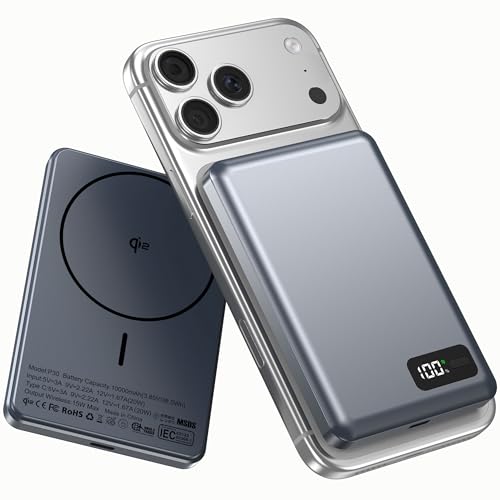
Qi2 Magnetic Power Bank 10000mAh — The Qi2 value 10K
This pack’s title is its argument, stated in specification order: a 10,000mAh magnetic power bank with Qi2 for the iPhone 12-to-18 range, a USB-C battery pack with PD 20W fast charging. Where the MagGo wraps the same standard in a brand and a design story, this listing leads with the standard and the numbers and lets them speak. For the evidence-led buyer, the proposition is legible at a glance — current-standard magnetic charging at full 10K capacity, a stated wired figure, and the broadest iPhone span in the guide, shared with the Baseus.
The 20W wired figure is the honest middle of this guide’s wired range: behind the Zolo’s 30W and the Picogo’s 27W, ahead of silence, and entirely adequate for the cable’s real jobs — the deliberate top-up, the friend’s phone, the gate-side boost. PD in the title means the wired delivery follows the USB Power Delivery negotiation your phone expects, rather than a legacy trickle wearing a fast costume. What the title does not state is a wireless wattage figure alongside its Qi2 claim; Qi2’s standard implies the 15W class the certified siblings quote, but this guide quotes figures only where titles print them, and the product page is where this pack’s number should be confirmed.
Value is the fair summary. The pack assembles the guide’s consensus specification — 10K, Qi2, USB-C, PD wired, full generation span — without a flagship brand’s premium or a design story’s overhead. Buyers who shop by brand narrative will drift to the Ankers; buyers who shop by stated specification will find this listing difficult to argue with, and should spend their diligence on the product page’s details — dimensions, finish, the wireless figure — where this pack will either confirm its paper case or quietly lose it.
- Capacity: 10,000mAh
- Wireless standard: Qi2, per the listing title
- Wireless pace: the listing title offers no figure for this — the maker’s own product documentation is the reference to trust
- Wired output: PD 20W fast charging via USB-C
- Compatibility per title: iPhone 12 through 18
- Format: magnetic USB-C battery pack
- Design details: not stated in the listing title
Strengths
- The consensus specification — 10K, Qi2, PD wired — in one plainly stated listing.
- Full iPhone 12-to-18 span matches the guide’s broadest compatibility.
- PD wired charging at 20W covers the cable’s real-world jobs.
Trade-offs
- Wireless wattage not printed in the title despite the Qi2 claim.
- No dimensions or finish stated for pocket planning.
- Anonymous listing — the specification carries the whole case.
Best for: specification-led buyers who want Qi2 and 10,000mAh without a brand premium.
Not suited for: a shopper who needs every figure, including wireless wattage, printed before shortlisting.
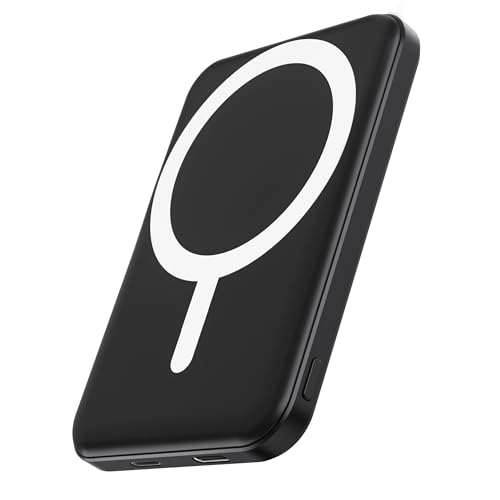
One household pattern suits this pack especially well: the drawer of hand-me-down iPhones. Its title spans iPhone 12 through 18, the widest generation range named by any pick here, so a teenager’s older handset and a parent’s current model can share one snapped-on reserve without checking compatibility at the door. That breadth also softens the Qi2 ambiguity noted in its spec box. The standard is named, yet the wireless wattage goes unstated, so a cautious buyer treats the magnetic side as convenient rather than quantified and leans on the documented PD 20W wired output whenever minutes genuinely matter. For a family pack that drifts between bags, school runs and car consoles, that combination — broad stated fit, honest wired pace, capacity enough for more than one phone’s bad afternoon — is a coherent reason to exist alongside the brand-name Qi2 pair above.
podoru MagSafe Power Bank 5000mAh — The cable-carrying slim pack
The podoru closes the guide with the 5K class’s most complete travel proposition: an ultra-slim 5,000mAh magnetic pack with 20W PD fast charging, presented as travel essentials with a USB-C cable included, for the iPhone 12-through-18 series in black. Each element of that title answers a known failure of slim packs. Ultra-slim answers the pocket. The 20W PD figure — a stated wired number the other 5K pick does not offer — answers the hurry. And the included cable answers the oldest travel farce in electronics: the charger that arrived without its means of being charged.
That cable deserves emphasis because a power bank is itself a device that must be refilled, usually the night before the day it saves. A pack sold with its cable, in a travel-essentials framing, is a kit rather than a component — the buyer is purchasing readiness, not assembling it. For the gym bag, the work tote, the second pack that lives in a partner’s car, that completeness is the product. The magnetic side of the proposition is stated as MagSafe compatibility across the full generation span; no Qi2 claim and no wireless wattage figure appear in the title, and we record both absences plainly.
It also makes an unexpectedly good desk citizen. A slim pack lives happily in a desk drawer or a laptop sleeve where a 10K unit would colonise the space, and the office afternoon — the phone dying between the last meeting and the commute — is precisely a 5K-sized problem. Households sometimes buy the expedition pack for the desk and the slim pack for the journey, which is the two-pack strategy assigned backwards; the podoru’s kit completeness argues for it as the traveller, and its slimness argues for it everywhere else, which is a pleasant kind of indecision to have.
Against the other 5K pick, the slim generic, the podoru trades a shade of anonymity for a fuller stated kit: cable, PD figure, travel framing. Against the 10K class, it makes the minimalist’s standing argument — presence over capacity — with better paperwork. Households building a two-pack strategy, one 10K for expeditions and one slim for every day, will find this the natural second pack; households buying their only pack should weigh whether 5,000mAh truly covers their worst day before choosing slimness as the headline.
- Capacity: 5,000mAh
- Wireless standard: MagSafe-compatible magnetic, per the listing title
- Wireless pace: the listing title offers no figure for this — the maker’s own product documentation is the reference to trust
- Wired output: 20W PD fast charging
- Included: USB-C cable, per the listing title
- Design: ultra-slim; black
- Compatibility per title: iPhone 18/17/16/15/14/13/12 series
Strengths
- Included USB-C cable makes it a complete travel kit out of the box.
- Stated 20W PD wired figure beats its 5K sibling’s silence.
- Ultra-slim form keeps the daily-carry promise of the 5K class.
Trade-offs
- Top-up capacity only — not an expedition reserve.
- No Qi2 claim or wireless wattage in the title.
- Less brand recognition than the Anker pair at the guide’s head.
Best for: travellers and second-pack buyers who want a slim kit that arrives complete.
Not suited for: a sole-pack buyer whose worst days need more than one full rescue.
Which Magnetic Pack Fits Your Pocket, Bag and Cable Habits?
| Pick | Capacity | Wireless standard | Wired output | Defining trait |
|---|---|---|---|---|
| Anker Zolo Magnetic Power Bank 10000mAh | 10,000mAh | MagSafe-compatible | 30W max | Fastest wired, travel build |
| Anker MagGo Power Bank Qi2 10000mAh | 10,000mAh | Qi2-certified, 15W | Not stated in title | Certified standard, ergonomic |
| Baseus Picogo MagSafe Portable Charger | 10,000mAh | Qi2, 15W | 27W | 0.5-inch thin at full capacity |
| Slim Magnetic Power Bank 5000mAh | 5,000mAh | MagSafe-compatible | Not stated in title | Slimmest daily-carry brief |
| Qi2 Magnetic Power Bank 10000mAh | 10,000mAh | Qi2 | PD 20W | Consensus spec, plainly stated |
| podoru MagSafe Power Bank 5000mAh | 5,000mAh | MagSafe-compatible | 20W PD | Cable included, ultra-slim |
The table’s story is the category’s maturation. A few seasons ago, magnetic packs competed on the snap itself; now the snap is assumed and the competition has moved to standards, wired pace and millimetres. Two cells reward a second look: the MagGo’s unstated wired figure, the only gap in an otherwise credentialed row, and the slim generic’s double silence on pace — the pack whose case rests entirely on presence. Neither gap is hidden by this guide, because a comparison table that papers over silences is an advertisement wearing a table’s clothes.
Choose by your dominant mode. Mostly magnetic, all day: the Qi2 rows. Mostly pockets, every day: the 5K rows. Mostly airports: the Zolo’s wired sprint or the Picogo’s thin dual-mode. The pack that matches your dominant mode will be charged, carried and used; the pack that matches your aspirational mode will be admired, at home, in a drawer.
How Does a Two-Pack Strategy Work in a Real Household?
Many households end up owning both classes, and the arrangement, once settled, feels inevitable. The 10K pack is the expedition unit: it lives by the door or in the travel pouch, comes out for journeys, conferences, festivals and the in-laws’ house with one socket per room, and returns to its station to refill. The 5K pack is the citizen: it lives in the everyday bag or jacket, handles the ordinary long afternoon, and asks so little pocket space that its presence stops being a decision. Each class covers the other’s failure mode — the citizen cannot do the expedition, the expedition unit will not be carried daily — and together they cost the household less attention than either does alone.
The strategy also solves the couple problem and the lending problem. A household with two phone users and one pack owns a negotiation; a household with a pack per class owns a rota, and the slim pack becomes the one that can be lent to a teenager, a guest or a colleague without a ceremony, because its absence is survivable. When you read the six titles with this division in mind, the guide reorganises itself: pick your expedition unit from the 10K rows on standard and wired pace, pick your citizen from the 5K rows on slimness and kit completeness, and stop asking either to be the other.
What the two-pack household should not do is duplicate. Two identical 10K packs double the drawer weight without doubling the coverage, and two identical slim packs leave the expedition day unarmed. Variety is the strategy; the titles’ differences — certification here, a cable there, a half-inch elsewhere — are the menu it is chosen from.
What Mistakes Do Magnetic Pack Buyers Keep Making?
The capacity illusion leads: expecting a 10,000mAh pack to deliver two full phone charges, then feeling cheated by physics — conversion and wireless losses are structural, and the honest expectation is a full charge plus a meaningful reserve. Second is the case oversight, discovering at the airport that a beloved thick case defeats the magnet the pack was bought for. Third is buying the expedition class for a commute-class life, then leaving the brick at home on the very afternoons it was purchased for — the minimalist picks exist as the correction. Fourth is ignoring the pack’s own refill: a power bank that is itself empty is a paperweight with magnets, and the included-cable podoru and a bedside refill ritual are the two defences.
Fifth is treating wireless pace as a slogan rather than a standard — “MagSafe compatible” and Qi2 are different levels of claim, and the titles in this guide show both, honestly labelled. Sixth is forgetting the cable entirely: the day a friend’s non-magnetic phone, a pair of earbuds or a gate-side deadline needs wired help, the packs with stated wired figures stop being phone accessories and become the bag’s general rescue service. Buy for the ecosystem in your pocket, not the single device in your hand.
How Should You Build the Daily-Carry Habit?
Assign the pack a home that is also a charging place — the bedside, the desk’s corner — and refill it where it lives, so “grab the pack” and “the pack is full” stay the same sentence. Pair the refill with an existing ritual: the pack charges when the phone charges, overnight, and the pair leave together in the morning like colleagues. If your pack is the slim class, let it live in the bag or jacket it serves rather than migrating between them; a 5K pack’s entire value is positional, and a pack with a fixed address is a pack that is present.
The bedside arrangement deserves one refinement: charge the pack and the phone as a pair, but not always through each other. A phone sipping from a pack that is itself sipping from the wall is living at the end of a chain of losses; on ordinary nights, the phone on its own charger and the pack on its own cable wake as equals, and the pack leaves the house genuinely full rather than approximately so. Reserve the through-chain for travel nights and small hotel rooms, where sockets are the scarcest resource in the building and efficiency is a luxury neither device can afford to demand.
Once a month, give the system a honest audit. Is the pack coming home empty or untouched? Empty means the class is right and the habit is working. Untouched for weeks means either your phone’s battery outgrew the problem — congratulations — or the pack’s size exiled it from daily carry, in which case the other capacity class in this guide is the correction, not a second identical pack. The goal is a boring equilibrium: a phone that never dies in public and a pack whose presence you notice only on the days it saves.
Final Recommendation
If one pack must serve most people, the Baseus Picogo makes the hardest case to refuse: Qi2 at 15W, 27W wired, full capacity, the broadest iPhone span, and a half-inch body that removes the class’s oldest excuse. The Anker MagGo answers for buyers who want the Qi2 certification carried by the category’s most established magnetic line, and the Zolo for travellers whose wired sprints matter as much as their magnetic cruising. The Qi2 10K generic serves the specification-led, the podoru the kit-minded, and the slim generic the true minimalist. Whichever you choose, choose the one your pocket will host daily — because a magnetic pack’s genius was never its capacity, but the fact that on the one afternoon everything runs long, it is simply, magnetically, there.
Frequently Asked Questions
Will these packs work with my iPhone 12 or 13?
The titles say yes for most of the six: the Baseus, the slim generic, the Qi2 10K and the podoru all name the 12 (and 13) in their spans, since magnetic charging arrived with the iPhone 12. The Anker MagGo’s title names the 14 series onward, so 12 and 13 owners should either pick a title that names their phone or confirm on that product page. As always in this guide, the title is the contract.
How many full charges does a 10,000mAh pack really give?
Plan on one full charge plus a substantial reserve rather than two full charges. The pack’s rated capacity is measured at the cell, and conversion to phone voltage plus wireless transfer losses take a structural share before your phone sees a milliamp. The 5,000mAh class, by the same arithmetic, is a decisive top-up. These are the honest expectations the category’s marketing rarely volunteers.
Is Qi2 worth insisting on?
If you charge magnetically most of the time, yes: Qi2 titles here state the standard and its 15W pace, which is the difference between a pack that keeps up with a heavy day and one that merely slows the decline. If your pack is mostly a wired rescue device with a magnetic convenience, the Zolo’s 30W wired case may serve you better than a certification. Match the standard to your dominant mode.
Can I charge another device with the cable?
The wired figures in these titles — 30W, 27W, 20W PD — describe real USB-C output, and a cabled connection does not care whether the receiving device has magnets. That is the quiet second life of every pack here: earbuds, a friend’s phone, a tablet in a pinch. The podoru even includes the cable for it. Check the product page for the exact port arrangement of your chosen pack.
Will a magnetic pack work through my phone case?
Through a MagSafe-compatible case, yes — that ecosystem is what these packs are built for. Through a thick, non-magnetic case, the hold weakens and charging suffers or fails. If your phone lives in heavy armour, verify the case’s magnetic compatibility before the pack’s first trip; the pack cannot be blamed for a barrier it was never promised to cross.
Does wireless charging from a pack generate worrying heat?
Warmth, yes; worry, no — within the standards these products are built and certified to. Wireless transfer is less efficient than a cable, and the difference surfaces as gentle heat in the pack and phone, most noticeably in warm environments or inside a pocket. If the pair feels properly hot rather than warm, separate them, let both cool, and prefer the cable for a while; heat is information, and the wired figures in these titles exist partly as the cool, fast alternative for exactly those moments.
How do I keep the pack itself ready?
Refill it where it lives, on the same overnight rhythm as the phone, and store it part-charged if it will sit unused for weeks — lithium packs age most gracefully neither brimmed nor empty. The monthly audit from the habits section applies: a pack that is always ready and occasionally used is a system working; a pack found empty twice is a ritual asking to be fixed.
What should I try first when a pack suddenly charges slowly?
Work through the physical causes before suspecting the electronics. Lift the pack off, clear any grit from the phone’s back, and reseat it until the magnetic hold feels centred rather than merely attached. Then repeat the session with the case removed, because a case swapped last week can quietly tax a connection that worked all winter. Next, plug the pack’s cable directly into the phone: if the wired pace feels brisk, the cells and circuitry are healthy and the slowdown lives in the wireless link, most often alignment or warmth. Finally, check the pack’s own remaining charge, since a nearly empty reserve can behave politely yet deliver little. Each step isolates one variable, and together they take less time than a frustrated return.
Related Guides
For the rest of the charging map: Best Home Level 2 EV Chargers covers the car, Best Tesla Chargers its NACS sibling, and Best PS4 Controller Chargers the controllers waiting in the den.


