What's inside
- Key Takeaways
- Quick Picks
- How We Chose These Picks
- What Makes NiMH Charging Different From Other Chemistries?
- How Does Self-Discharge Change Your Charging Routine?
- When Does a Refresh Cycle Earn Its Keep?
- Why Do RC Packs Need a Completely Different Charger?
- How Should You Treat Cells That Come Back From Long Storage?
- What Role Does Temperature Play While Charging?
- How Do You Read a NiMH Charger’s Behaviour Like a Diagnostician?
- What Should You Do With Brand-New NiMH Cells?
- How Does NiMH Behave in Cold and Hot Weather?
- Why Do Matched Sets Outperform Mixed Ones?
- How Do You Audit a Second-Hand Batch of Cells?
- What Is the Sensible Way to Retire NiMH Cells?
- How Should Beginners Prioritise Their First NiMH Purchase?
- What Maintenance Do NiMH Chargers Themselves Need?
- How Do You Choose Between Eight Bays and Sixteen?
- What Do the Listings on This Page Not Tell You?
- How Does NiMH Suit Outdoor and Emergency Kits?
- A Note on Charging Labelling and Honest Expectations
- Which NiMH Chargers Deserve a Closer Reading?
- Where Do These Six NiMH Chargers Differ Most?
- What Are the Most Common Mistakes With NiMH Chargers?
- Final Recommendation
- Frequently Asked Questions
- Related Guides
As an Amazon Associate I earn from qualifying purchases. This post may contain affiliate links at no extra cost to you.
**[widgetverdict.com] is reader-supported. When you buy through links on our site, we may earn an affiliate commission.**
Where to buy: each charger below links to its Amazon listing under its full product name, so you can verify bay count, input type and included accessories against the listing before you commit.
The best battery nimh chargers are not simply AA chargers with a chemistry label on the box. Nickel-metal hydride cells have their own habits — a shallow voltage curve, a modest self-discharge appetite even in modern low-leak designs, and a full-charge signal measured in millivolts — and a charger built with those habits in mind extracts noticeably more cycles from the same cells than a generic unit that treats every battery as identical.
This shortlist approaches NiMH from the chemistry outward. It includes high-bay household stations, a charger that also speaks to 1.5-volt lithium-format cells, a travel unit with a USB port, and one specialist that charges NiMH and NiCd battery packs for radio-controlled models — a different sub-class entirely, included because pack owners searching this term need it and cylindrical-cell owners need to know it is not for them.
Read the detailed sections with your own drawer in mind. The right charger for a drawer of matched eneloop-style cells is not the right charger for a drawer that mixes NiCd veterans, 1.5-volt novelties and an RC pack, and pretending otherwise is how good money follows bad into the wrong box.
Key Takeaways
- NiMH fullness is signalled by a tiny voltage dip, so per-cell detection beats timers by a wide margin.
- Refresh modes help diagnose tired cells; they cannot repair damaged or shorted ones.
- Low-self-discharge cells still prefer a top-up before important use after months on a shelf.
- Pack chargers for RC models and cylindrical-cell chargers solve different problems and never substitute.
- Heat is the chemistry’s enemy during charging; a cool finish is a healthy finish.
Quick Picks
| Charger | Badge | Why it earns a place |
|---|---|---|
| BONAI AA AAA Battery Charger 16 Bay for NiMH Rechargeable Batteries | Best high-volume NiMH station | Sixteen independent bays devoted purely to NiMH AA and AAA cells. |
| EBL AA AAA Battery Charger, 8-Bay Individual Charger for NiMH NiCD | Best NiMH and NiCd all-rounder | Eight individual bays that accept both NiMH and NiCd cells, on a mains plug with fast charging. |
| XTAR L8 Pro 8-Bay AA AAA Battery Charger for NiMH and 1.5V Li-ion | Best for mixed NiMH and 1.5V cells | Eight independent slots with an LCD, a refresh mode for old cells, and support for 1.5V lithium-format cells. |
| Amazon Basics Rechargeable Battery Charger for AA and AAA Ni-MH with USB Port | Best portable NiMH charger | A travel-friendly NiMH charger with a USB port and stated over-charge protection. |
| Universal RC NiMH NiCd Battery Pack Charger | Best for RC and airsoft packs | Charges assembled NiMH and NiCd packs across a wide voltage span for RC cars and airsoft replicas. |
| HiQuick 8-Bay Smart AA AAA Battery Charger | Best Type-C eight-bay | Eight smart slots for NiMH cells with Type-C input and multi-protection, aimed at remotes, toys and controllers. |
How We Chose These Picks
Selection started with termination behaviour: every cylindrical-cell pick here watches individual cells rather than pairs or timers, because NiMH’s shallow full-charge signal is easily missed by cruder methods and missed signals become heat. We then spread the picks across household sizes and power sources so the list serves a two-person flat and a Scout troop with equal honesty.
One deliberate inclusion deserves explanation. The universal RC pack charger charges assembled NiMH and NiCd packs through a lead, not loose cells in bays, and it appears because thousands of hobbyists search this exact phrase while holding a Traxxas or airsoft pack. Its section states plainly what it cannot do, and cylindrical-cell buyers should skip it without a second thought.
Specification discipline follows the same rule as the rest of this site: features named in a listing title are treated as verified, and anything the title leaves out is flagged in the spec box as a point to confirm with the maker rather than filled in from imagination.
We also required honest labelling. A charger that supports an unusual format — 1.5-volt lithium-format cells, assembled packs — had to say so in its own listing, in plain terms, because buyers cannot be expected to guess at chemistry support from a photograph. Every unusual capability claimed in the sections below traces to words the maker printed in the product’s title.
Price played no part in the ordering of this list. The sequence follows the logic of a collection audit — fleets first, then mixed chemistries, then travel — because readers scanning for their own situation find their charger faster that way than in a ladder of costs.
What Makes NiMH Charging Different From Other Chemistries?
A NiMH cell spends most of its charge cycle near a plateau, then shows fullness through a small voltage peak and dip accompanied by a gentle temperature rise. Chargers detect that dip — called negative delta V — and stop. Detect it late and the cell vents heat and ages; detect it on a pair of cells wired together and the stronger cell’s signal can mask the weaker one’s entirely, which is why individual channels recur throughout this guide.
NiMH also tolerates, and occasionally benefits from, a full discharge-charge cycle after long storage, unlike lithium cells which prefer partial cycling. That tolerance is why refresh modes exist on NiMH chargers and why they are genuinely useful here rather than marketing garnish: a stored cell suffering voltage depression can present as worn out until one conditioning cycle restores its working voltage.
How Does Self-Discharge Change Your Charging Routine?
Classic NiMH cells could lose a fifth of their charge in the first day after charging and keep leaking steadily afterwards, which made them poor spares. Modern low-self-discharge designs fixed most of that, holding the majority of a charge for many months, and they are what most households now buy whether the packet says so loudly or not.
The routine consequence is simple: charge spares when convenient, but top them up before anything important — a wedding, a camping trip, a tournament weekend — because a cell at four-fifths after a season on the shelf is still a cell at four-fifths. Chargers with clear per-cell indicators make that top-up a five-minute job instead of an act of faith.
When Does a Refresh Cycle Earn Its Keep?
Reach for refresh when a set’s runtime collapses suddenly after storage, when one cell in a matched group starts finishing its charge far earlier than its siblings, or when a new-to-you batch of second-hand cells needs auditing before joining your rotation. The cycle discharges, measures behaviour and recharges, giving you evidence instead of suspicion.
Skip refresh as a weekly ritual. Each conditioning cycle is still a cycle, consuming a slice of the cell’s finite life, and healthy cells in regular service gain nothing from it. Think of the mode as a workshop tool: invaluable on the bench during a diagnosis, pointless as a daily ceremony performed on equipment that was never broken.
Why Do RC Packs Need a Completely Different Charger?
An RC pack is a welded string of cells inside a wrapper, charged as one unit through a connector, at a voltage set by how many cells the string holds. A bay charger cannot touch it, and a pack charger cannot charge your loose AAs. The two products share chemistry words and nothing else, and confusing them wastes money in both directions.
Pack charging also carries its own discipline: match the charger’s voltage setting to the pack, charge on a non-flammable surface, and stay nearby while it runs. The universal pack charger below covers a wide span of pack voltages for cars and airsoft replicas, which is exactly the flexibility a hobby bench needs and exactly what a kitchen drawer does not.
How Should You Treat Cells That Come Back From Long Storage?
Cells retrieved from a year in a drawer often show depressed voltage and refuse the first charge attempt on smarter chargers that expect a minimum starting voltage. Some units offer a recovery or boost behaviour for this case; where a listing does not claim one, patience and a refresh cycle, if fitted, are the tools available. A cell that accepts a charge and then holds it overnight has usually recovered.
Judge recovered cells in gentle service first — a clock, a remote — before trusting them in a flash or a game controller. Storage survivors that pass a fortnight of light duty can rejoin the main rotation with a pencil mark recording their adventure, so future you knows why that set behaves a fraction differently from its shelf-mates.
What Role Does Temperature Play While Charging?
NiMH charging converts a portion of its energy to heat, and the conversion rises sharply near full charge, which is one of the signals better chargers monitor. A charging room that is already hot — a sunlit windowsill, a van in summer — narrows the margin, slowing detection and stressing cells. Charge in ordinary room conditions and the chemistry behaves as the manuals promise.
After charging, let cells rest a few minutes before sealing them into an airtight device, and never cover a working charger with paperwork or cloth. These are small courtesies, but battery chemistry rewards small courtesies with years of extra service and punishes their absence with mysterious early failures.
How Do You Read a NiMH Charger’s Behaviour Like a Diagnostician?
Watch three things across a charge: how long each cell takes relative to its siblings, how warm it feels at the end, and how it performs afterwards in a device you know well. A cell that finishes early, runs warm and fades fast in service is failing on all three counts, and no charger setting will talk it out of retirement.
Keep notes for a month and patterns emerge that memory alone would miss. The set that always finishes together is your first-choice set for demanding work; the set with one habitual laggard gets split, its healthy members regrouped into a gentler duty group. This is the unglamorous craft that separates owners whose rechargeables last five years from owners who swear the technology never worked.
What Should You Do With Brand-New NiMH Cells?
New cells rarely arrive at full stride. Manufacturers ship them partially charged, and the first two or three cycles wake the chemistry up, so judge a new set by its third charge rather than its first evening. If a charger offers a break-in or refresh behaviour, the first week is its most defensible moment to use it.
Mark the purchase date on every new set the day it arrives. That tiny habit powers every later decision in this guide: grouping, rotation, retirement. A set with a date is data; a set without one is folklore, and folklore is how five-year-old cells end up paired with fresh ones and ruining both their reputations.
How Does NiMH Behave in Cold and Hot Weather?
Cold slows NiMH chemistry, trimming the current it can deliver and the capacity it shows, which is why winter camping torches fade early even on freshly charged cells. Warm the spares in an inside pocket and rotate them through the torch, and the same set performs respectably. Heat is the worse enemy: a hot car boot in August ages cells faster than a season of honest work.
Charge at room temperature whenever you can, store spares away from radiators and sunny sills, and treat any cell that swells, leaks or smells unusual as finished. NiMH is among the most forgiving rechargeable chemistries ever sold, but forgiveness has limits and weather finds them.
Why Do Matched Sets Outperform Mixed Ones?
Cells in series share current, so the weakest member reaches empty first and then gets pushed backwards by its stronger partners — the fastest route to permanent damage in this chemistry. A matched set, bought together and cycled together, empties in unison and spares every member that abuse, which is why matched sets so often outlive mixed ones by years rather than months.
Chargers with individual channels quietly enforce matching discipline, because they show you the laggard instead of hiding it inside a pair. When the display or the finish times tell you one cell no longer belongs, believe them the first time rather than the fifth.
How Do You Audit a Second-Hand Batch of Cells?
Used cells arrive cheap and unknown, and the charger is your interview room. Charge each cell individually, rest the batch overnight, then run every cell through the same forgiving device — a torch with a timed session works well — and record which ones fade early. Cells that charge evenly, rest calmly and work honestly join the second-line group; the rest go straight to recycling.
Never merge auditioned cells into your front-line matched sets, however well they behave in week one. Their history is unknown, their remaining life is a guess, and front-line sets earn their reliability precisely by sharing a known history. Keep the audition group together, marked, and assigned to duty where a surprise fade costs nothing.
What Is the Sensible Way to Retire NiMH Cells?
Retire a cell when two of three witnesses agree: charge behaviour has changed, service runtime has collapsed, or the body shows damage, swelling or leakage. One witness can lie — a charger can misread, a device can develop a fault — but two together rarely do, and waiting for the third witness usually means a leaked cell in a favourite device.
Recycling is the only correct exit. Battery collection points accept NiMH without fuss, and taping the terminals of a handful of retired cells before the trip is a small courtesy that prevents shorts in the collection bin. A chemistry this recyclable deserves its proper ending rather than a landfill grave.
How Should Beginners Prioritise Their First NiMH Purchase?
Buy the charger before the exotic cells. A competent individual-channel unit makes even supermarket NiMH cells behave respectably, while premium cells on a crude paired charger disappoint within a season. Spend first on detection and channels, second on a modest stock of matched low-self-discharge cells, and only later on capacity upgrades or specialty formats.
Resist the giant multipack of unknown cells as a starting move. Begin with two matched sets, learn their behaviour in your hungriest devices, and expand the fleet in the same brand and line once the routine sticks. A small, understood collection outperforms a large, mysterious one in every device that matters.
What Maintenance Do NiMH Chargers Themselves Need?
Almost none, which is part of their charm, but contacts deserve a wipe twice a year. Spring terminals collect pocket lint and the faint residue of a thousand insertions; a dry cloth or a pencil eraser restores a clean connection, and clean connections keep charge detection honest. A charger that starts misreading cells is often simply a charger with dirty contacts.
Keep vents clear, store the unit dry, and coil its cable loosely rather than winding it tight around the body, because the cable’s entry point is the most common mechanical failure on units that otherwise outlive their cells. Five minutes of care a year is the entire maintenance contract.
How Do You Choose Between Eight Bays and Sixteen?
Count a peak week, not an average one. Add up the cells your household or club empties between Friday and Sunday, including the spares you wish you had, and buy bays for that number plus a small margin. Average weeks flatter small chargers; peak weeks are when disposables creep back in and habits quietly die.
If the peak count lands between the two sizes, choose by chemistry breadth instead: the household that also runs NiCd or 1.5-volt formats gains more from the versatile eight-bay units here than from raw bay count, while the pure-NiMH fleet gains more from the sixteen-bay station’s single-minded throughput.
What Do the Listings on This Page Not Tell You?
Listing titles rarely state charge current per slot, termination thresholds or behaviour with a deeply discharged cell, and those omissions are exactly why the spec boxes in this guide flag them for maker verification instead of guessing. A buyer comparing two finalists should spend five minutes in each maker’s documentation checking those three points before deciding.
That homework matters because two chargers with identical bay counts can treat a tired cell very differently — one coaxing it through a recovery, the other rejecting it outright. Neither behaviour is wrong in itself, but the right one for your collection is the one that matches how many tired cells you honestly own.
How Does NiMH Suit Outdoor and Emergency Kits?
NiMH earns its place in emergency kits through temperament rather than spectacle: it tolerates storage, partial use and rough handling better than most rechargeable options, and its cells are light enough to carry in useful numbers. A go-bag with two matched sets per device, rotated through a charger every few months, stays ready without any of the calendar anxiety that primary lithium stockpiles create.
Pair the kit with a USB-fed or travel charger from this list and the same cells can be revived from a vehicle or a power bank when the mains are down. That resilience, more than any single specification, is why NiMH remains the default chemistry of torches, radios and lanterns in prepared households.
A Note on Charging Labelling and Honest Expectations
Makers describe charging behaviour in their own dialects — smart, rapid, intelligent, pro — and none of those words is regulated. What can be verified is narrower and more useful: which chemistries the title names, whether channels are individual, what protection the maker claims in print, and which input the unit drinks from. This guide has leaned on exactly those verifiable points and flagged everything else for the maker’s documentation, because a charger review that invents its specifications helps nobody choose.
Which NiMH Chargers Deserve a Closer Reading?

BONAI AA AAA Battery Charger 16 Bay for NiMH Rechargeable Batteries — Best high-volume NiMH station
Viewed through a NiMH lens rather than a household one, the BONAI’s appeal is focus: every one of its sixteen bays exists for nickel-metal hydride cells and nothing else, so there are no chemistry menus to mis-set and no lithium modes to misunderstand. For an organisation cycling cells by the dozen — a theatre company with radio mics’ AA spares, a school with classroom gadgets — that single-mindedness removes a whole category of operator error.
NiMH behaviour at scale is a sorting problem as much as a charging one. Sixteen independent bays let a keeper run an entire fleet through on a Sunday evening and note, from the LED pattern, which cells finished implausibly fast and should be benched for a refresh or retired. Run in pairs or on a timer, the same fleet would hide its weak members until they failed in service.
The mains plug keeps charge behaviour identical week after week, which matters when you are comparing finish times across a fleet to judge cell health; a variable USB supply would muddy that evidence. Cells are not included, so budget for the fleet itself, and give the station a fixed shelf, because a charger this size that migrates between rooms soon stops being infrastructure and becomes clutter.
Fleet keepers should also plan the retirement pipeline: a labelled recycling box beside the station, so a benched cell leaves circulation immediately instead of drifting back into a lantern. At sixteen-bay scale, discipline about exits matters as much as discipline about charging, because one zombie cell in a shared fleet generates complaints out of all proportion to its numbers.
In short, the BONAI is NiMH infrastructure: buy it when the fleet is real, and it disappears into the routine it creates.
Organisations should name one person as keeper of the station. Shared chargers with no owner drift into chaos within a season, while a named keeper’s Sunday routine keeps the fleet’s records, rotations and retirements quietly straight.
The station also moonlights at events: a wedding venue’s box of LED candles and a festival’s lantern fleet both charge happily in its bays overnight.
- Bays: 16 bays sized for AA and AAA cells
- Chemistry: NiMH rechargeable batteries only, per the listing title
- Control: independent control with LED light per bay
- Plug: standard American AC charging plug
- Cells included: none — batteries not included per the title
Strengths
- Sixteen independent bays suit fleet-scale NiMH cycling
- Single-chemistry focus removes mode mistakes
- Consistent mains power makes finish times comparable
Trade-offs
- NiMH only — no NiCd or lithium-format support
- No cells included in the purchase
- Large footprint needs a permanent home
Best for: clubs, schools and big households cycling NiMH cells in bulk.
Not suited for: hobbyists who also need to charge assembled RC packs.

EBL AA AAA Battery Charger, 8-Bay Individual Charger for NiMH NiCD — Best NiMH and NiCd all-rounder
Plenty of benches still hold NiCd cells — in older cordless tools, garden lights and hobby gear — alongside modern NiMH stock, and this EBL serves both chemistries across eight individual bays. Individual control is the phrase that matters: each cell negotiates its own charge, so a NiCd AA and a NiMH AAA can share the unit without either being charged on the other’s assumptions.
Fast charging on a mains supply suits households that turn cells around daily, though the usual counsel applies: speed is for need, not habit, and cells charged gently on ordinary days will outlast cells sprinted nightly. The eight-bay layout hits the size most families actually fill, large enough for two game controllers plus remotes, small enough for a kitchen shelf.
If your collection is purely NiMH and you crave a screen, other picks here serve you better. If your drawer honestly mixes two chemistries and several decades, this is the pragmatic centre of the list — the charger that asks the fewest questions and answers most of them.
Workshop owners running NiCd-era garden tools will appreciate not needing a second legacy charger gathering dust. One caution travels with dual-chemistry units: keep the chemistries in separate, labelled groups at storage time, because the cells look identical on the shelf and only the charger’s per-cell detection stands between a mix-up and a spoiled set.
In short, the EBL is the diplomat of this list, fluent in two chemistries and welcome on any bench that speaks both.
If your NiCd stock is down to one cherished tool, this unit still justifies itself, because the alternative is a dedicated legacy charger bought for a single job and stored for a decade.
Keep one bay discipline with this unit: load the oldest set first when several queue, so no set waits discharged longer than its turn requires.
- Bays: 8 individual bays for AA and AAA cells
- Chemistries: NiMH and NiCd rechargeable batteries
- Plug: AC plug for mains power
- Charging style: fast charging claimed in the listing title
- Display type: absent from the title; EBL documentation decides the matter
Strengths
- Handles NiMH and NiCd in individual bays
- Eight bays match typical family demand
- Mains power keeps fast charging consistent
Trade-offs
- No screen for detailed cell diagnostics
- Fast charging used nightly shortens cell life
- Pure-NiMH homes pay for unused NiCd support
Best for: mixed-chemistry households with older NiCd gear still in service.
Not suited for: data-minded owners who want per-cell figures on a display.

XTAR L8 Pro 8-Bay AA AAA Battery Charger for NiMH and 1.5V Li-ion — Best for mixed NiMH and 1.5V cells
The L8 Pro addresses a confusion spreading through battery drawers: 1.5-volt lithium cells in AA and AAA clothing, which deliver a flat voltage curve that some devices adore and which absolutely require their own charging logic. XTAR’s station charges those alongside ordinary NiMH, slot by slot, with an LCD reporting what each position is doing — the correct, supervised way to run a genuinely mixed collection.
Its refresh mode speaks directly to this guide’s theme. Older NiMH cells that have slumped through storage can be cycled and assessed on the same unit that charges your modern stock, and the display turns the assessment into something readable rather than guesswork. Type-C power keeps the unit travel-friendly, drawing from the same cable ecosystem as your phone and laptop.
Respect the boundary the listing implies: the lithium support is for regulated 1.5-volt format cells, not raw cylindrical lithium cells, which belong on the dedicated chargers covered elsewhere in this cluster. Used within its brief, the L8 Pro is the most technically literate charger in this particular six.
The L8 Pro also rewards owners who keep a small notebook of refresh results. A cell that recovers most of its runtime after conditioning earns a second season; one that recovers little has told you its future plainly. Few household gadgets offer that kind of honest conversation, and owners who listen save real money across a year.
In short, the XTAR is the thinking owner’s charger, built for collections that mix formats and reward attention.
Owners of voltage-sensitive audio gear often prefer 1.5-volt format cells for their flat delivery; this is the charger that lets those cells coexist with the household NiMH stock under one supervised roof.
Photographers using 1.5-volt format cells in triggers and meters will value having those cells and their NiMH flash sets under one display.
- Bays: 8 bays with independent slots and mixed charging
- Chemistries: NiMH plus 1.5V Li-ion rechargeable AA and AAA format cells
- Display: LCD display showing slot status
- Modes: refresh mode for old cells stated in the title
- Input: Type-C powered
Strengths
- Charges NiMH and 1.5V lithium-format cells side by side
- Refresh mode audits tired NiMH stock
- LCD plus independent slots give full visibility
Trade-offs
- Type-C input depends on the strength of your supply
- More settings than casual users will ever touch
- Not a charger for raw unregulated lithium cells
Best for: technically confident owners running NiMH beside 1.5V format cells.
Not suited for: anyone wanting a plug-it-in-and-forget-it unit with zero menus.

Amazon Basics Rechargeable Battery Charger for AA and AAA Ni-MH with USB Port — Best portable NiMH charger
Travel exposes weak charging setups, because hotel rooms ration outlets and long drives ration patience. This Amazon Basics unit is built for that world: a portable body, a USB port for the pass-through charging of a small device, and stated over-charge protection for the cells riding in its bays while you sleep in an unfamiliar room.
NiMH cells are the right travel companions — no airline drama, available worldwide, forgiving of partial top-ups — and a charger that treats them individually keeps a small travel set healthy across a whole trip. Pack four AAs and four AAAs, charge in rotation, and remotes, torches and camera accessories all stay alive without a single disposable purchase abroad.
At home it plays the second-charger role happily, living in a guest room or a camper. Buyers wanting fleet capacity or a diagnostic screen should look at the bigger stations in this list, but buyers wanting a dependable NiMH companion that fits a wash bag have found their pick.
Caravan and narrowboat owners, who live with limited sockets and long evenings, are this unit’s natural constituency. It sips from whatever supply the site offers, keeps the torch and radio cells turning over, and its USB port covers the evening phone top-up without another adapter in the drawer.
In short, the Amazon Basics travel unit is the NiMH companion that fits the bag and minds its own behaviour.
For students in halls, the same portability applies: one small charger, one wash-bag pouch of cells, and no dependence on a shared kitchen’s single free socket.
A final travel virtue: the unit’s modest appetite plays nicely with the single free socket in a train compartment or a budget hotel room.
- Chemistries: AA and AAA NiMH batteries
- Extra: USB port included on the unit
- Protection: over-charge protection stated in the listing title
- Design: portable, travel-friendly body per the title
- Bay count: unlisted in the title — Amazon Basics publishes it in the manual
Strengths
- Portable body suits travel and caravans
- USB port adds device-charging utility
- Over-charge protection stated in the listing
Trade-offs
- Small capacity trails the eight-bay stations
- No display for cell-health insight
- Bay count needs confirming on the listing
Best for: travellers and caravan owners running a compact NiMH kit.
Not suited for: households cycling a dozen or more cells weekly.
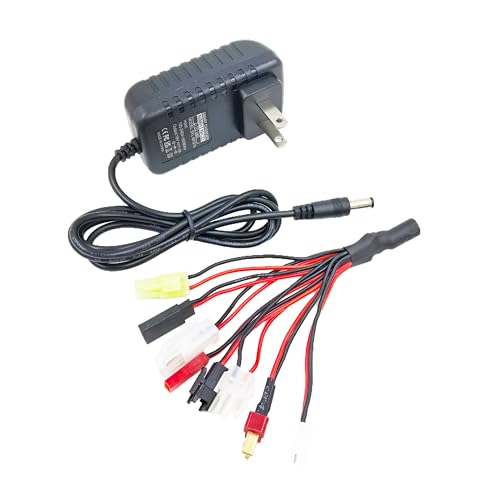
Universal RC NiMH NiCd Battery Pack Charger — Best for RC and airsoft packs
This charger exists for a different drawer entirely: the hobby box where assembled packs for RC cars and airsoft replicas live, each a welded string of NiMH or NiCd cells with a connector instead of loose ends. It charges those packs whole, across a 2-to-10-cell string range, covering the common pack voltages named in its title from small receiver packs to full-size car sticks.
Frame it correctly and it is indispensable; frame it wrongly and it is useless. It will not charge the loose AA cells in your television remote, and no bay charger in this guide will charge your RC packs. Owners of both worlds need both tools, which is precisely why this roundup separates them instead of pretending one product covers the hobby bench and the kitchen drawer.
Charge packs on a clear, non-flammable surface, confirm the voltage setting matches the pack before connecting, and stay within earshot while it runs. Treated with that ordinary hobby discipline, a universal pack charger like this one keeps a whole fleet of models running on rotation without a shelf of brand-specific bricks.
Bench discipline matters more than brand loyalty in pack charging. Keep a printed note of each pack’s cell count taped near the charger, set the voltage before connecting rather than after, and give finished packs a rest before running them. Packs treated that way deliver their seasons; packs charged carelessly on the wrong setting become cautionary tales at the club.
In short, the pack charger is a specialist tool that earns its shelf only in a genuine RC or airsoft household.
Clubs that lend models to newcomers should keep this charger at the pit table with its settings card attached, because borrowed gear returns with packs at every state of charge imaginable.
Keep the charger’s lead and adapters in a labelled pouch with the packs themselves, and the whole system survives being lent to a fellow club member intact.
- Function: charges assembled NiMH and NiCd battery packs, not loose cells
- Pack range: 2-10S strings per the listing title
- Voltages named: 4.8V, 7.2V, 8.4V, 9.6V and a 2.4V-12V span in the title
- Use cases named: RC cars including Traxxas packs, and airsoft battery packs
- Plug: AC-DC plug charger per the title
Strengths
- Covers a wide span of NiMH and NiCd pack voltages
- One unit replaces several brand-specific pack bricks
- Purpose-built for RC car and airsoft packs
Trade-offs
- Cannot charge loose cylindrical cells at all
- Requires the user to set pack voltage correctly
- No use to households without RC or airsoft gear
Best for: RC car and airsoft owners maintaining several assembled packs.
Not suited for: anyone shopping for a charger for loose AA or AAA cells.

HiQuick 8-Bay Smart AA AAA Battery Charger — Best Type-C eight-bay
HiQuick’s eight-bay unit is aimed squarely at the devices its listing names — remotes, toys and game controllers — which is to say the exact fleet that empties a family’s NiMH stock every week. Eight smart slots take any count from a single cell to a full house, and the Type-C input means the charger can feed from the same modern bricks and hubs already scattered around a family home.
Multi-protection, as stated in the listing, is the reassurance that matters in a charger children may load under supervision: the unit watches its own charging so a distracted household does not have to. Pair it with the maker’s bundled rechargeable cells, as the listing describes, and a family can convert its three hungriest devices in one purchase.
Feed it from a healthy Type-C supply rather than the weakest port in the house and charge times stay civilised. Households wanting NiCd support or pack charging should look at the EBL or the RC unit respectively; households wanting a modern, simple NiMH station for everyday devices will find this one easy to live with. Our next stop for many readers is the vehicle side of charging, covered in the best automatic battery chargers guide.
Parents should note the quiet virtue of slots that accept any count: a single cell for a night-light remote charges alone at bedtime without a partner hunt through the toy box. That small convenience, repeated nightly, is what keeps a family’s rechargeable habit alive after the novelty of the purchase fades.
In short, the HiQuick is the family NiMH station for homes whose devices empty cells faster than plans can track.
Grandparents hosting grandchildren weekly will recognise the pattern this charger serves: a burst of toy demand every Friday, a calm recharge every Sunday night.
Label the family’s sets by device — controller set, torch set, toy set — and this charger’s eight slots map neatly onto the household’s real demand.
- Bays: 8 slots for one to eight AA or AAA NiMH batteries
- Input: Type-C input for power
- Protection: multi-protection stated in the listing title
- Bundled cells: listing pairs the charger with AA and AAA rechargeable batteries
- Named uses: remotes, toys and game controllers
Strengths
- Eight smart slots match family device churn
- Type-C input suits modern homes
- Multi-protection stated for peace of mind
Trade-offs
- Charge pace depends on your Type-C supply
- NiMH focus excludes NiCd owners
- No screen for detailed diagnostics
Best for: families converting remotes, toys and controllers to NiMH.
Not suited for: hobbyists needing NiCd or assembled-pack support.
Where Do These Six NiMH Chargers Differ Most?
| Charger | Format and capacity | Standout trait |
|---|---|---|
| BONAI AA AAA Battery Charger 16 Bay for NiMH Rechargeable Batteries | 16 bays, NiMH AA and AAA | Chemistry-pure high-volume design |
| EBL AA AAA Battery Charger, 8-Bay Individual Charger for NiMH NiCD | 8 bays, NiMH and NiCd | Dual-chemistry individual channels |
| XTAR L8 Pro 8-Bay AA AAA Battery Charger for NiMH and 1.5V Li-ion | 8 bays, NiMH and 1.5V Li-ion | Refresh mode with LCD reporting |
| Amazon Basics Rechargeable Battery Charger for AA and AAA Ni-MH with USB Port | Compact bays, NiMH AA and AAA | USB port in a portable body |
| Universal RC NiMH NiCd Battery Pack Charger | Pack charging, 2-10S strings | Wide pack-voltage coverage |
| HiQuick 8-Bay Smart AA AAA Battery Charger | 8 bays, NiMH AA and AAA | Type-C input with multi-protection |
The honest split in this table is between cell chargers and the pack charger, which share a chemistry and nothing else. Among the cell chargers, choose by collection: pure NiMH fleets suit the BONAI or HiQuick, mixed NiCd stock suits the EBL, 1.5-volt format cells point to the XTAR, and travel points to the Amazon Basics. Chemistry first, bays second, brand last — that ordering produces the fewest regrets. One more distinction hides in the power column of your life rather than this table: Type-C and USB-fed units borrow their pace from your existing bricks, while mains units bring their own. Neither is superior in the abstract; the right answer is the one that matches the sockets where charging will actually happen. Keep the photograph of your drawer beside you while reading the table; it settles arguments that specifications alone cannot.
What Are the Most Common Mistakes With NiMH Chargers?
- Putting a 1.5-volt lithium-format cell on a plain NiMH-only charger and expecting the two to negotiate.
- Running refresh cycles weekly on healthy cells and spending their lifespan on diagnostics they never needed.
- Charging an RC pack with a bay charger, or loose cells with a pack charger, because both boxes mention NiMH.
- Storing charged spares in a hot car through summer and blaming self-discharge for the resulting fade.
- Trusting a cell that finishes charging in minutes to be full, when it is actually worn down to a fraction of its capacity.
The minutes-to-full trap deserves emphasis because it inverts intuition. A charger reports time against the capacity the cell can still accept, so a dying cell ‘charges’ fastest of all. When a once-slow set suddenly finishes early, celebrate nothing: run a refresh, test the set in a demanding device, and be ready to retire it.
Chemistry literacy is the thread through every mistake above. NiMH rewards owners who learn its handful of habits — gentle heat, per-cell detection, occasional conditioning — with years of boring reliability, which is the highest praise a battery system can earn.
There is also a purchasing mistake hiding in this category: buying a second charger to solve a cell problem. When runtimes sag across every device at once, the common cause is usually one ageing batch of cells moving through the house, and a refresh-equipped pick from this list will prove it in an evening for less than the cost of another blind charger.
A final purchasing trap: assuming the biggest bay count signals the best charger. Bays are capacity, not quality, and a sixteen-bay unit with poor detection would mistreat sixteen cells at once. Detection first, channels second, bays third — the ordering in this guide is deliberate.
Final Recommendation
A closing word on expectations: NiMH is a mature, well-understood chemistry, and the gains available now come from matching and management rather than miracle hardware. Every pick above manages cells individually; the differences that remain are about your collection’s shape, and this guide has tried to map each shape to its charger honestly.
One practical starting move: photograph your battery drawer today. The picture will show, more honestly than memory does, how many chemistries and formats you truly run, and it turns the choice between these six chargers from a guessing game into a matching exercise you can finish in one sitting.
If your home runs on NiMH and nothing else, the HiQuick eight-bay is the easiest daily driver here, while the BONAI station takes over when the fleet grows past a dozen cells in weekly motion. Mixed collections should start with the EBL for NiCd tolerance or the XTAR L8 Pro when 1.5-volt format cells and refresh diagnostics enter the picture.
Keep the pack charger in its own mental category, buy it only if assembled packs genuinely live in your hobby box, and let every other decision follow the chemistry in your drawer. Get that one ordering right and the charger you choose will still be quietly serving the same cells when the next battery technology fashion has come and gone.
Whichever direction you take, give the pairing a month before judging it. NiMH systems reveal themselves across cycles, not evenings, and the household that tracks one month of honest behaviour ends up with a setup it can trust for years.
Frequently Asked Questions
Are NiMH chargers and AA chargers the same thing?
Mostly, but not always. Nearly all AA bay chargers sold today are NiMH chargers, yet some also handle NiCd or 1.5-volt lithium-format cells, and RC pack chargers handle NiMH chemistry without accepting a single loose AA. Read the chemistry line of any listing before assuming your cells and a charger agree with each other. A charger that lists only NiMH should never be handed a lithium-format cell, whatever the shape suggests. Shape is a liar in battery drawers; the printing on the wrapper is the only witness worth trusting.
How do I know when a NiMH cell is fully charged?
On a smart charger, the indicator for that slot changes state when the charger detects the full-charge signal. Without instrumentation, the honest answer is that you cannot judge precisely by touch or time, which is why per-cell detection matters: the charger is watching a millivolt signal your fingers will never feel. Warmth in the final minutes is expected; heat that lingers afterwards deserves a closer look at that cell. A single odd reading deserves a retest before it earns a verdict on the cell.
Does fast charging damage NiMH cells?
Used occasionally, no meaningful harm; used nightly at the highest rates, it trades lifespan for convenience through extra heat. The sensible pattern is gentle charging for routine top-ups and faster modes when time genuinely presses. Cells are consumables either way, but the gentle pattern stretches each set across noticeably more cycles. Routine gentle charging remains the single kindest habit an owner can build. Households that charge gently also tend to notice problems earlier, because their baselines stay stable.
Can I leave NiMH cells in the charger between uses?
A smart charger that has ended its cycle and dropped to a maintenance state will not harm them over a day or two, and several listings here state over-charge protection explicitly. For longer storage, a cool shelf in a case is kinder than living in any charger, and it keeps your rotation honest. Rotation between two sets also halves the temptation to leave cells sitting in devices for months. A labelled charged pouch prevents most accidental deep-storage mistakes.
Why did my stored NiMH cells seem dead after a year?
Voltage depression and self-discharge together can make a stored cell look finished when it is mostly asleep. A refresh cycle, where the charger offers one, or two ordinary charge-and-use cycles in a gentle device, usually restores working behaviour. Cells that still refuse afterwards have genuinely reached the end. Two gentle cycles in a clock will tell you more than any amount of hopeful guessing. The first cycle after recovery is a probation shift, not a promotion.
What charger do Traxxas and airsoft packs need?
They need a pack charger matched to the pack’s cell count and voltage, such as the universal unit in this guide, which covers a 2-to-10-cell string span. Loose-cell bay chargers cannot connect to an assembled pack at all, and improvising connections is a firm no — use the charger built for the format. Keep each pack’s paperwork with the pack, and the correct setting is never a memory test. Voltage first, connector second, and patience throughout — pack charging rewards all three.
Can one charger really handle both NiMH and NiCd cells?
Yes, when the maker designs and lists it for both, as the EBL in this guide does. The two chemistries share enough charging character for a well-built unit to serve each properly on individual channels. The reverse assumption is the dangerous one: a NiMH-only unit should not be handed NiCd cells on optimism alone, and a charger silent about a chemistry has not promised it. When in doubt, split the batch and audition half this week and half next.
Related Guides
From loose cells the natural next step is the sealed battery in a vehicle, where charging turns automatic: our guide to best battery float chargers explains how modern units run a full charge cycle without supervision.
For batteries that sit in storage between seasons, the companion piece on best golf cart battery chargers covers the slow art of keeping them ready on a float charge.
Related guide: Best Home Level 2 EV Chargers
Related guide: Best Tesla Chargers
Related guides
- Best 14-Inch High-End Laptops: Flagships From Apple, Lenovo, ASUS and LG
- Best 15 Laptops Under $1000: Six 15-Inch Machines That Spend the Budget Honestly
- Best Affordable Android Phones: Value Measured Across Four Years
- Best 3D Printers With Auto Leveling: Beds That Set Themselves, Ranked by How Much Else They Calibrate

[…] the two or three dozen NiMH cells a station like this exists to serve. Our companion guide to the best battery nimh chargers goes deeper on chemistry behaviour if you want to understand what those cells are doing on the […]