What's inside
- Key Takeaways
- Quick Picks
- How We Chose These Picks
- Comparison
- Dye or Pigment: Which Ink Belongs on Canvas?
- How Do You Prepare a Photograph for Canvas?
- How Wide Should a Canvas Printer Be?
- What Does Canvas Do to a Photograph?
- How Do You Finish and Hang a Canvas Print?
- Common Mistakes
- How Should a Small Studio Organise Its Canvas Work?
- Final Recommendation
- Frequently Asked Questions
- Related Guides
As an Amazon Associate I earn from qualifying purchases. This post may contain affiliate links at no extra cost to you.
widgetverdict.com is reader-supported. When you buy through links on our site, we may earn an affiliate commission.
A photograph on canvas stops being a file and becomes furniture. It hangs in a hallway, leans in a studio corner, gets wrapped as a gift that cannot be re-gifted. The best canvas photo printers are therefore judged by a stricter standard than ordinary photo printers: the print must survive being stretched, or mounted, or simply lived with at large size, where every weakness in colour gradation and shadow detail is enlarged along with the image. This guide reads six machines that can plausibly serve that ambition — five photographic inkjets built around wide formats and multi-colour ink sets, and one honest outlier, a 24-inch plotter, whose presence is explained rather than disguised below.
Canvas itself is the first thing to understand, because it is not paper with a texture printed on it. It is a woven medium with a tooth that drinks ink differently from glossy stock, softens the finest detail, and forgives some flaws while exposing others — banding shows cruelly across a canvas sky, while a slightly soft portrait often gains from the weave. Printing on it well is a partnership between the machine’s ink set, the width it can feed, and the photographer’s willingness to proof at small size before committing a full sheet. The machines below divide by ink philosophy: dye inks that sink in and glow, pigment inks that sit up and endure, a six-colour tank system that trades a little refinement for running costs a working studio can sustain, and the plotter’s CAD-bred line, which plays by different rules entirely.
As throughout this site, no prices and no star ratings appear here. What appears is a close reading of each listing title — the verified facts each manufacturer chose to put in it — and analysis built only on those facts: format width, ink colours and type where stated, display, speed where stated, and intended setting. Where a title is silent about canvas media handling specifically, the spec boxes say so in plain words, because a canvas buyer deserves to know which claims are printed by the manufacturer and which must be confirmed in the documentation before a roll of canvas enters the house.
Key Takeaways
- Width is the canvas gatekeeper: five picks print at 13 inches or wider, with the Canon PRO-1100 reaching 17 inches and the HP DesignJet T210 plotter reaching 24 inches by a completely different route.
- Ink philosophy splits the field — the PRO-200S uses an 8-colour dye set, the PRO-310 a 9-colour pigment set, and that dye-versus-pigment choice matters more on canvas than on glossy paper.
- The Epson EcoTank Photo ET-8550 is the only tank machine here, printing 13 x 19 inches in six colours without cartridges — the volume canvas printer’s economy.
- The DesignJet T210 is a plotter built for CAD and posters; it can put an image on a large sheet, but it is not a photographic inkjet and is reviewed as its own species.
- No listing title here states canvas media handling explicitly, so every spec box records that silence and points to the manufacturer documentation — verify media support before buying canvas stock.
- Displays are unusually good in this class: both Canon PRO models carry a 3-inch colour LCD, useful when the printer lives across the studio from the computer.
Quick Picks
| Pick | Badge | Why it earns its place |
|---|---|---|
| Epson Expression Photo HD XP-15000 | Wide-format home studio value | Six-colour wide-format photo printing up to 13 x 19 inches with auto 2-sided printing, aimed at photographers and home studios. |
| Canon PIXMA PRO-200S | Dye-ink colour richness | A professional 13-inch machine with an 8-colour dye ink system and a 3-inch colour LCD for standalone control. |
| Canon imagePROGRAF PRO-310 | Pigment-ink gallery intent | A professional 13-inch printer with a 9-colour pigment ink set — the archival temperament in the smaller format. |
| Epson EcoTank Photo ET-8550 | Tank economy at 13 x 19 | Cartridge-free six-colour wide-format printing with scan and copy, at up to 16 ppm, for creators who print constantly. |
| HP DesignJet T210 24-inch Plotter | The large-format outlier | A 24-inch plotter for CAD and poster prints — the route to genuinely large canvas-style pieces, with a plotter’s compromises stated openly. |
| Canon imagePROGRAF PRO-1100 | 17-inch exhibition class | The widest photographic format here at 17 inches, from Canon’s professional imagePROGRAF line. |
How We Chose These Picks
Canvas printing imposes three requirements before any question of quality arises. The machine must feed wide media, because a canvas piece smaller than its ambition is a coaster. It must lay down colour with enough subtlety that skin, sky and shadow survive enlargement onto a textured weave. And it must be a machine a photographer can live with in a studio rhythm — proofing, adjusting, reprinting — without each iteration feeling like a financial event. The selection below was built by applying those three requirements to the verified pool for this site and keeping the machines that answer at least two of them emphatically.
Ink sets were read as the primary quality signal, because on canvas the ink is the image: there is no glossy surface to flatter a weak colour. Six colours is the floor in this company, and the field rises through the PRO-200S’s eight dye colours to the PRO-310’s nine pigment colours. Dye and pigment are treated throughout as temperaments rather than a hierarchy — dye for saturation and smooth gradation, pigment for matte depth and longevity — and the guide argues the choice from the kind of canvas work being done rather than crowning one chemistry for all purposes.
The plotter requires its own explanation, and it gets one here rather than in a footnote. A canvas guide that pretended the large-format world did not exist would fail readers whose ambition is a metre-wide piece. The HP DesignJet T210 states its purpose in its title — CAD and poster prints — and it is included as exactly that: a 24-inch plotter that some canvas buyers will legitimately choose for scale, understanding that its ink system and media path were designed for line work and posters. It is labelled a plotter in every table and heading in this guide. A reader who wants photographic ink on canvas should read its review as a boundary marker showing where the photographic machines end.
Finally, an honesty note that applies to every pick: none of the six listing titles states canvas media support in so many words. Wide-format photo printing is stated; canvas, specifically, is not. Canvas buyers should confirm media compatibility, thickness limits and feed path in the manufacturer documentation for their chosen model before ordering canvas stock — the spec boxes repeat this per machine, deliberately, because it is the single most consequential check in the entire purchase.
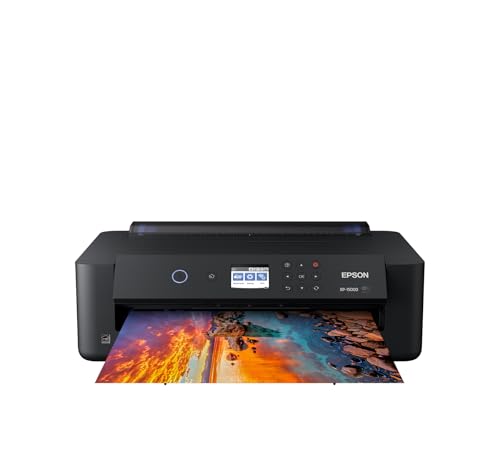
Epson Expression Photo HD XP-15000 — Wide-format home studio value
The XP-15000’s title is a compact manifesto: six-colour wide-format photo printing, up to 13 x 19 inches, up to 9.2 ppm, auto 2-sided printing, aimed at photographers and home studios. For canvas work, the load-bearing words are “wide-format” and “13 x 19”. A 13 x 19 sheet is the classic photographic canvas size in the home studio — large enough to hang, small enough to handle, stretch and frame without a workshop — and a six-colour ink set is the traditional photographic recipe for smooth gradations, the quality canvas skies and skin tones depend on. Epson built its photographic reputation on exactly this formula, and the XP-15000 is its home-studio expression.
The stated speed, up to 9.2 ppm, should be read as a document figure rather than a photo promise; a full-bleed 13 x 19 photograph takes the time it takes on any machine in this class, and canvas pieces take longer still in the photographer’s workflow because each one is proofed, examined and often reprinted. What matters more in practice is the rhythm the machine permits: wireless connectivity, stated in the title, means the printer can live where the studio has room for a wide-format body — and wide-format bodies are wide — while the computer lives where the photographer edits. That separation is not a convenience in a small studio; it is often the difference between owning a 13 x 19 machine and not owning one.
Auto 2-sided printing, also stated, is a document feature wearing a photographer’s badge, and it earns its keep around the canvas work rather than in it: contact sheets, order forms, test prints of layouts, the paper administration of a small studio. The canvas buyer should note what the title does not state — no display is mentioned, and canvas media handling is not claimed — and plan accordingly: control from the computer, and a documentation check on media before the first canvas sheet is fed. As the entry point to wide-format canvas printing from a photographic brand, the XP-15000’s stated recipe is the most straightforward in this guide: six colours, big sheets, home studio intent.
- Type: Wireless wide-format photo inkjet
- Format stated: Up to 13 x 19 inches
- Ink stated: 6-colour
- Speed stated: Up to 9.2 ppm
- Duplex stated: Auto 2-sided printing
- Canvas media handling: Not stated in the listing title — verify with the manufacturer documentation
Strengths
- Six-colour wide-format printing at 13 x 19 inches is the classic home-studio canvas recipe.
- Wireless operation lets a physically wide machine live where the studio has space for it.
- Auto 2-sided printing covers the studio’s document work without a second machine.
Trade-offs
- Six colours is the floor of this company; the Canon PRO models field eight and nine.
- No display is stated, so at-machine control and status lean on the computer.
- Canvas media support must be confirmed in documentation — the title claims wide-format photo printing, not canvas by name.
Best for: photographers opening a home studio who want genuine 13 x 19 photographic output as their canvas foundation. Not suited for: the buyer whose canvas pieces must exceed 13 inches in width — that ambition belongs to the PRO-1100 or the plotter below.
Examine this Epson’s current listing on Amazon: check price on Amazon.

Canon PIXMA PRO-200S — Dye-ink colour richness
The PRO-200S makes its argument in three phrases: professional 13-inch, 8-colour dye ink, 3-inch colour LCD. Take them in reverse. The display first, because it signals the machine’s working style: a 3-inch colour screen is a photographer’s interface, large enough to review settings and ink status standing at the machine, and it marks the PRO-200S as a printer meant to be operated as an instrument rather than merely sent files. The 13-inch format places it in the home studio’s sweet spot — the same sheet class as the XP-15000 and the ET-8550, the size at which canvas pieces become wall-worthy without becoming logistics.
The heart is the ink: eight colours of dye. Dye inks dissolve into the receiving layer rather than sitting on it, and their photographic signature is saturation and smoothness — colours that glow, gradations that refuse to band, the sunset that holds together from horizon to zenith. On canvas, whose weave already softens detail, dye’s smoothness is a genuine alliance: the texture supplies the character, the ink supplies the colour depth, and the combination is why dye machines remain the choice of photographers whose canvas work is vivid, contemporary and colour-forward. Eight colours extend the gamut beyond the six-colour machines here, and on the saturated subjects — flowers, festivals, golden-hour landscapes — that extension is visible from across the room.
The honest counterweight is dye’s temperament over time and on matte surfaces. Pigment, represented by the PRO-310 below, is the chemistry associated with archival ambitions and matte depth; dye is the chemistry of immediacy and brilliance. A canvas destined for a bright room and a long life deserves the pigment conversation. A canvas destined to be loved now, reprinted as tastes change, and produced in a run of vivid pieces is dye’s home ground. The PRO-200S also carries its professionalism in its line — PIXMA PRO is Canon’s dedicated photo range — and the buyer choosing it is choosing the colour-first philosophy within that range, eyes open.
- Type: Professional wireless inkjet photo printer
- Format stated: 13 inches
- Ink stated: 8-colour dye ink
- Display stated: 3-inch colour LCD
- Finish stated: Black
- Canvas media handling: Not stated in the listing title — verify with the manufacturer documentation
Strengths
- Eight dye colours deliver the saturation and smooth gradation that vivid canvas work feeds on.
- The 3-inch colour LCD gives the machine a real photographer’s interface at the printer itself.
- A professional 13-inch format hits the home studio’s most useful canvas size.
Trade-offs
- Dye ink is the brilliance-first choice; archival ambitions point to the pigment PRO-310.
- Thirteen inches is its ceiling — no path to larger pieces within this machine.
- Canvas media support is not stated in the title and must be verified in documentation.
Best for: photographers whose canvas work is vivid and colour-led, and who reprint as readily as they archive. Not suited for: the gallery seller promising decades of stability, whose conversation starts with pigment.
Look at the PRO-200S listing on Amazon in full: check price on Amazon.

Canon imagePROGRAF PRO-310 — Pigment-ink gallery intent
If the PRO-200S is the colourist, the PRO-310 is the archivist. Its title pairs the same professional 13-inch format and the same 3-inch colour LCD with a different heart: 9-colour pigment ink. Pigment particles rest on the media surface rather than dissolving into it, and on matte and textured media — canvas is the textbook case — that behaviour buys two things photographers pay for: depth in the dark tones, where pigment holds detail that dye can gloss over, and endurance, the resistance to fading that turns a print into an heirloom or a saleable gallery piece. Nine colours widen the pigment gamut so that the archivist does not have to surrender the colourist’s range to get the archivist’s stability.
The imagePROGRAF name matters here. It is Canon’s professional printing line, the same family as the 17-inch PRO-1100 at the end of this guide, and it signals a machine built for people who print photographs as a practice — proofing, profiling, editioning — rather than as an occasional event. In a canvas workflow, that practice-orientation shows up in the unglamorous places: consistent output from the first print of an edition to the last, a display that supports working at the machine, and an ink system whose behaviour on matte media is the product’s reason to exist.
Thirteen inches is the honest limit, and it should be faced squarely. A 13-inch canvas is a substantial object — framed and hung, it commands a wall section — but the photographer whose editions run larger must step up to the PRO-1100’s 17 inches or leave the photographic class entirely. Within its format, the PRO-310 is the canvas pick for work meant to last and to be sold with a straight face: portraits that families will keep, landscapes that galleries will hang, any image whose value compounds with years rather than expiring with a season’s decor.
- Type: Professional wireless inkjet photo printer
- Format stated: 13 inches
- Ink stated: 9-colour pigment ink
- Display stated: 3-inch colour LCD
- Finish stated: Black
- Canvas media handling: Not stated in the listing title — verify with the manufacturer documentation
Strengths
- Nine pigment colours unite matte depth, dark-tone detail and archival temperament in one 13-inch machine.
- The imagePROGRAF pedigree suits editioned, repeatable photographic production.
- A 3-inch colour LCD supports working at the printer during proofing sessions.
Trade-offs
- Pigment’s matte depth can read as restraint beside dye’s gloss-rich saturation on vivid subjects.
- The 13-inch ceiling is firm; larger editions require the 17-inch step up.
- Canvas media support remains a documentation check, unstated in the title.
Best for: photographers printing canvas to keep or to sell, for whom permanence is part of the work’s value. Not suited for: high-volume decorative canvas production, where the tank machine’s economy argues louder.
Review the PRO-310’s current Amazon listing here: check price on Amazon.

Epson EcoTank Photo ET-8550 — Tank economy at 13 x 19
The ET-8550 rewrites the canvas equation by changing what a print costs to attempt. Its title states the recipe: cartridge-free six-colour wide-format photo printing, scan and copy, up to 16 ppm, 13 x 19 inches, for creators and home studios. The EcoTank system — refillable tanks instead of cartridges — means the marginal cost of the next proof, the next test strip, the next full canvas is low enough to stop rationing. Canvas printing is an iterative craft; the first full-size attempt is rarely the final one, and a machine that makes iteration cheap makes the photographer better, because the proofing loop that quality requires stops hurting.
Six colours at 13 x 19 inches puts the ET-8550 shoulder to shoulder with the XP-15000 on format and ink count, and ahead of it on stated speed — up to 16 ppm against 9.2, a document figure that hints at a generally brisker machine. The all-in-one functions, scan and copy, add a studio utility the dedicated photo printers lack: scanning a texture, a sketch, a client’s reference print, digitising the physical world that canvas pieces often incorporate. For the creator whose canvas work mixes photography with scanned material, that built-in capture is a workflow, not a bonus.
The trade is refinement against economy, and it should be named plainly. The Canon PRO machines field more colours and professional-line intentions; the ET-8550 fields six colours and a tank. For decorative canvas, for a creator selling at craft scale, for the studio producing pieces weekly, the tank’s arithmetic usually wins the argument. For the single exhibition piece on which a reputation hangs, the PRO-310’s pigment or the PRO-1100’s width may still call. The ET-8550 is the machine for canvas as a practice — frequent, experimental, productive — and there are more photographers in that description than in any other.
- Type: Wireless wide-format all-in-one tank printer
- Format stated: Up to 13 x 19 inches
- Ink stated: Cartridge-free 6-colour
- Speed stated: Up to 16 ppm
- Functions stated: Print, scan, copy
- Canvas media handling: Not stated in the listing title — verify with the manufacturer documentation
Strengths
- Tank ink makes proofing and reprinting canvas pieces a cheap habit rather than a budget decision.
- Wide-format 13 x 19 output matches the photographic machines on sheet size.
- Built-in scanning suits mixed-media canvas workflows that begin from physical originals.
Trade-offs
- Six colours trail the eight- and nine-colour Canon PRO ink sets in gamut ambition.
- Refilling tanks is a periodic hands-on ritual the cartridge machines never ask for.
- Canvas media support is unstated in the title — documentation must confirm it.
Best for: creators and home studios printing canvas frequently, where cost per attempt shapes the whole practice. Not suited for: the once-a-year exhibition printer, who will never print enough to cash the tank’s economy in.
See the ET-8550’s listing on Amazon for the current offer: check price on Amazon.

HP DesignJet T210 24-inch Plotter — The large-format outlier
Now for the machine that is not like the others, labelled as such everywhere in this guide: the DesignJet T210 is a plotter. Its title says so — a large-format 24-inch plotter printer, for easy CAD and poster prints. It draws its lineage from architectural drawing offices, not darkrooms. Its native subjects are line plans and posters. It earns a place in a canvas guide for one reason only: scale. At 24 inches wide, it addresses the buyer whose canvas ambition is a genuinely large piece, wider than any photographic machine here can feed, and who is willing to accept a plotter’s terms to get there.
Those terms deserve spelling out. A plotter’s ink system and media handling were designed around CAD linework and poster graphics — bold areas, text, diagrams — rather than the continuous-tone subtlety a photograph demands. A photographic image printed on a plotter can absolutely succeed as a bold, graphic, poster-like canvas piece, the kind of large statement art where scale is the effect. It will not match a PRO-310’s tonal finesse in a portrait’s skin or a misty landscape’s gradations, and a buyer expecting photographic inkjet behaviour from it will be disappointed in proportion to their subtlety. Presented honestly, as this guide presents it, the T210 is a legitimate tool for a particular canvas aesthetic: big, graphic, unmissable.
There is also a practical identity to respect: a 24-inch plotter is a piece of office equipment with a footprint and a media path to match, happiest in a studio or workspace that can give it a wall. Roll-fed large-format work, which is the plotter’s natural mode, changes the canvas workflow from sheets to lengths — a different discipline of cutting, handling and stretching that suits production of large pieces and overwhelms the occasional small one. Buy the T210 for the wall-sized work, knowingly, and it will do that work on its own stated terms. Buy it as a substitute for a photographic printer and it will spend its life being blamed for not being one.
- Type: Large-format plotter printer — not a photographic inkjet
- Format stated: 24 inches
- Stated purpose: Easy CAD and poster prints
- Model reference stated: 8AG32D
- Ink system: Not stated in the listing title — verify with the manufacturer documentation
- Canvas media handling: Not stated in the listing title — verify with the manufacturer documentation
Strengths
- Twenty-four inches of width opens canvas scales no photographic pick here can reach.
- Poster printing is a stated purpose, and bold poster-style canvas art is its natural success.
- DesignJet is HP’s established large-format line, built for workspace duty.
Trade-offs
- It is a CAD and poster plotter; continuous-tone photographic finesse is not its design brief.
- Its footprint and roll-media workflow belong to a studio or office, not a spare-room corner.
- Neither ink system nor canvas support is stated in the title — both are documentation checks.
Best for: buyers whose canvas ambition is wall-scale and graphic, who understand and accept a plotter’s character. Not suited for: photographic canvas work where tonal subtlety is the point — the photographic machines above serve that purpose far better.
Inspect the T210’s Amazon listing with its plotter identity in mind: check price on Amazon.

Canon imagePROGRAF PRO-1100 — 17-inch exhibition class
The PRO-1100’s title is the shortest in this guide and the most confident: a 17-inch professional wireless inkjet photo printer, from the imagePROGRAF line. Seventeen inches is a threshold in photographic printing. It is the width at which a print stops being a large photograph and becomes an exhibition object — the size class of gallery editions, of the piece above the mantel that the room arranges itself around, of canvas work that a photographer signs. Everything else in this guide tops out at 13 inches; the PRO-1100 exists for the work that 13 inches constrains.
Because the title is terse, this review is disciplined about what it claims: professional positioning, wireless operation, inkjet photo printing, 17-inch format, imagePROGRAF lineage. The lineage carries meaning for those who know the line — Canon’s professional printers are built for editioned, colour-managed production — but the ink colour count and type are not stated in this title, and this guide does not invent them. A buyer at this level will read the full listing and the documentation as a matter of course; what the title alone establishes is the format and the professional intent, and for many canvas photographers the format is the decision. If the work must be 17 inches wide, the shortlist in this guide has one photographic name on it.
Scale changes the whole workflow around the machine, and the PRO-1100 should be bought with that in mind. Media at 17 inches is handled in larger sheets, proofing consumes more ink per iteration, the finished canvas pieces need wall and storage to match, and the printer’s own body claims studio territory rather than a desk corner. None of that is a criticism; it is the honest price of the exhibition class, and photographers who work at this size organise their studios around it gladly. For the photographer whose canvas practice has outgrown 13 inches — whose editions sell at sizes the smaller machines cannot feed — the PRO-1100 is not an upgrade. It is the removal of a ceiling.
- Type: Professional wireless inkjet photo printer
- Format stated: 17 inches
- Line stated: Canon imagePROGRAF professional series
- Ink colours/type: Not stated in the listing title — verify with the manufacturer documentation
- Display: Not stated in the listing title — verify with the manufacturer documentation
- Canvas media handling: Not stated in the listing title — verify with the manufacturer documentation
Strengths
- Seventeen inches is the exhibition threshold, and this is the only photographic pick that reaches it.
- imagePROGRAF professional lineage suits editioned, colour-managed canvas production.
- Wireless operation keeps a large machine placeable where the studio has room.
Trade-offs
- The terse title leaves ink configuration and display unstated — serious buyers must read the full documentation.
- Working at 17 inches raises every surrounding cost: media, proofing ink, storage, wall space.
- Its body and workflow claim studio territory; it is not a casual desktop resident.
Best for: photographers whose canvas editions have outgrown 13 inches and who print for exhibition or sale at scale. Not suited for: the photographer still finding their canvas feet at smaller sizes, for whom the 13-inch machines teach the craft at lower stakes.
Study the PRO-1100’s full listing on Amazon before committing: check price on Amazon.
Comparison
| Printer | Format | Ink as stated | Display | Character |
|---|---|---|---|---|
| Epson Expression Photo HD XP-15000 | 13 x 19 in | 6-colour | Not stated in title | Home-studio wide-format all-rounder |
| Canon PIXMA PRO-200S | 13 in | 8-colour dye | 3-inch colour LCD | Colour-richness first |
| Canon imagePROGRAF PRO-310 | 13 in | 9-colour pigment | 3-inch colour LCD | Archival gallery intent |
| Epson EcoTank Photo ET-8550 | 13 x 19 in | 6-colour, cartridge-free tank | Not stated in title | Volume and iteration economy |
| HP DesignJet T210 (plotter) | 24 in | Not stated in title | Not stated in title | CAD/poster plotter — scale over subtlety |
| Canon imagePROGRAF PRO-1100 | 17 in | Not stated in title | Not stated in title | Exhibition width |
The table compresses the guide into one decision tree. Fix your width first: 13 inches covers most home canvas work, 17 inches is the exhibition step, 24 inches is plotter territory with plotter terms. Then fix your ink philosophy: dye for brilliance, pigment for permanence, tank for volume, six colours for the straightforward photographic recipe. The machine at the intersection of your width and your philosophy is your shortlist of one, and the remaining work is verifying media handling in its documentation.
Dye or Pigment: Which Ink Belongs on Canvas?
The chemistry merits a fuller hearing, because canvas is where the dye-versus-pigment argument stops being theoretical. Dye ink is a solution; its colourants dissolve and sink into the media’s receiving layer. The result, at its best, is colour with light inside it — saturated, smooth, continuous. On glossy paper that quality is famous. On canvas, the weave breaks the gloss anyway, and what survives of dye’s character is the saturation and the gradation: sunsets without banding, skin without contour lines, the deep blues of water rendered as a slope rather than a staircase.
Pigment ink is a suspension; its colourant particles lodge on and near the surface. On matte and textured media that behaviour is an advantage twice over. Dark tones keep their separation because the pigment layer holds detail at the surface where the eye meets it, and the image resists the fading forces — light, atmosphere, time — that dissolve dye’s brilliance over years. Canvas, matte by nature and usually displayed unglazed, is nearly pigment’s ideal stage, which is why the gallery end of this guide, the PRO-310 and the professional line it belongs to, is pigment territory.
Choose by the piece’s destiny. A canvas that is decor — vivid, current, likely to be reprinted when the room changes — plays to dye’s strengths and forgives its impermanence. A canvas that is a record — the portrait, the once-in-a-lifetime landscape, the edition sold with the artist’s name — belongs to pigment. A canvas practice that is a business of many pieces belongs, by arithmetic, to the tank. The error is not choosing any of these; the error is choosing one while imagining another’s virtues come with it.
How Do You Prepare a Photograph for Canvas?
Begin at the file, because canvas is unforgiving of shortcuts taken upstream. Work from the largest, cleanest version of the image you have; enlargement onto a textured weave will find every compression artifact and every noisy shadow and give it a physical presence. Edit with the destination in view: canvas softens micro-contrast, so images that look merely sharp on screen print with the right amount of presence, while images sharpened aggressively for screen can turn harsh and wiry on the weave. Slightly open the shadows. Canvas drinks light, and shadow detail that reads clearly on a backlit monitor can close up entirely on a wall in ordinary room light.
Mind the edges, because canvas has a physical fate that paper does not. A piece destined for gallery wrapping folds its edges around a frame, which means the outer band of the image becomes the side of the object — compose or extend accordingly, keeping faces and critical detail out of the fold zone. A piece destined for flat mounting or framing keeps its edges, but gains a frame’s overlap instead. Decide the finishing method before printing, not after, because the decision changes what the file should contain at its borders.
Proof small, on the actual canvas stock, before committing the full sheet. A quarter-size proof on the real medium teaches more about that canvas’s appetite for ink, its colour shift and its texture than any profile promise: skies reveal banding early, skin reveals colour casts early, and the cost of the lesson is a fraction of a full sheet. Then print the full piece, let it dry completely before handling or stretching — inkjet surfaces are tender when fresh — and examine it in the light it will live in, not the light of the studio. The wall is the final reviewer. Print for the wall.
How Wide Should a Canvas Printer Be?
Answer from the wall backwards. Measure the spaces the work is meant for — the hallway run, the panel above the sofa, the studio’s selling wall — and let those dimensions set the format, because a printer bought by ambition alone tends to produce pieces that fit nowhere. Thirteen inches, the format of four picks here, yields canvases that suit bedrooms, studies, hallways and gifts: present, personal, manageable. Seventeen inches yields the statement piece, the one the room is arranged around. Twenty-four inches, the plotter’s territory, yields architectural scale, where the image becomes part of the room’s structure.
One more width consideration hides in the numbers themselves. The two Epsons state their format as 13 x 19 inches — a sheet dimension, the full photographic “Super B” page — while the Canon PRO machines state a 13-inch width, and the PRO-1100 a 17-inch width. In practice these describe the same class of machine by different habits of speech: what matters is the widest media the machine feeds, and the length it can handle, both of which live in the full specifications rather than the titles. A canvas buyer comparing across brands should translate every claim into those two numbers — maximum width, maximum length — before comparing anything else, because canvas pieces are planned in two dimensions and a machine generous in one and stingy in the other will frustrate a specific, predictable set of compositions.
Remember that width is also a workflow commitment. Wider media costs more per sheet, wastes more per mistake, needs more room to handle, dry and store, and demands more of the file — a weak image exposed at 24 inches has nowhere to hide. The photographer’s honest progression usually climbs the formats as the work earns them: master the craft at 13, where iteration is affordable, and let success at that size argue for the step up. The exception is the buyer whose purpose is fixed from the start — the gallery edition, the office installation — where the destination size is known and the machine should simply match it.
What Does Canvas Do to a Photograph?
Texture first. A canvas weave is a grid of tiny hills, and light striking it scatters in every direction, which is why a canvas piece has no single viewing angle that glares and why it reads as an object rather than a window. The same scattering softens the finest detail — eyelashes merge, distant foliage becomes painterly mass, micro-texture in stone or fabric simplifies. Photographers coming from glossy paper often mourn this for exactly one print, then start composing for it: bolder shapes, clearer subjects, detail that lives at the scale the weave preserves.
Colour behaves differently too. Canvas stocks are typically matte and slightly absorbent, so colours sit deeper and darker than the same file on glossy paper, and the brightest whites are the canvas’s own unprinted weave — warm, never clinical. Blacks, correspondingly, are the medium’s glory when the ink cooperates: a pigment black on canvas has a velvet quality that glossy surfaces, for all their depth, render differently. This is why the proofing ritual matters so much on this medium. The file’s screen appearance is a rumour; the canvas proof is the news.
Scale completes the transformation. At 13 inches and above, a photograph stops being inspected and starts being inhabited — viewed from across a room, lived beside, noticed peripherally a hundred times a day. Images that reward that relationship are not always the images that win on a screen: the quiet landscape, the portrait with presence rather than detail, the bold graphic composition. Choosing images for canvas is a curatorial skill the printer cannot supply, and developing it — printing candidates, living with them, noticing which ones the eye keeps returning to — is the real curriculum of owning one of these machines.
How Do You Finish and Hang a Canvas Print?
The print is the midpoint of the object, not the end of it. The classic finish is the gallery wrap: the canvas is stretched over a wooden frame, stapled at the back, its edges carrying either the image’s continuation or a clean mirrored or coloured border. Stretching is a learnable hand skill with unforgiving moments — tension must be even, corners must fold neatly, and a fresh print must be fully dry before it is asked to flex. The alternative finishes deserve equal respect: flat mounting on board for a crisp, modern object; traditional framing behind nothing, where the frame supplies the edge the wrap would have; or the simplest of all, the unmounted canvas hung from a dowel or clips, which suits the poster’s informality and the plotter’s large graphic pieces particularly well.
Protection is the quiet question. Canvas inkjet surfaces are more delicate than their woven toughness suggests — the ink layer can scuff, and unglazed display exposes it to dust, kitchen air and sunlight. Many canvas workflows finish with a protective coating designed for inkjet canvas, brushed or sprayed, which also lets the maker tune the final sheen from matte toward satin. Whether to coat is a genuine choice rather than a rule: coated pieces wipe clean and shrug off handling; uncoated pieces keep the raw textile honesty some photographers prefer. Decide per piece, and decide before printing if the coating will shift the colour — proof the coating on the test strip, not the masterpiece.
Hanging, finally, is composition completed. A canvas at eye level in the light it was proofed under is the goal; a canvas shoved above a door in corridor gloom wastes the machine that made it. Group smaller 13-inch pieces in deliberate clusters rather than scattering them singly, and give the 17-inch piece the wall it was printed for, alone. The printer’s work ends at the output slot. The photograph’s work begins on the wall, and the finishing choices are where the two are reconciled.
Common Mistakes
Assuming “photo printer” implies “canvas printer.” The titles in this guide state wide-format photo printing; canvas media handling is stated in none of them. Canvas is thicker, heavier and differently surfaced than photo paper, and feeding it through a machine whose documentation does not support it is how feed paths get damaged. The documentation check repeated in every spec box above is not boilerplate — it is the purchase.
Judging a canvas printer by a glossy test print. Gloss flatters dye, hides banding and says nothing about matte depth. If a showroom or a review sample is available, judge on matte or canvas stock, in ordinary light, at the size you intend to hang. The medium is the message in the most literal sense available to printing.
Printing the masterpiece first. The full-size, full-cost canvas should be the last print of a session, not the first — proofed small on the real stock, adjusted, proofed again if the subject is tricky. Photographers who skip proofing pay for their education in full sheets; the tank machine exists partly to make that education cheaper, but no ink system makes it free.
Ignoring the finishing while choosing the printer. Stretching, mounting and framing are half the object’s final quality and all of its final cost beyond the print. A 17-inch habit implies 17-inch frames, stretcher bars and wall space. Buy the printer whose format matches the finishing you will actually do, in the sizes you will actually hang.
Treating the plotter as a photo printer with a width bonus. The DesignJet T210’s review states its nature plainly; the mistake is reading “24 inches” and skipping the rest. Bold graphic canvas from a plotter can be superb. A subtle portrait expected to behave like a PRO-310 print will not be, and the disappointment will be misaddressed to a machine that never claimed otherwise.
How Should a Small Studio Organise Its Canvas Work?
Batch the decisions, not just the printing. A studio that proofs on Monday, prints on Wednesday and finishes on Friday wastes less of everything — less media to half-opened packs ageing in the light, less ink to interrupted sessions, less attention to context-switching. Keep the proofing stock and the production stock physically separate and labelled, because the most expensive sentence in a small studio is “I thought that was the test canvas.” Store finished pieces flat or rolled face-out in a dry, dark place; canvas remembers curls and creases with photographic fidelity, and a piece stored badly for a month can carry the evidence for years.
Keep a print log, however humble. Date, file, machine, media, settings, verdict. Canvas work involves too many variables for memory to govern: the proof that sang in March becomes unrepeatable in June unless the log remembers what the photographer cannot. Editioned work makes the log non-negotiable — a buyer of print three of ten is owed the same object as the buyer of print one — but even the solo hobbyist benefits, because the log converts accidents into knowledge. Half of craft is remembering what you did when it worked.
Finally, price the whole object when canvas work is sold, not the print alone. Media, ink, proofing waste, stretching, coating, hanging hardware and the hour of finishing are all inside the object the buyer carries away. Studios that price only the print subsidise their customers with their own evenings. The machines in this guide span a wide range of purchase and running economies precisely so that a studio can align its equipment with its pricing honestly — the tank for volume, the pigment machines for premium editions — rather than letting the wrong machine quietly tax every piece.
Final Recommendation
For most photographers beginning serious canvas work, the Canon imagePROGRAF PRO-310 is this guide’s centre of gravity: pigment ink for the medium that rewards it, nine colours, a professional line’s discipline, at the 13-inch format where canvas craft is learned and most pieces live. Choose the PIXMA PRO-200S instead when the work is vivid and colour-led and reprinting is part of the pleasure. Choose the Epson EcoTank Photo ET-8550 when canvas is a weekly practice and ink economics govern; choose the XP-15000 for the straightforward six-colour, 13 x 19 home-studio recipe. Step up to the PRO-1100 when the work has genuinely outgrown 13 inches, and consider the DesignJet T210 only with both eyes open — for wall-scale, graphic pieces, from a plotter that calls itself one. Whichever name wins, do the unglamorous thing before the exciting thing: open the manufacturer documentation, confirm canvas media support for that exact model, and only then order the canvas. The print will thank you for the paperwork.
Frequently Asked Questions
Can these printers definitely print on canvas?
Their titles state wide-format photographic printing — 13 x 19 inches, 13 inches, 17 inches — but none of the six titles states canvas media by name, and this guide does not upgrade that silence into a claim. Canvas compatibility, thickness limits and the correct feed path must be confirmed in each manufacturer’s documentation for the exact model. That check, done once before purchase, is the difference between a canvas practice and a damaged feed path.
Can I print canvas pieces to sell with these machines?
Plenty of working photographers do exactly that, and the honest requirements are consistency and candour rather than any particular badge. Consistency means a proofed, logged workflow — the print log discussed above — so that piece twelve matches piece one. Candour means describing the work accurately: the ink type, the canvas, the finish. Pigment machines like the PRO-310 suit editioned work sold on permanence; the ET-8550 suits open-edition decorative work sold on volume and price. Both are legitimate businesses. The machine matters less than the match between what is promised and what is delivered.
Is dye or pigment ink better for canvas?
Better depends on the piece’s destiny. Dye, in the PRO-200S’s 8-colour set, gives saturation and smooth gradation — decor and vivid work. Pigment, in the PRO-310’s 9-colour set, gives matte depth and endurance — portraits, editions, anything sold or kept for decades. The full discussion sits in the dye-versus-pigment section above; the short answer is that canvas rewards pigment’s temperament for permanence and dye’s for brilliance.
Why is a plotter in a photo printer guide?
Because canvas ambition sometimes means width, and the HP DesignJet T210 offers 24 inches — labelled everywhere here as what it is: a plotter for CAD and poster prints. Bold, graphic canvas pieces are legitimate poster work. Subtle photographic work is not a plotter’s brief, and the review says so in terms. It is included as a signposted boundary, not smuggled in as a peer of the photographic machines.
What size canvas should a beginner start with?
Thirteen inches, the format of four picks here. It is large enough to hang with presence, small enough to proof, handle and finish without special equipment, and the media and frames around it are the most available. Master colour, proofing and finishing at 13 inches; the step to 17 is then a purchase the work itself has argued for.
How long does a canvas print take to dry before stretching?
Longer than impatience suggests. An inkjet canvas print feels dry to a careful fingertip within minutes, but the ink layer continues to settle and harden well beyond that, and stretching a tender print invites scuffs and micro-cracks along the fold lines where the canvas bends around the frame. Give a finished piece a full day of flat, undisturbed rest in a clean place before it is stretched, coated or rolled — and handle it by its edges in the meantime. Photographers who build the drying day into their production rhythm stop losing finished pieces to their own enthusiasm.
Does a tank printer compromise canvas quality?
The ET-8550’s six-colour set is a photographic recipe, and its prints stand on that. What the tank changes is economics, not intent: proofing and iteration become cheap, which improves a developing photographer’s results faster than a wider gamut would. The Canon PRO models field more colours for the photographer who has reached the point where gamut, not practice, is the limit.
Related Guides
Once canvas pieces are coming off the printer, the monitors used to edit them start to matter; our guide to printers for Linux and Ubuntu is the next read for studios running open-source workstations, where driverless printing decides what works. Studios planning a room around large work should also see our roundup of printers for an architecture office, where large-format plotters are the main event rather than the outlier. And for the closest cousin of this guide — machines devoted to fine-art reproduction — our selection of fine art giclée printers takes the pigment conversation to its natural conclusion.


