What's inside
- Key Takeaways
- Quick Picks
- How We Chose These Picks
- Comparison Table
- Why does 13 by 19 inches change what a printer is for?
- How do the three wide intents, photo, all-round and Pro, actually differ?
- How do you set up a wide-format tank printer at home or in a small office?
- What mistakes do wide-format buyers most often make?
- How does proofing at full size change photographic work?
- Final Recommendation
- Frequently Asked Questions
- Related Guides
As an Amazon Associate I earn from qualifying purchases. This post may contain affiliate links at no extra cost to you.
widgetverdict.com is reader-supported. When you buy through links on our site, we may earn an affiliate commission.
Wide format, in the language of this search, means one specific and glorious thing: paper at 13 by 19 inches, the A3+ sheet that turns a home printer from a document servant into a display instrument. The best eco tank printers wide format are the refillable machines that print at that size without sending their owners to a print shop, and five of the six picks below are exactly that, Epson EcoTank models spanning home, office and photographic ambitions. The sixth pick is present under a flag of complete honesty: the Epson Expression Photo HD XP-15000 is a cartridge printer, not a tank printer, included as the contrast that sharpens the category, and it is labelled as not a tank machine in its badge, its specification box and its verdict, as it will be every time this guide mentions it.
The five genuine tank machines divide by intent, and the division is the guide’s spine. Two are Photo models, the EcoTank Photo ET-8550 and ET-8500, built around six-colour printing for creators. One is the all-round wide machine, the EcoTank ET-15000, carrying print, scan, copy and fax with Ethernet for homes and small offices. Two are EcoTank Pro machines, the ET-16600 and ET-16650, wide-format business instruments with stated speeds of up to 25 pages per minute. A buyer who knows which of those three intents, beauty, versatility or business volume, describes their own wide work already knows which third of this list to read closely, and the titles, as ever in this series, print the evidence for every claim made below.
Why marry the wide format to a tank at all? Because width multiplies ink appetite. A 13 by 19 inch photograph or poster drinks colour the way a letter page never does, and the cartridge era made large printing an exercise in watching money evaporate by the square inch. Refillable tanks collapse that cost anxiety, which changes behaviour: the photographer proofs at full size, the teacher prints the classroom display in-house, the club stops tiling four letter sheets into a banner with visible seams. The wide tank printer is therefore not two features stapled together; it is a single idea, large output without large-output fear, and the five tank picks below are its five dialects.
A word on the contrast pick’s presence, since a tank guide containing a cartridge machine requires a defence. The XP-15000 is, on its title, a six-colour wide-format photo printer for photographers and home studios, and it is the machine many wide-format shoppers will meet first and compare against. Excluding it would not make the comparison go away; it would merely make the comparison uninformed. It stays, labelled relentlessly as a cartridge printer and not a tank printer, so that a buyer can weigh its photographic case against the tank machines’ economics with both facts on the table at once.
Keep your own evidence in front of you while you read: the largest thing you printed last year, the largest thing you wished you could print, and the number of times a print shop’s opening hours decided the question for you. Wide format is bought with those three memories or it is bought with fantasies, and the memories make far better advisers. The picks below are arranged so that a reader holding real memories can stop early, at the machine whose title answers them, while a reader holding fantasies will at least meet the housing and paper warnings before the order goes in.
Key Takeaways
- Wide format here means 13 x 19 inch output; five picks are genuine EcoTank refillable machines and one is not.
- The Epson Expression Photo HD XP-15000 is a CARTRIDGE printer, not a tank printer, included and labelled as the contrast pick.
- The EcoTank Photo ET-8550 and ET-8500 are the six-colour photographic picks, aimed at creators and creative projects.
- The EcoTank ET-15000 is the wide all-rounder: print, scan, copy and fax, with Ethernet, at up to 17 ppm as Epson states it.
- The EcoTank Pro ET-16600 and ET-16650 bring business volume to the wide format, each stating up to 25 ppm.
- The Pro twins divide on stated facts: a 500-sheet capacity on the ET-16600 against a duplex ADF on the ET-16650.
- The ET-8500 title prints no paper-size figure, unlike its sibling the ET-8550; confirm that model’s sheet size on its listing before assuming the pair match on paper.
- Auto two-sided printing appears in exactly one title here, and it belongs to the cartridge contrast pick, a reminder that feature checklists and ink systems are separate questions.
- Stated speeds in this guide run from up to 25 ppm on the Pro pair down to up to 9.2 ppm on the contrast pick, a spread that mirrors intent: business pace at one end, photographic patience at the other, with the all-rounder and the Photo pair between.
- Scan and copy appear across the five EcoTank picks, so the wide sheet can be captured as well as produced; the contrast pick’s title claims printing alone, one more honest difference between it and the tank machines.
- Every wide pick in this guide, tank or cartridge, should be measured into its home before ordering: the sheet travels nearly twenty inches through the machine, and alcoves that fit the box can still crumple the page.
- Buyers whose wide work is photographic should start at the Photo pair; buyers whose wide work is organisational should start at the all-rounder and the Pro twins.
- None of the six verdicts below borrows a fact from a sibling’s title, which is why the twins and siblings in this list may read closely: closeness, stated honestly, is information too.
Quick Picks
| Pick | Badge | Why it earns its place |
|---|---|---|
| Epson EcoTank Photo ET-8550 | Six-colour wide photo flagship | Six-colour cartridge-free photo printing at 13 x 19 inches for creators and home studios. |
| Epson EcoTank ET-15000 | The wide all-rounder with fax | Wide format plus the full office set: fax, Ethernet and a stated up to 17 ppm. |
| Epson EcoTank Pro ET-16600 | Wide Pro volume, stated capacity | Business-wide with numbers: up to 25 ppm and a stated 500-sheet capacity, fax included. |
| Epson EcoTank Pro ET-16650 | Wide Pro with duplex ADF | The wide Pro that digests two-sided originals automatically, with fax and up to 25 ppm. |
| Epson EcoTank Photo ET-8500 | Six-colour photo, creative projects | The ET-8550’s six-colour sibling for creative projects, with USB and memory card support in its title. |
| Epson Expression Photo HD XP-15000 | Contrast pick — cartridge printer, NOT a tank | CONTRAST PICK: a six-colour wide cartridge printer — NOT a tank machine — with auto 2-sided printing. |
How We Chose These Picks
Admission to this shortlist worked on two conditions, and both had to be met. A machine needed the wide format stated or clearly described in its title, 13 by 19 inches where the title prints the figure, and it needed a relationship to the tank idea honest enough to print: five picks are cartridge-free EcoTank machines, and the sixth was admitted only under the contrast rule, labelled as a cartridge printer wherever it appears, because a wide-format buyer will meet it in the market whether or not a guide acknowledges it. Machines that were wide but irrelevant to home and small-studio buyers, and tank machines that were not wide, were both left to their own guides.
Within the gate, the picks were arranged to expose the format’s three intents rather than to crown a single winner. The Photo pair tests whether six colours and creator positioning matter more than office functions. The ET-15000 tests whether a wide machine can remain a complete household and small-office citizen, fax and Ethernet included. The Pro pair tests whether business volume, stated speed and either stated capacity or a duplex feeder, is what a wide buyer actually lacks. A shortlist that mixed those intents into one ranking would have answered a question nobody was asking, so the verdicts below are given per intent, with the overall recommendation reserved for the intent most wide buyers bring.
Evidence discipline matched the earlier guides in this series: only title facts are claimed, speeds are Epson’s stated up-to figures, and silences are reported as silences. That discipline matters doubly at wide format, where marketing reaches for gallery language and buyers deserve to know that the ET-8500’s title, for instance, prints no paper-size figure while its wide sibling’s does, a small asymmetry this guide notes rather than papers over, leaving the size confirmation for that model to its listing, where it belongs.

Epson EcoTank Photo ET-8550 — Six-colour wide photo flagship
The ET-8550 leads this guide because it is the wide tank idea in its purest form: cartridge-free six-colour photo printing at 13 by 19 inches, with scan and copy aboard, a stated speed of up to 16 pages per minute in Epson’s figure, aimed squarely at creators and home studios. Six colours is the phrase to hold onto. Photographs fail or sing in their transitions, the dusk sky that must not band, the skin tone that must not posterise, the green shadow that must stay green, and a six-colour system exists to persuade exactly there, where four colours approximate. On a sheet this size, approximation has nowhere to hide, which is why the photographic wide machines in this guide all carry the six-colour claim and the office wide machines do not.
Tank economics transform the photographer’s workflow in a way a specification cannot. Lab printing teaches caution and delay; cartridge printing teaches dread of the large proof. A six-colour tank teaches iteration: print the proof at final size, pin it up, live with it overnight, adjust the curve, print again. That loop is the actual product being bought here, and home studios reorganise themselves around it within a month. The stated speed, Epson’s up to 16 ppm, is respectable for a photo-led machine, and scan and copy keep the studio’s paperwork on the same device, but neither should distract from the centre: this machine exists to make large photographs at home feel economically ordinary.
The title’s silences mark its intent as clearly as its claims. No fax is claimed and no Ethernet is named, because studios move files digitally and the printer serves the workstation that matters. Judging the ET-8550 by office criteria would mistake its design brief; it is a darkroom that also copies, not an office that also photographs. Buyers whose wide work is informational, posters of text, plans, charts, should read the ET-15000 and the Pro pair below with more appetite, because their titles spend their claims on the functions informational work actually uses.
Choose the ET-8550 if your wide ambition is photographic and your standard is the print on the wall rather than the file on the screen. It is the flagship of this guide not because it does the most things but because it does the category’s defining thing, large colour-critical printing, with the most complete stated toolkit: six colours, the full 13 by 19 canvas, and tanks that make proofing a habit instead of a budget meeting. Creators who have priced lab printing for a year of serious work will understand the proposition in one arithmetic sitting.
- Functions: print, scan, copy, per the title
- Ink system: cartridge-free 6-colour tank printing
- Paper: wide format, 13 x 19 in. stated
- Speed: up to 16 ppm, as stated by Epson
- Tank status: a genuine EcoTank refillable machine
Strengths
- Six-colour printing for photographic transitions
- Full 13 x 19 canvas for serious prints
- Tank ink makes full-size proofing a habit
Trade-offs
- No fax is claimed in the title
- No Ethernet is claimed in the title
- Photo virtues are wasted on text posters
Best for: a photographer or creator printing large, colour-critical work at home, proofing freely on tank ink.
Paperwork days expose the missing function at once: this photo flagship claims no fax, leaving wired office traffic to the ET-15000 alongside it.

Epson EcoTank ET-15000 — The wide all-rounder with fax
If the ET-8550 is the wide idea as art, the ET-15000 is the wide idea as citizenship. Its title claims cartridge-free print, scan, copy and fax at 13 by 19 inches, with a stated speed of up to 17 pages per minute and Ethernet, for home and small offices. That is a remarkable combination when you sit with it: the machine that prints the poster’s size also sends the fax, joins the wired network, and handles the household’s ordinary letter pages without complaint. Small organisations, schools, clubs, churches, trades offices, live exactly in that overlap, printing big on display days and small on paperwork days, and resenting any suggestion that they need two machines to do it.
Ethernet, named here and in no other pick in this guide, suits the shared setting this machine will inhabit. A wide printer tends to live in a shared space, the office corner, the school workroom, the studio’s far wall, where wireless signal is whatever the building gives it and where a cable, once run, ends the conversation permanently. The stated speed, up to 17 ppm in Epson’s figure, sits above the photo flagship’s, consistent with a machine whose everyday work is documents that occasionally grow. Fax completes the traditional circuit: the organisations that print wide for display often still fax for administration, and this title refuses to make them choose.
What the title does not claim is photographic machinery: no six-colour language appears, so a buyer whose wide work is gallery photography should not mistake this all-rounder’s competence for the Photo models’ specialism. Colour posters, charts, signs and plans will print at size with tank economy, which is the actual need in most small offices, but skin tones at exhibition standard belong to the six-colour picks. The ET-15000’s honesty about its lane is a virtue of the title, and this guide mirrors it: versatile wide, office wide, not studio wide.
Choose the ET-15000 when one machine must cover a small organisation’s whole paper life, from the faxed form to the 13 by 19 display poster, on a wired connection that stays put. It is the wide pick most households and small offices will actually live with best, because its compromises are the ones daily life forgives and its strengths, completeness at two sizes, are the ones daily life uses. Measure its home before it arrives, as with every wide machine here, and store its paper flat; the format rewards a household that houses it properly.
- Functions: print, scan, copy and fax, per the title
- Paper: wide format, 13 x 19 in. stated
- Networking: wireless plus Ethernet
- Speed: up to 17 ppm, as stated by Epson
- Tank status: cartridge-free Supertank refillable machine
Strengths
- Full four functions at wide format
- Ethernet for a stable shared connection
- One machine for display days and paperwork days
Trade-offs
- No six-colour photo claim in the title
- Wide footprint needs a measured home
- Photo specialists will want the Photo pair
Best for: a school, club or small office printing posters and plans wide while keeping fax and wired networking.
Not suited for: exhibition prints judged on colour transitions, since no six-colour system is claimed for this four-function wide machine.

Epson EcoTank Pro ET-16600 — Wide Pro volume, stated capacity
The Pro pair brings the wide format into the world of stated volume. The ET-16600’s title describes a cartridge-free wide-format machine with print, scan, copy and fax, a stated speed of up to 25 pages per minute and a stated 500-sheet capacity, for small offices and businesses. Both figures are Epson’s own, and in the wide context they describe a specific organisation: one that prints big often enough that the tray’s appetite matters, production runs of signage, batches of plans, sets of oversized documents where stopping to reload is a workflow event rather than a pause. Capacity, unglamorous everywhere, is doubly valuable at wide format, where the paper itself is bulkier to handle and store.
Fax at this tier signals the Pro line’s intended habitat: established businesses with traditional counterparties, where the wide documents and the faxed orders belong to the same working day. The ET-16600 is not a home machine wearing a bigger tray; its title’s positioning, small offices and businesses, matches its stated kit, and households should let the positioning warn them about footprint and intent. This is equipment for a room where printing is production, and its virtues, pace as stated, capacity as stated, completeness of functions, are production virtues.
Against its twin, the ET-16650, the division is one stated fact deep, and this guide keeps the twins honest: the 16600’s title states the 500-sheet capacity and no duplex feeder; the 16650’s states a duplex ADF and no capacity figure. A wide office choosing between them is choosing its bottleneck, the supply side that feeds long runs or the intake side that digests two-sided originals. Neither twin is the better machine in the abstract, and any guide that crowns one without asking about your stacks is guessing with your money. The pick sections are written so that the two offices can recognise themselves separately.
Choose the ET-16600 when your wide work arrives in runs: the print week where the tray will be emptied and refilled by the calendar rather than by the job. Its stated capacity is a promise you can verify with a ream on delivery day, which is the best kind of promise in this category, and its fax and function completeness keep the wide machine at the centre of the office’s document life rather than exiled to a poster corner. Offices whose wide work arrives one sheet at a time should save the Pro premium and live happily with the ET-15000 above.
- Functions: print, scan, copy and fax, per the title
- Format: wide-format tank printing
- Speed: up to 25 ppm, as stated by Epson
- Capacity: 500-sheet capacity, as stated by Epson
- Tank status: cartridge-free EcoTank Pro machine
Strengths
- Stated capacity feeds long wide runs
- Wide format with full business functions
- Stated speed tops this guide’s figures
Trade-offs
- No duplex ADF is claimed in the title
- Business footprint and intent, not a home machine
- No six-colour photo claim in the title
Best for: a small business printing wide documents in production runs, where tray capacity sets the rhythm.
Stacks of two-sided originals stall at the feeder here: duplex ADF language is absent, and that intake claim sits in the ET-16650’s title instead.

Epson EcoTank Pro ET-16650 — Wide Pro with duplex ADF
The ET-16650 spends its distinguishing title words on intake: a duplex ADF, the feeder that scans both sides of an original as it passes, mounted on a cartridge-free wide-format machine with print, scan, copy and fax and a stated speed of up to 25 pages per minute. Consider the organisation that needs both halves of that description. It prints wide, plans, displays, oversized forms, and it receives wide or two-sided paperwork in stacks: signed agreements, applications, records that must become files whole, both sides, in order, without a human flipping pages at a flatbed for an afternoon. For that organisation the duplex feeder is not an accessory; it is the difference between scanning as a project and scanning as a habit.
The twin discipline applies here in full. Against the ET-16600, everything else in the titles matches, wide format, functions, fax, stated speed, business positioning, and the only stated difference runs the other way from its sibling: this title claims the duplex ADF and prints no sheet capacity. An office should therefore not assume the 16650 inherits the 500-sheet figure, however reasonable the assumption feels; capacities belong to the titles that state them, and a buyer for whom tray size is a purchasing criterion should confirm it on this model’s listing. That single check is cheap, and it protects the one disappointment twin machines reliably produce, the feature that lived on the other box.
Fax and the Pro positioning complete a portrait of the traditional, paper-serious business at wide scale: the firm whose documents are large in both dimensions, sheet size and page count, and whose counterparties still move paper by every channel invented. The 16650’s stated speed, up to 25 ppm in Epson’s figure, matches its twin’s, so the pair cannot be separated by pace and should not be; they are separated by the direction of the office’s pain, and pain, honestly located, is the most reliable buying instrument in the whole Pro category.
Choose the ET-16650 when two-sided originals are your intake and wide output is your product. It is the most specialised machine in this guide and, for its intended office, the most obviously correct one, because no other title here unites the wide sheet with automated two-sided digestion. Offices whose originals are single-sided, or whose scanning is occasional, will find the twin’s stated capacity the better spend, and should take the hint the titles are offering: Epson built the fork deliberately, and the honest office will know which side of it they live on.
- Functions: print, scan, copy and fax, per the title
- Format: wide-format tank printing
- Speed: up to 25 ppm, as stated by Epson
- Feeder: duplex ADF stated in the title
- Tank status: cartridge-free EcoTank Pro machine
Strengths
- Duplex ADF automates two-sided originals
- Wide output with full business functions
- Stated speed matches the Pro top tier
Trade-offs
- No sheet capacity is stated in the title
- Most specialised footprint in the guide
- No six-colour photo claim in the title
Best for: a paper-serious business whose intake is two-sided stacks and whose output runs wide.
Not suited for: production runs scheduled against a stated tray figure, because no sheet capacity is printed in this model’s title.

Epson EcoTank Photo ET-8500 — Six-colour photo, creative projects
The ET-8500 is the photo flagship’s sibling, and the sibling relationship should be stated with the same honesty this series applied to near-twins elsewhere. Its title claims cartridge-free six-colour photo printing, scan and copy, a stated speed of up to 16 pages per minute, and USB and memory card support, aimed at creative projects. What its title does not print, where the ET-8550’s title does, is the 13 by 19 inch figure. This guide therefore describes the ET-8500 as the six-colour creative machine whose wide-format membership comes from its family and this guide’s brief, and it leaves the exact sheet figure for this model to be confirmed on its listing, rather than borrowing the sibling’s number and printing it as fact.
One more preliminary concerned the format’s paper itself, because wide buyers routinely budget for a machine and forget the medium. Thirteen by nineteen inch stock is a standing supply, bought in packs, stored flat, and handled with a little more ceremony than a ream of letter paper, and the households that thrive with wide printers are the ones that treat the paper shelf as part of the purchase. That small logistics truth shaped the setup advice later in this guide and the housing warnings in its mistakes section, both written from the same observation: at this size, printing is a small domestic industry, and industries run on supplies that somebody remembered to order.
That discipline aside, the machine’s identity is clear and appealing. Six-colour printing is the photographic core, shared with the 8550, and the memory card support is a genuinely domestic convenience the flagship’s title does not mention: the camera card goes into the printer, and prints come out, without a computer mediating the relationship. For creative households, school projects, craft work, family photography printed the same evening it was shot, that directness is a workflow of its own, and it suits the title’s stated audience of creative projects rather than home studios. The positioning words differ between the siblings, studio against projects, and the difference feels true to the machines’ emphases.
USB support, also named here, matters to the buyer whose printer lives beside one computer and prefers a cable’s certainty for large photo files, a preference wide-format photographers often develop after watching a big print job wobble on a busy network. Between the siblings, then, the honest summary is this: the ET-8550’s title spends its words on the wide figure and the studio; the ET-8500’s spends its words on card and USB access and the project desk. A buyer choosing between them should confirm the sheet size on the 8500’s listing first, then choose by workflow, studio iteration against project directness.
Choose the ET-8500 when your creative printing is six-colour at heart, your camera cards want a slot to come home to, and your projects value directness over the studio framing of its sibling. Confirm the paper-size figure on the listing before ordering if the full wide sheet is essential to a specific project, because this guide will not lend it a number its title did not print. With that one check made, the 8500 stands as the creative household’s six-colour tank, proof that the wide family’s photographic virtues reach below the flagship’s tier.
- Functions: print, scan, copy, per the title
- Ink system: cartridge-free 6-colour photo printing
- Access: USB and memory card support stated
- Speed: up to 16 ppm, as stated by Epson
- Paper size: no figure printed in this title; confirm on listing
- Tank status: a genuine EcoTank refillable machine
Strengths
- Six-colour printing for creative photo work
- Memory card support for computer-free prints
- USB offers a certain path for large files
Trade-offs
- No paper-size figure is printed in the title
- No fax or Ethernet is claimed
- Studio sibling states its wide figure outright
Best for: a creative household printing six-colour photographs and projects, often straight from a camera card.
A guaranteed 13 by 19 sheet cannot be read off this listing: the title prints no paper-size figure, while its studio sibling states one outright.
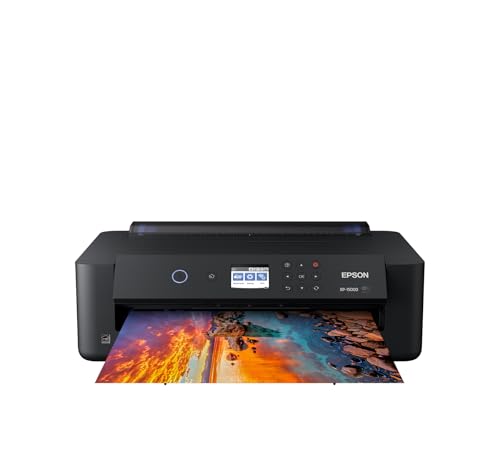
Epson Expression Photo HD XP-15000 — Contrast pick — cartridge printer, NOT a tank
Read this section’s badge again before reading anything else in it: the XP-15000 is not a tank printer. It is a cartridge printer, an Epson Expression Photo HD machine whose title describes six-colour wide-format photo printing at 13 by 19 inches, a stated speed of up to 9.2 pages per minute, and auto two-sided printing, for photographers and home studios. It earns its place in this guide as the contrast that defines the category’s edge, because it is the wide six-colour machine a shopper will inevitably compare with the EcoTank Photo models, and the comparison is only fair when the cartridge fact is printed as loudly as the photographic one, which is why this guide repeats it in the badge, the table and the specification box.
The photographic case for this cartridge machine, stated fairly, is real. Six colours at the full wide sheet is the same colour argument the ET-8550 makes, and the XP-15000 adds a claim neither Photo EcoTank title makes: auto two-sided printing, useful for portfolios, booklets and double-sided presentation work. Its stated speed, up to 9.2 ppm in Epson’s figure, is the slowest headline in this guide, which suits a machine whose pages are photographs rather than documents. A photographer who prints rarely, a few exhibition sheets a month, may rationally prefer this cartridge machine’s lower-commitment shape, and that trade-off deserves to be stated plainly.
But the economics that created this entire category stand on the other side of the scale, and they must be stated in this cartridge printer’s own section so the contrast does its work. Every large photograph from the XP-15000 is printed from cartridges, with the cartridge era’s cost per sheet and its rationing psychology, at exactly the paper size where ink consumption is highest. The tank machines above exist because that arithmetic broke photographers’ hearts. A high-volume wide photographer choosing this machine should do so knowingly, pricing the cartridge habit at 13 by 19 inches rather than discovering it across the first year of prints.
Verdict for the contrast pick, with its status stated one final time as required: the XP-15000 is NOT a tank printer, and it should be bought, if it is bought, as a cartridge printer with excellent stated photographic credentials, six colours, the wide sheet, auto two-sided printing, for the low-volume photographer whose output is occasional and precious. The moment wide printing becomes a weekly habit, the tank machines above reclaim the argument on economics alone, and the ET-8550 in particular answers this machine colour for colour with bottles instead of cartridges. Contrast picks exist to make the category’s value visible; this one has done its work if a single buyer chooses it, or rejects it, with both eyes open.
- TANK STATUS: NOT a tank printer — a cartridge printer, stated plainly
- Functions: wide-format photo printing per the title
- Ink system: 6-colour cartridge inkjet, not refillable tanks
- Paper: 13 x 19 in. stated; auto 2-sided printing stated
- Speed: up to 9.2 ppm, as stated by Epson
Strengths
- Six-colour wide photo printing at 13 x 19 inches
- Auto 2-sided printing, unique among the photo picks
- Lower-commitment shape for occasional printing
Trade-offs
- NOT a tank printer: cartridge costs at wide sizes
- Slowest stated speed in this guide
- No scan or copy is claimed in the title
Best for: an occasional, low-volume photographer who knowingly chooses a cartridge machine for six-colour wide prints.
Refillable-tank economics are simply not on offer here: cartridges feed this machine, so running costs follow cartridge rules, not EcoTank bottle refills.
Comparison Table
| Pick | Print, copy, scan | Headline fact from its listing title |
|---|---|---|
| Epson EcoTank Photo ET-8550 | Print, scan, copy | 6-colour photo printing; 13 x 19 in.; up to 16 ppm per Epson |
| Epson EcoTank ET-15000 | Print, scan, copy, fax | 13 x 19 in.; Ethernet; up to 17 ppm per Epson |
| Epson EcoTank Pro ET-16600 | Print, scan, copy, fax | Wide format; up to 25 ppm and 500-sheet capacity per Epson |
| Epson EcoTank Pro ET-16650 | Print, scan, copy, fax | Wide format; up to 25 ppm per Epson; duplex ADF stated |
| Epson EcoTank Photo ET-8500 | Print, scan, copy | 6-colour photo printing; up to 16 ppm per Epson; USB and memory card support |
| Epson Expression Photo HD XP-15000 | Print (photo all-in-one class listing) | NOT A TANK: cartridge printer; 6-colour wide format; 13 x 19 in.; up to 9.2 ppm |
Why does 13 by 19 inches change what a printer is for?
A letter sheet is read in the hands; a 13 by 19 inch sheet is read on a wall, across a classroom, or over a client’s shoulder, and that difference in reading distance changes everything the print must do. Type can breathe, charts can carry their data without a magnifier, photographs can hold the composition the photographer actually framed. Wide format is therefore not a luxury enlargement of ordinary printing but a different medium with its own jobs: display, presentation and art. Buyers should interrogate their own walls and meetings for evidence of those jobs, because a wide machine bought for jobs that never materialise becomes the largest paperweight in the building, while a wide machine bought for real display work becomes the most praised appliance in it.
The tank marriage matters because display work is ink-hungry in a way documents are not. A full-bleed 13 by 19 photograph lays colour across every square inch; a poster background is a lake of ink shaped like a rectangle. Cartridge economics made that appetite a budget line, and rationing followed, smaller proofs, fewer iterations, displays printed elsewhere at shop prices and shop schedules. Refillable tanks return the wide sheet to the household’s own timetable and temper, which is why the format and the tank rose together in the market and why this guide treats them as one idea with five expressions rather than as a feature checklist.
There is a discipline the format demands in return: housing. Wide paper must be stored flat or it will curl its way into every feed; the machine needs a surface with clearance for a sheet nearly twenty inches long to travel; and the finished prints need somewhere to be, a portfolio, a frame, a wall, because large prints stacked on a chair become large regrets. Households that solve the housing question in advance describe their wide printers with affection. Households that improvise it describe the same machines as clutter with a power cord, and the difference was never the printer.
How do the three wide intents, photo, all-round and Pro, actually differ?
Intent is visible in what each title spends its words on. The Photo machines spend theirs on colour: six-colour printing, creators, studios, creative projects, because their buyer’s first question is how a sky will render. The all-round ET-15000 spends its words on citizenship: fax, Ethernet, a function list with no gaps, because its buyer’s first question is whether one machine can cover the organisation’s whole paper life. The Pro machines spend their words on throughput: stated speed on both, capacity on one, a duplex feeder on the other, because their buyer’s first question is how the work flows at volume. Three buyers, three first questions, and a wide market that answers each in a different dialect of the same format.
Mistakes happen when a buyer asks one intent’s question and buys another intent’s machine. The office that buys the Photo flagship for its posters discovers the missing fax on the first administrative morning. The photographer who buys the Pro for its stated speed discovers that pace was never the constraint on a proofing loop, while colour, unmentioned in the Pro title, was. The household that buys the all-rounder for gallery ambitions discovers that competence and specialism are different virtues. None of these machines failed; the matching failed, and it failed at the title-reading stage, which is why this guide keeps returning the reader to titles rather than to adjectives.
A practical way to hold the intents apart is to name your wide output’s audience. If the audience will judge it, a client, a gallery wall, your own portfolio, you are in Photo territory and colour claims are your currency. If the audience will use it, a class, a crew, a congregation reading the poster, you are in all-round territory and completeness is your currency. If the audience is a workflow, the next desk, the file, the archive, you are in Pro territory and stated throughput is your currency. Audiences are easier to identify than specifications, and they point at the right third of this list with embarrassing reliability.
How do you set up a wide-format tank printer at home or in a small office?
Measure first, and measure the sheet’s journey as well as the machine’s footprint: a 13 by 19 inch page needs entry and exit room, and a printer wedged into an alcove will crumple the very size it was bought to produce. Place the machine on a surface that can take its weight without wobble, within reach of the computer or network point it will serve, and give its paper a flat home nearby, because wide stock stored rolled or leaning will feed its curl into every job. Fill the tanks during setup if your machine is one of the five genuine EcoTank picks, on a level surface, unhurried, and store the bottles where the machine lives.
Print three test objects in the first week, chosen to rehearse the machine’s real future: one ordinary letter document, because most pages stay ordinary even in a wide household; one full-size colour piece, a photograph or poster, because that is the format’s reason to exist; and one copy or scan, because the all-in-one functions atrophy in owners’ minds if they are not used early. Photographers should print the same image at letter and wide sizes and live with both for a day; the comparison teaches more about the machine’s colour behaviour than any settings menu, and it teaches it before a print that matters is on the clock.
Finally, decide where finished wide prints live, before the pile decides for you. A portfolio case, a designated flat drawer, a rotation of frames on one wall: any system works, and the absence of one guarantees that large prints migrate to chair backs and table edges, where they curl, gather dust and quietly argue that the machine was a mistake. Wide printing is a small domestic industry, and like every industry it rewards the household that arranges its inputs, its workspace and its outputs as one system rather than as three surprises.
What mistakes do wide-format buyers most often make?
The first is buying the format for a fantasy: the exhibition that is not scheduled, the poster business that exists as a compliment from a friend, the classroom that has not asked. Wide machines are large, their paper is a standing order, and fantasy rent is charged monthly in space. The second mistake is the opposite timidity, tiling letter sheets for a display job that recurs, and paying in seams and labour what a wide machine would have cost in money once. Both errors come from refusing to count: last year’s actual large jobs, listed by month, will settle the format question more honestly than any amount of imagining in either direction.
Third is intent confusion, buying the Photo machine for office posters or the Pro machine for family photographs, a mistake this guide’s intent sections exist to prevent. Fourth is ignoring the contrast in the room: assuming every wide machine on a shop page is a tank machine, when the XP-15000 in this very guide is a cartridge printer wearing wide photographic credentials. The label check takes ten seconds, look for cartridge-free or tank language in the title, and skipping it can put a household on the wrong ink economics for years. Fifth is housing neglect, the wide printer on the wobbling table, its paper leaning in a corner, its prints colonising the furniture.
The sixth mistake is subtler: judging a wide machine by its letter-size behaviour alone. Most pages in most wide households are ordinary, true, but the machine was bought for the extraordinary ones, and a buyer who tests only documents will choose the all-rounder every time and then wonder why the photographs feel unremarkable. Test the job the format was bought for, at the size it was bought at, with the colours that job actually contains. Wide format is a promise about large moments; shop for it in large moments, and the machine that keeps the promise will not be hard to recognise.
How does proofing at full size change photographic work?
Photographers raised on labs and small proofs learn a cautious grammar: judge the image small, imagine it large, commit once. A six-colour tank machine at 13 by 19 inches teaches the opposite grammar, because the full-size proof costs little enough to be a draft rather than a verdict. Compositions reveal themselves honestly at size, the horizon that sags, the shadow that blocks, the crop that amputates, and the photographer corrects the work while it is still a file rather than after it has become a framed disappointment. Studios describe the change as the moment printing stopped being the end of the process and became part of the middle of it, where it always belonged.
The tank is the enabling half of that change, and it is worth saying plainly in a guide that also contains a cartridge machine: the XP-15000, which is not a tank printer, can produce a beautiful wide photograph, but its cartridge economics tax every iteration of the proofing loop, and taxed loops get skipped. The EcoTank Photo pair remove the tax. Between those two, the choice is workflow, the 8550’s title-stated wide figure and studio framing against the 8500’s card and USB directness, and photographers should confirm the 8500’s sheet figure on its listing before assuming the siblings match on paper as they match on colour.
There is a craft dividend beyond cost. Printing at size, repeatedly, teaches a photographer their own machine’s colour personality the way darkroom printers once learned a paper’s, and that intimacy shows in final prints that need no apology. The wide tank format, used this way, is less a purchase than a practice, and the buyers who thrive with it are the ones who wanted a practice all along: regular, iterative, unafraid of the second proof. If that description fits, the Photo end of this guide is your home, and the only remaining question is which sibling’s title describes your desk.
Final Recommendation
For most wide-format buyers, the EcoTank ET-15000 is the recommendation to beat: it is the only pick uniting the full function set, fax included, with Ethernet and the stated wide sheet, which makes it the wide machine a household or small office can live on entirely. Photographers should overrule it without hesitation in favour of the EcoTank Photo ET-8550, whose six-colour claim and title-stated 13 by 19 figure make it the guide’s photographic flagship, with the ET-8500 as the creative-project alternative once its sheet figure is confirmed on the listing. Business volume at wide sizes belongs to the Pro twins, capacity on the ET-16600 for run-driven offices, the duplex ADF on the ET-16650 for intake-driven ones.
And the contrast pick closes the guide by defining it: the XP-15000 is not a tank printer, it is a cartridge printer with genuine six-colour wide credentials, and it suits only the photographer who prints rarely enough that cartridge economics at 13 by 19 inches remain a tolerable tax. Everyone else in this market is really buying the tank as much as the width, the freedom to print large without metering the colour, and that freedom is what the five EcoTank picks, in their three intents, each deliver. Name your intent, photo, citizenship or production, and the wide machine whose title was already speaking it will be easy to choose and easier to keep.
Frequently Asked Questions
What paper size counts as wide format in this guide?
Thirteen by nineteen inches, the A3+ sheet, stated outright in the titles of the ET-8550, the ET-15000 and the XP-15000. The Pro twins describe themselves as wide-format machines in business terms, and the ET-8500’s title prints no size figure, which is why this guide leaves that model’s exact sheet size to be confirmed on its listing rather than borrowing a sibling’s number. If a specific project needs the full sheet guaranteed, buy on a title that prints the figure.
Is the XP-15000 an EcoTank printer?
No. The Epson Expression Photo HD XP-15000 is a cartridge printer, not a tank printer, and this guide labels it that way in its badge, its comparison row, its specification box and its verdict. It is included as a contrast pick because its six-colour wide-format photo printing invites comparison with the EcoTank Photo models. Anyone seeking refillable tank economics should choose one of the five EcoTank picks and treat the XP-15000 as the market’s cartridge alternative, knowingly priced in cartridges.
Which wide pick is best for photographs?
The EcoTank Photo ET-8550, on title evidence: six-colour cartridge-free photo printing at a stated 13 by 19 inches, aimed at creators and home studios. Its sibling, the ET-8500, shares the six-colour claim and adds memory card support in its title, but prints no sheet figure there, so confirm size on its listing. The office wide machines make no six-colour claim and should not be bought for gallery colour.
Which wide pick should a small office choose?
It depends on the office’s bottleneck, and the titles say so. The ET-15000 covers the whole paper life, fax and Ethernet included, for offices whose wide work is occasional display. The EcoTank Pro ET-16600 adds stated speed and a stated 500-sheet capacity for run-driven wide production, while the ET-16650 answers with a duplex ADF for offices digesting two-sided originals. Name the bottleneck first; the titles have already named the machines for each one.
Do wide-format printers still handle ordinary letter pages?
Yes, and in most households most pages will be ordinary ones. Every pick here is an all-in-one or printer that treats letter work as its daily bread, with the wide sheet as its special power. That is precisely why the all-round ET-15000, with fax and Ethernet, suits mixed organisations: the poster’s size is available on display days without exiling the paperwork to a second machine. Judge a wide pick by both diets, the daily letter and the weekly wide, because you will feed it both.
Why do the Pro twins state different extras?
Because Epson built a fork and printed it honestly. The ET-16600’s title states a 500-sheet capacity and no duplex feeder; the ET-16650’s states a duplex ADF and no capacity figure. They share wide format, functions, fax and a stated up to 25 ppm. Buy the twin whose stated extra matches your office’s actual stall, supply side or intake side, and verify any unstated figure on the listing rather than assuming twins share a contract.
Related Guides
Width is one axis of the tank map: best home printers with large ink tanks two sided copy returns to letter size with the two-sided copying question, best canon dslr cameras follows the photographers from this guide back to their cameras, and best digital dslr cameras widens that camera conversation across brands.


