What's inside
- Key Takeaways
- Quick Picks
- How We Chose These Picks
- Which Three-Bank Charger Matches Your Batteries and Your Calendar?
- How Do the Six Three-Bank Chargers Compare on the Only Axis That Hurts?
- How Long Will Your Trolling Batteries Actually Take to Recharge?
- How Do You Install a Three-Bank Charger So It Lasts?
- What Mistakes Shorten a Bass Boat Battery’s Life?
- How Should a Three-Bank Charger Behave Through Winter Storage?
- AGM, Flooded or Lithium: How Does Chemistry Change the Choice?
- What Should You Check When a Bank Stops Charging?
- How Does a Guide’s Boat Use a Three-Bank Charger Differently?
- What Is the Plug-In Routine That Separates Ready Boats From Sorry Ones?
- What Changes When a Boat Moves From 24 Volts to Bigger Trolling Power?
- How Should You Read a Charger’s Indicator Lights Like a Professional?
- Final Recommendation
- Frequently Asked Questions
- Related Guides
As an Amazon Associate I earn from qualifying purchases. This post may contain affiliate links at no extra cost to you.
widgetverdict.com is reader-supported. When you buy through links on our site, we may earn an affiliate commission.
Where to buy: the six chargers below all link to checked Amazon listings, and every one is a three-bank onboard unit that mounts permanently in the boat; if your rig runs a different battery count, this is the wrong shortlist and the reviews will say so cheerfully.
The best bass boat 3 bank chargers exist because a modern bass boat is really three batteries wearing a hull. A cranking battery starts the outboard and runs the electronics, and two trolling batteries, wired for a 24-volt motor, do the day’s quiet work. Plug in one charger with three independent banks and all three recover together overnight, each on its own circuit, each watched by its own charging program. This guide gathers six such units, from 5-amp-per-bank maintainers to 10-amp-per-bank chargers built for tournament mornings, and it treats the difference between those figures as the central decision, because it is.
Let that decision be stated plainly at the top, as it deserves: per-bank amps decide how fast a big, deeply drained trolling battery comes back. A 5A bank feeding a large trolling battery that gave up most of its charge to a windy day needs a long overnight to finish, and a short night before a second tournament day may not be long enough. A 10A bank halves that arithmetic. Neither is better in the abstract; a recreational angler who fishes Saturdays and plugs in until the next weekend is perfectly served by 5A banks, while a tournament angler who drains two big batteries by Saturday weigh-in and needs them full by Sunday launch should be shopping the 10A end of this list. Everything else, waterproofing, chemistry modes, displays, is commentary on that single axis.
All six picks share the onboard virtues: IP68 waterproofing across the board, mounting holes for a permanent home in a battery compartment, protection against overcharge and temperature extremes, and compatibility spanning lead-acid in its flooded and AGM forms through to lithium and LiFePO4 trolling setups. They differ in per-bank current, in the refinement of their battery-type selection, in displays and repair modes, and in the badge on the case, which in NOCO’s two entries carries a weight of its own in the marine world. Read the reviews with your battery sizes and your fishing calendar open beside them.
Key Takeaways
- Per-bank amperage is the deciding specification: 5A per bank suits recreational rhythms, 10A per bank exists for large trolling batteries and short tournament turnarounds.
- Every pick is a true three-bank onboard charger, one independent circuit each for the cranking battery and two trolling batteries.
- IP68 waterproofing is universal across this shortlist, because a battery compartment is a wet neighbourhood even on a dry lake.
- Chemistry selection matters: flooded, AGM and lithium LiFePO4 batteries want different charging profiles, and the better picks let you set each bank accordingly.
- Onboard chargers are designed to stay plugged in at the dock or in the garage, maintaining batteries between trips rather than merely refilling them.
- Temperature compensation, offered by several picks, adjusts charging to the compartment’s heat or cold and quietly extends battery life.
Quick Picks
| Pick | Badge | Why it earns its place |
|---|---|---|
| 3 Bank Marine Battery Charger 5X3 15A (5A/Bank) – 12V Boat Charger | The straightforward 15A starter | Three 5A banks, IP68 sealing and 24/7 plugged-in design for lead-acid and lithium, the honest baseline of the category. |
| NOCO GEN5X3 12V 15A 3-Bank OnBoard Marine Battery Charger | The compact NOCO standard | NOCO’s GEN5X3 delivers 5A per bank with temperature compensation in a notably compact waterproof case. |
| NOCO GENPRO10X3 12V 30A 3-Bank OnBoard Marine Battery Charger | The tournament-grade NOCO | Ten amps per bank, thirty total, for anglers whose trolling batteries must recover completely between competition days. |
| 3 Bank Marine Battery Charger 10X3 30A (10A/Bank) – 12V Boat Charger | The high-output value pick | Thirty amps across three 10A banks with IP68 sealing and 24/7 design, matching the flagship current without the flagship badge. |
| 3 Bank Marine Battery Charger, 12V (5A/Bank) with LCD | The display-equipped maintainer | Five amps per bank with an LCD readout and profiles spanning lead-acid, AGM, EFB and LiFePO4, for owners who like to see the numbers. |
| WAVLINK 3 Bank 15A Marine Battery Charger 12V IP68 Onboard | The battery-repairing all-rounder | Fifteen amps with multi-stage charging and a desulfating repair mode across SLA, AGM, LiFePO4 and calcium batteries. |
How We Chose These Picks
The first filter was categorical: true three-bank onboard units only, each bank an independent 12-volt circuit, each charger built to mount in the boat and live there. Portable single-bank chargers, however excellent, solve a different problem and were left to their own guides. Within the category we insisted on IP68 sealing without exception, because the difference between water-resistant and waterproof is measured in seasons inside a bilge-adjacent compartment, and on compatibility that reaches lithium, since LiFePO4 trolling batteries have moved from exotic to ordinary in a few short years.
Second, we structured the list around the per-bank axis deliberately, with three 5A-class units and two 10A-class units plus a repair-focused all-rounder, because a shortlist that only offered one speed would fail half its readers. The two NOCO models anchor their respective classes with the brand’s marine reputation and temperature compensation; the unbranded 15A and 30A units answer with the same headline figures and simpler presentations; the LCD and WAVLINK models add information and restoration features respectively. Every class a real bass boat might need is represented by at least one honest candidate.
Finally, we favoured chargers designed to remain connected, the charged-24/7 philosophy named in several listings, because that is how onboard chargers are actually used: plugged in at the trailer, maintaining through the week, ready at launch. A charger that must be disconnected to protect the batteries misunderstands its own job. The six survivors all understand it, and the reviews now take them one bank at a time.
Which Three-Bank Charger Matches Your Batteries and Your Calendar?

3 Bank Marine Battery Charger 5X3 15A (5A/Bank) – 12V Boat Charger — The straightforward 15A starter
This is the category’s honest baseline: three banks at 5A each, fifteen amps in total, IP68 waterproofing, overcharge and temperature protection, and compatibility with lead-acid and lithium batteries, in a unit designed to be charged around the clock without supervision anxiety. For the angler whose boat fishes weekends and rests between them, that specification is not a compromise; it is a precise fit. Five amps per bank refills a moderately drained trolling battery across a full night with time to spare, and the charger’s maintenance behaviour keeps all three batteries topped and ready through the week.
The plainness is the point and also the limit. There is no display to narrate the charging, no repair mode to attempt on a tired battery, and no extra current for the tournament scenario this guide keeps returning to: two big trolling batteries emptied by Saturday, needed full by Sunday’s launch, with perhaps ten hours of darkness to do it in. On that arithmetic, 5A banks leave the job half done, and the angler wakes to batteries at a partial charge and a motor that fades by midday. The charger does not fail in that story; the match fails.
Buy it for the rhythm it serves and it will serve for years, quietly, in a wet compartment, asking nothing. First-time three-bank buyers, recreational bass anglers and pontoon-adjacent bass rigs with modest trolling demands form its natural parish. When the fit is right, this 15A three-bank charger is the simplest route into onboard charging on the page.
- Output: 15A total, 5A per bank across three banks
- Sealing: IP68 waterproof onboard design
- Use pattern: designed to remain connected, charged 24/7
- Protection: overcharge and temperature protection built in
- Compatibility: lead-acid and lithium boat batteries
Strengths
- The full onboard formula, three banks and IP68, without flagship complexity.
- Stay-connected design suits the trailer-and-garage routine perfectly.
- Lithium compatibility keeps it relevant as trolling batteries modernise.
Trade-offs
- Five amps per bank is slow arithmetic for large, deeply drained trolling batteries.
- No display, so charging status is a matter of indicator lights and faith.
- No repair or desulfation mode for ageing lead-acid batteries.
Best for: recreational anglers on a weekly rhythm with standard-size batteries. Not suited for: tournament turnarounds or very large trolling batteries on short nights.
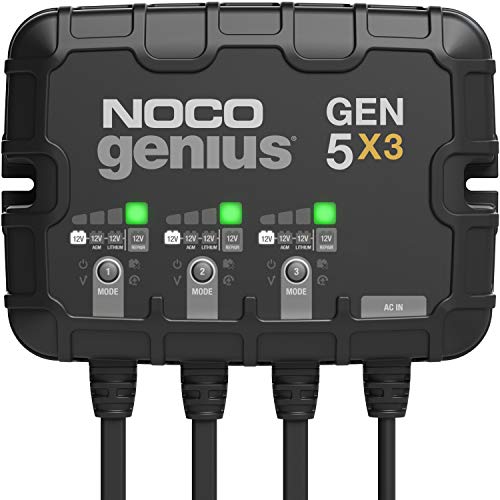
NOCO GEN5X3 12V 15A 3-Bank OnBoard Marine Battery Charger — The compact NOCO standard
NOCO’s GEN series is close to a default setting in marine charging, and the GEN5X3 shows why: 15A across three 5A banks, IP68 sealing, overcharge protection and temperature compensation, in a case notably compact for its class. That compactness is a genuine feature in a bass boat, where the battery compartment also hosts pumps, plumbing and the occasional forgotten lure, and where a charger’s mounting footprint decides whether the installation is clean or a negotiation. Temperature compensation is the other grown-up detail: the charger adjusts its behaviour to the compartment’s conditions, charging a cold spring battery and a heat-soaked August battery with appropriately different manners.
As a maintainer and charger for lead-acid and lithium alike, the GEN5X3 fits the recreational and club-angler mainstream precisely. Its 5A banks carry the same arithmetic as the baseline pick above, overnight comfort for ordinary drains and patience required for extraordinary ones, and NOCO’s bank-level battery-type thinking rewards owners who set each bank for the battery actually attached to it, cranking on one profile, trolling pair on another. The brand’s support ecosystem and documentation depth are the quiet extras that owners appreciate in year three rather than week one.
Choose it over the unbranded 15A unit when provenance, compactness and temperature compensation matter to you; choose the GENPRO below when current matters more. For the large middle of the bass-boat world, the NOCO GEN5X3 remains the standard against which other 15A three-bank chargers are measured.
- Output: 15A total, 5A per bank across three banks
- Sealing: IP68 waterproof onboard construction
- Compensation: temperature compensation for seasonal charging
- Protection: overcharge protection on every bank
- Compatibility: lead-acid and lithium marine batteries
Strengths
- Compact case eases installation in crowded battery compartments.
- Temperature compensation treats winter and summer batteries appropriately.
- NOCO’s marine track record and documentation support long ownership.
Trade-offs
- The same 5A ceiling as every maintainer-class pick here.
- Brand quality is priced into the unit compared with unbranded rivals.
- Anglers needing per-bank displays should look at the LCD pick below.
Best for: recreational and club anglers wanting the proven compact standard. Not suited for: high-drain tournament schedules that need 10A banks.
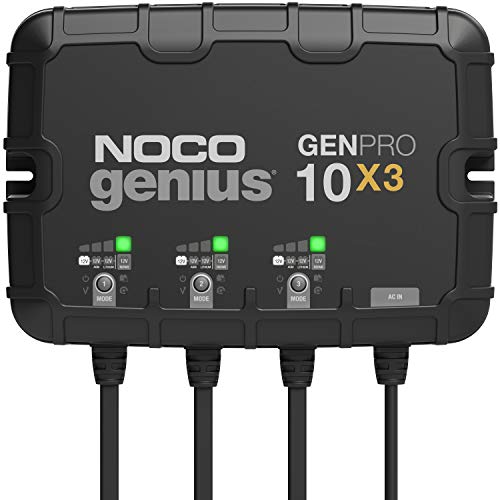
NOCO GENPRO10X3 12V 30A 3-Bank OnBoard Marine Battery Charger — The tournament-grade NOCO
The GENPRO10X3 doubles the only figure that matters on a tournament night: 10A per bank, 30A in total, in NOCO’s sealed, temperature-compensated, overcharge-protected format. Run the arithmetic that decides competitions. Two large trolling batteries, worked hard against wind and current until weigh-in, come home deeply discharged. On 5A banks they need a night longer than the one a tournament schedule provides; on 10A banks they are full, rested and balanced by launch, with the cranking battery, fed by its own 10A circuit, equally ready. That is not a luxury difference. It is the difference between a motor that holds all day Sunday and one that fades during the afternoon run.
The PRO designation also reflects build intent: this is the unit NOCO aims at anglers and guides whose boats work for a living, with the sealing and protections to live permanently in the compartment and the charging intelligence to handle lead-acid and lithium banks across the same three circuits. Guides who fish clients six days a week will recognise the deeper value: batteries that are fully and properly charged every night last more seasons, and the charger’s cost is repaid in battery longevity before it is repaid in convenience.
Recreational anglers should buy it only with open eyes: if your trolling batteries are modest and your nights are long, the extra current will spend its life unused, and the GEN5X3 above serves you identically at a lower commitment. But for the tournament boat, the guide boat and the big-motor rig with large lithium or AGM trolling capacity, the GENPRO10X3 is the correct answer to the only question that matters at 4 a.m. on day two.
- Output: 30A total, 10A per bank across three banks
- Sealing: IP68 waterproof onboard construction
- Compensation: temperature compensation across banks
- Protection: overcharge protection built in
- Compatibility: lead-acid and lithium, including large trolling setups
Strengths
- Ten amps per bank halves recovery time for big trolling batteries.
- Tournament and guide duty is its explicit design brief.
- Full nightly charges extend expensive battery life across seasons.
Trade-offs
- The flagship commitment is wasted on small batteries and long weekends.
- Its output assumes the boat’s batteries can accept the pace happily.
- Anglers wanting a display still need to look elsewhere in this list.
Best for: tournament anglers, guides and large-battery rigs on tight turnarounds. Not suited for: casual weekend boats, whose batteries will never ask for its pace.

3 Bank Marine Battery Charger 10X3 30A (10A/Bank) – 12V Boat Charger — The high-output value pick
The value argument in this category writes itself: the same headline arithmetic as the flagship, 10A per bank and 30A total, with IP68 sealing, overcharge and temperature protection, lead-acid and lithium compatibility, and a stay-connected 24/7 design, without the flagship’s badge. For anglers whose decision is purely electrical, two big trolling batteries recovered overnight, this unit makes the current available at the friendlier end of the category’s pricing logic, and the fish, it must be said, cannot read logos.
What the badge buys, and what a buyer should weigh honestly, is the ecosystem around the electricity: documentation depth, long-term support, and a multi-decade trail record in compartments. The unbranded unit’s listing promises the protections that matter, and its specifications match the flagship figure for figure. Owners comfortable judging a charger by its stated protections and their own installation care will find little to miss; owners who value a manufacturer’s marine pedigree as a form of insurance will understand exactly what the NOCO premium purchases.
Electrically, though, the story is identical and worth repeating: 10A banks transform the tournament and heavy-use arithmetic, refilling large trolling batteries across a single night and maintaining them through the week. If your batteries are big and your schedule is tight, and your confidence runs to specifications rather than badges, this 30A three-bank charger delivers the flagship’s pace on a value ticket.
- Output: 30A total, 10A per bank across three banks
- Sealing: IP68 waterproof onboard design
- Use pattern: designed to remain connected, charged 24/7
- Protection: overcharge and temperature protection built in
- Compatibility: lead-acid and lithium boat batteries
Strengths
- Flagship-class current without the flagship badge’s premium.
- Full IP68, stay-connected onboard formula at 30A.
- Lithium compatibility covers modern trolling conversions.
Trade-offs
- A thinner documentation and support ecosystem than the branded rivals.
- No display or repair program to extend its talents.
- Brand-agnostic value only appeals if you are comfortable judging by specification.
Best for: heavy-use anglers who shop by amperage and specification. Not suited for: buyers who treat manufacturer pedigree as part of the product.

3 Bank Marine Battery Charger, 12V (5A/Bank) with LCD — The display-equipped maintainer
Most onboard chargers communicate in the semaphore of small lights: charging, charged, fault, guess. This unit adds an LCD, and with it a different relationship between owner and batteries. Voltage and charging state become readable facts rather than interpretations, which matters most on the morning something is wrong: a bank sitting at an odd voltage announces a tired battery or a loose connection before it announces itself as a dead trolling motor at the far end of the lake. Information, on a boat, is a safety feature wearing a convenience costume.
The charging beneath the display is maintainer-class and proud of its breadth: 5A per bank with profiles spanning lead-acid, AGM, EFB and LiFePO4, the widest chemistry menu in this guide, plus overcharge protection and temperature compensation. That breadth suits the modern mixed boat, where a flooded cranking battery, AGM trolling pair and a future lithium conversion might all pass through the same compartment across the charger’s life. Set each bank for its battery, read the display when you plug in, and the system manages itself.
Its ceiling is the class ceiling: 5A banks and tournament nights do not mix, whatever the display’s charms. Within the recreational and club rhythms, though, this is arguably the most informative pick in the guide, and owners who enjoy knowing rather than assuming will gravitate to it naturally. For the angler who reads gauges for pleasure, this LCD three-bank charger turns the battery compartment into an instrument panel.
- Output: 5A per bank across three banks
- Display: LCD readout for voltage and charging state
- Chemistry: lead-acid, AGM, EFB and LiFePO4 profiles
- Compensation: temperature compensation included
- Sealing: IP68 waterproof onboard design
Strengths
- The display converts guesswork about battery health into readable fact.
- The widest chemistry menu here, including EFB and LiFePO4.
- Temperature compensation protects batteries across the seasons.
Trade-offs
- Maintainer-class current, with the usual tournament-night limits.
- A display in a battery compartment is one more thing to keep clean and readable.
- Information tempts owners to watch numbers that mostly manage themselves.
Best for: detail-minded owners with mixed battery chemistries. Not suited for: fast turnarounds, where amperage outranks information.

WAVLINK 3 Bank 15A Marine Battery Charger 12V IP68 Onboard — The battery-repairing all-rounder
WAVLINK’s entry adds a talent none of its rivals here claim: a desulfating repair mode within its multi-stage charging, aimed at the lead-acid battery’s most common slow death. Sulfation, the crystalline crust that builds on plates in batteries that sit discharged or undercharged, steals capacity month by month, and a repair program that pulses against it can recover some of what neglect took, or at least slow the taking. For owners whose boats hibernate through winter, that mode addresses the exact season when their batteries are dying quietly in the cold.
The rest of the specification is the complete maintainer formula: 15A across three 5A banks, IP68 sealing, multi-stage charging with multi-protection safeguards, and compatibility spanning SLA, AGM, LiFePO4 and calcium batteries, a menu that covers the lead-acid family’s branches more thoroughly than most. Multi-stage charging is the unglamorous virtue underneath everything: bulk charge to refill, absorption to finish gently, float to maintain, the sequence that treats a battery as a chemical system rather than a bucket.
Set expectations for the repair mode honestly: desulfation can help a sulfated battery and cannot resurrect a shorted or mechanically failed one, and no charger mode repeals age. Within that truth, this is the pick for the owner whose batteries lead hard, seasonal lives and whose charger is expected to be part caretaker. When the fleet winters in storage and wakes in spring, the WAVLINK 15A with repair mode brings the most caretaking to the job.
- Output: 15A total, 5A per bank across three banks
- Charging: multi-stage programs with a desulfating repair mode
- Compatibility: SLA, AGM, LiFePO4 and calcium batteries
- Sealing: IP68 waterproof onboard design
- Protection: multi-protection safeguards across banks
Strengths
- The repair mode fights sulfation, the seasonal battery killer.
- Calcium and LiFePO4 coverage widens its chemistry parish.
- Multi-stage charging treats batteries as chemical systems, properly.
Trade-offs
- Repair cannot revive a battery that has failed mechanically.
- Five-amp banks keep it out of the tournament class.
- WAVLINK’s marine record is younger than NOCO’s in this specific arena.
Best for: seasonal boats and owners nursing lead-acid fleets through winters. Not suited for: anglers whose priority is raw overnight current above caretaking.
How Do the Six Three-Bank Chargers Compare on the Only Axis That Hurts?
| Charger | Per bank | Total | Chemistry reach | Signature |
|---|---|---|---|---|
| 15A 5X3 Charger | 5A | 15A | Lead-acid, lithium | Straightforward baseline |
| NOCO GEN5X3 | 5A | 15A | Lead-acid, lithium | Compact, temperature compensation |
| NOCO GENPRO10X3 | 10A | 30A | Lead-acid, lithium | Tournament-grade pace |
| 30A 10X3 Charger | 10A | 30A | Lead-acid, lithium | Flagship current, value badge |
| LCD 3 Bank Charger | 5A | 15A | Lead-acid, AGM, EFB, LiFePO4 | LCD information |
| WAVLINK 15A | 5A | 15A | SLA, AGM, LiFePO4, calcium | Desulfating repair mode |
The table is deliberately blunt: two speeds, three banks each, and a set of signatures that matter only after the speed question is answered. Choose the wrong speed and the finest display or repair mode in the world will not save your Sunday. Choose the right speed and the signature column becomes a pleasant tiebreaker among chargers that will all do the core job for years.
How Long Will Your Trolling Batteries Actually Take to Recharge?
The arithmetic is simple enough to do on a dock with a pencil. A battery’s usable capacity, in amp-hours, divided by the bank’s amps gives the rough hours of bulk charging, to which the finishing stages add their slower tail. A large trolling battery drained by half across a hard day might need ten hours on a 5A bank to be truly finished, tail included, and around five on a 10A bank. Those are the numbers behind this guide’s refrain: the recreational night, twelve hours and more between Saturday’s return and the next outing a week later, swallows the 5A figure easily. The tournament night, often eight to ten hours between weigh-in and launch, with batteries drained deeper than a casual day drains them, can exceed it entirely.
Depth of discharge is the hidden variable. A battery used gently to a third of its capacity returns quickly on any bank; the same battery run to the edge of its useful charge needs the full arithmetic and resents shortcuts. Lithium trolling batteries change the pattern somewhat, accepting charge eagerly through most of their range, which flatters both classes, but their larger capacities in modern rigs restore the advantage to the 10A banks. There is no way to argue around the multiplication, and anglers are better served by doing it honestly in the driveway than by discovering it at the launch ramp.
How Do You Install a Three-Bank Charger So It Lasts?
Mount the unit where air can move around it and water cannot pool against it, high in the battery compartment rather than in its bilge-adjacent floor, with the case’s mounting feet taking the vibration that a trailer and a chop will deliver for years. Route each bank’s leads to its assigned battery with the cables’ slack managed and their insulation protected from chafe against compartment edges, because a chafed lead in a wet box is a fault rehearsing. Keep the charger’s AC cord’s path to the boat’s inlet or your extension equally considered; the plug-in moment at the trailer should be a ten-second habit, not a wrestling match that owners begin to skip.
Assign banks deliberately and label them. Bank one to the cranking battery, banks two and three to the trolling pair, with each bank’s chemistry setting matched to its battery where the charger offers per-bank selection. A label maker applied on installation day prevents the confusion that arrives in year two, when a battery is replaced and a well-meaning helper reconnects the leads by optimism. Finally, test the whole system at home: plug in, confirm every bank reports charging, and let it run a full night before the first trip depends on it. Installation is a one-afternoon investment that the charger repays across its whole service life.
What Mistakes Shorten a Bass Boat Battery’s Life?
Leaving batteries discharged is the first and worst: a trolling battery that sits empty for a week after a trip is sulfating while it waits, which is why the stay-connected chargers in this guide exist. Second is charging on the wrong chemistry profile, feeding a lithium battery a lead-acid program or the reverse, a mistake per-bank settings prevent when owners use them. Third is assuming the charger makes battery maintenance optional; water levels in flooded batteries, terminal corrosion and cable condition remain the owner’s parish. Fourth is buying 5A banks for a tournament life and blaming the batteries for Sunday fade. Fifth is unplugging for the winter and forgetting, the seasonal error the WAVLINK’s repair mode was born to forgive but cannot always.
How Should a Three-Bank Charger Behave Through Winter Storage?
Winter is where onboard chargers quietly earn their purchase price. A boat stored with its charger connected spends the cold months with its batteries held at full, counteracting the self-discharge that otherwise walks a battery down into the sulfation zone by spring. The routine asks only that the connection be checked occasionally, that the storage space’s power be reliable, and that flooded batteries have their water levels seen to before the long sleep rather than after it. Owners in genuinely cold climates should appreciate temperature compensation here most of all, because a charger that understands a freezing compartment charges a winter battery very differently from one that assumes a summer afternoon.
The alternative winter, batteries removed to a garage shelf and charged monthly by hand, works only for owners whose discipline survives until February. Most boats are better served by the installed charger doing its designed job unattended. Where shore power at the storage site is unavailable, the honest fallback is a full charge before storage, terminals cleaned and disconnected to stop parasitic draws, and a mid-winter visit with a charger in hand. What no battery survives gracefully is the forgotten winter: discharged in November, discovered in April, and pronounced dead by a charger whose repair mode can only shrug. The WAVLINK’s desulfation exists for the mild version of that story, and prevention exists for the rest.
AGM, Flooded or Lithium: How Does Chemistry Change the Choice?
Flooded lead-acid remains the budget foundation of bass boats: tolerant, well understood, and demanding in small ways, water checks and ventilation among them. AGM batteries seal the chemistry, spill nothing, accept charge a little more eagerly and ask a slightly different voltage conversation. LiFePO4 lithium changes the sport’s arithmetic most deeply: far more usable capacity from the same rated figure, a fraction of the weight, a long cycle life, and a charging profile that is distinctly its own, with no float in the lead-acid sense and a battery management system supervising from inside.
For the charger decision, chemistry mostly argues for per-bank selectability and honest lithium support, both of which this shortlist provides in varying degrees. A mixed boat, flooded cranking and lithium trolling, is no longer an exotic configuration, and it is precisely the boat that suffers when a charger forces one profile across all three banks. When you replace batteries, replace the bank settings in the same afternoon; the charger cannot know the chemistry changed unless it is told, and a lithium pair charged on a flooded profile for a season will have opinions about it.
Weight deserves a final mention, because lithium conversions often begin there: shedding two heavy lead trolling batteries changes a boat’s handling and a trailer’s tongue weight noticeably. The charger is the smallest part of that project’s cost and the part that protects the whole investment, which is why this guide treats lithium compatibility as a requirement rather than a flourish.
What Should You Check When a Bank Stops Charging?
Work from the battery outward. A bank that reports a fault is often reporting the battery honestly: a cell shorted, a terminal corroded into isolation, or a battery so deeply discharged that the charger refuses it for its own protection. Clean the terminals, check the bank’s fuse and connections, and try the suspect battery on another bank; if the fault follows the battery, the charger has done you a diagnostic favour. If the fault stays with the bank while a known-good battery sits on it, then the charger’s turn for suspicion has arrived.
Water is the second suspect in any onboard electrical story. Inspect the compartment for standing water, check that the charger’s case and cable glands are intact, and remember that IP68 describes a sealed unit, not a licence to mount it in a puddle. Heat is the third: a charger that has spent summers baking in a sealed, sun-struck compartment may age early, and a unit that runs alarmingly hot under ordinary load should be retired before it chooses its own moment. Most three-bank chargers, honestly installed, outlast the batteries they serve by several generations, which is the correct relationship between the two.
How Does a Guide’s Boat Use a Three-Bank Charger Differently?
A guide’s boat is a workplace, and its charger is workplace equipment with a workplace rhythm: plug in at the dock or the lodge every night without exception, because tomorrow’s clients are paying for a trolling motor that lasts until the photographs are taken. Guides drain batteries deeper and more often than any other users in this guide, which pushes them toward the 10A class for the same reason a taxi fleet buys different tyres than a commuter. It also makes them connoisseurs of the unglamorous: a charger that has never once needed attention across three seasons is, to a guide, a more eloquent specification than any display.
The economics reinforce the rhythm. A guide who replaces trolling batteries a season early because they lived half-charged has spent the difference between the 15A and 30A classes several times over, in the wrong direction. Full, prompt, properly profiled charging is battery-life policy, and the charger is the policy’s enforcement arm. Recreational anglers can borrow the guide’s logic at their own scale: the more your boat works, the more the charger’s pace and reliability stop being features and start being the business model of your weekends.
What Is the Plug-In Routine That Separates Ready Boats From Sorry Ones?
It takes ten seconds and it happens before anything else: trailer parked, boat wiped down later if at all, but the charger connected now, while the day’s drain is fresh and the batteries are warm and receptive. Batteries left until tomorrow to begin charging have spent a night sitting discharged, which is precisely the condition that ages them, and the habit of immediate plug-in is worth more seasons of battery life than any single feature in this guide. The ready boats at any launch ramp share this liturgy; the sorry ones share the other, in which charging is remembered on Thursday for a battery drained on Sunday.
Build the routine into the boat’s geography. The AC inlet or the charger’s cord should live where the returning angler’s hand falls naturally, the extension at the garage or dock should be a permanent resident rather than a borrowed citizen, and the confirmation glance, every bank showing charge, becomes as automatic as the trailer’s safety chains. Ten seconds, every trip, no exceptions for tiredness or weather. That is the whole secret, and the six chargers in this guide were all chosen to reward it faithfully for years.
What Changes When a Boat Moves From 24 Volts to Bigger Trolling Power?
This guide’s parish is the classic arrangement, two trolling batteries in series for a 24-volt motor plus a cranking battery, and it is worth being explicit about the borders. Boats stepping up to 36-volt trolling motors carry three trolling batteries and need a fourth bank; no three-bank charger, however strong, covers that boat, and owners planning the upgrade should buy the charger for the boat they are building rather than the one in the driveway. Conversely, smaller boats with a 12-volt trolling motor and a cranking battery sometimes press a three-bank unit into service with a bank to spare, which works harmlessly but spends money on an idle circuit.
The subtler change is appetite. Bigger motors and bigger boats drain bigger batteries, and anglers upgrading their trolling power often discover that the charger class must upgrade in the same project, from 5A banks that once kept pace to 10A banks that the new batteries’ capacity demands. Planning the two purchases together, motor and charger, batteries and banks, is the mark of a rig that will fish its first season without a weak link. The chargers in this guide cover the 24-volt heartland completely; let them also serve as the template for what to demand, in sealing, chemistry and per-bank honesty, if your boat outgrows them.
How Should You Read a Charger’s Indicator Lights Like a Professional?
The lights are a compressed language, and fluency takes one evening. Each bank speaks separately: a charging indication, a complete indication, and on most units a fault indication that owners should learn to distinguish from the other two in the dark, by position if not by colour. The professional habit is the confirmation glance at plug-in, verifying that every bank has entered charging rather than faulting silently on a loose connection, because a bank that never started is discovered, by the unobservant, at the launch ramp. A second glance before bed on tournament nights, and a third at dawn, turns the lights into a genuine instrument rather than a decoration.
The LCD pick in this guide exists for owners who want the language uncompressed, and there is no shame in either fluency. What matters is that the owner and the charger share some channel of truth. Batteries fail gradually and then suddenly; the gradual part is visible in charging times that lengthen across a season, in a bank that finishes hours after its siblings, in a fault that appears after a rough day. Anglers who notice the gradual part replace one battery at home, in daylight, at leisure. Anglers who do not, meet the sudden part at the far end of the lake, where the trolling motor’s silence has a very distinctive sound.
Final Recommendation
Answer the amperage question first and the rest of this guide becomes easy. Recreational anglers on weekly rhythms should take the NOCO GEN5X3 for its compact, compensated reliability, the LCD model for its information, the WAVLINK for its winter caretaking, or the baseline 15A unit for its plain honesty. Tournament anglers, guides and big-battery rigs should take 10A banks without debating it further, choosing between the GENPRO10X3’s pedigree and the 30A value pick’s arithmetic. Mount it high, label the banks, plug in the day you return, and a bass boat that once gambled its Sundays on battery hope will launch every morning with three full batteries and nothing left to chance but the fishing.
Frequently Asked Questions
Can I leave a three-bank charger plugged in all the time?
Yes, that is the design intent of every pick here, several of which state the charged-24/7 pattern in their listings. Once the batteries are full, the chargers settle into maintenance behaviour, replacing self-discharge losses and keeping the boat ready. It is the kindest routine a boat battery can live on.
What if my boat has two batteries, or four?
Then buy the bank count that matches, rather than forcing this shortlist onto the wrong rig. A two-battery boat wastes a bank; a four-battery boat, typically a 36-volt trolling setup plus cranking, needs a four-bank unit. Three banks serve the classic 24-volt trolling plus cranking arrangement that most bass boats run.
Do these chargers work with lithium trolling batteries?
Yes, every pick lists lithium or LiFePO4 compatibility, and several let you select the profile per bank. Set the bank to the lithium profile where the option exists, because lithium batteries want a different charging conversation than lead-acid, and the correct setting is part of what you are paying for.
Why is my cranking battery full but a trolling battery is not?
Because the banks work independently and the batteries live different lives. The cranking battery is refilled by the outboard’s alternator during the day and arrives home nearly full, while the trolling pair arrive deeply drained. The trolling banks are simply doing more work overnight, which the per-bank arithmetic in this guide predicts exactly.
Can a three-bank charger charge batteries wired in series for 24 volts?
Yes, that is its standard job: each bank connects across one 12-volt battery, so the pair can remain wired in series for the 24-volt motor while each battery is charged individually. Connect per the charger’s diagram, one bank per battery, and never improvise a single bank across the whole 24-volt string.
What does temperature compensation actually do?
It adjusts charging voltage to the battery’s temperature, because a cold battery and a hot battery accept charge differently and suffer differently from the same fixed voltage. The adjustment is automatic and invisible, and its benefit compounds quietly across seasons in longer battery life, particularly for boats stored in unheated or sun-baked spaces.
Can I charge through a long extension cord at a marina?
Use a cord rated for the job, keep it as short as the dock allows, and never coil the excess tightly while it works, because a coiled cord under load becomes a warm cord. Marina power also argues for checking the boat’s inlet and the charger’s indicators after plugging in, since shared dock circuits live harder lives than garage sockets and occasionally deliver less than they promise.
Should I disconnect the charger before starting the engine?
Onboard chargers are built for boats that live plugged in at the dock and unplugged for the water; the natural sequence is to unplug before launching, which removes the question entirely. Nobody should be starting an engine while still tethered to shore power in normal practice, and the chargers here are designed around that rhythm rather than around charging underway.
How do I know if my trolling batteries are too big for 5A banks?
Do the dock arithmetic honestly: estimate how much of each battery a hard day uses, divide by five, and ask whether your shortest regular night covers the answer with the finishing stages included. If the arithmetic only works on your longest nights, your batteries have outgrown the class, and the 10A picks in this guide are the honest remedy rather than a hope that Sundays will somehow lengthen.
Does a three-bank charger help my electronics battery?
Boats that run a dedicated electronics battery alongside cranking and a 24-volt trolling pair actually carry four batteries, and should be looking at four-bank units. Boats whose cranking battery doubles as the electronics supply, the classic arrangement this guide assumes, are fully served here, with the cranking bank keeping the graphs and pumps fed through the same nightly routine.
Why do my batteries read full in the morning but fade by midday?
That pattern usually means capacity, not charge, is the problem: an ageing battery accepts a charge quickly, shows a healthy surface voltage, and then collapses under sustained load because the active material that stores real energy has dwindled. A charger cannot restore lost capacity, though the WAVLINK’s repair mode may help where sulfation is the specific thief. Load testing at a marine shop separates a tired battery from a charging fault definitively.
Is it worth paying for temperature compensation in a mild climate?
Mild climates still produce hot compartments: a black hull in summer sun can bake its battery box far beyond the air temperature, and compensation responds to the battery’s world rather than the weather report. The feature costs little in the picks that carry it and pays in battery longevity across seasons, which makes it one of the better quiet values in the category.
Can I mount the charger in the rod locker instead of the battery compartment?
You can mount it anywhere dry-ish, ventilated and within lead length of the batteries, and some anglers prefer a locker for access. The battery compartment remains the natural home because the leads stay short and the installation stays simple, but the charger’s sealing forgives either choice. What it does not forgive is a mounting spot where the case sits in pooled water or against a heat source.
What size breaker or circuit does a 30A charger need at home?
Less than the headline suggests, because the 30A figure describes the DC output across three banks, not the AC draw from the wall, which is a few hundred watts at most. An ordinary garage circuit handles any pick in this guide comfortably alongside the usual loads, though a circuit already hosting a freezer, a heater and a compressor deserves the same respect you would give any shared resource.
Can I use a three-bank charger on a boat that lives on a lift?
Yes, provided shore power reaches the lift safely and the connection routine stays weatherproof; lift-kept boats are in some ways the ideal onboard-charger citizens, since they return to the same power point after every outing. Keep cords clear of the lift mechanism, confirm the indicators after each docking, and the routine is identical to the trailer boat’s, minus the trailer.
Why does one bank finish hours before the others?
Usually because its battery started the night fuller, which is the cranking battery’s ordinary story, or because its battery is smaller. A bank that suddenly begins finishing implausibly fast, on a battery that also fades early on the water, is reporting lost capacity rather than efficiency, and that battery should be tested before the season trusts it again.
Should I replace all three batteries at once when one fails?
For the trolling pair, replacing together is the wiser economy, because series partners age as a team and a new battery yoked to a tired one inherits the tired one’s limits. The cranking battery lives its own life and can be replaced on its own schedule. Whatever you replace, update the charger bank’s chemistry setting in the same visit, and let the new batteries’ first charge be a full, unhurried one at home.
Does an onboard charger draw power from the batteries when unplugged?
A properly designed unit draws nothing meaningful while disconnected from shore power, and the stay-connected philosophy of this category assumes the boat spends its resting life plugged in anyway. If a boat must sit unplugged for months, the storage routine described earlier, full charge, clean terminals, parasitic loads disconnected, protects the batteries better than worry does.
What is the single best habit a new three-bank owner can build?
The confirmation glance, without close competition: plug in, look at every bank, confirm charging has begun on all three. It takes seconds, catches loose connections, tripped circuits and faulted batteries at the only moment when fixing them is free, and it converts the charger from an appliance you hope is working into a system you know is working. Every other virtue in this guide compounds from that small act of attention.
Can a three-bank charger live on a boat stored outdoors all year?
Yes, that is the life these IP68 units are sealed for, through rain, frost and the summer bake of a covered cockpit. The owner’s part is the occasional inspection: case intact, cables unchafed, indicators sane, and the compartment’s drain doing its job so the charger is weathered rather than submerged. Equipment this sealed asks for very little, but it does ask to be looked at a few times a year.
Related Guides
The bass boat’s charging story continues on the hobby bench for anglers who also fly or race, in best lipo balance chargers, where per-cell care replaces per-bank care. The road-going half of a tournament weekend, phones and laptops in the truck and the hotel, is served by best laptop chargers for the machine that edits the day’s footage. And the pocket companion to every launch morning, keeping the phone alive through a day on the water, belongs to best travel chargers for phones and the adapters that travel with them.
Related guides
- Best 3D Mechanical Engineering Laptops: Certified Workstations for CAD and Simulation
- Best Tattoo Printers: Thermal Stencil Machines for Clean, Lasting Transfers
- Best Battery NiMH Chargers: Six Units That Understand the Chemistry
- Best 15 Laptops Under $1000: Six 15-Inch Machines That Spend the Budget Honestly


