What's inside
- Key Takeaways
- Quick Picks
- How We Chose These Picks
- Comparison Table
- How much sun do the best 12 volt solar chargers actually need?
- Do you need a charge controller with a solar panel?
- How do you install a solar maintainer on a stored vehicle?
- Can a solar charger bring back a flat battery?
- What size panel does your vehicle actually need?
- How do solar maintainers compare with mains trickle chargers?
- Where should you mount a panel for a boat or RV?
- Common Mistakes
- Final Recommendation
- Frequently Asked Questions
- Related Guides
As an Amazon Associate I earn from qualifying purchases. This post may contain affiliate links at no extra cost to you.
widgetverdict.com is reader-supported. When you buy through links on our site, we may earn an affiliate commission.
The best 12 volt solar chargers exist for one unglamorous job: replacing the charge that a parked vehicle quietly loses, so the battery is alive on the day you actually need it. A car, boat, tractor or RV that sits for weeks bleeds charge to its clock, its alarm, its keyless-entry receiver and the battery’s own self-discharge, and a small solar panel on the dashboard or deck hands that charge back using nothing but daylight. The six panels reviewed below range from a gentle 7.5-watt maintainer to 20-watt kits with proper charge controllers, and the differences between them — panel type, controller intelligence, weatherproofing, mounting — decide whether solar maintenance works beautifully or disappoints slowly.
Where to buy: the six picks link to checked Amazon listings, and we describe each kit by what is actually in the box, because solar kits vary enormously in their included hardware. Some arrive as a bare panel with a cable; others include the controller, mounting feet and battery leads that turn a panel into a working system. Prices shift with seasons and sales, so check price on Amazon when you are ready rather than trusting any figure quoted in a review. If a listing shows a different wattage variant under the same product page, confirm you have selected the variant this guide describes before ordering.
Set expectations before the rankings, because solar maintainers are widely misunderstood. These panels maintain and slowly top up; they are not fast chargers, and a 10-watt panel will not resurrect a flat battery over a weekend — it delivers, on a good summer day, roughly the output of a few hours of a tiny mains trickle charger, and in winter considerably less. Bought for the right job, they are close to magical: no mains socket, no extension lead across the yard, no monthly ritual. Bought for the wrong job, they are an expensive coaster. The six reviews below therefore spend as much time on the vehicle and the parking spot as on the panel itself, because in solar maintenance the context is half the product, and a well-matched modest panel will outperform a mismatched powerful one every single season. The sections below are written to keep you firmly in the first group.
Key Takeaways
- Panel wattage between 7.5 and 20 watts covers vehicle maintenance; bigger is about cloudy climates and larger batteries, not speed records.
- A charge controller is not optional decoration — it prevents overcharging on bright days and blocks reverse drain at night.
- The Voltset and SOLPERK 20-watt kits suit RVs, boats and tractors whose batteries work harder and sit longer.
- Dashboard placement behind a windscreen costs a meaningful share of output, so outdoor mounting earns its effort on any vehicle stored outside.
- SUNER POWER’s two sizes let a household match panel to vehicle instead of buying one wattage for everything.
- Solar maintenance prevents the flat-battery failure; it does not cure a battery that is already worn out.
Quick Picks
| Pick | Badge | Why it makes the cut |
|---|---|---|
| SUNER POWER 12W Solar Maintainer | Best all-round maintainer | Balanced output, built-in blocking protection and a weatherproof panel for cars and boats. |
| Voltset 20W Solar Charger Kit | Best full kit | 20-watt panel with an upgraded charge controller and complete mounting hardware. |
| SOLPERK 20W Solar Charger Kit | Best for RVs and tractors | Sturdy framed panel, controller included, built for permanent outdoor mounting. |
| POWOXI 7.5W Solar Maintainer Kit | Best for a single stored car | Modest output matched to one healthy car battery, with tidy cabling and suction mounting. |
| SUNER POWER 20W Solar Maintainer | Strongest SUNER panel | Higher output for larger batteries, trucks and short winter days. |
| Topsolar 10W Solar Trickle Charger | Simplest setup | Lightweight 10-watt panel with straightforward connections for occasional use. |
How We Chose These Picks
Our first filter was honesty of purpose. The solar shelf is crowded with panels marketed with language borrowed from mains chargers, implying recovery speeds no small panel can deliver. We favoured products described by their makers as maintainers and trickle chargers, with wattages in the band that genuinely matches vehicle standby losses, and we read the specifications for the details that separate a system from a toy: blocking diodes or controller protection against night-time reverse current, waterproofing ratings for outdoor panels, and cable and connector quality.
The second filter was the controller question. Panels above roughly 10 watts, or any panel left connected indefinitely to a small battery, should work through a charge controller that regulates voltage; two of our picks are complete kits built around that principle. Smaller maintainers can manage with integrated protection for typical car batteries, and we say in each section which arrangement a pick uses and what that means for the size of battery it should serve. A panel that overcharges a small motorcycle battery all summer is worse than no panel at all.
Mounting and placement flexibility came third, because a solar maintainer only earns its keep on the days it is actually deployed. Suction cups for windscreens, frames with mounting holes for deck or roof fitting, cable lengths that reach from a dashboard to a battery under a bonnet — these unglamorous details decide whether the panel lives on the vehicle or in a cupboard. Finally, we spread the six across the realistic use cases: the daily-parked car at an airport, the boat on a mooring without shore power, the tractor in a barn with no mains, the RV in storage, and the classic car in a rented garage where the landlord forbids extension leads.
Durability evidence mattered more than feature lists at the final cut. A maintainer is, by design, equipment you install and then ignore for years, often outdoors, so we weighted sealed surfaces, strain-relieved cable entries and frames that can be screwed down over cosmetic slimness. A panel that delaminates in its second summer or whose cable cracks at the gland has not maintained anything except a purchase habit. The six survivors are not the six most advertised panels in the category; they are the six we would leave alone on a roof for five years with the fewest reservations.
We excluded panels whose listings leaned on implausible output claims, kits with no overcharge protection path at all, and fragile novelty panels meant for charging phones rather than maintaining vehicle batteries. What remains is a short list in which every pick has a defined vehicle, a defined battery size and a defined mounting style — the three facts a buyer needs to choose correctly.
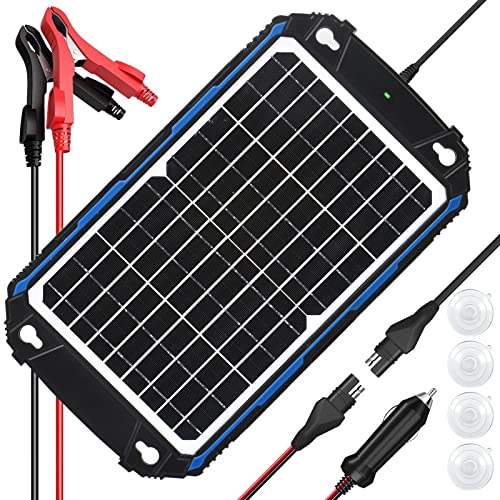
SUNER POWER 12W Solar Maintainer — Best all-round maintainer
Twelve watts turns out to be the Goldilocks output for the standard job — one car-size battery, parked outdoors or in a bright garage, losing charge to standby drains and time. The SUNER POWER 12W pairs that output with a weatherproof panel that can live on a boat deck, a caravan roof or a fence post beside a parking space, and built-in protection that stops the panel from draining the battery back overnight. It is the pick we would hand to a reader who said only: my vehicle sits a lot, sort it out.
The panel’s construction suits permanent outdoor life better than dashboard duty. A sealed surface shrugs off rain, the frame takes mounting screws for a fixed installation, and the supplied leads reach a battery without extension improvisation. Output in strong sun is enough to hold a healthy battery against typical parasitic loads with charge to spare, and in the dimmer months it still offsets most of what a modern car sips while asleep. Owners of boats on swing moorings — where no shore power exists at any price — form a large share of this panel’s natural constituency, and for them the combination of weatherproofing and fit-and-forget operation is exactly the point.
Its limits are the limits of its class, stated plainly. Twelve watts will not recover a flat battery in any useful timeframe, and on a large dual-battery truck in a northern winter it merely slows the decline rather than fully offsetting it; that reader should step up to the 20-watt SUNER or a controller kit. The panel also assumes a fundamentally healthy battery — connect it to a battery that is dying of age and it will faithfully maintain a corpse. Within its brief, though, it is the most balanced solar maintainer in this guide: enough output, proper protection, honest weatherproofing.
- Output: 12 watts, 12-volt battery maintenance
- Protection: built-in blocking diode against night reverse drain
- Construction: weatherproof sealed panel, mountable frame
- Connection: battery clamp and ring-terminal lead options
- Intended load: one car, boat or caravan battery
Consider how this panel behaves across a full year on a typical car, because that cycle is its real test. Through spring and summer it finishes most days with the battery brimful and the surplus simply unused — the sign of a correctly sized maintainer. In autumn it still breaks even on all but the gloomiest weeks. In the darkest stretch of winter it may fall slightly behind on a car with heavy standby electronics, which the owner answers with a single mains top-up rather than a bigger installation. That pattern — autonomous for ten months, assisted for two — is what success looks like in solar maintenance, and the 12W hits it for more vehicles than any other size in this guide.
Strengths
- Output is well matched to a single vehicle battery’s standby losses.
- Weatherproof build allows permanent outdoor mounting.
- Reverse-drain protection is integrated, no extra parts to buy.
Trade-offs
- Cannot recover a discharged battery in a useful timeframe.
- Marginal for large batteries in dark northern winters.
- No full charge controller for owners who want regulated multi-stage charging.
Best for: boat owners on moorings and drivers whose car or caravan sits outdoors for weeks between uses, on one healthy battery. Not suited for: reviving flat batteries, or maintaining big twin-battery setups through a northern winter.
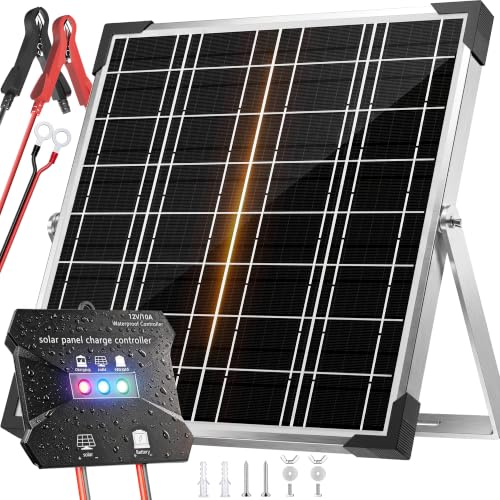
Voltset 20W Solar Charger Kit — Best full kit
The Voltset kit is what the bare-panel picks grow up to be: a 20-watt panel sold with the charge controller, cables and mounting hardware that turn solar maintenance into a small permanent installation. The controller is the headline. It regulates the panel’s output into a proper charging pattern, protects the battery against overcharge on blazing days, prevents reverse current at night, and shows system status on a small display — the difference between a panel that is connected and a system that is managed.
Twenty watts gives the kit headroom that matters in real weather. On overcast days, at high latitudes, or mounted at a compromised angle on an RV roof, a 20-watt panel still gathers enough to cover standby losses where a 10-watt panel falls behind. That headroom also suits larger batteries — the deep-cycle house battery in a camper, the tractor battery in a barn — whose self-discharge alone exceeds a small panel’s winter output. The kit’s controller includes a load output and USB charging on many configurations, letting the same installation keep a battery full and top up small devices at a campsite or in a field shelter.
Installation is the price of admission. Where the dashboard panels in this guide deploy in two minutes, the Voltset asks for an hour: mount the panel, route the cable, fix the controller near the battery, connect in the right order. Owners who want seasonal, movable solar should look at the lighter picks. Owners building a fit-once system for a stored RV, a boat or off-grid equipment get the most complete and most controllable package in this guide, and the one whose charging behaviour they can actually inspect rather than assume.
- Output: 20 watts, 12-volt systems
- Controller: included, with overcharge and reverse-current protection
- Kit contents: panel, controller, battery leads, mounting hardware
- Extras: controller display; load/USB outputs on the controller
- Intended load: RV, boat, tractor and deep-cycle batteries
The controller’s configurability deserves a word, because it is what separates this kit from a panel with a diode. Battery type selection lets the same installation serve a flooded battery today and a sealed AGM when the RV’s house battery is next replaced, and the controller’s protections watch both directions of trouble: excess voltage from the panel on a brilliant day, and excess discharge through any load wired to its output terminals. Owners who check the display monthly gain something the simple panels cannot offer — evidence. A system that shows its charging state turns vague trust into verified maintenance, and on a vehicle stored an hour from home, that evidence is the difference between relaxing and wondering.
Strengths
- Real charge controller makes charging regulated and inspectable.
- 20-watt headroom keeps working in cloud and winter.
- Complete kit avoids the extra purchases bare panels demand.
Trade-offs
- Installation takes an hour or so; not a casual dashboard setup.
- More components mean more connections to check seasonally.
- Oversized for a single small car battery in a sunny climate.
Best for: RV and boat owners building a permanent solar maintenance installation on a larger battery, especially away from mains power. Not suited for: drivers who need a panel they can move between cars in minutes.

SOLPERK 20W Solar Charger Kit — Best for RVs and tractors
SOLPERK’s 20-watt kit competes closely with the Voltset and distinguishes itself with hardware that feels aimed at working equipment rather than leisure vehicles. The framed panel is built to be bolted to a tractor cab roof, a barn wall above a parked mower, or the roof of a stored motorhome, and to stay there through weather that would peel a flexible panel off its backing. The included controller regulates charging for flooded and sealed lead-acid batteries and guards the system against overcharge, over-discharge on its load terminals, and reverse flow after dark.
Farm and storage duty is where this kit’s character shows. Equipment batteries live hard lives — long idleness punctuated by days of heavy cranking — and they die disproportionately in storage, not in work. A fixed 20-watt panel on the barn means the tractor starts in spring without the annual battery purchase that many small farms treat as a ritual tax. The controller’s indicator lights give a quick health read on a walk past, and the kit’s cabling is long enough for the panel-on-wall, battery-in-machine layouts that agricultural storage actually involves.
Against the Voltset, the choice is fine-grained: the SOLPERK leans toward rugged fixed mounting and straightforward lead-acid service, while the Voltset’s controller presentation suits owners who like more visible system information. Neither kit is the right answer for a hatchback at an airport car park — both are installations, and both ask for tools and an hour. Judged on its intended ground, the SOLPERK is the sturdiest route in this guide to a tractor, boat or RV battery that simply stays ready.
- Output: 20 watts, 12-volt systems
- Controller: included, for flooded and sealed lead-acid batteries
- Construction: rigid framed panel for bolted outdoor mounting
- Protection: overcharge, reverse-current and load-side safeguards
- Intended load: tractors, RVs, boats, gate and equipment batteries
There is a small economy argument buried in this kit that farmers understand instinctively. A tractor battery replaced a year early costs more than the panel that would have prevented it, and a single failed start during a narrow weather window for field work costs more than either. Fixed solar on agricultural equipment is not a gadget purchase; it is insurance bought once against a recurring seasonal loss. The SOLPERK’s appeal is that it prices and installs like a maintainer while behaving like infrastructure — bolted, weatherproof, and still on the barn wall doing its quiet work when panels bought as novelties have long been discarded.
Strengths
- Rigid frame and hardware suit permanent agricultural and marine mounting.
- Controller included, with clear status indicators.
- Generous cabling fits real barn and storage layouts.
Trade-offs
- Fixed installation; moving it between vehicles is impractical.
- Controller is lead-acid focused; lithium systems need different kit.
- Panel size needs a proper mounting surface, not a dashboard.
Best for: farmers, smallholders and RV owners whose equipment batteries die in storage and who can bolt a panel up once and forget it. Not suited for: apartment dwellers parking on the street, or lithium house-battery systems.
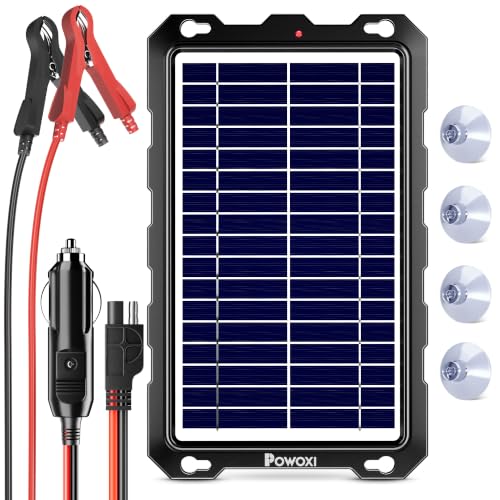
POWOXI 7.5W Solar Maintainer Kit — Best for a single stored car
The POWOXI makes the case for restraint. At 7.5 watts it is the lowest-output pick in this guide, and for its intended job — one healthy car battery, in a vehicle parked at home, at an airport, or in a storage unit with a window — that output is honestly sufficient in most seasons and climates. The kit includes tidy connection options for the battery and suction mounting that holds the panel against the windscreen, turning the car’s own glass into the mounting system and keeping the whole arrangement removable in a minute.
Dashboard duty defines both its charm and its ceiling. A windscreen filters and angles sunlight, so the panel behind glass harvests less than the same panel outside; the POWOXI’s modest rating assumes that placement and still covers the standby draw of a typical modern car in temperate conditions. Frequent flyers are the natural owners: the car waits three weeks at the airport, the panel waits with it, and the return journey starts with a turn of the key rather than a call to the breakdown service. Classic-car owners in rented garages, where running a mains lead is forbidden, use it the same way.
Where it cannot follow is anywhere demanding. A large battery, a vehicle with a heavy standby drain, a dark winter at high latitude, or a battery already weakened by age will each outrun 7.5 watts, and the panel’s integrated protection, while present, is the basic blocking arrangement rather than a full controller. Treat it as a well-judged minimum for the simplest case in solar maintenance — one good battery, one parked car, reasonable light — and it is a satisfying, inexpensive-feeling solution. Ask it to be a system, and the 20-watt kits above are waiting.
- Output: 7.5 watts, 12-volt battery maintenance
- Protection: built-in blocking diode
- Mounting: suction cups for windscreen or window placement
- Connection: clamp and ring-terminal leads included
- Intended load: one standard car battery
Airport parking is the scenario to picture, because it exposes every weakness a maintainer can have and the POWOXI answers each one adequately. The car will sit in an open-air long-stay park, so daylight is plentiful. The absence runs two to four weeks, long enough to flatten a battery with a healthy standby draw but not long enough to justify a permanent installation on a daily driver. The owner arrives home at midnight, in the rain, needing the car to start first time. A panel that lives in the boot, deploys onto the windscreen in a minute before the shuttle bus arrives, and covers the car’s sip for the whole trip is precisely engineered for that midnight moment — modest in specification, exact in purpose.
Strengths
- Deploys in a minute with no tools or permanent fitting.
- Output honestly matched to a single car battery’s losses.
- Removable between vehicles, unlike the bolted kits.
Trade-offs
- Lowest output here; beaten by dark winters and big batteries.
- Windscreen placement reduces harvest further.
- Basic protection only, not a regulated controller.
Best for: frequent travellers and classic-car owners storing one car with a healthy battery in reasonable light. Not suited for: large batteries, high-latitude winters, or any battery already past its prime.

SUNER POWER 20W Solar Maintainer — Strongest SUNER panel
SUNER POWER’s 20-watt maintainer answers the objection that sank its smaller sibling: what about the truck, the dual-purpose boat battery, the short grey days of a northern November? With close to double the 12-watt model’s harvest, this panel keeps ahead of standby losses in conditions that leave smaller maintainers merely slowing a battery’s decline. It keeps the family formula — weatherproof sealed panel, integrated blocking protection, leads for clamps or ring terminals — and scales the collection area rather than changing the concept.
The extra output buys margin in three common situations. Vehicles with thirsty standby electronics, including modern trucks with telematics and security systems that never fully sleep, draw more than their predecessors and need the bigger panel to break even. Batteries at the larger end of the automotive range self-discharge more in absolute terms. And any panel mounted at a fixed, imperfect angle — flat on a roof rather than tilted at the sun — surrenders a share of its rating that a 20-watt panel can afford and a 7.5-watt panel cannot. This is the SUNER to buy when the vehicle is big, the parking spot is shaded part of the day, or the winters are long.
It remains a maintainer, not a system: there is no full charge controller in the box, so owners who want regulated charging curves, system displays or load outputs should choose the Voltset or SOLPERK kits instead. On a small battery in a very sunny climate, an unregulated 20-watt panel also deserves a watchful eye in high summer — the integrated protection prevents the worst, but a controller is the thorough answer for small batteries under big panels. As a fit-and-forget maintainer for substantial batteries in unkind light, it is the strongest simple panel in this guide.
- Output: 20 watts, 12-volt battery maintenance
- Protection: built-in blocking diode against reverse drain
- Construction: weatherproof sealed panel, mountable
- Connection: clamp and ring-terminal leads
- Intended load: trucks, larger boat and RV batteries
Owners stepping up from the 12-watt model sometimes ask whether the extra harvest is wasted on a battery that is full by noon in summer. In summer, largely, yes — and that is fine, because maintainers are bought for their worst month, not their best. The 20-watt panel’s surplus in June is the premium that buys its competence in December, when the same vehicle under the same parking spot offers the panel a fraction of the light. Sizing solar by the darkest period in which the vehicle must survive unattended is the discipline this pick embodies, and it is why we recommend it without hesitation to anyone whose storage season includes a real winter.
Strengths
- Output headroom covers thirsty modern standby electronics.
- Keeps working through overcast spells and imperfect mounting angles.
- Same simple, weatherproof formula as the 12-watt model.
Trade-offs
- No full controller; regulated charging requires a kit pick instead.
- Generous for small batteries in very sunny climates.
- Still a maintainer — flat batteries need a mains charger first.
Best for: truck owners and northern-climate drivers whose batteries face long, dark storage periods and heavy standby drains. Not suited for: small motorcycle batteries in hot sunny regions, or owners wanting controller displays and load outputs.

Topsolar 10W Solar Trickle Charger — Simplest setup
The Topsolar 10W is the panel for the reader who wants solar maintenance without a project. It is light, flat and undemanding: connect the leads to the battery, place the panel where the sun falls — dashboard, deck, or leant against a garage window — and the arrangement is complete. Ten watts sits in the sensible middle for a standard car battery, and the panel includes the blocking protection that stops night-time backflow, so the simplicity is not bought by omitting the one safeguard that matters most.
That simplicity suits seasonal and occasional duty particularly well. The mower that sleeps in a shed with a window, the second car that covers a few hundred miles a year, the boat battery brought home and kept in a bright porch — each is a case where a permanent installation is overkill and a panel that deploys in moments is the difference between maintenance happening and being postponed forever. The Topsolar also travels easily, which makes it a reasonable companion for a camper who wants to offset a leisure battery’s losses during a stationary week without wiring a roof installation.
Its compromises follow from its lightness. The build is less armour-plated than the framed kit panels, so permanent exposed mounting on a working boat or tractor is beyond its brief; think of it as semi-portable equipment that lives indoors or under cover when not deployed. Output in poor light is modest, as any 10-watt panel’s is. And like the POWOXI, it relies on integrated protection rather than a controller. For the reader whose requirement is genuinely simple, it is the least friction in this guide between owning a panel and having a maintained battery.
- Output: 10 watts, 12-volt battery maintenance
- Protection: built-in blocking diode
- Construction: lightweight flat panel for portable use
- Connection: battery leads with clamp option
- Intended load: cars, mowers, seasonal equipment batteries
The Topsolar also earns a mention as the panel most likely to be bought as a gift that actually gets used. Battery care is a classic reluctant purchase — everyone agrees it matters, nobody enjoys shopping for it — and a lightweight panel with two leads defeats the inertia that kills more elaborate solutions. It suits the parent whose mower dies every spring, the neighbour whose second car is forever on jump leads, the boat owner whose battery winters in the porch. None of those people will install a controller kit. All of them will lay a panel in the light and clip two leads, which is why this simplest pick may prevent more flat batteries than the sophisticated kits combined.
Strengths
- Fastest, simplest deployment of any pick here.
- Portable between vehicles and storage spots.
- Sensible 10-watt size for a standard car battery.
Trade-offs
- Light build is not meant for permanent exposed mounting.
- Modest harvest in overcast or winter conditions.
- Basic protection; no controller regulation.
Best for: seasonal equipment and second cars that need occasional, portable solar maintenance with zero installation. Not suited for: permanent marine or farm installations, or large batteries in poor light.
Comparison Table
| Pick | Output | Controller | Mounting style | Standout trait |
|---|---|---|---|---|
| SUNER POWER 12W | 12W | Blocking diode | Fixed or portable | Balanced all-round maintainer |
| Voltset 20W Kit | 20W | Full controller | Permanent installation | Regulated charging with display |
| SOLPERK 20W Kit | 20W | Full controller | Bolted frame | Rugged farm and RV duty |
| POWOXI 7.5W | 7.5W | Blocking diode | Windscreen suction | One-minute dashboard setup |
| SUNER POWER 20W | 20W | Blocking diode | Fixed or portable | Headroom for big batteries |
| Topsolar 10W | 10W | Blocking diode | Portable flat panel | Simplest seasonal use |
How much sun do the best 12 volt solar chargers actually need?
Think in hours of useful light rather than in the panel’s headline watts, because the wattage is a laboratory figure measured in perfect noon sun that your dashboard will never see. A maintainer’s real job is arithmetic: over a week, the panel must harvest at least what the vehicle consumed while asleep. A healthy modern car might sip a modest standby current continuously, plus the battery loses a little charge to its own chemistry. A 10-to-12-watt panel in a temperate climate, given a reasonably bright parking spot, typically harvests enough across a day to cover that sip with something left over; the same panel in a dark December at high latitude may cover only part of it, which is why the 20-watt picks exist.
Placement multiplies or divides everything. A panel tilted toward the midday sun outdoors can collect several times what the identical panel gathers flat behind a windscreen, because glass filters ultraviolet and some visible light, the dashboard angle is rarely ideal, and roof pillars shade the panel through the day. If your vehicle lives outside, mounting the panel outside — on a roof, deck or nearby post — is the single most effective upgrade available, worth more than stepping up a wattage class. If the vehicle lives in a garage, a panel in a south-facing window with the lead run to the car beats a panel on the dashboard of a car in the dark.
There is a simple field test for owners who already have a panel and wonder whether it is coping. Note the battery’s rested voltage after a week of the vehicle’s normal storage, then again after a second week. A voltage holding steady or rising slightly means the panel is winning; a slow week-on-week slide means the vehicle is out-drinking the panel, and the answer is a bigger panel, a better position, or a parasitic drain worth hunting — an interior light, a faulty module, an accessory left alive. Solar arithmetic is unforgiving but it is also legible, and two multimeter readings a fortnight apart tell you more than any amount of specification reading.
Season planning follows from the same arithmetic. Many owners run a simple rhythm: solar maintenance through the brighter two-thirds of the year, and one full mains charge before the darkest months plus another in midwinter for vehicles in harsh climates. That hybrid approach is not an admission of solar’s failure; it is how experienced boat and RV owners have always treated it — solar carries the routine load, and the mains charger handles the extremes.
Do you need a charge controller with a solar panel?
It depends on the ratio between panel and battery, and on how unattended the arrangement will be. A small panel on a large battery is self-limiting in everyday use: the battery’s capacity absorbs everything a 7.5 or 10-watt panel produces in a day without its voltage climbing into danger, and a blocking diode covers the night-time direction. That is the design logic behind the POWOXI, Topsolar and SUNER maintainers, and for standard car batteries it is sound. The arrangement to avoid is a large panel on a small battery left indefinitely in strong sun, where even a modest daily surplus accumulates into chronic overcharge.
A controller earns its place as panels grow, batteries shrink, or the installation becomes permanent. The Voltset and SOLPERK kits regulate voltage properly, add temperature-aware behaviour on some models, and protect against the slow overcharge that shortens battery life invisibly — the battery never boils dramatically; it just dies at three years instead of six, and the owner blames the battery. Controllers also add information: a display or indicator lights that tell you the system is alive, which matters for an installation on a distant mooring or in a barn you visit monthly.
Lithium batteries change the answer completely: they require a controller or charger with a lithium profile, full stop. None of the simple diode-protected maintainers in this guide should be connected to a lithium battery, and the lead-acid controllers in the two kits are for lead-acid systems. If your stored vehicle runs a lithium house battery, buy a solar controller built for that chemistry rather than adapting anything reviewed here.
How do you install a solar maintainer on a stored vehicle?
Start by deciding where the panel will live, because that decision drives the rest. Outdoors and tilted toward the midday sun is best; a windscreen is acceptable; a shaded corner is a waste of money. Clean the panel’s spot and the battery terminals in the same visit. Corroded terminals resist the panel’s small current even more than a mains charger’s, and a maintainer connected through green crust is a maintainer in name only.
Connect in the order the kit’s instructions specify — for controller kits, the battery connects to the controller before the panel does, so the controller wakes up knowing the system voltage. Route cables away from door seals that will crush them, exhaust parts that will melt them, and steering or pedal areas where a loose lead is a genuine hazard. For a dashboard setup, leave the cable slack arranged so it cannot slide into the driver’s footwell. Then verify life: the controller’s indicator, or a multimeter showing the battery voltage a touch higher in bright sun than in shade, confirms the harvest is arriving.
Finally, build the check into an existing habit. A solar maintainer needs a glance, not a service: is the panel still in place, unshaded by the boxes that migrated in front of the window, its surface not blanketed in dust or leaves? A dirty panel can lose a large share of its output, and a panel knocked face-down harvests nothing at all. Thirty seconds during the monthly walk past the stored vehicle is the entire maintenance contract, and it is why solar, honestly installed, is the lowest-effort battery care that exists.
Can a solar charger bring back a flat battery?
Technically, given weeks of good sun and a battery that is merely discharged rather than damaged, a maintainer will eventually lift it — and practically, this is the wrong tool and the wrong expectation. A deeply discharged lead-acid battery is being damaged by sulfation every day it sits low, so the slow solar route lets the injury deepen while it works. The correct sequence is a mains charger first: a full, proper charge from a smart charger, ideally with a repair mode if the battery has sat flat for a while. Only then does the solar panel take over, holding the recovered battery at full so the situation never repeats.
This division of labour is worth internalising because it explains most solar disappointment stories. An owner connects a panel to a battery that is already flat or already dying, watches it fail to perform miracles, and concludes solar maintenance does not work. The panel was asked to be an ambulance when it is a vaccine. Fit solar to a healthy, charged battery and it will keep that battery healthy for years; ask it to resurrect the dead and it will fail on schedule. If your battery is flat today, our companion guide to mains smart chargers is the right first read, and this guide is the right second one.
What size panel does your vehicle actually need?
Work backwards from the vehicle’s appetite rather than forwards from a catalogue. Three questions size the job. First, how big is the battery? A compact hatchback battery and a large truck battery lose charge at different absolute rates, and the truck simply needs more panel to stand still. Second, how thirsty is the vehicle asleep? An older car with a clock and nothing else sips almost nothing; a modern vehicle with keyless entry listening, an alarm armed, telematics reporting and a dashcam in parking mode drinks steadily, and some vehicles are notorious for it — if your model has a forum reputation for killing batteries in a fortnight, believe it and size up. Third, how dark is the storage? A panel in Arizona and the same panel in Scotland are different products in practice.
Combine the answers honestly. Small battery, light sleeper, bright climate: the POWOXI or Topsolar territory. Standard car, modern electronics, temperate light: the SUNER 12W’s home ground. Large battery, heavy standby draw, or a storage season with real winter: the 20-watt panels, and if the vehicle also lives far from mains power, the controller kits. Owners who run this arithmetic before buying almost never return a panel; owners who buy the smallest panel on the page and hope are the solar industry’s most reliable repeat customers, because they come back for the size they needed first time.
How do solar maintainers compare with mains trickle chargers?
A mains smart charger is the more capable tool in absolute terms: it charges faster, through proper multi-stage programmes, in any weather, at any hour, and the good ones repair and diagnose as they go. If your stored vehicle parks within extension-lead reach of a socket, a mains maintainer is the straightforward choice and solar is the eccentric one. Solar wins exactly where mains cannot go — the mooring, the barn without power, the rented garage, the airport car park, the street outside a flat — and in the subtler currency of effort: a panel never needs its lead run out, its socket checked, or its bill considered.
The two also fail differently, which argues for the hybrid pattern many experienced owners adopt. Mains maintainers fail by being unplugged, switched off at the wall, or tripping a breaker unnoticed for a month. Solar fails by shade, dirt and dark seasons. A vehicle kept on solar with a mains top-up at the season’s extremes is protected against both failure families. Nothing in this guide should be read as solar replacing the mains charger in the toolkit; the flat-battery rescue and the annual deep charge still belong to the mains unit, while the long, quiet, unattended months belong to the sun.
Where should you mount a panel for a boat or RV?
Boats and RVs reward the same principle as cars — unobstructed sky — with complications of their own. On a boat, the pushpit rail, the top of a coachroof and a stern arch are the usual homes; the test is shade through the day, because a mast, boom or neighbouring vessel’s rig can shadow a panel for the exact hours it should be harvesting. A panel that spends its noon behind a mast is a smaller panel than its label claims. On a mooring, also consider theft and storm: a bolted framed panel from the kit picks survives weather and discourages casual removal in ways a loose dashboard panel cannot.
RV roofs offer area and elevation but impose a flat mounting angle and a long cable run down to the battery compartment, which is why the controller kits, with their generous cabling and proper regulation, suit RVs better than simple panels with short leads. Route the cable through an existing gland or a properly sealed entry, never trapped in a door or hatch seal, and place the controller close to the battery rather than close to the panel, so its voltage sensing reflects the battery’s reality. A weekend spent doing this installation properly buys a decade of unattended storage; a rushed version buys mysterious undercharging and a cable that chafes through by the second season.
Common Mistakes
Buying by wattage alone is the most common error. A cheaply made 20-watt panel with no blocking diode, thin cable and an optimistic rating can maintain worse than a well-made 10-watt panel — and can drain the battery overnight into the bargain. Judge the system: protection, cable, connectors and mounting, with wattage as one input among several.
Second is the shaded compromise nobody re-checks. The panel goes up in spring on a bright wall; by autumn a grown hedge, a stacked woodpile or the sun’s lower angle has put it in shade for most of the day, and the battery fades while the owner trusts a system that no longer sees the sun. Solar installations need a seasonal glance at their light, not just their wiring.
Third is connecting a maintainer to a battery that was never healthy. Solar holds charge; it does not restore capacity lost to age, sulfation or a failing cell. A battery that needed a jump twice last season needs testing and probably replacing, and the panel budget is better spent after the new battery is fitted.
One further mistake deserves its own warning because it can damage the vehicle rather than merely the battery: routing a panel’s cable where it does not belong. Leads trapped in door seals get crushed and short; leads draped across a hot engine bay melt; leads left loose in a footwell tangle with pedals. Every kit here supplies enough cable to route properly — through an existing grommet, along a loom, or neatly under trim — and the ten extra minutes that routing takes are the cheapest safety work in the whole installation. A maintainer should be the most boring equipment on the vehicle, and boring begins with cable that nobody ever notices again.
Fourth is forgetting the vehicle’s own drains when choosing a size. A modern truck with telematics, an alarm and keyless entry sips far more than a 1990s hatchback, and a panel sized by the old car’s habits will lose the new truck’s winter. When in doubt between two sizes in this guide, the larger panel is the cheaper mistake.
Final Recommendation
Match the panel to the parking reality, not to optimism. One car, reasonable light, healthy battery: the SUNER 12W is the balanced default, with the POWOXI as the lighter dashboard option and the Topsolar as the portable seasonal choice. A bigger battery, a darker climate or a thirstier vehicle pushes you to the SUNER 20W. And when the vehicle lives away from mains power for months — the moored boat, the barn tractor, the stored RV — skip the simple panels and install a controller kit: the Voltset for its display and completeness, the SOLPERK for rugged fixed duty. Solar maintenance done this way is nearly invisible, and that invisibility is the achievement: the battery is simply always ready, and the flat-battery phone call stops happening. If there is one sentence to carry away from this guide, it is that the sun is already shining on your parked vehicle every day it sits there losing charge — a panel in this size range merely collects the refund, quietly, for years, at the cost of one thoughtful installation.
Frequently Asked Questions
Will a solar maintainer work on cloudy days?
Yes, at reduced output. Panels harvest diffuse light as well as direct sun, so an overcast day still contributes — often enough to cover a sleeping car’s standby draw with a 12 or 20-watt panel, and partially with smaller ones. Long runs of dark winter days are the real test, which is why northern owners size up a class and why a midwinter mains top-up remains a sensible ritual in harsh climates.
Can I use one of these panels through a windscreen?
You can, and the POWOXI is designed for exactly that, but expect a noticeable reduction in harvest: glass filters part of the light and the dashboard angle is rarely aimed at the sun. For a car in regular light with a healthy battery, windscreen placement usually still covers standby losses. For marginal cases — winter, big battery, shaded street — mount the panel outside the glass if you possibly can.
Does a solar panel charge while the vehicle is being driven?
It contributes a trickle, but the alternator does essentially all of a driven vehicle’s charging, dwarfing any panel in this guide. Solar maintenance is a parked-vehicle technology. Leaving a dashboard panel connected while driving is harmless for the diode-protected and controller-based picks here, provided the cable is routed where it cannot interfere with the driver.
How long will a solar maintainer keep a battery healthy?
Indefinitely, in the sense that matters: a battery held at full charge does not sulfate, and sulfation during storage is the main killer of vehicle batteries. Owners routinely report stored-vehicle batteries lasting their full service life instead of dying in their second or third winter. The panel itself has no wearing parts in normal use; keep its surface clean and its cable intact and it will outlast several batteries.
Can one panel maintain two batteries?
Not properly. Two batteries at different states of charge connected to one small panel will share its output unevenly, and the weaker battery — the one needing most — usually gets least. The honest solutions are a panel per battery, or a dual-battery controller system beyond the scope of these simple kits. For a boat with start and house batteries, two modest panels are cheaper than one clever compromise that serves neither well.
Do solar panels work in winter?
They work, with two opposing effects in play. Cold actually improves a panel’s electrical efficiency slightly, but winter’s short days, low sun angle and frequent cloud overwhelm that gain, so total daily harvest falls — in northern regions, dramatically. This is the season the 20-watt picks were chosen for, and the season when placement matters most: a tilted panel aimed at the low midday sun gathers far more than one lying flat. Owners in severe climates should treat winter solar as partial maintenance and schedule the midwinter mains top-up described earlier in this guide.
What size panel does an RV in storage need?
For a single house battery plus the chassis battery’s standby loads, start at 20 watts with a controller — the Voltset or SOLPERK kits in this guide — and expect that to hold both only if the RV’s parasitic loads are modest and the panel is roof-mounted in decent light. Larger RVs with heavy standby electronics may need a bigger array, which becomes a dedicated solar installation rather than a maintainer.
Related Guides
Pair solar maintenance with the rest of a stored-vehicle routine — the annual battery test, the terminal clean, the tyre and fluid checks a stored vehicle quietly needs — using our guides to the best 10 amp auto battery chargers for recovery charging, the best AGM battery chargers for start-stop vehicles, and the best portable chargers for travel emergencies.
Related guide: Best Hand Crank Chargers
Related guide: Best Tesla Chargers
Related guide: Best PS4 Controller Chargers
Related guide: Best Flexible Solar Chargers



[…] complete battery-care corner, or helping a family member set up theirs, may also want our guides to the best solar battery maintainers for stored vehicles, the best AGM battery chargers for start-stop cars, and the best portable jump starters to keep in […]