What's inside
- Key Takeaways
- Quick Picks
- How Did We Assemble a List Across Two Panel Families?
- What Is the Real Difference Between Bending and Folding Panels?
- How Much Power Will a Panel Actually Deliver on a Real Day?
- Which Panels Charge Phones Directly, and Which Feed a 12V System?
- What Goes Wrong Most Often With Small Solar Chargers?
- How Should You Run a Panel Day on the Trail or at Anchor?
- How Do You Mount a Bendable Panel Without Regretting It Later?
- What Should Boaters and Van Owners Know That Campers Do Not Need To?
- How Long Do Panels in These Families Reasonably Last?
- How Do You Size a Solar Setup for a Weekend, a Season or a Life Off Grid?
- What Does a Sensible First Purchase Look Like for Each Kind of Buyer?
- Why Does Panel Placement Matter More Than Panel Brand?
- What Should You Check in the First Week of Owning Any Panel Here?
- How Do Seasons Rewrite the Same Panel’s Personality?
- What Role Does a Power Bank Play in Making Solar Feel Reliable?
- Which Accessories Genuinely Earn Their Space Beside a Panel?
- Final Recommendation
- Frequently Asked Questions
- Related Guides
As an Amazon Associate I earn from qualifying purchases. This post may contain affiliate links at no extra cost to you.
widgetverdict.com is reader-supported. When you buy through links on our site, we may earn an affiliate commission.
Where to buy: every panel reviewed below links to a checked Amazon listing; two small FlexSolar folding panels for phones, one genuinely bendable 15W USB panel, two 100W bendable 12V panels from Renogy and XINPUGUANG for curved roofs, and a 45W GEYOTO fast-charging panel between them cover two different solar families that are too often confused.
The best flexible solar chargers begin with a vocabulary problem, so let us settle it before any product appears. A flexible panel is a semi-rigid sheet that bends along a curve — the roof of a van, the deck of a boat, the top of a cabin — and stays there, mounted, flexing to follow a surface that is not flat. A foldable panel is a different animal: rigid or fabric-backed segments joined by hinges, designed to fold flat for a backpack and unfold on the ground at camp. The two families share sunlight and little else. This guide reviews both, because shoppers search for them together, but it never blurs the distinction: each pick is labelled by what it actually is, according to its own listing.
The second divide is electrical. Small USB panels in the 15W to 45W range speak directly to phones, power banks, fans and camping lights through USB-A and USB-C ports. The 100W bendable panels are 12V system components: they feed charge controllers and batteries in RV, marine and off-grid installations, and they will not charge a phone without the rest of that system around them. Buying across that divide by mistake is the most expensive error in this category, so the reviews below state each panel’s world plainly and the comparison table keeps the two groups visibly apart.
Key Takeaways
- Flexible means bendable and mountable on a curve; foldable means hinged and packable. They are different products.
- USB panels charge phones and power banks directly; 100W 12V panels need a controller and a battery to be useful.
- Panel wattage is a laboratory figure; real output depends on sun angle, heat, shade and the device accepting the charge.
- Waterproof ratings differ sharply between picks, from IP57 to IP68, and matter for anything living outdoors.
- A power bank between the panel and the phone smooths clouds and makes small panels far more practical.
- Curved-surface mounting is the one job rigid panels cannot do, and it is where bendable panels earn their premium.
Quick Picks
| Pick | Badge | Why it earns its place |
|---|---|---|
| FlexSolar 25W Portable Solar Panel Charger | The packable phone panel | A folding 25W panel with USB-A and USB-C ports, IP57 sealing and a weight of 0.8lbs for camp charging. |
| FlexSolar 15W Foldable Solar Panel Charger | The emergency folder | A foldable 15W 5V USB panel, IP67 waterproof, sized for hiking and emergency phone charging. |
| 15W Flexible Solar Panel Charger USB-C | The truly bendable USB panel | A flexible and waterproof 15W panel with USB-C and Lightning connections for cameras, fans and phones. |
| Renogy Flexible Monocrystalline Solar Panel 100W | The curved-roof standard | A 100W panel that bends up to 240 degrees, 0.1 inch thick, for marine, RV and cabin curves. |
| XINPUGUANG 100W Flexible Solar Panel | The value bendable | A 100W 12V bendable monocrystalline panel on fiberglass, aimed at RVs, boats and uneven surfaces. |
| GEYOTO 45W Flexible Solar Panel Charger | The fast-charge traveller | A pocket-size 45W panel with PD 25W USB-C plus USB-A and IP68 sealing for phones and tablets. |
How Did We Assemble a List Across Two Panel Families?
We began by sorting listings by construction rather than by marketing language, because the word flexible is used loosely across the category. Panels whose own titles describe folding were classified as foldable even when their brand name suggests otherwise, and panels whose titles describe bending — degrees of flex, curved surfaces, fiberglass backing — were classified as genuinely flexible. That discipline produced the honest shape of this roundup: two folders, one small bendable USB panel, two large bendable system panels, and one compact fast-charging panel whose listing emphasises size and sealing over construction claims.
Output and ports formed the second sort. For phone charging we favoured panels with both USB-A and USB-C, because a mixed bag of devices travels with most campers. For system panels we favoured established monocrystalline designs at the common 100W size, which matches the charge controllers and battery banks already installed in most vans and boats. Readers whose needs are purely domestic should compare the wall-powered options in our guide to best android fast chargers, because solar only earns its complexity once a socket is out of reach.
Weather sealing was the third filter. A panel that lives on a boat deck or a van roof meets rain as a routine, not an accident, and a panel carried for emergencies must survive being rained on while it works. The ratings named in the listings range from IP57 to IP68, and the reviews note each one, because a buyer choosing for a marine installation should not accidentally select a panel sealed for occasional splashes.
What Is the Real Difference Between Bending and Folding Panels?
A bendable panel is built on a flexible substrate with the cells laminated into a sheet that tolerates a continuous curve. Renogy’s listing quantifies this with a 240-degree flex figure and a thickness of a tenth of an inch, numbers that describe a panel you can conform to a wheelhouse roof and fix there permanently. The bend is a one-time installation act, not a daily party trick: repeated flexing back and forth fatigues any such panel, and owners should treat the curve as a mounting decision, not a storage method.
A folding panel takes the opposite approach to portability. Its segments are comparatively rigid, joined so the whole assembly collapses into a flat package with a handle or a slim profile for a pack. FlexSolar’s two entries here work that way, and their natural habitat is a backpack, a car boot or an emergency drawer. They do not conform to curved roofs, they are not meant to be mounted permanently, and their hinges and fabric are wear points a mounted panel does not have.
Confusing the two leads to two classic disappointments. The camper who buys a bendable 12V panel expecting to charge a phone at a picnic discovers a system component with no USB port in sight. The van owner who buys a folding panel expecting to skin a curved roof discovers hinges where the curve should be. Both products are good at their own jobs. This guide’s job is to keep the jobs separate, and every review below opens by placing its panel in the correct family before discussing anything else.
How Much Power Will a Panel Actually Deliver on a Real Day?
Rated wattage is measured under standard test conditions: strong, direct, perpendicular sunlight at a controlled temperature. Real days offer angled morning light, passing clouds, hot panel surfaces that reduce efficiency, and phones that taper their intake as they fill. A small USB panel rated at 25W may deliver a fraction of that to a phone across a typical hour, which is still genuinely useful — enough to reverse a draining battery during a lunch stop — provided expectations are set by physics rather than by the box.
The power-bank pattern transforms small-panel ownership. Charge a power bank from the panel while the sun is strong, then charge the phone from the bank whenever convenient, including after dark. The bank absorbs the panel’s fluctuations, presents the phone with the steady input it prefers, and turns an intermittent source into a dependable routine. Direct phone charging from a panel works, but phones may repeatedly connect and disconnect as clouds pass, and some will not resume charging gracefully without being re-plugged.
For the 100W system panels, the arithmetic runs through a charge controller into a battery, and daily yield is best thought of in energy terms across the whole day rather than in peak watts at noon. Orientation, latitude, season and shade from roof furniture all move the result more than the difference between two reputable 100W panels. Buyers planning an installation should size the battery and controller with the same care as the panel, because the panel is only the front door of the system.

FlexSolar 25W Portable Solar Panel Charger — The packable phone panel
Classification first, as promised: this FlexSolar panel is a folding design. Its own listing calls it a folded solar panel, describes a portable 25W charger with USB-A and USB-C ports, IP57 waterproof and dustproof sealing, and a weight of 0.8lbs, compatible with cellphones and camping lights. Nothing about it bends around a roof, and it should not be bought for that purpose. What it does instead is travel: folded flat, light enough to forget in a pack, and ready to open toward the sun at a lunch stop or a campsite.
Twenty-five watts is a useful size for direct device charging in good sun, and the pairing of USB-A with USB-C covers a phone plus a light, or a phone plus a partner’s phone at gentler rates. The IP57 rating speaks to dust and temporary water exposure, appropriate for camp life where a shower of rain should not end the charging session or the panel. Owners should still dry it before folding it away for storage, because trapped moisture is unkind to any electronics over a winter.
As a first solar panel for a camper, hiker or festival-goer, this is the balanced entry in the FlexSolar pair: more output than the 15W folder, still genuinely light, and honest about its construction. Pair it with a power bank for the cloud-smoothing routine described earlier and it becomes a dependable travel system rather than a fair-weather novelty.
- Construction: folding panel (not bendable)
- Rating: 25W
- Ports: USB-A and USB-C
- Sealing: IP57 waterproof and dustproof
- Weight: 0.8lbs per the listing
Strengths
- Dual USB standards cover modern phones and older accessories in one panel.
- Sub-pound weight makes it a realistic backpack resident rather than a car-only tool.
- IP57 sealing tolerates the dust and splashes that camp charging involves.
Trade-offs
- It folds rather than flexes, so curved-surface mounting is outside its design.
- Direct phone charging still fluctuates with clouds unless a power bank intervenes.
- Twenty-five watts shared between two devices leaves each with a modest share.
Best for: campers and hikers wanting a light folding panel for phones and lights.
Not suited for: a van owner seeking a panel that conforms permanently to a curved roof.
See the FlexSolar 25W folder on Amazon if your charging problem begins where the trail does.

FlexSolar 15W Foldable Solar Panel Charger — The emergency folder
The smaller FlexSolar is also a folding panel, and its listing is equally clear: a 15W foldable portable 5V USB solar panel charger, IP67 waterproof, lightweight, intended for emergency charging while camping, hiking and backpacking, for cell phones and fans. Fifteen watts at 5V is a modest source, best understood as a lifeline rather than a lifestyle: it keeps a phone alive for maps and messages, tops up a fan on a still night, and waits in an emergency kit without complaint.
IP67 is a stronger water rating than its larger sibling carries, reflecting a design expected to be caught in weather. In an emergency drawer, in a glovebox, or strapped to a pack through a wet week, that sealing is the feature that matters most after the panel simply existing. The foldable format keeps it flat and protected among other gear, and the light output matches the modest devices it is meant to rescue.
Buyers wanting to run a campsite’s worth of gadgets should step up to the 25W model or the GEYOTO. Buyers wanting insurance — a panel bought once, stored, and trusted to wake up a dead phone after a storm or a long drive — will find this smaller FlexSolar sized exactly to that modest, vital job.
- Construction: foldable panel (not bendable)
- Rating: 15W, 5V USB output
- Sealing: IP67 waterproof
- Stated uses: emergency charging, camping, hiking, phones and fans
- Role: emergency kits and light backpacking
Strengths
- IP67 sealing suits a panel stored for emergencies and used in bad weather.
- The folding format stores flat among documents, tools or pack layers.
- Its modest output matches the phones and small fans it is honestly aimed at.
Trade-offs
- Fifteen watts is a lifeline rate, not a rapid-charging experience.
- It offers no route to tablets or laptops expecting stronger USB-C delivery.
- Like its sibling, it folds; it does not bend for curved mounting.
Best for: emergency kits, gloveboxes and hikers who value a waterproof lifeline.
Not suited for: a camper planning to charge several hungry devices every afternoon.
Look at the FlexSolar 15W folder on Amazon when the panel’s job is to be there on the worst day.

15W Flexible Solar Panel Charger USB-C — The truly bendable USB panel
Here is the small panel in this guide that genuinely flexes. Its listing describes a 15W 5V solar panel, flexible and waterproof, with a USB-C solar charger offering Type-C and Lightning connections, a 4-core cable and no reverse current, aimed at camping, outdoor cameras, fans and water pumps. That combination — bendable construction at phone scale — is rarer than the category’s vocabulary suggests, and it opens uses the folders cannot serve: a panel that can be draped or lightly curved over a pack, a tent surface or an uneven perch while it works.
The stated device list is telling. Outdoor cameras, fans and small pumps are steady, patient loads that suit a 15W source, and the reverse-current protection guards a connected battery or device when the sun drops. The inclusion of both USB-C and Lightning connections broadens the phone compatibility beyond the Android focus of most of this batch, which households with mixed devices will appreciate.
Treat its flexibility with the respect the construction deserves: bend it to settle it, not as a daily folding routine, because repeated sharp flexing is no friend to any laminated cell. Within that understanding, it is the most versatile small panel here — part travel charger, part utility power source for the small machines that keep a camp or a garden running.
- Construction: flexible, bendable panel
- Rating: 15W, 5V
- Connections: USB-C and Lightning per the listing
- Protection: no reverse current
- Stated uses: phones, outdoor cameras, fans, water pumps
Strengths
- Genuine bendability at USB scale suits packs, tents and uneven surfaces.
- Reverse-current protection protects connected devices when light fades.
- Dual connection types serve mixed phone households without adapters.
Trade-offs
- Fifteen watts remains a gentle rate for modern large phones.
- Bendable construction should not be folded sharply or flexed daily.
- The listing gives its sealing in general waterproof terms rather than a numbered IP rating.
Best for: campers powering cameras, fans and phones from one bendable panel.
Not suited for: a buyer needing rapid charging for a tablet-heavy expedition.
Check the flexible 15W USB-C panel on Amazon if your surfaces refuse to be flat.
Renogy Flexible Monocrystalline Solar Panel 100W — The curved-roof standard
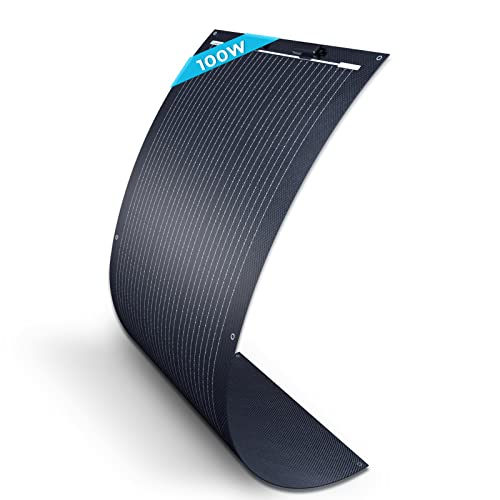
Renogy’s panel is the reference design for bendable solar at system scale. The listing describes a flexible 100W panel with 240 degrees of ultra flex bendability, monocrystalline cells, a thickness of 0.1 inch, a lightweight black build, and intended homes across marine, RV, cabin, van, car and boat curved surfaces and off-grid systems. Read that list again: every word is about permanent installation on something that moves or floats. This panel is not a phone charger, and any review implying otherwise would be doing its readers a disservice.
In an installation, the panel feeds a charge controller, the controller tends a battery, and the battery runs the lights, fridge, fans and device charging of a small off-grid world. The Renogy’s thinness and bend let it sit on surfaces that would defeat a rigid framed panel, and its light weight matters on roofs where every kilogram counts against payload. Renogy’s position in the RV and marine market also means controllers, cables and documentation designed to match are easy to find.
Installation quality decides this panel’s fate more than its specification does. The curve should be within its stated flex, the fixing method should follow the maker’s guidance for the surface involved, and cable runs should be protected from chafe where a vehicle vibrates. Owners who treat those steps seriously gain a silent power source that asks for an occasional wash and little else for years.
- Construction: flexible monocrystalline, bends up to 240 degrees per the listing
- Rating: 100W, 12V system class
- Thickness: 0.1 inch
- Intended surfaces: marine, RV, cabin, van, car and boat curves
- Requires: charge controller and battery to form a working system
Strengths
- Quantified bendability lets installers plan curved mounting with confidence.
- Featherweight thinness suits roofs and decks sensitive to load and profile.
- Renogy’s ecosystem simplifies matching controllers and accessories.
Trade-offs
- It cannot charge a phone directly; a controller and battery are mandatory partners.
- Permanent mounting makes it the least portable object in this guide.
- Output depends heavily on installation angle and shading from roof furniture.
Best for: van, boat and cabin owners electrifying a curved surface properly.
Not suited for: a hiker expecting USB power from a panel carried in a pack.
View the Renogy 100W flexible panel on Amazon when the roof in question refuses to be flat.

XINPUGUANG 100W Flexible Solar Panel — The value bendable
XINPUGUANG offers the same fundamental proposition as the Renogy — a bendable 100W 12V panel — at the value end of the market. The listing describes a flexible solar panel of 100W and 12V, a bendable charger for RV and boat use, high-efficiency monocrystalline cells, and a fiberglass lightweight bendable construction suited to RVs, boats, cabins, vans, cars and uneven surfaces. Fiberglass backing is a sensible foundation for a flex panel, giving the laminate structure while keeping weight down.
The honest comparison with the Renogy runs through support and documentation rather than through the headline specification, which matches on wattage, voltage class and cell type. Renogy publishes extensive installation material and sells matched components through a large organisation. XINPUGUANG’s appeal is the panel itself at its tier, and buyers comfortable planning their own controller pairing and mounting details may find that trade entirely rational, particularly for a second panel expanding an existing system.
As with every system panel, the buying checklist extends beyond the panel: a suitable charge controller, cabling of adequate gauge, fusing, and a mounting approach appropriate to the surface and its warranty. A boat’s cabin top and a van’s roof are expensive canvases; test the layout, measure twice, and let the panel’s bend serve the curve rather than fight it. Judged as a component in a competently planned system, this XINPUGUANG is a credible way to add curved-surface capacity without paying the brand premium.
- Construction: flexible, fiberglass-backed, bendable
- Rating: 100W, 12V class
- Cells: monocrystalline, described as high efficiency in the listing
- Intended surfaces: RV, boat, cabin, van, car, uneven surfaces
- Requires: charge controller and battery system
Strengths
- Matches the 100W bendable specification of pricier rivals on the headline figures.
- Fiberglass construction balances flex with structural steadiness.
- Suits expansion of an existing 12V system as naturally as a first installation.
Trade-offs
- Documentation and matched accessories are thinner than the Renogy ecosystem offers.
- Installers must supply more of their own planning and component judgement.
- It shares the system panels’ rule: no controller and battery, no useful power.
Best for: confident DIY installers adding bendable capacity to a 12V system.
Not suited for: a first-time buyer wanting a guided, matched-component installation.
See the XINPUGUANG 100W flexible panel on Amazon if you plan your own system around the panel.

GEYOTO 45W Flexible Solar Panel Charger — The fast-charge traveller
GEYOTO’s panel returns us to device charging with the strongest specification among the portable picks. The listing describes a 45W solar panel charger with fast charging for phones, PD 25W delivery across USB-C and USB-A ports, a pocket-size format, and IP68 waterproofing, aimed at phones, tablets, power banks, camping and backpacking. That PD figure is the headline: a power bank or phone that accepts USB-C PD can take a genuinely brisk charge in strong sun, at least by solar standards.
One honesty note belongs here. The listing’s own wording emphasises wattage, ports, size and sealing rather than a quantified bend specification, so buyers for whom certified flexibility is the whole point should treat the small 15W bendable panel or the big system panels as the proven-flex choices, and the GEYOTO as a compact fast-charging traveller whose title in this guide follows the category it was sold into. What is stated is impressive enough without embellishment: IP68 is the strongest sealing in this roundup, and pocket-size portability with 45W on tap is a rare pairing.
In the field, the sensible routine is panel-to-power-bank during the bright hours, then bank-to-phone at leisure, letting the PD port do its best work into a patient battery. Tablets, which are pickier about input, benefit most from that arrangement. As the portable flagship of this six, the GEYOTO suits travellers whose devices are modern, whose weather is unreliable and whose patience for trickle charging ran out several trips ago.
- Rating: 45W
- Ports: USB-C with PD 25W stated, plus USB-A
- Sealing: IP68 waterproof
- Format: pocket-size per the listing
- Construction note: the listing title does not state a bend figure — check the product page if certified flex is essential
Strengths
- PD 25W over USB-C gives power banks and phones the fastest solar feed here.
- IP68 sealing leads this roundup for weather confidence.
- Pocket-size format keeps 45W-class output realistically portable.
Trade-offs
- Its listing does not quantify flexibility the way the Renogy listing does.
- Solar variability still applies: PD speeds need strong, steady sun.
- Tablets charge best through a power bank intermediary rather than directly.
Best for: modern-device travellers wanting the briskest portable solar feed available here.
Not suited for: an installer needing a documented bend specification for a curved roof.
Browse the GEYOTO 45W panel on Amazon when pocket size and weather sealing both matter.
Which Panels Charge Phones Directly, and Which Feed a 12V System?
| Panel | Family | Rating | Direct phone charging | Sealing |
|---|---|---|---|---|
| FlexSolar 25W | Foldable | 25W | Yes, USB-A and USB-C | IP57 |
| FlexSolar 15W | Foldable | 15W | Yes, 5V USB | IP67 |
| Flexible 15W USB-C | Flexible | 15W | Yes, USB-C and Lightning | Waterproof per listing |
| Renogy 100W | Flexible | 100W | No — controller and battery required | Outdoor installation class |
| XINPUGUANG 100W | Flexible | 100W | No — controller and battery required | Outdoor installation class |
| GEYOTO 45W | Portable charger | 45W | Yes, PD USB-C and USB-A | IP68 |
Keep this table beside you while shopping anywhere in the category, because it encodes the two questions that prevent expensive mistakes: does it bend or does it fold, and does it speak USB or does it feed a system? Readers whose travels stay within reach of mains power may find the adapters in our guide to best android wireless chargers a simpler answer, while drivers should note that a vehicle alternator outperforms any panel once the engine is running, a point our guide to best apple car chargers develops for the road-bound half of the year.
What Goes Wrong Most Often With Small Solar Chargers?
Shade is the silent killer, and partial shade is worse than intuition suggests: a shadow across part of a small panel can cut output far beyond the shaded fraction. Positioning therefore beats specification. A modest panel in full sun outperforms a proud one in dappled light every time, so move the panel with the sun’s arc during a long stop rather than setting it once and wandering off. The second error is expecting laboratory wattage at breakfast: low sun angles deliver gentle power, and planning the day’s charging around the bright middle hours produces visibly better results.
Third, owners forget that panels grow hot in the same sun that feeds them, and hot cells are less efficient cells. A panel laid on a dark, heat-soaking surface at noon can underperform its own morning self. A little airflow beneath a portable panel, where its design allows, is free output. Fourth, cables and connectors suffer outdoors: grit in a USB port, a strained cable at the panel’s junction box, and pockets of trapped moisture after rain account for many panels reported dead that are merely disconnected in spirit. A quick inspection ritual at packing time prevents most of it.
How Should You Run a Panel Day on the Trail or at Anchor?
Begin at breakfast by placing the panel where the midday sun will find it, not merely where the early light happens to fall, and connect the power bank before the devices. Let the bank drink through the bright hours while phones stay in pockets being used sparingly. At the evening stop, charge phones from the bank in the tent or cabin, and let any remaining light top the bank again. This rhythm, repeated daily, converts variable sunshine into a predictable nightly service, and it works identically on a boat at anchor, where the system panels keep the house battery ahead of the fridge and lights while the USB panels handle personal devices on deck.
At anchor or on a site with a 12V installation, the routine is mostly monitoring: glance at the controller’s report, keep the panel surface clean of salt and dust, and notice when a new shadow — a boom, a roof box, a neighbouring vehicle — starts stealing the afternoon. Small corrections, made early, are the entire secret of solar satisfaction in both worlds.
How Do You Mount a Bendable Panel Without Regretting It Later?
Permanent mounting begins with honesty about the surface. Clean it, dry it, and check its material against the adhesive or fixing method the panel maker recommends, because a panel that departs a van roof at motorway speed is a failure nobody should experience twice. Many owners use a combination of adhesive rated for the surface and mechanical fixings at the corners where the design allows, and many add a sacrificial layer or spacer strips beneath the panel to let air move and heat escape. That air gap costs a little aerodynamic smoothness and returns cooler, happier cells.
Cable entry deserves the same care. Route the leads to a proper gland or junction point, seal it as if the weather were personally offended by your installation, and leave a service loop so the panel can be lifted for inspection without rewiring the roof. Photograph the layout before you seal anything. Inside the vehicle or boat, the controller belongs somewhere ventilated, visible and dry, with fusing where the system’s design calls for it. None of this is glamorous, and all of it is the difference between an installation that is forgotten for a decade and one that is revisited every rainy season.
Finally, plan for removal even while installing permanently. Panels outlive vehicles’ electrical fashions, roofs need repairs, and a mounting method that can be undone with patience beats one that requires violence. Future you, standing on a ladder with a scraper, will be grateful for every decision present you made with removal in mind.
What Should Boaters and Van Owners Know That Campers Do Not Need To?
Salt changes everything. Marine installations live in an atmosphere that corrodes connectors, creeps into junctions and punishes cheap cable. The bendable panels’ marine billing is genuine, but the system around them must be marine-minded too: tinned cable, sealed connections, and a cleaning rhythm that treats salt film as an output tax to be rinsed away. A panel on a boat also shares its sky with masts, booms and rigging, so shade mapping matters more at anchor than it ever does in a field.
Van owners face vibration and heat instead. A roof that bakes in a summer car park asks a lot of adhesives and laminates, and the miles ask connectors to stay seated through constant small movement. Check fixings and cable chafe points at every service interval, the way you would check tyre pressures. Both tribes should also respect local rules: some marinas, campsites and jurisdictions have views about permanent-looking installations and cabling, and a conversation before drilling is cheaper than a conversation after.
Winter brings its own arithmetic to both worlds. Short days and low sun cut yield dramatically at northern latitudes, and a system sized generously for July can merely tread water in January. Owners who travel year-round size for the worst month they intend to endure, or accept a supplementary source — a drive, a hookup, a generator hour — as part of the design rather than as a defeat.
How Long Do Panels in These Families Reasonably Last?
System panels from established makers are built for years of outdoor service, with output that declines gradually rather than falling off a cliff. The enemies are physical: delamination from repeated flexing beyond the design’s intent, impact damage, connector corrosion and fixings that loosen until movement becomes abrasion. A bendable panel treated as the one-time-curved installation it is, inspected annually and kept clean, should serve through several batteries and at least one change of vehicle fashion.
Portable panels live harder lives in smaller ways: hinges flexed daily, fabric abraded by grit, cables yanked by wind-blown phones. Their realistic horizon is measured in seasons of trips rather than in decades, and the folding FlexSolar pair and the GEYOTO should be bought with that rhythm in mind. Store any portable panel dry, unfolded or loosely folded as its maker advises, with its cable unstressed. A panel that is put away kindly in October is a panel that works in April, which cannot be said of one stuffed damp into a boot and forgotten.
How Do You Size a Solar Setup for a Weekend, a Season or a Life Off Grid?
Weekend thinking is forgiving. A camper away for two nights needs a phone kept alive and perhaps a light and a fan; the folding panels and a modest power bank cover that brief with room to spare, and the cost of a cloudy Saturday is a dimmer Sunday rather than a ruined trip. Buy for the weekend you actually take most often, and let rare expeditions borrow extra capacity in the form of a second power bank charged at home before departure.
Seasonal thinking — a van used from spring to autumn, a boat on a mooring all summer — rewards the system panels. Here the question is daily balance: does the installation harvest more across an average day than the fridge, lights, pumps and devices consume across an average night and morning? Answering it requires an honest list of loads and a realistic view of your latitude’s sun, not a hopeful one. Both 100W picks can anchor such a system, and a second panel can join later if the first season’s diary shows a deficit.
Full-time off-grid life is an engineering project wearing a shopping list’s clothes. Panel wattage becomes one variable among battery capacity, controller sizing, wiring losses, seasonal sun and the discipline of the people using the power. This guide’s system panels can contribute to that life, particularly on curved surfaces nothing else fits, but nobody should mistake a product roundup for a system design. At that scale, draw the whole system on paper, cost every component, and let the panels be chosen last, to fit the architecture rather than to define it.
What Does a Sensible First Purchase Look Like for Each Kind of Buyer?
The curious beginner should buy the FlexSolar 25W folder and a power bank they may already own, then spend three trips learning the choreography of sun, shade and evening charging. The lessons are cheap at that scale and transfer upward forever. The prepared household should buy the smaller FlexSolar for the emergency drawer and test it on a garden afternoon, because an emergency tool first handled during an emergency is a gamble disguised as a plan.
The van converter mid-build should settle the electrical architecture — battery size, controller, loads — before choosing between the Renogy and the XINPUGUANG, and should buy the panel whose documentation best matches their confidence level. The boat owner should start from the corrosion conversation: panel, cable, connectors and cleaning kit chosen as one marine system. The gadget traveller with modern PD devices should go straight to the GEYOTO and a good power bank, and skip the apprenticeship entirely.
Every one of those buyers should resist the category’s most seductive mistake, which is buying wattage as a substitute for thought. A panel twice as powerful in the wrong family, the wrong place or the wrong system delivers less than a modest panel correctly matched. The six reviews above are organised to make the matching easy; the only step left to the reader is naming their own job honestly before naming a product.
Why Does Panel Placement Matter More Than Panel Brand?
Sunlight is a local resource. Two identical panels can live entirely different lives because one spends its days square to the midday sun on an unshaded roof while the other lies flat beneath a roof box’s afternoon shadow. Portable panels forgive placement sins because their owners can chase the sun around a campsite, rotating and tilting through the day. Mounted panels cannot move, which makes the pre-installation survey — watching the surface across a full day, noting every shadow’s timetable — the most valuable hour in the whole project.
Flat mounting, the norm for bendable panels on vehicle roofs, sacrifices the ideal tilt in exchange for simplicity, low profile and the ability to charge while driving. At summer latitudes the sacrifice is small; in winter it grows, which is why seasonal expectations should be set by the worst month of intended use. Portable users can recover tilt with a backpack, a rock or a camp chair, and should: even a rough angle toward the sun visibly outperforms a panel lying flat in grass at ten in the morning.
Cleanliness is placement’s quiet partner. A film of dust, pollen or salt dims a panel the way a dirty windscreen dims headlights, gradually enough that owners blame the season instead. A soft cloth and plain water, applied when the panel is cool, restore what the weather took. Build that wipe into the same routine as checking tyre pressures or emptying the van’s grey water, and the panel’s tenth season will resemble its first far more closely than neglect would ever allow.
What Should You Check in the First Week of Owning Any Panel Here?
For a portable panel, stage a rehearsal in the garden or on a balcony. Run the full routine — unfold or unroll, position, connect the bank, charge a phone from the bank in the evening — and time each stage against your patience. Note where the cable falls short, which connector fights you with cold fingers, and how the panel behaves when a cloud crosses. Those small discoveries, made beside your own kitchen, are the difference between a tool and a puzzle when the same steps happen at a rainy trailhead.
For a system panel, the first week is about baselines. Record what the controller reports on a clear day at noon, how the battery voltage sits at dawn after an ordinary night, and how quickly the surface gathers dust in its new home. Photograph the installation from every side. Those records become the comparison set for every future suspicion: when output seems low in year two, a baseline tells you whether the panel changed or the season did.
Both kinds of owner should also confirm the paperwork in week one: the listing details, the maker’s mounting and care guidance, and the warranty terms, saved somewhere that is not the box the panel arrived in. Solar gear is bought for the long term, and the long term has a way of asking questions that only documents can answer.
How Do Seasons Rewrite the Same Panel’s Personality?
A panel bought in June meets a generous sun: long days, high angles, and output that flatters every specification. The same panel in November, at a northern latitude, works a short shift under a low sun and may deliver a third of its summer daily harvest. Neither experience is the panel lying; both are the planet tilting. Owners who understand this in advance plan storage, supplementary charging and travel dates around it, while owners who expect June forever conclude wrongly that their equipment has failed by Christmas.
Portable panels feel the seasons as opportunity instead. Winter sun is weak but winter travel often heads south, and a folding panel in a suitcase follows its owner to stronger light. The emergency FlexSolar, meanwhile, earns its drawer space precisely in the storm season, when its job is not abundance but a single charged phone. Matching the panel’s calendar to your own — trips, seasons, storm months — is the last layer of the matching exercise this guide has asked for at every step: family first, then surface, then system, then season.
What Role Does a Power Bank Play in Making Solar Feel Reliable?
It is difficult to overstate the bank’s importance, because it changes solar from a weather report into a service. Without one, every cloud is an interruption your phone experiences personally, and every charging session must coincide with both sunshine and your willingness to leave the phone sitting beside a panel. With one, the panel and the bank keep their own schedule in the sun while you and the phone go about the day, reuniting in the evening for a conventional, steady charge. The bank is, in effect, a small portable nightfall full of stored noon.
Choose the bank for the panel as much as for the phone. It should accept a meaningful USB-C input so the GEYOTO’s PD output is not wasted, tolerate the gentle variability of a solar feed without sulking, and hold enough charge for at least one full phone refill plus a margin for the fan, light or camera batteries that share camp life. Label it as the solar bank and keep it with the panel, so the system travels as a unit rather than dissolving into the household’s general battery population between trips.
Which Accessories Genuinely Earn Their Space Beside a Panel?
Very few, and that restraint is a virtue in any kit. A longer, well-made USB cable earns its place by letting the panel sit in sun while the bank rests in shade, because batteries dislike heat even more than panels do. A small soft cloth earns its place by keeping the surface honest. A simple notebook or a notes app earns its place by holding the baselines, shadow timetables and seasonal observations that turn guesswork into management. Beyond those, most solar accessories sold to beginners are answers to problems the beginner does not yet have.
For installed systems the list grows more serious and less optional: the correct controller, fusing, cable of honest gauge and sealed entry hardware are not accessories but parts of the panel’s working body. Skimping there while spending proudly on the panel itself is the installation equivalent of fitting a fine door and no hinges. Buy the unglamorous components with the same care, from the same plan, and the glamorous one on the roof will repay the respect.
One habit ties every successful owner in this category together, from the backpacker with a folding panel to the liveaboard with a skinned cabin top: they look at their panel. Not anxiously, not daily, but regularly enough to notice the new shadow, the dusty film, the cable beginning to chafe, the connector no longer seating with its old confidence. Solar equipment rewards that light attention with extraordinary loyalty, quietly converting an untended resource into power for years, and it punishes total neglect with a slow fade that owners too often misread as the technology failing rather than the partnership lapsing.
So walk the long way around the van, the boat or the campsite once in a while, panel in view, and let your eyes do the maintenance that no app subscription can. The glance costs a minute. The panel, noticed and kept honest, returns seasons of silent work in exchange, which is the best exchange rate anywhere in this guide.
And when the glance reveals a problem too early to have cost you a trip — a lifting corner, a green tinge at a connector, a hinge beginning to fray — fix it that week rather than that season. Solar faults are patient but cumulative, and nearly every expensive failure in this category began life as a small observation somebody meant to act on later.
Later, in solar ownership, is a place where good panels go to be underestimated. Act while the fault is still a sentence in a notebook, and the panel you chose from this guide will still be converting light into journeys long after the listing that sold it has been forgotten by everyone except you.
That, ultimately, is the quiet promise underneath every wattage figure and waterproof rating in this roundup: not a gadget for a season, but a working surface that turns the sky above your own roof, deck or campsite into a utility you can plan a life around.
Plan for that life honestly — the right family, the right surface, the right system — and whichever of these six panels you choose will stop being a purchase and start being infrastructure.
Infrastructure, unlike a gadget, is judged in years and in journeys completed without discussion, which is the standard your panel should be held to from the day it first meets the sun.
Hold it to that standard, and choose accordingly.
Final Recommendation
Decide your family first. If the job is a curved roof or deck, the Renogy is the confident installation and the XINPUGUANG the value-minded alternative, each waiting for the controller and battery that complete it. If the job is a phone far from sockets, the GEYOTO leads on speed and sealing, the FlexSolar 25W folder balances weight and output for camp life, its 15W sibling guards the emergency kit, and the small bendable USB panel serves the odd, uneven surfaces nothing else fits. On a sailboat off the Cornish coast, the right panel is the one whose construction matches the surface beneath it and whose output matches the system around it.
Frequently Asked Questions
Can a flexible panel be walked on or folded for storage?
Neither, as a rule. Bendable panels tolerate a mounting curve, not foot traffic and not repeated folding. Walking loads and sharp creases can damage cells invisibly, showing up later as lost output. Portable folding panels are the correct tool when storage shape is the priority.
Will a 100W flexible panel charge my phone at a campsite?
Not directly. The Renogy and XINPUGUANG are 12V system panels that feed a charge controller and battery; phones charge from that battery through the system’s USB outlets. For direct phone charging without a system, choose one of the USB panels in this guide instead.
What does an IP68 rating on the GEYOTO actually promise?
IP68 describes dust-tight construction and protection against sustained immersion under the conditions the maker specifies. For a travel panel it means rain, splashes and worse weather are survivable events rather than fatal ones. It is not a licence to charge underwater; ports and connections still deserve ordinary care.
Why is my panel delivering far less than its rated wattage?
Sun angle, cloud, heat, partial shade and a nearly full phone battery all reduce real output, usually in combination. Test at midday in clear conditions with a depleted power bank connected; that arrangement gives a small panel its fairest chance to show what it can do.
Do bendable panels need an air gap beneath them?
Many installers add a modest gap or spacer strips so heat can escape and moisture cannot sit trapped against the roof. Follow the panel maker’s mounting guidance for your surface, because adhesive choices and roof materials vary, and the maker’s instructions govern warranty expectations.
Can one panel serve both my van system and my phone?
Indirectly, yes: a 100W system panel charges the van’s battery, and the phone charges from that battery through the van’s USB outlets. That is the normal architecture of vehicle solar, and it is more dependable than asking one panel to speak two electrical languages at once.
Related Guides
Round out the picture with best android fast chargers for socket-powered speed, best android wireless chargers for home convenience, and best apple car chargers for the hours when an engine is your power station.
Related guides
- Best 3.0 Qualcomm Quick Chargers: QC 3.0 Adapters That Still Earn Their Outlet
- Best Time Machine Compatible Hard Drives: Mac-Ready and Reformatted Picks
- Best 3D Mechanical Engineering Laptops: Certified Workstations for CAD and Simulation
- Best Tattoo Printers: Thermal Stencil Machines for Clean, Lasting Transfers


