What's inside
- Key Takeaways
- Quick Picks
- How We Chose These Picks
- Comparison
- How Does Quick Charge 3.0 Actually Work?
- Which Phones and Gadgets Still Use Quick Charge 3.0?
- Quick Charge 3.0 or USB-C Power Delivery: Which Should You Buy?
- How Can You Tell a Sound QC Charger From a Risky One?
- How Should You Set Up Fast Charging for a Parent or a Child?
- Why Does a QC Phone Charge More Slowly as It Ages?
- What Should You Do When a Charger Starts Misbehaving?
- Where Do QC Chargers Earn Their Keep Outside the Bedroom?
- Common Mistakes
- Final Recommendation
- Frequently Asked Questions
- Related Guides
As an Amazon Associate I earn from qualifying purchases. This post may contain affiliate links at no extra cost to you.
widgetverdict.com is reader-supported. When you buy through links on our site, we may earn an affiliate commission.
Hunting down the best 3.0 Qualcomm Quick Chargers — wall adapters built on Qualcomm Quick Charge 3.0 — matters because millions of perfectly good phones still speak that language and charge at a crawl on anything else. Quick Charge 3.0 was the fast-charging standard of the late-2010s Android world: Galaxy models from that era, LG’s G and V lines, HTC flagships, plenty of Xiaomi and Motorola handsets, plus a long tail of tablets, battery packs and Bluetooth gear with a QC logo near the port. Feed one of those devices a plain 5-volt adapter and it sips; feed it a genuine QC 3.0 charger and the same battery fills in a fraction of the time.
Links first: five of the six picks below go to listings confirmed in the checked pool for this guide; the sixth — a discontinued Anker veteran — is discussed in prose because its listings have become too inconsistent to send you to with confidence. Every linked pick is a USB-A wall charger with Quick Charge 3.0 output, and the differences between them are about port count, pack size, size on the wall and how honestly each maker describes its output. Printed prices drift too much to quote responsibly, so check price on Amazon when you are ready to order rather than trusting any figure in an article.
Quick Charge 3.0 deserves a one-paragraph explanation before money changes hands. Earlier fixed-voltage fast charging pushed power at set levels; QC 3.0 introduced step-by-step negotiation, letting the phone request voltage in small increments across a wide range so the charger delivers close to the most the battery can accept at its current temperature and charge level. The practical result is a battery that charges quickly when empty without cooking itself near full. A charger that merely prints a QC-style logo without the certified circuitry cannot perform that negotiation, which is why this guide sticks to listings with a verifiable identity.
Expectations should be set by the device, not the adapter. A QC 3.0 charger cannot make a non-QC phone charge faster than its own limit, and it will politely serve plain 5-volt power to anything else you plug in — an iPhone, a Kindle, a game controller. That backward manners system makes a good QC charger a useful household spare even after the QC phone retires. The picks below were chosen for households in exactly that mixed situation: one or two QC-era devices that still matter, surrounded by ordinary gear that also needs feeding.
Key Takeaways
- Quick Charge 3.0 negotiates voltage in fine steps, so supported phones fill quickly without the heat older fast charging produced.
- The single-port 18W charger at the top of this list is the right default for one QC phone and one outlet.
- Dual-port and multi-pack options suit couples and families keeping several QC-era devices alive at once.
- A QC charger still feeds non-QC gadgets at standard speed, so none of these picks becomes useless when phones change.
- Heat at the plug and a phone that stops requesting fast charge are signs to retire a bargain adapter, not to endure it.
- Certification and a traceable maker matter more in this category than in almost any other charging purchase.
Quick Picks
| Pick | Badge | Why it makes the cut |
|---|---|---|
| Quick Charge 3.0 18W Wall Charger | Best Overall | One honest QC 3.0 port in a compact brick that does the core job without fuss. |
| Quick Charge 3.0 Wall Charger 18W | Travel Friendly | A slim second adapter for the work bag, the car kit or the spare room. |
| Dual-Port QC 3.0 Charger 2-Pack | Two Stations | Two chargers, each ready to run a phone plus a companion gadget overnight. |
| OKRAY QC 3.0 Charger 2-Pack | Household Pair | A matched pair that standardises the kitchen counter and the bedside table. |
| Besgoods QC 3.0 Charger 4-Pack | Whole-House Pack | Four adapters to end outlet arguments in a home full of older Android gear. |
| Anker PowerPort+ 1 Quick Charge 3.0 | Prose-Only Veteran | The discontinued benchmark of the QC era, covered without a link. |
How We Chose These Picks
Quick Charge hardware lives or dies on its negotiation circuitry, so the first filter was identity: chargers from makers whose QC 3.0 implementation is documented and consistent, with listings that describe output in recognisable QC terms rather than invented wattage theatre. Adapters that promised exotic numbers no QC 3.0 port can deliver were excluded on sight, because a maker willing to exaggerate the headline is rarely careful with the safety circuitry underneath it.
The second filter was thermal behaviour as reported over time. Wall chargers work hardest in their first twenty minutes with a flat phone, and weak designs grow hot enough to throttle or to worry anyone who touches them. Picks that accumulated reports of excessive heat, buzzing, or swelling cases were cut. What remained were adapters owners describe with the most reassuring word in this category: unremarkable. They get warm, they charge, they stop being interesting — precisely what a device plugged into your home’s wiring should be.
Pack logic shaped the final list. A single QC phone needs a single good charger; a household with two QC phones, a QC power bank and a pair of QC-era tablets needs something closer to infrastructure. Rather than crown one adapter and dismiss the rest, the six picks map onto those realities: two singles with different strengths, two twin-packs for two-station homes, one four-pack for the fully committed, and the prose-only veteran for readers who enjoy hunting down the original benchmark. Every linked ASIN comes from the verified pool; nothing outside it received a purchase link.
Reader questions steered the final ordering more than specifications did. Again and again, the same frustrations surfaced: the fast charger that lived in the wrong room, the holiday ruined by a borrowed brick, the power bank that took all night to refill. The shortlist is arranged to answer those frustrations in sequence — a default, a traveller, two answers for two-station homes, a flood-the-house pack, and a benchmark for reference — because charging problems are usually logistics problems wearing a technical disguise.
Cable reality also played a part, even though this guide ranks chargers. Quick Charge travels over ordinary USB-A cables, yet a damaged or hair-thin cable can throttle a QC session as surely as a weak adapter, so the buying-guide sections below treat cable and charger as one system. Picks were favoured when their makers acknowledged that system view — stating cable expectations plainly — over listings that implied the brick alone performs miracles regardless of what it is plugged into.
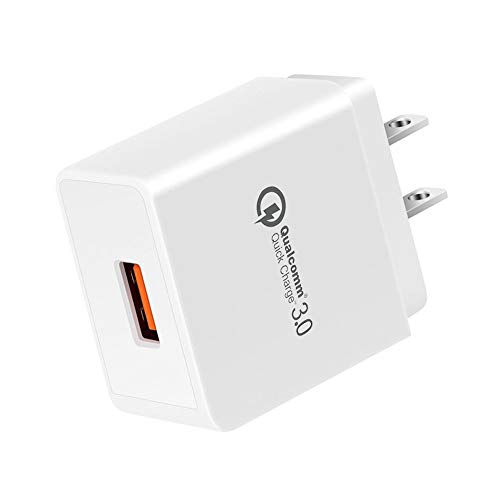
Quick Charge 3.0 18W Wall Charger — Best Overall
Most people searching this category own one Quick Charge phone and want one adapter that treats it properly; this single-port 18W charger is that adapter with nothing bolted on. Plug a supported handset in at bedtime-flat and the QC negotiation does its quiet work, pushing the battery through its hungry early phase briskly, then tapering as the cells fill and warm. The brick itself stays composed through that demanding first stretch — warm to the touch, never alarming — which is the everyday signature of circuitry that was designed rather than merely assembled.
Size matters at real outlets, and this unit keeps a tidy footprint that leaves the neighbouring socket usable on a standard duplex plate and does not crowd a power strip. The prongs fold or sit fixed depending on region, and the body resists the scuffed, loose feel that bargain bricks develop after a season in a travel bag. In a kitchen it can live permanently behind the fruit bowl; in a hallway it disappears. Chargers that demand attention get unplugged and lost, while this one simply becomes part of the house’s furniture.
Its manners with non-QC gear deserve mention. An iPhone, a pair of earbuds, a Nintendo handheld from the micro-USB years — all receive standard power without complaint, because the charger only speaks QC when a device asks for it in QC’s own protocol. That makes the spare-port problem vanish in mixed homes: the QC adapter can serve as the household’s general-purpose brick on the nights the QC phone is elsewhere, rather than sitting in a drawer as a specialist tool awaiting its one true device.
What it will not do is charge two things at once, and it will not impress anyone chasing the newest USB-C Power Delivery speeds for a modern laptop. Those are different purchases for different devices. Judged on its actual assignment — one QC 3.0 port, honestly delivered, in a brick that behaves itself for years — this is the adapter the rest of the list is measured against, and the one to buy when analysis paralysis threatens a very simple decision.
- Output: single USB-A port with Quick Charge 3.0, up to 18W class
- Compatibility: QC 3.0 devices, plus standard charging for everything else
- Body: compact brick, neighbour socket stays usable
- Negotiation: stepwise voltage per QC 3.0 specification
- Typical duties: one QC phone at a bedside or kitchen outlet
- Cable: use a sound USB-A cable; the brick cannot fix a ruined cord
Strengths
- Textbook QC 3.0 behaviour with supported phones, brisk early and gentle late.
- Compact body respects crowded outlets and travel strips alike.
- Serves ordinary gadgets politely when the QC phone is away.
Trade-offs
- One port means one device per session, full stop.
- No USB-C output for the newer half of a mixed household.
- Fixed focus: households with several QC devices should look at the packs below.
Best for: the owner of a single Galaxy, LG or Xiaomi handset from the QC era who wants its proper charger back on the nightstand. Not suited for: a couple trying to fast-charge two phones from one brick every night.
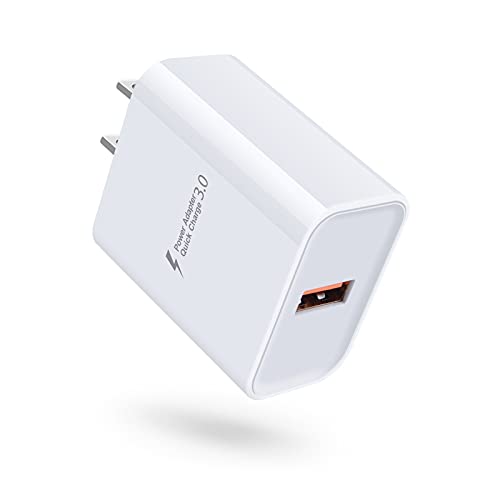
Quick Charge 3.0 Wall Charger 18W — Travel Friendly
Second chargers live harder lives than first chargers. They ride in laptop bags, get forgotten in hotel rooms, spend weekends in the car and still need to perform like the good adapter at home when a phone hits empty in an airport. This 18W QC 3.0 unit earns the travel slot through a slim profile that vanishes into a bag’s flat pocket and a shell that shrugs off the knocks of the road. It is the adapter you buy after the trip where the bundled charger stayed home and a borrowed brick took all evening.
Performance on arrival is the entire point of a travel QC charger: a supported phone plugged in during a forty-minute layover should gain a genuinely useful slice of battery, not a token few percent. QC 3.0’s stepped negotiation suits that sprint, front-loading power while the battery is empty and receptive. Paired with a short, sturdy cable kept permanently in the same bag pocket, this brick turns dead time in terminals and waiting rooms into range for the evening ahead.
Hotels expose a weakness of bulky adapters — sockets hidden behind beds, loose wall plates, strips already crowded with a partner’s gear. A slim charger that sits flat and light does not lever itself out of a tired hotel socket overnight, so the phone is actually full at checkout rather than face-down and empty beside a dangling brick. Anyone who has woken to that scene before a flight understands why this mundane trait outranks raw specifications for the travel role.
At home it moonlights as the spare-room or guest adapter, and guests with older Android phones will find it quietly faster than the generic brick in the drawer. Buy it as a deliberate second rather than an afterthought, keep its cable with it, and the whole kit becomes a small ritual of competence: bag, pocket, done. Few purchases this modest remove so much low-grade travel stress.
- Output: single USB-A port, Quick Charge 3.0, 18W class
- Body: slim, flat profile for bag pockets and hotel sockets
- Compatibility: QC 3.0 handsets; standard power for other USB gear
- Role: dedicated second charger for travel and guest use
- Typical duties: layover top-ups, work bag, car kit backup
- Pairing: keep a short cable stored with it permanently
Strengths
- Slim body stays seated in loose hotel and airport sockets.
- QC sprint charging suits short windows between commitments.
- Tough enough to live in a bag rather than a drawer.
Trade-offs
- Still a single port, so travel companions take turns.
- No advantage over the top pick if it will never leave the house.
- Small size makes it the easiest charger in the home to misplace.
Best for: a frequent traveller whose QC-era phone must gain real charge during a layover coffee. Not suited for: a family that needs one permanent adapter to serve a whole kitchen counter.

Dual-Port QC 3.0 Charger 2-Pack — Two Stations
Two chargers in the box change the planning from “where is the fast adapter” to “both stations are fast”. This twin-pack pairs dual-port QC 3.0 bricks, so the bedside unit can run a phone on the QC port while a watch, a power bank or a partner’s handset uses the second socket, and the kitchen unit mirrors the arrangement downstairs. Households fight over chargers at predictable hours — the pre-bed scramble, the pre-school run — and a second port at each station dissolves most of those negotiations before they start.
Honesty about shared output matters with dual-port designs. When both ports work simultaneously, the total power is divided by the circuitry, and a QC phone sharing its brick will charge more slowly than it would alone. That is not a defect; it is physics wearing a name tag. Overnight, the division is irrelevant because both devices have hours. The arrangement shines precisely in those unhurried windows, while the solo sprint before a night out still belongs to whichever device gets the brick to itself.
Getting two identical bricks also simplifies a household’s troubleshooting instincts. If a phone charges slowly at the kitchen station, move it to the bedroom brick; the comparison instantly separates a tired charger from a tired phone. Identical spares mean a failure anywhere is a swap, not a shopping trip. There is a quiet luxury in a home where every fast-charging point behaves the same, and this pack is the cheapest route to that consistency for QC-era gear.
Couples with matching phones from the same Android generation are the natural audience, followed closely by anyone running a QC phone plus a QC power bank that itself refills faster from a QC source. Two stations, two ports each, no hierarchy of good and bad outlets — the pack turns fast charging from a scarce resource into background infrastructure, which is where it always belonged.
- Contents: two dual-port wall chargers
- Output: Quick Charge 3.0 port plus a second standard port per brick
- Sharing note: simultaneous use divides total output between ports
- Compatibility: QC 3.0 phones and power banks; standard gear on port two
- Typical duties: bedside pair charging, kitchen counter station
- Household logic: identical bricks simplify swaps and fault-finding
Strengths
- Two ports per station ends the nightly queue for the fast outlet.
- Matched pair makes every charging point in the home behave identically.
- QC power banks refill briskly from the same bricks that serve phones.
Trade-offs
- Sharing a brick slows the QC phone compared with solo charging.
- Dual-port bricks are bulkier at tight outlets than the singles above.
- Two bricks still leave a third room unserved in larger homes.
Best for: a couple with two QC-era phones who charge a phone and a power bank side by side each night. Not suited for: a solo user with one phone, who would leave half of every brick idle forever.

OKRAY QC 3.0 Charger 2-Pack — Household Pair
OKRAY’s twin-pack takes a slightly different route to the same destination: two straightforward QC 3.0 adapters meant to be separated on day one and never reunited. One claims the kitchen counter, where phones land during cooking and need meaningful charge in the time a sauce simmers. The other takes the hallway or the study, the opportunistic socket that catches devices between rooms. Because the bricks match, nobody in the house needs to remember which adapter is the good one — a small mercy that generic mixed drawers never provide.
The charging behaviour is the familiar QC 3.0 pattern, delivered without drama: supported phones negotiate upward quickly, top-up sessions of twenty minutes produce a visibly moved battery gauge, and overnight charges finish with the adapter merely warm. OKRAY has sold into this accessories tier for years, and the design reflects it — no theatrical fins, no glowing logos competing with a bedside clock, just a brick that does its shift and keeps its opinions to itself.
Where this pair quietly wins is replacement economics. Chargers die, get borrowed permanently by teenagers, or emigrate to partners’ flats. A matched pair bought together means the household standard survives one loss; the remaining brick still anchors the busiest station while a like-for-like replacement joins it. Families who have standardised on a single adapter type report a peculiar calm around charging that mixed households find enviable, and it starts with an unglamorous purchase exactly like this one.
Choose this pack over the dual-port option above when your rooms each host one device at a time and simplicity outranks simultaneity. Choose it over the singles when two rooms tie for busiest and neither deserves the slow brick. It is the middle path of the list — not the most capable per outlet, not the cheapest per box — and for a great many two-station homes it is the one that fits without a single compromise worth mentioning.
- Contents: two single-purpose QC 3.0 wall chargers
- Output: Quick Charge 3.0, 18W class per brick
- Compatibility: QC 3.0 devices; standard fallback for all USB gear
- Role: one adapter per busy room, matched behaviour
- Typical duties: kitchen counter top-ups, study or hallway station
- Household logic: standardisation survives the loss of one unit
Strengths
- Two rooms gain proper QC speed in a single purchase.
- Plain, quiet design suits kitchens and hallways alike.
- Matched bricks keep household charging behaviour predictable.
Trade-offs
- No second port for a companion gadget at either station.
- Less travel-shaped than the slim pick earlier in this list.
- Homes with three busy stations will still come up one brick short.
Best for: a household splitting fast charging between a kitchen counter and a study desk for two older Android phones. Not suited for: anyone who routinely charges a phone and a tablet from the same outlet at the same time.
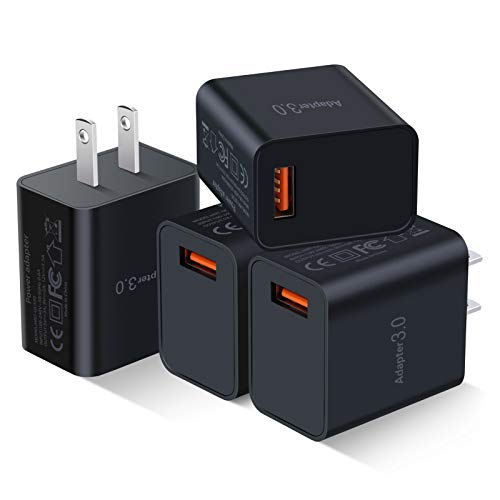
Besgoods QC 3.0 Charger 4-Pack — Whole-House Pack
Four QC 3.0 adapters in one box is a declaration that the argument is over. Besgoods aims this pack at the home where fast charging has been rationed for years — one good brick migrating between rooms, trailing resentment — and simply floods the zone: bedroom, kitchen, living room and the bag that lives by the door each receive their own. The per-adapter cost of a four-pack undercuts buying singles repeatedly, and the behavioural consistency across every outlet in the house is a benefit owners consistently say they underestimated.
Each brick delivers the standard QC 3.0 pattern, stepping voltage to match what a supported phone requests and idling politely for everything else. Four identical adapters also change how a household treats spares: one can live permanently in a travel kit without denuding a room, and one can be lent to a visiting parent whose older Galaxy is crawling on a hotel-grade brick. Abundance, in a category this cheap, is a legitimate strategy rather than an indulgence.
There are honest limits to declare. Scattering four adapters does not make any single charge faster; a supported phone on any of these bricks charges exactly as QC 3.0 allows and no more. Homes whose devices have largely moved to USB-C Power Delivery will find diminishing returns here, since only the QC-era stragglers benefit from the protocol itself while everything else receives standard power. This pack is a love letter to a specific installed base — and that base is enormous, still working, and still undersupplied with decent adapters.
Gift-giving is an underrated use: adult children hand parents a four-pack and quietly upgrade every room of the family home in one visit. Teachers, landlords fitting a rental, and anyone equipping a workshop bench with QC-era test phones will find the same logic applies. When the goal is coverage rather than a single heroic outlet, this is the purchase that finishes the conversation.
- Contents: four QC 3.0 wall chargers
- Output: Quick Charge 3.0, 18W class per brick
- Compatibility: QC 3.0 phones, tablets and power banks; standard fallback otherwise
- Role: whole-house coverage, one adapter per room plus travel
- Typical duties: multi-room Android households, rentals, gifts for parents
- Household logic: abundance removes rationing and borrowing
Strengths
- Every busy room gains QC speed in one purchase.
- Identical bricks make spares, loans and travel kits painless.
- Per-adapter value beats accumulating singles over time.
Trade-offs
- No single charge is faster than any other pick here.
- USB-C households will use the QC protocol on fewer devices each year.
- Four bricks invite four separate games of hide-and-seek with teenagers.
Best for: a family home running three or four QC-era phones and tablets across as many rooms. Not suited for: a minimalist with one modern USB-C phone, for whom this entire category is a history lesson.
Anker PowerPort+ 1 Quick Charge 3.0 — Prose-Only Veteran
For years, the answer to “which QC 3.0 charger should I buy” was this Anker, and its reputation was earned honestly: tight voltage behaviour, a shell that survived bags and drops, and the reassuring backing of a maker that answered its support email. We describe it here without a purchase link, because the model has been discontinued and the listings that still carry its name vary wildly in provenance — old stock, regional variants and outright imitators share the same search results, and sending you into that thicket with a single link would be a disservice dressed as convenience.
As a piece of hardware, the PowerPort+ 1 represents the mature end of the QC 3.0 era: a single USB-A port, the full stepped-voltage negotiation, and thermal manners that set expectations the budget tier still chases. Owners who bought one in its prime routinely report it outliving the phone it was bought for, then the phone after that. If you already own one, nothing in this guide obliges you to replace it; the picks above are for the rooms and people your veteran cannot cover alone.
Hunting one down new is a judgement call. Anker’s own storefront occasionally surfaces remaining stock, and reputable electronics retailers are a safer bet than marketplace sellers trading on the name. Verify the model name character by character, be suspicious of prices that undercut the era’s normal retail by half, and remember that the linked chargers above deliver the same protocol with a warranty that starts today. The veteran earns its prose as a benchmark and a reminder of what good looked like — not as a scavenger hunt.
Readers sometimes ask whether a discontinued benchmark outperforms the current packs. In raw charging terms the protocol caps everyone equally; the differences live in build, heat and trust. That is precisely why this guide can honour the Anker while recommending you actually buy the verified listings — the performance is equivalent, and the provenance is certain.
- Output: single USB-A port, Quick Charge 3.0
- Status: discontinued; listings vary in provenance
- Compatibility: QC 3.0 devices; standard fallback for other gear
- Build reputation: the era’s benchmark for shell and thermals
- Typical duties: still serving owners who bought it in its prime
- Coverage style: described without a link in this guide
Strengths
- Set the build and thermal standard for the whole QC 3.0 category.
- Long service life reported across years of daily use.
- Single-port focus delivers the protocol at its cleanest.
Trade-offs
- Discontinued, so sourcing a genuine unit takes care.
- Marketplace listings under its name include imitators.
- No fresh warranty path comparable to the linked picks.
Best for: an owner who already has one and wants confirmation it still anchors a charging station proudly. Not suited for: a first-time buyer who wants a guaranteed-genuine adapter shipped with a current warranty — pick any linked charger above.
Comparison
| Pick | Bricks | Ports each | Protocol | Headline strength |
|---|---|---|---|---|
| QC 3.0 18W Charger | 1 | 1 | QC 3.0 | The honest default for one phone |
| QC 3.0 Charger 18W | 1 | 1 | QC 3.0 | Slim travel shape, layover sprints |
| Dual-Port QC 3.0 2-Pack | 2 | 2 | QC 3.0 + standard | Phone plus companion at each station |
| OKRAY QC 3.0 2-Pack | 2 | 1 | QC 3.0 | Matched pair for two busy rooms |
| Besgoods QC 3.0 4-Pack | 4 | 1 | QC 3.0 | Whole-house coverage in one box |
| Anker PowerPort+ 1 QC 3.0 | 1 | 1 | QC 3.0 | Discontinued benchmark, prose only |
How Does Quick Charge 3.0 Actually Work?
Plug a QC 3.0 phone into a plain adapter and the phone receives the old fixed 5 volts, sipping current at a rate set years before big batteries became normal. Plug it into a QC 3.0 charger and a conversation begins over the cable’s data lines: the phone states what it can accept, and the charger adjusts its output voltage in small steps — the system Qualcomm named INOV, for Intelligent Negotiation for Optimum Voltage. The battery receives close to its ideal intake at each stage of the charge rather than a compromise fixed at the factory.
The shape of a QC 3.0 charge follows from that conversation. An empty battery is hungry and cool, so the charger pushes hard; as the battery fills and warms, the phone asks for progressively gentler delivery, protecting the cells from the stress that ages them early. This is why two chargers with identical peak claims can produce different full-charge times — the quality of the negotiation, not the headline number, decides how long the brisk phase lasts before caution takes over.
Heat is the silent variable in every fast-charge story. Energy lost as heat inside the phone is energy the battery never stores, and it accelerates wear on the cells. QC 3.0’s fine steps exist largely to keep that waste down compared with its predecessor, which jumped between fixed voltages. A charger that runs its side of the bargain properly — and a phone with a clean port and a sound cable — keeps the system in the efficient zone where speed and battery kindness coexist.
Which Phones and Gadgets Still Use Quick Charge 3.0?
The installed base is larger than the industry admits. Samsung’s Galaxy S and Note lines from the QC years, LG’s flagships before the brand’s exit from phones, HTC’s U series, Motorola’s G and Z families of that period, and a wide spread of Xiaomi, Sony and ASUS handsets all carry QC 3.0 support. Many of those phones now serve as children’s first devices, parents’ dependable handsets, work phones and drawer spares — roles where they will live for years yet, charging nightly all the while.
Beyond phones, QC 3.0 hides in power banks that advertise fast input as well as output, in car accessories from the same era, in some tablets and portable speakers, and in the previous generation of handheld gaming gear. A power bank with QC input refills dramatically faster from a QC wall charger, which turns the wall adapters in this guide into infrastructure for the whole ecosystem rather than single-phone accessories. Check the fine print near a device’s port or in its manual for the Quick Charge logo before assuming; the branding was licensed, so genuine support is usually declared openly.
Devices without QC support lose nothing by sharing these chargers. The negotiation only begins when a device asks for it in the protocol’s own language; everything else receives the standard 5-volt service that USB-A has provided for decades. That politeness is why a QC charger can anchor a mixed household’s spare drawer long after the last QC phone retires — it degrades gracefully into an ordinary good adapter.
Quick Charge 3.0 or USB-C Power Delivery: Which Should You Buy?
Buy for the devices on your counter, not for the spec sheet of the moment. USB-C Power Delivery is the present and future: it serves modern phones, tablets and laptops from one standard, at powers QC 3.0 never attempted. If your household’s daily drivers are recent, a PD charger is the correct purchase and this guide is a nostalgia trip. But PD cannot speak QC’s protocol dialect to an older phone that expects it, and that older phone will fall back to slow charging on a PD brick exactly as it does on a plain adapter.
Mixed households — which is to say, most households — often need one of each. The QC charger keeps the older handset, the power bank and the hand-me-down tablet fed at their best speed; the PD charger serves the new flagship and the laptop. Neither purchase shames the other. The mistake is forcing one standard to cover devices that speak another, then blaming the charger when a 2018 Galaxy takes all evening on a brick that was never going to negotiate with it.
Longevity argues for honesty about timelines. A QC phone expected to serve three more years justifies a proper QC adapter many times over in saved waiting; a QC phone being replaced next month does not. Run that small calculation per device and the right basket assembles itself — usually one good QC brick per surviving QC device location, which is exactly the shape of the shortlist above.
How Can You Tell a Sound QC Charger From a Risky One?
Start with identity. A sound charger carries a real maker’s name, a model number, and regulatory markings that match the maker’s other products; a risky one hides behind a rotating cast of unpronounceable storefront brands and a listing full of borrowed photographs. Then read the output description: genuine QC 3.0 is described in the protocol’s terms, with plausible voltage ranges. Listings promising absurd wattage from a single USB-A QC port are announcing their dishonesty in the headline, saving you further research.
In the hand, weight and finish talk. A charger with real safety circuitry has a certain heft and moulding that feels finished rather than hollow; prongs sit straight and firm; the case seams meet cleanly. None of that is proof, yet across hundreds of owner reports the pattern holds strongly enough to use as a screen. In use, the verdicts are heat and behaviour: an adapter that grows too hot to hold comfortably, buzzes audibly, or makes a phone’s touchscreen misbehave while charging should be unplugged and replaced, not managed.
Finally, buy through channels that make returns boring. Every linked pick in this guide was chosen partly because a dissatisfied buyer can send it back without a fight. A wall charger is a safety device that happens to charge phones; treat provenance as a feature, keep the receipt, and retire any adapter that survives a drop onto concrete with a cracked case, however well it seems to work afterwards.
How Should You Set Up Fast Charging for a Parent or a Child?
The best charging setup for someone else is the one that requires no decisions. Place the QC adapter at the socket that person already uses, attach a cable long enough to reach their chair or bed without tension, and remove the slow old brick from that spot entirely so there is nothing to grab by mistake. A parent who plugs in at the kitchen counter every morning should find the fast charger there every morning, labelled if the household has several similar bricks, with the cable’s far end parked in a clip or a small dish where it cannot slide behind the counter.
Children add cable abuse to the equation: cords get yanked, stepped on and borrowed for dens. Give a child’s station the sturdiest cable you own, route it where feet do not travel, and keep the QC adapter itself on a hard surface rather than a bed or carpet where heat lingers. The speed of QC charging is genuinely useful for a school phone forgotten until breakfast — twenty minutes on a proper adapter can rescue a school day — but only if the station is assembled before the crisis, not improvised during it.
Finally, teach the one diagnostic that matters: if the phone does not show its fast-charging message, reseat both ends of the cable before concluding anything is broken. Lint in a pocket-carried phone’s port is the most common cause of mysteriously slow charging in family life, and a gentle clean with a wooden toothpick, phone powered off, restores more “dead” chargers than any purchase. A household that knows that trick stops replacing working hardware.
Why Does a QC Phone Charge More Slowly as It Ages?
Batteries are consumables wearing a disguise. Each charge cycle leaves the cells slightly less able to accept power quickly, and the phone’s management system responds by negotiating more cautiously with the charger — requesting lower steps sooner, tapering earlier, protecting what capacity remains. A three-year-old QC phone on a perfect charger will therefore post slower sessions than it did when new, and that gap is chemistry, not a failing adapter. Owners who understand this stop churning through chargers hunting for speed the battery can no longer accept.
Ports age alongside batteries. A socket that has swallowed years of pocket lint, desk dust and slightly angled insertions develops loose, oxidised contacts that interrupt the negotiation or add resistance the system reads as heat risk. The symptoms masquerade as charger failure — intermittent fast charging, sessions that start fast and fall back — yet follow the phone from brick to brick. Cleaning the port carefully, and replacing a cable whose plug has gone sloppy, restores many ageing handsets to something close to their original manners.
Software plays a smaller, real role. Updates sometimes retune charging curves conservatively after battery incidents elsewhere in the industry, and background load grows as apps accumulate, so a phone that is busy while charging fills more slowly than an idle one. None of this argues against keeping a QC-era phone in service; it argues for judging its charging against its age, not its launch reviews. With a sound adapter from this list, a clean port and realistic expectations, an older handset remains a perfectly dependable daily tool.
What Should You Do When a Charger Starts Misbehaving?
Define misbehaving precisely: a case too hot to rest a finger on, a buzzing or ticking sound, a burnt smell, a phone that connects and disconnects repeatedly, or visible damage such as a cracked shell or a prong that wobbles. Any one of those retires the adapter immediately, mid-charge if necessary. Wall chargers are inexpensive; the devices and homes they serve are not. There is no troubleshooting path that ends with “keep using the buzzing one”, and any guide suggesting otherwise should be closed.
For milder puzzles — slower charging, an adapter that works in one room and not another — swap components methodically. Try the suspect brick with a different cable and a different phone; try the original phone on a known-good adapter from this list. The fault will follow one component, and that component is the one to replace. Note the pattern before you shop, because “slow everywhere” points at the phone, “slow on one brick” points at the brick, and “slow on one cable” has ended more arguments than any other sentence in this category.
Disposal deserves a sentence of its own. Retired adapters belong in electronics recycling, not the kitchen bin, and a charger that failed dramatically should not be donated, lent or demoted to a child’s room. Replace it with a traceable model, mark the new one with its purchase month if you are feeling organised, and enjoy the peculiar satisfaction of a drawer where every brick can be trusted. That drawer, more than any single product, is what this guide is really selling.
Where Do QC Chargers Earn Their Keep Outside the Bedroom?
Workshops and garages run on older phones more than marketing admits: a retired handset becomes the music player, the manual viewer and the timer, living on a bench where a fast top-up between jobs keeps it useful. A QC adapter on the bench socket turns a fifteen-minute coffee break into a meaningful charge, and the protocol’s tolerance of standard devices means the same brick feeds a work light or a Bluetooth speaker when the phone is away. Dust and cold argue for a brick with a sound shell — another reason the traceable picks above beat anonymous bargain adapters in outbuildings.
Cars present a similar pattern through the glovebox: many drivers keep a QC wall charger in the travel kit for the destination rather than the journey, since the QC era’s phones are now the household’s spares and spares travel as backups. Arriving at a rental or a relative’s house with your own fast adapter removes dependence on whatever brick the guest room offers. The slim travel pick in this guide exists for exactly that bag, yet any of the singles can do the duty if space allows.
Small businesses quietly depend on this standard too. Delivery drivers, market traders and tradespeople often run QC-era handsets as work phones because replacements are cheap and the devices are known quantities. A trader whose card-reader phone dies at noon loses money by the minute; a QC charger behind the stall is business continuity in its smallest form. Equipping a work bag, a van cab and a home base with matched adapters — the twin-pack logic again — is how that continuity stops depending on memory.
Common Mistakes
The most common error is assuming any adapter with a lightning-flavoured logo delivers Quick Charge. The protocol requires specific circuitry and licensing; look for the actual Quick Charge 3.0 name and a maker you can trace. Closely related is blaming a new QC charger for slow charging when the cable is the culprit — thin, damaged or excessively long cables strangle the negotiation, so test with a short, known-good cord before returning anything.
Another frequent misstep is stacking a QC phone on a multi-port brick alongside two other devices and expecting solo speed. Shared output is divided output, as the dual-port review above explains; overnight that hardly matters, but the twenty-minute pre-party top-up should get the brick to itself. People also leave fast chargers buried under bedding or inside sofa cushions where heat cannot escape. Adapters need air like any small appliance; a charger that lives on a hard, open surface will outlast one that sleeps under a pillow.
Finally, there is the drawer of doom: a tangle of unlabelled bricks accumulated over a decade, from which family members grab at random. Label your QC adapters with a dot of paint or a tag when they arrive. Ten seconds of marking saves years of accidentally feeding the fast phone from the slowest brick in the house — the single most common reason owners conclude, wrongly, that their new charger does nothing.
Final Recommendation
For one QC phone and one outlet, buy the single-port 18W charger at the top of this list and stop thinking about the subject; it delivers the protocol exactly as intended and asks nothing of you in return. Two-station homes should choose between the dual-port twin-pack, when devices double up at each outlet, and the OKRAY pair, when each room hosts one device at a time. The Besgoods four-pack settles the question for whole houses and gift-givers, while the slim 18W pick belongs in every QC owner’s travel bag. Honour the Anker veteran if you own it, and let the rest of us buy verified stock. Quick Charge 3.0 gear may belong to an earlier Android generation, yet millions of those phones still start every morning on a charger — they deserve one that speaks their language fluently.
One last perspective before the questions below: a charger is the cheapest component in the chain and the one everything else depends on, which makes it a strange place to economise blindly. The difference between an anonymous brick and a verified pick is small money spread over years of nightly service, hundreds of charges, and the quiet confidence that the warm object on your nightstand is warm within its design limits. Buy the protocol your phones speak, buy it from a name you can trace, and let this be the last time you think about the subject until your next phone arrives speaking something new.
Frequently Asked Questions
Will a QC 3.0 charger damage a phone that does not support Quick Charge?
No. The higher voltages only flow after a supported device negotiates for them; everything else receives standard 5-volt USB power. That built-in politeness is why QC adapters can safely serve as household spares for earbuds, controllers and older gadgets of every description.
Why does my QC phone sometimes charge slowly on a QC charger?
Heat, a nearly full battery, a poor cable, or a shared multi-port brick are the usual causes. The phone deliberately slows itself when warm or above roughly four-fifths full, which protects the cells. Test with a short sound cable, a cool phone and the brick to itself before suspecting the adapter.
Can I use a QC 3.0 charger with a USB-C phone?
Physically, with a USB-A to USB-C cable, yes — and many USB-C phones from the QC era will negotiate QC speeds over exactly that arrangement. Newer USB-C phones built around Power Delivery will simply charge at standard speed. The cable must be a proper, undamaged one; cheap USB-C cables with incorrect resistors were a genuine hazard in the standard’s early years, so buy cables from makers with names.
Does Quick Charge 3.0 wear out a battery faster?
Any fast charging trades a little long-term cell wear for convenience, and QC 3.0 was designed to soften that trade by tapering power as the battery fills and warms. In real ownership, the difference across a phone’s working life is modest compared with the effects of heat, deep discharges and age itself. Charge overnight at QC speed without guilt; avoid cooking the phone under a pillow while it charges.
How long should a QC 3.0 charge take?
For a typical supported phone of its era, expect the first half of the battery to arrive briskly — often within half an hour or so — with the remainder tapering over the following hour. Exact times depend on battery size, temperature and what the phone is doing meanwhile. Treat any listing promising a full charge in a handful of minutes as fiction.
Is it safe to leave a QC charger plugged in all the time?
A sound adapter from a traceable maker is designed to sit plugged in, drawing negligible power while idle. Keep it on an open surface, away from bedding, and retire it if the case cracks, the prongs loosen or it begins running unusually hot. The chargers in this guide were picked with exactly that permanent-residency duty in mind.
What cable do I need to get full QC 3.0 speed?
Any sound USB-A cable of sensible length with intact connectors will carry the negotiation and the current. Frayed plugs, hair-thin bargain cords and very long runs can all throttle a session. If a new charger disappoints, swapping the cable is the first diagnostic step, ahead of returns or reviews written in anger.
Can a QC 3.0 charger refill a power bank faster too?
Only if the power bank itself supports Quick Charge on its input, which many from that era do and declare on the case or in the manual. A QC-input power bank on a QC wall adapter can refill in a fraction of the time a plain adapter needs, which changes how useful a big power bank feels on trips. If the bank lacks QC input, the same adapter still works — it simply serves standard power and the refill takes the long way home. Checking the bank’s input specification before a journey is a two-minute habit that saves an evening of waiting at the destination.
Should I replace a working QC charger with a newer standard?
Replace chargers when devices change, not when marketing does. A QC adapter serving a QC phone is already the right tool, and its replacement should arrive with the phone that speaks a different protocol. The exception is condition: any adapter showing heat, noise or damage retires immediately regardless of standard. Otherwise, let the installed base decide — the picks above exist because millions of QC devices still have years of service to give.
Related Guides
Round out your charging setup with our neighbouring roundups: best 5 port chargers, best 65 watt USB-C chargers and best 10 foot chargers micro-USB.
Related guide: Best Tesla Chargers
Related guide: Best PS4 Controller Chargers


