What's inside
- Key Takeaways
- Quick Picks
- How We Chose These Picks
- Comparison
- Why Do Independent Charging Channels Matter So Much?
- How Should You Organise a Household Battery Drawer?
- What Kills Rechargeable AAs — and How Do You Prevent It?
- How Fast Should an AA Charger Be?
- How Do You Know When a Cell — Not the Charger — Has Died?
- How Should Photographers and Gamers Set Up Differently?
- What About Travelling With Rechargeable AAs?
- How Do You Start a Rechargeable Household From Zero?
- What Should You Do With Batteries in a Power Cut or Emergency Kit?
- How Do Rechargeable AAs Behave in Cold and Heat?
- How Do You Teach Children to Run the Battery Drawer?
- Common Mistakes
- Final Recommendation
- Frequently Asked Questions
- Related Guides
As an Amazon Associate I earn from qualifying purchases. This post may contain affiliate links at no extra cost to you.
widgetverdict.com is reader-supported. When you buy through links on our site, we may earn an affiliate commission.
The best AA chargers keep a quiet promise that disposable batteries never could: the remote, the game controller, the camera flash, the child’s toy and the wireless mouse will simply work, because a fresh set of rechargeable AAs is always waiting in the drawer. Rechargeable AA batteries have become genuinely excellent — low-self-discharge cells that hold their charge on a shelf for months — yet the charger matters as much as the cells. A crude charger that cooks batteries on a timer will murder a good set within a year; a smart charger that watches each cell individually can keep the same set useful for many hundreds of cycles.
Where to buy: every pick in this guide links to a listing confirmed in the checked pool, because all six shortlisted chargers earned verified listings. The spread covers the philosophies of the category honestly: Panasonic’s eneloop chargers that favour gentleness, an Energizer and a Duracell that favour simplicity for mainstream households, an eight-bay POWEROWL for homes drowning in devices, and an Amazon Basics unit for the drawer that just needs the basics done safely. Any of them will charge standard NiMH AA cells; most also handle AAA, which covers the smaller remotes and bicycle lights that share the same drawer. Prices drift with bundles and seasons, so check price on Amazon when you are ready, and note that some listings bundle cells while others are charger-only — read which you are getting.
The single most important technical idea in this guide is independent channels. A charger with individual circuits for each bay reads every cell’s voltage on its own and stops for that cell when it is full. A paired or timer-based charger treats batteries as a committee, overcharging the strongest while the weakest catches up, and heat does the rest. Everything below was chosen with that distinction in mind, and the reviews will tell you plainly which philosophy each pick follows, because it decides how long your batteries live.
Expect the guide to talk about batteries almost as much as chargers. The two are one system: good cells forgive a mediocre charger for a while, good chargers rescue mediocre cells longer than they deserve, and the happiest households pair a smart charger with low-self-discharge cells and then stop thinking about AA power entirely. That state of not-thinking is the actual product being sold on this page, and it is worth more than any single specification below.
Read the six reviews with your own census in hand — the count of devices, the identity of the heaviest user, the drawer where the system will live. The right charger announces itself against that census almost immediately, and the wrong ones, however excellent, will feel like somebody else’s solution. That feeling is data; trust it completely, always.
Key Takeaways
- Independent charging channels are the feature that decides how many years your AA cells survive.
- The eneloop BQ-CC63 is the gentle precision pick for photographers and anyone who buys premium cells.
- Eight bays, as on the POWEROWL, end the queue in homes full of controllers, toys and flashes.
- Simple four-bay units from Energizer, Duracell and Amazon Basics suit households that value foolproof operation.
- Heat is the enemy: a charger that leaves cells hot to the touch is shortening their lives every cycle.
- Pair any pick here with low-self-discharge NiMH cells and the drawer stays ready for months at a time.
- Start with a household census: the number of AA devices you own decides the bay count you need.
Quick Picks
| Pick | Badge | Why it makes the cut |
|---|---|---|
| Panasonic eneloop BQ-CC63 Charger | Best Overall | Individual-cell intelligence and gentle pacing from the eneloop system itself. |
| Panasonic eneloop BQ-CC17 Charger | Gentle Classic | The long-running eneloop companion charger, patient with cells and simple to live with. |
| Energizer Recharge Pro Charger | Family Friendly | Clear indicators and fuss-free operation for a busy household drawer. |
| POWEROWL 8-Bay AA AAA Charger | Most Bays | Eight independent slots for controller-heavy and toy-heavy homes. |
| Amazon Basics 4-Bay AA AAA Charger | Simple Value | The basics done safely for the drawer that needs a dependable spare. |
| Duracell Ion Speed 1000 Charger | Mainstream Staple | A familiar name with straightforward charging for everyday devices. |
How We Chose These Picks
Charging intelligence was the first screen, applied without sentiment. Preference went to chargers that monitor cells individually and terminate on voltage behaviour rather than a kitchen timer, because that single design decision governs cell lifespan more than any other. Where a pick follows a simpler philosophy, the review says so and frames the trade honestly: simplicity has real value in a grandparent’s drawer, provided the household understands it is spending a little cell life to buy it.
Bay count and format shaped the spread. Most homes need four bays; homes with gaming controllers, camera flashes or a toy census in double figures need eight or a second unit. The shortlist covers both realities rather than pretending one size rules. Indicator clarity was judged as a safety feature, not a cosmetic one: a charger should tell you, unambiguously and from across a room, whether a cell is charging, done, or faulty. Ambiguous lights create the classic failure where dead cells go back into the drawer marked as fresh in somebody’s memory.
Compatibility discipline mattered too. Every pick handles NiMH AA cells, the rechargeable standard; most add AAA. None of these chargers should ever be fed alkaline or lithium primary cells, and the guide repeats that warning because the most dangerous charger mistake is a chemistry mistake. Picks earned trust partly by how clearly their makers state what belongs in the bays.
Finally, all six picks carry verified pool listings, so this guide needs no prose-only entry: the category’s trustworthy centre is well stocked. Makers with long records in rechargeable systems — Panasonic above all — anchor the list, while the value picks were admitted only where their safety behaviour could be stated plainly.
Household interviews added the last filter, and it was embarrassingly practical: can a tired person load this charger correctly at midnight, in a dim hallway, holding a dead torch? Bay orientation that fights the user, indicators that need a manual, lids that pinch — small frictions that laboratory comparisons forgive become the reason a charger migrates to a cupboard and the household slides back to disposables. Every pick here passed the midnight test in spirit: cells drop in one obvious way, lights mean one obvious thing, and the morning finds the fleet charged rather than the fleet charging beside an unplugged unit nobody noticed.

Panasonic eneloop BQ-CC63 Charger — Best Overall
Panasonic makes the cells this category revolves around, and the BQ-CC63 is the charger it built to treat them properly. Its defining trait is per-cell attention: each bay is monitored on its own circuit, so a nearly full cell borrowed from a remote stops charging while its emptier neighbour from a game controller continues. That independence is invisible in daily use — you load cells in any mixture of states, walk away, and collect them when their indicators settle — yet it is precisely the behaviour that lets a set of eneloops survive year after year of family service.
The charging pace is deliberate rather than frantic, and that deliberateness is a feature wearing a disguise. Gentler currents generate less heat inside the cell, and heat is the tax every cycle collects. Photographers who depend on AAs in speedlights, and parents who depend on them in everything, share an interest in cells that behave identically in year three as in month three. The BQ-CC63’s patience buys that consistency. Owners in a genuine hurry can keep a faster unit for emergencies; this charger’s job is to be the reason emergencies stay rare.
Indicators communicate per cell, so a failing battery announces itself instead of silently dragging a set down — replace the one tired cell and the rest continue. That diagnostic gift matters more as a household’s cell collection grows, because mixed-age batteries are the norm in every real drawer. The unit’s build and bay spacing accommodate cells without the wrestling that cheap chargers demand, and its footprint suits a permanent place on a shelf rather than a life in a cupboard.
As the default recommendation, the BQ-CC63 asks a small premium of money and time in exchange for the longest, calmest service your cells can give. For anyone who has already invested in good rechargeable AAs — or intends to — it is the charger that protects the investment, and the easiest first pick this guide has had to defend.
- Bays: four, AA and AAA NiMH
- Circuits: independent per-cell monitoring and termination
- Pace: gentle, lifespan-first charging
- Indicators: per-cell status, including fault signalling
- Typical duties: eneloop fleets, camera flashes, family devices
- System note: designed by the maker of eneloop cells
Strengths
- Individual channels treat mixed cells exactly as each deserves.
- Gentle pace preserves premium cells across hundreds of cycles.
- Per-cell indicators expose a failing battery before it spreads confusion.
Trade-offs
- Slower than rapid chargers when a flash must fire within the hour.
- Four bays may queue in controller-heavy households.
- Costs more than the simple units it outperforms in cell care.
Best for: a photographer running eneloops in speedlights who wants the same set performing identically season after season. Not suited for: a parent who needs eight toy batteries turned around between breakfast and the school run.
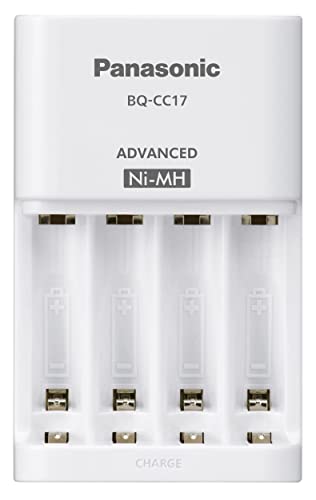
Panasonic eneloop BQ-CC17 Charger — Gentle Classic
Before the CC63 refined the formula, the BQ-CC17 defined it for a generation of eneloop owners, and it remains on sale because the formula works. Four bays, individual-cell awareness in the eneloop tradition, and a charging temperament that treats batteries as long-term companions rather than consumables. Households that bought this charger with their first eneloop multipack a decade ago are, in many cases, still using both — a sentence that can be written about very few pairings in consumer electronics.
The CC17’s appeal today is its proven plainness. There is nothing to configure, no mode to misunderstand, and its indicators state the essential facts. It asks only that you load NiMH cells and return later. In a market where chargers sprout displays and apps, that restraint reads almost as philosophy: the charger’s intelligence is spent on the cells, not on entertaining the owner. For a drawer in a family home or a grandparent’s kitchen, restraint is the correct specification.
Compared with its newer sibling, the differences are of degree — refinements in detection and signalling rather than a different creed. A buyer choosing between them should weigh how much they value the CC63’s polish against the CC17’s long record and typically friendlier pricing when bundled with cells. Bundles deserve attention here: this charger frequently travels with eneloop AAs in the same box, and a bundle is often the cheapest honest way to start or expand a rechargeable household.
Choose the CC17 when you want the eneloop system’s gentleness with the fewest possible decisions, or when a bundle puts cells and charger in the basket together. It is the classic for a reason, and classics in this category earn their status one uneventful decade at a time.
- Bays: four, AA and AAA NiMH
- Circuits: individual-cell charging in the eneloop tradition
- Pace: gentle, cell-friendly
- Indicators: straightforward per-bay status lights
- Typical duties: household eneloop fleets, bundled starter sets
- Bundle note: often sold with eneloop cells included
Strengths
- A decade-proven design with an enormous base of satisfied owners.
- Gentle treatment keeps bundled eneloops healthy for years.
- Nothing to configure; ideal for non-technical households.
Trade-offs
- Fewer refinements than the newer BQ-CC63.
- Four bays only, with no high-capacity sibling in the same design.
- Pace will frustrate anyone charging against a deadline.
Best for: a household starting its rechargeable life with an eneloop bundle and wanting zero learning curve. Not suited for: a flash photographer who needs per-cell diagnostics and faster turnaround for events.

Energizer Recharge Pro Charger — Family Friendly
Energizer’s Recharge Pro is built for the drawer that serves everyone and is maintained by no one. Its design language is clarity: cells drop in, lights speak plainly, and an audible signal joins the indicators when charging completes, which turns out to be a genuinely useful feature in a busy kitchen where nobody watches a charger. Families adopt it because a ten-year-old can operate it correctly on the first try, and that operability is a safety feature in its own right.
The Pro charges AA and AAA NiMH cells in pairs or sets according to its bay layout, with the mainstream convenience that implies. Its pace is brisker than the eneloop pair above, suiting households that discover dead controller batteries at the worst moments and need a working set by dinner. That convenience trades a measure of the Panasonics’ per-cell finesse, and this guide states the trade without flinching: for remotes, toys and controllers cycled constantly, the difference in cell lifespan is a fair price for speed and simplicity; for a photographer’s premium flash cells, choose the CC63.
Energizer’s ecosystem is the other half of the appeal. Its rechargeable cells sit in every supermarket and hardware store, so expanding or replacing a set never requires a special order. A charger whose companion cells are available at the corner shop will simply be used more, and a used charger beats a theoretically superior one ageing in a cupboard. The Recharge Pro understands its habitat — the mainstream family drawer — better than any other pick here.
Buy it for households where several people of several ages will load it unsupervised, where speed matters weekly, and where the cells it feeds are working tools rather than treasured instruments. It will not pamper batteries like the Panasonics, yet it will keep a busy home’s devices alive with the least friction on this page.
- Bays: four, AA and AAA NiMH
- Style: family-first indicators with audible completion signal
- Pace: brisk, convenience-oriented
- Compatibility: Energizer rechargeable cells and other NiMH brands
- Typical duties: controllers, toys, remotes in busy households
- Ecosystem note: companion cells sold in ordinary supermarkets
Strengths
- Clear lights plus a completion sound suit distracted households.
- Faster turnaround for the dead-controller emergency.
- Companion cells are available in ordinary shops everywhere.
Trade-offs
- Less per-cell finesse than the eneloop chargers.
- Audible signal may annoy in a quiet bedroom setup.
- Premium flash cells deserve the gentler picks above.
Best for: a busy family whose games controllers and toys eat AAs weekly and whose charger must be operable by everyone. Not suited for: a meticulous flash photographer standardising on premium cells for paid work.
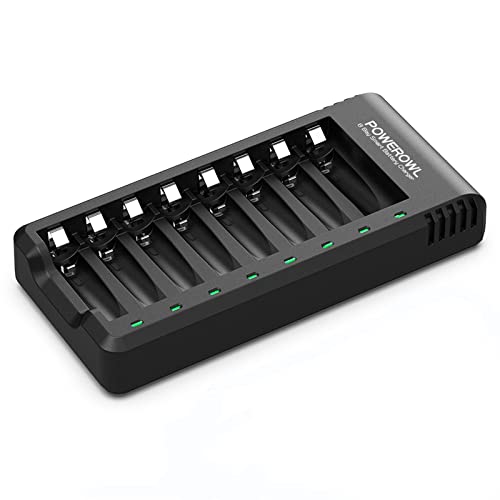
POWEROWL 8-Bay AA AAA Charger — Most Bays
Count a gaming household’s AA appetite honestly — four in two controllers, spares for the other two controllers, a flash, a set in the wireless keyboard, the toy drawer beyond counting — and four bays start to look like a queue with a roof. The POWEROWL’s eight bays end the queue. Each slot works independently, so cells can be loaded and retrieved in any combination at any stage, which suits the reality that devices surrender their batteries at random hours rather than in coordinated sets of four.
Independence across eight bays is the engineering that matters here; an eight-bay charger that merely duplicated a timer eight times would be a battery oven with extra seating. Owners use the POWEROWL as a small depot: charged cells stand in the right-hand bays, empties accumulate on the left, and the household develops a traffic flow that keeps fresh AAs perpetually available. That depot behaviour, more than raw capacity, is what high-consumption homes are actually buying.
The unit’s indicators speak per bay, letting you spot the one ageing cell in a fleet at a glance — pull it, mark the rest, move on. Its footprint is naturally larger than the four-bay picks, so give it a permanent berth on a shelf or in the utility room rather than drawer exile; depots need addresses. Powered from the wall, it asks nothing else of the household except a rule everyone follows: charged cells live here, nowhere else.
For homes whose AA consumption is measured in dozens per month, this is the pick that converts charging from a recurring chore into background infrastructure. Smaller households will find it surplus; the queue it abolishes has to exist before its value appears. Judge by your own toy-and-controller census.
- Bays: eight, AA and AAA NiMH
- Circuits: independent per-bay charging
- Indicators: per-bay status across all eight slots
- Style: depot format for high-consumption households
- Typical duties: multiple controllers, flashes, toys, keyboards
- Footprint: shelf-sized; plan a permanent berth
Strengths
- Eight independent bays abolish the charging queue entirely.
- Depot layout keeps fresh and spent cells visibly organised.
- Per-bay indicators make fleet maintenance a glance, not a project.
Trade-offs
- Largest footprint in this guide; needs dedicated shelf space.
- Surplus capacity for households with only a remote or two.
- More bays invite more mixed-age cells to manage.
Best for: a gaming household running four controllers plus a camera flash, where AAs cycle daily. Not suited for: a minimalist whose entire AA fleet is one TV remote and a wall clock.

Amazon Basics 4-Bay AA AAA Charger — Simple Value
Every rechargeable household eventually needs a second charger — for the other floor, the holiday home, the drawer at work — and the Amazon Basics four-bay unit is shaped exactly like that need. It charges AA and AAA NiMH cells with the essential safety behaviours in place, speaks through simple indicators, and declines to charge for features its buyers will never open. As a primary charger for a light-duty home it is entirely respectable; as a spare it is close to perfect.
The honest framing is that this pick competes on adequacy. Its charging is unhurried and its manners are plain, which for remotes, clocks, torches and the occasional toy is all the situation ever requests. Pair it with Amazon Basics’ own rechargeable cells — themselves a popular budget fleet — and a household can convert its low-drain devices to rechargeable power for a remarkably small outlay, then spend the savings where this guide’s premium picks earn them: the high-drain devices that cycle weekly.
What it should not be asked to do is pamper a photographer’s eneloop collection or referee a gaming household’s nightly queue. Those duties belong to the CC63 and the POWEROWL respectively, and this guide’s structure exists to route each reader to the right tool rather than to crown one charger for all seasons. The Basics unit’s dignity is in knowing its station.
There is also a gift logic here: converting a parent’s remote-and-torch drawer to rechargeables with a simple charger and a starter set of cells is a small, complete kindness that requires no ongoing expertise from the recipient. Simple indicators, forgiving operation, nothing to configure — the same traits that make it a good spare make it a good ambassador for the whole rechargeable idea.
- Bays: four, AA and AAA NiMH
- Style: plain indicators, no configuration
- Pace: unhurried, suited to low-drain devices
- Compatibility: Amazon Basics cells and other NiMH brands
- Typical duties: remotes, clocks, torches, second-drawer duty
- Role: value primary for light homes; ideal household spare
Strengths
- Converts a light-duty drawer to rechargeables for very little.
- Simple enough to give as a gift without a tutorial.
- Perfectly shaped as the household’s second charger.
Trade-offs
- Unhurried pace and plain feedback only.
- Not the guardian premium cells deserve.
- Four bays will queue in high-consumption homes.
Best for: a grandparent’s drawer of remotes, clocks and torches being converted to rechargeable power. Not suited for: a working photographer or a four-controller gaming den.

Duracell Ion Speed 1000 Charger — Mainstream Staple
Duracell’s Ion Speed line has sat in more supermarket baskets than perhaps any charger in this guide, and familiarity is a legitimate feature: a household that already trusts the copper-top brand for its disposables can adopt its rechargeable system without a research project. The Ion Speed 1000 handles AA and AAA NiMH cells in a compact four-bay body with the straightforward indicators mainstream buyers expect, and it pairs naturally with Duracell’s own rechargeable cells sold on the same shelves.
Its charging character is mainstream in the precise sense: designed for the devices that fill ordinary homes — remotes, game controllers in moderate use, torches, toys — at a pace that balances convenience with reasonable cell treatment. It does not offer the eneloop chargers’ per-cell devotion, and this guide will not dress it as doing so. What it offers is competence with ubiquity: if it ever needs replacing, its successor is in the nearest supermarket, and its companion cells never require a special trip.
The compact body suits the kitchen-drawer habitat where this charger will actually live. It shares shelf space with the batteries it feeds, emerges when the controller dies mid-film, and returns to the drawer without ceremony. Households run on such unglamorous reliability far more than on enthusiast optimisation, and the Ion Speed’s long retail life suggests Duracell understood the assignment early.
Choose it when the household’s priority is a known name, easy replacement and zero fuss, and when the cells it feeds are everyday workers rather than a curated fleet. Enthusiasts will graduate to the Panasonics; everyone else can simply get on with never buying disposable AAs again, which was the point all along.
- Bays: four, AA and AAA NiMH
- Style: compact mainstream body, simple indicators
- Pace: balanced for everyday household devices
- Compatibility: Duracell rechargeable cells and other NiMH brands
- Typical duties: remotes, controllers, torches, toys
- Retail note: companion cells and replacements in ordinary shops
Strengths
- Trusted mainstream name lowers the adoption barrier to zero.
- Compact body lives happily in the kitchen drawer.
- Companion cells available wherever batteries are sold.
Trade-offs
- No per-cell refinement comparable to the eneloop pair.
- Four bays, mainstream pace — queues appear in heavy homes.
- Enthusiasts will want clearer per-cell diagnostics.
Best for: a mainstream household converting remotes and controllers to Duracell rechargeables with zero fuss. Not suited for: an eneloop devotee who tracks individual cells across a flash kit.
Comparison
| Pick | Bays | Cell attention | Pace | Headline strength |
|---|---|---|---|---|
| eneloop BQ-CC63 | 4 | Individual | Gentle | Finest care for premium cells |
| eneloop BQ-CC17 | 4 | Individual | Gentle | Proven classic, bundle friendly |
| Energizer Recharge Pro | 4 | Mainstream | Brisk | Clearest family operation |
| POWEROWL 8-Bay | 8 | Individual | Steady | Depot capacity for heavy homes |
| Amazon Basics 4-Bay | 4 | Standard | Unhurried | Value spare and starter |
| Duracell Ion Speed 1000 | 4 | Mainstream | Balanced | Ubiquitous name and cells |
Why Do Independent Charging Channels Matter So Much?
Batteries age unevenly. Two cells bought together, used together, will still drift apart over years — one holding slightly less, filling slightly sooner. A charger that treats a pair or a set as one unit keeps feeding all of them until the slowest is satisfied, which means the fastest spends the end of every cycle being gently overcooked. Multiply that by hundreds of cycles and the drift becomes a death spiral: the strong cell weakens, the set’s performance converges on its worst member, and the owner blames the battery brand.
Independent channels break the spiral at its source. Each bay watches its own cell and stops for that cell alone, so a strong battery is never punished for its strength and a weak one is identified rather than hidden. The practical signs are easy to feel: cells that come off the charger merely warm instead of hot, sets whose runtime stays consistent across years, and a drawer where any four AAs can be grabbed with confidence because each was finished on its own merits.
This is why the guide’s premium picks are Panasonic’s and why the eight-bay POWEROWL’s independence matters as much as its count. Simpler chargers are not villains — they are compromises with their eyes open, appropriate where cells are cheap workers. But any household investing in quality cells should house them in a charger that respects them individually.
How Should You Organise a Household Battery Drawer?
Give charged and spent cells different addresses and never let them share one. A small box, a zip pouch, even a labelled jam jar for the fresh set — the container matters less than the rule. The classic household failure is the anonymous drawer where full, flat and half-used AAs mingle, guaranteeing that the remote receives one fresh cell and one corpse and dies again by Friday to general mystification. Two containers and a house rule end that genre of evening entirely.
Date your cells with a fine marker when they arrive — month and year on the wrapper — and rotate by age. Sets that live together should stay together for high-drain duties like flashes and controllers, because matched cells discharge evenly; orphans and mixed ages can serve remotes and clocks where nobody notices variance. When a device starts eating batteries suspiciously fast, suspect the oldest set first and test it as a group before blaming the device.
Keep the charger where the drawer is, not across the house. Systems survive when the distance between “battery died” and “battery is charging” is under ten steps. The depot layout described in the POWEROWL review — empties gathering at one side, fresh standing at the other — is the drawer principle given furniture form, and even four-bay households can borrow it with two labelled boxes and a charger between them.
What Kills Rechargeable AAs — and How Do You Prevent It?
Heat is the first assassin. Cells charged hot, stored hot or worked hot lose capacity permanently, cycle by cycle. Prevention is mundane: charge on a hard surface with air around the charger, store the drawer away from radiators and sunny sills, and treat a charger that leaves cells uncomfortably hot as a suspect, not a personality. The gentle picks in this guide earn their keep largely by refusing to cook their residents.
Deep neglect is the second. NiMH cells left flat in a dead device for a year can sag to voltages that lazy chargers refuse to recognise, writing off recoverable batteries. Rotate stored cells through the charger every few months, keep spares charged rather than flat, and rescue a deeply drained cell in a smart charger that attempts a gentle revival before judging it. Low-self-discharge cells like eneloops forgive shelf time far better than older NiMH designs, which is why this guide keeps steering readers toward them.
Mixing chemistries and ages in one device is the quiet third. A fresh cell paired with a tired one works double shifts and dies young; an alkaline slipped into a rechargeable set gets charged by mistake one day and leaks the next. Keep chemistries in separate containers with labels a tired parent can read at midnight, and never — under any circumstances — put alkaline, lithium primary or any non-NiMH cell into the chargers in this guide.
How Fast Should an AA Charger Be?
Speed in this category is a genuine trade, not a free upgrade. Rapid charging exists for the flash photographer between ceremony and reception and the parent between breakfast and the school run, and it earns its place in those emergencies. Its cost is collected inside the cell as heat and stress, modest per cycle and cumulative across a set’s life. Households that charge overnight — most households, most of the time — gain nothing from speed except a slightly earlier green light nobody is awake to see.
The sensible household architecture is a gentle primary charger doing the nightly work and, if life truly includes emergencies, one brisk unit for rescues. That is the CC63-plus-Energizer pattern this shortlist quietly assembles. Judge any charger’s pace by your own emergencies: count last year’s genuine battery crises honestly, and you will likely find they number in single digits — too few to justify cooking a premium fleet 300 nights a year.
Manufacturers’ hour claims deserve a reader’s squint. Times are quoted for their own cells, at their own capacities, often for a pair rather than a full load. Treat the numbers as weather forecasts — directionally useful, locally unreliable — and trust the philosophy instead: gentle chargers say gentle things, rapid chargers say rapid things, and your cells will live the philosophy you choose.
How Do You Know When a Cell — Not the Charger — Has Died?
A dying cell betrays itself by runtime first: the flash recycles slowly, the controller fades in days instead of weeks, the torch dims early. Confirm by rotation — move the suspect set into a device that behaves well on other cells, and move a known-good set into the suspect device. The fault follows the guilty party with satisfying reliability. Chargers with per-cell indicators, like the eneloop pair and the POWEROWL, shortcut the detective work by flagging cells that refuse a proper charge.
Voltage tells the same story to anyone with a cheap meter: a rested NiMH cell that sits far below its siblings after charging is a cell in retirement. Retire it properly through battery recycling, and resist the folk habit of keeping corpses “for the clock” — a leaking or shorted cell in a clock is a clock destroyed to save pennies. Mark the surviving set’s new size honestly; a trio is not a set of four, and devices that need four should receive four matched residents.
Expect good cells on a good charger to serve for years — hundreds of cycles is the design intent of modern low-self-discharge NiMH. When a set dies young, audit the system before replacing like with like: Was the charger cooking them? Were they stored flat in a hot drawer? Were they mixed with strangers? The answers usually indict a habit, and habits are cheaper to replace than batteries.
How Should Photographers and Gamers Set Up Differently?
Photographers live by matched sets. A speedlight drinks four AAs evenly or misbehaves, so flash cells should be bought together, dated together, charged together on an individual-channel charger, and retired together. The BQ-CC63 exists for this discipline. Between events, store flash sets charged and separate from household stock, because a set borrowed by a toy is a set unbalanced. Photographers who follow that liturgy stop thinking about batteries entirely, which is the highest state this category offers.
Gamers live by volume and turnaround. Controllers surrender cells at random hours, spares must always exist, and the depot logic of the eight-bay POWEROWL matches the traffic pattern exactly. Gamers should also standardise the fleet — one cell model everywhere — because a drawer of identical AAs makes every grab a good grab at 1 a.m. before a raid. The charger that serves this life is infrastructure, and it should be bought like infrastructure: capacity first, cleverness second.
Both tribes converge on the same commandments: independent channels, honest indicators, no chemistry mixing, and a drawer system a tired human can operate. The equipment differs in scale; the discipline is identical. That is why a single guide can serve a wedding photographer and a teenager with four controllers without either feeling the advice was written for someone else.
What About Travelling With Rechargeable AAs?
Rechargeables travel well when the system travels with them. Pack the charger if the trip is longer than the cells’ round trip — a four-bay unit in the wash bag covers a camera flash and both controllers for a fortnight’s holiday — and carry charged spares in a closed case where terminals cannot meet coins or keys. Loose cells in a pocket are a short circuit looking for an afternoon; cases cost almost nothing and weigh about the same.
Airlines treat loose rechargeable cells as cabin items, so keep them in hand luggage with the camera gear they serve. At the destination, the chargers in this guide accept the local supply through the appropriate plug adapter where applicable — check your exact model’s input range before an intercontinental trip, since a minority of budget units are single-voltage. A charger that dies on foreign voltage takes the whole system with it, so the check is worth the minute it costs.
Field workers and festival crews should scale the depot idea rather than abandon it: two four-bay chargers in different bags beat one eight-bay in a single point of failure. Redundancy is a theme this guide returns to across categories, because the cost of a spare charger is trivial against the cost of a dead flash at a wedding or a dead controller at a tournament.
How Do You Start a Rechargeable Household From Zero?
Begin with an audit, not a purchase. Walk the house with a notebook and count every device that eats AAs: remotes, controllers, torches, toys, clocks, the bathroom scale, the wireless keyboard. Most households guess a third of the true number. The census tells you the charger size — four bays for a census under eight devices, eight bays beyond it — and the cell count to buy, which is the census plus a full spare set for the busiest devices. Buying against a count prevents the classic under-purchase that leaves the system rationed from birth.
Phase the conversion by drain. High-drain, frequently used devices convert first because they repay fastest and teach the household the drawer system while enthusiasm is high. Low-drain clocks and remotes convert as their disposables die, using the same cell model so the fleet stays uniform. Within a month the house runs on rechargeables without a single dramatic Saturday of swapping forty batteries, and the drawer system — fresh box, spent box, charger between them — has become habit rather than project.
Keep the disposables you remove in a small reserve box rather than binning them; a few alkalines serve the one sulky vintage device every house owns and act as emergency stock during a power cut. Then close the loop socially: tell everyone in the house the two rules — fresh cells live in the marked box, dead cells go straight onto the charger — and write them on the drawer itself if your household runs on written law. Systems that fit on an index card survive; systems that need a manual do not.
What Should You Do With Batteries in a Power Cut or Emergency Kit?
Rechargeables belong in emergency kits precisely because low-self-discharge cells wait patiently. Stock the kit with charged AAs in a sealed case, the torches they feed, and a note of the month they were charged; refresh the set twice a year when the clocks change, rotating the old set into household service and charging a fresh one into the kit. That rhythm keeps emergency power genuinely ready instead of theoretically ready, which is the difference that matters at 2 a.m. in a dark house.
Choose kit devices that share the AA standard so one cell type covers torches, a radio and a lantern. Standardisation is the emergency version of this guide’s household advice: in a crisis nobody should be hunting for three battery sizes by candlelight. The chargers in this guide cannot help during the cut itself unless a generator or car inverter is in the picture, which is exactly why the kit’s cells must start full — the system’s discipline happens in peacetime.
After any emergency use, recharge everything before the kit goes back into its cupboard, and replace any cell that behaved oddly under pressure. Emergencies are audits you did not schedule; let them teach the system what to fix while the lesson is fresh and the weather is calm again.
How Do Rechargeable AAs Behave in Cold and Heat?
Cold slows every battery chemistry, and NiMH is no exception: a torch kept in an unheated garage will feel weaker in January than the same cells did in July, recovering as they warm. For winter car kits and outdoor work, keep the working set indoors and rotate it out to the cold device, rather than storing cells in the cold and blaming them. Photographers shooting winter events learn this once, memorably, and thereafter keep spares in an inside pocket where body heat keeps them honest.
Heat is the more damaging direction. A car dashboard in summer, a drawer above a radiator, a charger on a sunny sill — sustained heat permanently eats capacity that no charger can restore. Store the fleet in the coolest boring place in the house, charge away from direct sun, and never leave cells cooking in a parked car between jobs. The eneloop-class cells tolerate temperature swings better than most, yet “better” is a slope, not an immunity.
Seasonal households — caravans, boats, holiday cabins — should build the temperature rule into their opening and closing rituals: cells come home to the cool drawer in winter, travel charged in spring, and never overwinter in an unheated space if the main house can host them. Batteries are small livestock; they thrive on the same boring, temperate routine as everything else that lasts.
How Do You Teach Children to Run the Battery Drawer?
Children adopt the system happily when it is built at their scale: the fresh box and the spent box at their height, the charger where an adult passes often, and a rule simple enough to chant — dead ones go on charge, charged ones go in the box. Let a child own the rotation for their own toys and controllers and the habit sets for life, because the system rewards them immediately with toys that always work. Supervise the chemistry rule absolutely, though: only the marked rechargeable cells ever enter the charger, and an adult handles any cell that looks damaged.
Make the invisible visible for young scientists: a marker date on each cell, a small chart of how many times the games-controller set has been charged, a torch experiment comparing a fresh set with a tired one. The drawer becomes a child’s first energy system, understood rather than merely used. Households that teach it this way report a side benefit adults did not predict — the children become the enforcers, correcting grandparents who reach for disposables with the serene confidence of the recently converted.
Common Mistakes
Charging alkaline batteries is the dangerous classic: primary cells are not built to be refilled, and forcing current into them risks leaks and rupture. The chargers here are for NiMH rechargeables only — read a cell’s label the way you would read a fuel pump’s. The second classic is the anonymous drawer, condemned at length above, where charged and dead cells mingle until nobody trusts any of them. The third is judging a charger by its speed headline and cooking a premium fleet into an early grave for green lights nobody watches.
Mixing ages inside one device quietly shortens every set involved, as the cell-care sections explain, yet households do it weekly because the drawer offers no guidance. Label, date and containerise — the whole fix costs one marker pen. Owners also abandon deeply drained cells that a smart charger could have revived, and nurse genuinely dead cells that should have been recycled; learn the rotation test and both errors shrink.
Finally, there is the single-charger bottleneck in a house that has outgrown it: four bays serving a dozen devices, with a queue that guarantees something important is always flat. Count your household’s AA residents honestly. When the census passes eight devices in regular use, the eight-bay depot stops being an extravagance and becomes the obvious arithmetic.
Final Recommendation
Buy the eneloop BQ-CC63 if you want the finest care for good cells and the clearest view of their health; buy the BQ-CC17 if you prefer the same gentleness in its classic, bundle-friendly form. Busy families should take the Energizer Recharge Pro for its speed and clarity, heavy households the POWEROWL’s eight-bay depot, light drawers the Amazon Basics as a starter or spare, and mainstream loyalists the Duracell for a name they already trust. Whichever you choose, pair it with low-self-discharge cells, give fresh and spent batteries separate homes, and never feed it anything but NiMH. Do those three things and the AA drawer — that small museum of household anxiety — becomes the most boring, reliable corner of the house.
A final word about what success looks like in this category: it looks like nothing. Six months after the right purchase, nobody in the house talks about batteries. The controller works, the torch works, the flash fires, and the drawer holds a small, organised fleet that quietly rotates through the charger like books through a library. When a technology reaches that level of invisibility in a home, it has been bought correctly — and every pick on this page, matched to its proper household, is capable of disappearing in exactly that way.
Frequently Asked Questions
Can these chargers charge AAA batteries too?
Yes — every pick in this guide accepts AAA NiMH cells alongside AA, usually in the same bays with sprung contacts that adjust to the smaller size. AAA cells hold less and finish sooner, which independent-channel chargers handle automatically. Keep the same rules: NiMH only, matched sets for demanding devices, and no mixing chemistries in one device.
How long does a full AA charge take?
It depends on the charger’s philosophy and the cells’ capacity: gentle units take the long, kind road of several hours, while brisk mainstream units finish notably sooner. Treat any single figure as approximate, because cell size, age and temperature all vote. Overnight charging makes the question mostly academic — load the bays at bedtime and collect full cells at breakfast.
Can I leave batteries in the charger after they are done?
For a day or two, a smart charger that has properly terminated will not harm them, though the tidy habit is to move finished cells to the fresh container so the drawer system stays honest. Avoid leaving cells for weeks in a charger that trickles continuously, and never leave any charger buried under papers or bedding while it works.
Why do my rechargeable AAs seem weaker than disposables in some devices?
NiMH cells run at a slightly lower nominal voltage than fresh alkalines, and a few devices — some older torches and finicky electronics — notice the difference. Most modern gear is designed with rechargeables in mind and performs identically or better, especially under heavy drain where NiMH holds its voltage far more stubbornly than alkaline. If one vintage device sulks, feed it disposables and let everything else enjoy the rechargeable system.
Is it worth switching a whole house to rechargeable AAs?
For any home with controllers, toys, flashes or a drawer of remotes, emphatically yes — the cells pay for themselves quickly and then keep paying for years, while the waste stream shrinks to nearly nothing. Low-drain devices like wall clocks are the marginal case, though even they behave well on low-self-discharge cells. Start with the busiest devices and let the economics convert the rest of the house by example.
What does low self-discharge actually mean?
Older NiMH cells lost their charge on the shelf within weeks, which made spares unreliable. Low-self-discharge designs — eneloop being the famous example — retain most of their charge across many months of storage, so a charged spare is still a charged spare when the camping trip arrives. It is the single battery innovation that made the whole rechargeable drawer system practical, and it is why this guide pairs its chargers with such cells at every opportunity.
Can I mix brands of NiMH cells in one charger?
In an independent-channel charger, yes — each bay minds its own cell, so brands can share the unit safely. Inside a device, prefer matched sets of the same brand, age and capacity for even discharge. In simpler chargers that treat cells as groups, keep groups homogeneous. The charger tolerates diversity better than the device does.
How many AA cells should a household own?
Count the devices, multiply by their cell counts, then add one full spare set for the busiest third of the fleet. That formula keeps every device running while a full rotation charges, without buying cells that will age unused in the drawer. Gamers and photographers should add a second spare set for event days. Cells are cheap compared with devices; the discipline is in the organisation, not the purchasing.
Do rechargeable AAs leak like old disposables did?
Healthy NiMH cells are far less leak-prone than ageing alkalines, which is one of the quieter reasons to convert devices that sit for months, like emergency torches and seasonal decorations. A cell that has been abused, overcharged for years or physically damaged should still be retired promptly and recycled. Inspect the fleet when you rotate it; any cell with a swollen wrapper or corrosion at the cap has finished its service.
Related Guides
Keep reading in the charging section: best 5 port chargers, best 65 watt USB-C chargers and best affordable fast wireless chargers.



[…] with the neighbouring charging roundups: best 65 watt USB-C chargers, best 3.0 Qualcomm Quick Chargers and best affordable fast wireless […]