What's inside
- Key Takeaways
- Quick Picks
- How Did We Compare Chargers That Live in a Battery Compartment?
- Why Three Banks, and What Does Each One Do?
- What Does IP68 Sealing Buy You in a Compartment?
- Which Three-Bank Charger Belongs on Your Boat?
- How Does Shore Power Quality Affect an On-Board Charger?
- What Happens When You Replace One Battery in a Three-Bank System?
- How Do You Diagnose a Bank That Never Finishes Charging?
- Three-Bank Marine Chargers Head to Head
- How Do You Install an On-Board Charger Properly?
- How Does an On-Board Charger Behave Across a Season?
- What Mistakes Do Boat Owners Make With On-Board Chargers?
- How Do You Plan Trolling-Motor Runtime Around Charging?
- What Should a Buyer Verify in the First Week After Installation?
- Does Salt Water Change How You Should Treat the Installation?
- How Does the On-Board Charger Share Duties With the Engine’s Alternator?
- Final Recommendation
- Frequently Asked Questions
- Related Guides
As an Amazon Associate I earn from qualifying purchases. This post may contain affiliate links at no extra cost to you.
**[widgetverdict.com] is reader-supported. When you buy through links on our site, we may earn an affiliate commission.**
An on-board charger changes a boat’s relationship with its batteries: bolt it in the compartment once, wire it to each bank permanently, and from then on, charging is a shore-power plug and nothing else. This guide to the best on board marine battery chargers compares six three-bank units — two NOCO models at 15A and 30A total, and four alternatives spanning the same two power classes — all sealed to IP68 as their titles state, all built to charge and maintain three 12V batteries at once. The decision that matters is per-bank current: 5A per bank for maintenance-minded owners, 10A per bank for boats that come home empty and leave again soon.
Amazon carries all six, and the typical boat they serve runs three batteries in some arrangement — a starting battery and two trolling or house batteries is the classic layout, though twin-engine and bass-boat configurations rhyme with it. Every pick here claims compatibility across lead-acid family chemistries, and each states lithium support in its title in its own wording, which the reviews quote carefully rather than generalise. Owners whose batteries live ashore instead — in an RV or a solar shed — will find the portable side of the family in Best LiFePO4 Battery Chargers; this guide is for chargers that move in and stay.
Key Takeaways
- All six picks are 3-bank, 12V on-board chargers rated IP68 waterproof in their titles — sealed for life in a battery compartment.
- The field splits by per-bank current: 5A per bank (15A total) from the NOCO GEN5X3, WAVLINK and LCD models; 10A per bank (30A total) from the NOCO GENPRO10X3 and two alternatives.
- NOCO’s pair carries the deepest stated feature set: overcharge protection and temperature compensation on both, with the GENPRO doubling per-bank power.
- Desulfation and repair modes appear in the WAVLINK and one 30A alternative’s titles — manufacturer claims this guide reports as claims, not promises.
- Lithium support is stated per model in differing words; match the exact wording to your batteries before ordering.
Quick Picks
| Pick | Badge | Why it earns its place |
|---|---|---|
| NOCO GEN5X3 12V 15A 3-Bank OnBoard Marine Battery Charger | Best proven all-rounder | Three banks at 15A total, IP68, temperature compensation and overcharge protection, for lead-acid and lithium batteries. |
| NOCO GENPRO10X3 12V 30A 3-Bank OnBoard Marine Battery Charger | Best for fast turnaround | The GENPRO line doubles per-bank output to reach 30A total, with the same IP68 sealing and protection set. |
| WAVLINK 3 Bank 15A Marine Battery Charger 12V IP68 Onboard | Best with repair mode | 5A per bank, multi-stage charging with a stated desulfating repair function, across SLA, AGM, LiFePO4 and calcium batteries. |
| 3-Bank 30A Marine Charger (LiFePO4-ready) | Best 30A value | 10A per bank at 30A total, IP68, titled for SLA, AGM and lithium (LiFePO4), for boat, RV and heavy truck. |
| 3 Bank Marine Battery Charger | Best with a display | 5A per bank with an LCD on board, IP68, temperature compensation, spanning lead-acid, AGM, EFB, LiFePO4 and lithium. |
| 3-Bank 30A Smart Marine Charger | Best 30A with desulfator | 10A per bank, smart waterproof design, maintainer and desulfator claims, for SLA, AGM, lithium (LiFePO4), calcium and deep-cycle batteries. |
How Did We Compare Chargers That Live in a Battery Compartment?
Per-bank current was the first sort, because it is the specification that decides how a fishing weekend ends. A trolling battery drained over a long day needs hours of replenishment; at 5A per bank that is an overnight-and-then-some proposition for a large battery, while 10A per bank roughly halves it. Both classes maintain equally well once the batteries are full — maintenance sips are tiny — so the choice is really about turnaround, and this guide assigns the two NOCO lines and their four rivals to the class their titles state rather than blurring them into one ranking.
Stated protections formed the second sort. Temperature compensation — adjusting charge voltage as the compartment heats and cools — appears in the NOCO titles and the LCD model’s title, and it matters in a sealed box under a sun-baked deck; overcharge protection is the baseline promise of any maintainer and is quoted where titles make it. Desulfation and repair claims were handled as claims: two titles make them, the reviews report them in the makers’ words, and no pick was credited with resurrecting batteries, because a charger that maintains well is already doing the job that prevents most sulfation in the first place.
Chemistry wording closed the work, and it is quoted per pick because the titles genuinely differ — lead-acid and lithium on the NOCO pair; SLA, AGM, LiFePO4 and calcium on the WAVLINK; EFB joining the list on the LCD model. “Lithium” in these titles refers to the 12V lithium drop-in batteries, overwhelmingly LiFePO4, that boats increasingly run; it does not make these chargers suitable for the lithium-ion packs of bikes and tools, a distinction the ebike world enforces from its side in Best Ebike Battery Chargers.
Why Three Banks, and What Does Each One Do?
A bank, in charger language, is one independently managed charging output, and a 3-bank charger is really three chargers sharing a sealed housing and one power cord. Each bank connects to one 12V battery and runs its own charge programme — bulk, finishing, maintenance — without regard to the others. That independence is the entire point: a starting battery that barely worked all day and a trolling battery emptied to its knees can sit on neighbouring banks and each receive the charge it actually needs, rather than being yoked together by a single output that understands neither.
The layouts this serves are the standard ones. Bass boats run a cranking battery plus two trolling batteries for a 24V or 36V trolling motor — and note carefully that the charger still treats them as three individual 12V batteries, which is exactly how on-board chargers are designed to work. Centre consoles run starting plus house banks; twin-engine boats add a third. What a 3-bank charger does not do is charge a 24V bank as a unit or rescue a boat with four batteries; those owners step up to more banks, and this guide’s six are honestly three-bank tools.
Installation permanence is the other half of the concept. Portable chargers visit batteries; on-board chargers marry them — ring terminals bolted down, leads routed and secured, the unit mounted where its indicators can be seen when the hatch opens. The reward is a routine reduced to one gesture at the dock: plug the boat in. Boats that live on trailers get the same gesture in the driveway, and boats in slips get it from the pedestal, which is why this category, once adopted, is rarely abandoned. The gesture is worth designing around — an inlet reachable without boarding, a cord stored where it dries, an indicator check folded into the same motion as securing the lines — because systems that demand a scavenger hunt get skipped on tired evenings, while systems that ask for one plug get used ten thousand times, and that usage, repeated across seasons, is the whole difference between batteries that are maintained and batteries that are merely owned.
What Does IP68 Sealing Buy You in a Compartment?
IP68 is the highest common ingress rating: dust-tight, and protected against continuous immersion in water under conditions the maker specifies. In a battery compartment, the realistic enemies are not submersion but the daily weather of boating — spray through a hatch seal, a washdown hose’s enthusiasm, condensation that forms and drips for months, and the corrosive breath of the batteries themselves. A sealed charger shrugs at all of it in a way a ventilated portable never could, which is why every pick in this guide carries the rating in its title: at this point it is the category’s entry ticket rather than a premium feature.
Sealing has a thermal price, and honest reviews should charge it. A waterproof housing sheds heat through its case rather than through vents, so on-board chargers are engineered conservatively and mounted where air can reach the case. The installation guidance in this guide — mount with clearance, keep the unit out of the bilge’s standing water despite its rating, route cables so they do not chafe — exists because IP68 describes the charger’s resistance, not an invitation to test it. Treat the rating as insurance for the bad day, and the charger will spend its life dry anyway.
Which Three-Bank Charger Belongs on Your Boat?
The NOCO pair first — they are the category’s reference points — then the alternatives by class. Decide your per-bank current before reading, and the reviews become confirmations rather than arguments.
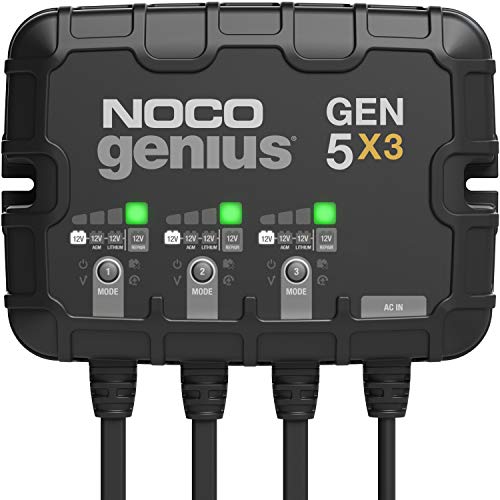
NOCO GEN5X3 12V 15A 3-Bank OnBoard Marine Battery Charger — Best proven all-rounder
The GEN5X3 is the charger other three-bank units get compared to, and its title assembles the reference specification: 12V, 15A across three banks — 5A per bank — charging three batteries at once, IP68 waterproof, overcharge protection, temperature compensation, and compatibility with lead-acid and lithium batteries. Five amps per bank is the maintenance-minded class: a trolling battery used moderately through a day returns to full overnight, the starting battery is kept at its peak indefinitely, and the whole system idles through winter storage as a maintainer that never overfeeds.
Temperature compensation is the feature to appreciate in July. A battery compartment under a dark deck can run far hotter than the morning air in which you set out, and charge voltage that suits a cool battery mistreats a hot one; compensation adjusts for the compartment the charger actually lives in, which is the sort of detail that separates a marine charger from a garage charger wearing a waterproof coat. NOCO’s documentation culture matters here too — this is the pick for owners who read manuals, follow mounting instructions and expect a decade of silent service, and the GEN5X3 is built and documented to reward exactly that owner.
- Output: 15A total across 3 banks (5A per bank), 12V
- Sealing: IP68 waterproof, per the title
- Features: overcharge protection and temperature compensation stated
- Chemistries: lead-acid and lithium, as titled
Strengths
- The category’s reference feature set at 5A per bank
- Temperature compensation suits hot compartments
- Maintainer behaviour ideal for stored boats
Trade-offs
- 5A per bank is slow after a hard trolling day
- Premium positioning within its class
- No display; status is by indicator lights
Best for: a three-battery boat that fishes moderate days and stores between trips, maintained automatically. Not suited for: a tournament rhythm that empties big trolling batteries nightly and needs them back by dawn. Order the GEN5X3 if your boat’s charging problem is care, not speed.
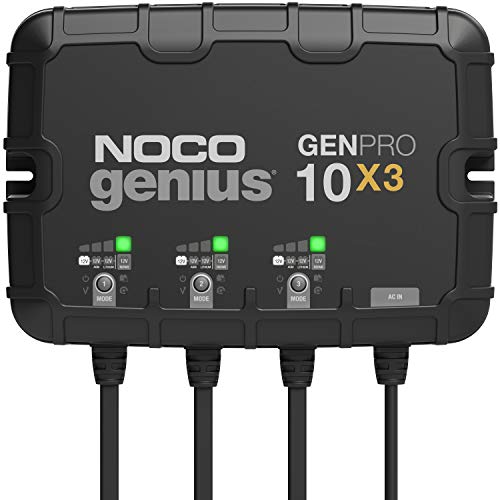
NOCO GENPRO10X3 12V 30A 3-Bank OnBoard Marine Battery Charger — Best for fast turnaround
The GENPRO10X3 is the GEN5X3’s stronger sibling: same three banks, same IP68 sealing, same protection and temperature-compensation set, and double the muscle — 30A total, 10A per bank, a figure encoded in its very name. Ten amps per bank changes the overnight maths for the big trolling batteries that modern bass boats carry: a deeply used 100Ah-class battery that would still be drinking at breakfast on 5A is finished and maintaining on 10A, and a two-day tournament stops being a battery-management exercise.
That power is aimed at a recognisable owner: the angler who fishes long days on the trolling motor, the guide whose boat is a workplace, the cruiser whose house bank works hard at anchor. For them the GENPRO is not an upgrade but the correct tool, and its premium over the 5X3 buys hours every single night. Owners whose boats sip rather than gulp should read the trade honestly in reverse — unused charging capacity is not a virtue, merely a cost — which is why this guide keeps both NOCO lines in print rather than crowning the bigger one. Match the charger to the depth of your typical discharge and the GENPRO’s case makes itself.
- Output: 30A total across 3 banks (10A per bank), 12V
- Sealing: IP68 waterproof, per the title
- Features: overcharge protection and temperature compensation stated
- Chemistries: lead-acid and lithium, as titled
Strengths
- 10A per bank halves big-battery recharge times
- Full NOCO protection and compensation set
- Built for daily hard use rather than occasional care
Trade-offs
- The class’s premium price for power some boats never need
- Larger appetite demands a healthy shore-power supply
- Over-specified for a lightly used weekend boat
Best for: hard-fished boats with large trolling or house batteries that must be full every morning. Not suited for: a lightly used boat whose batteries never dip far, where the GEN5X3 maintains for less. Choose the GENPRO10X3 when turnaround time, not maintenance, is your problem.

WAVLINK 3 Bank 15A Marine Battery Charger 12V IP68 Onboard — Best with repair mode
WAVLINK’s entry matches the GEN5X3’s class — three banks, 15A total, 5A per bank, IP68 — and differentiates with its stated extras: multi-stage charging with a desulfating repair function, multi-protection wording, and the widest chemistry list in the 15A class, spanning SLA, AGM, LiFePO4 and calcium batteries. That breadth suits the mixed fleet reality of many boats, where a sealed starting battery, an AGM house battery and a newer LiFePO4 trolling battery can share one hull and, with this charger, one charging routine.
The desulfating repair mode deserves the guide’s standard treatment: it is a manufacturer claim, reported as such. Sulfation — the crystal build-up that strangles neglected lead-acid batteries — is real, and chargers that attempt to reverse it with specialised pulses exist across the industry; what no honest guide can promise is that a given tired battery will return to service. Read the WAVLINK’s repair mode as a maintenance argument instead: a charger with multi-stage habits, left connected, is precisely how sulfation gets prevented, and the repair attempt is a bonus for the battery you already neglected. Judged that way, the WAVLINK is a full-featured 15A alternative with a chemistry list that covers mixed banks gracefully.
- Output: 15A total across 3 banks (5A per bank), 12V
- Sealing: IP68 waterproof onboard design
- Features: multi-stage charging and desulfating repair, as claimed in the title; multi-protection
- Chemistries: SLA, AGM, LiFePO4 and calcium, as titled
Strengths
- Widest stated chemistry span in the 15A class
- Repair mode may help neglected lead-acid batteries
- Multi-stage programme suits permanent connection
Trade-offs
- Repair outcomes are a claim, not a guarantee
- 5A per bank shares the class’s slow turnaround
- Documentation thinner than NOCO’s
Best for: a mixed-chemistry three-battery boat wanting one charger that names every battery it owns. Not suited for: resurrecting a battery that has sat dead for a year — no charger here promises that. Order the WAVLINK when your banks are a mixed fleet under one hatch.

3-Bank 30A Marine Charger (LiFePO4-ready) — Best 30A value
This unbranded 30A unit brings the GENPRO’s power class — three banks at 10A per bank, 30A total, IP68 — to a wider chemistry promise and a wider vehicle list: SLA, AGM and lithium (LiFePO4) in the title, with boat, RV and heavy truck named as its habitats. The RV and truck mentions are worth taking seriously rather than as listing sprawl: a permanently mounted 3-bank charger serves any vehicle that carries three 12V batteries and parks near an outlet, and owners of such rigs will find the specification identical in kind to the marine brief it headlines.
As the value route into 10A-per-bank charging, its argument is straightforward: the power class and sealing of the flagship tier, the lithium wording spelled out as LiFePO4, and an unbranded tier’s documentation as the accepted cost. Boats converting their trolling banks to LiFePO4 — a migration happening across the fleet for the weight savings — need chargers whose titles say the chemistry plainly, and this one does. Verify the lithium profile details in its documentation on arrival, as with any charger meeting a new battery type, and the unit settles into the same plug-in-and-forget routine as every pick here.
- Output: 30A total across 3 banks (10A per bank), 12V
- Sealing: IP68 waterproof
- Chemistries: SLA, AGM and lithium (LiFePO4), as titled
- Stated habitats: boat, RV and heavy truck
Strengths
- 10A per bank without the flagship badge
- LiFePO4 named explicitly for lithium conversions
- Serves RV and truck three-battery rigs as well
Trade-offs
- Unbranded manual and support depth
- No temperature compensation is claimed in the title
- Feature wording is thinner than NOCO’s
Best for: a hard-used three-battery boat, especially one converting to LiFePO4, wanting 10A per bank. Not suited for: an owner who wants temperature compensation stated in writing before purchase. Pick this 30A unit when the power class matters more than the badge.

3 Bank Marine Battery Charger — Best with a display
An LCD on an on-board charger is rarer than it should be, and this unbranded 15A unit — three banks, 5A per bank, IP68 — builds its identity around it, adding overcharge protection and temperature compensation and the guide’s longest chemistry list: lead-acid, AGM, EFB, LiFePO4 and lithium. EFB — the enhanced flooded batteries common as starting batteries — is a thoughtful inclusion, since mixed compartments often hold exactly that chemistry in the cranking role. The display turns the hatch-open check into a reading rather than an interpretation of blinking lights: bank states at a glance, in numbers or plain status, before the boat leaves the dock.
That readability serves a particular owner well: the one who shares the boat, lends it, or maintains it for a family, where “check the charger” must be an instruction anyone can execute. It also serves the diagnostician — when a battery begins to fail, the bank that lingers in its charging stage on the display is the suspect, identified weeks before it strands anyone. At 5A per bank it shares its class’s gentle pace, so the display is the reason to choose it, and for the right owner that reason is sufficient and honest.
- Output: 15A total across 3 banks (5A per bank), 12V
- Sealing: IP68 waterproof onboard design
- Feedback: LCD display on the unit
- Chemistries: lead-acid, AGM, EFB, LiFePO4 and lithium, as titled; overcharge protection and temperature compensation stated
Strengths
- LCD makes bank status readable by anyone
- Temperature compensation included at 15A class
- EFB named for modern starting batteries
Trade-offs
- 5A per bank pace for big trolling batteries
- Unbranded support and documentation
- Display is one more component exposed to compartment life
Best for: a shared or family boat where anyone should be able to verify charging at a glance. Not suited for: nightly tournament turnarounds, which belong to the 10A-per-bank class. Install this LCD model where the hatch opens often and the questions are frequent.

3-Bank 30A Smart Marine Charger — Best 30A with desulfator
The last pick pairs the 30A class — three banks at 10A per bank — with the maintainer-and-desulfator combination, in a smart waterproof onboard design titled for SLA, AGM, lithium (LiFePO4), calcium and deep-cycle batteries. Deep-cycle in the title is the operative phrase: this charger addresses itself to the hard-worked trolling and house batteries that define its class, the ones cycled deeply daily and expected to be ready again by morning, season after season.
Its desulfator claim receives the same honest framing as the WAVLINK’s: a manufacturer’s stated function, valuable chiefly as part of a maintenance regime that prevents the condition it names, with any revival of a neglected battery treated as a possible bonus rather than a purchased outcome. Within those terms, the package is coherent — high per-bank current for turnaround, smart multi-stage behaviour for the long connected hours, and a chemistry list that spans the lead-acid family plus LiFePO4. For the unbranded tier, the advice mirrors the other value picks: read its documentation fully at installation, run one supervised first charge, and let its behaviour, observed, become your confidence.
- Output: 30A total across 3 banks (10A per bank), 12V
- Design: smart, waterproof onboard charger and maintainer
- Features: desulfator function claimed in the title
- Chemistries: SLA, AGM, lithium (LiFePO4), calcium and deep-cycle batteries, as titled
Strengths
- 10A per bank with a maintenance-led feature set
- Broad chemistry span including calcium and deep-cycle
- Built for permanently connected service
Trade-offs
- Desulfation results are claimed, not assured
- Unbranded documentation tier
- No temperature compensation is stated in the title
Best for: deep-cycled trolling and house banks on a three-battery boat that fishes hard and often. Not suited for: an installation where every protection feature must be named by a major brand in writing before purchase. Choose this 30A smart charger when deep-cycle duty is the daily reality of your banks.
How Does Shore Power Quality Affect an On-Board Charger?
Marina power is a variable disguised as a constant. Long dock runs and a hundred neighbours’ air conditioners can sag the voltage at your pedestal on a hot evening, and a charger fed sagging power simply charges more slowly — a fact worth knowing before blaming the unit for a bank that took longer on the holiday weekend. Pedestal breakers also trip, silently, which is why the experienced owner’s dock routine includes a glance at the charger’s indicators after plugging in, confirming the system is awake rather than assuming the shore cord’s presence equals power.
Generators and inverters enter the picture for boats that charge away from marinas. A charger is a load like any other, and the 30A-class picks draw meaningfully more from a small generator than the 15A class; owners who recharge from a portable generator on a trailer or at a remote ramp should size that pairing deliberately. The deeper principle matches the rest of this guide: the charger is one component in a chain — pedestal or generator, cord, inlet, charger, leads, battery — and the chain’s weakest link sets the evening’s result. Walking the chain once, at installation, with eyes open, prevents a season of blaming the wrong link.
Galvanic concerns belong in a footnote that saltwater owners should actually read: a boat plugged into shore power connects its underwater metals to the marina’s electrical ecosystem, and while a battery charger is not the culprit in galvanic corrosion stories, the shore-power connection that feeds it is part of that system. Boats kept plugged in permanently — the exact pattern these chargers encourage — should have their galvanic protection in order as a matter of routine seamanship, a topic for the boat’s own manual rather than this guide, but one the plug-in lifestyle makes relevant.
What Happens When You Replace One Battery in a Three-Bank System?
Batteries in a system age at their own rates, and the independent-bank design handles that gracefully: replace the failing battery, and its bank simply charges the new one while the others continue their programmes. The discipline is in the pairing rules. Batteries wired together in series for a 24V trolling motor should be replaced as a pair — a fresh battery yoked to a tired one will be dragged through its partner’s decline — while independent batteries, like a starting battery beside a house bank, can be replaced singly without apology.
Chemistry changes deserve the same deliberation as the original purchase. Converting one role to LiFePO4 — the trolling pair, most often — while the starting battery stays lead-acid is a legitimate, common pattern, and every charger here claims wording that covers mixed banks; the verification is to confirm that the specific bank’s charging suits the new battery, per both manuals. What must not happen is the casual swap: a lithium battery installed on a Friday and charged all weekend on assumptions. The manuals take ten minutes; the batteries cost what they cost. Read first, and the conversion becomes the upgrade the fleet says it is — lighter, deeper-cycling, and maintained by the same plug-in gesture as before.
Keep a battery log while you are at it: install dates, type, and the bank each battery sits on, noted in the boat’s documents. When a bank misbehaves two seasons later, that log converts a guessing session into a reading exercise, and it travels with the boat if it is ever sold — a small professionalism that buyers notice.
How Do You Diagnose a Bank That Never Finishes Charging?
Begin with the connection, as always: a bank that lingers in its charging stage for days usually has a corroded terminal, a loose ring connector or a chafed lead adding resistance, and the charger is honestly reporting a battery it cannot quite fill. Clean, tighten, and retry before condemning anything with a price tag. Second suspect is a load left on — a bilge pump cycling, a light in a locker, a stereo’s memory draw — sipping from the battery as fast as the maintainer stage can pour, a tug of war that looks exactly like a charger failing.
If connections and loads are innocent, the battery itself is the witness to interview. A battery that will not reach its finishing voltage after a long, supervised charge, that warms noticeably, or that collapses quickly under a modest load has described its own retirement. The desulfator-equipped picks may be given their chance per their makers’ instructions — expectations calibrated by this guide’s earlier framing — but a battery that fails the same test twice is done, and replacing it promptly protects the charger and the other banks from the consequences of its decline. Diagnosis in this order — connection, load, battery, charger — resolves nearly every case, and the charger, notably, is last on the list, because in well-installed systems it is the least likely culprit.
Three-Bank Marine Chargers Head to Head
| Charger | Total output | Per bank | Sealing | Signature feature in title |
|---|---|---|---|---|
| NOCO GEN5X3 | 15A | 5A | IP68 | Temperature compensation, overcharge protection |
| NOCO GENPRO10X3 | 30A | 10A | IP68 | Double power, same protection set |
| WAVLINK 3 Bank 15A | 15A | 5A | IP68 | Desulfating repair, four chemistries |
| 3-Bank 30A (LiFePO4-ready) | 30A | 10A | IP68 | Boat, RV and truck scope |
| 3 Bank with LCD | 15A | 5A | IP68 | LCD display, EFB support |
| 3-Bank 30A Smart | 30A | 10A | IP68 | Maintainer and desulfator claims |
Two power classes, one sealing standard, six variations of feature wording — and one shared promise underneath all of it, that the boat’s batteries stop being a subject of conversation. If you know your per-bank number, the table reads as a confirmation; if you do not, the sections around it exist to help you find it.
How Do You Install an On-Board Charger Properly?
Choose the mounting spot with three criteria in order: dry in practice — high in the compartment, out of any bilge water’s reach despite the IP68 rating; ventilated in practice, so the sealed case can shed its heat to moving air; and visible, because a charger whose indicators or display you cannot see is a charger you will stop checking. Mount it firmly to a bulkhead or the compartment structure with the maker’s hardware, oriented as the manual directs, and only then run the leads.
Each bank’s leads go to their own battery: positive and negative ring terminals bolted cleanly to the posts, in the order the manual prescribes, with the boat’s loads and engine connections undisturbed. Route the cables along existing runs, secured against chafe and away from steering linkages, fuel lines and anything that moves or heats. Keep each bank’s pair together and label them — bank one to starting, bank two and three to trolling, say — with the labels at both ends, because the day you replace a battery, those labels are the difference between a ten-minute job and an archaeology dig.
The AC side deserves the same respect: the charger’s cord should reach the boat’s inlet or a proper outlet without strain, adapters or a cord draped across a walkway. Then comes the supervised first charge — plug in at the dock or driveway, confirm each bank shows charging, check again in an hour for abnormal warmth or smell, and let the system complete a full cycle before trusting it unattended. A charger installed this carefully becomes part of the boat, and like all good boat systems, it will mostly be forgotten — which is the highest state a charging system can achieve.
How Does an On-Board Charger Behave Across a Season?
In season, its life is rhythm: fish, plug in, unplug, fish. The maintainer stage is where it spends most hours, holding each bank at its proper rest without the slow overcharge that killed batteries in the era of dumb chargers. Owners who leave the boat plugged in between trips — the normal pattern for slip-kept boats and many trailer boats — should still walk the compartment occasionally: a glance at indicators, a hand near (not on) the case for abnormal heat, a look at terminals for the first green whisper of corrosion. Five minutes a month is the entire maintenance contract from the owner’s side.
Winter rewrites the routine by geography. Where boats store ashore with batteries aboard, the on-board charger, fed by a yard outlet or an occasional visit with an extension lead, is the ideal winter keeper — provided the arrangement is checked, since a tripped yard breaker discovered in April explains a spring of dead batteries. Where batteries come home for winter, they leave the charger’s care, and the portable-charger discipline of our LiFePO4 guide takes over in the garage. Lithium banks add their own storage preferences per their makers, which outrank any general advice: read the battery manual in October, not the hard way in April.
The nightstand version of the same convenience exists indoors, incidentally — a folding station from Best Multi-Device Wireless Chargers for iPhone does for phones what these chargers do for boats, which is to make charging a place rather than a task.
What Mistakes Do Boat Owners Make With On-Board Chargers?
Undersizing the banks’ appetite leads: a 5A-per-bank charger married to huge, hard-cycled trolling batteries produces a boat that is never quite full by morning, and an owner who blames the batteries. The second mistake is installation casualness — a charger tossed loose in the compartment to migrate and chafe, leads draped rather than routed, ring terminals finger-tight over corroded posts. Sealed chargers forgive water; nothing forgives a bad connection at 10A except time spent doing it properly once.
Third comes chemistry drift: replacing a lead-acid trolling battery with a LiFePO4 drop-in and never checking that the charger’s lithium wording covers it, or assuming a profile exists because the word lithium appears somewhere in a manual. Fourth is the forgotten boat — plugged in during October, unvisited until May, its tripped breaker or chewed cord undiscovered. And fifth, subtlest of all, is expecting a maintainer to resurrect: a battery left dead-flat for a season has often suffered damage no charger reverses, desulfator claims notwithstanding, and the honest fix is a battery, not a more hopeful charger.
How Do You Plan Trolling-Motor Runtime Around Charging?
The charger’s per-bank amps and the trolling motor’s appetite are two ends of one budget, and owners who plan them together stop having battery surprises. Estimate the day’s draw honestly — hours at the speeds you actually run, not the speeds you intend — and compare it with the bank’s usable capacity; then set the evening’s expectation by the charger class: a 5A bank returns roughly fifty amp-hours across a long night, a 10A bank about double that across the same hours, tapering included. A boat whose daily draw exceeds its nightly return is on a countdown no charger setting can repeal, and the honest fixes are capacity, current, or a shorter day — in that order of expense.
Tournament and charter rhythms make the arithmetic vivid, which is why the 30A class exists. Two consecutive dawn starts after two long days is a pattern a 15A charger cannot fund on big batteries, and owners discover it on the second morning, at the worst hour. Pleasure boats live the gentler version: a hard Saturday, a plugged-in week, a full boat by the next Saturday, where the 15A class’s patience is perfectly matched to the calendar. Neither pattern is more virtuous; they are simply different budgets, and the charger is where the budget is set in hardware.
What Should a Buyer Verify in the First Week After Installation?
Treat the first week as sea trials for the charging system. Confirm each bank reaches its maintenance stage after a normal day’s use, and note roughly how long the bulk stage takes — that duration becomes your baseline, and a bank whose bulk stage stretches week by week is announcing a battery’s decline while it is still cheap to plan around. Check the compartment after a charge for the smells and heat that should not be there, confirm the shore connection’s breaker holds under the charger’s full draw alongside the boat’s other dockside loads, and photograph the installation for your records while it is clean and labelled.
Then read the battery manuals one more time with the charger now a physical fact rather than an abstraction, checking the two documents against each other for the lithium profile, the temperature notes and the storage instructions that will matter in October. File both manuals, the battery log and the installation photo together. A charging system documented that way can be maintained by a yard, a partner or a future owner without a single phone call to you — the final form of the convenience this entire category promises.
Does Salt Water Change How You Should Treat the Installation?
Salt water accelerates every corrosion story in the compartment, and the installation should be built for the accelerated version even by owners who mostly boat fresh water, because one coastal holiday rewrites the exposure. Ring terminals should be clean, tight and protected as the charger manual directs; cable runs should drip-loop so water travelling along a cable sheds before it reaches a terminal; and the monthly glance recommended earlier becomes, in salt service, a genuine inspection — terminals brushed, any green growth investigated, the charger’s case wiped of the salt film that condenses on everything afloat.
The batteries themselves ask for the same escalation: hold-downs secure against a chop that freshwater boats never meet, caps and vents checked where the chemistry has them, and a washdown routine that respects the charger’s sealing without testing it at point-blank range with a pressure nozzle. None of this is burdensome — it is the ordinary liturgy of saltwater ownership, applied to one more system — and an on-board charger installed and kept to that standard will outlast several sets of the batteries it serves, which is the economic heart of the category: buy the charging system once, maintain it lightly, and let the consumables be the batteries alone.
How Does the On-Board Charger Share Duties With the Engine’s Alternator?
Underway, the engine’s alternator is the charging system, feeding the starting battery first and, through whatever combining or isolating arrangement the boat uses, the rest of the banks. The on-board charger’s shift begins when the engine stops and shore power connects. The two systems coexist without negotiation because they work different hours, and the owner’s part is simply to keep both healthy: an alternator that undercharges underway leaves the shore charger a deeper hole to fill overnight, which shows up in those baseline bulk-stage times this guide keeps recommending you notice.
Boats that run long distances under power may arrive with banks nearly full, and their on-board chargers live almost entirely as maintainers — a legitimate, gentle life that the 15A class serves perfectly. Boats that sail, drift and troll electrically all day arrive empty and need the charger’s full programme. Knowing which boat yours is, across a typical month rather than a typical hope, is the last piece of the sizing puzzle, and it is knowable from one instrument: the time your charger spends in its bulk stage after your most common kind of day.
Final Recommendation
A word about expectations before the verdict: an on-board charger is the least glamorous purchase a boat owner makes and the one most often thanked in October, when boats whose owners skipped it are jump-starting at the ramp. Its value compounds silently — batteries that live their full service lives instead of dying young of neglect, mornings that begin with a key turn instead of a diagnosis, a boat that is simply ready. Price the six picks here against the cost of one ruined trip and one premature battery set, and the category’s economics settle themselves.
Start with your discharge depth. Boats that fish moderate days and rest between trips belong with the 15A class: the GEN5X3 for its reference feature set and temperature compensation, the WAVLINK for mixed chemistries and its repair claim, the LCD model where shared crews need readable status. Boats that empty big batteries daily belong with the 30A class: the GENPRO10X3 for the full NOCO package at 10A per bank, the LiFePO4-ready unit for value with the chemistry spelled out, the smart desulfator model for deep-cycle duty. If the boat is shared — family, fishing partners, a co-owned hull — leave the battery log and the charging routine written down aboard, so the system survives your absence as gracefully as it survives the winter. Whichever you bolt in, install it like it will live there a decade — because a good on-board charger, matched to its banks and wired with care, does exactly that, turning every return to the dock into the end of the battery question — and every departure into a boat that is simply, reliably ready.
Frequently Asked Questions
Can a 3-bank charger charge my 24V trolling motor batteries?
Yes, in the way it was designed to: a 24V trolling system is two 12V batteries in series, and the charger connects one bank to each 12V battery individually, charging each on its own programme. It does not connect across the pair as a 24V unit, and the wiring should follow the charger manual’s diagram for series setups exactly.
Should I choose 5A or 10A per bank?
Match it to how empty your batteries come home and how soon they must be full. Moderate use with overnight at the dock suits 5A per bank; large trolling or house batteries drained daily, especially on back-to-back days, justify 10A. Maintenance once full is identical, so you are buying turnaround, not care quality.
Can I leave an on-board charger plugged in all winter?
That is what maintainers are for, and all six picks are built for permanent connection. The practical conditions are a reliable power supply — check that the yard or garage outlet stays live — and an occasional visit to confirm the system is awake. A charger cannot maintain batteries through a tripped breaker it cannot report.
Do these chargers work with LiFePO4 trolling batteries?
Each title here states lithium support in its own words, and 12V lithium drop-ins are LiFePO4 — but confirm the exact profile details in the charger’s documentation against your battery maker’s requirements before the first charge. Chemistry wording differs per model, which is why this guide quotes it pick by pick rather than issuing a blanket yes.
What does temperature compensation actually do?
It adjusts the charging voltage in response to the temperature around the batteries, because a battery’s ideal charge voltage shifts as it heats and cools. In a sun-baked compartment the difference is meaningful for battery life, which is why the feature is highlighted on the NOCO pair and the LCD model, whose titles state it.
How long should an on-board charger last?
A well-installed unit in a dry, ventilated mounting should serve across several battery sets — the charger is infrastructure, the batteries are consumables. Its enemies are the compartment’s classics: chronic standing water, chafed cables, corroded connections heating under load, and heat with nowhere to go. The monthly glance and the honest installation are what convert that potential lifespan into an actual one.
What should I do before the first trip after a winter on the maintainer?
Run one deliberate check rather than trusting the green lights of spring: open the compartment, inspect terminals and cables, confirm each bank still cycles correctly by watching a short charge after a modest discharge, and test the batteries under a real load before the season’s first long day. A system that has maintained quietly all winter usually passes in minutes — but the one time it does not, the driveway is a far better place to learn it than the far side of the lake.
Can one bank charge two batteries in parallel?
A bank can serve a parallel pair wired as a single 12V battery, treating them as one larger battery — a common house-bank arrangement. Keep the pair matched in type and age, connect across the pair’s main take-off points, and remember the bank’s current now feeds the combined capacity, so charge times lengthen accordingly.
Is an on-board charger worth it for a boat used only on weekends?
For a three-battery boat, usually yes — the weekend pattern is exactly where batteries die of neglect between outings, and a maintainer that works all week quietly prevents the flat-battery Saturday that ruins one trip in three for un-charged boats. The calculation weakens for a single-battery boat, where a portable charger does the same job without installation, and strengthens with every battery added beyond two.
Can I install an on-board charger myself?
Many owners do, since the work is mounting, routing and bolting ring terminals to battery posts, all within a careful owner’s competence and the manual’s diagrams. The boundaries are the usual ones: work with shore power unplugged, respect the manual’s fuse and cable requirements, and hand the job to a marine electrician if your boat’s wiring is unfamiliar territory or the installation touches the boat’s AC system beyond plugging in a cord.
Why does one bank’s indicator behave differently from the others?
Because the banks are independent and the batteries are individuals: a starting battery that idles all day finishes in minutes, while a trolling battery emptied by evening needs the night. Different behaviour across banks is the design working, not a fault — the fault pattern is a bank whose behaviour changes from its own baseline over time, which is the diagnostic thread this guide’s troubleshooting section follows.
The dock pedestal breaker trips when I plug the boat in. Where do I start?
Start by separating the boat from the pedestal, because the same symptom has two very different owners. Plug a known-good appliance into the pedestal outlet: if the breaker trips for that too, the fault is ashore and belongs to the marina. If the pedestal holds, reconnect the boat with the on-board charger switched off at its own supply if your installation allows it, then bring the charger back on its own. A trip that happens the instant the charger energises, repeatably and with dry weather, points toward a ground fault or damaged insulation somewhere in the charger’s supply lead or the unit itself, and that is a stop-and-call-an-electrician pattern rather than a reset-and-see one. A trip that only follows rain or a washdown points first to water in a shore inlet, a cracked plug, or a damp junction. Keep a simple log of when trips happen and what was running; marine electrical faults are far easier to trace from a pattern recorded over three weekends than from memory in a single frustrated afternoon.
What should I do after the battery compartment has flooded?
Disconnect shore power before you reach into standing water, then treat the charger’s IP68 rating as protection for the sealed unit, not as a clean bill of health for everything attached to it. The charger body may well have survived immersion exactly as rated, while ring terminals, inline fuses, and cable jackets sat in bilge water that leaves conductive residue and starts corrosion the day the compartment dries. Pump and dry the space fully, then inspect each bank lead end to end, cleaning or replacing any terminal showing green growth or stiff, discoloured cable near the lug. Only then reconnect and watch one complete charge cycle per bank at the dock, feeling connections for warmth partway through. A bank that charges normally after that inspection has earned trust; one that runs hot at a terminal has told you precisely where the flood damage settled, and the fix is the connection, not the charger.
Related Guides
Charging beyond the boat: stationary lithium banks in Best LiFePO4 Battery Chargers, bike batteries in Best Ebike Battery Chargers, and the bedside trio in Best Multi-Device Wireless Chargers for iPhone.
Related guide: Best Marine Deep-Cycle Battery Chargers