What's inside
- Key Takeaways
- Quick Picks
- How Did We Sort These Replacement Chargers?
- Why Do 48V Batteries Charge at 54.6 Volts?
- Which Plug Does Your Battery Actually Have?
- Which Replacement Charger Should You Buy for Your Bike?
- What Do Certifications and Casing Ratings Actually Tell You?
- How Should You Care for a Charger So It Lasts as Long as the Bike?
- Is It the Charger or the Battery? A Short Diagnostic Routine
- How Does a Spare Charger Change the Way You Use the Bike?
- Putting the Six Ebike Chargers Next to Each Other
- How Do You Verify a Replacement Charger Before the First Charge?
- How Long Should a Charge Take, and Can You Speed It Up?
- What Mistakes Do Riders Make With Replacement Chargers?
- How Do Charging Habits Shape a Battery’s Lifespan Over Years?
- What Changes When You Charge in Winter or Travel With a Charger?
- When Is the Original Manufacturer’s Charger the Right Answer Instead?
- Final Recommendation
- Frequently Asked Questions
- Related Guides
As an Amazon Associate I earn from qualifying purchases. This post may contain affiliate links at no extra cost to you.
**[widgetverdict.com] is reader-supported. When you buy through links on our site, we may earn an affiliate commission.**
A lost charger, a second home for the bike, a spare for the office — the reasons riders shop for the best ebike battery chargers are ordinary, but the purchase itself is not, because an ebike battery is the most expensive component on the bike and the least forgiving of a wrong charger. The six replacement chargers in this guide split into two voltage families that must never be confused: four output 54.6V for 48V lithium-ion batteries, and two output 42V for 36V batteries. Everything else — plugs, amps, fans, displays — is secondary to getting that one number right.
All six are sold through Amazon as third-party replacement chargers, and honesty about that matters: none of them is the original equipment charger from a bike brand, and the long lists of compatible bike models in their titles are the sellers’ claims, not certifications from those brands. The sensible way to shop is to treat your battery as the authority. Its label states a nominal voltage — 48V or 36V — and its charge port has one specific shape. Match the voltage exactly, match the plug physically, and only then compare the comforts. Start with the voltage on your own battery label and let that decide which family below is even allowed into your cart; riders whose questions concern stationary lithium iron phosphate banks are shopping in a different category entirely, with different voltages and different hardware.
Key Takeaways
- Voltage first, always: 54.6V chargers serve 48V batteries, 42V chargers serve 36V batteries, and the two families are never interchangeable.
- Four picks are 48V-family units at 2A, 3A and 4A with multi-plug kits or a fixed 3-pin XLR connector; two picks are 42V units for 36V bikes and scooters.
- Multi-plug kits — five-in-one and seven-plug sets — solve the connector lottery that makes replacement charging confusing.
- One 54.6V pick is UL certified per its title, and another adds auto shut-off, temperature control and a fireproof-rated casing.
- Compatibility lists naming bike brands are seller claims; your battery label and charge-port shape are the only verification that counts.
Quick Picks
| Pick | Badge | Why it earns its place |
|---|---|---|
| 54.6V 5-in-1 Plugs Charger (48V) | Best certified all-rounder | UL certified per its title, with five plug styles for 48V lithium batteries across many scooter and bike brands. |
| QKIIP 54.6V 2A Ebike Charger | Best plug coverage | Seven plug tips and a title naming Lectric, Rad Power, Aventon and other 48V platforms, at a gentle 2A. |
| 54.6V 3A Ebike Charger (UL) | Best safety feature set | UL certified, with auto shut-off, temperature control and a V0 fireproof casing, plus four barrel and XLR style tips. |
| YZPOWER 54.6V 4A Ebike Charger XLR | Fastest 48V charge | Four amps through a fixed 3-pin XLR connector, fan cooled, with a red/green indicator for bikes that use XLR ports. |
| Jucuwe 42V 2A Charger (36V) | Best simple 36V spare | A plain 42V 2A adapter with a 5.5mm DC male connector for 36V electric bike and scooter batteries. |
| 42V 2A Smart Display Charger (36V) | Best 36V with display | Five-in-one plugs, a smart display and overcharge protection for 36V scooter and ebike batteries. |
How Did We Sort These Replacement Chargers?
Voltage families came first, because a mixed list invites the single most dangerous mistake in this category. Four picks charge 48V batteries and two charge 36V batteries, and the reviews below keep the families clearly separated and labelled at every step. Within the 48V family we then spread the choices by plug strategy: two multi-plug kits for riders unsure of their port, one certified charger with a safety-led feature set, and one fixed-connector 4A unit for riders who know they have an XLR port and want the fastest turnaround here.
Certification claims were the second sort. Two titles state UL certification, and those picks are flagged for it, because a charger that will run unattended in a garage benefits from independent safety testing. Where a title makes no certification claim, the review says nothing either way — silence in a listing is not evidence of danger, but it is not evidence of testing, and readers deserve to know which picks carry the claim and which do not.
Finally, we treated brand-compatibility lists with open scepticism throughout. When a title says a charger fits Lectric, Rad Power, Aventon, Gotrax, Ninebot or other named platforms, that is the seller speaking. Some of those claims will be accurate for many models and wrong for others, because brands change ports between model years. The verification routine in this guide — read the battery label, photograph the port, compare measurements — is therefore not fine print; it is the actual method, and the picks are just the hardware that survives it. For a look at how differently the phone world handles the same matching problem, see Best Chargers for Google Pixel Phones, and for the broader replacement-charger landscape across devices, Best Multi-Device Wireless Chargers for iPhone shows the wireless side of the family.
Why Do 48V Batteries Charge at 54.6 Volts?
The number on an ebike battery is its nominal voltage — a label for the middle of its working range, not its full point. A 48V pack is built from thirteen lithium-ion cells in series, the 13S layout, and each cell is full at 4.2V. Thirteen times 4.2 is 54.6, which is why every 48V charger in this guide outputs exactly that. A 36V pack is ten cells in series, 10S, and ten times 4.2 gives the 42V printed on the two smaller picks. The charger’s job is to push current in while holding that ceiling precisely, then taper and stop as the pack reaches it.
This arithmetic explains the danger in crossing families. A 42V charger connected to a 48V battery simply cannot finish the job — the pack would sit part-charged forever, which is annoying but not destructive. The reverse is the hazardous direction: a 54.6V charger driving a 36V battery pushes ten cells toward a voltage meant for thirteen, and the battery’s management system becomes the only thing standing between the pack and serious overcharge stress. Good management systems will disconnect, but a protection circuit is a seatbelt, not a steering wheel. Never rely on it to rescue a mismatched charger.
It also explains why these chargers have nothing in common with the 14.6V LiFePO4 units used for RV and solar banks, despite both being “lithium”. Lithium-ion cells at 4.2V per cell and lithium iron phosphate cells at 3.65V per cell are different chemistries with different ceilings, and their chargers are strangers to each other. The word lithium on a label is a family name, not a specification. The same lesson repeats at pocket scale in Best Rechargeable CR123A Batteries and Chargers, where three different cell voltages share one physical size and cause the same kind of expensive confusion.
Which Plug Does Your Battery Actually Have?
After voltage, the charge port decides everything. The ebike world never standardised, so ports include round DC barrels in several diameters, 3-pin XLR connectors borrowed from the audio world, and a scattering of brand-specific shapes. The multi-plug kits in this guide — the five-in-one certified charger, the QKIIP with seven tips, and the 42V smart-display unit with five plugs — exist precisely because sellers know buyers often cannot name their port. A kit turns a guessing game into a fitting session: try tips gently until one seats fully and correctly, then use only that tip forever after.
The fixed-connector picks demand certainty up front. The YZPOWER commits to a 3-pin XLR, common on many 48V bikes and scooters, and rewards that commitment with 4A charging and fan cooling. The Jucuwe commits to a DC male plug of 5.5mm diameter for 36V batteries, with the title noting 2.1mm and 2.5mm pin variants — a reminder that even “the same” barrel comes in sub-sizes that matter. Measure your port with a ruler or calipers if you can, and compare against the title’s stated dimensions before ordering; a photograph of your port next to a coin for scale is the next best evidence.
Polarity is the quiet third variable. Nearly all of these chargers wire centre-positive on barrels and use the standard XLR pin arrangement, but “nearly all” is doing heavy lifting in that sentence. If your bike’s original charger is still alive, its label and plug are the reference; if a replacement behaves oddly — sparking, refusing to start, an indicator that never changes — stop and investigate rather than leaving it connected on hope.
Which Replacement Charger Should You Buy for Your Bike?
The 48V family comes first, in plug-flexibility order, followed by the two 36V units. If you only remember one instruction from this page, make it this: find your battery’s nominal voltage before reading another word of any review, including these.
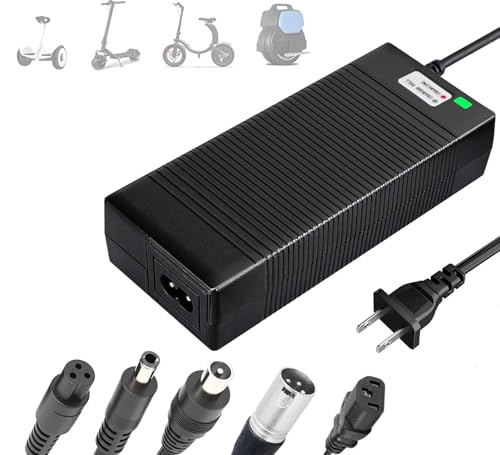
54.6V 5-in-1 Plugs Charger (48V) — Best certified all-rounder
This charger leads the 48V family on two credentials: its title states UL certification, and its five-in-one plug set covers the spread of charge ports found on the big scooter and bike names it lists — Razor, Jetson, Voyage, Gotrax, Ninebot and Segway among them, alongside Hiboy. Treat that brand list as a starting hypothesis rather than a promise, and treat the plug kit as the real product: five chances that one tip matches your battery’s port exactly, which is the difference between a spare charger that works and one that lives in a returns parcel.
As a second charger it makes obvious sense. The original stays at home, this one lives at the office or the in-laws’ garage, and the certification claim matters most in exactly those settings, where a charger runs in someone else’s building. The title does not state its charge current, so do not assume it is fast; plan around an overnight or a long workday until the unit’s own label tells you otherwise. What it sells is breadth and a safety credential, and for a household with more than one 48V machine wearing different ports, breadth may be the whole argument.
- Output: 54.6V, for 48V lithium-ion batteries only
- Plugs: five-in-one set, per the title
- Certification: UL certified, as stated in the listing title
- Charge current: the title does not give an amp figure, so check the charger’s own label on arrival before planning charge times
Strengths
- UL certification stated outright, rare in this category
- Five plug styles cover most 48V ports in one purchase
- Ideal spare for a second location or a mixed-brand household
Trade-offs
- Unspecified current means unknown charging speed
- Brand-fit list is a seller claim, not brand certification
- Loose tips in a kit are easy to misplace over time
Best for: a 48V bike or scooter needing a certified spare charger for a second location. Not suited for: any 36V battery, because its 54.6V output belongs to the 48V family only. Riders who value the certification can order this five-plug charger as their household’s universal 48V backup.

QKIIP 54.6V 2A Ebike Charger — Best plug coverage
Seven plug tips is the headline here, and the QKIIP’s title aims them at the heart of the mainstream 48V market: Lectric’s XP 2.0 and 3.0, Ecotric, Rad Power, Aventon, Ancheer, Jetson and Evercross. Two amps is the traditional ebike charge rate — the pace most original chargers use — which makes this unit a like-for-like replacement in speed terms for the large share of 48V batteries in the 10–15Ah range: roughly five to seven hours from empty, or a couple of hours to replace a normal commute’s worth of charge.
The seven-tip kit deserves a disciplined first session. Lay the tips out, test each against your charge port with the charger unplugged, and identify the one that seats fully without force. Mark it — a paint pen dot or a zip tie — and store the rest somewhere they will not migrate into a junk drawer, because the day a tip is needed for a second bike is the day it will be missing. From then on the QKIIP is unremarkable in the best way: plug in after the ride, see the indicator, unplug in the morning. Replacement charging should be boring, and a 2A kit charger that fits the big-name bikes is boring done right.
- Output: 54.6V at 2A, for 48V lithium-ion batteries
- Plugs: seven tips included, the widest coverage in this guide
- Named platforms in title: Lectric XP 2.0/3.0, Ecotric, Rad Power, Aventon, Ancheer, Jetson, Evercross — seller claims to verify against your port
- Certification: no certification is stated in the title
Strengths
- Seven tips maximise the chance of an exact port match
- 2A matches the original-charger pace most bikes ship with
- Title names the highest-volume 48V platforms directly
Trade-offs
- 2A is not fast on a large 20Ah battery
- No certification claim appears in the title
- Tip abundance invites using a near-fit instead of the right fit
Best for: owners of mainstream 48V bikes from the brands its title names, replacing a lost original charger. Not suited for: a 36V bike, or a rider needing a sub-three-hour turnaround on a big battery. If your port is an unknown, the QKIIP’s seven chances make it the practical order.

54.6V 3A Ebike Charger (UL) — Best safety feature set
This 3A charger reads like it was specified by someone who has thought about garages. The title stacks UL certification, auto shut-off, temperature control and a V0 fireproof casing — V0 being a flammability rating for the plastic housing — on top of a 54.6V output for 48V batteries, with Lectric, TST and Heybike named among its fits and four connector styles in the box: DC, XLR, Junlei and aviation barrel. Three amps trims roughly a third off the 2A charging time for a typical battery, which turns an overnight charge into an evening one for commuters who ride twice a day.
Auto shut-off and temperature control are the features to weigh if your charging happens unattended — and most ebike charging does, whatever the manuals advise. A charger that ends the session itself and watches its own temperature is simply better matched to real behaviour than one relying on the rider remembering a timer. The fireproof-rated casing is the last line of that same argument: housings do not prevent faults, but a casing that resists burning changes what a fault can become. None of this makes the charger magic, and the fit list remains a seller claim to verify against your port, but as a package of stated safety features nothing else in this guide comes close.
- Output: 54.6V at 3A, for 48V lithium batteries
- Connectors: DC, XLR, Junlei and aviation barrel styles named in the title
- Safety set: UL certified, auto shut-off, temperature control, V0 fireproof casing — all per the title
- Named fits: Lectric, TST and Heybike models, to be verified against your actual port
Strengths
- Most complete stated safety package in this guide
- 3A pace suits twice-a-day commuters
- Four connector styles cover the common 48V ports
Trade-offs
- Still slower than the 4A XLR pick for compatible bikes
- Junlei and aviation tips help only the minority with those ports
- Safety features do not excuse a damaged battery or cable
Best for: a 48V commuter bike charged indoors or in a garage, where the shut-off and temperature features match real unattended use. Not suited for: a 36V battery under any circumstances, or a bike whose port matches none of its four tips. For safety-led buyers, this is the charger to order first.

YZPOWER 54.6V 4A Ebike Charger XLR — Fastest 48V charge
YZPOWER is an established name in replacement chargers, and this unit is the specialist of the group: 54.6V at 4A through a single fixed 3-pin XLR connector, fan cooled, with a red/green indicator to report charge state. Four amps is double the traditional rate, cutting a typical 14Ah battery’s full charge to roughly three and a half hours of bulk charging, and the fan exists because pushing that current generates heat a sealed brick cannot shed quietly. The trade is noise and commitment — you will hear it working, and it only fits bikes whose charge port is that XLR socket.
XLR is a genuinely good connector for this job, which is why so many 48V bikes and scooters use it: the pins are shrouded, the plug latches, and it cannot be inserted half-way by accident. If your bike has one, this charger is the fastest legitimate route in the guide, provided your battery’s documentation tolerates a 4A charge rate — most mid-size and large packs do, but small or elderly batteries deserve a check of the manual first, because charge rate limits live in the battery, not in the charger. Delivery riders and anyone whose bike earns money by the hour will understand the value of the saved hours immediately; a leisure rider with all night to charge gains less.
- Output: 54.6V at 4A, for 48V lithium batteries
- Connector: fixed 3-pin XLR only
- Cooling: fan cooled, per the title — expect audible fan noise
- Feedback: red/green charge indicator
Strengths
- Fastest charging here for XLR-port 48V bikes
- XLR connector is secure, latched and shrouded
- Simple two-colour indicator is readable across a garage
Trade-offs
- One connector only; useless if your port is a barrel
- Fan noise rules out bedroom charging for light sleepers
- 4A may exceed the stated charge limit of small batteries
Best for: an XLR-port 48V bike ridden daily or commercially, where hours saved per charge compound. Not suited for: barrel-port bikes, or small 48V packs whose manuals cap charging below 4A. If your port is XLR and your schedule is tight, order the YZPOWER and take the time back.
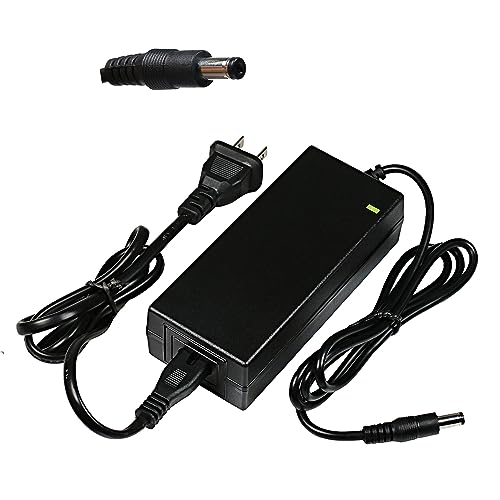
Jucuwe 42V 2A Charger (36V) — Best simple 36V spare
Crossing into the 36V family, the Jucuwe is deliberately plain: a 42V 2A power adapter with a DC male connector of 5.5mm diameter, offered for 36V electric bike and scooter lithium batteries, with the title noting both 2.1mm and 2.5mm centre-pin variants. That pin detail is the whole purchase. A 5.5 by 2.1 plug and a 5.5 by 2.5 plug look identical across a room and behave differently in the socket — one seats and charges, the other wobbles or refuses — so confirm which variant your battery takes before ordering, using the original charger’s plug as the reference if you still have it.
At 2A this is a like-for-like spare for the enormous fleet of 36V machines: folding bikes, kick scooters grown into commuters, and older ebikes from the years when 36V was the default. A typical 10Ah 36V battery refills in about five hours, matching the rhythm of the original adapter it replaces. There are no displays, no plug kits and no certification claims in the title to analyse, and that plainness is the point — this is the inexpensive, correct-voltage spare that lives in a desk drawer at work so a forgotten home charger never strands the ride home.
- Output: 42V at 2A, for 36V lithium batteries only
- Connector: DC male, 5.5mm outer diameter, with 2.1mm/2.5mm pin variants noted in the title
- Role per title: electric bike and escooter battery charging
- Extras: none claimed in the title — no display, no multi-plug kit, no certification statement
Strengths
- Correct, honest 42V specification for 36V machines
- Pin variants acknowledged in the title itself
- Simple enough to keep as a permanent second-location spare
Trade-offs
- Wrong pin variant means no fit at all
- No certification or protection features are stated
- Barrel-only: no help for XLR-port 36V bikes
Best for: a 36V bike or scooter with a 5.5mm DC charge port needing a spare adapter. Not suited for: any 48V battery, which this 42V unit can never fully charge. Measure your pin, then order the Jucuwe variant that matches it.

42V 2A Smart Display Charger (36V) — Best 36V with display
The second 36V pick adds the two things the Jucuwe leaves out: a five-in-one plug set for port uncertainty, and a smart display that reports charging status, alongside stated overcharge protection and fast-charging wording in its title. The display is more useful than it sounds on a scooter or folding bike, because those machines often hide their battery gauge or lack one entirely; a charger that shows you the session’s progress answers the “is it even charging?” question that a bare LED leaves open, especially when a borrowed plug tip is involved and confidence is low.
Its title claims compatibility with multiple models across 36V electric scooters and ebikes, and the five-plug kit is the mechanism that makes such breadth plausible. Work through the tips methodically on day one, mark the winner, and the charger settles into ordinary service at 2A — the standard rate for this class, refilling a typical 36V pack overnight or across a workday. The overcharge protection claim is welcome in a category where chargers run unattended in hallways, though it supplements rather than replaces the battery’s own management system, which remains the primary guardian of the pack.
- Output: 42V at 2A, for 36V lithium scooter and ebike batteries
- Plugs: five-in-one universal set, per the title
- Feedback: smart display showing charge status
- Protection: overcharge protection stated in the title
Strengths
- Display removes guesswork about whether charging is happening
- Five plugs solve the 36V port lottery in one box
- Stated overcharge protection suits hallway charging
Trade-offs
- 2A pace is standard, not quick, on larger 36V packs
- Display is one more component that can fail over years
- Multi-model compatibility remains a seller claim to verify
Best for: a 36V scooter or folding bike whose port shape you are unsure of, charged where you can glance at a display. Not suited for: a 48V battery, which needs 54.6V hardware from the family above. Buyers who like visible confirmation will find this display-equipped 42V charger the reassuring order.
What Do Certifications and Casing Ratings Actually Tell You?
Two titles in this guide state UL certification, and it is worth understanding what that claim buys. A certified charger has been tested by an independent laboratory against a safety standard covering electric shock, fire risk and abnormal operation — a fuse that should blow, does; a fault that should shut the unit down, does. Certification does not make a charger immortal or its output cleaner; it means its failure behaviour has been examined by someone other than its maker. In a category crowded with anonymous bricks, that examination is the strongest single trust signal a listing can offer, which is why the certified picks are flagged wherever they appear here.
The V0 casing on the 3A pick speaks a different dialect of the same language. Flammability ratings describe how a plastic behaves when exposed to flame; a V0-rated housing is designed to stop burning quickly once the ignition source is removed. Housings are the last line of defence, not the first — the protections that matter daily are the electronic ones, like the same pick’s temperature control and auto shut-off, and the battery’s own management system behind them. Read safety features as layers: certification examines the whole, electronics manage the session, the casing limits the worst day. A charger with all three layers stated is making an argument; a charger with none stated is asking you to supply the trust yourself, and you should price that ask accordingly.
One more label deserves literacy: the output line printed on every charger brick. It states output voltage and maximum current in plain figures, and it overrules every marketing sentence in the listing. When a charger arrives, read that label before the first use and compare it against what you ordered. Mistakes in fulfilment happen; the label is where they confess.
How Should You Care for a Charger So It Lasts as Long as the Bike?
Chargers die of cable fatigue more often than electronic failure. The wire flexes at the two strain points — where it leaves the brick and where it meets the plug — and years of coiling tightly around the brick for storage work those points like a paperclip. Coil loosely, never wrap under tension, and carry a travelling charger in a padded pocket rather than letting it rattle against tools in a pannier. When unplugging, pull the plug body, not the cable; the habit takes a week to build and doubles cable life.
Heat is the second enemy, and mostly a placement problem. A charger under a blanket, inside a closed pannier or on a carpet is a charger cooking in its own waste heat. Give it air on all sides, especially the fan-cooled YZPOWER, whose vents are its lungs. Dust in those vents can be blown out occasionally; a charger that runs hotter each season is often just a charger that can no longer breathe. Keep bricks dry, too — a garage charger that gets splashed every time the car is washed will eventually object, and a simple shelf above splash height prevents the whole category of problem.
Finally, retire chargers honestly. A brick with a cracked case, a cable with visible conductors, an intermittent indicator or a plug that runs hot at the pins has finished its service, whatever it cost. Batteries are expensive and fires are worse; a charger is the cheapest component in the system, and replacing a suspect one is the easiest safety decision in ebike ownership.
Is It the Charger or the Battery? A Short Diagnostic Routine
When a bike stops charging, riders tend to blame whichever component they like less. A few ordered checks separate the suspects. First, the wall: plug something else into the outlet. Second, the charger alone: most of these units show a standby indication when powered — a lit indicator or, on the display-equipped 42V pick, a live screen — before any battery is connected. A charger that shows nothing at the wall has confessed. Third, the connection: reseat the plug fully, and inspect the port for bent pins, debris or the green tint of corrosion, which a dry cloth and a wooden toothpick address better than any metal tool.
If the charger wakes but charging never starts, suspicion moves to the battery’s management system, which may have disconnected after a deep discharge, a short or a fault it detected. Some packs recover after resting; some need the maker’s service. Resist the folklore remedies — jump-starting a lithium pack from another battery concentrates every risk this guide has warned about into one gesture. If charging starts but ends implausibly fast, think connections again: a high-resistance plug or damaged cable makes the charger see full voltage early. And if the battery charges on a friend’s known-good charger of the correct voltage, your charger has been identified by elimination, the most reliable diagnostic instrument in the whole routine.
Write down what you find. Intermittent faults love amnesia, and a note that says “stopped at half charge twice, both times with the office charger” is worth more than a month of guessing when you finally talk to a shop.
How Does a Spare Charger Change the Way You Use the Bike?
The underrated purchase in this guide is not the fastest charger but the second one. A spare at the workplace converts range anxiety into arithmetic: the commute that uses sixty percent of the battery becomes sustainable daily because the battery returns to full during the workday, on a gentle 2A unit that asks nothing of anyone. A spare at a partner’s flat, a parent’s house or a holiday cabin quietly extends the bike’s territory without a single component upgrade. Several picks here — the multi-plug kits especially — are priced and built exactly for that distributed life.
There is a discipline to spares, though: label each charger with its voltage in large characters, because a household that accumulates a 42V and a 54.6V brick in identical black plastic has manufactured its own hazard. A strip of tape and a marker on day one is the entire solution. Keep each spare with its correct tip fitted if it is a kit charger, so the borrowed-charger scramble never begins with a handful of loose barrels and a guess.
Putting the Six Ebike Chargers Next to Each Other
| Charger | Output | For battery | Connector strategy | Stated safety notes |
|---|---|---|---|---|
| 54.6V 5-in-1 Plugs Charger | 54.6V, current not stated | 48V | Five-plug kit | UL certified per title |
| QKIIP 54.6V 2A | 54.6V, 2A | 48V | Seven tips | None stated in title |
| 54.6V 3A Charger (UL) | 54.6V, 3A | 48V | DC, XLR, Junlei, aviation | UL, auto shut-off, temperature control, V0 casing |
| YZPOWER 54.6V 4A XLR | 54.6V, 4A | 48V | Fixed 3-pin XLR | Fan cooled, red/green indicator |
| Jucuwe 42V 2A | 42V, 2A | 36V | Fixed 5.5mm DC male | None stated in title |
| 42V 2A Smart Display | 42V, 2A | 36V | Five-plug kit | Overcharge protection, smart display |
The table’s middle column is the one that can hurt a battery if ignored, so read the list as two separate shortlists sharing a page: four candidates if your label says 48V, two if it says 36V, and no legitimate way to shop across that line.
How Do You Verify a Replacement Charger Before the First Charge?
Begin with the battery removed from the bike if it removes, or the bike switched off if it does not. Read the battery label and write down three things: nominal voltage, capacity in amp-hours or watt-hours, and any stated charge-current limit. Then examine the charge port — not the discharge connector, which is a different socket entirely — and identify its shape: round barrel, XLR, or something proprietary. Photograph it beside a ruler. Only now open the charger’s box, and compare the charger’s output label against your notes: the output voltage must be 54.6V for a 48V battery or 42V for a 36V battery, exactly, not approximately.
Fit the plug with the charger unplugged from the wall. The correct connector seats fully with modest pressure and does not rock; a tip that enters but wobbles is the wrong tip, however hopeful it feels. With the right tip confirmed, connect battery first, wall second, and stay for the first minutes: the indicator should show charging, the charger should warm gently rather than hot, and there should be no smell, buzz or flicker. Check again at half an hour. A first charge watched this carefully teaches you the unit’s normal behaviour, which is the reference every later session gets compared against.
Charge on a hard, non-flammable surface with air around the charger, away from bedding, paper and solvents, and never cover a fan-cooled unit like the YZPOWER. If the battery itself is damaged — swollen, cracked, hissing, or freshly crashed — no charger in this guide is the answer; quarantine the pack and talk to the bike maker or a battery specialist instead.
How Long Should a Charge Take, and Can You Speed It Up?
Divide the battery’s amp-hours by the charger’s amps for a first estimate, then add a margin for the tapering finish, when current falls away as the pack nears full. A 14Ah 48V battery therefore takes about seven hours at 2A, under five at 3A, and around three and a half at 4A, while a 10Ah 36V battery at 2A needs roughly five hours. Partial charges scale down in proportion: replacing the half you used on a commute takes about half the full-charge time, and lithium-ion packs are perfectly content with partial charging — there is no memory effect to fight and no need to run the battery flat to “condition” it.
Watt-hours give the same picture from the energy side, and many batteries print them when amp-hours are absent. Divide watt-hours by the battery’s nominal voltage to recover amp-hours — a 672Wh pack at 48V is a 14Ah battery — and the same division by charger amps estimates your hours. Riders comparing bikes will find watt-hours the fairer range currency anyway, since a 10Ah battery at 48V stores a third more energy than a 10Ah battery at 36V, a difference the amp-hour figure alone hides. Whichever unit your label offers, do the small arithmetic once, write the expected full-charge time on the same tape label that marks the charger’s voltage, and every future session can be judged against a number instead of a feeling.
The honest ways to charge faster are a higher-amp charger your battery’s documentation permits, and nothing else. There is no technique, cable trick or setting that makes a 2A charger behave like a 4A one. What you can do is charge more conveniently: a second charger at the destination, as several picks here suit, converts dead time at work into range. And for battery longevity, the riders who keep packs for years tend to share habits — avoid leaving the battery at completely full or completely empty for weeks, store it part-charged in a cool place, and let a hot battery from a hard ride cool down before plugging in.
What Mistakes Do Riders Make With Replacement Chargers?
Voltage confusion heads the list, and it usually arrives disguised as a bargain: a 42V charger bought for a 48V bike because the plug looked right, or a 54.6V unit inherited from a bigger bike and tried on a 36V scooter “just to see”. The second mistake is trusting a compatibility list over a physical port check — brands revise ports between model years, and a title written for last year’s Lectric may describe a socket this year’s bike does not have. Third comes force: a barrel that almost fits, pushed harder. Ports bend, pins snap, and a five-minute impatience becomes a battery repair.
Riders also mishandle the good days. Leaving a charger connected for a week because the bike is parked “on charge” ages a full battery for no benefit; charging a pack that is still hot from a summer climb, or frozen from a winter shed, stresses cells that a half-hour of patience would have spared. And the quietest mistake is losing track of which tip in a multi-plug kit was the right one, then using the near-fit next time. Mark the winner, as the QKIIP review urged, and the kit stays an asset instead of becoming a drawer of tempting errors.
How Do Charging Habits Shape a Battery’s Lifespan Over Years?
An ebike battery is a consumable on a long fuse: hundreds of charge cycles spread over years, with capacity fading gradually rather than failing at once. Charging habits nudge that fade rate in both directions. The gentlest pattern for lithium-ion cells is also the most convenient one — charge after rides, in partial top-ups as needed, and avoid parking the battery at the extremes. A pack left at one hundred percent on a connected charger for a month of holiday ages faster than one stored at half charge in a cool cupboard, and a pack repeatedly run to automatic cutoff and left empty suffers at the other extreme. None of this demands obsession; it asks only that long storage happen at partial charge and that daily charging stay as unthinking as it already is.
Temperature writes the second chapter. Cells dislike being charged when they are cold-soaked from a winter shed or heat-soaked from a summer ride, and the management systems in better packs may refuse or limit charging until temperatures moderate. The rider’s part is simple patience: bring the battery indoors for a while before charging in deep winter, and let a hard-ridden pack rest after a hot climb. Chargers contribute their share by living in temperate spots themselves; the brick in the uninsulated metal shed experiences the same seasons as the bike.
Depth of discharge is the third variable, and mostly a planning matter. A battery sized so that daily riding uses its middle — rather than its last gasp — will outlast a smaller pack drained to cutoff every day, even at identical mileage. That is an argument made at bike-purchase time, but the charger participates too: a rider with a destination spare charger effectively halves the depth of each discharge, which is one more reason the humble second charger may extend battery life more than any premium feature on a single unit. Treat the pack kindly in these three dimensions and it will still be delivering useful range when the bike around it needs its second set of brake pads, chain and tyres.
What Changes When You Charge in Winter or Travel With a Charger?
Winter compresses every margin. The battery delivers less, the ride uses more, and charging itself wants a warmer room than the shed provides. Riders in cold climates learn to keep the battery indoors between rides — most packs remove in seconds — and to charge it there, where both the cells and the charger work in human temperatures. A battery brought in from a freezing ride should sit until the chill leaves its case before the charger connects; condensation and cold cells are both poor companions for a charging session.
Travel rearranges the kit rather than the rules. A charger in luggage should travel with its cable loosely coiled and its plug protected, and multi-plug kit owners should pack only the correct tip, fitted, plus perhaps one spare — the full tip collection invites the wrong-fit experiment in a hotel room far from help. Voltage families do not change with geography, but mains plugs do; a travel adapter for the wall side is a separate purchase from anything in this guide, and the charger’s input label will state the mains voltages it accepts. Check that label before a trip rather than at a foreign outlet, and the bike’s charging routine survives the journey intact.
When Is the Original Manufacturer’s Charger the Right Answer Instead?
Sometimes it is, and this guide loses nothing by saying so. If your bike is under warranty and its maker conditions coverage on using their charger, the original is the rational purchase regardless of price. If your battery uses a proprietary port with a communication handshake — some systems have the charger and battery exchange data, and a dumb replacement cannot speak the language — only the original will work at all. And if your pack is a high-capacity or unusual-voltage system outside the 36V and 48V families covered here, the original, or a charger the maker names, is the honest route.
The replacement chargers in this guide earn their place in the wide middle ground: out-of-warranty bikes, second-location spares, lost originals for common 36V and 48V systems with standard ports. That middle ground is enormous — it is most of the ebikes on the road — and serving it well means being precise about its borders, which is why the verification routine matters more than any single pick. A rider who has read the battery label, identified the port and chosen a certified or feature-led replacement has not cut a corner; they have done the engineering homework the category demands, and the homework, once done, stays done for every future charger the bike ever needs.
Final Recommendation
Decide your voltage family from the battery label, then shop inside it. In the 48V family, the 3A UL-certified charger is the easiest recommendation for most riders — a real safety feature set and a usefully quicker pace — while the YZPOWER owns the XLR-port niche where speed matters, and the QKIIP or the five-plug certified charger solve port uncertainty with kits. In the 36V family, choose the display-equipped five-plug unit when your port is a mystery, and the plain Jucuwe when you already know your 5.5mm pin size and simply need a faithful spare. Whichever you order, spend the first charge nearby and attentive; a replacement charger that has proven itself once, on your battery, with your eyes on it, becomes boring equipment — and boring is exactly what battery charging should be.
Frequently Asked Questions
Can I use a 54.6V charger on a 36V battery if I watch it?
No. Watching does not change the voltage mismatch: a 54.6V charger is built for thirteen cells in series, and a 36V battery has ten. The pack’s protection system might intervene, but relying on a safety cutoff as a charging strategy risks the battery and voids any sympathy from its maker. Use a 42V charger.
My original charger is lost. How do I know my battery’s voltage?
Read the battery’s own label — nominal voltage is printed there, often alongside capacity. If the label is gone, the bike’s manual or the maker’s specification page for your model year will state it. Do not guess from the motor’s wattage, which describes the motor, not the battery.
Are third-party chargers as safe as the original?
They vary, which is why this guide flags stated certifications: two picks claim UL certification in their titles, and one adds auto shut-off, temperature control and a fireproof-rated casing. An original charger remains the reference standard, but a certified replacement, verified against your battery and watched on its first charge, is a reasonable and common choice.
Why does my new charger get warm and hum?
Warmth is normal — converting wall power to battery power wastes some energy as heat, and higher-amp units like the fan-cooled 4A YZPOWER move that heat with a fan you can hear. Hot to the touch, a burning smell, or a loud buzz is not normal; unplug and investigate rather than letting the session continue.
Can I leave the battery plugged in overnight?
Millions of riders do, and chargers with auto shut-off are built for it, but the conservative pattern is to unplug when the indicator shows full rather than leaving the pack connected for days. Charge where a problem would be noticed, on a hard surface, and never on a bed or sofa.
Will a higher-amp charger damage my battery?
Only if it exceeds the charge rate your battery’s documentation allows. Many 48V packs accept 3A or 4A happily, while some small or older packs specify 2A. The limit belongs to the battery, so check its label or manual before choosing the faster picks. If the documentation is silent and the battery is small — under about 10Ah — the cautious reading is to stay with a 2A charger, whose pace the pack was almost certainly designed around, rather than discovering the limit experimentally with a battery you cannot afford to replace.
Can one charger serve two bikes from different brands?
Only if both batteries share the same nominal voltage and the charger’s plug — or one tip from its kit — matches each port exactly. That combination is common among mainstream 48V bikes, which is what the multi-plug picks are built for. The moment the second bike is a 36V model, the answer becomes no, and the household needs one charger per family.
My charger shows full after twenty minutes. What is wrong?
Usually the connection, occasionally the battery. A plug that is not fully seated, a corroded port or a damaged cable can make the charger see full voltage almost immediately. Reseat everything, inspect the port, and try again while watching the first minutes; if the behaviour repeats on a known-good charger of the correct voltage, the battery itself needs professional attention.
The charge port got wet on a rainy ride. When is it safe to plug in?
Not yet is the only safe answer while any moisture remains visible. Park the bike somewhere dry and ventilated, leave the port cover open if it has one, and let the socket air-dry completely; a gentle wipe with a dry cloth removes surface water, but do not blow into the port with compressed air, which can drive droplets deeper onto the contacts, and do not apply a hairdryer on a hot setting near a lithium pack. Inspect the pins once dry for green or white corrosion spots, because a port that got wet once and was charged anyway often corrodes quietly over the following weeks and then presents as an intermittent connection. On the first charge after drying, stay nearby for the opening minutes and feel the plug body: warmth spreading into the connector itself, rather than the charger brick, means resistance at the contact and a session to stop. Riders who commute through wet months can prevent most of this by drying the port area as a habit on arrival, before the bike is parked and forgotten. A port dried properly once will usually charge normally for years afterwards, without any lasting effect on the battery or its seals at all.
Related Guides
Keep the voltage families straight across all your charging gear: phone bricks live in Best Chargers for Google Pixel Phones, the wireless desk side is covered by Best Multi-Device Wireless Chargers for iPhone, and small-cell charging gets the same careful treatment in Best Rechargeable CR123A Batteries and Chargers.
Related guides
- Best 4K Monitors for MacBook Pro: USB-C Panels With Real Power Delivery
- Best Routers for Remote Work: VPN Gateways, Travel Routers and Home Wi-Fi That Holds a Call
- Best Acer Laptops for School: Six Picks for Pupils, Backpacks and Homework
- Best 32GB Memory SD Cards for Older Cameras and Everyday Devices


