What's inside
- Key Takeaways
- Quick Picks
- How Did We Choose These Chargers for Snowmobile Duty?
- Why Does Storage Kill More Snowmobile Batteries Than Winter Does?
- What Is the Difference Between Charging and Maintaining?
- How Does Deep Cold Change Charging When Winter Arrives?
- Should Each Machine Have Its Own Maintainer?
- What Safety Features Matter on a Charger That Stays Connected for Months?
- Which Maintainers Deserve a Closer Look?
- The Six Maintainers, Lined Up Head to Head
- How Should You Put a Snowmobile Into Storage So It Starts in Winter?
- What Should You Check Before the First Ride of the Season?
- When Is It Time to Replace the Battery Rather Than Maintain It?
- What Are the Most Common Mistakes With Snowmobile Batteries?
- How Do Rental Fleets and Cabins Handle Batteries Differently?
- Final Recommendation
- Frequently Asked Questions
- Related Guides
As an Amazon Associate I earn from qualifying purchases. This post may contain affiliate links at no extra cost to you.
**[widgetverdict.com] is reader-supported. When you buy through links on our site, we may earn an affiliate commission.**
Here is the honest premise of this guide, stated before any product is named: nobody makes a charger exclusively for snowmobiles. The best battery chargers snowmobiles can use are the 12V powersports maintainer chargers shared with ATVs, motorcycles and lawn equipment, because a snowmobile battery is a small powersports battery and its needs in storage are identical to theirs. Anyone who tells you a sled needs a snowmobile-specific charger is selling you a label. What a sled does need — more than most vehicles — is a maintainer, because no common vehicle sits unused for as many consecutive months, and a small battery left alone from April to November will discharge, sulphate and quietly die before the first snowfall.
All six picks are sold through Amazon marketplace listings and all six are automatic maintainer-style chargers rather than workshop fast chargers. That is deliberate. The snowmobile charging problem is not speed; it is the long, cold storage season and the first start of winter. Four picks come from Battery Tender, the brand that effectively defined this category, because its powersports line is where the catalogue genuinely concentrates; a Unocho smart charger and a MOTOPOWER maintainer round out the six at the budget end. Chemistry handling — sealed lead-acid, AGM, gel, and on some models lithium — is stated per pick from the listing titles, because the newest sleds increasingly arrive with lithium batteries that older maintainers cannot serve safely.
Key Takeaways
- There is no snowmobile-only charger category; these are shared 12V powersports maintainers, and this guide says so rather than pretending otherwise.
- The maintainer’s job is the off-season: holding a small battery at full charge for months so the sled starts on the first cold morning.
- Four picks are Battery Tender models at 1.25A, 800mA, 3A and 4A — the two smaller ones are storage maintainers, the two larger ones also recover a flat battery in reasonable time.
- Lithium-equipped sleds must use a charger whose title states lithium support: the Battery Tender Junior 800mA, the 3 Amp and the 4A models do; the Unocho and MOTOPOWER titles describe lead-acid families only.
- Selectable 6V/12V models suit households that also keep older equipment, lawn tractors or a classic bike on the same shelf.
- Reverse-polarity protection and automatic float behaviour are the safety features that matter when a charger stays connected for months at a time.
Quick Picks
| Pick | Badge | Why it earns its place |
|---|---|---|
| Battery Tender Plus 1.25A (Selectable) | Classic Powersports Maintainer | The selectable 6V/12V original, titled for powersports, ATVs, motorcycles and snowmobiles by name. |
| Battery Tender Junior 800mA (Lithium) | Lithium-Switchable Pick | Switchable between lead acid and lithium in a compact 800mA storage maintainer. |
| Battery Tender 3 Amp Charger | Faster Recovery Charger | 3A with 12V/6V switching and lead acid, AGM, gel and lithium support for sleds that also need reviving. |
| Battery Tender 4A | Highest Output Pick | The strongest output here, for households maintaining a sled alongside cars, SUVs and trucks. |
| Unocho 1.5A Smart Charger | Budget Smart Maintainer | 6V/12V automatic trickle and float charging across the lead-acid family, snowmobiles named in its title. |
| MOTOPOWER MP00205A Battery Maintainer | Compact Desulfator Pick | An 800mA automatic maintainer and trickle charger with a desulfator function for stored batteries. |
How Did We Choose These Chargers for Snowmobile Duty?
The first filter was the job description itself: automatic maintainer behaviour. A charger for snowmobile storage must charge a small 12V battery to full, then hold it there — floating or monitoring and topping up — for months without cooking it. Manual chargers and simple trickle units that push current indefinitely were excluded, because a charger that needs supervision is the wrong tool for a machine nobody looks at between spring and autumn.
The second filter was size honesty. Snowmobile batteries are small, typically in the range used across powersports, so maintainer currents of 800mA to 1.5A are correctly matched to storage duty; the 3A and 4A models earned their places for the second job — recovering a battery that was found flat — and for households whose charger also serves cars and trucks. We did not include high-output workshop chargers, because their bulk-charge pace buys a sled nothing and their fans, clamps and size argue against leaving them connected in a corner all summer.
Chemistry coverage was the third filter, and it split the field. Titles that state lithium support matter because lithium batteries are appearing in newer sleds and in lightweight aftermarket replacements, and a lead-acid-only maintainer connected to a lithium battery is a genuine mismatch, not a technicality. Each pick below is labelled with exactly the chemistries its title claims, no more.
Finally, we kept the two budget maintainers — the Unocho and the MOTOPOWER — because many sleds live at cabins, in rental fleets or as the second machine, and their owners reasonably want a dedicated maintainer per battery rather than one premium unit rotated between machines. Their titles are more modest in their chemistry claims, and the sections below hold them to those claims.
Why Does Storage Kill More Snowmobile Batteries Than Winter Does?
A battery discharges itself slowly even with nothing connected, and a snowmobile’s small battery has little reserve to spare. Across a seven-month off-season, self-discharge alone can pull a stored battery deep into the zone where sulphation — hard crystals forming on the lead plates — begins to permanently eat its capacity. Add a parasitic draw from a clock, an ECU memory or a tracker, and the battery can reach the bottom well before autumn. Cold storage slows the chemistry but does not stop it, and a discharged battery is also the one vulnerable to freezing damage in deep cold, because discharged electrolyte is mostly water.
The cruel arithmetic is that the damage is silent and cumulative. The sled starts in November, a little more reluctantly; it starts in December; by the second season the battery that “was fine last year” fails at the trailhead, twenty miles from the trailer, in the cold that exposes every weakness. Owners blame the cold, but the cold is only the examiner — the studying was skipped all summer. A maintainer connected through storage holds the battery at full charge, where self-discharge is continuously replaced and sulphation never gets its foothold, and it does so for less electricity than a night light uses.
This is also why the maintainer question should be settled in spring, at the moment the sled is parked, rather than in autumn when the battery is already diminished. A maintainer cannot resurrect a battery that sulphated all summer; it can only protect the one that enters storage healthy. The routine this guide recommends is unglamorous: charge fully at season’s end, connect the maintainer, and let the machine wait for snow in the only condition that guarantees a start — full.
What Is the Difference Between Charging and Maintaining?
Charging is the act of refilling; maintaining is the act of keeping full. A charger sized for refilling works at amps; a maintainer, once the battery is full, works at the trickle of current that exactly offsets self-discharge, or it watches the voltage and wakes to top up when needed. The six picks here all present themselves as charger-maintainers — they do both jobs in sequence, automatically — and that combination is what “connect and forget until winter” actually requires.
The distinction matters when shopping beyond this guide, because the cheapest units in the wider category are sometimes plain trickle chargers: they push a small current forever, with no float regulation and no shut-off intelligence. Left on a small sled battery for seven months, an unregulated trickle can overcharge, dry out a sealed battery and shorten the life it was bought to extend. Every pick below describes itself as automatic, smart or float-equipped in its title, and that vocabulary — not the price — is the line between a maintainer and a liability.
Owners of other stored machines will recognise the same pattern across the garage. The discipline that keeps a sled battery alive is the discipline that keeps any stored battery alive, and readers who also manage mobility equipment batteries will find the chemistry-matching half of the lesson in our guide to the Best Wheelchair Battery Chargers, where matching the charger profile to the pack matters even more.
How Does Deep Cold Change Charging When Winter Arrives?
A battery that spent the summer maintained meets winter in the only condition that gives it a chance, but cold still taxes the system. Chemical reactions slow as temperature falls, so a battery at twenty below delivers its cranking power reluctantly and accepts charge slowly too. This is why the first-start routine matters: a sled that has been on a maintainer starts on its stored charge, and no charger needs to perform heroics in the cold. Owners who find a battery flat in deep winter should bring it indoors to warm before charging rather than forcing current into a frozen battery — a discharged battery can freeze solid, and charging a frozen battery is both futile and unsafe.
Charging location deserves a thought in cold climates. A maintainer working in an unheated shed at the bottom of its temperature range will do its holding job adequately, because holding takes so little current, but recovery charging is better done in a space above freezing where the battery’s chemistry cooperates. The practical pattern for northern owners is therefore: maintain in place all summer, recover indoors if recovery is ever needed, and return the battery to the sled fully charged rather than asking the sled’s own system to finish the job on the first ride.
Cold also exposes marginal connections. A terminal that conducted adequately in July can fail in January as metal contracts and corrosion insulates; the monthly maintainer glance recommended elsewhere in this guide should include a terminal check in autumn, cleaning and tightening before the season rather than at the first failed start. None of this requires expertise — it requires only that the battery be treated as part of the machine’s preseason service rather than as an afterthought with cables.
Should Each Machine Have Its Own Maintainer?
For households with several stored machines, the one-maintainer-per-battery answer is usually the right one, and the budget picks in this guide exist partly to make it affordable. A single premium maintainer rotated weekly between a sled, an ATV and a mower protects each battery only during its connected week and leaves the others discharging in between; the rotation always slips during busy months, and the battery that slips longest is the one that fails. Dedicated maintainers remove the schedule entirely — every battery, all season, continuously held — which is the condition the whole strategy depends on.
The exception is the mixed-fleet household whose charger doubles as the recovery tool. There, one higher-output automatic unit like the 3A or 4A Battery Tender serves as the garage’s working charger, while inexpensive dedicated maintainers hold each stored battery day to day. That pairing — muscle in the middle, patience at the edges — is how larger collections are actually managed, and it is cheaper than it sounds because the holding units are the simplest in this guide.
Whatever the arrangement, label each maintainer with the machine and chemistry it serves. A switchable unit moved between a lithium sled and a lead-acid ATV without its setting being changed recreates the mismatch problem in its purest form, and a strip of tape on the casing is the entire prevention.
What Safety Features Matter on a Charger That Stays Connected for Months?
Duration changes the safety calculation. A charger used for an afternoon is supervised by its owner’s presence; a maintainer connected from April to November is supervised by nobody, so its protections must be automatic. The features that matter are the ones that forgive mistakes and contain faults: protection against reversed connections, because a hurried autumn hook-up can swap the leads; regulation that stops pushing current into a full battery, because months of overcharge will dry out and ruin a sealed battery; and a design that fails safe — shutting down rather than forcing charge — if the battery develops an internal fault.
Owners should verify these features on the full listing of whichever pick they choose, because the titles in this guide state the headline behaviour — automatic, smart, float, switchable — rather than enumerating every protection. The monthly glance recommended in this guide is the human half of the system: a maintainer whose indicator looks wrong, a case running hot, a battery case swelling or a smell of hot electrics near the setup are all instructions to disconnect first and investigate second. A maintainer is a trust-extending device, and like all such devices it works best inside a routine that checks on it occasionally.
Placement completes the picture: the charger on a shelf or a board rather than on a concrete floor that can flood, its vents unobstructed by the covers and clutter of a storage corner, and its mains lead routed where it will not be pinched by the sled’s own movement on and off a stand. Set up that way, a maintainer asks for minutes of attention across an entire off-season.
Which Maintainers Deserve a Closer Look?
Six chargers, ordered from the classic storage maintainers toward the higher-output units and the budget pair. Chemistry labels are taken word for word from each title — where a title does not claim lithium, the pick is treated as lead-acid-only throughout.

Battery Tender Plus 1.25A (Selectable) — Classic Powersports Maintainer
The Battery Tender Plus is the reference design of this category, and this selectable version is the one whose title speaks directly to sled owners: a 12V, 1.25A charger and maintainer, fully selectable between 6V and 12V, described for powersports ATVs, motorcycles, snowmobiles and more, under the model code 022-0211-DL-WH. That naming matters because it removes the translation step — this is not a car charger being stretched to sled duty, but the powersports unit itself.
At 1.25A, the pace is storage pace: overnight to refill a small sled battery from a working discharge, then an automatic hold at full charge for as long as it stays connected. The 6V selection is the feature that widens its household — vintage bikes, older lawn equipment and classic machinery with 6V systems share the shelf in many garages, and one selectable maintainer covers them all across their staggered storage seasons.
The title does not claim lithium support for this model, and that silence should be respected: sleds on lead-acid, AGM or gel batteries are its territory. Owners whose sled carries a lithium battery should move to the Junior below or the 3A and 4A models, whose titles state lithium outright. Within its chemistry, though, this remains the default recommendation of the category — the unit against which the budget picks are measured.
- Output: 12V, 1.25A; selectable 6V or 12V operation
- Role stated in title: charger and maintainer for powersports, ATVs, motorcycles, snowmobiles
- Model code in title: 022-0211-DL-WH
- Lithium support: not claimed in the title — treat as lead-acid family only
- Lead style (clamps, ring terminals): not described in the title — check the listing for what is in the box
Strengths
- Snowmobiles are named in the title itself — no cross-category guesswork.
- 6V/12V selectability lets one maintainer serve older garage equipment too.
- The 1.25A rate is correctly sized for small powersports batteries in long storage.
Trade-offs
- No lithium claim, so newer lithium-equipped sleds must look elsewhere in this guide.
- Recovery of a deeply discharged battery is slow at maintainer current.
- One unit serves one battery at a time; multi-sled households need one per machine or a rotation habit.
Best for: owners of lead-acid family sleds who want the category’s reference maintainer connected from spring to first snow.
Not suited for: lithium-battery sleds, which need the switchable Junior or the lithium-claiming 3A and 4A picks.
Search for this model by its code, 022-0211-DL-WH — the code separates the selectable Plus from the wider Battery Tender range instantly.
Battery Tender Junior 800mA (Lithium) — Lithium-Switchable Pick
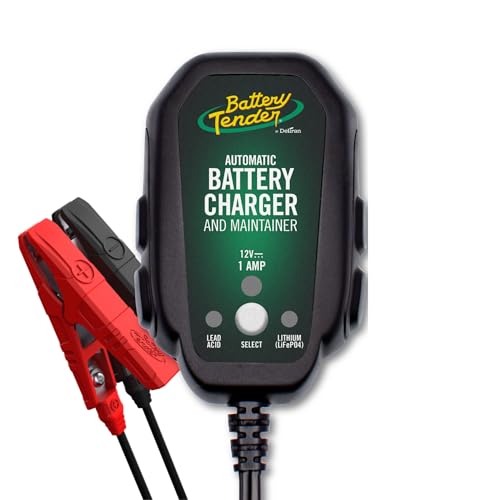
The Junior is the small maintainer with the modern trick: its title states it is a 12V, 800mA charger and maintainer for lead acid and lithium batteries, switchable between them, built for powersports, under code 022-0199-DL-WH. That switchability is the entire reason it leads the lithium conversation in this guide. A household whose older sled runs lead-acid and whose newer sled runs lithium can keep one model of maintainer on both, switching the profile to match each battery rather than memorising which box belongs to which machine.
At 800mA this is a pure storage maintainer, and it should be bought as one. It will refill a small sled battery given a day or so, and it will hold any battery in this class at full charge indefinitely, but it is not the tool for reviving a battery found flat on the first cold morning — that job belongs to the 3A and 4A picks, after which the Junior resumes the holding role it is best at. Judged on holding, its modest current is a virtue: gentle, cool and kind to small batteries across a long season.
The switch itself deserves respect. A switchable charger set to the wrong profile recreates exactly the mismatch this guide warns about, so the owner’s routine should include a glance at the setting whenever the unit is connected to a different battery. Label the sled’s battery type on the battery itself and the habit becomes foolproof.
- Output: 12V, 800mA
- Chemistries stated in title: lead acid and lithium, switchable
- Role stated in title: charger and maintainer for powersports
- Model code in title: 022-0199-DL-WH
- 6V operation: not claimed in the title — this is a 12V unit
Strengths
- Lithium and lead-acid support in one compact maintainer — the only small unit here that claims both.
- The gentle 800mA rate is ideal for months-long storage connection.
- Compact size suits cabins and trailer storage where the sled actually lives.
Trade-offs
- Too slow to be the household’s only charger if batteries are ever found flat.
- The profile switch must be set correctly for each battery — a human step that can be missed.
- No 6V mode for the older equipment the selectable Plus can serve.
Best for: mixed households running one lithium sled and one lead-acid sled, and any lithium sled owner who wants a dedicated storage maintainer.
Not suited for: owners who need recovery speed, and 6V equipment owners served by the selectable Plus above.
Find this one by its code, 022-0199-DL-WH, or by searching the Junior name with “lithium” — the chemistry word is what separates it from the lead-acid-only Junior variants.

Battery Tender 3 Amp Charger — Faster Recovery Charger
The 3 Amp model steps out of the pure-storage class. Its title describes a 3A charger and maintainer, switchable between 12V and 6V, smart and automatic, framed for cars, SUVs and trucks, and supporting lead acid, AGM, gel and lithium batteries, under code 022-0202-COS. Nothing in that framing names a snowmobile, and this guide will not pretend otherwise — its place here is earned by chemistry range and recovery pace, not by a powersports label.
Why include a car-framed charger in a snowmobile guide at all? Because the real household pattern is mixed. The same owner who stores a sled stores a truck, and the morning the sled’s battery is found flat is often the morning the truck’s is tired too. A 3A automatic unit recovers a small powersports battery in a few hours rather than a day, covers the vehicles, and then settles into maintainer duty for whichever battery needs holding. The chemistry list — AGM and gel named alongside lead acid and lithium — is the broadest in this guide, which matters for AGM-equipped sleds whose owners want the chemistry stated rather than implied.
The trade is size and intention: this is a larger unit than the powersports maintainers, bought for a garage rather than a cabin corner, and its 3A pace is more than a small sled battery needs for storage — though its automatic staging means the battery receives only what it asks for. Owners with a single sled and no other vehicles will find the Plus or Junior a more tailored purchase.
- Output: 3A; switchable 12V or 6V
- Chemistries stated in title: lead acid, AGM, gel and lithium
- Role stated in title: smart automatic charger and maintainer for cars, SUVs and trucks
- Model code in title: 022-0202-COS
- Powersports framing: not claimed in the title — its sled role is by chemistry and current, not by label
Strengths
- The broadest chemistry list in this guide, with AGM and gel named explicitly.
- 3A recovery pace turns a flat-battery morning into a same-day ride.
- 6V/12V switching plus vehicle framing makes it the garage’s general-purpose unit.
Trade-offs
- Not powersports-sized or powersports-labelled; cabin and trailer users may find it bulky.
- More charger than a single stored sled requires, in both output and cost class.
- Lithium support is claimed, but the owner must still confirm the sled battery maker’s own charging guidance.
Best for: owners who keep a sled alongside cars or trucks and want one automatic charger that recovers and maintains everything, lithium included.
Not suited for: a lone sled stored remotely, where the compact Junior or Plus is the proportionate tool.
Search by the code 022-0202-COS to land on this exact 3A model among Battery Tender’s many similar listings.

Battery Tender 4A — Highest Output Pick
The 4A model is the top of this guide’s output range, titled as a 4 amp charger and maintainer, switchable 12V or 6V, smart and automatic, for cars, SUVs and trucks, supporting lead acid, AGM, gel and lithium, under code 022-0209-BT-WH. As with the 3A model, the framing is automotive; its snowmobile relevance is the shared battery chemistry and the recovery scenario, stated plainly rather than dressed in powersports language.
The extra amp over the 3A model is not about the sled at all — a sled battery cannot usefully absorb charge any faster — it is about the rest of the fleet. Large truck batteries, dual-battery diesels and the household’s general run of stored machinery refill meaningfully sooner at 4A, and the owner with one charger for everything rationally buys the stronger one. On the sled, the automatic staging governs: the battery is offered current according to its state, and the maintainer phase holds it like any other pick here.
Choose between the 3A and 4A by the largest battery you will ask it to recover, not by the sled. If the fleet tops out at ordinary cars, the 3A suffices; if a big truck or a boat battery joins the rotation, the 4A earns its step up. Both share the chemistry breadth that makes them the flexible half of this guide, and both ask the same discipline: confirm the profile matches the battery, especially when lithium is involved.
- Output: 4A; switchable 12V or 6V
- Chemistries stated in title: lead acid, AGM, gel and lithium
- Role stated in title: smart automatic charger and maintainer for cars, SUVs and trucks
- Model code in title: 022-0209-BT-WH
- Snowmobile naming: absent from the title — included for chemistry range and recovery duty across a mixed fleet
Strengths
- The fastest recovery in this guide for large vehicle batteries in the same household.
- Full chemistry coverage — lead acid, AGM, gel, lithium — with 6V/12V switching.
- One automatic unit can rotate across sled, truck and boat without profile guesswork beyond the chemistry setting.
Trade-offs
- The least sled-specific purchase here; its strengths are aimed at bigger batteries.
- Oversized for a storage-only role on a small powersports battery.
- Owners must still set and check the chemistry handling for lithium batteries rather than assuming the unit guesses.
Best for: households with a sled plus large vehicles, where one automatic charger must recover a truck battery on Saturday and hold the sled all summer.
Not suited for: single-sled owners seeking a small dedicated maintainer — the Plus and Junior fit that brief at a fraction of the size.
Identify this listing by its code, 022-0209-BT-WH; the 4A Battery Tender line has several siblings and the code is the reliable separator.

Unocho 1.5A Smart Charger — Budget Smart Maintainer
The Unocho is the budget route into automatic maintaining, and its title is commendably specific about its territory: a 6V/12V, 1.5A automatic trickle charger and smart float charger for car, motorcycle, lawn mower, boat, ATV and snowmobile, across lead-acid, AGM, GEL, SLA, VRLA and WET batteries. That is the whole lead-acid family tree named in one breath, with snowmobile printed outright — and, equally clearly, no lithium anywhere in it. Owners of lead-acid sleds get a charger that names their machine and every chemistry variant their battery might be; owners of lithium sleds get an unambiguous signal to shop elsewhere in this guide.
At 1.5A it is the briskest of the storage-class picks, refilling a sled battery overnight with time to spare, then floating it. The “smart float” language in the title describes the behaviour storage requires — the charger holds the battery at a maintained level rather than pushing charge indefinitely — and the automatic designation means the stages manage themselves. For a second sled, a cabin machine or a rental unit, that combination at a budget position is a rational purchase.
The expectations to set are about brand depth rather than function. Unocho does not carry Battery Tender’s decades of category presence, and this guide makes no claim about long-term support or accessory ecosystems. What the listing offers is a correctly specified automatic maintainer whose title chemistry list is the most exhaustive of any pick here, and for many stored sleds that is the whole requirement.
- Output: 6V/12V, 1.5A
- Chemistries stated in title: lead-acid, AGM, GEL, SLA, VRLA, WET
- Behaviour stated in title: automatic trickle, smart float
- Snowmobile named in title: yes
- Lithium support: not claimed — lead-acid family only
Strengths
- The most complete lead-acid chemistry list in this guide, naming six variants.
- Snowmobiles are named in the title alongside ATVs and boats.
- 1.5A gives the storage class a little recovery pace without leaving maintainer territory.
Trade-offs
- Lead-acid only — lithium sleds are excluded by the title’s own list.
- A smaller brand presence than Battery Tender, with the support unknowns that implies.
- Float behaviour is claimed in the title, but owners should still check the battery monthly during the first storage season.
Best for: lead-acid sled owners who want an automatic float maintainer per machine, including second sleds and cabin sleds, at the budget end.
Not suited for: lithium batteries of any kind, and owners who want the category leader’s support network behind a primary machine.
Search the Unocho name with “1.5A” and “float” — the float wording picks this smart model out from the maker’s simpler trickle units.

MOTOPOWER MP00205A Battery Maintainer — Compact Desulfator Pick
The MOTOPOWER closes the guide at the compact end: a 12V, 800mA automatic battery charger, maintainer and trickle charger with a desulfator function, under model MP00205A. The desulfator is its distinguishing claim — a function intended to help break down the sulphate crystals that storage builds on lead plates, which is the precise failure mode this whole guide is organised against. As a claim it should be read at title value: the function is stated, its miracles are not, and no maintainer function reverses a battery that has been left discharged and sulphated for seasons. Prevention remains the maintainer’s real work.
At 800mA the MOTOPOWER matches the Junior’s storage pace, and its automatic designation puts it in the connect-and-forget class rather than the supervised trickle class. The title does not enumerate chemistries the way the Unocho’s does, and it makes no lithium claim; the conservative reading, and the one this guide adopts, is lead-acid family duty. Its compact maintainer format suits the same places the Junior suits — cabins, trailers, the far corner of a garage — at the budget end of the shelf.
For a healthy lead-acid sled battery entering storage, this unit covers the essential job description: automatic charging to full, maintained holding thereafter, and a desulfation function aimed at the storage disease itself. Owners who value the stated chemistry breadth or lithium coverage will step up to the picks above; owners who need a small, dedicated keeper for one lead-acid battery will find this one honestly specified for it.
- Output: 12V, 800mA
- Functions stated in title: automatic charger, maintainer, trickle charger, desulfator
- Model code in title: MP00205A
- Chemistry list: not enumerated in the title and no lithium claimed — buy it for lead-acid family batteries
- 6V operation: not claimed in the title
Strengths
- The desulfator function targets the exact storage failure mode of sled batteries.
- Automatic maintainer behaviour at a compact 800mA storage pace.
- Small format suits remote storage locations where a sled waits out the summer.
Trade-offs
- No chemistry list in the title, so the lead-acid reading is a conservative inference buyers should confirm on the listing.
- Desulfation is a maintenance aid, not a resurrection — a long-dead battery stays dead.
- 800mA recovery of a flat battery is an overnight-and-more proposition.
Best for: owners of a single lead-acid sled stored away from home, who want a small automatic maintainer with a desulfation function watching it.
Not suited for: lithium batteries, and owners who need stated AGM/gel chemistry coverage — the Unocho and the larger Battery Tenders print those lists.
Search by the model code MP00205A; MOTOPOWER sells several maintainers and the code is the clean way to this exact unit.
The Six Maintainers, Lined Up Head to Head
| Charger | Output | Voltages | Chemistries in title | Standout trait |
|---|---|---|---|---|
| Battery Tender Plus 1.25A | 1.25A | 6V/12V selectable | Lead-acid family (lithium not claimed) | Snowmobiles named in title |
| Battery Tender Junior 800mA | 800mA | 12V | Lead acid and lithium, switchable | Lithium in a compact maintainer |
| Battery Tender 3 Amp | 3A | 12V/6V switchable | Lead acid, AGM, gel, lithium | Broad chemistry list |
| Battery Tender 4A | 4A | 12V/6V switchable | Lead acid, AGM, gel, lithium | Fastest fleet recovery |
| Unocho 1.5A Smart Charger | 1.5A | 6V/12V | Lead-acid, AGM, GEL, SLA, VRLA, WET | Six lead-acid variants named |
| MOTOPOWER MP00205A | 800mA | 12V | Not enumerated; no lithium claimed | Desulfator function |
Choose from the table by chemistry first, then by the second job. A lithium sled narrows the field to three Battery Tender models immediately. A lead-acid sled opens all six, and the decision becomes whether the charger also owes you recovery pace, 6V coverage for older equipment, or simply the lowest-effort holding of one battery in a remote shed.
While the sled sleeps, the rest of the household’s charging continues: the Best Chargers for Motorola Phones covers the phones that map the trails, and the Best USB-C Chargers for MacBook Pro covers the laptop that edits the helmet-camera footage when the season ends.
How Should You Put a Snowmobile Into Storage So It Starts in Winter?
Begin at the last ride. Wash and dry the sled, then run the final tasks in the order the battery prefers: any fuel and engine storage steps your manufacturer specifies, and a full charge for the battery before the maintainer takes over. A battery put away at partial charge spends the summer sulphating from a head start; a battery put away full, on a maintainer, spends it ready.
Connect the maintainer with the sled’s own access in mind. Many owners fit the charger’s quick-connect lead permanently to the battery terminals — where the chosen listing provides one; check the box contents on the listing, since titles here do not enumerate leads — so the seasonal routine becomes plugging in a connector rather than removing bodywork to reach the battery. Route the lead where it cannot chafe, keep the charger itself off the floor and ventilated, and if the sled stores outdoors under a cover, keep the charger under the same shelter with its vents clear.
Through the season, glance monthly: the maintainer’s indicator where fitted, the connection’s firmness, any sign of a battery swelling or a terminal corroding. In autumn, the reward for the routine is anticlimactic — the sled simply starts. Do a deliberate first start before the first trip rather than at the trailhead, and if the battery shows weakness despite a maintained summer, replace it in the warm garage rather than discovering its verdict at twenty below. Owners who store other battery equipment alongside the sled will recognise the same connect-and-monitor habit from wheelchair battery care, where stored batteries carry even higher stakes.
What Should You Check Before the First Ride of the Season?
The preseason check is the maintainer strategy’s moment of proof, and it takes ten minutes. Disconnect the maintainer and let the battery rest for a few hours, then try the starter: a healthy, maintained battery spins the engine briskly without the labouring slowdown that signals weakness. If the sled carries a voltmeter or its dash shows system voltage, a rested reading in the healthy range for a charged 12V battery confirms what the starter suggests. Either test beats discovering the truth at a trailhead.
Inspect while you are there. Terminals should be clean and tight, the case uncracked and unswollen, the maintainer’s lead undamaged where it was routed in spring. A battery that passes its start test but shows a swelling case or heavy terminal corrosion is giving notice; plan its replacement during the season’s early weeks rather than its coldest weekend. Batteries replaced in a warm garage in October are a errand; batteries replaced in a parking lot in January are a story.
One more preseason habit pays for itself: photograph the whole charging setup before you disturb it — maintainer position, lead routing, terminal connections. If anything is moved during the season by another pair of hands, the photograph restores the arrangement in seconds, and it documents the battery’s installation date if the terminals carry one, which settles many a later argument about how old the battery really is.
Then reconnect the maintainer between rides. Storage discipline does not end when the season starts — a sled ridden on weekends still spends five days a week parked, often in deep cold, and short rides may not return what cold starts withdrew. The maintainer’s lead, left in place from spring, makes the between-rides connection a ten-second habit, and the battery arrives at every Saturday fully charged regardless of what the week’s weather did.
When Is It Time to Replace the Battery Rather Than Maintain It?
Maintainers extend a battery’s working life; they do not make it immortal. A powersports battery that has given several seasons of service will eventually lose capacity to age alone, and the signs are consistent: charge times that end suspiciously quickly because there is less capacity to fill, a starter that sounds strong for the first attempt and fades on the second, and a battery that will not hold its rested voltage across a week even with the maintainer’s help freshly removed. Any one sign is a suspicion; two together are a verdict.
The replacement decision is cheapest when made early. A new battery bought in autumn, charged fully and placed on the maintainer, enters service at its best and will outlast a battery nursed through one more winter of jump starts and deep discharges. When the new battery goes in, note its chemistry before choosing which maintainer profile it meets — replacements are the moment when a household quietly acquires its first lithium battery, in a lightweight aftermarket unit, and connects it to the lead-acid maintainer out of pure habit. Read the new battery’s label as carefully as this guide reads titles.
Dispose of the old battery through the retailer’s or municipality’s battery recycling route; lead-acid batteries are among the most completely recycled products in existence, and the core-return system at most sellers makes the responsible route also the cheapest one.
What Are the Most Common Mistakes With Snowmobile Batteries?
The first mistake is shopping for a snowmobile-specific charger and paying for the label, when the honest category is the powersports maintainer this guide covers. The second is the seasonal one: parking the sled in April with the battery at whatever charge the last ride left, and meeting the consequences in December. Storage damage is done in summer and only revealed in winter.
The third mistake is the chemistry shortcut — connecting whichever maintainer is on the shelf to whichever battery is in the sled. Lithium batteries in particular must meet only chargers whose titles claim lithium, and switchable units must actually be switched. The fourth is using an unregulated trickle charger for months-long connection because it was cheap; automatic float behaviour is the feature that makes long connection safe, and every pick here was chosen for stating it.
The fifth mistake is jump-starting a stored sled repeatedly instead of replacing a battery that has failed its maintained summer. A battery that cannot hold a charge under a maintainer’s care has told you its condition; repeated jumps stress the sled’s electronics and strand their owner eventually. Replace the battery in autumn, connect the new one to the maintainer, and let the system do the quiet work it was bought for.
How Do Rental Fleets and Cabins Handle Batteries Differently?
A cabin sled or a small rental fleet multiplies every lesson in this guide. Machines stored at a distance cannot be glanced at monthly by their owner, so the setup must be right at installation: maintainers mounted off the floor, leads routed and labelled per machine, and a laminated note for whoever closes the property in spring describing exactly what stays plugged in and why. More than one visiting relative has “tidied away” a maintainer in June, and the battery paid for the tidiness in December.
Fleets standardise for a reason. One maintainer model across every sled means one set of leads, one indicator language to learn, and no chemistry surprises when machines are swapped. Where the fleet mixes lead-acid and lithium machines, the switchable Junior’s profile discipline — or a strict labelling regime — becomes an operating rule rather than a suggestion, written into the same closing checklist as the fuel and the covers. The cost of the chargers is trivial beside a single no-start morning with guests waiting in their gear; fleet operators understand, earlier than most owners, that the maintainer is not an accessory but part of the machine’s winterisation.
Final Recommendation
For the classic lead-acid sled, the Battery Tender Plus 1.25A selectable is the maintainer to beat — powersports-framed, snowmobiles named, correctly paced for storage, with 6V coverage for the rest of the shed. Lithium sleds should take the switchable Junior for dedicated storage duty, while households whose charger must also recover cars and trucks should choose between the 3A and 4A models by the largest battery they own. The Unocho is the budget pick with the most thorough lead-acid chemistry list, and the MOTOPOWER the compact keeper with the desulfator. Buy the maintainer in spring, connect it the day the sled is parked, and the first start of winter becomes the least dramatic moment of the season — which, for a machine that lives to be ridden far from help, is exactly what good charging should buy.
Frequently Asked Questions
Is there really no charger made specifically for snowmobiles?
Correct, in any meaningful sense. Snowmobile batteries are standard small 12V powersports batteries, and the chargers built for them are the powersports maintainers shared with ATVs and motorcycles — two picks in this guide name snowmobiles in their titles, and all six serve the battery identically. Shop by chemistry, current and automatic behaviour, not by a snowmobile label.
Can I leave a maintainer connected for the entire off-season?
That is what automatic maintainers are designed for. Every pick here describes automatic, float or switchable maintainer behaviour in its title, which means it holds the battery at full without pushing charge indefinitely. Check the connection monthly, keep the unit ventilated, and the battery will spend the summer at the one charge level that prevents storage damage.
My new sled has a lithium battery. Which picks are safe for it?
The three whose titles state lithium: the Battery Tender Junior 800mA (switchable lead acid and lithium), the Battery Tender 3 Amp and the Battery Tender 4A (both listing lithium among their chemistries). Set any switchable unit to its lithium profile, and follow the battery maker’s own charging guidance alongside. The Plus, Unocho and MOTOPOWER titles make no lithium claim and should not be connected to a lithium battery.
Should I remove the battery from the sled for storage?
It is optional when a maintainer is connected. Removal suits unheated or insecure storage and makes monthly inspection easy; leaving the battery in place with a quick-connect lead suits owners who value a thirty-second routine. Either way, the battery should be fully charged and maintained — an removed battery on a shelf without a maintainer discharges exactly like an installed one.
Why did my battery die even though it was stored indoors?
Because indoor storage stops the cold, not the self-discharge. A small battery loses charge steadily on a shelf, and months of sitting at partial or empty charge sulphate the plates whether the room is warm or cold. Indoor storage plus a maintainer is the complete answer; indoor storage alone is only half of it.
Do I need a different charger for my ATV and motorcycle?
No — and that is the practical upside of this category’s honesty. The same powersports maintainers serve ATVs, motorcycles, lawn tractors and snowmobiles interchangeably, because the batteries are the same class and the storage problem is the same problem. A household can standardise on one maintainer model across all its small machines, provided each battery’s chemistry matches the unit’s claims and any switchable profile is set per machine.
Does a maintainer use much electricity over a whole summer?
Very little. Once the battery is full, a maintainer only replaces the small self-discharge loss, drawing power comparable to a small night light — and the smarter units sip in pulses as the battery asks. Set against the cost of one replacement battery, let alone a ruined first weekend of the season, the electricity across an entire off-season is the cheapest line in the snowmobile budget.
What size charger do I need just for storage?
Storage is the undemanding job: any maintainer in the 800mA to 1.5A range — the Junior, the MOTOPOWER, the Plus and the Unocho in this guide — holds a sled battery at full charge indefinitely, because holding only has to replace the battery’s slow self-discharge. Larger outputs earn their place when the same charger must also recover flat batteries or serve cars and trucks, not because storage itself needs them.
Can a maintainer revive a battery that was left flat all summer?
Sometimes partially, rarely fully. A maintainer’s gentle current may coax a sulphated battery back to a usable level, and the MOTOPOWER’s desulfator function is aimed at exactly that damage, but capacity lost to a season of neglect is usually gone for good. Test any revived battery under load before trusting it at a trailhead, and treat the experience as the argument for connecting the maintainer next spring.
Related Guides
For the rest of the garage and the house, see the Best Chargers for Motorola Phones, the Best USB-C Chargers for MacBook Pro, and the Best Wheelchair Battery Chargers — three more charging problems where matching the charger to the battery is the whole game.


