What's inside
- Key Takeaways
- Quick Picks
- How We Chose These Picks
- What Does a Maintainer Do That a Plain Charger Does Not?
- Lead-Acid or Lithium — Why Does Chemistry Come First?
- How Does a Vehicle Battery Actually Fade While It Sits?
- One Charger per Vehicle, or One Charger Moved Around the Fleet?
- What Does a Sensible Seasonal Routine Look Like?
- Which CTEK Charger Fits Which Battery Job?
- How Can You Tell Whether a Battery Is Tired or Merely Hungry?
- Where Should the Charger Live, and How Should the Leads Run?
- What Goes Wrong When Owners Maintain Batteries Badly?
- Does the Size of the Battery Change Which Pick You Need?
- How Do You Put a Stored Vehicle on a Maintainer Properly?
- How Does CTEK’s Approach Differ From the Jump-Start World?
- What Should You Do the Day a New CTEK Arrives?
- Which Vehicles in a Real Driveway Benefit Most, Ranked Honestly?
- Final Recommendation
- Frequently Asked Questions
- Related Guides
As an Amazon Associate I earn from qualifying purchases. This post may contain affiliate links at no extra cost to you.
[widgetverdict.com] is reader-supported. When you buy through links on our site, we may earn an affiliate commission.
Where to buy: five of the six CTEK chargers in this guide carry links to their Amazon listings; the sixth, the Lithium XS, is covered in prose only, because we could not verify a clean listing for it in this round — it is reviewed in full below, simply without a buy link attached.
The best ctek battery chargers share a philosophy that sets the Swedish brand apart from the booster-pack world: a battery rarely dies in a single dramatic moment. It fades — through short trips that never quite refill it, through winters spent in a cold garage, through the slow self-discharge of a vehicle that moves twice a month. CTEK built its name on chargers that fight that fade, fully automatic units you connect and then genuinely forget, which top up, maintain and in some cases recondition a 12-volt battery without asking you to supervise the process or interpret a gauge.
That shared philosophy makes choosing inside the range a subtler exercise than choosing between brands. Five of the six picks here are 12V automatic charger-maintainers, and two of them — the MXS 5.0 and the NXT 5 — even share the same 4.3-amp headline. The differences live in the details: which battery chemistries each unit is built to serve, whether it is hardened for extreme cold, whether it can act as a workshop power supply as well as a charger, and whether lithium batteries are its whole purpose or one mode among several. This guide sorts the range by the battery and the vehicle in front of you, which is the order CTEK itself seems to design by.
A word about what these chargers are not. None of the six is a jump starter; a CTEK maintainer persuades a battery back to health over hours, it does not deliver a cranking burst in a car park. Readers who need rescue power as well as maintenance will find the contrast drawn in our guide to Best Schumacher Battery Chargers, whose range leans toward engine-start muscle. CTEK’s corner of the market is the opposite temperament — patience, automation and chemistry — and the picks below are ranked inside that temperament, not against it.
Key Takeaways
- CTEK’s range is built on fully automatic charge-and-maintain behaviour: connect the unit, and it manages the battery without supervision.
- The MXS 5.0 and NXT 5 are the mainstream 4.3-amp choices for ordinary 12V car batteries.
- The CT5 is the chemistry-flexible pick, listed for lead-acid and 12V LiFePO4 lithium across cars, motorcycles, ATVs and snowmobiles.
- The MUS 4.3 Polar is the extreme-climate specialist, an 8-step charger built for serious cold.
- The PRO25SE is the professional step-up: charger and power supply in one, with reconditioning mode and a desulfator.
- The Lithium XS is covered prose-only in this guide and exists for one job: dedicated lithium battery care.
Quick Picks
| Pick | Badge | Why it earns its place |
|---|---|---|
| CTEK MXS 5.0 | The household standard | Fully automatic 4.3-amp charging and maintaining for the ordinary 12V car battery. |
| CTEK NXT 5 | The newer 4.3-amp sibling | CTEK’s current-generation take on the same automatic 12V brief as the MXS 5.0. |
| CTEK CT5 | Chemistry-flexible pick | Listed for lead-acid and LiFePO4 lithium across cars, motorcycles, ATVs and snowmobiles. |
| CTEK MUS 4.3 Polar | Extreme-cold specialist | An 8-step automatic charger built for vehicles that live through harsh winters. |
| CTEK PRO25SE | Professional power supply | Charger, maintainer and power supply with reconditioning mode and desulfation. |
| CTEK Lithium XS | Prose-only lithium specialist | A dedicated lithium charger, reviewed here without a link — see the verification note. |
How We Chose These Picks
We built this shortlist from CTEK’s own 12V range and sorted it by the questions owners actually ask. The first is chemistry: a charger must match the battery in the vehicle, and the range divides between lead-acid households, mixed households with a lithium battery somewhere in the fleet, and dedicated lithium use. The second is climate, because a charger that lives in an unheated barn in January faces a different job from one in a temperate garage. The third is role — pure maintenance for a stored vehicle, everyday care for a daily driver, or workshop duty where a unit must also hold a vehicle’s voltage steady while other work happens.
Automation was treated as a given rather than a feature to award points for, since every pick here is fully automatic in its listing; the meaningful differences are the extras layered on top — the Polar’s cold-climate design, the PRO25SE’s power-supply mode and reconditioning, the CT5’s breadth of vehicle types. We also kept the guide honest about scope: these are chargers and maintainers, and any pick that sounded like a rescue device in our notes was rewritten until its patience showed. One listing could not be verified cleanly enough to link, so the Lithium XS appears as a prose-only pick with its marker set accordingly; its section is written to the same depth as the linked five.
What Does a Maintainer Do That a Plain Charger Does Not?
A plain charger fills a battery and stops, or worse, keeps pushing. A maintainer — the word in most of these listings — treats charging as a cycle with a long final act: once the battery is full, the unit drops to a watchful float, topping up the small losses that self-discharge and a vehicle’s sleeping electronics steadily cause. That float stage is the entire reason a seasonal car, a boat or a mower can sit connected from October to April and start on the first turn in spring. The battery was never left full-and-forgotten; it was held, gently, at readiness.
The distinction matters most for vehicles with irregular lives. A daily driver recharges itself through use and needs a maintainer only across holidays and repairs. A motorcycle, a classic car, a snowmobile in July — these live in the long gaps where batteries quietly sulphate and fade, and they are the natural citizens of CTEK’s range. When you read the pick sections below, read them with your vehicle’s calendar in mind rather than its badge: the right charger is the one whose patience matches the longest gap in that calendar.
A note on expectations for readers arriving from the phone-charging world: vehicle charging runs on a different clock. A phone’s battery is small, its charger is quick, and its owner expects visible progress in minutes. A car battery holds vastly more energy, is charged deliberately gently by the units in this guide, and measures its recovery in hours and its maintenance in seasons. Buyers who import phone expectations into the garage conclude wrongly that a maintainer is broken because nothing seems to happen; nothing visible happening, for months, while a stored car stays ready, is the product working exactly as designed. The two halves of the charging world meet in this guide’s related reading, and the reader who holds both clocks in mind at once will choose well in each.
Lead-Acid or Lithium — Why Does Chemistry Come First?
Lead-acid and lithium batteries accept charge on different terms, and a charger that ignores the difference can undercharge one or mistreat the other. The listings in this guide draw the map clearly. Most picks are framed around conventional 12V automotive batteries. The CT5 explicitly covers both worlds — its title names lead-acid and lithium ion in its 12V LiFePO4 form — which makes it the natural pick for a household whose motorcycle or powersport machine runs a lithium battery while the car stays lead-acid. The PRO25SE also lists lithium charging among its roles, inside a professional brief. The Lithium XS, as its name declares, exists solely for lithium care.
The practical rule is simple: read the battery before the charger. The chemistry is printed on the battery’s label, and matching the charger’s listed chemistries to that label is the one decision in this guide that cannot be fudged with adapters or patience. Everything after it — amperage, climate rating, extra modes — is optimisation. Chemistry is compatibility.

CTEK MXS 5.0 — The household standard
The MXS 5.0, model 40-206 in CTEK’s numbering, is the charger most people picture when the brand is mentioned: a fully automatic 4.3-amp unit for 12V batteries that charges and then maintains, asking nothing of its owner beyond a correct connection. Its longevity in the range is itself an argument — this is the template from which the rest of the line is variations. For the ordinary family car that sits outside through winter, does short school-run trips and occasionally rests for a fortnight, the MXS 5.0 is the complete answer in one object.
What makes it the household standard rather than merely the default is the trust its automation earns. Battery care fails in most homes not through wrong equipment but through abandoned routines: a charger that needs checking gets checked twice and then lives in a drawer. A unit that can be connected in November and thought about again in March changes the battery’s whole winter. The 4.3-amp rating suits car-sized batteries with time available — this is an overnight-and-onwards charger, not a while-you-wait one — and its maintainer stage is the point of the product, not an afterthought mode.
Owners stepping up from bargain chargers notice the silence of the experience most: no fan drama, no decisions, no interpretation. Owners stepping down from workshop ambitions should notice the opposite boundary — the MXS 5.0 is a car battery’s caretaker, not a power supply for workshop electronics and not a lithium specialist. Within its brief it is close to a finished idea, which is why it leads this guide.
There is also a resale-of-attention argument for this pick: because it is the template, every accessory habit in the CTEK world — extension leads, comfort connectors, wall mounts — is built around units of its class first. An owner who standardises the household on MXS-class chargers ends up with interchangeable leads across vehicles, which quietly removes the friction that kills maintenance routines in year two.
- Model: CTEK 40-206 MXS 5.0
- Output: 4.3 amp
- System: 12V batteries
- Behaviour per listing title: fully automatic battery charger and maintainer
Strengths
- Fully automatic care removes the routine-keeping that defeats most battery maintenance.
- 4.3-amp output is sized for ordinary car batteries with overnight time available.
- The established template of the range, with the maintainer stage as its centrepiece.
Trade-offs
- No lithium specialisation in its listing; mixed-chemistry homes should look at the CT5.
- Not a workshop power supply — that role belongs to the PRO25SE.
- 4.3 amps is a patient pace for a large, deeply flat battery.
Best for: the ordinary 12V family car that needs charging and winter-long maintaining.
Not suited for: lithium battery owners or workshops needing a power-supply mode.

CTEK NXT 5 — The newer 4.3-amp sibling
The NXT 5, model 40-658, is CTEK’s newer answer to the same brief the MXS 5.0 defined: fully automatic, 4.3-amp, 12V, charger and maintainer. Two picks sharing a headline specification might look like a duplication in a guide, but inside a single brand’s range this is how progress actually looks — a current-generation model standing beside the established one, letting buyers choose between the proven template and its successor rather than between different jobs.
Judged on its listing, the NXT 5 asks for the same trust as its sibling: connect it to a 12V car battery and let the automation run the charge and the long maintain that follows. For a buyer whose vehicle is a mainstream petrol or diesel car with a conventional battery, the decision between the two 4.3-amp picks is genuinely a matter of preferring the newer platform. What the NXT 5 is not is a chemistry expansion or a climate special: lithium households and extreme-cold garages have their own picks further down this page, and the NXT 5’s honesty about being the mainstream choice is part of its appeal.
There is a quiet advantage to buying the current generation of a mature product category. Chargers live for years in garages, and the newer model is the one whose design assumptions match today’s vehicles — heavier sleeping electronics, longer idle periods, batteries that work harder standing still. If the MXS 5.0 is the range’s foundation stone, the NXT 5 is the same stone cut fresh.
Placed side by side in a two-car household, the MXS 5.0 and NXT 5 make a sensible pair rather than a dilemma: the established unit on the vehicle that stores longest, the newer one on the car whose electronics sip hardest while asleep. Nothing in either listing forbids the pairing, and a household that thinks in posts rather than products will find the duplication resolves itself.
- Model: CTEK 40-658 NXT 5
- Output: 4.3 amp
- System: 12V batteries
- Behaviour per listing title: fully automatic battery charger and maintainer
Strengths
- Current-generation version of CTEK’s mainstream automatic brief.
- Same connect-and-forget maintenance behaviour as the established MXS line.
- 4.3-amp output matched to ordinary car batteries and overnight windows.
Trade-offs
- Listing frames it for conventional 12V duty; lithium is not its headline.
- No extreme-climate billing of the kind the Polar carries.
- Buyers wanting workshop power-supply features must step up to the PRO25SE.
Best for: mainstream 12V car owners who prefer the newest version of the classic formula.
Not suited for: dedicated lithium care or sub-zero barn duty as a speciality.

CTEK CT5 — Chemistry-flexible pick
The CT5 is the range’s diplomat. Its listing addresses the whole driveway at once — auto, motorcycle, ATV and snowmobile — and names both chemistries a modern household juggles: lead-acid and lithium ion in its 12V LiFePO4 form. It works as a trickle charger and a maintainer, which in practice means it can spend the summer on the snowmobile’s battery and the winter on the motorcycle’s, then take its turn on the car, without the owner performing chemistry arithmetic each time.
That breadth suits how powersport households actually accumulate batteries. The vehicles are seasonal in opposite directions, their batteries are smaller and more varied than a car’s, and at least one of them increasingly arrives from the factory with a lithium unit under the seat. A charger whose title explicitly covers both chemistries removes the most dangerous moment in home battery care — the shrug before connecting the wrong profile to a lithium battery. The CT5’s trickle-and-maintain framing also fits small batteries well, since small batteries are the ones most often left connected for months.
Its compromise is specialisation traded for range. The dedicated lithium owner has the Lithium XS below; the workshop has the PRO25SE; the deep-winter barn has the Polar. The CT5 instead covers the widest map of ordinary situations in this guide, and for a garage with three machines and two chemistries, coverage is the feature that matters every single week.
The CT5 also quietly solves the borrowed-charger problem. Powersport owners lend chargers to each other constantly, and a unit whose title covers both chemistries is safer in circulation than a specialist that might be clipped onto the wrong battery by a helpful neighbour. Breadth, in a lending culture, is a safety feature.
- System: 12V automotive charging
- Vehicles per listing title: auto, motorcycle, ATV, snowmobile
- Chemistries per listing title: lead-acid and lithium ion (12V LiFePO4)
- Behaviour per listing title: trickle charger and battery maintainer
Strengths
- One charger honestly covers the mixed fleet: cars plus powersport machines.
- Both lead-acid and LiFePO4 lithium named in its own listing title.
- Trickle-and-maintain behaviour suits small seasonal batteries left connected.
Trade-offs
- Breadth replaces depth: dedicated lithium or workshop picks serve those niches harder.
- No extreme-climate design claim like the Polar’s.
- Households with only one car battery pay for flexibility they may never use.
Best for: mixed garages running lead-acid and LiFePO4 batteries across cars and powersport machines.
Not suited for: a workshop needing power-supply duty, which is the PRO25SE’s ground.
CTEK MUS 4.3 Polar — Extreme-cold specialist
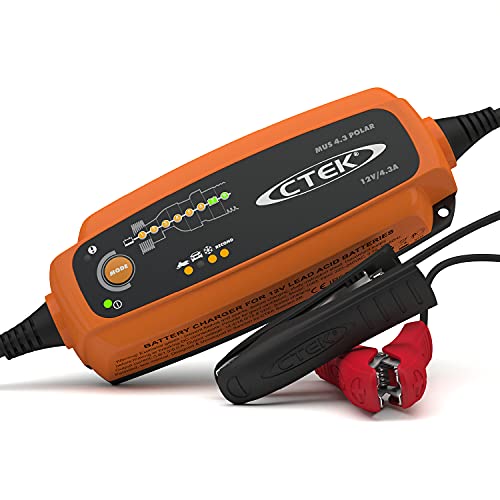
Cold is a battery’s worst working condition and a charger’s hardest posting, and the MUS 4.3 Polar — model 56-958 — is the pick CTEK built for it: a fully automatic 12-volt charger whose listing leads with extreme climate and an 8-step charging programme. Eight steps is the vocabulary of thoroughness in this category; a staged programme can treat a cold, deeply discharged battery more carefully than a blunt single-rate push, beginning gently and building as the battery accepts charge.
The Polar’s natural habitat is the unheated space: the barn, the detached garage, the cabin where a vehicle winters at temperatures that make ordinary electronics sulk and battery chemistry sluggish. In those postings, the maintainer half of its job doubles in value, because a battery held at full charge through a freeze is a battery that survives to spring, while one left half-charged in the cold degrades on a schedule measured in weeks. Readers in mild climates should read this pick with respect and then walk past it — its specialisation is real, and it is aimed at a map they do not live on.
Within the range, the Polar is the clearest example of CTEK’s design habit: take the automatic template, then harden one variable until it becomes the product. Here the variable is temperature. For the snow-belt owner whose truck lives outside and whose winters are measured in months, that hardening is not a luxury trim; it is the difference between a charger that works in January and one that merely works in the brochure photograph of January.
Cold-weather owners will also recognise the Polar’s less obvious virtue: confidence at the far end of an extension lead. Barns and detached garages rarely offer a socket beside the vehicle, and a charger designed for extreme climates is the one you trust at the end of a long cable run in January, doing its staged work unwatched while the building sits at the temperature the season chose.
- Model: CTEK 56-958 MUS 4.3 Polar
- Output: 4.3 amp class, 12 volt
- Programme per listing title: fully automatic, 8-step charging
- Design brief per listing title: extreme climate
Strengths
- Extreme-climate design brief aimed squarely at unheated, deep-winter postings.
- 8-step automatic programme suits careful recovery of cold, flat batteries.
- Maintainer behaviour protects stored vehicles through the whole freeze.
Trade-offs
- Mild-climate owners pay for hardening they will never test.
- Listing frames it around conventional 12V duty, not lithium specialisation.
- No power-supply mode for workshop electronics work.
Best for: vehicles stored through serious winters in unheated spaces.
Not suited for: temperate garages, where the mainstream 4.3-amp picks cover the job.

CTEK PRO25SE — Professional power supply
The PRO25SE changes the conversation from the driveway to the workshop. Its listing stacks roles the other picks do not attempt: professional 12V charger and power supply, battery tender and maintainer, lithium ion charging, a reconditioning mode and a desulfator. The power-supply role is the headline for anyone who works on modern vehicles, because it lets the unit hold a car’s electrical system at a steady voltage while diagnostics, coding or long repairs drain what the battery alone cannot spare.
Reconditioning and desulfation speak to the other workshop reality: batteries arrive neglected. A unit that can attempt to restore a sulphated battery — the desulfator’s whole purpose — turns some replacements into recoveries, and even when recovery fails, the attempt costs an overnight connection rather than a new battery. Combined with lithium capability, the PRO25SE becomes the range’s answer for the professional or the serious home mechanic whose bench sees every chemistry and every state of neglect.
It is, deliberately, more machine than a stored car needs. A weekend maintainer user will never open its deeper toolbox, and this guide says so plainly so the pick lands with the readers it was built for: workshops, detailers, restorers, and households maintaining several vehicles where one failure costs a working day. For them, the PRO25SE is not the expensive version of the MXS 5.0; it is a different instrument that also charges.
Restorers should note a use the listing implies rather than states: a long restoration is a battery’s worst biography — months of stillness punctuated by electrical testing — and a unit that can both maintain the battery and power the car during tests covers the whole biography with one purchase. That dual coverage is the PRO25SE’s real economy, invisible to anyone pricing it as a mere charger.
- Role per listing title: professional 12V battery charger and power supply
- Also listed as: battery tender charger and maintainer
- Chemistry per listing title: includes 12V lithium ion charging
- Recovery tools per listing title: reconditioning mode and battery desulfator
Strengths
- Power-supply mode supports diagnostics and workshop work on modern vehicles.
- Reconditioning mode and desulfator give neglected batteries a recovery path.
- Covers lithium alongside conventional batteries in one professional unit.
Trade-offs
- Far more capability than a single stored car will ever call on.
- Its workshop brief makes it the least set-and-forget-shaped pick here.
- Specialist cold-climate or dedicated-lithium buyers have narrower, fitter picks.
Best for: workshops and serious home mechanics who need charging plus a vehicle power supply.
Not suited for: a single garaged car needing only winter maintenance.
CTEK Lithium XS — Prose-only lithium specialist
The Lithium XS occupies the narrowest and clearest niche in this guide: it is CTEK’s dedicated charger for lithium batteries, the pick for owners whose motorcycle, powersport machine or lightweight performance car runs a lithium unit and who want a charger designed around that chemistry alone rather than one that visits it as an extra mode. We are covering it in prose only in this round, because we could not verify a clean listing for it to link with the confidence this guide requires; the pick is real, the hesitation is about the link, and the distinction is worth stating openly.
Why does a dedicated unit matter when the CT5 and PRO25SE both name lithium? Because specialisation removes a decision. A dual-chemistry charger asks its owner to select or trust a profile; a lithium-only charger has one job and one behaviour, which suits owners who connect in the dark, in a hurry, or through a second pair of hands. Lithium batteries also reward chargers that respect their narrower tolerances, and a unit built exclusively for them is the conservative choice for an expensive lightweight battery.
If your fleet is entirely conventional lead-acid, this section is a signpost to walk past — the MXS 5.0 and NXT 5 are your ground. If one machine in the garage runs lithium and it is the machine you care about most, the Lithium XS is the range’s specialist answer, and it is included here, link or no link, so that the map of CTEK’s range in this guide is complete rather than merely shoppable.
A final word in its favour: lithium batteries are often chosen to save weight in machines that are themselves cherished — the restored motorcycle, the track-day car — and their owners tend to be the readers least willing to gamble a distinctive battery on a generalist charger. The Lithium XS exists for that temperament, and this guide respects it enough to include the pick on its merits alone.
- Role: dedicated charger for lithium batteries (prose-only in this guide)
- System: 12V lithium battery care
- Link status: no verified clean listing in this round — covered without a buy link
- Position in range: single-chemistry specialist beside the dual-chemistry CT5 and PRO25SE
Strengths
- Single-chemistry focus removes profile-selection doubt entirely.
- Built for the lithium batteries that dual-purpose chargers treat as a second mode.
- Completes the range map for lithium-only owners.
Trade-offs
- No use to a lead-acid-only household.
- Covered without a purchase link in this guide, so sourcing takes an extra step.
- Narrower brief than the CT5 for mixed fleets.
Best for: owners of lithium-equipped motorcycles and powersport machines wanting dedicated care.
Not suited for: lead-acid-only garages, which the mainstream picks serve directly.
How Does a Vehicle Battery Actually Fade While It Sits?
Understanding the fade explains why maintainers exist at all. A parked vehicle’s battery loses charge three ways at once. It self-discharges internally, a slow chemical leak that no switch can stop. The vehicle itself sips power while asleep — clocks, alarms, keyless receivers, telematics — a small but relentless parasitic load that modern cars carry in far greater measure than their grandparents did. And every short trip that starts the engine spends more than the drive replaces, so a car used for ten-minute errands can end a busy week emptier than one that never moved.
Inside a lead-acid battery, discharge has a physical residue: sulphate crystals form on the plates as charge falls, soft at first, hardening the longer the battery sits low. A battery recharged promptly sheds the soft crystals; a battery stored half-empty for a season grows the hard kind, and capacity quietly becomes permanent loss. This is the mechanism behind the familiar spring discovery — the vehicle that “was fine in October” and will not turn over in April was not betrayed by winter; it was eroded by arithmetic. A maintainer interrupts the arithmetic at its first line, holding the battery at full charge where sulphation barely progresses and self-discharge is repaid as it happens.
Lithium batteries fade by a different etiquette — they dislike sitting at absolute full for months and dislike deep discharge even more — which is precisely why this guide keeps returning to chemistry-matched charging. The dedicated lithium pick and the dual-chemistry picks are not marketing garnish; they are the range acknowledging that the fade now happens in two chemistries, and each deserves a charger that speaks its language.
One Charger per Vehicle, or One Charger Moved Around the Fleet?
Multi-vehicle households face a logistics question the single-car reader never meets: does each stored vehicle get its own maintainer, or does one unit rotate? Rotation sounds thrifty and fails in practice, because maintenance is a state, not an event — a battery rotated onto the charger for one week in four spends three weeks fading, and the human rota collapses the first busy month. The honest pattern is one maintainer per simultaneously stored vehicle, with a shared charger only for the vehicle in active rotation.
That arithmetic shapes which pick a fleet should buy. Two stored conventional cars argue for two of the mainstream automatics rather than one flagship; a stored car plus a stored motorcycle argues for the CT5’s chemistry breadth at one post and a mainstream unit at the other; the workshop’s PRO25SE earns its place not by maintaining the fleet but by rescuing and powering the work around it. Buyers sometimes invert this, purchasing one impressive unit and three intentions. Batteries cannot read intentions. Count the vehicles that will be asleep at the same time in February, and let that number, not enthusiasm, set the order quantity.
What Does a Sensible Seasonal Routine Look Like?
Autumn, before storage: charge each battery fully while the vehicle is still in use, clean the terminals, then connect the maintainer as the vehicle goes to sleep rather than weeks later. A battery stored full and maintained is the spring success story; a battery stored flat and maintained has been preserved in its failure. Winter, monthly: the glance described earlier — power on, clamps seated, lead undamaged — plus a check that no new parasitic fault has announced itself through a charger working unusually hard.
Spring, at waking: disconnect calmly, start the vehicle, and drive it properly — a real journey, not a driveway idle — so the alternator and the battery reintroduce themselves under load. Summer, for the machines that sleep then (the snowmobile, the snow-blower’s sibling fleet), the same routine runs in mirror image, which is where the CT5’s snowmobile listing stops looking like trivia. Written down, the routine is four lines long. Its entire difficulty is that it must happen every year, which is why the automation in these listings matters more than any single specification in this guide.
Which CTEK Charger Fits Which Battery Job?
| Pick | Output / role | Chemistry focus | Defining trait |
|---|---|---|---|
| CTEK MXS 5.0 | 4.3A charger-maintainer | Conventional 12V | The established household template |
| CTEK NXT 5 | 4.3A charger-maintainer | Conventional 12V | Newer generation of the same brief |
| CTEK CT5 | Trickle charger-maintainer | Lead-acid and LiFePO4 | Widest vehicle list: auto to snowmobile |
| CTEK MUS 4.3 Polar | 4.3A, 8-step automatic | Conventional 12V | Extreme-climate design |
| CTEK PRO25SE | Charger and power supply | Includes lithium ion | Reconditioning mode and desulfator |
| CTEK Lithium XS | Dedicated lithium charger | Lithium only | Prose-only specialist in this guide |
The table reads as a set of concentric answers. At the centre sit the two 4.3-amp automatics for the ordinary car. Around them, each pick hardens one variable: the CT5 widens chemistry and vehicle type, the Polar hardens climate, the PRO25SE adds the workshop, and the Lithium XS narrows to a single chemistry done exclusively. If your situation matches one of those hardened variables, the choice makes itself; if it matches none, the centre holds.
How Can You Tell Whether a Battery Is Tired or Merely Hungry?
Owners replace batteries that were only hungry, and nurse batteries that were already finished, because the symptoms overlap: a slow crank on a cold morning can mean a discharged battery, a dying one, or a starter motor asking for help. A maintainer gives you the cheapest diagnostic in the garage — time. Connect the charger, let it complete a full automatic cycle, and then judge the vehicle. A battery that accepts the charge and then holds its readiness across the following weeks was hungry. A battery that charges, starts once with enthusiasm and is flat again within days is telling you its capacity has gone, and no charger in this guide — not even the PRO25SE’s reconditioning mode — is obliged to resurrect it.
That distinction is worth money twice over. It stops the premature replacement of good batteries flattened by a fortnight of airport parking, and it stops the opposite waste: a season of hopeful maintaining spent on a battery whose plates have already surrendered. The reconditioning attempt sits between the two verdicts — worth running once on a sulphated battery, as the desulfator’s presence in the PRO25SE listing acknowledges, and worth accepting as a verdict when it fails. Chargers are caretakers and witnesses; the witness function, honestly reported by your own observations across a fortnight, is half their value.
Where Should the Charger Live, and How Should the Leads Run?
Garage geography decides whether a maintenance routine survives contact with real life. The charger wants a fixed home — a shelf, a wall hook, a bench corner — close enough to the vehicle’s parking spot that connecting it is a ten-second act performed without moving anything else. Every obstacle between the charger and the battery is a future excuse, and excuses compound faster than sulphation. Route the lead along the wall rather than across the floor, leave enough slack that the bonnet or seat can open without tugging the clamps, and keep the unit itself out of the drip line of a wet vehicle and off any surface that floods in spring.
For vehicles stored away from home — the barn, the rented lock-up, the relative’s garage — the same logic argues for the charger living with the vehicle rather than visiting it. A maintainer left in your own garage maintains nothing at the lock-up, which sounds obvious and is nonetheless the most common logistics failure in seasonal storage. The Polar’s extreme-climate brief exists for exactly those remote, unheated postings; the mainstream picks serve the home garage where a monthly glance is easy. Match the charger’s home to the vehicle’s home, and the routine described in this guide becomes a property of the building rather than a resolution of the owner.
What Goes Wrong When Owners Maintain Batteries Badly?
The most common failure is also the quietest: the charger bought in a crisis and abandoned after it. A battery maintained for one winter and forgotten for the next gains little; the value of every pick in this guide compounds across seasons of boring, connected consistency. Beside it sits the chemistry mistake — a charger connected to a lithium battery without lithium support in its listing — which is why this guide repeats the label-checking rule until it becomes reflex. Third comes the rescue fantasy: expecting a maintainer to revive, by Friday, a battery that has sat flat since spring. Maintainers prevent that story; they are not obliged to reverse it, though the PRO25SE’s reconditioning mode exists precisely to attempt the reversal honestly.
Connection habits cause the rest. Clamps thrown onto corroded terminals charge the corrosion more faithfully than the battery, so terminals deserve a clean before a season of maintenance begins. Chargers left dangling by their leads strain cables and invite accidents in busy garages; give the unit a shelf or a hook. And a maintainer connected to a vehicle with a parasitic drain — a boot light, a faulty module — will fight that drain forever and be blamed for the draw it cannot fix. The charger maintains the battery; the vehicle’s own faults remain the vehicle’s.
Does the Size of the Battery Change Which Pick You Need?
Within this guide’s 12V world, battery size changes the timescale more than the selection. A 4.3-amp automatic will charge a small motorcycle battery briskly and a large car battery patiently; given the overnight-and-storage windows these chargers are bought for, both arrive at the same destination. Size becomes a deciding factor only at the extremes — the very large battery bank of a motorhome’s house system, or a workshop cycling several batteries a week — and those readers have already been directed to the PRO25SE’s professional brief. For everyone else, the honest advice is to stop shopping by amp envy: the maintainers here are sized for the vehicles their listings name, and a battery that reaches full charge by morning has not been under-served, whatever the number on the box.
The variable that does deserve attention is time pressure. A charger bought for a vehicle in daily service that must recover from a deep discharge between Monday’s failure and Tuesday’s commute lives a harder life than a storage maintainer, and that reader should weight the workshop-grade pick more heavily than this guide’s storage-first framing does. Name your deadline when you name your battery, and the range sorts itself with very little argument left over.
How Do You Put a Stored Vehicle on a Maintainer Properly?
Start with the battery’s label: confirm the chemistry and that the charger you own lists it. Clean the terminals until the clamps bite bright metal, connect with the vehicle’s ignition off, and route the charger’s lead so it cannot be driven over, slammed in a door or chewed by the garage’s resident wildlife. Then walk away — that is the procedure’s most important step, and the one owners find hardest. An automatic maintainer is designed for absence; checking it hourly converts a tool into a hobby.
Across the storage season, a monthly glance is the right cadence: confirm the unit is powered, the connection undisturbed, and no garage mishap has intervened. Before the vehicle returns to service, disconnect in the reverse spirit of the connection — calmly, ignition off — and let the first start be the verdict. Owners who also keep phones and small devices on charge at home will recognise the rhythm from our guide to Best Anker Wireless Chargers: slow, cool, consistent charging beats heroic rescue in every battery chemistry humans commonly own. For emergencies that patience cannot solve — the flat battery an hour before a journey — the crank-first world of Best Hand Crank Chargers covers the small-device end, while vehicle rescue belongs to jump packs rather than anything in this guide.
How Does CTEK’s Approach Differ From the Jump-Start World?
It is worth stating the contrast plainly, because buyers cross-shop the two philosophies constantly and they answer different emergencies. The jump-start world assumes the battery has already failed and buys back mobility in minutes; the maintenance world assumes failure is a slow process that can be refused, and buys years of unremarkable mornings. A household can rationally own both — a maintainer on the stored car, rescue power in the daily driver’s boot — but it should never confuse their jobs. Rescue power does nothing for the battery’s long health, and a maintainer does nothing for the driver already late in a car park.
CTEK’s entire range, from the household MXS 5.0 to the workshop PRO25SE, sits on the prevention side of that line, and the brand’s fully automatic framing is the tell: these are appliances for a calendar, not for a crisis. Readers who feel the pull of the other philosophy are not wrong; they are simply shopping for a different day of the year. Decide which day you are buying for — the ordinary February morning or the exceptional one — and the two ranges stop competing and start complementing each other.
What Should You Do the Day a New CTEK Arrives?
Resist the urge to begin with the worst battery you own. Start with the healthiest vehicle, connect the charger, and watch one full automatic cycle complete so you learn the unit’s normal behaviour — its indicators, its patience, its silence — on a battery that asks little of it. That baseline teaches you what “working” looks like, and every later judgement about a tired battery becomes a comparison against a known good performance rather than a guess.
Then write two things down: the date, and which vehicle the charger now belongs to. Fleets blur; a note on the garage wall assigning each unit its post prevents the spring reshuffle in which the motorcycle’s charger ends the winter on the boat. Finally, put the vehicle’s next storage date in whatever calendar you actually read. The charger will handle everything electrical from that day forward — but it cannot put itself on the battery, and the whole philosophy of this range reduces, in the end, to being connected.
Which Vehicles in a Real Driveway Benefit Most, Ranked Honestly?
If the whole guide had to be compressed into a driveway tour, the beneficiaries would line up in this order. First, the seasonal machine with the longest sleep: the convertible, the classic, the boat-hauling truck that works three weekends a year. Its battery faces the deepest fade and gains the most from any maintainer in this range. Second, the short-trip car — the school-run and supermarket specialist whose alternator never gets a long sentence to finish — which fades while technically in daily use and surprises its owner accordingly. A monthly overnight connection to a mainstream automatic quietly rewrites that car’s battery biography.
Third, the powersport fleet, whose small batteries are cheap individually and relentless collectively; the CT5’s breadth was designed for this driveway. Fourth, the winter-stored vehicle in a genuinely cold posting, the Polar’s home ground. Fifth, the workshop’s project car, living the stop-start electrical life the PRO25SE was built to accompany. The daily long-distance commuter comes last and honestly: its battery is exercised by the commute itself, and a maintainer serves it mainly across holidays and repairs. Ranking your own vehicles this way tells you not only which charger to buy but where to connect it first — and a charger connected first to the vehicle that fades fastest pays for itself in avoided replacements sooner than any specification promised.
Final Recommendation
For the single ordinary car, choose between the MXS 5.0’s proven template and the NXT 5’s newer cut of it, and let the matter rest for a decade. Mixed fleets should go straight to the CT5 and enjoy never thinking about chemistry at connection time again. Serious winters promote the Polar from luxury to logic. Workshops and multi-vehicle households belong to the PRO25SE, and lithium devotees to the Lithium XS, sourced carefully since we link it not. CTEK’s range rewards the owner who names their battery, their climate and their calendar honestly — after that, the charger does the remembering for you, which is the entire point of the brand. Buy the pick that matches the vehicle you actually store, connect it on the day the vehicle goes to sleep rather than the week after, and the most likely outcome is the one this category promises at its best: a spring morning, years from now, when the first turn of the key sounds exactly like the last turn of autumn — and you realise the charger has been doing its quiet work so long you had forgotten it was there at all.
Frequently Asked Questions
Can I leave a CTEK charger connected all winter?
That is the use the maintainer design exists for. A fully automatic charger-maintainer charges the battery and then holds it against self-discharge, so a stored vehicle can stay connected across a season with only occasional glances to confirm nothing has disturbed the setup.
Will one of these chargers start my car?
No. These are chargers and maintainers, not jump starters; they restore a battery over hours. The PRO25SE’s power-supply mode supports workshop electronics, which is a different job from cranking an engine.
How do I know whether my battery is lead-acid or lithium?
Read the label on the battery itself — the chemistry is printed there. Match it against the chemistries named in the charger’s listing title: the CT5 names lead-acid and 12V LiFePO4, the PRO25SE names lithium ion, and the Lithium XS is lithium-only.
What is the difference between the MXS 5.0 and the NXT 5?
On their listings, remarkably little: both are fully automatic 4.3-amp 12V charger-maintainers. The NXT 5 is the newer generation of the same brief, the MXS 5.0 the established template; the choice is between the proven model and its successor rather than between different capabilities.
What does a desulfator do, in plain terms?
Sulphation is the crust that builds on a lead-acid battery’s plates when it sits discharged, choking its capacity. A desulfator, like the one in the PRO25SE’s listing, attempts to break that crust down during a reconditioning cycle — sometimes restoring a neglected battery, always worth trying before a replacement is bought.
Do these chargers work in an unheated garage?
The range is built for garage duty, and the MUS 4.3 Polar is the pick whose listing is explicitly framed for extreme climate, making it the confident choice for unheated spaces in serious winters. For milder garages, the mainstream automatics are the natural posts.
Can one CTEK look after two vehicles at once?
A single charger maintains a single battery connection properly. Households with two stored vehicles should plan on two units — which is why the mainstream automatics, bought as a pair, often serve a fleet better than one flagship shared between posts.
Why is the Lithium XS not linked in this guide?
Because we could not verify a clean listing for it in this round, and this guide only links what it can verify. The pick is reviewed in full above so lithium owners still get the complete map of the range.
Related Guides
Continue with Best Schumacher Battery Chargers for the engine-start end of vehicle charging, Best Anker Wireless Chargers for the phones that ride in those vehicles, and Best Hand Crank Chargers for charging when no battery or socket can help.


