What's inside
- Key Takeaways
- Quick Picks
- How We Chose These Picks
- Charger, Maintainer or Tender: What Do Those Words Actually Mean?
- The Six Chargers, Pick by Pick
- How Do the Six Compare Side by Side?
- How Do You Connect a Maintainer for a Whole Winter Without Regretting It?
- Why Does a Parked Bike Drain Its Battery Faster Than You Expect?
- How Do You Tell Whether a Battery Deserves a Charger or a Replacement?
- What Changes When the Garage Holds Two or Three Bikes?
- How Does Cold Weather Change the Charging Picture?
- How Do You Read What the Charger Is Telling You Mid-Charge?
- What Mistakes Do Riders Make With Battery Tenders?
- Final Recommendation
- Frequently Asked Questions
- Related Guides
As an Amazon Associate I earn from qualifying purchases. This post may contain affiliate links at no extra cost to you.
[widgetverdict.com] is reader-supported. When you buy through links on our site, we may earn an affiliate commission.
Where to buy: all six units below are sold through the linked listings, and every one of them is a small 12-volt-class device meant to live on a garage wall or a shelf near the bike, not in a saddlebag.
The best motorcycle battery chargers solve a problem that has nothing to do with riding and everything to do with parking. A motorcycle battery is small, it discharges while the bike sits, and modern bikes sip a little current even with the key out — a clock here, an immobiliser there, an alarm that never truly sleeps. Leave a bike alone for a wet month and the battery slides into the voltage range where plates sulphate and cranking turns doubtful. The chargers in this guide exist to interrupt that slide, either by refilling a battery that has gone flat or by holding a healthy one exactly where it wants to be, week after week, without cooking it.
Before the picks, one distinction has to be nailed down, because the whole category blurs it on purpose. A charger pushes current into a depleted battery at a meaningful rate until the battery is full. A maintainer — often sold as a tender — watches a battery that is already charged and tops it up in small sips, holding it at a float voltage through the off-season. Plenty of units do both jobs in sequence, charging first and maintaining afterwards, and those are the ones worth owning. What none of the six below does is jump-start anything. There is no crank-assist burst hiding in a 750-milliamp wall unit, and any rider who needs emergency starting power needs a separate lithium jump pack, not a tender with optimistic packaging.
The second dividing line is chemistry. Most motorcycles still run lead-acid batteries in flooded, gel or AGM form, and every pick here serves those. A growing minority run lithium iron phosphate batteries, marked LiFePO4, and those demand a charger with a dedicated lithium mode, because the charging profile and the recovery behaviour differ from lead-acid in ways that matter. Two brands in this guide answer that demand directly: NOCO builds a lithium setting into both of its units, and OptiMATE sells a charger designed around lithium from the first step of its programme. If your bike carries a lithium battery, those three picks are your shortlist and the lead-acid-only tenders are not, whatever their other virtues.
Key Takeaways
- Charging and maintaining are different jobs: a charger refills a flat battery, a maintainer holds a full one at float through storage, and the useful units here sequence both.
- None of these six units jump-starts a bike — the largest output in the guide is 2 amps, which is refill power, not cranking power.
- Lithium LiFePO4 batteries need a dedicated lithium mode; only the two NOCO units and the OptiMATE Lithium 4s offer one among these picks.
- Outputs run from 750mA to 2A, which suits motorcycle-sized batteries; car owners with large batteries should expect slow refills from the smaller units.
- The two Battery Tender models are the long-storage specialists, built to sit connected for months at float.
- The OptiMATE is the lithium rescue specialist: an 8-step programme for sealed 12.8V lithium batteries, including a saving mode for deeply discharged ones.
Quick Picks
| Pick | Badge | Why it earns its place |
|---|---|---|
| MOTOPOWER MP00205A 12V Battery Charger | The straightforward refill | 800mA automatic unit that charges, maintains, trickles and desulfates, pitched squarely at everyday powersports batteries. |
| Battery Tender Junior 12V 750mA | The storage classic | 750mA charger and maintainer built for motorcycles and ATVs that sit for weeks between rides. |
| Battery Tender Plus 12V 1.25A | The faster tender | 1.25A output with float charge, for owners who maintain a bike and occasionally a car battery too. |
| NOCO GENIUS2 Smart Battery Charger | The two-amp all-rounder | 2A smart unit covering 6V and 12V, lead-acid in wet, gel and AGM forms, plus lithium LiFePO4, with force mode for very flat batteries. |
| NOCO GENIUS1 Smart Battery Charger | The compact NOCO | The same chemistry coverage as its bigger sibling at 1A, sized for a single bike kept on maintenance. |
| OptiMATE Lithium 4s Charger | The lithium specialist | 0.8A, 8-step charger and maintainer built specifically for sealed 12.8V lithium batteries, with a battery-saving recovery stage. |
How We Chose These Picks
We began with the battery itself. A motorcycle battery is a small reservoir — far smaller than a car battery — so the outputs that look feeble on a car forum, three quarters of an amp, are correctly sized here: gentle current, delivered over hours, is what a small battery accepts without stress. Any unit claiming huge amperage for this job would have raised questions rather than earned a place. Each pick states its output in its listing title, and we held every pick to that stated figure rather than to marketing adjectives elsewhere on the page.
Chemistry coverage came next. A guide written only for lead-acid would ignore the lithium conversions spreading through the custom and performance scenes, while a guide written only for lithium would abandon the overwhelming majority of bikes in garages today. The six below span both worlds deliberately: three lead-acid tenders and chargers, two dual-chemistry NOCO units, and one lithium-only specialist. Between them, every battery chemistry a rider is realistically running has a correctly matched pick.
We also looked for honesty about function. Listings that named their stages — charge, maintain, float, desulfate — scored better than listings promising vague resurrection powers, because a rider connecting a device to a battery for four months deserves to know the sequence it will follow. The desulfator claims carried by the MOTOPOWER and the NOCO pair are treated in this guide as maintenance features for sulphation-prone lead-acid batteries, not as guarantees that a dead battery returns to service; no charger in this price class repeals chemistry, and we have written the picks accordingly.
Finally, we weighted the storage use case heavily, because that is how these devices actually earn their keep. A rider who rides daily rarely needs any of this. A rider with a seasonal bike, a second bike, or a northern winter needs a unit that can be connected in November and trusted until March. Float behaviour, automatic switching and temperature awareness therefore matter more in the scoring below than raw refill speed, and the picks are ordered with the garage shelf, not the emergency, in mind.
Charger, Maintainer or Tender: What Do Those Words Actually Mean?
Start with the plain charger. Its job is restoration: a battery that has fallen below its working voltage gets connected, and the charger pushes current in until the battery approaches full. On a motorcycle battery, even a modest output completes that job overnight. The risk in a plain, dumb charger is the ending — left connected past full, it keeps pushing, the battery warms, electrolyte suffers, and a device bought to save a battery becomes the thing that shortens its life. That failure mode is exactly why the maintainer exists.
A maintainer assumes the battery is already healthy and charged. It monitors voltage, and when the battery’s natural self-discharge pulls it down a fraction, the maintainer sips it back up and returns to watching. The Battery Tender brand built its name on this pattern and on the float stage that defines it: hold the battery at a steady, gentle voltage indefinitely, neither charging hard nor letting go. For a bike in winter storage, float is the whole product. The battery wakes in spring at the same readiness it had in autumn, and the owner never thinks about it in between.
The tender word is mostly a synonym wearing a friendlier coat — the category uses charger, maintainer and tender almost interchangeably in listings, which is precisely why this guide reads the stated functions instead of the label. The MOTOPOWER’s title, for instance, lists automatic charging, maintaining, trickle and desulfating as separate named behaviours; that list tells you more than any single noun could. When you shop this category, shop the verbs.
Trickle deserves its own sentence because it is the oldest word here and the most abused. A true old-fashioned trickle charger delivered a small constant current forever, float judgement included in neither the device nor, often, the owner — and it could overcharge a small battery over a long winter. The modern automatic units below borrow the word but not the behaviour: their trickle is supervised, switching off or down to float when the battery says enough. When a listing pairs the word trickle with the word automatic, as the MOTOPOWER and both NOCO units do, the pairing is the reassurance.
Desulfation is the last term to demystify. When a lead-acid battery sits discharged, lead sulphate crystals harden on its plates and capacity shrinks; certain charging pulses can soften early sulphation and recover some of what was lost. It is a real mechanism with real limits — a battery left flat for a year has damage no pulse programme will undo. Treat desulfator features as a reason a borderline battery might come back, never as a promise that any battery will, and treat any listing that promises resurrection of the long-dead as a listing that has stopped describing its product.
Underneath all of this sits one practical truth about motorcycle electrics: the battery is the smallest, cheapest and most abused component in the starting system, and it fails by neglect far more often than by defect. A rider who keeps a maintainer connected during every long park rarely meets a no-start morning. A rider who relies on the bike’s own charging system to undo months of sitting asks an alternator designed for topping up to perform resurrections. These six devices are cheap insurance against a failure mode that is almost entirely optional.
The Six Chargers, Pick by Pick

MOTOPOWER MP00205A 12V Battery Charger — The straightforward refill
The MOTOPOWER states its whole job description in its title: automatic battery charger, maintainer, trickle and desulfator, at 800 milliamps on a 12-volt system. That completeness is its appeal. A rider whose bike sat through a house move, a holiday or a long repair can connect the MP00205A to a sagging lead-acid battery and let the automatic sequence do the thinking — bulk refill first, then the gentler behaviours once the battery is back. At 800mA the refill of a typical motorcycle battery is an overnight affair rather than a coffee-break one, and that pace suits the battery fine; small batteries prefer patience to force.
Picture the owner this fits: one bike, ridden most weekends, parked through the worst month of winter. The MOTOPOWER lives on the garage shelf, gets clipped on when the forecast turns, and gets forgotten until the cover comes off. Its desulfator stage gives it a second use in spring, when a battery that dipped lower than intended over the cold months needs coaxing rather than replacing. What it will not do is start the bike at the roadside, and its 12-volt-only focus means the owner of a 6-volt vintage machine should look at the NOCO pair instead.
- Output: 800mA
- System voltage: 12V
- Named functions in the listing title: automatic charging, maintaining, trickle, desulfator
- Lithium mode: the listing title does not name one — treat this as a lead-acid pick unless the full listing states otherwise
- Jump-start capability: none — this class of unit cannot crank an engine
Strengths
- Four named behaviours in one small unit cover the refill-to-storage arc without a second device.
- Automatic sequencing means the owner sets nothing and can leave it connected through a storage stretch.
- The desulfator stage addresses the sulphation that parked lead-acid batteries accumulate.
Trade-offs
- 800mA refills slowly; a large battery borrowed from the car side of the garage will take a very long time.
- No 6V mode is stated, so vintage bikes on 6-volt systems fall outside its stated scope.
- No lithium programme is named in its title, which excludes LiFePO4-equipped bikes from its safe uses.
Best for: a single 12V lead-acid bike that parks for weeks at a time and needs one automatic unit for both refills and storage. Not suited for: a LiFePO4 battery with no lead-acid fallback, a 6V vintage system, or a rider expecting roadside starting help.
Garage riders with a conventional battery can check the MOTOPOWER listing and confirm the connector style suits how their bike’s battery is reached.

Battery Tender Junior 12V 750mA — The storage classic
The Junior is the device that taught a generation of riders the maintainer habit. Its 750mA output is the gentlest in this guide, and that is a deliberate fit rather than a shortcoming: the listing names powersports machines — motorcycles and ATVs — as its home ground, and powersports batteries are small enough that three quarters of an amp, applied automatically and then held at float, is the correct prescription for a battery that mostly waits. The model designation 021-0123 in its title is worth noting when ordering, since the Tender family contains several lookalike units.
Where the MOTOPOWER leans toward the refill, the Junior leans toward the vigil. Connect it when the riding season ends and its automatic behaviour carries the battery through the dark months, sipping when the voltage drifts, resting when it does not. Riders with a bike and an ATV can rotate it between the two, a week here and a week there, because at float the device is guarding rather than filling. Its ceiling shows only when a battery starts truly empty: 750mA into a flattened battery is a slow road back, measured in a day rather than an evening, and owners who regularly drain batteries flat should step up to the Plus or the GENIUS2.
- Output: 750mA
- System voltage: 12V
- Named role in the listing title: charger and maintainer for powersports — motorcycles and ATVs named explicitly
- Model reference stated in the title: 021-0123
- Lithium programme: none named in the listing title — lead-acid batteries are its stated territory
Strengths
- Output sized exactly for small powersports batteries, gentle enough for indefinite float duty.
- Motorcycles and ATVs are named in its title, so a quad in the same shed is covered by the same unit.
- Its automatic charge-then-maintain sequence asks nothing of the owner between connecting and spring.
Trade-offs
- The slowest refill here; a fully flat battery is a long wait at 750mA.
- Lead-acid only on the evidence of its title — lithium conversions need a different pick.
- A single-battery device at a time; a three-bike garage will rotate it or buy siblings.
Best for: a motorcycle or ATV stored for a season on a lead-acid battery, where float vigilance matters more than refill speed. Not suited for: a rider who flattens batteries regularly and needs them back by morning, or any lithium-equipped machine.
If seasonal storage is your pattern, look at the Junior’s listing and match the 021-0123 designation before ordering.

Battery Tender Plus 12V 1.25A — The faster tender
The Plus takes the Junior’s formula and gives it shoulders. At 1.25 amps it refills a motorcycle battery noticeably sooner, and its title widens the stated territory to car and motorcycle batteries alike, with ATVs named alongside and float charge called out as a headline behaviour. That breadth changes its garage role: this is the tender for the household where the bike shares space with a car that also sits — a summer car, a project car, a second vehicle that moves twice a month — and one device is expected to guard both in rotation.
Float charge being named in the title matters more than it might appear. Plenty of chargers maintain; fewer say plainly that the end state of their programme is a float hold, which is the state a stored battery should live in. The Plus is therefore the pick we would hand to the owner whose bike disappears under a cover from November to April and whose only demand is that April’s first start sounds like October’s last one. The extra amperage over the Junior buys forgiveness for the occasions when the battery was not full when the cover went on.
- Output: 1.25A
- System voltage: 12V
- End state named in the listing title: float charge
- Stated territory: automotive and motorcycle batteries, ATVs included
- Chemistry scope per the title: conventional automotive and powersports batteries; no lithium mode is named there
Strengths
- Nearly double the Junior’s output, so refills finish in an evening instead of a day.
- Float charge is stated outright, which is the behaviour long storage actually depends on.
- Car and motorcycle coverage in one unit suits mixed garages with a single shelf outlet.
Trade-offs
- Still a maintainer’s pace by car-charger standards; a big flat car battery remains an overnight-plus project.
- No lithium programme is named, so a LiFePO4 bike battery stays outside its remit.
- Owners wanting diagnostic feedback or a 6V mode will find neither promised in its title.
Best for: a mixed garage where one 12V tender rotates between a stored motorcycle and a little-used car, both on lead-acid batteries. Not suited for: lithium battery owners, 6V systems, or anyone needing a deeply flat large battery restored quickly.
Mixed-garage owners can read the Plus listing for its float description and check that its lead set reaches both vehicles’ batteries from one outlet.

NOCO GENIUS2 Smart Battery Charger — The two-amp all-rounder
The GENIUS2 is the most capable unit in this guide by a clear margin, and its title reads like a checklist of everything the simpler tenders leave out. Two amps of output. Both 6-volt and 12-volt systems. Lead-acid in its wet, gel and AGM forms, plus a lithium mode for LiFePO4. Overcharge protection, a desulfator, temperature compensation, and a force mode for batteries that have fallen so low that an ordinary smart charger would refuse to recognise them. Each of those phrases corresponds to a real garage situation, which is why this unit, rather than a basic tender, is the recommendation for riders whose battery life is complicated.
Force mode deserves the spotlight. A battery drained to near zero — lights left on, a parasitic draw through a damp month — often falls below the voltage threshold at which automatic chargers will begin, because the charger cannot tell a dead battery from no battery. Force mode overrides that refusal and starts the refill anyway, under the owner’s deliberate instruction. Temperature compensation is the quieter virtue: charging voltage that suits a July garage mistreats a battery in a January one, and a unit that adjusts for ambient temperature is doing winter storage properly rather than approximately. Add the lithium mode and the GENIUS2 becomes the only pick here that can follow a rider through a lead-acid present and a lithium future without being replaced.
- Output: 2A
- System voltages: 6V and 12V
- Chemistries named in the listing title: lead-acid (wet, gel, AGM) and lithium LiFePO4
- Named features: overcharge protection, desulfator, temperature compensation, force mode
- Roles named in the title: charger, trickle charger and maintainer
Strengths
- The only pick pairing a lithium mode with 6V support, so vintage bikes and lithium conversions share one device.
- Force mode addresses the flat-below-recognition battery that defeats lesser automatic units.
- Temperature compensation suits unheated garages where storage season and cold season are the same season.
Trade-offs
- Two amps is still maintainer territory; it will not hurry a large battery and never cranks an engine.
- Its feature set is wasted on a rider with one healthy lead-acid bike who only needs float duty.
- Mode selection means the owner must pick the right chemistry setting — the lithium mode is a choice, not an automatic detection promised in the title.
Best for: riders juggling mixed chemistries, a 6V classic alongside a modern bike, or batteries that sometimes fall below a normal charger’s starting threshold. Not suited for: a single lead-acid bike on simple float duty, where the Junior does the same vigil for less complexity.
Riders with complicated battery lives can open the GENIUS2 listing and confirm the force-mode instructions match the flat-battery scenario they fear.
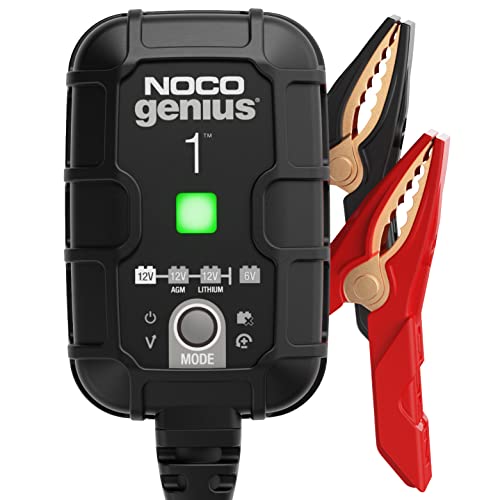
NOCO GENIUS1 Smart Battery Charger — The compact NOCO
The GENIUS1 carries the same intelligence as the GENIUS2 at half the output, and for a single motorcycle that difference mostly evaporates. Its title repeats the family promises — 6V and 12V coverage, overcharge protection, desulfator, temperature compensation, force mode, and compatibility spanning lead-acid in wet, gel and AGM forms plus lithium LiFePO4 — at 1 amp. A motorcycle battery being maintained does not know whether the unit guarding it could deliver one amp or two; it knows only that its voltage is being held. The GENIUS1 is therefore the thinking rider’s single-bike pick: NOCO’s chemistry breadth and recovery tricks, sized to the battery actually in front of it.
The honest limitation is refill pace after a genuine flattening. One amp into a battery that spent a month under a parasitic draw is a slow restoration, and a rider who flattens batteries often — short winter trips that never repay the starter’s draw are the usual cause — will feel the difference between this and the GENIUS2 across a season. But for the far commoner pattern, a bike that is ridden, parked, and guarded, the GENIUS1’s output is correctly matched, and its smaller appetite suits a garage where the maintainer shares an outlet strip with everything else.
- Output: 1A
- System voltages: 6V and 12V
- Chemistries named in the listing title: lead-acid (wet, gel, AGM) and lithium LiFePO4
- Named features: overcharge protection, desulfator, temperature compensation, force mode
- Roles named in the title: charger, trickle charger and maintainer
Strengths
- Full NOCO chemistry coverage, including the lithium mode, in the smaller and simpler unit.
- Force mode is present even at this size, covering the deeply discharged battery scenario.
- One amp is a well-judged maintenance rate for a single motorcycle battery on long connections.
Trade-offs
- Refills after a hard discharge take roughly twice as long as on the GENIUS2.
- Sharing it between a bike and a car battery exposes its pace; the car side will wait.
- As with its sibling, the correct chemistry mode is the owner’s selection to make.
Best for: one bike — lead-acid today or lithium tomorrow — kept on maintenance in a garage where refill emergencies are rare. Not suited for: riders who flatten batteries often, or a two-vehicle rotation where the second vehicle carries a large battery.
Single-bike owners can compare the GENIUS1 listing against its sibling’s and decide whether refill pace justifies stepping up.

OptiMATE Lithium 4s Charger — The lithium specialist
The OptiMATE Lithium 4s, model TM-471, is the only pick here that wants nothing to do with lead-acid, and that single-mindedness is its credential. Its title describes an 8-step, 0.8-amp programme for sealed 12.8-volt lithium batteries, with battery saving named in the description — the recovery behaviour for a lithium battery that has been discharged further than lithium batteries forgive. Lithium packs carry protective electronics, and a pack that has shut itself down in self-defence needs a charger that knows how to wake it gently rather than one that simply refuses or, worse, forces a lead-acid profile into it.
Eight steps sounds like marketing until you map them onto a lithium battery’s life: wake a sleeping pack, test whether it accepts charge, refill at a rate the chemistry tolerates, verify, then maintain at the voltage lithium prefers — which is not the float voltage lead-acid prefers, one of several reasons cross-using chargers between chemistries is a poor idea even when the connector fits. The 0.8A output matches the modest capacity of motorcycle lithium batteries, which trade lead-acid’s bulk for lightness and rarely need bulk current. If your bike runs a lithium battery, this pick and the two NOCO units are the guide’s whole answer, and between them the OptiMATE is the one designed by specialists in exactly this chemistry.
- Output: 0.8A
- Battery target stated in the title: sealed 12.8V lithium batteries
- Programme: 8-step charging and maintaining, with a battery-saving stage named
- Model reference stated in the title: TM-471
- Lead-acid use: outside its stated purpose — this is a lithium-only pick on the evidence of its title
Strengths
- A programme written for lithium alone, including recovery of a pack that has shut down discharged.
- Its maintenance voltage behaviour targets lithium’s preferences rather than lead-acid float habits.
- Eight named steps give the owner a legible sequence to follow during a rescue charge.
Trade-offs
- Useless to the lead-acid majority; a two-battery household needs a second device or a NOCO.
- 0.8A is a maintenance rate — a large lithium bank, if one were fitted, would refill slowly.
- Its specialism only pays off if the bike’s battery is genuinely LiFePO4; check the battery label first.
Best for: a motorcycle running a sealed 12.8V lithium battery, especially one that sits long enough to risk a protective shutdown. Not suited for: any lead-acid battery, a 6V system, or a rider unsure of their battery chemistry who has not read its label.
Lithium-bike owners can read the TM-471 listing and match its 12.8V sealed-battery description against the label on their own pack.
How Do the Six Compare Side by Side?
| Pick | Output | Voltages | Chemistries | Defining trait |
|---|---|---|---|---|
| MOTOPOWER MP00205A | 800mA | 12V | Lead-acid | Four named behaviours including desulfator |
| Battery Tender Junior | 750mA | 12V | Lead-acid | Powersports storage classic, model 021-0123 |
| Battery Tender Plus | 1.25A | 12V | Lead-acid | Float charge named; car and bike coverage |
| NOCO GENIUS2 | 2A | 6V / 12V | Lead-acid + LiFePO4 | Force mode and temperature compensation |
| NOCO GENIUS1 | 1A | 6V / 12V | Lead-acid + LiFePO4 | Same chemistry breadth at half output |
| OptiMATE Lithium 4s | 0.8A | 12.8V lithium | Lithium only | 8-step programme with battery-saving stage |
How Do You Connect a Maintainer for a Whole Winter Without Regretting It?
Begin before the cold does. The maintainer’s ideal starting condition is a healthy, fully charged battery, so give the bike a proper final ride or a full charge first, then clean the terminals while you are there — corrosion under a clamp is resistance the maintainer cannot see past, and winter is a long time to charge through a dirty connection. Check the electrolyte level on a serviceable flooded battery, top up only as its manufacturer directs, and confirm the battery holds its charge overnight disconnected before entrusting it to a season of float; a maintainer can guard a good battery, but it cannot rehabilitate a dying one, and discovering that in April helps nobody.
Route the leads like you mean to forget them, because you will. The connector should sit where it cannot chafe against a frame edge, dangle near the chain, or rest against an exhaust that will be hot the one time the bike is started mid-storage. Many riders fit the charger’s quick-connect pigtail to the battery once and thereafter plug the maintainer into that, rather than wrestling the seat off monthly; whichever arrangement you use, the discipline is the same — connections made deliberately in October stay trustworthy in February, while a clip grabbed in a hurry works loose by Christmas.
Then leave it alone, with two scheduled exceptions. Glance at the unit’s indicator whenever you pass the bike, because a maintainer that has switched itself off after a power cut, or a breaker that tripped in a storm, announces itself only to someone who looks. And if the bike must be started during storage — to move it, say — let it run long enough to repay the starter’s draw, or reconnect the maintainer and let it finish the job; a thirty-second start followed by a month of parking is the one pattern that reliably defeats the whole arrangement.
Why Does a Parked Bike Drain Its Battery Faster Than You Expect?
Three drains work on a parked motorcycle simultaneously. The first is the battery itself: lead-acid chemistry self-discharges sitting on a shelf, faster in warmth than in cold, and a battery stored partly charged sulphates as it slides. The second is the bike: clocks, immobilisers, alarm systems and the small standby appetites of modern electronics draw a continuous trickle that the marketing department never mentions. A draw too small to notice across a weekend becomes a flattened battery across a month. The third drain is the owner’s pattern — short winter trips that take more from the battery at the starter than the ride returns, repeated until the reserve is gone.
Understanding the trio explains the maintainer’s value better than any feature list. The bike’s own charging system was designed on the assumption of regular, decent-length rides; it tops up, it does not restore. A maintainer replaces the assumption with a guarantee, holding the battery at the top of its range where self-discharge does the least damage and the parasitic draw is quietly repaid as it happens. Riders who measure a mysterious flat battery in spring usually find one of the three drains was larger than they believed — most often an alarm or a tracker fitted years ago and forgotten, still sipping in the dark.
How Do You Tell Whether a Battery Deserves a Charger or a Replacement?
Every spring, garages fill with riders performing the same hopeful ritual: connecting a charger to a battery that died two winters ago and interpreting any sign of life as recovery. A disciplined test saves the season. Start by charging the battery fully with the most capable unit available to you — in this guide, the GENIUS2 — then disconnect it completely and let it rest overnight, untouched. A battery that cannot hold a healthy resting voltage through a single quiet night, with nothing drawing on it, has an internal problem that no maintenance regime will outrun. It may still start the bike on a warm afternoon. It will strand you on the first cold morning, which is when starting demands peak and battery output troughs.
Watch behaviour during the charge itself, because the charger is quietly reporting evidence. A battery that races to full suspiciously quickly has usually lost capacity — there is simply less reservoir left to fill — while one that never settles, keeping the charger working and warm for days, may be fighting an internal short or advanced sulphation. Either performance is a diagnosis. Riders often blame the charger for both, swapping units while the battery declines in place; the tell is that a known-good battery on the same unit behaves normally, which is why owners of several bikes possess an accidental laboratory: the charger is rarely the variable.
Age frames the verdict. A conventional lead-acid motorcycle battery lives a handful of seasons under kind treatment, fewer under the parked-and-forgotten regime that makes this guide necessary. When a four-year-old battery that spent two winters unmaintained starts failing tests, replacement is not surrender — it is arithmetic, and the new battery, connected to a maintainer from its first week, will likely outlive its predecessor by years. The chargers in this guide are inexpensive partly because their real economic role is protecting the recurring cost of batteries; spending that protection on a battery already past saving inverts the bargain.
Lithium packs fail differently and deserve a separate paragraph. A lithium battery that has triggered its protective shutdown after deep discharge is not necessarily damaged; it is waiting for a charger that understands the wake-up sequence, which is the OptiMATE’s stated specialism and the reason force-aware lithium modes exist on the NOCO units. Repeated shutdowns, swelling, or a pack that warms noticeably during a gentle charge are different matters entirely — those are retirement signals, and the correct response is to stop charging and replace the pack rather than to shop for a more persuasive charger.
What Changes When the Garage Holds Two or Three Bikes?
Multi-bike ownership quietly rewrites the maintainer maths. One tender rotated weekly among three bikes works on paper, because a charged battery drifts slowly — but rotation depends on the owner’s memory, and memory is the component that fails in February. The failure is invisible until a starter button is pressed in April. Owners of several machines tend to converge on one of two honest systems: a dedicated inexpensive tender per bike, with the Junior and the MOTOPOWER as natural candidates, or a single smarter unit like the GENIUS2 assigned to whichever battery is in trouble, while healthy batteries take turns on a rota written on the garage wall rather than held in the head.
Chemistry mixing sharpens the problem. A garage holding a lead-acid commuter, a lithium-converted weekend bike and a 6-volt classic contains three different charging conversations, and the cost of confusing them ranges from a wasted weekend to a damaged lithium pack. This is the scenario the dual-chemistry NOCO units were plainly designed for, and it is also the scenario where labelling earns its keep: a tag on each lead set naming the bike and battery type it serves turns a shelf of similar black boxes into a system a family member can operate correctly in your absence.
Outlet discipline sounds trivial until a storm trips a breaker feeding four maintainers at once, and every battery in the shed begins its slow slide on the same night. Spread the load where you can, and make the post-storm garage check a habit — thirty seconds of glancing at indicator lights after bad weather protects the entire arrangement. The riders who arrive at spring with three healthy batteries are rarely the ones with the cleverest chargers; they are the ones whose systems assumed forgetfulness, weather and mixed chemistry from the start, and were built to survive all three.
How Does Cold Weather Change the Charging Picture?
Cold is the silent editor of every claim in this category. A lead-acid battery’s available cranking power falls as temperatures drop, at exactly the season when engines turn hardest against thickened oil, so the battery that felt adequate in September can be marginal in January even at the same state of charge. Charging itself slows in the cold, and the voltage a battery wants at freezing differs from the voltage it wants in a warm workshop — which is the practical reason temperature compensation, named on both NOCO units, is more than a spec-sheet ornament. A compensated unit adjusts its behaviour to the garage it is sitting in; an uncompensated one charges to a summer prescription all winter long.
The storage corollary matters just as much: a fully charged battery tolerates deep cold far better than a discharged one, whose electrolyte weakens toward the point where freezing itself becomes possible and the case pays for it. That single fact justifies the maintainer habit more completely than any convenience argument. The rider who connects a tender in November is not pampering the battery; they are keeping its chemistry in the state where winter cannot physically hurt it. Conversely, bringing a frozen-looking, deeply discharged battery indoors and charging it immediately at full enthusiasm is its own mistake — let it warm to room temperature first, then begin gently, and let the charger’s automatic stages make the pacing decisions.
Lithium batteries write their own cold rules. Their discharge performance in the cold is respectable once under way, but accepting a charge at very low temperatures is something lithium chemistry dislikes, and quality packs protect themselves accordingly. Owners of lithium-equipped bikes in unheated northern garages should read their battery maker’s cold guidance alongside the charger listing, and should not interpret a lithium charger pausing in a freeze as a fault. The OptiMATE’s deliberate, stepped programme exists partly for this temperament; patience, with lithium in the cold, is a specification rather than a delay.
Finally, cold garages test the human parts of the system: stiff cables that pull clips sideways, gloves that make small connectors fumble, and daylight that ends before the job feels finished. Set the connection up in autumn, while fingers still work, and the winter asks nothing of you but the occasional glance. Every part of this guide’s advice converges on that pattern — the decisions made early, in comfort, are the ones that determine whether spring begins with a ride or with a battery invoice.
How Do You Read What the Charger Is Telling You Mid-Charge?
Owners treat the little indicator on a maintainer as a verdict light — green good, anything else bad — and miss most of the information it carries. The sequence matters more than any single state. A unit that moves from charging to maintenance over the expected hours is narrating a normal refill; a unit that declares the battery full within minutes of connecting to one you know was drained is narrating lost capacity, and a unit that never leaves the charging stage across two days is narrating a battery that cannot accept a finish line. Learn your own unit’s staging from its manual once, in daylight, and the lights become a diagnostic language instead of a mood lamp.
Touch adds a second channel. A charger body warm under load is ordinary; a battery case warm to the hand during a gentle maintenance charge is not, and a single battery cell area noticeably hotter than the rest deserves disconnection and investigation. Smell is the third channel and the least subtle: a sulphurous, rotten-egg note around a charging lead-acid battery means gas is being produced faster than it should be, which means the session should end, the space should ventilate, and the battery’s condition should be questioned before any charger is trusted with it again.
None of this requires instruments, which is the point. The riders who catch failing batteries early are the ones who treat each charging session as a short inspection — glance, touch, sniff, note anything changed since last time — folded into the thirty seconds of connecting or disconnecting. A maintainer makes battery care easy; it does not make observation obsolete, and the difference between those two ideas is the difference between a battery that retires on schedule and one that fails at a fuel stop two hundred miles from home.
What Mistakes Do Riders Make With Battery Tenders?
The commonest mistake is expecting a maintainer to perform a resurrection. A rider flattens a battery through a winter of neglect, clips on a 750mA tender in March, and condemns the tender when the bike still will not start at lunchtime. The device was asked to do a charger’s heavy refill at a maintainer’s pace, into a battery whose capacity the neglect had already spent. Test the battery honestly first; if it will not hold a charge disconnected, replace it and let the new one live on the maintainer from its first week.
The second mistake is chemistry carelessness: connecting whatever charger is on the shelf to whatever battery is in the bike. A lithium battery on a lead-acid-only tender, or a lead-acid battery on the lithium-only OptiMATE, is a mismatch no connector compatibility can excuse. The third mistake is treating the tender as a starting aid — connecting it, waiting ten hopeful minutes, and thumbing the starter. Nothing in this guide supplies cranking current; that job belongs to a charged battery or a jump pack. The fourth is storage theatre: the tender connected, but to a battery with corroded terminals, in a shed whose outlet is dead, guarding a bike whose alarm drains faster than float repays. The device is only ever one link in a chain the owner assembles.
Final Recommendation
One last consideration belongs to the bike’s next owner as much as to you. A motorcycle sold with a documented charging habit — the maintainer included in the sale, the battery’s age stated honestly, the pigtail already fitted — carries a small but real credibility premium, because every experienced buyer knows that starting reliability is where used bikes lie. The devices in this guide cost little enough that including one in a sale is painless, and the habit they represent says more about how the machine was kept than any polished fairing can.
Match the device to the battery and the calendar. A lead-acid bike stored seasonally is served honestly by the Battery Tender Junior, and by the Plus if a car shares the rotation or the battery sometimes starts the winter less than full. The MOTOPOWER suits the rider who wants one automatic unit to handle both the spring refill and the winter vigil on a conventional battery. Riders with mixed chemistry, a 6V classic, or a habit of finding batteries flat past recognition should buy the GENIUS2; its smaller sibling covers the same ground for a single bike that rarely flattens. Lithium riders should choose between the NOCO pair’s lithium mode and the OptiMATE’s dedicated programme, and nobody in this guide should expect a jump-start from a device whose output is measured in fractions of an amp. Connect the right unit before the battery needs it, and the first start of spring stops being a ceremony of hope.
Frequently Asked Questions
Can I leave a maintainer connected all winter?
That is precisely the duty the automatic units here are built for. A charger that switches to float or maintenance once the battery is full can stay connected for months, sipping only when the voltage drifts. The habits that make it safe are mundane: sound terminals, leads routed away from heat and moving parts, and an occasional glance at the indicator after storms or power cuts.
Will one of these chargers jump-start my motorcycle?
No. Jump-starting demands a brief, heavy burst of cranking current, and the largest output in this guide is 2 amps delivered as charging current. A rider who needs emergency starting should carry a dedicated jump pack; a maintainer’s job is to make sure the morning the pack would be needed never arrives.
My bike has a lithium battery — which picks are safe for it?
The two NOCO units, using their lithium LiFePO4 mode, and the OptiMATE Lithium 4s, which is built for sealed 12.8V lithium batteries alone. The MOTOPOWER and the two Battery Tender models name no lithium programme in their titles, so treat them as lead-acid devices and keep them off a lithium pack.
How long does a flat motorcycle battery take to refill on these?
Overnight is the honest planning figure for the larger units, and a full day for the 750mA and 800mA picks, because small batteries accept gentle current and the final portion of any charge proceeds slowly by design. A battery that still will not hold its charge after a full, patient refill is telling you about its condition, not the charger’s.
What is force mode, and when would I use it?
On the NOCO pair, force mode lets the owner instruct the charger to begin charging a battery so deeply discharged that an automatic unit would otherwise refuse to start, unable to distinguish the battery from an empty clamp. It is a deliberate override for a known situation — a battery flattened by a light left on — not a everyday setting, and a battery needing it repeatedly is a battery asking to be tested.
Does a desulfator bring a dead battery back to life?
It can recover some capacity from a lead-acid battery whose plates carry early, soft sulphation from sitting discharged, which is why the MOTOPOWER and NOCO units include the function. It cannot reverse the damage of a battery left flat for seasons, and no pick here should be bought as a resurrection machine; buy it as prevention, and let any recovery be a pleasant surprise.
Related Guides
Related guides
- Best 14-Inch High-End Laptops: Flagships From Apple, Lenovo, ASUS and LG
- Best 15 Laptops Under $1000: Six 15-Inch Machines That Spend the Budget Honestly
- Best Battery NiMH Chargers: Six Units That Understand the Chemistry
- Best 3D Printers With Auto Leveling: Beds That Set Themselves, Ranked by How Much Else They Calibrate


