What's inside
- Key Takeaways
- Quick Picks
- How We Chose These Picks
- Comparison Table
- How long do the best 10 amp auto battery chargers take to charge a car battery?
- What is the difference between a charger, a maintainer and a jump starter?
- How do you charge a battery safely in a home garage?
- Which battery types need which charging mode?
- When is 10 amps the wrong rate?
- What should you check when a charger will not start charging?
- How do onboard and portable chargers compare over years of ownership?
- Common Mistakes
- Final Recommendation
- Frequently Asked Questions
- Related Guides
As an Amazon Associate I earn from qualifying purchases. This post may contain affiliate links at no extra cost to you.
widgetverdict.com is reader-supported. When you buy through links on our site, we may earn an affiliate commission.
Shopping for the best 10 amp auto battery chargers usually starts with a car that would not start on the one morning you could not be late. A 10-amp charger sits in the useful middle of the home-garage range: strong enough to bring a flattened car battery back to a startable state in hours rather than days, yet gentle enough, in smart form, to stay connected to a stored vehicle without cooking the plates. The six chargers reviewed below cover onboard units that live under a hood, bench chargers that shuttle between a truck and a lawn tractor, and one compact 5-amp maintainer we included deliberately, because plenty of readers who search for 10-amp charging actually need steady maintenance more than raw recovery speed.
Where to buy: each main pick links to a checked Amazon listing, and we flag the honest mismatches rather than hiding them. One pick here is a 6-amp unit and another is a 5-amp unit; both earned their places for specific jobs, and their sections say plainly what they cannot do. A seventh name, the NOCO Genius G7200, gets a prose mention in the buying-guide section because older garage guides still recommend it, but it carries no purchase link in this article. Listings change and stock rotates, so check price on Amazon when you are ready to order instead of trusting any figure printed in a guide like this one.
One safety note before the rankings. Modern smart chargers analyse the battery, adjust current as voltage rises, and shut down or float when the job is done. Older transformer chargers with a simple ammeter needle do none of that, and leaving one connected overnight is how batteries get overcharged. Every pick in this guide is a smart charger with automatic shutoff or float behaviour, spark protection, and reverse-polarity warnings, because a charger that guards against the two most common garage mistakes — reversed clamps and forgotten connections — is worth more than a slightly faster bulk charge.
A word on who this guide leaves out. Drivers whose only problem is a car stranded away from home need a jump pack, not anything reviewed here, and owners of 24-volt truck systems need chargers built for that voltage, which none of these six are. Everyone else — the boat owner, the two-car household, the parent rescuing a teenager’s sedan for the third time this year — will find their situation described somewhere in the six sections below, with the compromises stated before the purchase rather than discovered after it.
Key Takeaways
- The NOCO GENPRO10X1 is the charger to bolt into a boat or truck and forget, since its sealed onboard housing shrugs off bilge splash and road grime.
- TowerTop’s selectable 2/10/25-amp output makes it the most flexible bench unit here, covering motorcycles through diesel pickups with one box.
- A two-bank charger such as the NOCO GEN5X2 solves the two-battery problem — boat house and start batteries, or a car and a tractor — without buying two separate units.
- True 10-amp output matters for recovery; the 5-amp and 6-amp picks in this list maintain beautifully but revive a deeply discharged battery slowly.
- AGM, gel, lithium and flooded batteries each want a different charge profile, so a charger with a selectable battery-type mode is not a luxury feature.
- Desulfation and repair modes can rescue some neglected batteries, but no charger reverses a shorted cell — test before you blame the charger.
Quick Picks
| Pick | Badge | Why it makes the cut |
|---|---|---|
| NOCO GENPRO10X1 | Best onboard | Fully sealed 10-amp onboard charger built to live permanently in a boat or engine bay. |
| TowerTop 2/10/25A Smart Charger | Most versatile bench charger | Three selectable charge rates plus repair mode in a fan-cooled workshop unit. |
| Schumacher SC1361 | Best workshop value pick | A 6-amp charger and maintainer from a long-running garage brand, with a clear rate display. |
| NOCO GEN5X2 | Best for two batteries | Two independent banks delivering 10 amps total, so two batteries charge on their own schedules. |
| NOONE 10A/20A Smart Battery Charger | Fastest recovery here | Selectable 10-amp or 20-amp output with temperature compensation for cold garages. |
| NOCO GENIUS5 | Best compact maintainer | A 5-amp charger small enough for a glovebox that still handles lithium and 6-volt batteries. |
How We Chose These Picks
We started by separating chargers that genuinely deliver around 10 amps of bulk current from units whose headline number describes a brief engine-start assist rather than sustained charging. That distinction eliminates a surprising share of the market. A charger that can push 10 amps for the first hour and taper sensibly will recover a discharged sedan battery far sooner than a unit advertising a big number it can only hold for minutes. Sustained output, verified against manufacturer specifications rather than box art, was the first filter.
The second filter was charge-profile intelligence. Each pick had to offer automatic multi-stage charging — analysis, bulk, absorption and float or an equivalent sequence — and selectable modes for the battery chemistries a home garage actually contains. Flooded lead-acid remains the default, but AGM batteries now ship in many start-stop vehicles, gel cells appear in mobility and marine gear, and lithium iron phosphate is spreading through powersports. A charger locked to one profile ages badly in a mixed garage.
Protection behaviour came next. We looked for reverse-polarity detection that refuses to charge rather than sparking, spark-proof clamp connection, thermal compensation or at least thermal shutdown, and housings rated for the environments these chargers live in. Onboard marine units need genuine water resistance; bench units need cooling that does not quit in a hot July garage. Finally, we weighed the human factors: clamp quality, cable length, display readability, and whether the controls make sense to someone kneeling on cold concrete with a torch between their teeth.
Ownership cost over time also shaped the list. A charger is one of the few garage tools bought to protect a more expensive consumable, and a cheap unit that undercharges — leaving a battery at ninety percent, cycle after cycle — quietly manufactures the early battery failure it was bought to prevent. We favoured chargers whose absorption and float behaviour we could verify from specifications and documentation over units advertising impressive amperage with no described programme behind it. The six that remain are the ones we would hand to a family member without a follow-up lecture.
We also kept two honest exceptions in the final six. The Schumacher SC1361 charges at 6 amps and the NOCO GENIUS5 at 5 amps, below the headline rate of this guide. They stay because reader behaviour says many people searching for a 10-amp charger end up happiest with a slightly slower unit that maintains better, costs them less worry, and fits the battery they actually own. Their sections state the trade-off in plain terms, and the comparison table shows the real output of every pick side by side.

NOCO GENPRO10X1 — Best onboard
The GENPRO10X1 belongs to a different category of ownership from everything else in this guide. Instead of living on a shelf and travelling to whichever battery needs help, it bolts down permanently — in a boat’s battery compartment, under the hood of a work truck, inside the battery box of a travel trailer — and charges the moment shore power or an extension lead reaches it. That single design decision shapes everything about the unit: the housing is fully sealed against water and dust, the case is built to take vibration that would rattle a bench charger apart, and the charging leads are meant to be ring-terminalled to the battery once and left alone.
Output is a true 10 amps into a 12-volt battery, with selectable profiles for flooded, AGM, gel and lithium chemistries, plus a repair mode aimed at stratified or lightly sulfated batteries. NOCO’s thermal sensor adjusts charge voltage against ambient temperature, which matters more in an engine bay than on a workbench: a battery baking at summer temperatures wants a lower absorption voltage than the same battery on a frosty morning, and chargers that ignore temperature quietly shorten battery life in hot climates. The unit also works as a small power supply, holding a steady voltage for tasks such as changing a battery without losing vehicle settings or running 12-volt accessories on the bench.
Installation deserves honest discussion. Mounting takes real time — finding a flat surface, routing cables away from exhaust heat and moving belts, crimping or confirming ring terminals — and once fitted, the charger serves that one vehicle only. Owners with three needy vehicles will find a portable unit more sensible. The status LEDs are informative but small, and reading charge stage from across a dark engine bay is harder than glancing at the TowerTop’s big display. None of that dents the core appeal: for a boat that sits on a trailer five days a week, or a plow truck that must start on the coldest morning of the year, a sealed onboard charger that simply keeps the battery full is the most reliable arrangement money buys in this class.
Daily life with the GENPRO10X1 fitted is defined by an absence: the absence of the flat-battery moment. Anglers who launch at dawn, guides whose bookings depend on a trolling motor and a starting battery both being ready, and snowplow contractors working storm rotations all describe the same relief — the boat or truck is simply ready, every time, because charging happened automatically after the last trip rather than hopefully before the next one. The unit’s tolerance for being hosed down with the rest of the boat and for living in compartments that swing between damp cold and engine heat is what separates it from a bench charger lashed in place as an improvisation, a setup that corrodes and fails within a season or two.
- Charge rate: 10 amps, 12-volt systems
- Battery types: flooded, AGM, gel, lithium (LiFePO4)
- Mounting: permanent onboard, bolt-down housing
- Protection: fully sealed waterproof and dustproof case, thermal compensation
- Extra mode: repair mode and 12-volt power-supply mode
Strengths
- Sealed housing survives bilge water, pressure washing and road salt that would kill a bench charger.
- Temperature-compensated charging protects batteries in hot engine bays and cold storage alike.
- Set-and-forget operation: connect shore power and the battery is maintained indefinitely.
Trade-offs
- Permanent mounting means one charger per vehicle; it cannot wander the garage.
- Installation takes an hour or more of careful cable routing on most vehicles.
- Small status LEDs are harder to interpret than a numeric voltage display.
Best for: boat owners and work-truck drivers who want one specific battery kept full automatically, season after season, without ever opening a charger box. Not suited for: renters or multi-vehicle households that need one charger to visit several batteries in different places.

TowerTop 2/10/25A Smart Charger — Most versatile bench charger
TowerTop built this unit around a simple observation: the garage that owns a car usually owns smaller and bigger batteries too. A selector offers 2-amp, 10-amp and 25-amp charge rates, so the same box trickles a motorcycle battery through winter, charges a family sedan at the guide’s headline rate, and leans harder on a big diesel truck battery that needs to be usable by morning. The 25-amp setting exceeds what this guide is nominally about, and we count that as flexibility rather than cheating — you select the rate, and the charger still runs its automatic multi-stage programme at whichever rate you picked.
A fan-cooled aluminium-leaning design keeps the unit working through long high-rate charges in warm weather, and the front panel shows voltage and charge progress in large characters readable from a crouch. The programme covers flooded, AGM and gel batteries, includes a repair mode that pulses a neglected battery in an attempt to break down sulfate crystals, and finishes in a float stage that can stay connected to a stored vehicle. Clamp leads are a sensible length for reaching from a bench to a battery still installed in the car, and the clamps themselves have enough jaw to bite corroded terminals that defeat flimsier hardware.
The compromises are the usual ones for a powerful bench unit. The cooling fan is audible — not objectionable in a workshop, but noticeable if the charger runs overnight in an attached garage under a bedroom. The case is splash-tolerant at best, so it should live indoors rather than in an open carport. And the 25-amp rate demands respect: it suits large batteries, while small powersports batteries should stay on the 2-amp setting, a choice the charger leaves to you rather than enforcing. Owners who read the manual’s rate table once will get years of flexible service from it; owners who treat the biggest number as the default will shorten small batteries’ lives.
Workshop owners will also appreciate how the TowerTop behaves as a shared tool. The controls survive being operated by whoever in the household drew the dead-battery short straw: a rate selector, a mode button, and a display that reports what is happening in numbers rather than in a code of blinking lights that requires the manual to interpret. In a family garage where the charger gets used by teenagers, grandparents and the occasional neighbour, that legibility prevents the classic shared-tool failure — the unit left on the wrong setting from the last job, quietly mistreating the next battery connected to it.
- Charge rates: 2, 10 and 25 amps selectable, 12-volt systems
- Battery types: flooded, AGM, gel
- Display: large digital readout of voltage and charging stage
- Cooling: internal fan, workshop bench design
- Extra mode: battery repair (desulfation) programme
Strengths
- Three rates cover motorcycles, cars and large truck batteries with one purchase.
- Big, legible display makes charge progress obvious at a glance.
- Repair mode gives neglected batteries a genuine second chance.
Trade-offs
- Cooling fan is audible during long high-rate charges.
- Not sealed against water; indoor or covered use only.
- No lithium profile, so LiFePO4 batteries need a different charger.
Best for: a one-charger household whose battery fleet ranges from a lawn tractor to a diesel pickup and wants rate control on a clear display. Not suited for: lithium battery owners, or anyone needing a charger that lives outdoors in the weather.

Schumacher SC1361 — Best workshop value pick
Schumacher has sold battery chargers to American garages for generations, and the SC1361 shows that heritage in its priorities: a straightforward 6-amp charge rate, a 3-amp maintenance mode, clear rate selection, and controls a first-time user can decode without a video tutorial. We are stating its output plainly because honesty matters more than the headline of this guide — at 6 amps it is not a 10-amp charger, and a fully flattened large battery will take noticeably longer on it than on the GENPRO10X1 or the NOONE. What it offers instead is an undemanding, well-sorted maintainer-charger for the single-car household whose battery rarely falls below half.
The charging programme is fully automatic, moving from bulk charge into a float-maintenance stage that can stay connected for months, which makes the SC1361 a sensible answer for the classic second car, the convertible that sleeps through winter, or the mower battery that dies every spring. It handles standard flooded and AGM batteries, includes auto-voltage detection safeguards, and protects against reversed clamps by refusing to charge and flagging the error rather than punishing it. The housing is a bench unit in the traditional mould — vented, upright, with a handle — and it feels built for a shelf in a dry garage rather than a boat locker.
Where it falls behind the newer designs is information and chemistry range. There is no lithium mode, no dedicated gel profile, and no repair programme for sulfated batteries, so owners of powersports lithium packs or badly neglected batteries should look elsewhere in this list. Feedback during charging is more basic than the NOCO units’ staged LEDs or TowerTop’s numeric display. Yet there is a real audience for exactly this: a driver who wants a known brand, two buttons, and a battery that is simply ready whenever the car is needed. For that reader, the SC1361’s restraint is the feature.
- Charge rates: 6-amp charge, 3-amp maintain, 12-volt systems
- Battery types: standard flooded and AGM
- Operation: fully automatic with float maintenance
- Protection: reverse-polarity warning, auto shutoff into float
- Form: upright bench housing with carry handle
Strengths
- Dead-simple controls suit first-time charger owners.
- Float maintenance keeps a stored vehicle ready indefinitely.
- Long-established brand with wide parts and support availability.
Trade-offs
- 6-amp ceiling means slow recovery on large, deeply discharged batteries.
- No lithium or gel profiles and no desulfation repair mode.
- Basic feedback compared with display-equipped rivals.
Best for: a single-car household or winter-stored second car that needs dependable charging and months-long maintenance without a learning curve. Not suited for: owners of lithium batteries, sulfated project-car batteries, or anyone in a hurry to revive a big dead battery.
NOCO GEN5X2 — Best for two batteries
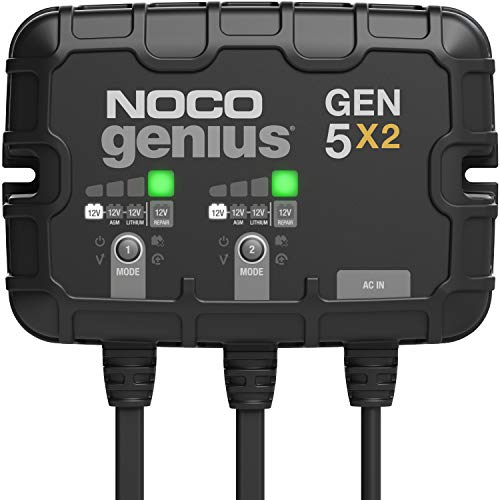
Two batteries are the quiet reality of a lot of driveways and docks: a boat with separate start and house batteries, a motorhome with a chassis battery and a leisure battery, a farm gate opener beside the tractor it serves. The GEN5X2 answers that reality with two fully independent charging banks in one sealed onboard housing, delivering 10 amps in total — 5 amps per bank when both are working. Each bank runs its own programme, so a nearly full start battery can sit in float while the deep-cycled house battery is still absorbing charge beside it, something a single charger with split leads can never do properly.
Like its single-bank sibling, the GEN5X2 is built to be installed and left: waterproof sealed construction, tolerance for vibration, thermal compensation that trims voltage to suit the compartment’s temperature, and profiles for flooded, AGM, gel and lithium batteries. A repair mode serves each bank, and a power-supply mode helps during battery swaps. Mounting two sets of leads doubles the installation work of the GENPRO10X1, and cable routing between battery boxes that sit apart — common on larger boats — needs planning so the fixed lead lengths reach without strain or chafe.
The honest limitation sits in the arithmetic. Five amps per bank maintains and recovers modest batteries well, but a large house bank that has been drawn down hard over a weekend will take a long time to refill at 5 amps, and owners of big lithium banks should size up to higher-output onboard systems instead. For the common case — two automotive-size batteries that need to be full every Friday — the GEN5X2 removes an entire category of faff: no swapping clamps between batteries, no second charger to store, no arguments about which battery got charged last.
Motorhome owners make the case for this unit most vividly. A leisure battery that runs lights, a water pump and a television through an evening arrives at the charger in a very different state from the chassis battery that merely started the engine that morning. Charging both from one single-output unit with split leads forces a compromise voltage on two batteries at two different states of charge, and the fuller battery pays for the emptier one’s appetite. The GEN5X2’s banks simply refuse that compromise: each battery gets the programme its own condition calls for, which is the technically correct arrangement and, over seasons, the cheaper one in battery replacements avoided.
- Output: 10 amps total across 2 independent banks (5 amps each)
- Battery types: flooded, AGM, gel, lithium (LiFePO4)
- Mounting: permanent onboard, bolt-down sealed housing
- Protection: waterproof sealed case, thermal compensation per bank
- Extra modes: repair mode, power-supply mode
Strengths
- Two genuinely independent programmes charge mismatched batteries correctly at the same time.
- Sealed marine-grade housing matches the single-bank model’s durability.
- Eliminates clamp-swapping for boats and motorhomes with twin battery systems.
Trade-offs
- 5 amps per bank is slow for large, deeply discharged house banks.
- Fixed lead lengths can complicate installations with widely separated batteries.
- Double the wiring work of a single-bank onboard install.
Best for: boat and motorhome owners with separate start and house batteries who want both maintained automatically from one shore-power connection. Not suited for: owners of one very large battery bank that needs high single-output charging, or renters who cannot bolt equipment down.

NOONE 10A/20A Smart Battery Charger — Fastest recovery here
The NOONE charger is the pick for the reader whose battery is dead now and whose patience is short. Its selectable output runs at 10 amps for ordinary charging or 20 amps when a large battery needs maximum sensible speed, and it layers on temperature compensation that adjusts the programme for winter garages and summer heat — a feature that used to belong only to premium brands. Seven-stage automatic charging carries the battery from analysis through bulk and absorption into float, and a dedicated repair mode attempts recovery on batteries that have sat discharged.
A clear display reports voltage and mode, and the unit covers the chemistries a modern mixed garage holds: flooded, AGM, gel and lithium iron phosphate, in 12-volt systems, with a lower-current mode suitable for smaller batteries. Pulse maintenance during float keeps a connected battery topped without the slow overcharge damage of old trickle boxes. The housing is a portable bench design with a handle, intended to travel between vehicles rather than bolt into one, and the clamps and leads are sized for that roving life.
Speed has boundaries the manual respects and owners should too. Twenty amps suits large automotive and truck batteries; pushing that rate into a small motorcycle battery is abuse the charger will allow if you select it, so rate discipline sits with the user. The unit is not sealed for marine installation, and its display, while clear, reports less diagnostic detail than a dedicated battery tester. Judged as a fast, flexible bench charger for households that regularly rescue big batteries — a work van on Monday, a parent’s sedan on Saturday — it earns its place as the quickest route back to a turning starter in this guide.
There is also a diagnostic honesty to a charger that works quickly: it separates the merely discharged from the genuinely dying. Put a healthy but flat battery on the NOONE at 20 amps and the programme marches through its stages in a predictable arc; put a failing battery on the same setting and the abnormal behaviour — voltage that sags, a stage that never completes, heat that should not be there — announces itself within the hour rather than after an overnight wait. For a small workshop or a family that maintains several vehicles, that speed of information is worth nearly as much as the speed of the charge itself.
- Charge rates: 10-amp and 20-amp selectable, plus low-current mode, 12-volt
- Battery types: flooded, AGM, gel, lithium (LiFePO4)
- Programme: 7-stage automatic charging with pulse maintenance
- Compensation: automatic temperature adjustment
- Extra mode: repair mode for discharged batteries
Strengths
- 20-amp rate revives large batteries faster than anything else in this guide.
- Temperature compensation protects batteries in unheated winter garages.
- Broad chemistry support including lithium iron phosphate.
Trade-offs
- High rate can be misapplied to small batteries; selection is the user’s job.
- Bench housing is not sealed for permanent marine mounting.
- Display shows charging data, not full battery health diagnostics.
Best for: households and small workshops that repeatedly rescue large, deeply discharged 12-volt batteries and want recovery measured in hours, not overnight. Not suited for: permanent onboard installation in wet compartments, or forgetful users who will not match charge rate to battery size.

NOCO GENIUS5 — Best compact maintainer
The GENIUS5 is the charger we recommend to the reader who finishes this guide suspecting that 10 amps was never really their requirement. It delivers 5 amps — half the headline rate — from a body small enough to disappear into a glovebox or a motorcycle’s storage compartment, and it does so with a sophistication the bigger budget units lack. It charges 6-volt and 12-volt batteries, handles flooded, AGM, gel and lithium chemistries, includes a dedicated repair mode, and compensates for temperature as it charges. For a battery that starts the day mostly charged — which describes most batteries most of the time — 5 amps is ample, and the maintenance intelligence matters more than bulk speed.
Its party piece is reviving batteries that other chargers refuse. A force mode allows charging to begin on batteries discharged down to very low voltage, the situation that leaves many smart chargers blinking an error at exactly the moment you need them most. Thermal sensing adjusts output so a battery in a freezing garage is not undercharged and one in a hot shed is not overcooked. The clamps are compact, the housing shrugs off workshop knocks, and the whole unit runs silently, which suits an attached garage or a storage unit where a fan-cooled box would drone.
The trade is time, and it is a real one. A large SUV battery run flat by an interior light will take most of a day to refill at 5 amps, and if your pattern of life involves repeatedly rescuing big dead batteries, the NOONE or TowerTop will serve you better. The GENIUS5 also serves one battery at a time with no expansion path. Within its brief — keeping cars, bikes, mowers and boats’ smaller batteries healthy, and rescuing the occasional deeply discharged one given time — it is the most complete small charger in this guide, and the one most likely to still be in daily use a decade from now.
- Charge rate: 5 amps, 6-volt and 12-volt systems
- Battery types: flooded, AGM, gel, lithium (LiFePO4)
- Revival: force mode starts charging on deeply discharged batteries
- Compensation: integrated thermal sensor
- Extra mode: battery repair mode
Strengths
- Exceptionally small and silent; stores anywhere, runs unnoticed.
- Force mode rescues deeply discharged batteries rivals reject.
- 6-volt support covers classic cars and older motorcycles.
Trade-offs
- 5-amp output makes large flat batteries an all-day project.
- Single battery only; no multi-bank option in this size.
- Compact clamps can feel fiddly on large truck terminals.
Best for: motorcyclists, classic-car owners and second-car households whose real need is intelligent maintenance plus occasional gentle recovery. Not suited for: fleets, diesel trucks, or anyone whose batteries regularly die completely and must be back by morning.
Comparison Table
| Pick | Max output | Battery types | Form | Standout trait |
|---|---|---|---|---|
| NOCO GENPRO10X1 | 10A | Flooded, AGM, gel, lithium | Onboard, sealed | Permanent marine-grade installation |
| TowerTop 2/10/25A | 25A | Flooded, AGM, gel | Bench, fan-cooled | Three selectable rates, big display |
| Schumacher SC1361 | 6A | Flooded, AGM | Bench, upright | Simplest controls in the guide |
| NOCO GEN5X2 | 10A total, 2 banks | Flooded, AGM, gel, lithium | Onboard, sealed | Two independent charging banks |
| NOONE 10A/20A | 20A | Flooded, AGM, gel, lithium | Portable bench | Fastest recovery, temp compensation |
| NOCO GENIUS5 | 5A | Flooded, AGM, gel, lithium | Compact portable | Force mode for dead batteries, 6V support |
How long do the best 10 amp auto battery chargers take to charge a car battery?
Work from capacity, not hope. A typical car battery holds somewhere around 50 to 70 amp-hours of usable rating, and a battery that will not start the car has usually given up roughly half its charge. Replacing 30 amp-hours at 10 amps sounds like a three-hour job, and the bulk stage does run at about that pace — but charging is not linear. As the battery approaches full, the charger tapers current through the absorption stage to protect the plates, so the last portion arrives slowly. A realistic expectation for a half-discharged car battery on a 10-amp charger is four to six hours to a genuinely full charge, with the car startable well before that, often within the first hour or two.
Temperature bends those numbers. A battery in a freezing garage accepts charge reluctantly, which is why temperature-compensated chargers such as the NOONE and the NOCO models adjust their programme in cold weather. Battery size bends them further: the same 10 amps that refills a compact hatchback battery by lunch will still be working on a large diesel truck battery at dinner. If your household’s pattern involves a big battery and a deadline, the 20-amp rate of the NOONE or the 25-amp setting of the TowerTop exists precisely for that arithmetic.
One more distinction matters: charging to start is not charging to full. Jump-starting a car and driving it hands the alternator a job it does poorly — alternators maintain charge; they are not designed to refill a deeply discharged battery, and asking them to do it repeatedly shortens both alternator and battery life. When a battery has gone flat, give it a complete charger cycle before judging it, because a battery tested half-charged looks guilty of failures it did not commit.
What is the difference between a charger, a maintainer and a jump starter?
These three tools solve three different problems, and confusing them wastes money. A charger, the subject of this guide, refills a battery over hours using mains power, ideally through a multi-stage programme that ends in float. A maintainer is a charger optimised for the last stage of that work: low current, indefinite connection, keeping a stored battery at full charge against the slow self-discharge and parasitic drains that kill batteries in garages every winter. Several picks here, notably the GENIUS5 and the SC1361, are really maintainer-first designs with enough output to charge as well.
A jump starter is a battery for your battery — a portable pack that delivers a burst of cranking current to start the engine now, then needs recharging itself. It solves the stranded-in-a-car-park problem and nothing else; it does not refill your car battery, repair sulfation, or maintain anything. Many households end up owning both a smart charger at home and a jump pack in the boot, and that pairing is rational: the pack handles emergencies away from home, the charger handles health at home.
The older NOCO Genius G7200 belongs in this explanation because so many garage forums still cite it. It was a respected 7.2-amp smart charger from an earlier NOCO generation, covering similar chemistries to the GENIUS5 and GENPRO lines, and owners who have one in working order have no urgent reason to replace it. We mention it by name only, without a purchase link, because current buying advice should point at the models in this guide’s main list, whose listings we verified for this article.
How do you charge a battery safely in a home garage?
Start with the battery itself. Check the casing for cracks or bulging and the terminals for heavy corrosion; a battery that is physically damaged or swollen should be replaced, not charged. On a serviceable flooded battery, electrolyte should cover the plates in every cell. Work in ventilation — charging produces small amounts of hydrogen gas, trivial in an open garage and a genuine hazard in a sealed small space — and keep sparks, cigarettes and grinding tools away from the battery while connections are made or broken.
Connection order is the ritual that prevents the classic mistake. With the charger unplugged or switched off, connect the positive clamp to the positive terminal first, then the negative clamp to the negative terminal or, better, to a solid engine-bay ground point away from the battery. Only then connect the charger to mains power and select the programme. Removal runs in reverse: mains off first, negative clamp off first. Every charger in this guide detects reversed clamps and refuses to charge, but the ritual costs nothing and protects older equipment and jump packs that lack the safeguard.
Decide honestly whether the battery comes out of the car. Modern vehicles tolerate in-car charging from a smart charger well, provided clamps are secure and the charger is a regulated multi-stage unit like the six reviewed here. Removing the battery makes sense when terminals need cleaning, when the battery sits somewhere inaccessible, or when you suspect case damage. If you do remove it, charge it on a wooden board or mat rather than bare cold concrete, keep it level, and refit it promptly — a charged battery stored on a shelf loses its charge to self-discharge within weeks to months depending on type and temperature.
Which battery types need which charging mode?
Flooded lead-acid, the traditional serviceable battery, tolerates the widest range of charging and benefits from a full absorption stage. AGM batteries — fitted to most start-stop vehicles and many premium cars — charge at slightly different voltages and, critically, should not be equalised the way flooded batteries sometimes are; an AGM mode respects that ceiling. Gel batteries are the most voltage-sensitive of the lead family and want the gentlest profile of all. Selecting the wrong mode rarely causes instant drama, but repeated charging of an AGM battery on a hot flooded programme, or a gel battery on anything aggressive, quietly takes months off its life.
Lithium iron phosphate, increasingly common in powersports, marine house banks and lightweight performance applications, is a different chemistry entirely: it wants a lithium profile with no desulfation pulses and no temperature-compensated voltage swings designed for lead. Of the picks here, the NOCO models and the NOONE carry lithium modes; the TowerTop and Schumacher do not, which is a hard dividing line for lithium owners rather than a soft preference. If your battery’s label says LiFePO4, treat a lithium mode as non-negotiable.
When in doubt, the battery label and the vehicle handbook outrank any guide, including this one. Manufacturers print the chemistry on the case, and many modern cars specify the battery type in the owner’s manual because the vehicle’s own charging system is programmed around it. Match the charger’s mode to that printed chemistry, and when a battery’s type genuinely cannot be determined, charge it on the standard flooded setting at a moderate rate and monitor it — the conservative programme is the safest default.
When is 10 amps the wrong rate?
Ten amps is a sensible default for automotive batteries, but three situations call for less. The first is any small battery: motorcycle, ATV, lawn tractor and mobility batteries hold a fraction of a car battery’s capacity, and 10 amps into a 12-amp-hour battery is a violent rate that generates heat and shortens life. Drop to the 2-amp setting on the TowerTop, the maintenance rate on the Schumacher, or a compact unit such as the GENIUS5 whose entire output suits small batteries. The second situation is a battery in poor condition being given a first charge after months of neglect; a gentle rate with a repair programme gives the chemistry time to recover and gives you time to notice a battery that grows hot, which is a stop signal at any rate.
The third situation is heat itself. Charging a battery in a closed vehicle boot on a scorching day, at maximum rate, stacks ambient heat on charging heat. Temperature-compensated chargers reduce their voltage in the heat, but the owner can help by charging in shade or with the compartment open. Conversely, in deep cold a battery accepts charge slowly whatever the dial says, and warming the battery — by bringing a removable one indoors for a few hours — does more for charge acceptance than any rate increase. Rate selection is where charger ownership stops being plug-and-play and becomes judgement; the six units here give you the options, and the battery’s size, condition and temperature tell you which to choose.
What should you check when a charger will not start charging?
Begin at the terminals, because most refusals are born there. A smart charger must sense battery voltage before it will begin, and a layer of corrosion, a clamp bitten onto a plastic-covered post, or a loose ring terminal can hide that voltage completely. Clean the posts to bright metal, reseat the clamps with a wiggle that bites through surface film, and try again. Next, measure the battery if you own a multimeter: a battery sitting below the charger’s minimum detection threshold — common after months of discharge — may need the GENIUS5’s force mode, which is designed to start charging into a nearly flat battery that other units declare absent.
If connections are clean and voltage exists, check the obvious trio: mains power at the outlet, the correct chemistry mode for the battery in front of you, and any error code against the manual’s table rather than guesswork. A charger that begins, then stops repeatedly, is often reporting a battery that cannot accept charge — the shorted-cell scenario described in the mistakes section — and the honest test is a load test at a parts store. What you should not do is defeat the safeguards: no charger in this guide needs its clamps held in place, its polarity warnings ignored, or its case opened. A refusal is information, and nine times in ten it is the battery or the connection confessing, not the charger failing.
How do onboard and portable chargers compare over years of ownership?
The purchase price of the two styles looks similar, so the real comparison is behavioural. A portable charger only works when someone remembers to fetch it, connect it and select the right programme; an onboard charger works every time its vehicle is plugged in, with no memory involved. Over five winters, that difference decides which battery survives. Boat batteries maintained by an onboard GENPRO or GEN5X2 routinely outlast identical batteries on portable chargers simply because the maintenance never gets postponed. Reliability compounds quietly, and batteries are where quiet reliability pays.
Portable units win the comparison on flexibility and diagnosis. One TowerTop or NOONE serves every battery a household owns, travels to a neighbour’s driveway, and — with its display — tells you more about what it found. Onboard units also age with their vehicle: sell the boat and the charger leaves with it, while the portable box stays on your shelf. The households that think this through usually land on a pattern rather than a winner: onboard for the one vehicle that sits longest and matters most, portable for everything else, and a compact maintainer like the GENIUS5 filling the gap for bikes and seasonal machines. That layered approach costs less than replacing batteries early, which is the expense all of this equipment exists to prevent.
Common Mistakes
The most expensive mistake is charging a battery that has already failed internally and interpreting the charger’s error light as a charger fault. A battery with a shorted cell will accept charge endlessly, grow warm, and never reach full voltage; no repair mode fixes a short. Test a suspect battery — most parts stores will load-test one free — before buying a second charger to replace a first charger that was telling the truth.
Second comes rate impatience: selecting the highest output for every battery. Small batteries charged hard and often lose capacity early, and sealed batteries can vent if driven too fast. Match the rate to the battery size — the general guidance is a charge rate around a tenth of the battery’s amp-hour capacity for routine work — and reserve the big numbers for big batteries with deadlines.
Third is the forgotten chemistry setting, particularly after a charger has been lent to a neighbour or moved between vehicles. An AGM battery charged repeatedly on a lithium or repair programme, or a lithium battery exposed to desulfation pulses, ages in ways the owner never connects to the charger. Make a habit of confirming the mode at every connection; it takes two seconds.
Finally, owners defeat good chargers with bad connections. Clamps bitten onto corrosion rather than clean metal, ring terminals left loose on an onboard install, extension leads of hair-thin cable dropping voltage over a long run — each produces slow charging that gets blamed on the unit. Clean terminals to bright metal, tighten hardware, and keep mains leads appropriately rated, and the charger you already own will often turn out to have been fine all along.
Final Recommendation
Choose by installation, then by battery fleet. If one vehicle matters most and it lives near a power outlet — a boat on a trailer, a truck in a barn — the sealed onboard route is the most dependable: the GENPRO10X1 for a single battery, the GEN5X2 when start and house batteries both need care. If your charger must roam, the TowerTop’s three rates make it the flexible workshop default, the NOONE is the recovery specialist for big batteries on deadlines, and the Schumacher SC1361 covers the simple single-car case without fuss. And if reading this guide has clarified that your batteries are rarely flat, merely neglected, the little GENIUS5 is the honest answer: half the amps, twice the convenience, and the maintainer most owners will actually use every single week. A battery kept full by any of these six will outlast one rescued dramatically twice a year — the quiet charger on the shelf, plugged in and patiently working, is the one that saves you money year after year.
Frequently Asked Questions
Can you leave a smart charger connected all winter?
Yes — that is exactly what float or maintenance mode is for, and every pick in this guide provides it. The charger holds the battery at full charge, replacing self-discharge losses, and a battery kept full through winter typically lasts far longer than one left to sit discharged, because sulfation hardens while a battery sits low. Check the connection monthly, keep the area ventilated, and confirm the charger shows its maintenance stage rather than still bulk-charging, which would suggest a battery problem.
Will a 10-amp charger damage a motorcycle battery?
It can if the rate is not reduced. Small powersports batteries want a low charge rate — the TowerTop’s 2-amp setting, the Schumacher’s maintenance mode, or the GENIUS5’s small-battery-friendly programme are appropriate, while a fixed 10 or 20 amps is too aggressive for routine use. If your charger offers no low rate, it is the wrong tool for the bike, however good it is on the car.
What does a repair or desulfation mode actually do?
When a lead-acid battery sits discharged, lead sulfate crystals form on the plates; soft crystals dissolve during normal charging, but neglected batteries develop hardened deposits that reduce capacity. Repair modes apply controlled pulses or a specialised charge pattern intended to break those deposits down. Results vary honestly: mildly sulfated batteries often recover useful capacity, while batteries with shorted cells, shed active material or cracked cases are beyond any charger’s help.
Can these chargers start a car directly?
No. None of the six is an engine-start unit, and that is deliberate — chargers refill batteries over hours, while starting demands a burst of several hundred amps. Some workshop chargers elsewhere offer a start-assist mode, but in this guide the route to a starting car is patience: an hour or two of charging usually restores enough for a start, and a full cycle restores the battery properly. For instant starts away from home, carry a separate jump pack.
How do you know when a battery is fully charged?
Trust the charger’s stage indicator first: every pick here signals completion by moving to float or maintenance. A rested battery — disconnected and left for a few hours — should read roughly 12.6 to 12.8 volts on a multimeter for a healthy flooded or AGM unit. Voltage read immediately after charging runs high from surface charge and flatters a weak battery, which is why the rest matters before judging.
Does a smart charger use much electricity sitting in float?
Very little. Once a battery is full, a maintainer in float mode only replaces the small losses from self-discharge and the vehicle’s own standby drains, sipping power in short pulses or at a low continuous draw. The seasonal cost of keeping a stored vehicle on a maintainer is modest — typically far less than the cost of the battery it preserves, since a lead-acid battery left discharged through one winter often loses a large share of its capacity permanently. If the vehicle has an unusually heavy standby drain, such as an alarm or tracker, the charger works a little harder, which is still cheaper than the alternative.
Is an onboard charger worth it for a car?
For a daily-driven car, usually not — the alternator keeps it charged and a portable unit covers the rare flat. Onboard chargers earn their mounting time on vehicles that sit: boats, stored classics, seasonal trucks, motorhomes. If the vehicle plugs into shore power or an extension lead anyway, an onboard unit like the GENPRO10X1 turns battery care into something that happens by itself.
Related Guides
Readers setting up a complete battery-care corner, or helping a family member set up theirs, may also want our guides to the best solar battery maintainers for stored vehicles, the best AGM battery chargers for start-stop cars, and the best portable jump starters to keep in the boot.
Related guide: Best CTEK Battery Chargers
Related guide: Best Schumacher Battery Chargers
Related guide: Best Home Level 2 EV Chargers
Related guide: Best Tesla Chargers


