What's inside
- Key Takeaways
- Quick Picks
- How We Chose These Picks
- Why Does the Cable Matter More Than the Block for iPhone Charging?
- Which iPhone Charger Kits Deserve Your Money, Kit by Kit?
- How Do the Six iPhone Kits Differ Once the Wattage Is Identical?
- How Do You Tell Which Side of the Divide Your iPhone Is On?
- How Do You Get the Fastest Charge Your iPhone Supports?
- How Does Travelling With an iPhone Change the Charger You Need?
- What Goes Wrong Most Often When People Buy iPhone Chargers?
- Final Recommendation
- Frequently Asked Questions
- Related Guides
As an Amazon Associate I earn from qualifying purchases. This post may contain affiliate links at no extra cost to you.
[widgetverdict.com] is reader-supported. When you buy through links on our site, we may earn an affiliate commission.
Where to buy: you will find each of the six kits below at the listing linked from its name, and because every one of them is built around the same 20W idea, the differences that matter are the cable in the box and the connector on its end.
Shopping for the best iphone chargers in 2026 means shopping across a divide that Apple itself created. Every iPhone from the 15 series onward charges through USB-C. Every iPhone before it — the 14, 13, 12, 11 and the older models still in daily service in millions of pockets — charges through Lightning. The wall block is the same either way: a USB-C Power Delivery brick, and 20W is the rating every pick in this guide carries, because that is the output class Apple built its fast-charging story around. What changes across the divide is the cable, and a kit that bundles the wrong cable is not a bargain at any price — it is a block you can use and a cable you cannot.
That divide organises the six picks below more honestly than brand or price ever could. Two kits are Lightning kits, certified under Apple’s MFi programme and aimed at the older phones: the AISNI four-pack with 6 ft cables for the iPhone 14, 13 and 12 generation, and the two-pack of MFi Lightning cables with blocks for everything from the iPhone 14 down to the iPhone 7 generation and AirPods. Two kits are USB-C kits for the newer phones: a two-pack with 6 ft USB-C to C cables for the iPhone 18 through 15 lines, and a single kit whose cable stretches to 10 ft for the same USB-C generations. The remaining two are blocks first and kits second: Apple’s own 20W USB-C adapter, the reference object of the whole category, and Anker’s 20W block sold as a two-pack with two cables in black. Every claim in this article comes from the listing titles; where a title leaves a cable’s connector ambiguous, the section says so and tells you what to check.
So before the picks, one question decides your shortlist: which port does your iPhone actually have? Answer it by looking at the phone, not the calendar — plenty of iPhone 14s will be in service for years, and plenty of households run one generation on each side of the divide, which is a legitimate reason to buy one kit from each camp.
Key Takeaways
- All six picks are 20W USB-C Power Delivery blocks; the real dividing line is the bundled cable — USB-C to C for iPhone 15 and later, Lightning for iPhone 14 and earlier.
- The MFi Lightning two-pack (for iPhone 14 down to 7 and AirPods) must never be bought for a USB-C iPhone; its cables physically cannot plug into one.
- Apple’s own 20W adapter is the only pick sold as a bare block story — the reference charger, with cable decisions left entirely to you.
- Cable length is a genuine specification here: the kits span 6 ft, 6.6 ft territory and one 10 ft cable built for sofas and hotel rooms.
- Pack counts differ sharply — single, two-pack and the AISNI four-pack — which matters more than brand for households equipping several rooms.
- MFi certification appears in the two Lightning kits’ titles; it is Apple’s licensing programme for third-party Lightning accessories, and it is the mark to look for on that side of the divide.
Quick Picks
| Pick | Badge | Why it earns its place |
|---|---|---|
| Apple 20W USB-C Power Adapter | The reference block | Apple’s own compact 20W adapter — the charger the whole category is measured against, from the company that designed the phones. |
| Anker 20W USB C Charger | The two-room Anker kit | A two-pack of 20W blocks with two cables in black, titled for the iPhone 18 Pro down through the 15 Pro Max and iPad Pro. |
| AISNI 20W USB-C Charger 4-Pack with Cables | The Lightning household four-pack | Four MFi-certified 20W kits with 6 ft cables for the iPhone 14/13/12 generation — one purchase that equips a whole house. |
| MFi iPhone Charger 2-Pack with Lightning Cables | The certified Lightning pair | Two MFi-certified 6 ft Lightning cables with wall blocks, titled for iPhone 14 through 7 and AirPods. |
| USB-C 20W iPhone Charger 2-Pack with 6FT Cables | The USB-C two-pack | Two 20W blocks with 6 ft USB-C to C cables, built for the iPhone 18/17/16/15 generations and iPad. |
| 20W USB-C iPhone Charger with 10FT Cable | The long-reach single | One 20W block with a 10 ft USB-C to C cable in white, for the socket that is never where the sofa is. |
How We Chose These Picks
We started on the divide. A guide to iPhone chargers that mixes Lightning kits and USB-C kits without labelling them would fail its readers in the most expensive way — a box that arrives with cables for a phone they do not own — so the first selection rule was that every pick’s generation had to be legible from its own title. The two Lightning kits name the Lightning-era phones, down to the iPhone 7 generation in one case. The USB-C kits name the 15-through-18 generations. Apple’s and Anker’s blocks name their phones too, and where a block is generation-neutral because the cable is a separate decision, we say exactly that in its section.
The second rule was that 20W had to be the honest centre of the guide, because it is the rating these phones’ fast charging was designed around and the rating every title here carries. Bigger blocks exist and will charge an iPhone perfectly well — Power Delivery negotiates down to whatever the phone accepts — but a buyer shopping this keyword is shopping for an iPhone charger, not a laptop station, and a guide that quietly upsold everyone to laptop wattage would be serving sellers rather than readers. What we compared instead was everything around the identical wattage: how many blocks and cables the money buys, how long those cables run, whether certification is claimed where certification exists, and whose name stands behind the block.
Third, we weighed the kit as a kit. A charger purchase fails in practice not when the block underperforms but when the cable is too short for the bedside, too few in number for the household, or the wrong connector entirely. So pack architecture counted heavily: the AISNI four-pack and the two two-packs solve a distribution problem, the 10 ft kit solves a geography problem, and the Apple and Anker entries solve a trust problem — the buyer who wants the phone maker’s own block, or a major accessory brand’s, and is willing to handle cables separately or accept the pair as offered.
Why Does the Cable Matter More Than the Block for iPhone Charging?
Because the block’s job is finished the moment it offers 20W of USB-C Power Delivery, and every pick here does exactly that. From that point on, everything a buyer experiences — whether the cable reaches the sofa, whether it fits the phone at all, whether there is a second kit for the office — is cable. The connector question is absolute: Lightning and USB-C are different physical shapes, and no adapter habit or wishful thinking makes a Lightning cable charge a USB-C iPhone. Apple’s own transition means the used-phone market, the hand-me-down market and the two-phone household all straddle the divide, which is why this guide treats the connector as the headline specification and the wattage as the given.
Length is the second cable truth, and it is measured in furniture. A cable of around 6 ft — the length in the AISNI kit, the MFi Lightning pair and the USB-C two-pack — reaches from a bedside socket to a pillow, from a desk outlet to the far side of the desk, from most hotel sockets to the bed. The 10 ft cable in the final pick exists for the rooms where that arithmetic fails: the living room whose only socket hides behind the sofa’s far end, the office whose outlets live under the desk’s wrong corner. Buyers routinely discover length as a problem only after purchase, because listings photograph cables coiled; uncoiled, in your room, is the only measurement that counts.
The third cable truth is certification, and it applies to the Lightning side. MFi is Apple’s licensing programme for third-party accessories using its connector, and a certified Lightning cable carries a chip that identifies it to the phone. Uncertified Lightning cables are the ones behind the classic iPhone behaviours owners complain about — the accessory-not-supported message, the charge that works this week and not next. Both Lightning kits in this guide claim MFi certification in their titles, which is precisely the claim a Lightning buyer should look for; on the USB-C side, where the connector is an open standard, the equivalent discipline is buying cables from makers who state their ratings and stand behind them.
One boundary of this guide should be named before the picks, so nobody reads it as an oversight: these are wired chargers, all six, and deliberately so. Wireless and magnetic charging have their place — a pad on a desk is a pleasant way to keep a phone topped through a workday — but they trade speed and efficiency for the convenience, generate more heat at the phone, and solve a different problem from the one this keyword asks about. The buyer searching for an iPhone charger usually wants the fastest, simplest fill from a wall socket, and that remains a cable’s job. If your household later adds a magnetic pad for the desk, every block in this guide will feed it happily through its USB-C port; the wired kits below are the foundation, not a rival camp.
Which iPhone Charger Kits Deserve Your Money, Kit by Kit?

Apple 20W USB-C Power Adapter — The reference block
Every category has an object that defines it, and in this one it is Apple’s own adapter: a compact 20W USB-C block sold by the company that designed the phones it feeds. Its case rests on provenance. When Apple rates a block at 20W for its phones, that figure is not a marketing neighbour of the truth; it is the specification the phone’s charging behaviour was built around, and the buyer who wants zero daylight between the charger and the phone maker’s intentions has exactly one place to shop. The title’s own words are modest — fast and convenient charging, a compact Type C wall charger — and that modesty is itself the brand statement: this block does not need to shout.
The adapter is also the most generation-neutral purchase in the guide, and that neutrality cuts both ways. A USB-C PD block serves a Lightning iPhone and a USB-C iPhone with complete impartiality; only the cable changes. A household mid-transition — one phone on each side of the divide, or an upgrade planned this year — can buy Apple’s block once and let cables come and go around it for the life of several phones. For a buyer who keeps cables the way some people keep pens, in every drawer and bag, the bare-block proposition is not a gap in the box. It is the box, correctly sized to the one component that was actually missing.
The counterweight is everything the kits below include and this purchase does not. The title offers an adapter; the cable is your existing one, your spare, or a separate order, and a buyer whose only USB-C cable is fraying at the connector should count that second purchase honestly when comparing against the two-packs. There is also no second block for the second room. What the money buys is certainty and compactness from the source — and for a great many iPhone owners, particularly those burned before by a no-name block’s behaviour, that certainty is not a luxury. It is the entire reason they are on this page.
- Output: 20W USB-C Power Delivery
- Maker: Apple — the phone manufacturer’s own adapter
- Form: compact block, per the listing title
- Cable: the title describes the adapter itself; treat any cable as a separate decision and check the box contents on the listing
- Generation fit: the block serves both Lightning and USB-C iPhones, since the cable makes that distinction, not the brick
- Pack: single adapter
Strengths
- The phone maker’s own specification and quality control stand behind the block — no interpretation layer between charger and phone.
- Compact form suits travel and crowded sockets alike.
- Generation-neutral: the same block outlives a Lightning-to-USB-C phone upgrade, with only the cable changing.
Trade-offs
- No bundled cable is promised by the title, so a buyer without a sound USB-C cable faces a second purchase.
- One block equips one location; multi-room households will buy multiples or look at the packs below.
- Buyers pay for provenance — the kits below put more hardware in the box for a household that values count over origin.
Best for: the iPhone owner who wants the manufacturer’s own block and already owns, or will separately choose, the right cable. What arrives is the adapter and nothing else — no cable in the box — so a bedside setup starting from zero still has a second purchase ahead of it. If provenance tops your list, confirm the box contents on Apple’s 20W adapter listing and pair it with the cable your phone’s generation demands.

Anker 20W USB C Charger — The two-room Anker kit
Anker’s entry doubles Apple’s proposition and dresses it in black: two 20W USB-C blocks and two cables, titled for the iPhone 18 Pro, the 17 and 16 families, the 15 Pro Max and iPad Pro. The two-pack architecture is the argument. Most iPhone owners do not need a better charger; they need the same charger in two places — bedside and desk, home and office, upstairs and down — and a matched pair bought once ends the nightly migration of a single block around the house, which is how blocks get lost and cables get borrowed into other people’s rooms.
The black finish is a small detail with a practical shadow: on a dark desk or behind a dark headboard, a black block and cable disappear, where the white kits in this guide announce themselves. Anker’s presence also matters to buyers who want a major accessory brand’s warranty and support habits behind a third-party block — the middle position between Apple’s own adapter and the value packs. The title’s device list leans recent, naming the USB-C generations and iPad Pro, so a buyer should read its included cables in that light: this kit is aimed at the current side of the divide, and the full listing will confirm the cables’ connector for anyone equipping an older phone.
Its limits are the limits of its class. Twenty watts is the iPhone’s design point, not a laptop ration, and a buyer hoping one of the pair will also run a MacBook at working pace is shopping the wrong shelf — these blocks will feed a laptop slowly in an emergency and should be bought as phone chargers. Nor does a two-pack stretch to a four-room house; the AISNI below exists for that arithmetic. But for the standard two-location life, this is the guide’s most straightforward kit: a trusted name, doubled, in a colour that hides.
- Output: 20W per block, USB-C Power Delivery
- Pack: 2 blocks with 2 cables
- Colour: black
- Named devices: iPhone 18 Pro, 17/17 Plus/17 Pro Max, 16 series, 15 Pro Max, iPad Pro and more
- Cable connector: the title names the USB-C phone generations; confirm the included cables’ ends on the listing if an older Lightning phone is in the plan
- Role: matched pair for two charging locations
Strengths
- Two complete kits end the one-block migration between bedroom and desk that loses chargers.
- A major accessory brand stands behind the blocks, which matters to buyers wary of unbranded kits.
- Black blocks and cables vanish against dark furniture where white kits stand out.
Trade-offs
- The title’s device list targets the recent USB-C generations; Lightning households should verify cable ends before ordering.
- 20W blocks are phone chargers, not laptop feeds, whatever else shares the drawer.
- Two kits will not equip a large household; the four-pack below scales further.
Best for: an owner of a USB-C iPhone who charges in two fixed places and wants a matched, branded pair. Not suited for: a Lightning-era household that has not confirmed the cable ends, since the kit’s title speaks to the newer phones. Check the cable details on Anker’s two-pack listing, and if they match your phone, the two-room problem is solved in one order.

AISNI 20W USB-C Charger 4-Pack with Cables — The Lightning household four-pack
Four complete kits in one purchase is a different philosophy of charging: not a charger, but coverage. The AISNI pack puts a 20W USB-C block and a 6 ft cable in four places at once — both sides of a bed, the kitchen, the hallway, the office — and its title is explicit about whose phones it serves: the iPhone 14, 13 and 12 generation, with the 11 named in its compatibility line, and MFi certification claimed for the cables. That combination places it firmly and honestly on the Lightning side of the divide, and within that side it is the most complete answer in this guide.
The MFi claim deserves its sentence. Lightning is Apple’s proprietary connector, and certification is the difference between a cable the phone trusts and one it may reject or charge through grudgingly; a four-pack of uncertified Lightning cables would be four future annoyances, while a certified set is infrastructure. The 6 ft length is the other considered choice: long enough for bedside-to-pillow and desk-to-chair, short enough not to coil into a trip hazard in the hallway. A household running two or three Lightning iPhones — a common shape, since the 12 through 14 generations remain excellent phones — can standardise every charging point in the home in a single order and stop thinking about chargers entirely.
The pack’s boundary is the divide itself, and it is absolute: none of these cables will plug into an iPhone 15 or later. A household planning a USB-C upgrade this year should buy this pack with open eyes — the blocks remain useful with new cables, but the bundled Lightning leads retire with the phones. The title also frames the pack in white, which shows household wear sooner than black. Neither point diminishes what the pack is: the highest-coverage Lightning purchase in the guide, certified, sensibly cabled, and done in one box.
- Output: 20W per block, USB-C Power Delivery
- Pack: 4 blocks with 4 cables
- Cables: 6 ft, MFi-certified per the title
- Named devices: iPhone 14/13/12 fast charging, iPhone 11 in the compatibility line — the Lightning generations
- Colour: white
- USB-C iPhones: the bundled cables do not fit iPhone 15 or later; the blocks alone remain usable with USB-C cables bought separately
Strengths
- Four kits standardise every charging point in a Lightning household in a single purchase.
- MFi certification in the title addresses the trust question that defines third-party Lightning cables.
- 6 ft cables hit the bedside and desk distances that shorter leads fail.
Trade-offs
- The whole cable set is stranded when the household crosses to USB-C phones; only the blocks carry over.
- White cables and blocks show scuffs and household grime faster than the black kit above.
- Four identical kits are over-provision for a single-phone household, which would leave spares in a drawer.
Best for: a home running two or more Lightning iPhones that wants every room equipped at once, with certified cables. Not suited for: any buyer whose next phone is a USB-C model arriving soon, because the cables’ useful life ends at that upgrade. If your household is settled on the 12-to-14 generations, the AISNI four-pack’s listing is the shortest route to never discussing chargers again.

MFi iPhone Charger 2-Pack with Lightning Cables — The certified Lightning pair
If the AISNI pack is coverage, this two-pack is precision: two MFi-certified 6 ft Lightning cables with wall blocks, titled for the widest span of Lightning devices in the guide — iPhone 14, 13, 12 and 11, the XS and XR, the SE, and the 7 and 8 generations, plus AirPods. That device list reads like a census of the phones still serving as first phones, spare phones, parents’ phones and hand-me-downs, and the kit’s promise is that all of them charge properly from it. The title even frames one block as a travel plug brick adapter, a nod to the kit’s second job: one set lives at home, one rides in the bag.
Certification is again the load-bearing claim, and here it carries the oldest phones on the list, which are precisely the devices whose owners have the least patience for accessory-not-supported messages and the least interest in troubleshooting them. A certified cable talks to an iPhone 8 the way Apple intended, and for the relative whose phone you maintain remotely, that reliability is the product. The 6 ft reach serves the same constituency: sockets in older houses are where the builder put them, not where the chair is, and a longer cable forgives a great deal of architecture.
Now the boundary, stated as plainly as this guide can state it: these are Lightning cables. They fit nothing Apple has sold since the iPhone 15 arrived. Do not buy this kit for a USB-C iPhone, do not buy it as a future-proof spare for a household about to upgrade, and do not let its generous device list blur the single question that matters — the shape of the port on your phone today. Bought for the phones it names, it is a sound, certified pair. Bought for any other phone, it is a box of elegant incompatibility, and the blocks alone would be doing all the work with cables bought elsewhere.
- Output: 20W-class fast charging blocks (PD, per the kit’s framing)
- Pack: 2 blocks with 2 Lightning cables
- Cables: 6 ft, Apple MFi Certified per the title
- Named devices: iPhone 14/13/12/11, XS, XR, SE, 7, 8, 8 Plus, AirPods
- USB-C iPhones: not compatible — the bundled cables are Lightning only, full stop
- Travel note: one block is framed in the title as a travel plug adapter, suiting a home-plus-bag split
Strengths
- The widest Lightning device coverage in the guide, reaching back to the iPhone 7 generation and across to AirPods.
- MFi certification is claimed in the title, the key trust mark for third-party Lightning cables.
- Two kits split naturally between a fixed home point and a travel bag.
Trade-offs
- Lightning only: the cables are unusable with every iPhone from the 15 series onward.
- Two kits cover fewer rooms than the four-pack above for a large Lightning household.
- Its value concentrates in older phones; a household retiring its last Lightning device retires the cables too.
Best for: an owner — or the family tech support for an owner — of a Lightning iPhone from the 7 through 14 generations who wants certified cables in two places. Not suited for: any USB-C iPhone, under any circumstances; the connector will not fit and no setting changes that. Lightning owners matching the list should read this kit’s listing once, confirm the count, and order the pair with confidence.

USB-C 20W iPhone Charger 2-Pack with 6FT Cables — The USB-C two-pack
This is the mirror image of the Lightning pair: two 20W blocks with 6 ft USB-C to C cables, titled squarely at the iPhone 18, 17, 16 and 15 generations and iPad. Where the Lightning kits serve a vast installed base of older phones, this kit serves the present and the future — every iPhone Apple sells now carries the port these cables fit, and every cable in the box will still fit the phone bought three years from now. For a household that has crossed the divide, or crossed with one phone and kept a spare Lightning kit for the other, this is the standardisation purchase for the new side.
The two-pack logic repeats the Anker argument without the brand premium: bedside and desk, or home and partner’s home, equipped identically, so the charging experience — and the cable length, and the speed — is the same in both places. Six feet is the considered length again, enough for the pillow and the far side of the desk. USB-C to C cabling also future-proofs in a second direction: the same cables serve an iPad, a pair of USB-C earbuds’ case, and most other modern small electronics, so the kit’s usefulness leaks pleasantly beyond the phone it was bought for, which Lightning cables, loyal to one connector, could never do.
What the title does not offer is a famous name, and buyers should price that honestly. The block is a 20W PD block — a mature, standardised object — and the kit’s proposition is count and currency rather than provenance. Anyone whose trust requires Apple or Anker on the box has those sections above. Everyone else is asked a simpler question: do you need two correct, current, full-length kits in one order? If the answer is yes, this pack is the guide’s most direct route, and its cables will outlast the phone they were bought alongside.
- Output: 20W per block, USB-C Power Delivery
- Pack: 2 blocks with 2 cables
- Cables: 6 ft USB-C to C, per the title
- Named devices: iPhone 18/17/16/15 including Pro and Pro Max, iPad
- Lightning iPhones: the bundled cables do not fit iPhone 14 or earlier; those phones need a Lightning cable on any block
- Cross-use: USB-C to C cables also serve iPads and other USB-C small electronics
Strengths
- Two current-generation kits equip the two main charging points of a USB-C household in one order.
- The cables fit every iPhone Apple currently sells and will fit the next ones, ending the connector churn.
- USB-C to C cables double as general household cables for tablets and accessories.
Trade-offs
- No marquee brand stands behind the kit, which some buyers weigh heavily in a mains-powered product.
- Lightning phones in the same household gain nothing from the bundled cables.
- 6 ft is generous for a desk but still short of the 10 ft reach the final pick offers problem rooms.
Best for: a household settled on USB-C iPhones that wants two identical, full-length kits without paying for a logo. Not suited for: a Lightning iPhone owner, whose phone cannot accept these cables at all. If your phones are 15-series or newer, this two-pack’s listing is the plain, correct purchase — verify the count and the length against your rooms and be done.
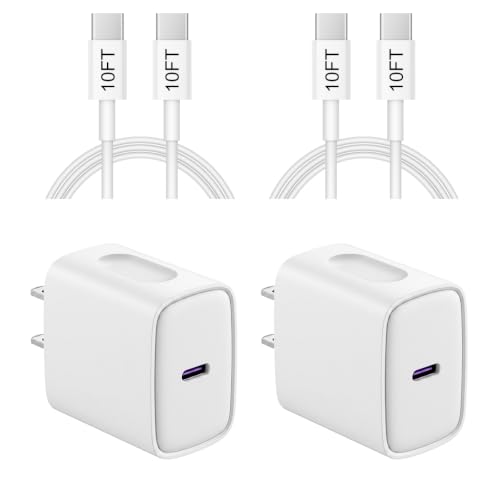
20W USB-C iPhone Charger with 10FT Cable — The long-reach single
Every other pick in this guide treats cable length as a settled question. This one treats it as the question. Its 20W block is the familiar object; its cable runs 10 ft, USB-C to C, in white, titled for the iPhone 18 through 15 generations, the Pro Max and Duo models among them, and iPad. Ten feet is not a luxury specification. It is the distance between the only socket in a rented living room and the sofa where a human actually sits, between a hotel outlet stranded behind the television and the bed, between an office socket under the desk’s far corner and the desktop where work happens. In those rooms, every other kit in this guide fails not electrically but geographically.
A long cable also changes charging posture in ways buyers discover with pleasure. The phone remains usable — genuinely usable, in hand, on the sofa arm — while it charges, instead of tethering its owner to a wall-hugging crouch. The block can live in the room’s one good socket permanently while the cable does the travelling, which suits households where socket access is contested by lamps and televisions. And because the cable is USB-C to C, it moonlights: ten feet of quality USB-C cable serves a tablet across a room, a laptop on a stand, any device whose own cable came up short, long after the phone it was bought for has been replaced.
The trade-offs are the physics of length and the arithmetic of one. A single kit equips a single point; a two-room household buys two or looks above. A 10 ft cable wants management — coiled neatly it is a tool, left loose it is a floor hazard and a vacuum cleaner’s enemy — and its extra length is pointless at a bedside where the socket sits behind the pillow, where it becomes four spare feet of tangle. Buy this kit for the room that defeats the others, not as a default. In that room, nothing else in the guide is even a candidate.
- Output: 20W, USB-C Power Delivery
- Pack: 1 block with 1 cable
- Cable: 10 ft USB-C to C — the longest in this guide by a wide margin
- Colour: white
- Named devices: iPhone 18/17/16/15 including Pro Max and Duo, iPad
- Lightning iPhones: the bundled cable does not fit them; a Lightning cable would be needed on this or any block
Strengths
- Ten feet of cable solves the socket-geography problem that defeats every standard kit in problem rooms.
- The phone stays usable in hand while charging, instead of pinning its owner beside an outlet.
- The long USB-C cable doubles as a general-purpose reach cable for tablets and other devices.
Trade-offs
- One kit, one location — no second room is equipped by this purchase.
- Surplus length tangles at a bedside where a short cable would be tidier.
- White shows travel and household wear, and a floor-run cable collects more of both.
Best for: the living room, rental or hotel routine where the socket and the seat are in different postcodes. Not suited for: a tidy bedside with the socket behind the headboard, where ten feet becomes a nest. Measure your problem room, and if the distance is real, this kit’s listing describes the only pick in the guide built for it.
How Do the Six iPhone Kits Differ Once the Wattage Is Identical?
| Pick | Blocks + cables | Cable length | Cable connector | Generations served by the kit |
|---|---|---|---|---|
| Apple 20W USB-C Power Adapter | 1 block (cable separate) | Your choice | Your choice | Any — the cable decides |
| Anker 20W USB C Charger | 2 + 2 | See listing | Titled to USB-C generations | iPhone 18 Pro to 15 Pro Max, iPad Pro |
| AISNI 20W 4-Pack with Cables | 4 + 4 | 6 ft | Lightning, MFi-certified | iPhone 14/13/12, 11 in compatibility line |
| MFi iPhone Charger 2-Pack | 2 + 2 | 6 ft | Lightning, MFi-certified | iPhone 14 down to 7, AirPods |
| USB-C 20W Charger 2-Pack | 2 + 2 | 6 ft | USB-C to C | iPhone 18/17/16/15, iPad |
| 20W Charger with 10FT Cable | 1 + 1 | 10 ft | USB-C to C | iPhone 18 to 15, iPad |
The table’s middle column is the guide in miniature. Two kits speak Lightning, two speak USB-C, one speaks whichever cable you bring, and one lets a brand name do the talking while its listing confirms the cables. Nobody’s choice here is about speed — the 20W row would be identical all the way down — it is about which connector your phone wears, how many rooms you are equipping, and how far your sockets are from your furniture. Answer those three questions and the table picks its own winner.
How Do You Tell Which Side of the Divide Your iPhone Is On?
Look at the port, not the marketing name. A USB-C port is an oval opening with a thin tongue in its centre, identical in shape to the port on a modern iPad or MacBook, and the cable plugs in either way up. A Lightning port is a slimmer slot, and its cable is a flat paddle with exposed contacts on one face. If the phone arrived in your household as an iPhone 15, 16, 17 or 18 model of any trim, it is USB-C. If it is a 14, 13, 12, 11, XS, XR, SE or anything older, it is Lightning. The SE line deserves a word of care, since it spans generations: every SE sold to date uses Lightning, whatever its release year might suggest.
Hand-me-downs and spares deserve the same inspection rather than an assumption. The phone in the drawer that serves as the household backup, the one a parent uses, the one a child inherited — each has its own port, and a kit bought for the main phone may leave the spare unchargeable on the one night it is needed. Mixed households are not an edge case; they are the norm during any transition, and the honest solution is a block on each side of the divide, since the blocks themselves are interchangeable and only the cables differ. A 20W block bought today will still be the right block for the phone bought in three years. The cable drawer is where transitions are actually managed.
One more identification habit: when a listing’s title names phone models, read it as a connector statement in disguise. A kit titled for iPhone 14 through 7 is telling you its cables are Lightning without using the word in every line; a kit titled for the 15 through 18 generations is telling you USB-C. The two Lightning picks in this guide do say Lightning outright, and the USB-C picks name their generations — but training yourself to translate model lists into connector shapes will protect you on every listing you ever open, including the ones written less carefully than these.
How Do You Get the Fastest Charge Your iPhone Supports?
Assemble the chain correctly and the speed follows. The block must offer USB-C Power Delivery at the 20W class — all six picks do — and the cable must be the right connector in sound condition, because a damaged cable is the most common silent cap on charging speed in any household. A cable whose connector wiggles in the port, whose jacket has split near either end, or which charges only at certain angles has already told you its diagnosis; replace it before blaming any block. On the Lightning side, prefer certified cables, since the phone’s trust in the cable is part of the negotiation.
Then manage expectations by battery level. iPhones charge fastest in the lower half of the battery and taper as they fill, a deliberate protection for the cells, so the 20W advantage shows itself in the top-up before leaving the house rather than in the overnight fill. A phone charged from low for half an hour on any pick in this guide gains the meaningful chunk of its day; the same half hour near full adds a sliver. Judging a new charger by plugging it into a nearly full phone is the surest way to conclude, wrongly, that it changed nothing.
Heat is the last variable, and it is mostly about the phone rather than the charger. A phone charging under a pillow, inside a thick case in a warm room, or while running a demanding game will slow itself to protect its battery, and no block in this guide — or anywhere — overrides that decision. Charge on a hard surface, in open air, with the phone left alone for the fast half of the charge, and the equipment you bought gets to do the job it was specified for. The charger supplies the ceiling; the phone, the cable and the room decide how close to it you get.
How Does Travelling With an iPhone Change the Charger You Need?
Travel compresses every charging problem into smaller rooms and stranger sockets. The hotel outlet hides behind the bed frame or lives inside the desk lamp’s base; the airport seat offers a socket at ankle height in a crowd; the rented flat puts its one free outlet in the hallway. In that world the kit virtues reorder themselves: a single block that travels in the bag and stays there beats a household fleet, a longer cable earns its coil, and a second kit left permanently in the travel pouch ends the most common travel-charging failure of all, which is the charger still plugged in beside your own bed while you are three hundred miles away. The MFi Lightning pair’s travel-framed block and the 10 ft kit both speak to this life directly, from opposite sides of the connector divide.
There is also a redundancy argument that only travellers fully appreciate. A charger is a single point of failure for the device that holds the boarding pass, the map and the payment cards, and it fails in the ways small electronics do — left behind, lent and not returned, sat on in a bag. Two modest kits, one in the bag and one in the room, are worth more on the road than one premium block, which is a structural reason the two-packs in this guide keep recommending themselves beyond the household logic of bedside and desk. The pair you split between home and bag is insurance that costs nothing extra, because you were going to equip two places anyway.
Finally, travel is where the block’s generation-neutrality pays its dividend. The same 20W block that feeds your USB-C iPhone feeds a travelling companion’s Lightning phone with a cable swap, charges the iPad in the evening and the earbuds’ case overnight, and asks nothing of foreign sockets beyond a plug adapter where the country requires one — the block itself accepts the world’s voltages as a matter of course for this class of adapter. Pack the block once, pack both cables if your party spans the divide, and the entire question of power abroad reduces to finding the socket, which in a strange room at midnight is quite enough of a quest on its own.
What Goes Wrong Most Often When People Buy iPhone Chargers?
The expensive failure is the connector mismatch: a Lightning kit ordered for a USB-C phone, or the reverse, discovered at unboxing. It happens because buyers shop by the word iPhone rather than by generation, and because a household’s newest phone quietly redefines what “our iPhone charger” means while the older phones still in service are forgotten. This guide has repeated the divide in every section because repetition is cheaper than returns. Check the port on every phone the kit must serve — not the flagship, every phone — before the order is placed.
The second failure is cable-length optimism: the kit whose cable reaches the bedside socket in the photograph but not in your bedroom, where the socket is behind the bed frame and the pillow is a body’s width away. Measure the run with a tape or a piece of string, from socket to where the phone actually rests, and add slack for the phone to be lifted and used. Six feet covers most honest measurements; the rooms it does not cover are exactly the rooms the 10 ft kit exists for. The third failure is pack-count regret — one block bought for a two-location life, beginning a nightly migration that ends, within the year, in a lost charger and a second purchase made in irritation.
The fourth failure is subtler: assuming the block is the upgrade. An owner whose charging feels slow replaces the block, keeps a five-year-old cable with a fatigued connector, and concludes that chargers are all the same. In truth the chain is only as strong as its tiredest link, and in most households that link is the cable, not the brick. Buy the chain — block and cable together, which is what the kits in this guide exist to sell — and the category stops being a recurring household argument.
There is a temptation, reading six near-identical 20W ratings, to conclude the choice hardly matters and grab whichever kit is nearest. Resist it on one ground: you will perform this purchase’s consequences twice a day for years. The wrong connector is discovered once and remembered; the short cable is cursed nightly; the missing second kit restarts the block migration every evening. The right kit, by contrast, is never thought about again, which is the highest praise any charger can earn. That invisibility is what the sections above are really selling — not watts, which are identical, but the absence of every small friction that surrounds them.
Final Recommendation
Start with your phone’s port and let it split the guide in half. USB-C owners: take the two-pack with 6 ft cables for the standard two-room life, the Anker pair if a brand name matters to you, or the 10 ft kit if one room’s geography defeats standard lengths. Lightning owners: take the MFi two-pack for a single phone’s home-and-travel life, or the AISNI four-pack to equip a whole Lightning household at once. And anyone mid-transition, or simply unwilling to gamble on third parties, should take Apple’s own adapter and choose cables deliberately around it. The right iPhone charger is the one whose cable fits your phone, reaches your furniture and exists in every room you charge in — get those three things right and the 20W does the rest, every night, without being thought about again.
Frequently Asked Questions
Will a 20W charger damage an older iPhone’s battery?
No. The phone controls the negotiation and draws only what its charging circuitry accepts; older iPhones simply draw at their own pace from the same block. The 20W figure is what the charger can offer, not what it imposes. Battery wear over years is driven far more by heat and by keeping a phone at full charge in hot conditions than by which PD block feeds it.
Can I use one of these blocks for both a Lightning and a USB-C iPhone?
Yes — the block is generation-blind. USB-C Power Delivery comes out of the same port regardless of which phone ultimately receives it; the cable is the translator. Keep a Lightning cable and a USB-C cable with any block in this guide and it will serve phones on both sides of the divide, one at a time. That is why transition households should think of blocks as permanent and cables as the consumable layer.
What does MFi certification actually guarantee?
MFi is Apple’s licensing programme for third-party accessories built on its proprietary connector. A certified Lightning cable contains an authentication chip the phone recognises, which is what keeps the accessory-not-supported message away and the charging behaviour consistent across iOS updates. It is not a guarantee of immortality — cables still wear — but it is the difference between a cable Apple has vetted and one it has never seen.
Why does my iPhone charge slowly even on a new 20W block?
Work the chain in order. The cable is the first suspect: fatigued connectors and split jackets throttle or interrupt charging without announcing themselves. The battery level is the second: an iPhone near full deliberately tapers, so test from low. Heat is the third: a phone charging in a warm room, a thick case or direct sun slows itself protectively. Only after those three should the block itself be suspected.
Is a longer cable slower than a short one?
At the lengths in this guide, no meaningful difference reaches the phone. A well-made 10 ft USB-C cable delivers the same negotiated charge as a 6 ft one for a 20W iPhone; cable quality matters more than cable length at this scale. What length changes is geography and tidiness, not speed — buy the length your room’s measurements demand and a cable from a maker who states its construction plainly.
Should I buy Apple’s adapter or a kit with cables included?
It depends on what your drawer already holds. If you own sound cables of the right connector, Apple’s block is the cleanest purchase in the guide — the manufacturer’s own adapter, nothing wasted. If your cables are worn, missing or the wrong generation, a kit solves block and cable in one box and usually equips more rooms doing it. Count your working cables honestly; the answer to this question is sitting in the drawer.


