What's inside
- Key Takeaways
- Quick Picks
- How We Chose These Picks
- What Separates Qi at 15W From Qi2 and Qi2.2 at 25W?
- Which Mounts Suit Which Phones and Cabins, Model by Model?
- Magnetic Snap or Motorised Arms: How Do the Six Holders Compare?
- How Do You Install a Wireless Car Charger So It Holds and Charges Properly?
- Why Does Wireless Charging Slow Down in a Hot Car, and What Helps?
- How Should Safety and the Second Car Shape the Purchase?
- What Mistakes Do Drivers Make When Buying a Wireless Car Charger?
- Final Recommendation
- Frequently Asked Questions
- Related Guides
As an Amazon Associate I earn from qualifying purchases. This post may contain affiliate links at no extra cost to you.
[widgetverdict.com] is reader-supported. When you buy through links on our site, we may earn an affiliate commission.
Where to buy: follow the name of any mount below to its listing; the six divide cleanly into magnetic mounts that ask for the right phone or case, and clamping mounts that ask for nothing but a phone, so know which camp your handset belongs to before you click.
The best wireless car chargers promise a small daily miracle: drop the phone onto the mount, and it holds, displays your navigation and charges, all in one gesture, with no cable to fumble at a junction. Whether the miracle survives contact with your actual car depends on three things the product photographs never show together. The first is the charging standard — plain Qi at up to 15W, or the newer Qi2 family, whose magnetic alignment and higher output this guide’s lead pick pushes to a Qi2.2-rated 25W. The second is how the phone is held: by magnets, which is effortless and conditional, or by motorised clamping arms, which is universal and mechanical. The third is where the mount can live in your specific cabin — air vent, dashboard or windshield — because a mount that fits no surface in your car is not a mount at all.
Here is the magnetic condition, stated once and then applied in every relevant section. Magnetic mounts of the MagSafe pattern work natively with iPhones that carry Apple’s magnetic ring — the iPhone 12 generation onward — and with phones or cases that provide an equivalent magnetic ring. A phone without that ring, in a plain case, will not be held by magnets alone, whatever the listing’s enthusiasm; it will slide at the first roundabout. Owners of such phones are not excluded from this guide — they are the exact audience for the two auto-clamping picks, whose arms close around any handset and whose Qi pads charge through ordinary cases. Read your phone first, then the picks.
The six divide accordingly. One is the Qi2.2 flagship: a LISEN 25W magnetic mount with a cooling fan and the car charger and cable included in the box. Two are 15W magnetic mounts, from ESR and LISEN, differing in mount hardware and framing. Three are 15W Qi charging holders — two JOYROOM auto-clamping models and an unbranded 3-in-1 mount that offers dashboard, vent and windshield installation in one box. Every wattage and mounting claim below comes from the listing titles; where a title leaves the power source or the vent hardware to the listing page, the spec boxes say so.
Key Takeaways
- Charging standards split the six: one Qi2.2 mount rated at 25W, and five Qi mounts at 15W — and a phone can only use the fastest tier its own hardware supports.
- Magnetic mounts require a MagSafe-pattern ring — iPhone 12 or later, natively, or a magnetic case; a phone without the ring needs the auto-clamping picks instead.
- The two JOYROOM models and the 3-in-1 mount hold any phone with motorised arms, including Android handsets and cased phones with no magnets at all.
- Only the LISEN Qi2.2 title states that the car charger and cable are included; the others leave the power source to the listing, and a mount is only as fast as the adapter feeding it.
- Mount surfaces differ: vent-only, vent-and-dash, and one 3-in-1 design covering dashboard, vent and windshield — your cabin’s geometry decides.
- The Qi2.2 LISEN adds a cooling fan, a direct answer to the parked-car heat that throttles wireless charging in summer.
Quick Picks
| Pick | Badge | Why it earns its place |
|---|---|---|
| LISEN Qi2.2 25W MagSafe Car Mount Charger (Cooling Fan) | The Qi2.2 flagship | 25W Qi2.2 magnetic charging with a cooling fan, certified 3-in-1 design, and the car charger and cable in the box. |
| ESR MagSafe Car Mount Charger | The established magnetic mount | 15W magnetic charging for iPhone 18 Pro Max down to 12 and Samsung S26, with air vent and dashboard mounting. |
| JOYROOM 15W Auto-Clamping Wireless Car Charger | The universal vent clamp | Motorised arms grip any phone on the air vent — no magnets required — with 15W Qi charging for iPhone, Galaxy and Pixel. |
| 3-in-1 Wireless Car Charger Mount 15W | The three-surface mount | Auto-clamping 15W charging with dashboard, vent and windshield installation in one kit, for iPhone 18–14 and Galaxy S24/S23. |
| LISEN 15W MagSafe Car Mount Charger | The value magnetic | 15W MagSafe-pattern magnetic holding with permanent magnets and a 2-in-1 mount, framed for near-universal vehicle fit. |
| JOYROOM 15W Qi Wireless Car Charger (Dash/Windshield) | The alignment clamp | Auto-clamping with alignment assistance, mounting on windshield, dashboard or vent, for iPhone 16 Pro Max/15 Pro and Galaxy S24/S23. |
How We Chose These Picks
We began by refusing to let the word magnetic blur two different products. A magnetic mount and a clamping mount solve the same problem with opposite contracts — one asks the phone to bring a magnetic ring and repays it with a one-handed snap; the other asks nothing and repays it with a motor’s patience — so the guide needed both camps properly represented, and it needed each pick’s camp legible from its title. All six pass that legibility test: the magnetic three name MagSafe in their titles, the clamping three name their auto-clamping action, and no pick is allowed to let a buyer guess which contract they are signing.
The second axis was the standard. Wireless charging in a car is a negotiation between the mount’s rating, the phone’s ceiling and the adapter feeding both, and titles that state their standard plainly — Qi2.2 at 25W, Qi at 15W — let a buyer predict the outcome for their handset. We kept one Qi2.2 flagship rather than padding the guide with near-duplicates, because only one pick here carries that rating, and its section explains carefully which phones can actually spend those 25 watts: a rating is a ceiling offered, not a speed delivered to every device.
Third, we weighed installation honesty. Mounts fail in driveways, not in photographs — a vent clip that fits no vent in your car, a suction cup on a textured dash, an adhesive pad in summer heat. The picks were chosen to span the realistic surfaces: vent specialists, a vent-and-dash magnetic mount, and two designs that add the windshield. Where a title does not detail the included power adapter, we flagged it rather than assuming, because the adapter is half the charging system and the cheapest place for a kit to quietly underdeliver.
What Separates Qi at 15W From Qi2 and Qi2.2 at 25W?
Alignment, first of all. The original Qi standard charges through a pair of coils that must sit in rough register; in a home, on a pad, you nudge the phone until the charging light agrees. In a car, over bumps, that register drifts, and a drifting coil means heat and a slowing charge. The Qi2 generation borrowed the magnetic alignment idea from Apple’s MagSafe: a ring of magnets snaps the phone into the coil’s exact sweet spot and holds it there over the road’s insults. Qi2.2 extends the family’s rated output further, and the LISEN flagship’s title claims 25W on that basis — a figure that belongs to phones whose own wireless hardware supports the higher tier, with the mount offering a ceiling the phone may or may not climb to.
The practical meaning of the numbers needs stating without romance. Fifteen watts of wireless charging, well aligned, is a genuinely useful in-car rate: navigation running, screen lit, music streaming, and the battery still climbing rather than merely holding. Twenty-five watts, on a phone that supports it, turns the same drive into a real refill — the commute that takes a phone from low to comfortable. On a phone that does not support the higher tier, the 25W mount charges at the phone’s own ceiling, which is why the flagship’s premium buys alignment, cooling and headroom rather than a guaranteed speed for every handset. Android owners should read the titles with the same care: the magnetic picks name iPhones first, with the ESR also naming a Samsung model, while the clamping Qi picks name Galaxy and Pixel outright.
Heat is the third character in this story, and cars are its home stage. Wireless charging is less efficient than a cable, the difference leaves as warmth, and a phone mounted on a sunlit dash or in front of a heating vent in winter is already warm before the coil adds its share. Phones protect themselves by slowing the charge, which is why a mount can test fast in an air-conditioned room and disappoint in August. The flagship’s cooling fan is a direct, mechanical answer — moving air across the phone while it charges — and the how-to section below covers the placement habits that help every pick: out of direct sun where possible, and never parked in the blast of a heater vent while charging.
Which Mounts Suit Which Phones and Cabins, Model by Model?

LISEN Qi2.2 25W MagSafe Car Mount Charger (Cooling Fan) — The Qi2.2 flagship
This is the mount for the driver whose phone supports the newest wireless tier and whose car is hot. Its title stacks the claims in the right order: Qi2.2 certification at 25W, MagSafe-pattern magnetic mounting, a cooling fan, a 3-in-1 magnetic design, compatibility named at the iPhone 18 Pro Max and the 17, 16 and 15 Pro Max — and, completing the system, the car charger and cable included in the box. That last inclusion is rarer than it should be and worth dwelling on: a 25W mount fed by a weak adapter is a 15W mount with ambitions, and LISEN removes the guesswork by supplying the feed its rating assumes.
The fan is the feature that will decide this pick’s reputation. In-car wireless charging fails thermally before it fails electrically: the phone sits in sun or vent blast, warms, and throttles its own intake to protect its battery, and the driver’s expensive fast mount becomes an ordinary one. A fan moving air across the phone’s back attacks the throttle at its cause. It will not repeal summer, and a phone already heat-soaked from a parked cabin will still start slowly — but across a long drive, active cooling is the difference between a mount that holds its rate and one that surrenders it by the second hour. Drivers in hot climates, and drivers whose navigation runs all day, are the audience this design was drawn for.
The conditions are the magnetic conditions, and they are not waived by the flagship price. The phone must present a MagSafe-pattern ring — an iPhone 12 or later natively, or a case that supplies the ring — and the 25W ceiling is spendable only by phones whose wireless hardware supports the Qi2.2 tier; an older iPhone will charge from it perfectly well at its own lower ceiling, held just as firmly, cooled just as diligently. A buyer paying the flagship premium for a phone that cannot use the top tier should ask whether the fan and the included adapter justify it, or whether the 15W magnetic picks below are the honest purchase. For the phone that can spend it, though, nothing else in this guide is even in the conversation.
- Standard and output: Qi2.2, rated 25W (the phone’s own ceiling governs what it actually draws)
- Holding: magnetic, MagSafe pattern — requires an iPhone 12-generation or later, or a magnetic-ring case
- Cooling: built-in fan, stated in the title
- Included: car charger and cable, stated in the title — the only pick here that promises the full feed
- Named phones: iPhone 18 Pro Max, 17/16/15 Pro Max
- Design: certified 3-in-1 magnetic mount, per the title
Strengths
- The highest wireless ceiling in the guide, on the newest standard, with magnetic alignment holding the coils in register.
- The cooling fan addresses the thermal throttling that quietly defeats fast wireless charging in real cars.
- Adapter and cable included, so the 25W system arrives complete rather than depending on your glovebox’s leftovers.
Trade-offs
- Phones without the Qi2.2 tier charge at their own lower ceilings; the premium buys headroom they cannot spend.
- Magnetic holding still requires the ring — a non-magnetic case defeats it as surely as on the cheaper magnetic picks.
- A fan is a moving part in a vibrating environment, one more mechanism than a passive mount carries.
Best for: a driver with a recent Pro-class iPhone that supports the higher wireless tier, in a warm climate or on long navigation days. Not suited for: a phone in a plain non-magnetic case, which this mount cannot hold, or a handset whose ceiling makes the 25W rating theoretical. If your phone can spend the watts, read the LISEN Qi2.2’s listing, confirm your case carries the ring, and let the fan earn its keep all summer.

ESR MagSafe Car Mount Charger — The established magnetic mount
ESR built its name in the MagSafe accessory ecosystem, and this mount is that ecosystem’s car seat: 15W magnetic wireless charging, titled for the iPhone 18 Pro Max and the run of generations back to the 12, with a Samsung S26 named alongside, and mounting hardware for both air vent and dashboard. The dual-surface provision is its quiet distinction. Vent mounting is the default of the category, but vents differ — some are too deep, too curved or too fragile-feeling for a loaded mount — and a kit that also offers the dashboard gives the installer a second chance in the same box, which is where most mount purchases are truly decided.
Fifteen watts, magnetically aligned, is the mature form of in-car wireless charging: the phone snaps to the coil’s centre, the charge runs at a rate that outpaces navigation’s appetite, and the whole interaction is one-handed — on with a snap, off with a lift, no motors, no waiting for arms to open. For the iPhone owner whose case carries the ring (or who uses the phone bare), this is the daily experience the category advertises, delivered by a maker whose magnetic accessories are its core trade rather than a sideline. The Samsung naming in the title extends the invitation to that phone’s owners, subject to the same ring condition — a magnetic case makes the arrangement, as it does for any non-Apple handset.
Its boundaries are the class boundaries. The title does not promise an included car charger, so the adapter feeding the mount is the buyer’s responsibility — and a 15W mount on a feeble adapter is the most common quiet disappointment in this category, curable with a proper USB-C car charger of adequate output. Nor does 15W satisfy the driver who has tasted the Qi2.2 tier above. But as the balanced magnetic purchase — established maker, two surfaces, the standard rate done properly — it is the pick most iPhone drivers in this guide will end at, and its section is content to say so without theatre.
- Standard and output: 15W magnetic wireless charging
- Holding: MagSafe-pattern magnets — iPhone 12-generation or later natively; other phones need a magnetic case
- Mounting: air vent and dashboard, per the title
- Named phones: iPhone 18 Pro Max through the 12 generation, Samsung S26
- Power source: the title does not state an included car charger — budget for a USB-C adapter of adequate output if your car lacks one
- Maker’s ground: ESR’s core business is magnetic phone accessories
Strengths
- Two mounting surfaces in one kit doubles the chance of a solid fit in an unfamiliar cabin.
- One-handed magnetic operation is the fastest daily routine in the category — snap on, lift off.
- An established magnetic-accessory maker stands behind the alignment and hold.
Trade-offs
- 15W is the mature standard rate, not the new ceiling; Qi2.2 phones leave speed unclaimed here.
- The adapter question is left to the buyer, and an underpowered one silently caps the mount.
- Dashboard mounting depends on your dash’s surface and your jurisdiction’s rules on placement, as with any dash mount.
Best for: an iPhone 12-or-later driver who wants the classic magnetic routine with a dashboard fallback if the vents refuse. Not suited for: a phone without a magnetic ring or magnetic case, which will not be held — the clamping picks below exist for it. If the ring condition is met, check the ESR mount’s listing for its adapter requirements and install it on whichever surface your cabin prefers.

JOYROOM 15W Auto-Clamping Wireless Car Charger — The universal vent clamp
The auto-clamping design begins from a refusal: it refuses to ask anything of your phone. JOYROOM’s mount grips the handset with motorised arms that close when the phone is set into the cradle, charges it through a 15W Qi pad, and mounts on the air vent with an upgraded, adjustable holder. iPhone, Galaxy, Pixel — the title names them all in one breath, because the clamp does not care what the phone is, how it is cased, or whether a magnet has ever been near it. For Android owners, for the family car shared between phone brands, for the thick-cased phone that defeats magnetic dreams, this is the architecture that simply works.
The daily routine differs from the magnetic snap, and honesty requires describing it fairly. You set the phone in the cradle; the arms close and hold it with a mechanical certainty no magnet matches over a pothole. Removal is a button or a sensor’s errand rather than a lift. It is a second slower at each end of the journey and considerably more certain in the middle of it — and on rough roads, that certainty is not a consolation prize. A clamped phone does not creep, tilt or part company with its mount on a broken B-road, and the Qi pad’s alignment is maintained by the cradle’s geometry, with the design’s adjustable vent grip keeping the whole assembly planted.
The costs are mechanism and appetite. A motor is a thing that can tire, and a clamp sized by its arms has a width envelope that the very largest phones in the very thickest cases should be checked against on the listing. The title also leaves the power adapter to the buyer, as most of this guide does — pair it with a car charger that can actually deliver the mount’s rated input. And the vent is its only stage: a car whose vents are fragile, deeply recessed or oddly shaped gives this specialist nowhere to stand, which is what the three-surface pick below is for. Within its stage, though, the JOYROOM clamp is the guide’s most democratic object: any phone, held fast, charging at the standard rate.
- Standard and output: 15W Qi wireless charging
- Holding: motorised auto-clamping arms — no magnetic ring required, any phone the arms span
- Mounting: air vent, with an upgraded adjustable holder per the title
- Named phones: iPhone, Galaxy, Pixel families
- Power source: not stated as included in the title — confirm the adapter requirement on the listing
- Case fit: thick cases charge through the pad but must fit the arms’ span; the listing carries the width envelope
Strengths
- Universal holding: brand, case and magnets are all irrelevant to the clamp.
- Mechanical grip is the most pothole-proof hold in the guide.
- Qi charging at 15W covers the mainstream fast-wireless rate for the phones it names.
Trade-offs
- The motorised routine is a beat slower than a magnetic snap at both ends of a trip.
- Vent-only mounting leaves cars with unsuitable vents unserved.
- Moving arms are a mechanism to wear, and the largest cased phones must be checked against their span.
Best for: an Android owner, a mixed-brand household car, or any phone in a case without magnets. Not suited for: a cabin whose air vents cannot carry a loaded mount — deep, fragile or unusually shaped slats. If your vents are ordinary and your phone is anything at all, the JOYROOM clamp’s listing will confirm the fit, and the arms will handle the rest.

3-in-1 Wireless Car Charger Mount 15W — The three-surface mount
Some cars defeat specialists. The vent is a designer’s sculpture, the dashboard is a slope of textured vinyl, and the only honest surface is the windshield — or the reverse in the next car. This unbranded mount answers with coverage: a 15W auto-clamping charging holder that installs on dashboard, vent or windshield from one kit, titled for the iPhone 18 through 14 generations and Samsung’s Galaxy S24 and S23. The 3-in-1 name refers to that trio of surfaces, and the buyer it serves is the one who has already returned a mount that fit nowhere, or who changes cars — rentals, a partner’s vehicle, a work van — often enough that adaptability outranks elegance.
The auto-clamping hold keeps the phone-side contract universal, as with the JOYROOM above: arms, not magnets, so cases and brands pass freely. What differs is the installer’s menu. Windshield mounting puts the phone high and in the sightline, which some drivers prefer for navigation and some jurisdictions restrict — the buyer is responsible for knowing their local rules about windshield obstruction, a caution this guide applies to both windshield-capable picks. Dashboard mounting via suction or adhesive lives or dies by the dash’s texture and the summer’s heat. Vent mounting remains the fallback of the species. Having all three in one box converts the installation from a gamble into an afternoon’s experiment: try the vent, judge the wobble, move to the glass, decide.
The trade for coverage is refinement. An unbranded kit carries no ecosystem reputation, its materials and motor are promises the listing must keep, and a mount that does everything rarely does the one thing your car needs as gracefully as a specialist would. The title also leaves its power adapter unmentioned, so the charging system is completed by the buyer’s own adapter, as elsewhere. But there is a real buyer — the two-car household, the rental regular, the driver of the odd-vented car — for whom the menu is the product, and for that buyer this is the only pick in the guide that cannot be defeated by a dashboard.
- Standard and output: 15W wireless charging
- Holding: auto-clamping arms — case- and brand-agnostic
- Mounting: dashboard, air vent and windshield from one kit (the title’s 3-in-1)
- Named phones: iPhone 18/17/16/15/14, Samsung Galaxy S24/S23
- Power source: the title does not include an adapter claim — the listing and your glovebox settle it
- Windshield note: check local rules on windshield-mounted devices before choosing that surface
Strengths
- Three installation surfaces make it the hardest mount in the guide to defeat with an awkward cabin.
- Clamping hold keeps it universal across phones and cases, like the JOYROOM picks.
- Suits drivers who change cars, since the kit re-installs wherever the next cabin allows.
Trade-offs
- An unbranded kit offers no maker’s reputation to lean on; the listing’s details carry the whole case.
- Suction and adhesive surfaces are at the mercy of dash texture and summer heat.
- A jack of three surfaces may wobble where a dedicated vent or dash specialist would sit dead still.
Best for: a driver whose car defeated a single-surface mount, or who moves between cars and needs one kit that adapts. Not suited for: a driver with a known-good vent who values a specialist’s solidity over a menu they will never use. If adaptability is the brief, this mount’s listing is where the three installations are spelled out — pick your surface before the first drive, not during it.

LISEN 15W MagSafe Car Mount Charger — The value magnetic
LISEN’s second entry in this guide takes the magnetic formula at its standard rate and frames it around fit: 15W MagSafe-pattern charging, permanent magnets doing the holding, a 2-in-1 mount design, and a title that claims compatibility with 99 percent of vehicles — a flourish we report as the maker’s framing rather than a measured fact, while noting the intent behind it. This is the magnetic mount for the driver who wants the snap-on routine without the flagship’s fan, tier or price of admission: the iPhone settles onto the ring, the coils align, the charge runs at the mature 15W rate, and the mount asks nothing further.
Set against its Qi2.2 sibling, the comparison is instructive rather than embarrassing. The flagship buys a higher ceiling for phones that can spend it, active cooling for cabins that need it, and an included adapter. This pick buys the same one-handed gesture and the same magnetic certainty at the rate most iPhones on the road actually use, since the installed base of phones charging at the 15W magnetic tier dwarfs the newest tier’s. A driver whose iPhone is a generation or two from the newest — the title spans the 18 down to the 12 — loses nothing in daily experience: navigation fed, battery climbing, phone on and off with a gesture.
Its conditions are the family’s conditions. The magnetic ring is required, full stop — iPhone 12 or later, or a case that provides the ring — and the adapter feeding it is the buyer’s affair, since the title makes no inclusion promise, so an adequate USB-C car charger belongs in the same order if the glovebox cannot supply one. The 2-in-1 mounting framing suggests flexibility between two positions; the listing will say which two, and the buyer whose cabin needs the third surface should be reading the 3-in-1 pick above. Within those honest borders, this is the magnetic routine at its most accessible, from the same maker as the flagship — the sensible sibling, and for most drivers the sufficient one.
- Standard and output: 15W MagSafe-pattern magnetic charging
- Holding: permanent magnets — requires the MagSafe ring on the phone or its case
- Mounting: 2-in-1 design, per the title (the listing names the two configurations)
- Named phones: iPhone 18 down to the 12 generation
- Vehicle fit: the title claims near-universal vehicle compatibility — read it as the maker’s framing and check your vent or surface against the listing
- Power source: no adapter inclusion is stated in the title
Strengths
- The full magnetic routine — snap, align, charge — at the rate most iPhones actually use.
- Shares a maker with the flagship, for buyers who trust the brand but not the need for 25W.
- Permanent-magnet holding has no mechanism to tire; the hold is the same in year three as day one.
Trade-offs
- No fan, so a sun-baked cabin will throttle it as it throttles every passive mount.
- Qi2.2-tier phones charge at 15W here, leaving their ceiling unclaimed.
- The ring condition and the bring-your-own adapter condition both apply in full.
Best for: an iPhone 12-or-later driver who wants the magnetic routine at the standard rate, without paying for a tier their phone cannot use. Not suited for: a non-magnetic-cased phone, or a driver whose new handset’s 25W ceiling is the point of the purchase. If standard-rate magnetic is your honest need, the LISEN 15W’s listing will confirm its two mounting configurations — choose yours and snap in.
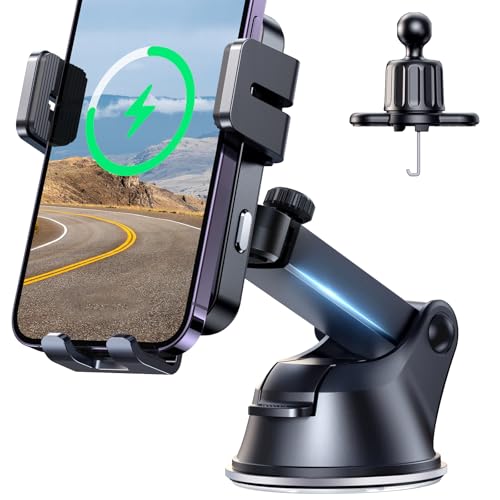
JOYROOM 15W Qi Wireless Car Charger (Dash/Windshield) — The alignment clamp
JOYROOM’s second mount in this guide moves the clamp off the vent and onto the glass and dash, and adds the feature its sibling lacks: auto-clamping alignment, the cradle’s habit of settling the phone into the charging coil’s proper register as the arms close. That detail matters more than it sounds. A clamp holds a phone where you put it; if you put it a centimetre high, a plain Qi pad charges a centimetre wrong — warmly and slowly. A design that aligns as it clamps removes the one piece of skill the universal camp otherwise demands, and it is aimed at the phones the title names: the iPhone 16 Pro Max and 15 Pro, Samsung’s Galaxy S24 and S23, and by extension the large handsets whose coil placement varies most.
The surface menu is the other half of its identity: windshield, dashboard or air vent, the full trio, in a brand-name kit — which sets it against the unbranded 3-in-1 above as the refined version of the same idea. Windshield placement earns its keep for drivers who want the navigation screen high and near the sightline, subject to the same local-rules caution; the dash serves cabins with a friendly surface; the vent remains the universal donor. A driver who knows they want off-vent mounting but not which surface will save them is this pick’s exact customer, with a maker’s name behind the suction cup.
The mechanism ledger still applies: motorised arms are a moving system, the largest phones in armour-grade cases should be checked against the cradle’s span on the listing, and the title leaves the feed adapter to the buyer. There is also a placement discipline the windshield imposes — a mount high on the glass in summer sun cooks the phone it holds, and the how-to section’s shade advice applies with double force. But as the guide’s most considered clamp — aligning, multi-surface, brand-backed — it is the pick for the driver who wants the universal hold and the big windscreen view, and who is willing to install it thoughtfully once.
- Standard and output: 15W Qi wireless charging
- Holding: auto-clamping with alignment assistance, per the title
- Mounting: windshield, dashboard or air vent
- Named phones: iPhone 16 Pro Max/15 Pro, Samsung Galaxy S24/S23
- Power source: the title states no included adapter — supply an adequate car charger
- Windshield note: placement rules for windshield devices vary by jurisdiction; the buyer checks their own
Strengths
- Alignment on clamping fixes the universal camp’s one skill requirement — the phone lands on the coil correctly.
- All three surfaces in a brand-name kit, refining the 3-in-1 idea.
- Windshield placement serves drivers who want navigation high in the sightline.
Trade-offs
- High windshield placement exposes the phone to the worst of the sun’s heat in summer.
- Motorised arms and big-case spans need the same listing checks as its sibling.
- Suction mounting on textured dashes can be the weak surface of the three.
Best for: a driver with a large phone who wants clamp universality, self-aligning charging and a windshield or dash position. Not suited for: a vent-only minimalist, or a jurisdiction whose windshield rules close that surface. If the big-screen, high-mount life is yours, read this JOYROOM’s listing for its cradle span, fit your largest case, and install it in the shade side of the glass.
Magnetic Snap or Motorised Arms: How Do the Six Holders Compare?
| Pick | Standard / rate | Hold | Surfaces | Adapter in the box? |
|---|---|---|---|---|
| LISEN Qi2.2 25W with Cooling Fan | Qi2.2 / 25W ceiling | Magnetic (ring required) | 3-in-1 magnetic design | Yes — charger and cable stated |
| ESR MagSafe Car Mount Charger | Qi / 15W | Magnetic (ring required) | Vent, dashboard | Not stated in title |
| JOYROOM 15W Auto-Clamping | Qi / 15W | Motorised arms | Vent | Not stated in title |
| 3-in-1 Wireless Car Charger Mount | Qi / 15W | Motorised arms | Dash, vent, windshield | Not stated in title |
| LISEN 15W MagSafe Mount | Qi / 15W | Magnetic (ring required) | 2-in-1 design | Not stated in title |
| JOYROOM 15W Qi (Dash/Windshield) | Qi / 15W | Arms with alignment | Windshield, dash, vent | Not stated in title |
The adapter column is the table’s quiet scandal and its most useful lesson. Five of the six titles leave the power source unmentioned, which means five of the six charging systems are completed by equipment the buyer may not own. A mount’s rating assumes a feed; the car’s built-in USB port, in many vehicles, is a data-era socket that cannot supply it. Read the table’s other columns for the mount you want, then budget the adapter the last column warns you about, and the system you install will be the system the titles promised.
How Do You Install a Wireless Car Charger So It Holds and Charges Properly?
Begin before the mount leaves its box, with the phone in your hand. Establish its camp: if it is an iPhone of the 12 generation or later, hold a fridge magnet’s gentler cousin — the phone’s own magnetic ring announces itself when a magnetic mount or accessory snaps to its back through your case; if the case kills the snap, the case is the problem, and a magnetic case is the cure. If the phone is Android or the ring is absent, you are in the clamp camp, and your only measurement is the cradle’s span against your phone in its thickest case. Ten minutes of this honesty in the driveway prevents the entire genre of mount disappointment.
Choose the surface by the car, not the photograph. Sit in the driver’s seat and rehearse: the vent you can reach without leaning, the dash area that does not block your view of the road’s near corner, the windshield zone your jurisdiction allows and your wipers sweep. Test the vent’s slats with a finger’s pressure — a vent that flexes under a fingernail will sag under a phone at motorway vibration, and a sagging mount aims your navigation at the gear lever. Fit the mount empty first, drive a rough street, and only then trust it with the phone; a mount that survives the empty test drive rarely surprises later.
Wire the feed like you mean it. Route the cable so it cannot tangle the wheel, the shifter or your knees, give the mount the car’s strongest USB-C source or a proper adapter rated for the mount’s input, and leave a service loop — a cable pulled banjo-tight will work its connector loose over a month of vibration. Then make the first charge a test: navigation on, screen bright, twenty minutes of real road, and check that the battery climbed and the phone is merely warm. A system that passes that test in your car, with your phone, is verified in the only laboratory that matters.
Why Does Wireless Charging Slow Down in a Hot Car, and What Helps?
The phone is protecting itself, and it is right to. A battery being charged generates heat; a coil transferring power wirelessly generates more; a cabin parked in sun can start the whole system at temperatures where the phone’s thermal management has already decided to be careful. The result is a charge rate that sags precisely on the journeys where you most want it — the summer road trip, the afternoon school run in a heatwave. This is physics managing chemistry, not a defective mount, and every passive pick in this guide obeys it equally.
What helps is unglamorous and effective. Cool the cabin before judging the charge: a phone that starts the drive at cabin temperature holds its rate far longer than one rescued from a baked dashboard. Place the mount out of direct sun where the cabin allows — the vent mounts have an accidental virtue here, since the car’s own air conditioning blows across the phone they hold, which is the poor driver’s version of the flagship’s fan; in winter, that same vent becomes a heater duct, and a vent mount in front of hot airflow should be moved or the vent closed. The LISEN Qi2.2’s fan exists for drivers whose cabins defeat these habits — the convertible, the sun-belt commute, the van with no air conditioning worth the name.
The last help is expectation management about what the rate is for. In-car wireless charging’s triumph is not the sprint; it is arriving with more than you left with while the phone worked as a navigator the whole way. Even throttled, a mounted phone that gains slowly beats a cabled phone in the cupholder that gains fast and cannot be seen. Judge these mounts by the full journey — hold, view, charge, in that order — and the thermal reality becomes a factor to manage, not a verdict on the category.
How Should Safety and the Second Car Shape the Purchase?
A phone mount is safety equipment wearing a charger’s clothes, and it should be bought with that seriousness. The entire point of mounting the phone is that navigation and calls happen at a glance, at the edge of the visual field, with hands on the wheel — a phone in a cupholder or a lap defeats the arrangement and, in many places, the law. So judge every pick here first by where it puts the screen relative to your eyes and the road: high enough to read with a flick of the eyes, never so central that it edits your view of a pedestrian’s approach. The windshield picks demand the most care in this placement, the vent picks the least, because a vent already lives at the dashboard’s edge — one more reason the humble vent mount remains the category’s default conscience.
The mount’s hold is the second safety layer, and it is not about the phone’s price. A handset that leaves its mount under braking becomes a loose object in a cabin of hard surfaces at exactly the moment the driver’s attention is fully committed elsewhere. This is the mechanical argument underneath the whole magnetic-versus-clamp debate: magnets hold superbly within their design — the ring, the case, the road quality they assume — and clamps hold by enclosure, indifferent to all three. Drivers on rough rural roads, in high-riding vehicles with firm suspension, or with heavy phones should weight the clamp’s certainty accordingly, whatever their phone’s magnetic talents. A mount that has never dropped a phone in your driving conditions is not a luxury feature; it is the feature.
Then there is the household’s second car, the purchase’s most commonly forgotten stakeholder. A mount is fitted to a cabin’s geometry and a phone’s camp, and both change across the driveway: the partner’s car has different vents, the partner’s phone has a different case, and the mount that was perfect becomes the mount that lives in the wrong vehicle. Households that swap cars should either buy the adaptable picks — the three-surface kits were chosen with this chaos in mind — or accept two mounts as the honest cost of two cabins. The cheapest version of this wisdom is a universal clamp in the shared car and a magnetic specialist in the personal one, each bought once, neither borrowed, lost or cursed at a rainy junction again.
What Mistakes Do Drivers Make When Buying a Wireless Car Charger?
The category’s signature error is buying magnets for a phone that has none. It arrives dressed as a bargain — a magnetic mount, a plain-cased Android or pre-12 iPhone — and it is discovered at the first corner, when the phone slides to the floor mat. The ring condition is stated in every magnetic section of this guide because it is the cheapest fact in the category to check and the most expensive to learn by experiment. The mirror error is buying a clamp for a MagSafe iPhone out of habit, and spending years waiting for arms to open and close around a phone that could have been snapping on and off in half a second.
The second error is starving the mount. A rated adapter is part of the product in everything but packaging for five of these six picks, and the car’s own USB socket — often a low-output legacy port — quietly turns a 15W mount into a battery-maintenance device that loses ground against navigation. The third error is surface optimism: the suction cup trusted on a pebble-grained dash in July, the vent clip trusted on slats designed by a sculptor. Mounts are mechanical before they are electrical, and the driveway test described above is the difference between an installation and an anecdote.
The fourth error is ignoring the law and the sightline. Windshield mounting is restricted in some places and unwise in any place where the phone blocks the road’s near field; a mount is a navigation aid, not a billboard, and it belongs at the edge of vision, not in its centre. The fifth is forgetting the passenger and the second car: the mount fitted perfectly to one cabin and one phone becomes the household’s problem when the other car, the other phone and the other case enter the story — which is when the universal clamps quietly justify their motors. Buy for the fleet you actually drive, in the cabins you actually sit in, and the mount disappears into the routine it was bought to create.
A closing word about the cable these mounts replace, because some drivers should keep it. If your journeys are short hops where the phone barely needs charge, or your car’s cabin defeats every surface in this guide, a cable remains an honourable tool — faster, cooler, indifferent to cases and rings. Wireless car charging earns its place on the journeys where the phone works for its living: navigating, streaming, taking the hands-free call, hour after hour. Buy the mount for those journeys and the cable stops being the benchmark; the benchmark becomes the drive itself, and whether you arrived with the phone charged, the route seen and the handset never once in your hand.
Final Recommendation
Let your phone choose the camp, then let your cabin choose the pick. MagSafe iPhone drivers: the LISEN Qi2.2 flagship if your handset can spend 25W and your summers are serious; the ESR if you want the established mount with a dashboard fallback; the LISEN 15W if the standard rate and the snap are the whole requirement. Everyone else — Android, older iPhone, thick case, shared car: the JOYROOM vent clamp for an ordinary cabin, the aligning JOYROOM for the windshield-and-dash life, the unbranded 3-in-1 when no cabin can be predicted. Whichever you choose, complete the system with an adapter that can feed it, install it in the driveway rather than the traffic, and the small daily miracle this category promises — phone on, route up, battery climbing — becomes the least interesting part of your drive, exactly as it should be.
Frequently Asked Questions
Will a magnetic mount hold my phone if it is in a case?
Only if the case carries the magnetic ring or is thin and designed to pass the magnetic field through — the reliable version of that sentence is: use a MagSafe-compatible case and the hold is as designed. A thick or plain case weakens or defeats the snap, and no mount in the magnetic camp can compensate from its side. If your case is non-negotiable and non-magnetic, the clamping picks are your section of this guide.
My car has a built-in USB port — is that enough to feed these mounts?
Often not. Many factory USB ports were specified for data and modest charging, and a mount rated at 15W or 25W fed from such a port will charge at whatever the port can give — sometimes barely enough to hold the battery level against navigation. A USB-C car adapter rated for the mount’s input, in the 12V socket, is the reliable feed; only the LISEN Qi2.2 pick includes its adapter in the box, per its title.
Does 25W wireless charging work with any iPhone?
The mount offers 25W; the phone decides what to accept. Only handsets whose wireless hardware supports the Qi2.2 tier can draw at that level; older MagSafe iPhones charge from the same mount at their own ceilings, held and cooled identically. Check your phone’s wireless charging specification against the standard before paying the flagship premium for a ceiling your handset cannot reach.
Are windshield mounts legal?
It depends where you drive. Some jurisdictions restrict objects mounted on the windshield or prescribe where on the glass a device may sit; others regulate obstruction of the driver’s view more generally. The two windshield-capable picks in this guide also offer dash and vent positions, so a driver in a restrictive jurisdiction still has the product — on a different surface. Check your local rules before choosing the glass.
Why does my phone get warm on a wireless car charger?
Because wireless transfer wastes a portion of its energy as heat, and the car adds its own — sun through the glass, heater air through the vents. Warm is normal; hot enough for the phone to slow its charge is the thermal protection working. Move the mount out of direct sun and vent blast, let the air conditioning reach it, or choose the fan-cooled flagship if your cabin makes those habits impossible.
Can a clamping mount damage my phone?
A properly fitted clamp holds by its padded arms at a pressure designed for phones, and the risk in practice is not pressure but fit: a phone forced into a cradle too narrow for its case, or rattling in one too wide. Check the cradle’s span against your phone in its case on the listing before ordering, set the phone in squarely so the coil aligns, and the mechanism is a safer pair of hands than a magnetic snap over a pothole.
Related Guides
- Best iPad Chargers
- Best PS5 Chargers
- Best Wall Chargers
- Best RC Car Chargers
- Best Upright Wireless Fast Chargers


