What's inside
- Key Takeaways
- Quick Picks
- How Did We Judge Chargers Meant for a Workbench?
- Why Does Balance Charging Matter So Much for LiPo Packs?
- How Do Watts, Amps and C-Rates Actually Interact?
- How Should a Beginner Grow Into This Category?
- What Does Race Day Ask of a Charger That a Basher Never Does?
- The Detailed Picks: Six RC Chargers Examined
- How Do the Six RC Chargers Stack Up on Power and Chemistry?
- What Safety Habits Should Surround Any of These Chargers?
- What Mistakes Do RC Owners Make When Choosing a Charger?
- How Should You Read a Charger’s Data Like an Owner?
- Final Recommendation
- Frequently Asked Questions
- Related Guides
As an Amazon Associate I earn from qualifying purchases. This post may contain affiliate links at no extra cost to you.
widgetverdict.com is reader-supported. When you buy through links on our site, we may earn an affiliate commission.
Where to buy: the six chargers in this guide are listed on Amazon; before ordering, match three things on the page against your own bench — the battery chemistries the charger supports, the cell counts it handles, and the connectors it ships with — because an RC charger that cannot speak to your packs is furniture, however impressive its wattage.
The best rc car chargers occupy a different world from the plug-it-in-and-forget-it charging elsewhere in this site’s guides. An RC battery is not a phone battery with a hobby attached; it is a high-energy pack that the owner handles, stores, transports and pushes hard, and the charger is the instrument that decides how safely and how quickly that cycle turns. Choose well and your packs live long, charge in parallel with your patience, and report their health honestly. Choose badly and you own a warm box of guesswork feeding the most volatile objects in the house.
The six picks below span the hobby’s real range. At one end sits a dual-channel flagship advertising AC 300W and DC 700W with a sync charging mode; at the other, a modest dual charger built for small 1S-to-3S packs at 15 watts. Between them are the workhorses: a long-established dual charger with an LCD and a chemistry list as long as your arm, a compact 80-watt unit that ships with its power supply, and two 10-amp-class chargers — one dual, one single — quoting broad chemistry support and discharge functions. The right one depends entirely on what you run: the size of your packs, the chemistries in your box, and whether your Sundays involve one car or a fleet.
Key Takeaways
- Chemistry support is the first filter: every pick here handles LiPo, but LiHV, LiFe, NiMH, NiCd and Pb support varies — check your packs against the titles.
- Cell count is the second: the field spans 1S–6S LiPo for most picks, while the little OVONIC D15 deliberately serves only 1S–3S small packs.
- Dual-channel chargers (X1 Pro, Pro Duo, D15, the Dual 10A) charge two packs at once; the B6 Mini and the 150W unit concentrate their power on one.
- Balance charging is non-negotiable for multi-cell LiPo packs — every pick here is a balance charger by title.
- Power supply arrangements differ: the B6 Mini’s title says a supply is included; high-power units may expect more of your bench setup, so read the fine print.
- Discharge and storage functions matter for pack longevity — the Venom and both 10A-class titles name discharging outright.
Quick Picks
| Pick | Badge | Why it earns its place |
|---|---|---|
| OVONIC X1 Pro Dual LiPo Charger | The dual-channel flagship | 1S–6S balance charging across LiPo, LiFe, NiCd, NiMH and LiHV at AC 300W / DC 700W and 16A, with a sync charging mode. |
| Venom Pro Duo LiPo Charger | The veteran all-chemistry bench | An LCD-equipped balance charger and discharger covering LiPo, LiHV, Li-Ion, LiFe, NiMH, NiCd and Pb, with charging leads included. |
| B6 Mini LiPo Balance Charger | The complete compact kit | 80W balance charging and discharging with its power supply included, spanning 1–6S lithium and 1–15S nickel packs, with XT60, JST and T connectors. |
| OVONIC D15 Dual LiPo Charger | The small-pack specialist | Dual charging at AC 15W and 1.2A aimed squarely at 1S–3S LiPo packs — the mini and micro fleet’s charger. |
| Dual 10A LiPo Balance Charger | The twin 10-amp workhorse | Two 10A channels of balance charging and discharging for 1S–6S lithium chemistries plus wide nickel and Pb ranges. |
| 150W 10A LiPo Balance Charger | The single-channel strong arm | 150W and 10A concentrated on one pack at a time, across 1S–6S lithium, 1–15S nickel and 2–20V Pb batteries. |
How Did We Judge Chargers Meant for a Workbench?
On the evidence of their titles, weighted by what actually ends RC batteries and weekends. Chemistry breadth came first because a charger that cannot address a chemistry you own is useless to you however powerful it is — and this field’s titles range from the D15’s deliberate LiPo-only narrowness to the Venom’s seven-chemistry sweep. Cell range came second, for the same reason in miniature. Then channel count and power, because they decide how a race day or a bash session is scheduled; then the supporting functions — discharging, storage preparation, sync modes — that separate a charger from a mere power supply with opinions.
We were equally careful about what titles cannot tell you. Charge rates in amps interact with pack capacity through the C-rate convention, and a title’s wattage ceiling says nothing about how a charger behaves with your specific packs until the two are matched — the analysis below keeps that arithmetic in view rather than crowning the biggest wattage. Safety features deserve the same discipline: balance charging is named across all six titles and is the headline safeguard for multi-cell lithium packs, but supervision, sensible charge rates and proper storage remain the operator’s duties with any charger ever made.
A word on this guide’s neighbours. The charging shelf in a hobby household rarely holds only RC gear — the car outside wants its own station, covered in Best Home Level 2 EV Chargers and, for the NACS driveway, Best Tesla Chargers, while the controllers in the den have their own docks in Best PS4 Controller Chargers. The disciplines differ — nobody balance-charges a games controller — but the habit is one: match the charger to the battery in front of you, on evidence, every time.
Why Does Balance Charging Matter So Much for LiPo Packs?
A multi-cell LiPo pack is not one battery but several cells in series wearing a single wrapper, and cells drift. One charges a touch faster, one discharges a touch deeper, and across cycles the pack’s cells arrive at the top of a charge holding unequal voltages. A dumb charger sees only the pack’s total and keeps feeding until the total looks right — by which point the keenest cell may be overcharged, the classic prelude to a puffed pack or worse. A balance charger watches the cells individually through the balance lead and coaxes them into line, finishing the charge with the pack genuinely full rather than merely full on average.
That is why the word “balance” appears in title after title below, and why its presence should be treated as the price of admission for multi-cell lithium charging rather than a premium feature. The chargers here all claim it; the operator’s part is to use it — balance lead connected, balance mode selected — every single time, including the rushed times, especially the rushed times. The sessions where a pack gets hurt are disproportionately the hurried ones before a race or a trip to the park.
Balance charging has a quieter second benefit: information. A charger that reports per-cell voltages teaches you your packs’ true condition across the season. A cell that consistently lags is a pack announcing its retirement in advance, politely, on a screen — far better than announcing it thermally in the pit lane. Several picks below put screens and per-pack data at the centre of their pitch for exactly this reason; treat that data as the charger’s second product, after the charge itself.
How Do Watts, Amps and C-Rates Actually Interact?
Three numbers govern every charging session, and titles advertise whichever flatters the unit. Amps are the flow you set. Watts are the charger’s total muscle — volts times amps — and they cap what flow is possible as pack voltage rises: a charger may offer its headline amps to a small pack yet run out of watts on a big 6S one. C-rate is the pack’s perspective: charging current relative to capacity, where 1C for a 5000mAh pack means 5 amps, and most LiPo packs are happiest charged at or around 1C whatever the charger can deliver. The practical lesson cuts against the marketing: a 16-amp flagship does not charge your 5000mAh pack at 16 amps responsibly, because that would be a harsh 3C-plus feed. Its power buys you parallelism and headroom — two packs at once, big packs at their proper rates — not brutality toward a single small pack.
Read the six titles through that lens and they sort themselves honestly. The X1 Pro’s 300W AC and 700W DC figures are a statement about running two channels hard and about thriving on a serious DC bench supply. The 150W unit concentrates a respectable budget on one channel. The D15’s 15 watts look tiny until you price its actual job — small 1S-to-3S packs whose capacities make 1.2 amps a perfectly civilised rate. Wattage is a means; the pack’s size and your channel count decide how much of it you will ever touch.
Power supply is the hidden half of this arithmetic. A charger rated in hundreds of watts must be fed by something, and titles differ in what they promise: the B6 Mini states its power supply is included, making its 80 watts a complete, honest offer out of the box. Higher-power units commonly assume a bench supply, particularly for their DC figures. Before ordering any charger in the upper half of this guide, establish what it plugs into at your bench — the finest charger in the world delivers zero watts through a supply that was never bought.
How Should a Beginner Grow Into This Category?
Beginners face a fork disguised as a product range. One path buys the charger for the car they own today — often a single 2S or 3S machine — and accepts a second purchase when the fleet grows. The other buys headroom immediately: dual channels, 6S range, chemistry breadth, on the theory that the hobby’s growth is predictable even if its direction is not. Both paths are defensible; the indefensible purchase is the one made without noticing the fork exists. If your first car is a mini, the D15 is not a compromise but a correct answer, and its modest cost leaves budget for the packs and tyres that make the hobby fun now. If your first car is a 4S basher and a second is already being eyed, the B6 Mini’s completeness or the Dual 10A’s twin channels buy time honestly.
The growth variable nobody prices correctly is connectors and chemistries arriving with future cars. A household that starts on one brand’s ecosystem may inherit different plugs with the second car; a charger with broad stated chemistry support and common connector coverage — the Venom and B6 Mini titles both argue this way — absorbs those arrivals with less friction. What should not grow is the charge rate habit: beginners who learn on a powerful charger sometimes learn to feed packs at whatever the charger allows. Learn the 1C courtesy first, while the packs are small and forgiving, and let it remain the household law when the packs get big enough to punish its breach.
Finally, budget the bench, not just the box. A charger presumes a place to charge, packs to charge, leads that fit and — in the upper half of this guide — a supply to feed it. The complete-kit picks state their completeness in their titles for a reason: the honest price of a charging setup is everything between the wall socket and the pack, and the beginner who totals that honestly will spend less than the one who buys a flagship and then shops for its entourage in a panic.
What Does Race Day Ask of a Charger That a Basher Never Does?
The basher’s charging life is pastoral: packs charged the night before, run until the fun or the light runs out, storage-charged at leisure. The racer’s is a timetable. Heats arrive on a schedule, packs must return to full — balanced, verified, at the right temperature of readiness — inside windows measured in minutes, and a charger becomes pit equipment whose failure modes are public. That is the world the dual-channel picks are built for: two packs in rotation, per-cell data on a screen to catch a fading pack before it costs a final, and enough wattage that the rotation never waits on the wall.
Sync charging, the X1 Pro’s named mode, belongs to this world too — twin-pack vehicles in competitive classes need their pairs treated as one organism, charged in step, so neither half of the partnership ages faster than the other. The discharger functions earn their keep here as well, in the unglamorous work of cycling and matching packs during the week so that race day holds no surprises. A basher can ignore every word of this section and lose nothing; a racer who ignores it will learn it from a results sheet instead.
Between those poles sits the club runner, and for them the Dual 10A’s proposition — twin channels, broad diet, discharge included, no flagship ceremony — is pitched with suspicious accuracy. Know which of the three lives yours is, and the guide’s six sort themselves with almost no further argument.
The Detailed Picks: Six RC Chargers Examined

OVONIC X1 Pro Dual LiPo Charger — The dual-channel flagship
The X1 Pro’s title reads like a specification sheet clearing its throat: a dual balance charger for 1S–6S LiPo batteries that also speaks LiFe, NiCd, NiMH and LiHV, rated AC 300W and DC 700W at 16A, with a sync charging mode. Take the numbers in order. Dual channels mean two packs charge simultaneously and independently — the single biggest quality-of-life upgrade for anyone running multiple cars or back-to-back heats. The chemistry list covers the lithium family broadly plus the nickel chemistries of older and starter packs, which makes this a plausible only-charger for a mixed household fleet. And the sync mode addresses the twin-pack ritual: matched packs for a dual-battery vehicle, charged in step rather than in sequence.
The power figures need the context the previous section built. On AC, 300 watts is a serious household figure, enough to run two channels at meaningful rates for typical car packs. The 700W DC figure assumes a bench supply of matching ambition — an investment the title does not bundle, and one a buyer should price before falling for the larger number. The 16A ceiling, likewise, is headroom for large packs and parallel work, not an invitation to feed a small pack at multiples of its comfortable C-rate. This is a charger for the operator who thinks in fleets and schedules, and its rewards scale with the size of the operation pointed at it.
There is also a bench-ergonomics point in the flagship’s favour that spec sheets underplay. Two channels with independent controls mean two sessions can be at different stages, chemistries and rates without sharing a menu or a mood — the 2S pack for the crawler topping up gently beside the 6S pair being prepared for the weekend. On single-channel units that coexistence is a queue; here it is a landscape. Households that charge in the evening, in passing, while doing other things, feel that difference daily and stop noticing it within a month, which is the definition of infrastructure doing its job.
Who should hesitate? The single-car, small-pack hobbyist, for whom this is a flight deck bought to charge a bicycle — the D15 below exists for that bench. And the newcomer without a bench supply, who should tot up the full system cost before comparing headline watts against the self-contained B6 Mini. For the established multi-car household, though, the X1 Pro is the guide’s ceiling and its anchor: dual, broad, powerful and sync-aware, with nothing in its title pretending to be something it is not.
- Channels: dual, with sync charging mode
- Chemistries: LiPo, LiFe, NiCd, NiMH, LiHV, per the listing title
- Cell range: 1S–6S LiPo
- Power: AC 300W / DC 700W, 16A, per the listing title
- Balance charging: yes, dual balance charger by title
- Discharge function: the listing title is silent on this point — the manufacturer’s manual is where it must be settled
- Power supply for DC ratings: not stated as included in the title
Strengths
- Two independent channels transform multi-pack households’ charging schedules.
- Broad chemistry coverage spans modern lithium and legacy nickel packs alike.
- Sync mode serves twin-pack vehicles that need matched charging.
Trade-offs
- The DC 700W figure presumes a substantial bench supply bought separately.
- Oversized for single small-pack setups, in cost, footprint and complexity.
- Discharge capability is not stated in the title for storage-charge planners.
Best for: multi-car households and racers charging several 1S–6S packs across mixed chemistries.
Not suited for: a single mini or micro car whose packs never exceed 3S.
Venom Pro Duo LiPo Charger — The veteran all-chemistry bench
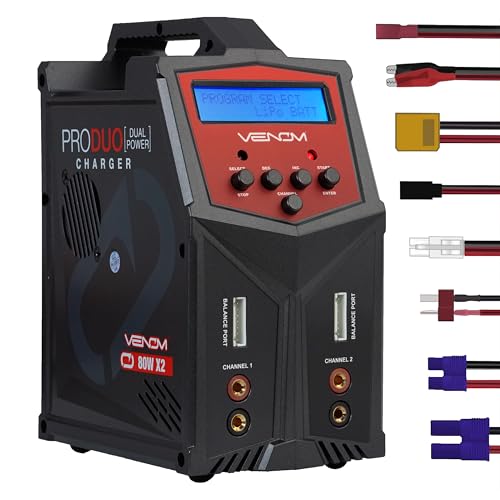
The Venom Pro Duo has the bearing of a product that has survived several eras of the hobby, and its title shows why: a balance charger and discharger for LiPo, LiHV, Li-Ion, Life, NiMH, NiCD and Pb batteries — seven chemistries, the broadest list in this guide — serving 1S–6S packs, with an LCD screen and charging leads in the box, addressed to drones and RC cars alike. That breadth is a household argument. The garage that holds a crawler, a basher, a starter box with a lead-acid heart and a drawer of ageing NiMH packs can run its entire battery zoo from this one bench position.
The LCD and the discharger are the two inclusions that separate a bench instrument from a mere charger. The screen is where per-cell truth lives — voltages, progress, the early warning of a tiring pack — and the discharge function is what makes storage charging and pack maintenance a deliberate act rather than a ritual of driving in circles to run a pack down. Venom’s inclusion of charging leads in the title also matters more than it sounds: connector roulette is the hobby’s pettiest tax, and a charger that arrives holding hands with its leads shortens the distance between box and first charge.
Balance requires noting what the title does not state: wattage and per-channel amperage figures are absent, so power expectations must be set from the product page rather than assumed from rivals’ numbers. Dual in the name promises two channels, and the chemistry breadth is unmatched here, but a racer whose life is measured in turnaround minutes should verify the power figures before ranking it against the X1 Pro. For the mixed-fleet household that values one instrument for everything over maximum muscle for one thing, the Pro Duo’s résumé remains the most persuasive in the six.
- Channels: duo (dual), per the product name
- Chemistries: LiPo, LiHV, Li-Ion, LiFe, NiMH, NiCd, Pb — the broadest list here
- Cell range: 1S–6S
- Display: LCD screen named in the title
- Functions: balance charging and discharging
- Included: charging leads named in the title
- Power figures: the listing title is silent on this point — the manufacturer’s manual is where it must be settled
Strengths
- Seven-chemistry coverage makes it a genuine one-charger household bench.
- Discharger included for storage preparation and pack maintenance.
- LCD feedback supports the per-cell monitoring that keeps packs honest.
Trade-offs
- No wattage or amperage figures in the title for power planning.
- Breadth is wasted on a single-chemistry, single-car household.
- An older design generation than the newest flagships in this guide.
Best for: mixed fleets spanning lithium, nickel and lead-acid packs under one roof.
Not suited for: a turnaround-obsessed racer who needs stated wattage before shortlisting.

B6 Mini LiPo Balance Charger — The complete compact kit
The B6 name is practically a genre in RC charging — the little blue box archetype that taught a generation of hobbyists what balance charging was — and this Mini’s title keeps the faith while fixing the genre’s oldest annoyance: the power supply is included. Around that completeness it offers 80 watts of balance charging and discharging for LiPo, Li-ion and LiFe packs from 1 to 6 cells, NiMH and NiCd from 1 to 15 cells, and a connector set naming XT60, JST and T connectors. For a first serious charger, or a travel charger, or a second bench position, that is a remarkably whole proposition in one box.
The 80-watt figure deserves the honest framing this guide applies everywhere. For the packs most RC cars actually run — 2S and 3S packs of ordinary capacity — 80 watts delivers proper 1C charging with room to spare, which means this compact unit is not a compromise for the mainstream of the hobby at all. It runs out of headroom at the big end: a large 6S pack at a full 1C would ask more than 80 watts, and the charger will simply take longer, gracefully. Buyers should map that against their largest pack, not their average one, and most will find the map reassuring.
Portability is the B6 Mini’s second career, and worth picturing. A charger with its own supply, modest wattage and broad connector coverage is the unit that goes in the car to the park, the holiday house, the friend’s track — the places where charging happens on a tailgate and the nearest bench supply is a rumour. Flagships stay home bolted to their infrastructure; the complete compact kit travels. Households with one car and an active social running life often find this, not the flagship, is the charger that actually shapes their hobby.
The connector trio named in the title is the other quiet virtue. XT60 covers the modern mainstream, JST the smaller and older packs, T the legacy standard that refuses to die — a spread that lets the B6 Mini meet a typical household’s existing fleet without an adapter shopping trip. Single-channel operation is the structural limit: one pack at a time, so multi-car households will queue. As the complete, self-powered, broad-enough charger it sets out to be, though, it may be the easiest recommendation in this guide to hand a newcomer.
- Channels: single
- Chemistries: LiPo, Li-ion, LiFe (1–6S); NiMH, NiCd (1–15S), per the listing title
- Power: 80W, with power supply included
- Functions: balance charging and discharging
- Connectors named: XT60, JST and T connectors
- Cell range: up to 6S lithium, 15S nickel
- Display and data: the listing title is silent on this point — the manufacturer’s manual is where it must be settled
Strengths
- Power supply included — the complete offer, working out of the box.
- Connector spread meets most existing household fleets without adapters.
- 80W honestly covers the 2S–3S mainstream at proper charge rates.
Trade-offs
- Single channel queues multi-pack households.
- Large 6S packs will charge below 1C as the wattage ceiling bites.
- No LiHV or Pb chemistry in the title’s list.
Best for: newcomers and mainstream 2S–3S runners wanting one complete box that simply works.
Not suited for: a fleet household needing two packs charged simultaneously every session.

OVONIC D15 Dual LiPo Charger — The small-pack specialist
Every guide needs the pick that refuses to be everything, and the D15 is gloriously that: a dual LiPo charger running on AC at 15 watts and 1.2 amps, built for 1S–3S packs — the title even translates the range into voltages, 3.7, 7.4 and 11.1 volts, for buyers who think in volts rather than cell counts. This is the charger for the mini and micro end of the hobby: the small-scale crawlers, the indoor racers, the little packs that a flagship charger handles the way a freight elevator handles a letter.
Judge it inside its parish and the specification is well-aimed. Small packs have small capacities, so 1.2 amps represents a healthy rate for them — often at or above the gentle 1C that keeps little cells happy — and dual channels mean both of a pair of mini packs charge together, which is how those vehicles are actually run. The AC input keeps the setup to a wall socket and the charger itself, no bench supply, no ceremony. For a household whose RC life happens at 1/24 and 1/18 scale, this is not the budget option; it is the correct-sized option, and oversizing would buy nothing but menu depth.
There is a teaching virtue in the little charger, too. A child or a newcomer learning the hobby on small-scale cars learns it on equipment whose energies are modest and whose operation is simple — plug in, balance, done — before graduating to the currents and chemistries of the big leagues. Households that start small on purpose, with a charger sized to the starting fleet, build the safety habits in the shallow end. The D15 is the shallow end’s proper equipment, and there is no shame in a charger whose ambition is to be outgrown.
The boundaries are equally clear and should be respected rather than resented. A 4S pack has no home here. A large 3S pack will charge slowly at the 1.2-amp ceiling relative to its capacity. Chemistries beyond LiPo are outside the title’s promise entirely. Households whose fleet is growing upward — and fleets have a way of doing that — should treat the D15 as a specialist they will supplement, not a foundation they will build on. Specialists earn their bench space by being perfect at their parish; this one’s parish is simply, honestly small.
- Channels: dual
- Chemistries: LiPo only, per the listing title
- Cell range: 1S–3S (3.7V, 7.4V, 11.1V)
- Power: AC 15W, 1.2A
- Input: AC, no separate bench supply implied by the title
- Balance charging: dual LiPo balance charger class; confirm balance lead arrangement on the product page for your packs
- Discharge function: the listing title is silent on this point — the manufacturer’s manual is where it must be settled
Strengths
- Correctly sized for mini and micro packs, at rates those small cells appreciate.
- Dual channels match how small-scale vehicles consume packs — in pairs.
- Simple AC operation with no bench supply to buy or house.
Trade-offs
- Nothing above 3S, ever — a hard ceiling for growing fleets.
- LiPo only, leaving nickel and other chemistries unserved.
- Large 3S packs will find the 1.2A ceiling slow.
Best for: mini and micro-scale households running 1S–3S LiPo packs in pairs.
Not suited for: a 4S–6S fleet, or any household whose packs are still growing.

Dual 10A LiPo Balance Charger — The twin 10-amp workhorse
This charger’s title is a plain statement of a strong position: dual 10-amp channels of fast balance charging and discharging, for 1S–6S LiPo, Li-ion, LiFe and LiHV packs, 1S–15S NiCd and NiMH, and 2–20V Pb batteries. Strip the adjectives and the architecture is what matters — two channels, each with a 10-amp ceiling, across effectively the whole chemistry map a car household is likely to own, with discharging included for storage discipline. It is the X1 Pro’s proposition translated into a workhorse dialect: less about flagship wattage theatre, more about two packs moving at proper rates all the time.
The 10-amp-per-channel figure interacts kindly with real packs. A typical 5000mAh car pack at a kind 1C wants 5 amps; a channel with 10 on tap serves it without strain and can take a larger pack at its proper rate too. Two such channels running simultaneously cover the two-car household, the racer’s rotation, the basher’s pair of big packs. The chemistry spread, meanwhile, quietly includes the Pb range — starter boxes and bench batteries — which saves a second charger for the household’s unglamorous lead-acid citizens.
What the title withholds is a total wattage figure, and dual-channel shoppers should care: two channels at full song draw serious combined power, and the product page’s wattage will reveal how the unit shares its muscle when both channels are loaded with big packs. Brand anonymity is the other consideration — the listing leads with specification rather than a name, so the evidence is the spec itself plus whatever the page adds. On paper, though, this is the dual-channel value architecture of the guide: breadth, balance, discharge and twin 10-amp channels, without flagship ceremony.
- Channels: dual, 10A per the listing title
- Chemistries: LiPo, Li-ion, LiFe, LiHV (1S–6S); NiCd, NiMH (1S–15S); Pb (2–20V)
- Functions: balance charging and discharging
- Total wattage: the listing title is silent on this point — the manufacturer’s manual is where it must be settled
- Balance charging: yes, by title
- Sync mode: not stated in the listing title
- Intended use per title: RC cars and drones
Strengths
- Twin 10A channels cover two-pack routines without queuing.
- Full chemistry sweep including Pb for starter boxes and bench batteries.
- Discharging included, supporting proper storage-charge habits.
Trade-offs
- Total wattage unstated in the title, so dual-loaded performance needs the product page.
- Specification-led anonymous listing — evidence is the spec, not a brand’s reputation.
- No sync mode claimed for matched twin-pack vehicles.
Best for: two-car households wanting dual channels and full chemistry cover without flagship pricing theatre.
Not suited for: a twin-battery vehicle owner who specifically needs a stated sync charging mode.
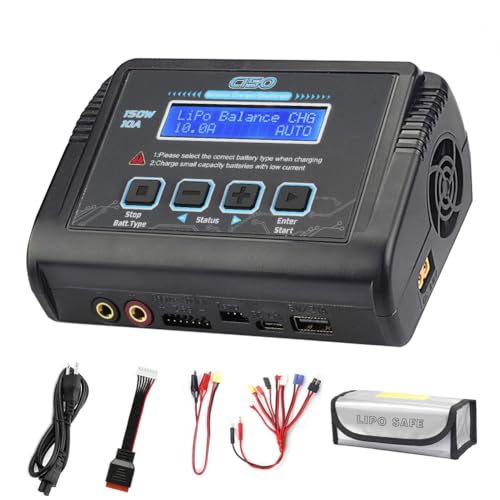
One line in this title rarely gets its due: the 2-20V PB range. Lead-acid support sounds antique beside lithium chemistries, yet pit lanes and club tracks still run on lead-acid starter boxes, field batteries and the occasional vintage receiver pack kept alive for a shelf queen. A dual unit that balances modern LiPo pairs on weekday evenings and tops up the starter box before a Sunday meet collapses two bench jobs into one purchase. It also changes the household maths for shared equipment: the same charger that serves two drivers’ race packs can maintain the communal gear nobody wants to buy a dedicated unit for. Buyers whose world is purely lithium can ignore the line entirely, but mixed-era garages will use it more than they expect.
150W 10A LiPo Balance Charger — The single-channel strong arm
The final pick concentrates everything on one pack at a time: 150 watts and 10 amps of balance fast charging and discharging for 1S–6S LiPo, Li-ion, LiFe and LiHV, 1–15S NiMH and NiCd, and 2–20V Pb smart batteries, addressed to RC cars and drones. The single-channel concentration is a legitimate philosophy. Households that run one car hard — big packs, long sessions, a charger that lives in the pit bag — often prefer all the muscle behind one connector rather than split across two, and 150 watts is a genuinely useful budget at the sizes where car packs live.
Run the arithmetic on typical hardware and the proposition firms up. A 4S or 6S pack of ordinary capacity at a kind 1C sits comfortably inside 150 watts; a 2S pack barely wakes the charger up. The 10-amp ceiling likewise covers the proper rate for packs up to large capacities, which means this unit’s limits appear mainly with the biggest packs in the hobby or with an owner determined to charge at aggressive C-rates — a determination this guide does not endorse as a habit regardless of hardware. The chemistry list mirrors the dual 10A pick’s breadth, including the Pb range, so the single-channel focus costs nothing in versatility of diet.
One more consideration belongs to this pick and the B6 Mini alike: they are the two units here a buyer might plausibly own alongside a dual charger rather than instead of one. The pit-bag and bench division of labour is real in active households — the dual unit runs the fleet at home while a strong single travels — and a guide that pretends every household owns exactly one charger misreads the hobby. If your life has a track bag, this pick’s candidacy strengthens considerably.
Its trade is written into its architecture: one pack at a time means the second pack waits, and on a two-car morning that queue is the product. Households should buy it with that queue priced in — as a pit-bag strong arm, a big-pack specialist, or the second charger beside a dual unit, it makes complete sense. As the only charger for a fleet, it asks for patience the dual picks do not. The title, to its credit, hides none of this: wattage, amperage, chemistries and discharge are all stated, a completeness the more theatrical listings could copy.
- Channels: single
- Power: 150W, 10A, per the listing title
- Chemistries: LiPo, Li-ion, LiFe, LiHV (1S–6S); NiMH, NiCd (1–15S); Pb (2–20V)
- Functions: balance fast charging and discharging
- Balance charging: yes, by title
- Power supply arrangement: the listing title is silent on this point — the manufacturer’s manual is where it must be settled
- Intended use per title: RC cars and drones
Strengths
- Full 150W budget behind one pack suits big-pack, single-car routines.
- Broad chemistry list including Pb matches the dual picks’ versatility.
- Key figures all stated in the title — wattage, amps, ranges, discharge.
Trade-offs
- One channel means multi-pack households queue on busy mornings.
- Largest packs at full 1C will still meet the wattage ceiling.
- Power supply inclusion is not stated in the title.
Best for: single-car households running larger packs, and pit bags that travel to the track.
Not suited for: a two-car household that charges both cars’ packs at the same time daily.
How Do the Six RC Chargers Stack Up on Power and Chemistry?
| Pick | Channels | Stated power | LiPo range | Chemistries beyond LiPo |
|---|---|---|---|---|
| OVONIC X1 Pro Dual LiPo Charger | Dual + sync | AC 300W / DC 700W, 16A | 1S–6S | LiFe, NiCd, NiMH, LiHV |
| Venom Pro Duo LiPo Charger | Dual | Not stated in title | 1S–6S | LiHV, Li-Ion, LiFe, NiMH, NiCd, Pb |
| B6 Mini LiPo Balance Charger | Single | 80W, supply included | 1–6S | Li-ion, LiFe, NiMH, NiCd |
| OVONIC D15 Dual LiPo Charger | Dual | AC 15W, 1.2A | 1S–3S | None — LiPo only |
| Dual 10A LiPo Balance Charger | Dual | 10A channels; watts unstated | 1S–6S | Li-ion, LiFe, LiHV, NiCd, NiMH, Pb |
| 150W 10A LiPo Balance Charger | Single | 150W, 10A | 1S–6S | Li-ion, LiFe, LiHV, NiMH, NiCd, Pb |
Read the power column with the C-rate discipline from earlier in this guide and the table stops being a leaderboard. The X1 Pro’s figures buy parallelism for big fleets; the D15’s buy exactly what small packs need and not a watt more; the two unstated cells — the Venom’s power and the Dual 10A’s total wattage — are the table’s honest gaps, to be closed on the product pages before money follows. Chemistry breadth, by contrast, is fully visible: only the little specialist declines to serve beyond LiPo, and it declines on purpose.
The channel column is where households should linger longest, because it predicts daily life. Dual channels halve the clock on every two-pack routine and remove the charger’s queue from the household’s schedule entirely; single channels concentrate money and muscle on one pack. Neither is a luxury or a lack — they are answers to different fleet sizes, and the fleet you actually own, counted on the bench tonight, is the only census that matters.
What Safety Habits Should Surround Any of These Chargers?
The charger is one component in a safety system whose other components are you. Charge on a surface that would forgive a failure — not on the car’s storage shelf among the fuel-adjacent clutter of a garage — and stay within earshot; lithium charging is a supervised activity in every responsible version of this hobby. Use the balance lead every time, at sensible rates, and retire packs that puff, that take a charge unevenly despite balancing, or that the charger’s own cell readings keep indicting. A charger with good per-cell data, used attentively, is an early-warning system; the warning only works if someone reads it.
Charging location deserves the same deliberateness as charging equipment. Pick a spot that is visible, ventilated and boring — a bench corner you pass daily, not a cupboard — because visibility is supervision’s practical form, and a pack that misbehaves in the open announces itself to eyes and nose in time to matter. Keep packs awaiting charge and packs at storage level in separate, labelled places; half of all charging errors are identity errors, a full pack treated as empty or a tired pack treated as fresh, and a bench with geography prevents them better than a bench with good intentions.
Storage is the habit that separates careful households from lucky ones. Packs left fully charged for weeks age quickly and sit at their most energetic; packs stored at a partial storage charge — the job the discharger functions on several picks here exist to do — age slowly and sit calmer. Build the ritual into the end of every session while the charger is still warm: packs to storage level, packs into their proper storage place, bench clear. It takes minutes, it doubles pack life, and it converts the riskiest objects in the hobby into the most boring ones, which is precisely the ambition.
What Mistakes Do RC Owners Make When Choosing a Charger?
The leaderboard mistake leads: buying the highest wattage as though it were a score, then feeding small packs at abusive rates or discovering the figure presumed a bench supply that was never budgeted. Second is chemistry blindness — falling for a charger whose title never promised the LiHV or NiMH packs already in the box. Third is the connector surprise, ordering a capable charger that shares no plugs with the household fleet; the B6 Mini’s title, naming XT60, JST and T, shows the information exists for those who read it. Fourth is ignoring discharge and storage functions until the first expensive pack puffs quietly in a drawer over winter.
Fifth is sizing for the fleet of today with no glance at tomorrow — the D15’s honest 3S ceiling is perfect until the household’s first 4S car arrives, an arrival this hobby schedules with metronomic reliability. Sixth is the opposite vanity: buying the flagship for a single mini car and drowning a simple job in menus and muscle. The fleet on your bench, its chemistries, its cell counts and its realistic growth — that census, taken honestly, picks the charger. Everything in this guide is commentary on that census.
How Should You Read a Charger’s Data Like an Owner?
A balance charger’s screen is a diary your packs are keeping about themselves, and owners who read it own their fleet longer. The entries that matter are few. Per-cell voltages at the end of a charge should sit close together; a cell that finishes notably below its siblings, session after session, is a pack asking to be retired before it makes the decision itself. Charge accepted — the milliamp-hours a pack takes in — drifting downward across a season is the same story told in a different column: capacity leaving, politely, in writing.
Internal resistance readings, where a charger offers them, sharpen the picture further: rising resistance is ageing made numeric, and a pack whose numbers climb while its siblings’ hold steady should be demoted to gentle duties before it is trusted with a final or a long bash. None of this requires expertise so much as attention — glance at the cells when you unplug, the way you would glance at a fuel gauge. The chargers in this guide that foreground their screens and data are selling exactly that glance, and it is worth more across a season than a hundred spare watts.
Keep the diary honestly, too. A pack that has been crashed hard, puffed slightly or left full through a hot month has a history the screen cannot know; mark suspect packs, watch them at storage level for a few cycles, and let the data confirm or clear them. The hobby’s battery accidents are rarely bolts from the blue — they are the ends of stories the equipment had been telling for weeks to anyone reading.
Final Recommendation
For the established multi-car household, the OVONIC X1 Pro is the ceiling worth aiming at: dual channels, sync mode, broad chemistries and power that treats two packs as a starting point. The Dual 10A workhorse makes the same dual-channel argument in a plainer dialect, and the Venom Pro Duo remains the answer for the household whose battery zoo spans seven chemistries and values a discharger and a screen. Newcomers should start with the B6 Mini’s complete, self-powered competence; big-pack single-car runners with the 150W unit’s concentrated muscle; and mini-scale households with the D15, the rare specialist that fits its parish exactly. Whichever you choose, let the packs on your bench cast the vote — a charger matched to its fleet, balance lead in, storage ritual kept, will quietly outlast several generations of the cars it feeds.
Frequently Asked Questions
What charge rate should I use for my LiPo packs?
The gentle convention is 1C — the pack’s capacity expressed in amps — unless the pack’s own documentation invites more. A charger’s higher ceiling is headroom for larger packs and parallel channels, not an instruction. Every pick here can be set to a kind rate; the discipline is the operator’s, and packs repay it with longer, calmer lives.
Can one charger handle both my LiPo and my old NiMH packs?
Most of this guide can. The X1 Pro, Venom Pro Duo, B6 Mini, Dual 10A and 150W titles all list nickel chemistries alongside lithium ones; only the OVONIC D15 is LiPo-only by design. Check the exact ranges in each spec box — nickel cell counts run to 15S on several picks — and match them against the packs in your box before ordering.
Do I need a separate power supply?
Sometimes. The B6 Mini’s title states its power supply is included, and the D15 runs on AC directly. High-power units, particularly for their DC ratings like the X1 Pro’s 700W figure, generally presume a bench supply of matching capacity. Treat the supply as part of the charger’s true cost and footprint, and confirm the arrangement on the product page for any pick whose title is silent.
What is a storage charge and why do dischargers matter?
Lithium packs age fastest and sit least calmly when stored fully charged or fully empty; a storage charge parks them part-full for the weeks between sessions. Chargers with a discharge function — the Venom, the Dual 10A, the 150W unit and the B6 Mini name it — can bring a full pack down to that level deliberately, instead of leaving you to run it down with the car. It is the single habit most likely to double a pack’s useful life.
Is a dual charger worth it for a two-car household?
Almost always. Two packs charging in parallel removes the queue from every shared session, and matched pairs for twin-pack vehicles stay matched — the X1 Pro’s sync mode formalises exactly that. The honest exception is the household whose two cars run on alternate days; for them a strong single channel, like the 150W pick, loses nothing but a simultaneity they never use.
Can I charge two different chemistries at the same time?
On a true dual-channel charger, yes — independent channels are independent instruments sharing a case, so a LiPo on one side and a NiMH on the other is an ordinary evening for the X1 Pro, the Pro Duo or the Dual 10A. Each channel still wants its own correct settings, entered per pack; the convenience is parallelism, not autopilot. Single-channel picks, by definition, ask the chemistries to take turns.
My packs use a connector none of these titles mention. What then?
Read the product pages for the full lead and adapter picture — titles summarise, and the B6 Mini’s named XT60, JST and T set shows how much a title can hold when a maker chooses. Adapters exist for most pairings in this hobby, but a charger whose included leads already meet your fleet, as the Venom’s title promises, saves the archaeology. Never improvise a connection to save a weekend; order the right lead and let the weekend wait.
Can I run one of these chargers away from a mains socket?
Only where the title supports the idea, and here the evidence is uneven. The X1 Pro states a DC figure alongside its AC rating, which points to bench-supply or vehicle-battery running for trackside use, subject to the product page’s input details. The other titles stay silent about DC input, so assuming a cigarette-lighter miracle from them would be guesswork. If pit power matters to your racing, shortlist by that stated DC capability first and confirm the exact input range before the charger joins your track bag.
Related Guides
The bench is one stop on a household’s charging map. The car outside is served by Best Home Level 2 EV Chargers and Best Tesla Chargers, while the den’s controllers are covered by Best PS4 Controller Chargers.
Related guide: Best Car Qi Chargers
Related guide: Best Chargers For Car Camping