What's inside
- Key Takeaways
- Quick Picks
- How Did We Choose These Dual USB-C Chargers?
- How Does Power Split Between Two USB-C Ports?
- Should You Choose Pure Dual USB-C or a Multi-Port Charger?
- Why Did USB-C Become the Port That Ate the Nightstand?
- How Do You Read a Dual-Port Listing Without Being Fooled?
- Which Dual-Port Charger Belongs on Your Nightstand? The Six Picks in Detail
- Which Dual-Port Setup Suits Which Household?
- What Happens When a Phone and a Tablet Share a Dual-Port Charger?
- How Do the Six Chargers Compare Side by Side?
- How Should You Set Up a Two-Device Charging Station?
- How Do Guests and Children Fit Into a Dual-Port Household?
- What Mistakes Do People Make When Buying a Dual-Port Charger?
- How Should You Label and Organise a Household’s Chargers?
- What Is the Right Dual-Port Charger for a Student or a First Flat?
- How Does a Dual-Port Charger Change the Morning Routine?
- Final Recommendation
- What Is the Case for Owning Two Dual-Port Chargers?
- How Does a Dual-Port Charger Behave on a Power Strip?
- When Should a Dual-Port Charger Be Replaced or Upgraded?
- Frequently Asked Questions
- Related Guides
As an Amazon Associate I earn from qualifying purchases. This post may contain affiliate links at no extra cost to you.
widgetverdict.com is reader-supported. When you buy through links on our site, we may earn an affiliate commission.
Where to buy: all six chargers below link to their Amazon listings from the quick picks table. Port layouts are the whole subject of this guide, so read the listing title’s port description against our spec boxes — in this category, what matters is printed there.
The best dual USB-C wall chargers answer the arithmetic of the modern bedside: two devices, one socket, both of them USB-C now. A phone and a watch, a phone and earbuds, two phones in a couple’s nightly ritual — the pair charges together or one of them waits, and a dual-port block is what lets them charge together without a power strip’s sprawl. Four of the six picks here are true dual USB-C chargers: Anker’s 47W Nano, Apple’s 35W adapter, Nekmit’s flat 40W design, and a 40W two-pack for households equipping two rooms at once.
Honesty requires a flag on the other two, and this guide plants it early rather than burying it. The UGREEN 30W and the Anker Zolo 50W are multi-port chargers, not dual-USB-C chargers in the strict sense: the UGREEN pairs its two USB-C ports with an additional USB-A port, and the Zolo carries two USB-C ports alongside two USB-A ports. We include them deliberately — many readers searching with that phrase actually want two USB-C ports plus legacy room for an older cable — but they are labelled for what they are in every table and review below, and the final recommendation separates the purists from the pragmatists.
Key Takeaways
- Four picks are true dual USB-C: the Anker Nano 47W, the Apple 35W, the Nekmit 40W and the 40W two-pack.
- Two picks are multi-port: the UGREEN 30W adds a USB-A port to its two USB-C ports, and the Anker Zolo 50W carries two USB-C plus two USB-A.
- Total wattage is shared between ports — 47W split two ways is a different offer from 47W to one device.
- The Nekmit’s flat, slim body is the pick for sockets behind furniture.
- The 40W two-pack equips two bedsides or two rooms with identical dual-port charging.
- Apple’s 35W is the official, compact choice; Anker’s 47W Nano is the higher-output traveller.
Quick Picks
| Pick | Badge | Why it earns its place |
|---|---|---|
| Anker Nano 47W 2-Port GaN Charger | Best True Dual-Port | 47W across two USB-C ports in a compact foldable GaN body. |
| Apple 35W Dual USB-C Adapter | Best Official Dual-Port | Apple’s own compact adapter with two USB-C ports and 35W. |
| Nekmit Dual USB C Wall Charger | Best Flat Design | A 40W dual-port charger in a flat, thin body for tight sockets. |
| 40W Dual USB C Charger Block 2-Pack | Best Two-Room Pack | Two 40W dual USB-C blocks, one for each bedside or room. |
| UGREEN 30W 3-Port USB C Charger | Best with Legacy Room | Two USB-C ports plus one USB-A port — multi-port, honestly labelled. |
| Anker Zolo 50W USB C Charger | Best Four-Port Hub | 50W across two USB-C and two USB-A ports for the whole nightstand. |
How Did We Choose These Dual USB-C Chargers?
The first filter was the port layout, read strictly from each listing’s own title. A charger entered the true dual-port group only if its title describes two USB-C ports; the two multi-port picks were admitted under their own names, with their full layouts — two USB-C plus one USB-A, and two USB-C plus two USB-A — stated wherever they appear in this guide. Blurring that distinction is how buyers end up with a port they cannot use, so we refused to blur it even where it would have made the guide tidier.
The second filter was shared-power sanity. A dual-port charger’s total must be high enough that two devices charging together each receive a useful share; that is why the true dual picks cluster between 35W and 47W rather than at the bottom of the market. Third came shape and maker: a flat design for furniture sockets, a two-pack for multi-room households, and established names — Anker twice, Apple, UGREEN — wherever the category offered them. Anything whose port layout could not be read plainly from its listing was left out.
How Does Power Split Between Two USB-C Ports?
Into shares of one total. A dual-port charger’s headline figure — 47W on the Anker Nano, 35W on the Apple — is the pool both ports draw from, and the charger divides it according to what is plugged in. One device alone can typically take the larger share; two devices negotiate portions. This is not a defect but the design’s entire economy: the block is sized for two ordinary devices charging together, not for two maximum draws at once, and it is priced and built accordingly.
The practical consequence is matching. Two phones, or a phone and a watch, divide these totals contentedly, because neither is a glutton. A phone and a tablet divide them acceptably. A laptop is where dual-port phone chargers reach their edge — the laptop will charge, slowly, and under heavy use may merely hold its level. Readers whose second device is a laptop should be reading our GaN laptop guide instead; this guide’s chargers are sized for the pairs that actually share a bedside. Buy the total for the pair you own, and the split will never surprise you.
Should You Choose Pure Dual USB-C or a Multi-Port Charger?
Count your cables, including the old ones. A household that has fully migrated — every device USB-C, every cable double-ended — is best served by a true dual-port block: no wasted port, no legacy compromises, the whole total devoted to the two ports in use. That is the Anker Nano and Apple case, and the Nekmit and the two-pack serve the same household in other shapes.
Most households, though, still own one beloved USB-A cable: the watch charger from two phones ago, the earbuds case, the e-reader that refuses to modernise. For them, the multi-port picks are not a compromise but the correct tool. The UGREEN keeps one foot in each era with two USB-C ports and one USB-A; the Zolo goes further, doubling both, and becomes the nightstand’s whole power station at 50W total. Neither should be bought under the illusion that it is a dual-USB-C charger — both should be bought, eyes open, as the thing they are. The mistake is not owning USB-A ports; it is discovering them after checkout.
Why Did USB-C Become the Port That Ate the Nightstand?
A decade ago the bedside was a museum of connectors: one shape for the phone, another for the tablet, a barrel for the laptop, a watch puck with its own cable species. USB-C’s victory was not won on speed but on sameness — one reversible plug that every maker could adopt, carrying a negotiation standard that lets a charger and a device agree on terms. The dual-port charger is the natural monument to that victory: a block that assumes, correctly, that the two devices arriving at the socket tonight both speak the same language.
The victory is incomplete, and this guide’s honesty about it is deliberate. USB-A survives in the long tail of devices — watches, earbuds, e-readers, the perfectly good cable from 2019 — and households live in the overlap for years. That is why this guide refuses to treat the multi-port picks as failures of the brief. The UGREEN’s extra USB-A port and the Zolo’s pair of them are accommodations to real drawers full of real cables, and a buyer served by them is better served than a purist whose watch charges from a laptop out of port poverty.
What the standardisation genuinely changes is the buying decision itself. When every device spoke a different language, chargers were bought per device and the question was compatibility. Now the question is arithmetic and geography: how much total power, divided how, in which rooms. That is a better question — it has answers a buyer can reason about from their own life, which is what the rest of this guide attempts to provide, pick by pick and port by port.
How Do You Read a Dual-Port Listing Without Being Fooled?
Read the port line before the wattage line, because the port line is where this category hides its surprises. A listing that says dual USB-C means two of the same modern port; a listing that says three-port or four-port with USB-C in the headline may mean, as two picks in this guide honestly declare, a mixture of USB-C and USB-A. Neither is a trick when it is printed plainly — the UGREEN and Zolo listings in this guide print their full layouts in their titles — but a buyer who reads only the headline number and the first three words will eventually be surprised by a socket. Surprises in this category are always about ports, never about watts.
Read the total as a household budget next. The figure is the whole pool, and the listing is not obliged to tell you the division — where a division matters to your pair of devices, prefer the picks whose totals are generous enough that any reasonable division serves both. That is the quiet logic behind this guide’s range: 35W is sized for two modest Apple devices overnight, 47W for two phones with somewhere to be, and the multi-port totals for families whose pool must stretch across four mouths of two different species.
Finally, read for the absences. A cable included will be shouted about; silence means your own leads complete the purchase, and their quality becomes your problem, as this guide has noted in every category it covers. A foldable design will be named; silence means fixed prongs and a bulkier bag life. The listings gathered here were chosen because their claims can be read completely from their titles — the discipline this section describes is how they were chosen, and it will serve you in every charging category beyond this one.
Which Dual-Port Charger Belongs on Your Nightstand? The Six Picks in Detail
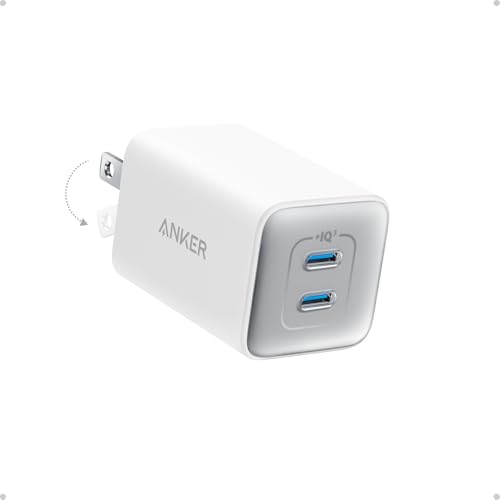
Anker Nano 47W 2-Port GaN Charger — Best True Dual-Port
The Nano is the purest expression of this guide’s title: its listing describes a 47W maximum, two-port GaN fast charger with USB-C, compact and foldable. Both ports are USB-C, the total is the highest among the true dual-port picks, and GaN keeps the body at travel size. For the couple whose two phones share one bedside socket, or the traveller whose phone and earbuds both land on the hotel desk at midnight, this is the block that ends the discussion.
Forty-seven watts divides gracefully between two phones — each receives a genuinely fast share rather than a ration — and a single device plugged in alone gets the pool’s full attention. The foldable body matters more than it sounds: a dual-port charger is, by purpose, the one that travels between bedsides, desks and hotel rooms, and prongs that fold travel without chewing the bag. Its boundaries are the category’s boundaries. It will not hurry a laptop, and it offers nothing to a legacy USB-A cable. Within the dual-USB-C brief, stated plainly and executed by the category’s most practised maker, it is the pick to beat.
- Total output: 47W maximum (per listing title)
- Port layout: 2 ports, USB-C
- Technology: GaN
- Form: compact, foldable
Strengths
- The highest total among the true dual USB-C picks.
- Two phones share without either dropping to a trickle.
- GaN body folds flat and travels like a single-port charger.
Trade-offs
- No USB-A port for the household’s surviving legacy cable.
- Phone-class wattage; a laptop will charge slowly at best.
- Cables are not part of the title’s proposition.
Best for: two USB-C phones sharing one socket, at home or in a hotel.
Not suited for: a nightstand that still runs one device from an old USB-A lead.

Apple 35W Dual USB-C Adapter — Best Official Dual-Port
Apple’s adapter is the conservative’s dual-port charger: a compact power adapter with two USB-C ports and 35W, described in its listing as fast and convenient charging in a Type C wall charger. The appeal is not specification bravado — 35W is the most modest total among the true dual picks — but the removal of questions. It is the phone maker’s own adapter, sized by the people who sized the phones, and for an iPhone household that values that alignment over a larger number, the conversation ends here.
In use, 35W shared between two Apple-class devices is a sensible nightly arrangement: both charge together at a civilised pace and both are full by morning, which is the only deadline a bedside charger truly faces. Where it cedes ground is the hurried top-up — one phone in a rush receives a smaller pool than the Anker Nano offers — and the household that has standardised on another maker’s ecosystem gains less from the badge. Buy it for the fit with an Apple nightstand and the simplicity of the official accessory, and it will not disappoint; buy it for raw pace and the Nano above is the better tool.
- Total output: 35W (per listing title)
- Port layout: dual USB-C ports
- Form: compact power adapter
- Maker: Apple’s own adapter
Strengths
- The maker’s own sizing for the devices it will mostly feed.
- Two ports in a genuinely compact body for travel.
- No compatibility research required for an Apple household.
Trade-offs
- The smallest total among the true dual-port picks.
- A single hurried phone gets less than the 47W Nano offers.
- No provision for USB-A cables.
Best for: an iPhone household that wants the official adapter and two ports.
Not suited for: a power user topping up two hungry phones against the clock.

Nekmit Dual USB C Wall Charger — Best Flat Design
Nekmit’s contribution to this guide is a shape. Its listing describes a dual-port USB-C wall charger with 40W PD fast charging in a flat, thin, slim body — and anyone who has tried to plug a cube charger into the socket behind a bed frame or a sofa knows exactly what problem that shape solves. A flat charger hugs the wall, lets furniture return to its proper distance, and puts the ports where the cables fall naturally instead of levering against the skirting board.
The specification behind the shape is respectable rather than theatrical: 40W of Power Delivery across two USB-C ports sits between the Apple and the Anker Nano in total, enough for two phones to share contentedly. Nekmit is a smaller name in this company, so the listing and seller details deserve the usual careful read, and a flat body can sit awkwardly in a floor-level socket where cables must bend upward. But for the specific, common misery of the hidden socket — behind the headboard, behind the dresser — this is the only pick here designed around it, and design aimed at a real misery is worth more than two extra watts.
- Total output: 40W PD (per listing title)
- Port layout: dual-port USB-C
- Form: flat, thin, slim wall plug
- Charging: PD fast charging
Strengths
- Flat body fits the sockets furniture has been pushed against.
- 40W is a well-judged total for two phones.
- Slim profile crowds neighbouring sockets less than a cube.
Trade-offs
- A smaller brand than the Anker and Apple picks here.
- Flat shapes can be awkward in floor sockets.
- USB-C only; legacy cables need another home.
Best for: the socket behind the bed, the sofa or the dresser.
Not suited for: a buyer who ranks maker reputation above every other quality.

40W Dual USB C Charger Block 2-Pack — Best Two-Room Pack
This pack’s logic is duplication: its listing describes a two-pack of 40W USB-C charger blocks, each with a dual USB-C port and fast charging capability. One block for your bedside, one for your partner’s; or bedside and office; or home and the bag that lives at the front door. The dual-port problem usually exists in two places at once, and a matched pair solves both places identically, so nobody’s side of the bed charges better than the other’s.
Forty watts per block is the sensible tier — the same total as the Nekmit, shared by two ports — and the pack format is the value: identical behaviour in two rooms builds the habit that makes charging invisible. The cautions are the unbranded listing’s usual ones: read the seller information, test both blocks on arrival, and supply your own cables, since none are part of the title’s claim. Judged as infrastructure rather than as a gadget, this is the purchase that finishes the dual-port question for a two-room household in a single order.
- Total output: 40W per block (per listing title)
- Port layout: dual USB-C port per block
- Pack: 2 charger blocks
- Charging: fast charging capability stated in the title
Strengths
- Two identical dual-port blocks settle two rooms at once.
- 40W per block is honestly sized for two phones each.
- Matched behaviour builds a household charging habit.
Trade-offs
- An unbranded listing — seller details and an arrival test matter.
- No cables are part of the stated proposition.
- Two blocks are wasted on a one-room, one-bedside life.
Best for: two bedsides, or a bedside and an office, equipped identically.
Not suited for: a single traveller who needs one block and no spare.

UGREEN 30W 3-Port USB C Charger — Best with Legacy Room
Let the record be exact, because this pick’s listing is: a three-port 30W charger block with GaN II, whose ports are two USB-C and one USB-A. It is not a dual-USB-C charger in the strict sense, and this guide does not call it one. It is the charger for the household in transition — two modern USB-C devices and one survivor on a USB-A cable, all fed from one compact block, with UGREEN’s GaN II internals keeping the body small.
Thirty watts is the modest total in this guide, and its sharing should be understood before ordering: three devices divide a small pool, so this block is a keeper-upper, ideal for overnight charging where morning fullness matters more than evening speed. Within that brief it is genuinely well aimed. The old watch cable stops needing its own ancient block, the two USB-C ports handle the phones, and the whole arrangement occupies one socket. Buyers whose lives are fully USB-C should take a true dual pick above and enjoy the extra watts; buyers with one foot in each era will find this the most honest bridge in the guide.
- Total output: 30W (per listing title)
- Port layout: 2 USB-C and 1 USB-A — three ports, stated exactly
- Technology: GaN II
- Form: compact charger block
Strengths
- Two USB-C ports plus legacy room in one small block.
- GaN II keeps a three-port charger compact.
- Ends the separate ancient block for the one surviving USB-A cable.
Trade-offs
- Not a pure dual-USB-C charger — one port is USB-A.
- 30W shared three ways is an overnight pace, not a hurried one.
- Fully migrated households get more from the true dual picks.
Best for: a household with two USB-C devices and one USB-A survivor.
Not suited for: a purist who wants both ports USB-C and nothing else.

Anker Zolo 50W USB C Charger — Best Four-Port Hub
The Zolo is the biggest idea in this guide, and its layout must be stated as plainly as its listing states it: 50W maximum output across four ports — two USB-C and two USB-A. It is therefore a small charging station rather than a strict two-port design, and it earns its place here because many readers who search for dual USB-C actually preside over a nightstand of four devices in two cable eras. For them, this one block replaces the strip, the two chargers and the argument about whose plug goes where.
Fifty watts is the highest total in the guide, and it needs to be, because four ports divide it. Two phones on the USB-C ports charge at a proper pace while a watch and earbuds take the USB-A side; load all four with hungry devices and everyone slows to the shared arithmetic. Anker’s Zolo line brings the maker’s usual polish to the format, and for a family nightstand or a shared desk the consolidation is real. The purist reading this guide for exactly two USB-C ports should stop at the Nano; the household quartermaster, feeding four devices from one socket, has found the end of the search.
- Total output: 50W maximum (per listing title)
- Port layout: 2 USB-C and 2 USB-A — four ports, stated exactly
- Maker: Anker Zolo line
- Role: multi-device charging station
Strengths
- Four devices, two cable eras, one socket and one block.
- The highest total output in this guide to share around.
- Anker’s execution behind the most ambitious layout here.
Trade-offs
- Not a dual-USB-C charger in the strict sense — half its ports are USB-A.
- Four busy ports divide 50W into modest shares.
- More block than a two-device bedside requires.
Best for: a family nightstand running four devices in two cable eras.
Not suited for: a minimalist who wants exactly two USB-C ports and no more.
Which Dual-Port Setup Suits Which Household?
The couple with matching phones is the design’s home crowd. Two handsets, one socket, a nightly ritual that should require no thought: the Anker Nano on the shared bedside, or the 40W two-pack when each side of the bed has its own socket and its own pride. The detail that decides between them is the room’s wiring, not the phones — one socket argues for one dual block working hard, two sockets argue for the pair and the symmetry it brings.
The solo dweller with a phone and a watch lives a smaller version of the same arithmetic, with a twist: the watch’s cable is frequently the USB-A survivor in an otherwise modern drawer. That single fact moves the recommendation from the pure dual picks to the UGREEN bridge, whose one legacy port exists for exactly that cable, or to charging the watch from the phone’s ecosystem by other means. Read your own drawer before reading the spec boxes; the correct charger is the one your cables vote for.
The family with a charging station — the hallway shelf or kitchen counter where every device in the house reports at night — has outgrown the dual-port brief entirely, and the Zolo is this guide’s honest answer to it: four ports, two eras, one block, and an end to the strip of chargers that colonised the shelf. Families should also hear the sharing arithmetic plainly: four devices on 50W charge overnight, not quickly, and overnight is the station’s whole job. Speed belongs to the one fast charger by the door; the station’s virtue is completeness.
The traveller’s household is a household of one bag. Hotels ration sockets and hide them behind beds, so the travelling dual-port charger must be compact, must fold, and must serve the phone and the earbuds from a single discovery. The Anker Nano and the Apple adapter divide this traveller between them — pace against officialdom — while the flat Nekmit serves the traveller whose rooms are furnished in the socket-hiding style. What none of them should be is the two-pack: a spare block is ballast when the second room is a different city each night.
What Happens When a Phone and a Tablet Share a Dual-Port Charger?
They negotiate, and the tablet usually wins the larger share by simply being hungrier. The practical result surprises owners who expected the phone’s fast charge to survive the pairing: with a tablet attached, the phone’s pace moderates to whatever the remaining pool allows. Overnight, nobody cares — both devices are full by morning, which is the bedside’s only real deadline. In the hurried hour before departure, everybody cares, and the correct behaviour is triage: give the phone the charger alone for its fast first stretch, then let the tablet inherit the block, because a phone’s early charging is rapid and a tablet’s patience is longer.
The totals in this guide divide the households neatly on this question. The 47W Nano absorbs a phone-and-tablet pairing with the least drama among the true dual picks; the Apple 35W handles it as an overnight arrangement rather than a hurried one; and the multi-port Zolo, with four sockets and the guide’s highest total, was practically designed for the family version of the problem, where the tablet is merely the largest of four mouths. None of them is the wrong tool — they are tools sized for different evenings, and the buyer’s job is to recognise their own evening in the description.
One habit improves every version of the pairing: stagger the starts. Plug the hungrier or more urgent device in first and let it establish its charge, then add the second. The negotiation settles more sensibly than when two empty devices arrive at the same second and divide the pool by reflex. It is a small ritual, free to adopt, and it is the difference between a dual-port charger that feels generous and the same charger feeling rationed.
How Do the Six Chargers Compare Side by Side?
| Pick | Total (per title) | Port layout, stated exactly | True dual USB-C? | Character |
|---|---|---|---|---|
| Anker Nano 47W | 47W max | 2 × USB-C | Yes | The purist traveller |
| Apple 35W Dual | 35W | 2 × USB-C | Yes | The official adapter |
| Nekmit 40W | 40W | 2 × USB-C | Yes | The flat one |
| 40W 2-Pack | 40W each | 2 × USB-C per block | Yes | Two rooms at once |
| UGREEN 30W 3-Port | 30W | 2 × USB-C + 1 × USB-A | No — multi-port | The bridge between eras |
| Anker Zolo 50W | 50W max | 2 × USB-C + 2 × USB-A | No — multi-port | The charging station |
How Should You Set Up a Two-Device Charging Station?
Give the station a fixed address and a fixed population. The charger stays plugged in; the two cables stay attached, routed to where the two devices sleep; nothing about the arrangement is renegotiated nightly. A station that must be assembled each evening will, within a month, be a charger in a drawer and two devices taking turns on a phone block. Permanence is the entire trick, and it costs nothing but the decision.
Match the cables to their devices and keep them distinguishable. Two identical white leads are fine until one frays, at which point the household plays detective at midnight. A coloured band, a different length for each side of the bed, the watch’s cable always on the left — small systems of order that survive tiredness. When a cable fails, replace that cable; the station’s charger, chosen from the picks here, will outlast several generations of leads and should be allowed to.
Place the station where the devices already gather, not where the socket happens to be easiest. Phones sleep where their owners put them down — the bedside, the hallway shelf, the kitchen counter’s dry end — and a station installed two rooms away from that gravity will be visited reluctantly and then not at all. If the gathering place has no socket, the flat Nekmit behind the furniture or a longer cable run is a better answer than relocating the household’s habits to suit the wiring. Habits win every contest with wiring; design for the habits.
How Do Guests and Children Fit Into a Dual-Port Household?
Guests arrive with dead phones and unfamiliar cables, and the household’s charging arrangements meet them at the door. A guest room served by a true dual-port block serves most visitors completely — their phone is USB-C, their need is overnight, the arithmetic is kind. The exception is the guest whose device still speaks USB-A, and for spare rooms that host grandparents and other keepers of older technology, the UGREEN bridge is the thoughtful installation: one legacy port, quietly present, ending the rummage through the household’s cable drawer at midnight.
Children change the calculation differently: their devices multiply, their cables wander, and their charging happens wherever they fall asleep, which is not always where the charger is. Households with children learn to value the two-pack’s identical redundancy — a block in the parents’ room and a block where the children charge, behaving the same, so no room is the good room. They also learn to keep the family’s one fast, single-purpose charger out of the children’s rotation entirely, because a charger adopted by a child’s desk has emigrated, whatever the household’s constitution says.
The thread through both cases is that a dual-port charger is a piece of hospitality as much as a piece of electronics. It says the household has thought about the second device — the partner’s, the guest’s, the child’s — rather than equipping only the owner’s. Chosen with the full population in mind, from the shapes this guide lays out, it stops being a purchase and becomes part of how the house runs.
What Mistakes Do People Make When Buying a Dual-Port Charger?
The first mistake is reading the total as a per-port promise. A 47W dual charger gives two busy phones shares of 47W, not 47W each, and the buyer who expected double will feel cheated by arithmetic printed in the listing. The second mistake is the port-layout surprise: ordering a charger described as multi-port and discovering a USB-A socket where a third USB-C was imagined — or, in reverse, buying a pure dual block while a beloved USB-A watch cable still needs a home. Read the layout line before the wattage line; this guide prints both for every pick for that reason.
Third, people size for the wrong pair. A dual-port phone charger asked to feed a laptop and a phone will feed both slowly, and the laptop owner should be shopping in the GaN laptop class instead. Fourth, the socket itself gets ignored: the charger that cannot fit behind the bed is the wrong charger however fine its numbers, which is the entire reason the flat Nekmit exists. Finally, households buy one dual block for a two-bedside problem and resume the nightly negotiation in the second room — the two-pack in this guide is the standing rebuke to that economy.
How Should You Label and Organise a Household’s Chargers?
It is the least glamorous advice in this guide and the kind that outlasts every specification in it. Chargers migrate; labels are how they come home. A small mark — initials on a piece of tape, a coloured dot for the travel block, a different colour for the bedside pair — converts the household’s charger population from an anonymous pool, in which every block is equally borrowable and equally losable, into a named fleet with homes. The two-pack’s identical blocks benefit most: identical in function, distinguished by a dot, each returning to its own room because the room’s colour is on it.
Pair the labels with a charging census, taken once and repeated when a device joins the household. Count the devices that sleep plugged in, count the sockets they sleep near, and compare the two numbers with the chargers actually owned. Most households discover the same finding: enough chargers in total, wrongly distributed — three in one room’s drawer, none where the second phone sleeps. Redistribution costs nothing and feels like a purchase. Thereafter the rule is the one this guide has repeated in every category: a charger per location, a cable per charger, and nothing important living in a drawer.
What Is the Right Dual-Port Charger for a Student or a First Flat?
The student’s arithmetic is the household arithmetic at its starkest: one room, one or two sockets that are truly reachable, two devices that must both be alive at eight in the morning. A true dual-port block is not a luxury in that room; it is the difference between an alarm that rings from a charged phone and a morning that begins with a negotiation conducted the night before. The Anker Nano is the student’s pick in this guide for its size and its total; the 40W two-pack is the pick for the shared flat, where two bedsides in two rooms have the same problem and a matched pair settles both before the argument about whose charger is better can begin.
First flats also teach the socket geography lesson early: the reachable socket is behind the bed, always, in every flat, as if by covenant. That is the Nekmit’s audition, and a student who solves the behind-the-bed problem in the first week owns a skill that homeowners twice their age still lack. What the student should not buy is the four-port station — a population of devices will come, but it has not come yet, and a charger bought for a future household is a charger wasted on the present one. Buy for the room you sleep in tonight; the census method in this guide will tell you when the room has changed.
How Does a Dual-Port Charger Change the Morning Routine?
Judge this category by its mornings. The household without enough ports begins the day with archaeology: a phone dug out from behind the bedside table where it spent the night on the wrong charger, a watch discovered uncharged because its cable lost the evening’s negotiation, a partner’s handset at a percentage that will shape their whole commute. None of these are tragedies. All of them are friction, repeated daily, at the hour when friction is least affordable — and friction of that kind is precisely what infrastructure exists to abolish.
The household with the right dual-port arrangement begins differently, and the difference is invisible, which is the point. Both phones are simply full, the way both taps simply run. Nobody remembers deciding it, nobody maintains a rota, nobody’s device is the household’s designated sacrifice. That invisibility is what the picks in this guide are actually selling, underneath their wattages and port layouts: a morning with one fewer negotiation in it. It sounds like a small thing to buy. Multiplied by every morning of the years these chargers serve, it is among the largest things a small purchase can return.
Final Recommendation
Decide first whether your household speaks only USB-C. If it does, the Anker Nano 47W is the dual-port charger to buy, with the Apple 35W as the official alternative, the Nekmit for the socket behind the furniture, and the 40W two-pack when the problem exists in two rooms. If a USB-A cable still has citizenship in your home, choose the UGREEN for one legacy device or the Zolo for a full four-device station, knowing exactly what each is. Two ports, honestly described and honestly shared, will quietly end the nightly negotiation over the last free socket — and that small domestic peace is the real product on this page.
What Is the Case for Owning Two Dual-Port Chargers?
Stronger than it first appears, because the dual-port problem is rarely singular. It exists at the bedside and at the desk, at home and in the travel bag, on your side of the bed and — in any household that values peace — on the other side too. One excellent dual-port charger solves one instance of it perfectly and leaves the others to improvisation. Two solve the pattern. The two-pack in this guide exists for exactly this recognition, and households that buy singles twice, months apart, usually end up owning the pair anyway, at the price of the months of negotiation in between.
The second charger’s deeper value is as the system’s spare. Chargers are lost to hotel rooms, lent to relatives, and adopted by children with a reliability that mocks planning; a household running on one dual-port block feels each loss as a small domestic crisis, while a two-block household degrades gracefully to one and replaces at leisure. Buy the pair when the second location is real, cascade the older block downward when an upgrade arrives, and the household’s charging becomes the kind of infrastructure that is only ever discussed in guides like this one — never at the bedside, at midnight, in percentages.
How Does a Dual-Port Charger Behave on a Power Strip?
Mostly well, with two courtesies to observe. The first is geometry: a bulky block can cover the neighbouring socket on a crowded strip, which is why compact and slim designs — the Nano’s folded neatness, the Nekmit’s flat profile — earn their keep in the strip environment that real desks and real bedsides actually have. The second is arithmetic at the strip level: a strip feeding a dual-port charger, a lamp and a laptop is a small power economy of its own, and while the totals involved are modest by household standards, the habit of knowing what shares a strip is the same habit this guide teaches about ports. Awareness scales; the devices change, the discipline does not.
There is also a strategic point. A dual-port charger is often the better alternative to a strip: the traveller who once packed a strip to feed two devices from one hotel socket now packs a block the size of a matchbox that does the same job. At home the strip keeps its place for the desk’s many mouths, but at the bedside — two devices, one socket, no other ambitions — the dual-port block is the tidier citizen, and tidiness at the bedside is a quality of life issue disguised as an electrical one.
When Should a Dual-Port Charger Be Replaced or Upgraded?
Replace it on behaviour, not on age. A dual-port block that runs hot at loads it once handled calmly, that drops one port intermittently, or whose prongs have loosened in the socket has finished its service, whatever its birthday says — a mains device earns no sentimental extensions. The modest end of this guide’s range exists partly so that such a replacement is a small, ungrudged purchase made the same week the symptoms appear.
Upgrade it when the household’s arithmetic changes. A second phone arriving in the family, a tablet joining the nightly pair, a watch that finally modernises its cable — each redraws the port map, and the correct response is to re-read your own drawer and re-choose from the shapes in this guide: pure dual where the migration is complete, a bridge where one legacy cable remains, a station where the population has grown to four. The displaced charger cascades to a lesser station — spare room, office drawer, the bag that stays in the car — and nothing is wasted.
What should not trigger an upgrade is a neighbour’s larger number. Dual-port charging is governed by the pair of devices you own, and a total beyond their combined appetite is headroom nobody drinks. The households that charge happiest are the ones whose chargers match their devices and then stay bought for years, through several phones, while the specification race happens to other people. Buy for your bedside as it is; it will still be right when the phones are not.
Frequently Asked Questions
Should the dual-port charger live at the bedside or by the front door?
At the bedside, if only one can be chosen — the night is when two devices most reliably need the same socket for the same long hours, and the bedside pair is the pairing this category was invented to serve. The front door’s hurried top-up belongs to a single fast charger, where one device gets an undivided pool for the minutes that matter. Households that eventually equip both spots will find the two chargers doing different jobs so completely that neither feels like a duplicate of the other.
What if only one of my two devices is USB-C?
Then your household is the bridge case this guide built two picks for. The UGREEN 30W gives the USB-C device its modern port and the older device a USB-A home in the same small block; the Zolo extends the same courtesy to four devices at once. What you should not do is force the older device through a chain of adapters dangling from a pure dual-port block — the arrangement works electrically and fails domestically, shedding adapters in the night. Buy the layout your cables already speak, and let the pure dual-port charger wait for the upgrade that retires the last USB-A lead in the house.
Do both ports on a dual USB-C charger charge at full speed?
They share one total. A single device plugged in can draw the larger share; two devices divide the pool between them. For two phones that division still means a fast, useful charge from every pick in this guide, because the totals were chosen for pairs. The headline wattage is the charger’s whole budget, never a per-port promise.
Is a charger with USB-A ports still worth buying?
If you own a device that charges from USB-A — an older watch cable, earbuds, an e-reader — yes, provided you buy it knowingly. The UGREEN and Zolo picks here state their mixed layouts exactly: two USB-C ports plus one or two USB-A ports. They are multi-port chargers, not pure dual-USB-C designs, and for a household in transition that is a feature.
Can a dual USB-C charger charge a laptop?
Slowly, and with caveats. These chargers are sized for phones and small devices; a laptop will accept a charge but may only hold its level under heavy use. Laptop owners should choose from the 65W-class GaN chargers in our laptop guide, where the totals and the intended machines match.
Why would I choose the Apple 35W over the Anker 47W?
For the official fit and the compact body, when your devices are Apple phones that charge overnight and never race the clock. The Anker offers more total power and GaN compactness for hurried top-ups. Neither is wrong; they are answers to a pace question and a preference question respectively.
What cables do I need for a dual USB-C charger?
Two USB-C cables, one per device, each rated for the charging you expect. The charger is only the middle of the circuit; a weak or damaged cable caps the pace regardless of the block. If your second device still uses USB-A, that is the argument for the multi-port picks rather than for an adapter dangling off a pure dual block.
Can I charge two phones from different brands on one dual-port charger?
Yes — that is the ordinary case, and the negotiation standard does not care about badges. An iPhone and a Galaxy on the same block each request their own terms and receive their own shares of the total. Brand-matching a charger to a phone matters for official-accessory simplicity, as with the Apple pick, not for basic compatibility, which the standard guarantees across the picks in this guide.
Is it safe to leave a dual-port charger plugged in with nothing attached?
Yes. An unloaded modern charger waits at a negligible draw, and the charging stations described in this guide are designed to live plugged in permanently. The sensible cautions are the usual ones for anything in a wall socket: keep the arrangement clear of bedding and clutter, and retire any charger whose casing is damaged or whose prongs have loosened, whatever its age.
Related Guides
Two ports at the bedside lead naturally to bigger questions. Best Internal Hard Drives covers the storage inside the machines these chargers keep alive, Best Backup Hard Drives looks at protecting what those machines hold, and Best Encrypted Portable Hard Drives is the next read when the data itself needs guarding.


