What's inside
- Key Takeaways
- Quick Picks
- How did we choose these six power banks?
- Why does a 10,000mAh bank not deliver 10,000mAh to your phone?
- How do the six power banks compare side by side?
- How do you pack and care for a power bank so it lasts?
- What mistakes do buyers make with phone power banks?
- How do you choose between a plain bank, built-in cables and a built-in plug?
- Final Recommendation
- Frequently Asked Questions
- Related Guides
As an Amazon Associate I earn from qualifying purchases. This post may contain affiliate links at no extra cost to you.
widgetverdict.com is reader-supported. When you buy through links on our site, we may earn an affiliate commission.
Where to buy: the six phone power banks below all link to checked Amazon listings; four of them carry their cables built in, two carry a wall plug in the body, and each section says which arrangement it is actually selling.
The best portable chargers and power banks for phones all begin with the same number, and understanding that number properly is most of what there is to know about this category. Every pick in this guide is a 10,000mAh bank, because that capacity class is the settled sweet spot for phones: large enough to refill a handset completely and then some, small enough to disappear into a coat pocket, light enough to be carried daily rather than ceremonially. But the milliamp-hour figure on the box is measured at the level of the cells inside the bank, at the cells’ own lower voltage — not at the voltage your phone charges at. Energy is the honest currency here, and energy is counted in watt-hours. When a bank converts its stored energy upward to the voltage a phone expects, and the phone converts it back down into its own battery, a share of that energy is spent on the conversions themselves and leaves as warmth. The usable refill you actually receive is therefore always smaller than the headline number suggests, for every bank ever made, by every maker. This is not a scandal and no brand in this guide is cheating; it is the physics of carrying electricity in one chemical form and spending it in another. What it means practically is simple: expect a 10,000mAh-class bank to deliver roughly one full phone charge plus a generous margin, or two partial top-ups across a long day — not the three full charges a naive division of the two capacity numbers seems to promise.
With capacity held equal across the guide, the picks separate on everything else, and the everything else is where daily satisfaction actually lives. Three designs compete here. The plain bank — one model in this guide, from Anker — is a brick with ports, depending on cables you supply. The built-in-cable banks fold their leads into the body, so the charger and its cable are one object that cannot be separated by forgetfulness. And two designs go a step further and build the wall plug into the bank itself, so the same object charges your phone by day and refills itself from a socket by night, with no second charger anywhere in the story. Output figures, a percentage-smaller claim here, an LED display there, and the number of devices that can share the bank at once complete the differences. Read with your own travel pattern in view: the commuter, the festival-goer and the long-haul flyer are all buying the same capacity and three different objects.
A note on the reused faces: a few of these models also appear in this site’s guide to chargers that need no separate cable, where they were judged on their leads alone. Here the judgement runs the other way — capacity behaviour, travel logic and what the 10,000mAh class honestly delivers — because a power bank is bought for the day the battery dies, and that day is about stored energy first and cable tidiness second.
Key Takeaways
- Capacity is stated in milliamp-hours at the cell’s own voltage; watt-hours are the honest measure, and conversion losses mean the usable refill is always less than the headline suggests.
- All six picks sit in the 10,000mAh class, which realistically means one full phone charge plus margin, or a day of top-ups.
- Four picks build their cables into the body, so charger and lead travel as one unlosable object.
- Two picks also build in a folding wall plug, letting the bank refill itself from a socket with no separate charger.
- Stated output figures — 30W on the Anker models, 22.5W on one built-in design — describe the fastest single-device pace, shared when several devices connect.
- Size claims such as a percentage smaller are maker comparisons; judge the bank against your own pocket and bag, not against the claim.
Quick Picks
| Pick | Badge | Why it earns its place |
|---|---|---|
| Anker Power Bank 10,000mAh 30W (USB-C) | The plain benchmark | A 30W USB-C bank with input and output on the same port idea, for buyers who already own good cables. |
| VRURC Portable Charger (Built-In Cables + AC Plug) | The self-refilling traveller | Built-in cables plus a wall plug in a navy body, so one object handles the phone and its own refill. |
| Zmmyuluo Portable Charger 10,000mAh (Built-In Cables) | The compact with a display | Four built-in cables, an LED display and a body the title calls notably smaller. |
| Portable Charger Power Bank 10,000mAh (Built-In Cables & AC Plug) | The four-device sharer | Built-in cables, its own AC plug and stated 22.5W output aimed at charging several devices at once. |
| Anker Nano 3-in-1 Portable Charger 10,000mAh | The three-in-one design piece | A built-in USB-C cable and a foldable wall plug folded into Anker’s small Nano body at 30W. |
| charmast Power Bank 10,000mAh (Built-In Cables) | The many-ported carrier | Four reinforced built-in cables with six outputs and three inputs, described by its maker as carry-on only. |
How did we choose these six power banks?
The capacity class chose itself: the brief was phones, and 10,000mAh is the class phone owners actually carry, so the guide holds capacity constant and spends its attention on the differences that survive that decision. Within the class, the picks were spread across the three real designs — plain bank, built-in cables, built-in cables plus wall plug — with two makers known to most readers and several smaller names whose titles compete on arrangement rather than reputation. Every pick’s stated figures were taken from its listing title and nothing else; where a title does not state a figure a shopper might want, such as the exact watt-hours, the sections treat that absence as information and say where the figure can be confirmed rather than estimating it into existence.
Two exclusions deserve stating as policy rather than passing over in silence. This guide contains no product from any maker or listing flagged in this site’s standing safety exclusions, and no model subject to the recall notices this site tracks for the category; a power bank is a stored-energy device carried against the body and slept beside, and the guide applies its strictest filter here rather than its loosest. What remains is six banks whose claims could be quoted exactly as their titles make them.
Why does a 10,000mAh bank not deliver 10,000mAh to your phone?
Because milliamp-hours are not a substance; they are a rate of flow counted over time, and the count changes with the voltage at which the flowing happens. Inside a power bank sit lithium cells whose chemistry works at a nominal voltage in the region of three and a half to four volts. The 10,000mAh figure counts the charge those cells hold at that internal voltage. Your phone, however, is fed at the higher voltage of the USB connection, and raising the voltage means the same stored energy emerges as a smaller number of milliamp-hours — the energy is conserved, the count is not. Watt-hours cut through the confusion because they multiply the two together: a bank’s watt-hour figure describes its actual stored energy regardless of the voltage at which anyone chooses to count it, which is why airlines write their carry-on rules in watt-hours and why the figure, where a listing provides it, is the one worth comparing across banks of different designs.
Then the conversions take their share. The bank’s electronics step its cell voltage up for output; the cable carries the result with small losses of its own; the phone’s electronics step the voltage down again into its battery. Each step is efficient and none is free, and the difference leaves as gentle warmth in the bank and the handset. Add the small standing costs of the bank’s own circuitry — the display, the cable-detection, the simple fact of being awake — and the delivered total lands meaningfully below the stored total. None of this varies much between honest makers, which is precisely why this guide refuses to rank its picks by imaginary delivered-capacity figures nobody measured. The physics is common to all six; the designs are what differ.
The buying translation is a rule of thumb, held loosely. A 10,000mAh-class bank carries enough stored energy to take a typical modern phone from empty to full once, with a useful remainder for a second partial charge — the earbuds, the partner’s phone at a concert, the top-up that gets a navigation app through the last hour of a drive. Owners who plan around that expectation find the class perfectly judged. Owners who believed the box arithmetic and packed for three full charges find themselves rationing a cable in an airport, which is a failure of expectation rather than of the bank. Size your day by watt-hours and delivered energy, and this entire category becomes honest at a glance.
One more consequence follows for travellers, and it is a happy one. Because airlines think in watt-hours too, a bank of this class sits comfortably below the thresholds that govern carrying stored energy onto aircraft — a point one pick in this guide makes explicitly in its title with the words carry-on only, a phrase that is really the maker acknowledging the same rule from the other side: this is hand-luggage equipment, sized for the cabin, and it belongs in the bag beside you rather than in the hold. The 10,000mAh class is, not coincidentally, the largest capacity most people can carry without ever having a conversation about it at a check-in desk.

Anker Power Bank 10,000mAh 30W (USB-C) — The plain benchmark
- Capacity: 10,000mAh class (per listing title)
- Output: 30W, manufacturer-stated in the title
- Ports: USB-C serving as both input and output (per listing title)
- Built-in cable: none — this bank works through cables you supply
- Colour named in the title: black
- Watt-hour figure: the listing title quotes capacity in mAh only, so the Wh number for airline paperwork should be taken from the bank’s own label or the full listing
The benchmark comes first because every other pick in this guide is, in some way, an argument with it. Anker’s plain bank does the category’s original job with no moving parts to discuss: a 10,000mAh reservoir, a USB-C port that both fills the bank and empties it into a phone, and a stated 30W output that puts it at the brisk end of phone charging — enough pace for a modern handset to gain ground quickly during a coffee stop rather than merely holding its percentage steady. The title calls it a travel essential, and the plain design is exactly what that phrase means in practice: one object, no hinges, no captive leads to fray at their roots, nothing to configure. It is the bank for the owner who already carries a good cable and sees no reason to buy a second one permanently attached to a battery.
Thirty watts deserves the same calibration this guide gives every output figure. It is the pace available to a single device able to accept it; connect a second device where the design allows and the total is shared according to the maker’s arrangement, which the title does not itemise. For the benchmark’s intended pattern — one phone, one cable, one urgent hour — the figure is the right size: phone batteries and phone charging curves are built around this neighbourhood of power, and a bank that meets a handset there feels fast in the hand rather than merely adequate on paper.
The plain design’s weakness is the one its rivals were invented to cure. A bank without a cable is half a system, and the half that goes missing is always the cable — left in the car, loaned to a colleague, sitting in yesterday’s bag. The benchmark’s owner must build the cable habit personally: a short lead that lives with the bank, in the same pocket of the same bag, treated as part of the product. Owners who keep that discipline get the most durable design in the guide; owners who know they will not keep it should read on, because the next four picks exist precisely for them.
Strengths
- 30W USB-C output at the brisk end of phone charging, in and out on one port type.
- No captive parts to fray: the simplest, most repairable-by-replacement design here.
- A major maker’s benchmark against which the built-in designs can be judged.
Trade-offs
- No built-in cable, so the system fails the day the separate lead is forgotten.
- No wall plug in the body; refilling the bank needs a separate charger at home.
- The title gives no watt-hour figure for quick airline-rule comparisons.
Best for: a cable-disciplined owner who wants one fast, plain bank for a phone. Not suited for: a bag where loose cables reliably go missing, or a traveller who hates packing a separate wall charger.
Choose the benchmark if your cable lives where your bank lives; its whole case rests on that habit, and for tidy carriers it is the strongest case in the guide.

VRURC Portable Charger (Built-In Cables + AC Plug) — The self-refilling traveller
- Capacity: 10,000mAh class (per listing title)
- Cables: built into the body (per listing title)
- Wall plug: built-in AC plug, so the bank refills itself from a socket (per listing title)
- Form words in the title: compact and lightweight
- Colour named in the title: navy
- Output wattage: the listing title does not attach a wattage number to this model, so judge its pace from the full listing if fast charging is your deciding factor
The VRURC answers the plain bank’s weakness twice over. Its cables are built in, so the lead cannot be left in another bag, and its wall plug is built in too, so the bank’s own refill — the errand every power bank owner forgets until the bank is empty at the wrong moment — becomes a matter of unfolding prongs and using any socket. That second feature quietly changes the object’s category. A bank with its own plug is not really an accessory to a charging setup; it is a complete charging setup, phone-side and wall-side in one navy slab, and for travel it collapses what is usually a three-item packing problem — bank, cable, wall charger — into a single item that can be checked off a list once.
The travel pattern it serves best is the overnight reset. Arrive at the hotel, plug the bank itself into the wall, let it drink while you sleep, and walk out with a full reservoir and its captive cables ready for the day. At home the same trick keeps a kitchen or bedside socket honest: the bank lives on the wall where it refills, and leaves with you when you leave. The title’s own words for the body are compact and lightweight, which in this class is the difference between a bank that gets carried on the speculative days — the long commute, the uncertain afternoon — and one that gets left at home precisely when it would have been needed.
The compromises are the built-in compromises, doubled. Captive cables are a convenience with a lifespan: they flex at their roots every day of their lives, and when one eventually tires, the cable cannot simply be swapped the way the benchmark’s can. The missing wattage figure in the title also matters to pace-led shoppers, who should take the number from the full listing and weigh it against the 30W models here before deciding that self-refilling convenience outranks charging speed. And the plug that makes it complete at a wall makes it slightly more particular in a pocket, prongs folded or not. None of this is hidden; it is the shape of the trade, and travellers who recognise their own forgetfulness in this description will pay it gladly.
Strengths
- Built-in cables and a built-in wall plug make it a complete one-item charging kit.
- The overnight self-refill pattern suits hotel travel perfectly.
- Compact, lightweight positioning for daily speculative carrying.
Trade-offs
- Captive cables cannot be replaced individually when they wear.
- No output wattage is stated in the title for pace-led comparison.
- The plug body is a little less pocket-shaped than a plain slab.
Best for: a traveller who wants bank, cables and wall charger as one unlosable object. Not suited for: a pace-first buyer comparing stated wattage, or an owner who replaces worn cables rather than whole devices.
Pack this listing’s idea mentally for your next trip; if the three-item charging kit has ever annoyed you, the single navy object is the answer.

Zmmyuluo Portable Charger 10,000mAh (Built-In Cables) — The compact with a display
- Stored capacity: the same 10,000mAh class as the rest of this guide, per its title
- Cables: four built in (per listing title)
- Display: LED display on the body (per listing title)
- Size claim in the title: 40 percent smaller — a maker’s comparison; the baseline it compares against is a detail for the full listing
- Wall plug: none mentioned in the listing title, so plan on refilling it through a separate charger and cable
- Output wattage: not numbered in the listing title; the title says fast charging, and the figure itself belongs to the listing detail
Four built-in cables is this pick’s headline act, and it is a more thoughtful feature than the count suggests. A bank with several captive leads serves the mixed household and the mixed pocket: the phone with one connector, the earbuds with another, the older device still earning its keep on a third. The owner stops performing cable inventory before leaving the house, because the inventory is bolted to the battery. Around that act the title wraps two more claims worth separating. The LED display is a genuine quality-of-life feature — a bank that shows its remaining charge as a readable figure ends the guessing game of the four-dot light, and guessing wrong about a power bank is always discovered at the worst hour. The size claim, forty percent smaller, is a maker’s comparison against some unstated baseline and should be received as enthusiasm rather than measurement; what can be said is that compactness is this model’s stated design goal, and in a class where every bank holds the same energy, a smaller body holding it is a real, if modest, engineering brag.
Set against the VRURC, the trade is visible at a glance: this bank spends its complexity on cables and information — four leads and a display — while the VRURC spends its on self-sufficiency, with a plug. It has no stated wall plug, so its refill still travels through a separate charger, and the traveller’s packing list keeps one extra item on it. Set against the benchmark, it trades the plain bank’s replaceable-cable durability for built-in readiness, the standing exchange of this entire category.
Its natural owner is the family charger and the shared desk drawer: the bank that gets borrowed, that must serve whatever phone is thrust at it, that benefits from a display because its next user never knows what its last user took. A personal bank can survive on memory — its owner knows roughly what is left — but a shared bank lives or dies by what it can announce, and this one announces. Buyers should still run the arrival routine this guide recommends for every lightly specified listing: charge a phone from full, note what the display claims against what the phone received, and let the return window arbitrate the size claim better than any percentage can.
Strengths
- Four built-in cables cover a household’s whole connector zoo at once.
- An LED display replaces charge-guessing with a readable figure.
- Compactness is the design’s stated priority within the capacity class.
Trade-offs
- No wall plug in the title, so a separate charger still packs for refills.
- The smaller-by claim rests on a baseline the title does not name.
- Output wattage is described rather than numbered in the title.
Best for: a shared family or desk-drawer bank serving several different devices. Not suited for: a solo traveller who wants the bank to refill itself from a wall socket.
Look at this listing if your charging drawer serves more than one phone brand; the four captive leads are a peace treaty with that drawer.
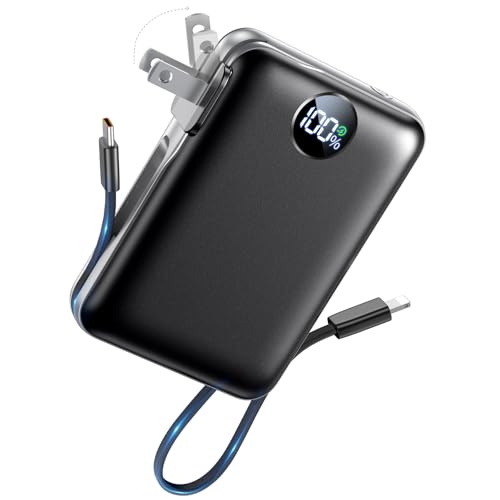
Portable Charger Power Bank 10,000mAh (Built-In Cables & AC Plug) — The four-device sharer
- Capacity: 10,000mAh class (per listing title)
- Cables: built in, with an AC plug built into the body as well (per listing title)
- Output: 22.5W fast charging, manufacturer-stated in the title
- Sharing claim in the title: charging for four devices
- Size claim in the title: 45 percent smaller — again a maker’s comparison whose baseline sits in the listing detail
- Brand: no brand name appears in the listing title, so the maker is a detail to confirm on the listing itself
Where the VRURC built its plug for the solitary traveller, this unbranded bank builds the same trick for a crowd. The title’s arithmetic is social: built-in cables, its own AC plug, a stated 22.5W of fast charging, and room — in the maker’s framing — for four devices at once. Picture the situations that framing serves. A family table at an airport, four phones in various stages of distress and one bank in the middle. A festival campsite where the bank refills itself at the café wall in the morning and then spends the afternoon as the group’s shared reservoir. The four-device claim should be read with the guide’s standing physics in view: a 10,000mAh-class store divided four ways is a round of top-ups, not four full charges, and the 22.5W is a total the connected devices negotiate among themselves. Read that way, the claim is honest and the product is coherent — this is a sharing device, and sharing devices are judged by how gracefully they divide, not by what they would do for one phone alone.
The 22.5W figure sits a step below the Anker models’ 30W, and in single-phone use that step is perceptible but rarely decisive: it is the difference between a brisk top-up and a slightly brisker one across a coffee, not between charging and not charging. Where this pick spends its budget instead is breadth — cables for the crowd, a plug for itself, a body the title claims is dramatically smaller than whatever it compares itself against. Buyers furnishing a group kit, a car glovebox or a holiday villa’s kitchen drawer will feel that breadth weekly. Buyers charging one phone at maximum pace will not, and the benchmark exists for them.
The unbranded caution from this site’s other guides applies in full. With no maker’s name in the title, support runs through the seller, and the sensible owner tests the bank hard in its first week: fill it from its own plug, empty it into the family’s actual phones, watch the sharing behaviour when three or four leads are occupied, and confirm the body warms ordinarily rather than alarmingly under that load. A sharing bank works harder per cycle than any other pick here, so its arrival tests matter more, not less. Pass them, and the anonymous slab becomes the hardest-working object in the travel kit.
Strengths
- Built-in cables plus its own AC plug, aimed squarely at group charging.
- Stated 22.5W output gives the sharing a respectable pace to divide.
- Four-device framing matches real family and campsite patterns.
Trade-offs
- Divided four ways, the capacity is top-ups for everyone, not full charges.
- No brand in the title; the arrival-test routine is essential, not optional.
- Single-phone pace trails the 30W picks in this guide.
Best for: families and groups who charge together at tables, campsites and departure gates. Not suited for: a solo user chasing the fastest single-phone pace, or a buyer who wants a named maker’s support behind the purchase.
Judge this listing by your most crowded charging moment of the year; if four devices appear in that picture, its whole design suddenly reads as restraint.
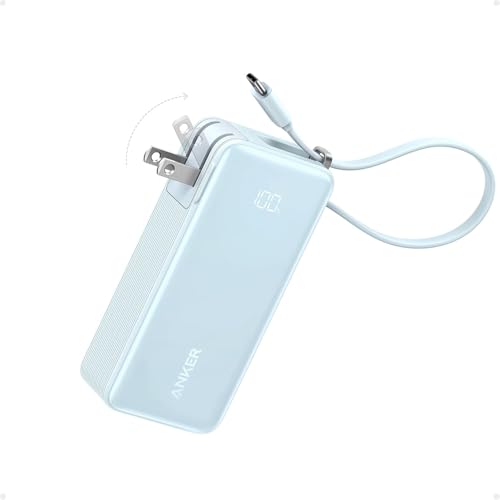
Anker Nano 3-in-1 Portable Charger 10,000mAh — The three-in-one design piece
- Capacity: 10,000mAh class (per listing title)
- Output: 30W, manufacturer-stated in the title
- Cable: a USB-C cable built into the body (per listing title)
- Wall plug: foldable plug built in, completing the three-in-one arrangement of bank, cable and charger (per listing title)
- Intended phones: the iPhone generations the title names, in the USB-C era of that line
- Colour named in the title: blue
Anker’s Nano takes the VRURC’s self-sufficiency idea and executes it inside the company’s small-form design language, then adds the pace the VRURC’s title leaves unstated. The three-in-one description is literal and worth unpacking, because each of the three is a separate packing decision abolished. It is a bank, holding the class-standard store of energy. It is its own cable, with a USB-C lead built into the body for the phone. And it is its own wall charger, with a foldable plug that turns any socket into its refill station. At 30W it matches the plain benchmark’s stated output while carrying none of the benchmark’s dependencies, which is the neatest summary of what design effort buys in this category: the same electricity, with the logistics engineered away.
This guide has met the Nano before, in the cable-free chargers roundup, where the built-in lead was the whole story. Judged here on capacity and travel logic, a different strength comes forward: the overnight pattern reaches its most complete form in this pick. The bank plugs into the hotel wall and can pass charge to a phone while it refills itself, so one socket runs the entire night shift — phone full by morning, bank full by morning, nothing else unpacked. For the one-socket hotel room and the one-socket spare bedroom, that is not a marginal convenience; it is the difference between a system and a queue. The blue finish named in the title is a small, real pleasure in a category of black slabs, and it makes the bank findable in a dark bag, which frequent travellers will confirm is a feature.
The boundaries are connector-shaped. The built-in lead is USB-C, which suits the current iPhone generations the title names and the wider USB-C phone world, but leaves owners of older Lightning-era iPhones reaching for a separate cable through one of the ports — at which point the three-in-one elegance partly dissolves into the ordinary bank experience. The captive cable carries the usual captive caveat about wear at its root, answered here only by the maker’s general reputation rather than by any replaceability. And as with the benchmark, the title quotes capacity in milliamp-hours alone, so the watt-hour figure for a traveller’s paperwork lives on the device label. Within the USB-C present tense, though, this is the most completely thought-through object in the guide.
Strengths
- Bank, cable and wall charger in one body, at a full stated 30W.
- One socket can refill the bank and charge the phone through the same night.
- Compact Nano design in a findable blue rather than anonymous black.
Trade-offs
- The built-in lead is USB-C only; older-connector phones fall back to ports and separate cables.
- The captive cable cannot be replaced on its own if it wears out.
- Watt-hours are not quoted in the title for airline-rule checks.
Best for: a USB-C phone traveller who wants the entire charging kit as one object. Not suited for: an owner of an older-connector iPhone as the main phone, or a household needing several cables at once.
If your phone is USB-C and your trips are short, this listing is the guide’s argument that the category has matured; everything else here is a variation on its completeness or its price of entry.

charmast Power Bank 10,000mAh (Built-In Cables) — The many-ported carrier
- Reservoir size: 10,000mAh, the class figure its title shares with every other pick here
- Cables: four built in, described in the title as reinforced
- Connections: six outputs and three inputs, per the listing title — the widest connection count in this guide
- Output pace: 3A fast charging as the title states it, expressed as current rather than a wattage figure
- Travel wording in the title: carry-on only, the maker’s own note that this is cabin equipment
- Wall plug: none is claimed in the listing title, so refills run through a separate charger like the other cable-only picks
The charmast closes the guide with the widest doorway of all: four built-in cables, reinforced at their roots according to the title — a direct answer to the captive-cable durability worry that has shadowed every pick since the VRURC — and a connection count of six outputs and three inputs that reads less like a phone accessory and more like a small power station for a travelling group. Three inputs deserve a word of their own, because inputs are the unglamorous side of power banks: a bank that can be refilled through several connector types is a bank that can be refilled from whatever charger and cable a hotel room, an office or a borrowed car happens to offer, and refill flexibility is what stands between a carried bank and a carried paperweight on the third day of a trip.
Its title also carries the guide’s favourite piece of honesty-by-accident: the words carry-on only. That is the maker telling you, in the product’s own name-space, that this stored energy belongs in the cabin — which aligns exactly with the watt-hour logic this guide opened with, and marks the bank as deliberate travel equipment rather than a drawer accessory. The pace is stated as 3A rather than in watts, an older dialect of fast-charging claim that resists direct comparison with the 30W and 22.5W figures elsewhere here; the fair reading is a bank built for breadth of connection over headline speed, serving several devices at serviceable pace rather than one device at maximum pace.
Like the four-device sharer above, it was also judged in the cable-free roundup on its leads; here, on capacity and travel grounds, its identity is the group reservoir with the reinforced plumbing. The absence of a built-in plug is its clearest limit — the VRURC and the Nano refill themselves, this one queues for a charger like the benchmark does — and its connection abundance is wasted on a solo traveller with one phone, who would be carrying outputs that never meet a device. But for the family holiday, the work crew’s shared kit bag and the festival group chat that always contains one person at four percent, the charmast is the pick that was clearly designed by someone who has been that person.
Strengths
- Four reinforced built-in cables answer the captive-cable wear concern head-on.
- Six outputs and three inputs give it the guide’s widest connection flexibility.
- Carry-on-only wording shows a maker designing honestly for air travel.
Trade-offs
- No built-in wall plug, so refills still need a separate charger.
- Pace is stated as current, not watts, which frustrates direct comparison.
- Solo travellers carry connection capacity they will never use.
Best for: groups, crews and families who refill from whatever charger is at hand. Not suited for: a solo traveller wanting a self-plugging bank, or a pace-led buyer comparing wattage figures.
Open this listing with your group’s last trip in mind; if a shared bank ran dry or a cable went missing, its reinforced, many-doored design is aimed at that memory.
How do the six power banks compare side by side?
| Pick | Stated output | Built-in cables | Own wall plug | Defining trait |
|---|---|---|---|---|
| Anker Power Bank 30W | 30W | None | No | Plain benchmark |
| VRURC Portable Charger | Not numbered in title | Yes | Yes | Self-refilling traveller |
| Zmmyuluo Portable Charger | Not numbered in title | Four | No | Display and compact claim |
| Power Bank with Cables & Plug | 22.5W | Yes | Yes | Four-device sharing |
| Anker Nano 3-in-1 | 30W | One USB-C | Yes, foldable | Complete three-in-one |
| charmast Power Bank | Stated as 3A | Four, reinforced | No | Widest connections |
Capacity is deliberately absent from the comparison because it does not vary: all six banks store the same class of energy and deliver it under the same physics described at the top of this guide. What the table compares is logistics — how each bank connects, how it refills, and how fast it claims to pour. Choose your row by the logistics of your worst travel day, not by a capacity number that is identical down the whole list.
How do you pack and care for a power bank so it lasts?
Carry it in the cabin, always — the carry-on-only wording on one pick in this guide is the category’s rule, not that maker’s quirk — and carry it where it will not be crushed, since a power bank is a battery with a case around it and deserves the respect that description implies. In the bag, keep the built-in cables folded into their slots rather than dangling, keep loose keys and coins away from exposed ports, and let the bank ride in the same pocket every trip so its presence becomes a packing habit rather than a packing decision. At the destination, banks with their own plugs should live on the wall overnight, refilling as a routine; banks without plugs should be refilled the moment they are unpacked, because a bank refilled on arrival is a bank that exists on departure day, and a bank left for later has a way of still being empty at the airport.
Across months, the kind habits are few. Stored energy prefers to rest neither brim-full nor bone-empty for long stretches, so a bank that travels rarely is happiest put away partly charged and topped up before a trip rather than after the previous one. Heat is the standing enemy of every lithium cell: a bank left on a sunny dashboard or against a radiator ages in dog years, while the same bank in a cool drawer ages gracefully. And run the bank through real work a few times a year even in quiet seasons, because a reservoir that cycles occasionally is one whose remaining capacity you actually know — and knowing, rather than trusting the figure on a box bought years ago, is what this entire category is for.
What mistakes do buyers make with phone power banks?
The first mistake is the arithmetic this guide opened with: dividing the bank’s milliamp-hours by the phone’s and expecting that many full charges, then feeling cheated by physics that was disclosed in the unit itself. Buy in watt-hours and delivered energy and the disappointment never forms. The second mistake is buying capacity for a fantasy trip — the week off-grid that happens once a year — and then carrying a brick daily for a decade of commutes that a pocketable bank would have served better; this guide’s class exists because most phone emergencies are measured in hours, not days. The third is the forgotten refill: a power bank is a promise that must be renewed at a wall, and the owners of plug-equipped picks have simply automated the renewal the rest of us must remember.
Two quieter errors complete the set. Buyers of built-in-cable banks sometimes never check whether the captive leads match their next phone, and discover after an upgrade that the bank’s whole convenience was connector-specific — the Nano section’s USB-C boundary is the standing example. And buyers of every kind of bank sometimes store it for a year, pull it out for the one trip that matters, and meet a reservoir that has quietly faded; the care routine above, dull as it reads, is the entire prevention. Power banks fail their owners socially far more often than they fail electrically, and every failure in this paragraph is a habit, not a defect.
How do you choose between a plain bank, built-in cables and a built-in plug?
The three designs in this guide are really three answers to a single question: which part of the charging system do you trust yourself to remember? Strip the question down and the choice makes itself. The plain bank trusts you with everything — cable, wall charger, refill schedule — and repays that trust with the fastest stated pace in the guide, the fewest parts that can wear, and a body with no hinges or captive leads to protect. It is the design for owners whose bags are organised systems, who keep a charging pouch the way other people keep a wallet, and who would experience built-in cables as clutter solving a problem they have never had. If that description fits without flattery, stop here: the benchmark is your pick and the rest of the guide is other people’s shopping.
The built-in-cable designs trust you with less, deliberately. They assume the cable is the weak link in human memory — which, across the whole history of portable charging, it demonstrably is — and they weld the weak link to the reservoir so the two can never be separated by a rushed morning. The cost is paid in flexibility and lifespan: the leads are the length the maker chose, they reach exactly as far as they reach, and their working life is tied to their roots. In exchange, the bank becomes grab-and-go in a way no plain bank ever achieves, and for commuters, parents and anyone whose charging happens in borrowed minutes on trains and in waiting rooms, that exchange is the entire product. Among the cable-carriers here, the further choice is temperament: a display if the bank is shared and must announce itself, reinforced leads if it will be borrowed roughly, connection counts if the household’s devices outnumber its patience.
The plug-equipped designs complete the logic by distrusting your memory entirely, including your memory of the bank itself. A reservoir that can refill itself from any wall socket removes the last errand, and with it the most common way power banks fail their owners — not by breaking, but by being empty. These are the travel designs in the deepest sense: not merely small enough for a trip, but organised around the trip’s actual rhythm of walls and mornings. Their premium is complexity, and complexity in a stored-energy device should be bought knowingly, tested on arrival, and kept from owners who would be better served by a slab with one port and nothing to learn. There is no hierarchy among the three designs, only fit. The most expensive mistake in this category is not choosing the wrong bank; it is choosing a bank designed for a more disciplined, or a more chaotic, person than the one who will actually carry it.
One last filter applies after design, and it is the phone in your pocket. Connector generations divide this guide quietly: a bank whose captive lead speaks your phone’s language is a complete system, while the same bank carried for a phone of the previous connector generation is a plain bank with decorative cables. Check the match before the design, because no amount of three-in-one elegance survives a lead that cannot plug into the device it exists to save. Owners between phone generations — the upgrade planned for next season, the work handset a generation behind the personal one — should favour the multi-cable picks, whose whole purpose is to straddle exactly that awkward interval in a household’s life.
Final Recommendation
Start from the admission that all six banks hold the same class of energy, and choose by the shape of your forgetfulness. If you forget cables, the built-in picks end that story — the VRURC for the solo traveller, the Nano for the USB-C owner who wants the complete three-in-one at full pace, the Zmmyuluo for the shared drawer that needs a display to announce what is left. If you forget nothing and simply want the fastest plain reservoir, the Anker benchmark has been waiting at the top of the guide. If your charging problem is plural — families, crews, campsites, four phones and one hero — the four-device sharer and the many-ported charmast divide their stores with the best grace. Whichever arrives, refill it the night you unpack it, carry it in the cabin, and remember the one number that matters: not the big milliamp-hour promise on the box, but the honest watt-hours inside, quietly sufficient for the day your phone would otherwise have died.
Frequently Asked Questions
How many times will a 10,000mAh bank charge my phone?
Realistically, once in full with energy to spare, or across several partial top-ups that add up to more than one full charge’s worth of delivered energy. The bank’s capacity is counted at its cells’ voltage, conversion steps spend some of the stored energy as warmth, and your phone’s battery is smaller than the naive division suggests once those losses are counted. Plan for a full refill plus a margin and you will never be caught out by the arithmetic.
What is the difference between mAh and Wh on a power bank?
Milliamp-hours count electric charge at a particular voltage, and the count changes when the voltage changes. Watt-hours multiply charge by voltage and therefore describe the actual stored energy, which is why airlines write their rules in watt-hours and why that figure is the honest one for comparing banks. A bank listing that gives both numbers is giving you the means to check its capacity claim properly.
Can I take these banks on a plane?
Power banks of this capacity class are cabin items: they travel in hand luggage, not in checked bags, and this class sits comfortably within the watt-hour limits airlines apply — one pick in this guide says carry-on only in its own title. Rules belong to airlines and do vary at the margins, so a traveller with several banks or an unusual itinerary should check the carrier’s current page, but a single bank of this class is among the least complicated objects in a carry-on.
Are built-in cables as durable as separate ones?
They live a harder life, flexing at the same root every day, and they cannot be replaced individually — which is why one pick here advertises reinforced cables and why the plain benchmark, with its bring-your-own lead, remains the durability purist’s choice. Treated gently and folded away properly, captive cables serve for years; treated as bag straps, they will not, and no listing can repeal that.
Does a bank with its own wall plug charge phones while it refills?
That pass-through behaviour is exactly what makes the plug-equipped picks in this guide so useful overnight — one socket, phone and bank both full by morning — but it is a designed feature rather than a universal one, and the titles here do not itemise it for every model. If the one-socket night shift is your deciding pattern, confirm the behaviour on the specific listing before ordering.
Why do two banks with the same capacity feel different in size?
Because capacity fixes the cells, not the object around them. Displays, plugs, captive cables, casing thickness and plain design choices all add or save volume, which is why several titles in this guide compete on percentage-smaller claims. Those percentages compare against baselines the titles do not name, so judge size against your own pocket, bag and hand rather than against a claim.
Related Guides
- Best Outdoor Wireless Routers
- Best Dd Wrt Routers
- Best Home Secure Routers
- Best Portable Chargers with Pass-Through Charging
- Best MagSafe Portable Chargers
- Best Cords And Chargers For Travel