What's inside
- Key Takeaways
- Quick Picks
- How did we choose these six slim chargers?
- Why does flatness cost ports and wattage?
- How do the six slim chargers compare side by side?
- Where do slim chargers earn their keep, and where do they not?
- How do you set up a charging spot behind furniture properly?
- How do you choose the right wattage for a flat charger?
- What mistakes do buyers make with slim chargers?
- Final Recommendation
- Frequently Asked Questions
- Related Guides
As an Amazon Associate I earn from qualifying purchases. This post may contain affiliate links at no extra cost to you.
widgetverdict.com is reader-supported. When you buy through links on our site, we may earn an affiliate commission.
Where to buy: all six flat chargers below link to checked Amazon listings. One of them is sold as a two-pack, which its section states plainly, because pack counts are exactly the kind of detail a skim-read misses.
The best slim chargers exist because of furniture. Behind the sofa, behind the bed headboard, behind the hotel dresser that has been pushed tight against the only socket in the room, the standard charging brick — a cube with prongs on one face and a cable jutting from the other — simply does not fit, or fits by bending its cable into a slow death. A slim charger rearranges the same electronics into a flat slab that hugs the wall, with prongs that fold away for travel and a cable port placed so the lead can escape along the wall instead of spearing into the back of a bookcase. That is the whole idea, and it is a genuinely good one. The honest trade sits on the other side of the ledger: flat bodies have less room to shed heat and less room for ports, so this category generally offers one or two ports and moderate wattage rather than the four-port, laptop-feeding abundance of a desktop charging station. Buy slim for the places slim is needed, and the trade feels fair every single day.
The six picks below are all wall chargers built around that flat idea, and they separate along two axes. The first is wattage: two 45W models for phones and tablets, a 50W two-pack, and a trio at 65W to 70W that can honestly feed a thin laptop as well as a phone. The second axis is ports: single-purpose dual USB-C designs at the top of the range, a three-port model in the middle, and dual-port mixes of USB-C and USB-A lower down. Every pick uses GaN technology according to its title where stated, and every pick folds its prongs flat, because a slim charger whose prongs stick out in a wash bag has betrayed its founding purpose. Read the sections with your actual sockets in mind — the one behind the sofa, the one in the kitchen where the counter overhangs, the one in the hotel room you have not met yet — because this is a category bought for places, not for spec sheets.
A word about wattage honesty before the picks. The number in a title is the charger’s maximum total output, and when two devices share a dual-port charger, that total is divided between them according to the maker’s design. A 65W flat charger feeding a laptop and a phone at once is not delivering 65W to each. For a single device — the way most slim chargers are actually used, one per awkward socket — the headline number is the relevant one. The pick sections keep that distinction visible wherever two ports invite the misunderstanding.
Key Takeaways
- Slim chargers trade port count and total wattage for a flat body that fits sockets behind furniture and travels without snagging.
- The MINIX 70W and the two 65W picks can feed a thin laptop; the 45W pair are phone-and-tablet chargers by design.
- Headline wattage is a total: two devices sharing one charger divide it.
- The Costyle pick is a two-pack of 50W chargers, which changes its value maths completely.
- Every pick here folds its prongs flat, per its listing title — check that detail when comparing outside this guide.
- GaN electronics are what make these flat bodies possible at these wattages, by running the conversion in a smaller, cooler package.
Quick Picks
| Pick | Badge | Why it earns its place |
|---|---|---|
| MINIX 70W Flat USB-C Wall Charger | The flat flagship | 70W across dual USB-C ports in a foldable flat body, enough for a thin laptop and a phone. |
| UGREEN Nexode Air 45W | The polished traveller | An ultra-slim 45W single-purpose design from a known charging brand, built for bags and hotel sockets. |
| Costyle 50W Slim Flat Charger (2-Pack) | The two-room two-pack | Two 50W USB-A and USB-C flat chargers in one box, for the sofa socket and the bedside at once. |
| POANES 65W Flat Charger (3-Port) | The three-port flat | Dual USB-C plus USB-A at 65W total, the most ports in this guide without leaving the flat form. |
| 65W Slim USB-C Wall Charger (Dual Port) | The plain 65W dual-port | An unbranded flat GaN charger with dual ports and 65W on the title, for buyers shopping the spec. |
| RUIFEI 45W Flat USB-C Wall Charger | The low-profile spare | A 45W dual-port flat charger in white whose title leads with its ultra-thin, low-profile body. |
How did we choose these six slim chargers?
Flatness had to be the product’s actual design, stated in its title, not a photograph taken at a flattering angle. Every pick here describes itself as flat or slim with a foldable plug, which is the category’s entry ticket. The second filter was spread: the guide deliberately spans 45W to 70W and one to three ports, because the reader behind a sofa with a phone and the reader docking a laptop at a shallow hotel desk are solving different problems with the same shape. The third filter was port honesty in the titles themselves — each listing states its wattage and its port arrangement plainly enough for this guide to quote without embroidery, and where a title leaves a detail unstated, such as the exact split of power between ports, the pick sections say the split is not stated rather than inventing one.
Brand spread was left to fall where it fell, and it fell interestingly: a known name in UGREEN, a specialist in MINIX, and several unbranded or lightly branded designs that compete on specification alone. That mixture is true to how this category actually shops, and the sections treat the unbranded picks with the same respect and the same scrutiny as the famous one — a flat charger’s spec sheet is either honest or it is not, whatever name is printed on the slab.
Why does flatness cost ports and wattage?
A charger is a small power station converting wall current into the lower voltages gadgets drink, and conversion makes heat. A cube charger has volume in every direction to spread components and shed warmth through its shell. A flat charger squeezes the same work into a slab perhaps a centimetre and a half thick, which constrains everything: the transformer flattens, the heat has two broad faces but a thin edge path, and the front face can physically fit only so many ports before the slab must grow taller or wider and stop being the thing you bought. GaN transistors are the technology that loosened this knot, switching more efficiently in less space, which is why the flat category flowered when it did — but GaN loosens the knot rather than cutting it, and the 45W to 70W, one-to-three-port envelope of this guide is the honest shape of the current compromise.
There is a second, quieter consequence of the thin body that buyers discover in hotel rooms: orientation. Sockets sit at every height and in every arrangement — vertical pairs, horizontal strips, single outlets inside furniture with a cut-out barely larger than the plug. A flat charger with prongs on its back face sits flush in all of them, and its cable leaves from the edge the maker chose, which the thoughtful buyer pictures against the actual socket before ordering. A slab whose port faces the wall’s skirting behaves differently from one whose port faces the room, and in the tightest installations that small geometry decides whether the cable drapes gracefully or juts into the furniture’s path. The listings’ photographs earn their keep here; study the port’s position the way you would study a door’s swing before buying the door.
The practical consequence is a shopping rule: buy slim chargers per socket, not per household. The flat charger behind the sofa serves the phone that lives on that sofa. The one in the travel pouch serves the phone and the watch at a hotel. Expecting one slim charger to be the family’s central station — laptop, two phones, a tablet, earbuds — asks the form to be what it is not, and the chunky desktop station on the kitchen counter remains the right tool for that job. Households that internalise the per-socket rule end up delighted with flat chargers; households that buy one as a universal replacement end up writing the disappointed reviews.

MINIX 70W Flat USB-C Wall Charger — The flat flagship
- Output: 70W maximum (per listing title)
- Ports: dual USB-C (per listing title)
- Body: slim flat design, foldable prongs, GaN (per listing title)
- Named companions in the title: recent iPhone models, MacBook Air, iPad Pro, Galaxy and Pixel phones, Steam Deck
- Power split between the two ports: not stated in the listing title — check the listing detail before relying on a two-device figure
The MINIX carries the highest wattage in this guide, and 70W in a flat body changes what the category can claim. A thin laptop of the MacBook Air class — named in the title — sips comfortably within that budget, which means the charger behind the shallow desk or in the travel pouch can be the laptop’s charger, not merely the phone’s. The second USB-C port then covers the phone, with the standing caveat that 70W is the household total the two devices divide. For the common travel pattern — laptop working, phone topping up beside it — that division is painless, and the flat body with foldable prongs disappears into a bag in a way no laptop brick ever has.
MINIX built its name on small computing and the accessories around it, and the title’s companion list reads like the kit bag of that world: flagship phones from three makers, a tablet, a handheld gaming PC. The Steam Deck mention is a useful tell. A charger maker names a device like that when the wattage is genuinely sufficient for it, because handheld PCs are unforgiving about underpowered supplies and complain loudly on screen. A 70W ceiling clears that class of device with room to spare, which positions this pick as the one-charger answer for the traveller whose bag holds a laptop, a phone and a toy.
Dual USB-C with no USB-A is a deliberate, modern omission. Every cable in the intended kit is USB-C at the charger end, which keeps the slab’s face clean and the negotiation simple, but owners of older USB-A leads — a legacy watch cable, an ageing e-reader — should notice the absence now rather than at the hotel. That is the pick’s only real constituency limit, alongside the discipline that any 70W flat body deserves: it will warm under sustained full load, as all chargers do, and a socket so tight that the slab is pressed hard against upholstery is a socket to reconsider, since chargers like a little air.
Set against the 65W pair below, the MINIX asks for its flagship position on the strength of the extra headroom and the dual USB-C purity. Set against the 45W pair, it is simply playing a larger game. The reader who needs one flat charger to do everything portable they own should start here and only step down if the laptop leaves the kit bag permanently.
Strengths
- Highest output in the guide at 70W, enough for a thin laptop plus a phone sharing.
- Dual USB-C matches the all-modern cable kit, with foldable prongs for travel.
- Title names demanding companions, including a handheld gaming PC, that lesser chargers cannot satisfy.
Trade-offs
- No USB-A port, so legacy cables need an adapter or a different pick.
- The two ports divide 70W; the listing title does not state the split.
- Flagship of the category, with the commitment that implies for a single socket.
Best for: a traveller or shallow-desk worker whose flat charger must feed a thin laptop and a phone from one socket. Not suited for: a household whose cables are mostly USB-A at the charger end.
Look at the MINIX listing with your laptop’s charger rating in mind; if the number on your current brick sits at or under this one’s ceiling, the flat flagship can genuinely replace it in the bag.
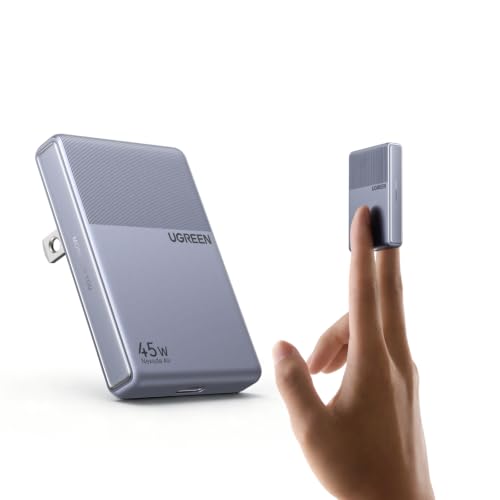
UGREEN Nexode Air 45W — The polished traveller
- Output: 45W maximum (per listing title)
- Body: flat, ultra slim, foldable plug, grey finish (per listing title)
- Technology: GaN (per listing title)
- Companions the title names: recent iPhone models, MacBook Air and Pro, Galaxy phones, iPad
- Port count detail: the title presents this as a USB-C charger block; confirm the exact port layout on the listing if a second port matters to you
UGREEN’s Nexode line is the closest thing the charging world has to a household name, and the Air variant is its entry in the flat category: 45W, ultra slim in the title’s own words, grey rather than the usual white, with a foldable plug and GaN inside. Forty-five watts is the considered size for the phone-first traveller. It fast-charges a modern phone at the pace the phone expects, keeps a tablet happy, and can maintain a thin laptop at light duty or charge it slowly while it sleeps — the title names MacBook models among its companions, and the honest reading is that this is emergency and overnight laptop duty, not a replacement for the laptop’s own full-size supply during a working day of heavy use.
The case for this pick is finish and trust as much as specification. A charger is a device you plug into unfamiliar wiring in hotels, airports and rental flats, and there is a real comfort in a maker whose broader range is sold and scrutinised worldwide. The Nexode Air’s design language — the slim slab, the folding prongs, the muted grey — suits the premium end of the travel kit, and its single-purpose simplicity suits the traveller who charges one thing at a time: phone overnight, tablet at breakfast, laptop sipping during a meeting.
That simplicity is also the boundary. A two-device traveller will feel the port arithmetic quickly, and the dual-port picks in this guide — the RUIFEI at the same 45W, or the 65W and 70W models above it — exist for them. Nor should the 45W ceiling be wished upward: a large phone’s fastest charging and a tablet’s brisk charging live inside it, but a hungry laptop under load will outdraw it and drain its own battery slowly while plugged in, which confuses owners into blaming the charger for arithmetic.
Within its intended shape, though, this is the pick this guide would hand to the reader who says: I travel light, I charge one device at a time, and I want the flat charger from the maker my other cables already come from. The Nexode Air is the category’s polished, conservative answer, and for a great many wash bags it is exactly the right one.
Strengths
- Ultra-slim flat body and folding plug from a major charging brand.
- 45W covers fast phone charging and honest tablet duty.
- Grey finish and tidy design suit a premium travel kit.
Trade-offs
- 45W is phone-and-tablet territory; laptop charging is overnight or emergency pace.
- Port layout should be confirmed on the listing if you charge two devices at once.
- Brand polish is part of the purchase; spec-only shoppers will find cheaper arithmetic below.
Best for: a light traveller charging one device at a time who values a known maker’s finish. Not suited for: a two-device traveller or a laptop-first worker, who should take the MINIX or a 65W pick.
Check the Nexode Air listing for its port layout against your nightly charging queue; if the queue is one device long, this is the most refined flat charger in the guide.

Costyle 50W Slim Flat Charger (2-Pack) — The two-room two-pack
- Pack contents: two chargers in one box — this is a 2-pack (per listing title)
- Output: 50W per the title’s wording (per listing title)
- Ports: USB-A and USB-C (per listing title)
- Charging standard named: Quick Charge 3.0 (per listing title)
- Body: slim flat with foldable plug (per listing title)
Say it first and plainly, because everything about this pick follows from it: the Costyle listing is a two-pack. Two separate 50W flat chargers arrive in the box, each with USB-A and USB-C ports and a foldable plug, and the correct way to value the pick is per charger and per socket. The household problem it solves is the two-socket problem — the sofa and the bedside, the kitchen and the guest room — where buying two individual flat chargers always felt like paying a design premium twice. Here the pair arrives together, matched, and the second charger costs the household no second decision.
Fifty watts per charger is a comfortable middleweight figure. A phone fast-charges, a tablet charges briskly, and the USB-A port keeps the household’s legacy cables in service — the older lead that lives by the bed, the watch or e-reader cable that has not been made in USB-C. Quick Charge 3.0 is named in the title, which speaks to the Android side of the house and to a slightly older generation of fast-charge negotiation than the newest USB-C PD designs; owners of the very latest phones should expect solid, quick charging rather than assuming the phone’s absolute peak proprietary pace, which often depends on the maker’s own brick.
The two-pack format also suits the sociology of chargers, which is that they migrate. A charger bought for the sofa is found in a teenager’s room; the bedside charger emigrates to a holiday suitcase and does not return. A matched pair lowers the household temperature around these migrations: there is a second one, it is identical, and the flat shape means both live in the tight sockets where the household’s charging actually happens rather than in the one generous socket everyone fights over.
The cautions are the unbranded-category cautions, stated without drama. The title does not describe the power split between its two ports when both are occupied, so simultaneous charging should be expected to divide the 50W. Nor does the title attach the kind of companion-device list the MINIX carries, so laptop duty should be treated as light and experimental rather than promised. Judged as what it declares itself to be — two honest mid-wattage flat chargers with a port for each cable generation — it is the household-value centre of this guide.
Strengths
- Two chargers in the box solve the two-socket household in one purchase.
- USB-A and USB-C together keep legacy and modern cables both in service.
- 50W per unit covers fast phone charging and brisk tablet charging.
Trade-offs
- Quick Charge 3.0 naming speaks to an older fast-charge generation than the newest PD designs.
- Port power split when both are used is not stated in the title.
- Laptop charging is not a stated purpose; treat it as light duty only.
Best for: a household with two tight sockets to serve and a mix of USB-A and USB-C cables in daily use. Not suited for: a buyer who needs one high-wattage charger for a laptop, where the MINIX or POANES fits better.
Read the Costyle listing as two chargers, not one, and divide your attention accordingly; the second unit in the box is the entire argument, and it is a good one.

POANES 65W Flat Charger (3-Port) — The three-port flat
- Output: 65W total, PD fast charging (per listing title)
- Ports: three — dual USB-C plus one USB-A (per listing title)
- Body: slim flat body, foldable plug (per listing title)
- Devices the title lists as companions: MacBook Air, iPad Pro, recent iPhone models, Galaxy phones
- Per-port figures when several devices share: not stated in the listing title
The POANES is the flat category’s maximalist: three ports — two USB-C and one USB-A — behind a 65W PD ceiling, in a slim body with a foldable plug. Three ports is the count at which a wall charger stops being a single-device servant and becomes a small station, and achieving it without abandoning the flat form is this pick’s whole engineering story. The natural home is the socket with a queue: the hallway table where a phone, a tablet and a set of earbuds rotate, the hotel desk where a laptop of the Air class named in the title shares with a phone, the bedside where a partner’s device has diplomatic rights.
The arithmetic must be read with the guide’s standing warning at full volume. Sixty-five watts is the total. A laptop drawing the large share leaves a modest remainder for the other two ports, and three hungry devices at once will each receive a fraction. This is not a flaw; it is physics wearing a name tag, and for the real queue — one big device, one medium, one sipping accessory — the distribution works gracefully. Where the POANES earns its keep is in replacing a power strip’s worth of single bricks in a tight spot, not in pretending to be a 65W charger three times over.
The port mixture is the thoughtful detail. Dual USB-C serves the modern pair, while the retained USB-A serves the cable that has not been replaced — and in most households there is exactly one such cable, trailing from a beloved older device. A three-port design that went all-USB-C would be cleaner on paper and less useful on the hallway table. The title’s companion list, spanning a laptop, a flagship tablet and two phone families, accurately sketches the intended mixed load.
Against the MINIX, the POANES trades ten watts of ceiling for the third port and the USB-A; against the unbranded 65W dual-port below, it trades minimalism for capacity. The buyer who recognises their socket in the queue description above has found their pick; the buyer whose flat charger will only ever serve one device is paying for ports that will spend their lives empty, and the slimmer answers in this guide suit them better.
Strengths
- Three ports in a flat body, the most in this guide, covering a real household queue.
- 65W PD ceiling handles a thin laptop as the queue’s anchor device.
- USB-A retained alongside dual USB-C for the household’s one legacy cable.
Trade-offs
- The 65W is shared; three busy devices divide it into modest portions.
- Per-port distribution is not stated in the title, so heavy simultaneous use is guesswork.
- More charger than a single-device socket needs.
Best for: a hallway, bedside or hotel socket where two or three devices genuinely rotate through one tight space. Not suited for: a single-phone socket, where the 45W picks are the tidier purchase.
On the POANES listing, picture your three most-charged devices sharing its face; if that picture is your hallway table exactly, the three-port flat has earned its place in the guide.

65W Slim USB-C Wall Charger (Dual Port) — The plain 65W dual-port
- Output: 65W (per listing title)
- Ports: dual port (per listing title)
- Body: slim flat design, GaN, white finish (per listing title)
- Companion devices appearing in the title: iPhone models, MacBook Pro and Air, iPad, Galaxy phones, Pixel
- Brand: no brand name appears in the listing title; the maker is best confirmed on the listing itself
This pick arrives without a name, and the guide treats that as information rather than embarrassment. The title is a specification wearing a product’s clothes: 65W, slim, USB-C, dual port, flat, GaN, white. A large slice of the charging market lives exactly here, where factories produce competent designs that reach the shelf under minimal branding, and the buyer’s protection is not a logo but a careful reading of what is and is not claimed. What is claimed is substantial: 65W is laptop-capable wattage for the Air class and light Pro use, the dual ports cover the phone-and-laptop pair, and the flat GaN body with the companions list — phones, tablets and laptops from the three big ecosystems — describes the same job the MINIX does, at the category’s plainer end.
The discipline for an unbranded pick is to buy the specification and verify the delivery. On arrival, the sensible owner tests the basics during the return window: does it charge the laptop at a sensible pace, does the second port behave when both are occupied, does the body run warm rather than alarming under load. Those ten minutes convert an anonymous purchase into a known quantity, and they are the honest price of the savings this end of the market offers. The title does not state a power split between ports, so the two-device experience should be discovered in that first week, not on a work trip.
Where does it sit against its named rivals? Against the MINIX it offers ten fewer watts and an unverified pedigree in exchange for the plainer proposition; against the POANES it drops the third port and the USB-A. Its constituency is the spec-literate buyer furnishing several sockets — a rented flat’s worth of awkward outlets, a workshop, a guest room — where the arithmetic per socket matters more than the badge, and where a failure would be an annoyance rather than a crisis.
One more honest note: support and warranty for unbranded electronics run through the seller and the platform rather than a maker’s service network. Buyers who find that thought uncomfortable have correctly identified why the UGREEN and MINIX picks exist. Buyers who find it acceptable, and who run the arrival tests, will likely be served perfectly well by a slab of GaN electronics that never learned to introduce itself.
Strengths
- Full 65W laptop-capable output and dual ports in the flat form.
- Companion list in the title spans laptops, tablets and phones across ecosystems.
- Plain-spec proposition suits furnishing several tight sockets economically.
Trade-offs
- No brand in the title; support runs through the seller rather than a maker.
- Port power split is not stated, so verify two-device behaviour on arrival.
- Pedigree is unproven compared with the named picks in this guide.
Best for: a spec-literate buyer equipping several awkward sockets who will test the charger during its return window. Not suited for: a buyer who wants a maker’s warranty network behind a primary laptop charger.
Treat this listing as a specification to be verified rather than a promise to be trusted, and it becomes a perfectly rational member of the guide: order it, test it promptly, and keep it only if it performs as titled.

RUIFEI 45W Flat USB-C Wall Charger — The low-profile spare
- Output: 45W (per listing title)
- Ports: dual ports (per listing title)
- Body: ultra thin flat body, foldable plug, low-profile design, white (per listing title)
- Technology: GaN (per listing title)
- Companions named by the maker: Galaxy phones and recent iPhone models
The RUIFEI’s title reads like a love letter to the flat idea itself: ultra thin, foldable, low-profile, with super fast charging claimed for the Galaxy and iPhone families it names. At 45W with dual ports, its proposition is the second charger — the one that lives in the kitchen drawer, the guest room, the work bag — where being forgotten until needed is the job description. Low profile is not a vanity metric in this role. The spare charger gets the worst sockets in the house, the ones behind the heaviest furniture, and a body that hugs the wall earns its keep precisely there.
Dual ports at 45W serve the overnight pattern well: a phone and a watch, a phone and earbuds, two phones of a couple travelling together and willing to share politely. The standing arithmetic applies — the 45W divides — and for overnight charging division barely matters, because time is abundant and batteries sip rather than gulp in the small hours. Where this pick should not be sent is into laptop duty or into a household’s single-charger role; those jobs belong to the 65W and 70W picks, and asking them of a 45W spare manufactures the disappointment that fills review sections.
Against the UGREEN at the same wattage, the RUIFEI trades the famous name for the second port and the more emphatic flatness claims. That is a real trade with real buyers on both sides of it: the traveller who charges one device and trusts brands takes the Nexode Air; the household that wants a dual-port slab waiting in the guest room takes this. As with the other lightly branded picks, the arrival-test advice applies — plug it in, charge two devices, feel the temperature, and let the return window stand behind the experiment.
There is a quiet virtue in a product that knows its station. The RUIFEI does not claim laptop companions, does not inflate its wattage into station territory, and describes its body three different ways because the body is the point. In a category bought for places rather than specifications, the low-profile spare that fits the worst socket in the house may end up the most-used charger in this entire guide.
Strengths
- Ultra-thin, low-profile body aimed at the tightest sockets in the house.
- Dual ports at 45W suit the overnight phone-plus-accessory pattern.
- Honest positioning: no laptop claims, no station pretensions.
Trade-offs
- 45W divides between two ports, so simultaneous fast charging is limited.
- Lightly branded; the arrival-test discipline of the unbranded picks applies.
- Not a laptop charger and not a household’s one-and-only charger.
Best for: a guest room, kitchen drawer or work bag needing a dual-port flat spare for phones and accessories. Not suited for: laptop charging or service as a home’s only charger.
Judge the RUIFEI listing by the socket you have in mind for it; if that socket is the one no normal brick has ever fitted, its low-profile body is the specification that matters.
How do the six slim chargers compare side by side?
| Pick | Output | Ports | Defining trait |
|---|---|---|---|
| MINIX 70W Flat | 70W | Dual USB-C | Laptop-capable flagship |
| UGREEN Nexode Air 45W | 45W | USB-C block; confirm layout on listing | Branded traveller |
| Costyle 50W (2-Pack) | 50W each | USB-A and USB-C | Two chargers in the box |
| POANES 65W (3-Port) | 65W total | Dual USB-C plus USB-A | Three-port flat station |
| 65W Slim Dual Port | 65W | Dual port | Unbranded spec buy |
| RUIFEI 45W Flat | 45W | Dual ports | Low-profile spare |
Two columns do the deciding. Output tells you the largest device each charger can honestly serve: phone-only at 45W, phone-and-tablet in the middle, thin laptops from 65W upward. Ports tell you how many devices queue at that socket in your real life. The Costyle row bends both columns because its unit of purchase is a pair, and the UGREEN row asks a small homework question about its layout. Everything else — finish, brand, shade of white — is preference, and the table is deliberately unhelpful about it so the functional columns get read first.
Where do slim chargers earn their keep, and where do they not?
The honour roll of slim-charger locations is specific. Behind the sofa where the cushions meet the wall and a cube brick would hold the furniture two inches off its line. Behind the headboard, where the charger must share a socket’s depth with the bed frame itself. In the hotel room, where the only free socket hides behind a dresser the housekeeping staff will not move and you should not have to. In the airport departure lounge’s floor-level outlets, where a flat charger and a short cable beat a dangling brick kicked by passing shoes, and where the traveller who packed the flat one simply gets on with the journey while everyone else negotiates with the furniture. In the kitchen, where counter appliances crowd the splashback sockets and a slab that hugs the wall keeps the worktop usable. Each of these is a place where the alternative is not a better charger but no charger, or a cable bent into an early grave.
The places they do not earn their keep are equally specific. The family charging shelf, where four devices queue nightly and a proper multi-port station with a cable for each is the honest tool. The desk of a worker whose laptop draws hard all day, where the machine’s own full-size supply or a desktop dock belongs. The workshop bench, where a charger will be knocked, dusty and swapped constantly, and a cheap cube’s disposability is a feature. Slim is a specialisation. Deployed at its specialisation it feels like a magic trick; deployed as a universal answer it feels like a compromise someone sold you.
A final placement note belongs to heat. All chargers warm in use, flat ones spread that warmth across a broad face, and the sensible owner gives any charger a little breathing room rather than sealing it between a mattress and a wall. If a socket is so confined that a charger would be pressed into soft furnishings on all sides, the right answer is a short extension lead that moves the charging point into the open — a humble accessory that has rescued more awkward sockets than any product in this guide.
How do you set up a charging spot behind furniture properly?
The installation begins before the charger arrives, with a tape measure and a honest look at the gap. Measure the distance between the socket face and the furniture that will stand in front of it, and picture the whole stack: charger body, plug folded or seated, cable connector leaving the port, and the cable’s first bend. A slim charger solves the body’s depth; the cable still needs its gentle exit, which is why the port’s position on the slab matters and why a right-angled or short, flexible cable so often completes the job. If the measured gap cannot accommodate the stack without pressure, the extension-lead solution from the previous section is not a defeat — it is the correct engineering, moving the charger a few inches into breathable space while the flat plug of the lead itself takes the tight spot.
Route the cable like you mean it. A lead that runs along the skirting and rises to the sofa’s arm will be used daily and kicked never; a lead that crosses the walkway to the lamp table will be tripped over by Friday and resented by Sunday. Where the cable must pass under a rug or behind a unit, choose a length that leaves no coiled surplus heating itself in a bundle, and no tension at either end. Chargers and cables fail at their joints, and joints fail from strain, so the graceful curve is a reliability feature disguised as tidiness.
Then make the spot a system rather than an event. The phone that lives on the sofa should find the same cable in the same place every evening, because a charging spot that must be reassembled is a charging spot that will be skipped on tired nights. Households that label nothing and arrange everything by habit still benefit from one deliberate act: deciding which charger belongs to which socket and letting the others stay out of the migration routes. The two-pack Costyle pick and the spare RUIFEI exist in this guide precisely because dedicated, per-socket chargers end the nightly hunt that a single shared brick guarantees.
Finally, revisit the spot once, a week later. Feel whether the charger runs warm in its confined home, check that the furniture has not crept tighter against it, and confirm the cable’s bend has not sharpened as things settled. That single inspection catches the slow problems — the creeping sofa, the cable slowly levering the plug — while they are still free to fix. After that, the spot should vanish from your attention, which is the entire ambition of this category: power, delivered invisibly, in the places furniture made impossible.
How do you choose the right wattage for a flat charger?
Start from the hungriest device the socket must serve, and find its appetite on its existing charger’s label or its maker’s documentation. Phones ask for the least and are satisfied across this whole guide. Tablets sit in the middle and charge happily from 45W upward, briskly from the higher tiers. Thin laptops define the top: match or exceed the rating of the supply the laptop came with if it will work while charging, and accept slower, overnight-only service from anything below that rating. Handheld gaming PCs and other dense little machines behave like small laptops for this purpose, whatever their size suggests.
Then subtract for sharing. If the socket’s charger will routinely serve two devices at once, the per-device share is the number that must clear the hungriest device’s bar, not the headline total — and since several titles here do not state their split, the conservative shopper either chooses a single-device pattern or steps up a tier to buy margin. Wattage bought as margin is rarely wasted in a charging drawer; it becomes the headroom that lets the next phone, the next tablet, the guest’s unknown device, all charge without a negotiation. The one direction not to err is downward, because an underpowered charger does not fail loudly — it merely makes everything slower, forever, in a way owners blame on their devices.
What mistakes do buyers make with slim chargers?
The classic error is reading the headline wattage as a per-port promise and then feeling cheated by arithmetic that was never hidden, merely unexamined. Close behind comes buying flat for the desk that did not need flat, then missing the ports a cube would have provided. A third error is ignoring the prongs: a slim charger whose plug does not fold is a travel disappointment waiting in the wash bag, which is why this guide’s picks all state foldable designs in their titles. And a fourth, quieter error is abandoning the cable question — a flat charger feeding a stiff, metre-long cable that levers against the furniture can still stress the socket, where a shorter, softer cable completes the installation the charger began.
A fifth error is subtler and belongs to the whole category: forgetting that the socket itself has a geography. Two outlets in a duplex plate sit close together, and a wide flat charger can annex its neighbour’s territory, leaving the second socket unusable for anything larger than a lamp’s plug. In the tight spots where these chargers shine that rarely matters — the neighbour was unreachable anyway — but at a kitchen strip or a bedside duplex it can quietly halve the available sockets. The fix is planning rather than regret: put the flat charger on the side of the plate where its body overhangs dead space, or accept the trade knowingly because the tight socket was the point.
Buyers of the unbranded end make one more: skipping the arrival tests. A named brand’s charger arrives pre-trusted by reputation; a plain-spec charger earns trust in its first week, under your devices, inside your return window. Ten minutes of testing converts the gamble into a decision, and skipping it converts a sensible saving into an unnecessary risk. The category is kind to careful buyers at every tier and unkind to assumptions at every tier.
Final Recommendation
Walk your home and count the sockets that defeat ordinary bricks; that count, not a spec sheet, is your shopping list. For the laptop-carrying socket, the MINIX 70W is the flat flagship and the POANES is its answer where a third port and a legacy cable join the queue, with the unbranded 65W serving the spec-literate buyer furnishing several spots at once. For phone territory, the UGREEN is the polished single-device traveller, the RUIFEI the dual-port spare for the worst socket in the house, and the Costyle pair the household bargain that furnishes two rooms in one box. Buy them per socket, test the plain ones promptly, measure the gap before you order, picture the cable’s exit before you plug anything in, and let the chunky station keep the family shelf. The slim charger’s triumph is a modest, daily one: a sofa pushed flush to the wall, a phone charging behind it, and nobody in the house aware that a small slab of GaN electronics made the arrangement possible at all.
Frequently Asked Questions
Will a 45W slim charger charge my laptop?
Slowly, and best while the laptop sleeps. Thin laptops generally ship with supplies in the 60W class or above; a 45W charger can maintain light use or refill the battery overnight, but a working laptop under load may draw more than 45W and drain slowly despite being plugged in. For working laptop duty, choose a 65W or 70W pick.
What does GaN actually change in a flat charger?
Gallium nitride transistors switch power more efficiently than older silicon designs, wasting less energy as heat in a smaller space. That efficiency is what lets a charger be both flat and reasonably powerful. It does not change the arithmetic of shared wattage or make a small charger immune to warming under sustained load.
When two ports are used, how is the power divided?
According to each maker’s design, and several titles in this guide do not state their split. Expect the headline wattage to be a total shared between the ports, with the exact division given in the full listing detail. If a two-device pattern matters to you, read that detail before ordering rather than assuming an even split.
Why do some slim chargers feel warm after an hour of charging?
Because conversion losses leave as heat, and a flat body has a thin edge through which to shed it, so the broad faces do the work and feel warm to the touch during hard charging. Warmth under load is normal across this category; a charger too hot to hold comfortably, or one that smells of hot plastic, is not, and should be unplugged and returned. The arrival tests recommended for the plainer picks in this guide include exactly this check.
Are flat chargers safe behind furniture?
They are designed for tight sockets, and the sensible precautions are the same as for any charger: do not bury one in soft furnishings, give its broad faces a little air, and use an undamaged cable that is not being bent sharply by the furniture. Where a socket is fully enclosed, a short extension lead that relocates the charger into the open is the wiser installation.
Why does one pick in this guide cost attention to a pack count?
Because the Costyle listing is a two-pack: two complete 50W flat chargers in one box. Read per-charger when comparing it with the single units here, and value it by the two sockets it furnishes rather than by the box’s headline alone.
Can a slim charger replace my laptop’s own power supply entirely?
For thin laptops whose supplied adapter rating sits at or below the slim charger’s ceiling — the pattern the MINIX and the 65W picks are built around — yes, for most working patterns, with the sharing caveat when a second device joins. For laptops with hungrier adapters, keep the original supply at the desk and let the flat charger be the travel and spare option; that division gives each tool the job its wattage honestly covers.
Do foldable prongs matter if the charger never travels?
Less, but not nothing. Folded prongs also protect the charger’s own body and neighbouring objects in a drawer, and they let a spare charger live in a bag or box without snagging. Since every pick here folds, the feature costs you no choice; it simply comes with the category done properly.
Related Guides
- Best Magnetic Chargers
- Best Portable Chargers And Power Banks For Phones
- Best Outdoor Wireless Routers


