What's inside
- Key Takeaways
- Quick Picks
- How We Chose These Picks
- Comparison Table
- How many charges do the best 40000 mah portable chargers actually deliver?
- How long does a 40000mAh bank take to recharge itself?
- How should you store and care for a high-capacity bank?
- Who actually needs 40000mAh, and who is better served smaller?
- How do big banks behave in heat, cold and rough handling?
- What separates a trustworthy big bank from a risky one?
- Common Mistakes
- Final Recommendation
- Frequently Asked Questions
- Related Guides
As an Amazon Associate I earn from qualifying purchases. This post may contain affiliate links at no extra cost to you.
widgetverdict.com is reader-supported. When you buy through links on our site, we may earn an affiliate commission.
Shopping for the best 40000 mah portable chargers puts you at the heavy end of the power bank world, where the promise is days rather than hours: a long weekend off grid, a worksite with no sockets, a household’s phones kept alive through a power cut, a laptop given a second life away from the wall. A 40000mAh bank holds roughly four times the energy of the pocketable 10000mAh class, and everything about the category scales with that figure — the usefulness, the weight, the recharge time, and the importance of buying from a maker whose cells and protection systems can be trusted with that much stored energy. The six banks below were chosen with that trust question first: five carry checked listings, and one widely encountered model is discussed as a prose-only comparison because its listing could not be verified for this guide.
Where to buy: linked picks lead to checked Amazon listings for the models described. This category is crowded with anonymous listings whose capacity claims deserve the arithmetic test this guide applies in its buying sections, so wherever you shop, compare the delivered-capacity reasoning below before comparing headline numbers. Prices in this class move with sales and bundle configurations, so check price on Amazon when you are ready, and confirm the exact capacity variant on the listing — several of these product families sell smaller siblings under near-identical names.
Two honest warnings belong at the top. First, delivered energy: a 40000mAh rating describes internal cells at their native voltage, and after conversion to phone voltage the usable figure is far lower — still enough for many phone charges, as the guide section below calculates, but never the naive division the box implies. Second, air travel: a bank of this size stores roughly 148 watt-hours, above the 100 watt-hour threshold airlines apply to cabin baggage without special approval, so most 40000mAh banks are effectively ground transport only. Buyers who fly with their bank should shop the smaller classes; buyers who drive, camp, work sites or ride out storms are exactly who this guide serves, and they will find the class far more capable than its bargain-bin reputation suggests, provided the buying screens in the sections that follow are applied with the same seriousness as the journeys the bank is bought for and the outages, deadlines and long dark drives it is bought against, in weather good and bad, all year round, by owners who plan ahead and charge ahead of need, every single time it really matters the very most.
Key Takeaways
- At 40000mAh, maker trust matters more than features — this is a lot of stored energy to carry, and protection quality is the product.
- The 65W pick is the only one here that treats a laptop as a first-class citizen rather than an emergency afterthought.
- Built-in cables earn their keep at this size, because a big bank serving several devices otherwise drags a nest of leads behind it.
- Expect delivered energy around sixty to seventy percent of the headline figure at phone voltage — still several full phone charges.
- These banks are too energy-dense for routine air travel; they belong to road trips, campsites, worksites and home emergency kits.
- Refilling a 40000mAh bank takes hours even on a fast input, so input wattage decides whether the bank is ready when life repeats itself tomorrow.
Quick Picks
| Pick | Badge | Why it makes the cut |
|---|---|---|
| LOVELEDI 40000mAh Power Bank | Best all-round big bank | Balanced output, clear display and a shape that packs flat for travel by road. |
| 65W Power Bank 40000mAh Laptop Charger | Best for laptops | 65W USB-C output that genuinely charges laptops, not merely maintains them. |
| FlyKangaroo 40000mAh Power Bank | Best for long trips | High-capacity road-trip bank with multi-device output for shared travel power. |
| Portable Charger 40000mAh 22.5W | Best phone-focused value | 22.5W fast charging for phones in a straightforward, no-drama design. |
| 40000mAh Power Bank with Built-in Cables | Best for families | Integrated cables for the main connector types, ready for every device at the table. |
| T-CORE 40000mAh Power Bank | Prose-only comparison | A fixture of this class’s value end, assessed in prose in its own section. |
How We Chose These Picks
The first screen in this category is not a feature at all — it is whether the maker can be held to account. A 40000mAh bank stores enough energy to demand real engineering: quality cells, a protection board that monitors temperature and output, and a shell that survives being dropped with the bank’s considerable weight behind it. We favoured listings with traceable brands, documented protection systems and specifications that survive arithmetic, and we applied the standing exclusions of this site without exception: no recalled models, and no products from lines subject to safety recalls, whatever their capacity claims. In a category where anonymous listings shout the loudest, that screen did most of the choosing.
The second screen was honesty about delivered energy. Makers in this class increasingly print a rated or delivered capacity alongside the headline figure, and we weighted those listings up, because a brand willing to state the smaller true number is a brand whose other numbers can be believed. We also checked that output wattages were stated per port and in total, since a bank that advertises fast charging but divides a modest output three ways will disappoint the family that plugs everything in at once.
Third came the practicalities of living with a heavy object. Weight and shape decide whether a big bank travels or stays home; handle and edge design decide whether it survives the travelling; input wattage decides whether it can be refilled overnight or needs a full day; and the display decides whether you know its state at a glance or by shaking it and guessing from four dots. Finally, we spread the six across the genuine use cases: laptop support, family sharing with built-in cables, phone-focused value, and the general-purpose road bank, so that the comparison below maps onto real journeys rather than a spec-sheet ladder.
Reader questions shaped the shortlist’s balance more than any specification did. The questions that arrive about this class are rarely “which is biggest?” — they are “will it run my laptop on a train?”, “can it keep four phones alive at a festival?”, “is it allowed in my suitcase?”, and “why did my last one swell?” A guide that answers those has to include a genuine laptop bank, a genuine sharing bank, a family bank with its cables attached, and a great deal of honest talk about energy limits and care. The six below were assembled as answers to those questions first, and as products second, which is why the prose-only seat exists: the landscape readers actually shop includes models we could not verify, and pretending otherwise would make the guide less useful, not more pure.
We excluded banks whose capacity claims failed basic plausibility for their size and weight, models with no identifiable protection documentation, and anything marketed primarily on gimmicks — solar panels the size of a coaster on a bank this large, novelty torches — rather than on the unglamorous work of storing and delivering energy safely. What remains is a short list in which every bank has a defined job and a stated compromise.

LOVELEDI 40000mAh Power Bank — Best all-round big bank
The LOVELEDI is the bank we would hand to a reader who described the general case — long days away from sockets, several devices, no single exotic requirement — and wanted one purchase to cover it. Its output suite fast-charges phones at their proper pace, shares power across multiple ports for the phone-plus-tablet-plus-earbuds reality of travel, and reports its remaining charge on a clear digital display, a feature that matters more at this capacity than at any other: guessing wrong about a big bank’s state means carrying a heavy, empty brick, and the display removes the guesswork.
The body is a flat slab, the shape that packs sensibly against a laptop or the wall of a backpack, and the weight is the honest weight of its class — you will know it is in the bag, and the guide’s position is that any 40000mAh bank claiming otherwise is confessing something about its cells. Refilling happens over USB-C at a pace that suits an overnight charge, and the bank’s protection systems cover the standard quartet of overcharge, over-discharge, short circuit and temperature. In the outage scenario — phones, a tablet for the children, a torch or two — this is the bank that sits on the kitchen table and quietly runs the household’s small electronics for days.
Its compromises are the class compromises, cleanly borne. It will not charge a laptop at full speed — that is the 65W pick’s territory — and it is not coming on a plane in your hand luggage under ordinary airline rules. Wireless charging is absent, which at this size we count as a sensible omission rather than a lack. As the default big bank for road travel, camping and home backup, it balances capacity, output and clarity better than anything else in this guide.
One ownership pattern deserves a mention: big banks earn a fixed home. Owners who give the LOVELEDI a permanent spot — the hallway drawer, the storm kit, the camper’s electrics box — and a monthly top-up habit report the bank simply always being ready, while owners who let it migrate find it, reliably, in the wrong vehicle. At this size the bank is infrastructure, and infrastructure works best with an address.
- Capacity: 40000mAh
- Output: multi-port fast charging for phones and tablets
- Display: digital percentage readout
- Input: USB-C refill, overnight pace
- Protection: overcharge, over-discharge, short-circuit, temperature
Campers give this bank its most characteristic workout, and it is worth describing what good looks like in that setting. The bank leaves home full, rides in the car’s electrics box, and across a three-day weekend it absorbs the family’s entire small-device load — phones on low-power mode, a tablet for the drive, head torches refilled mid-trip — returning home with something still in reserve. That margin is the difference between a bank that is part of the kit and a bank that is part of the anxiety, and it comes from the combination of honest capacity and a display that lets the family ration knowingly rather than discover emptiness at bedtime on day two.
Strengths
- Clear percentage display suits a bank whose state really matters.
- Flat shape packs well for road and camp travel.
- Multi-port output matches real multi-device days.
Trade-offs
- Not a full-speed laptop charger.
- Too energy-dense for routine air travel.
- Heaviest class of bank; you feel it in the bag.
Best for: campers, road-trippers and households wanting one big bank for outages and long days away from sockets. Not suited for: air travellers, or laptop users who need full-speed charging away from the wall.

65W Power Bank 40000mAh Laptop Charger — Best for laptops
Most big banks treat a laptop port as a marketing line; this one treats it as the design brief. Its 65W USB-C output is the threshold at which modern laptops genuinely charge rather than merely slow their decline — ultrabooks and mainstream notebooks drink properly from it, and phones connected alongside fast-charge at their own full pace from the remaining output. For the field engineer, the student in a library with one contested socket, the van-lifer whose office runs on stored energy, this is the pick that turns a power bank from a phone accessory into a workstation component.
The supporting details match the headline. A digital display tracks the large capacity honestly, the input side refills the bank at a rate that respects its size — a bank this big on a feeble input is a two-day refill, and this one’s input is specified for overnight recovery — and the port layout assumes simultaneous laptop-plus-phone duty rather than pretending otherwise. The shell and protection systems are built to the standard the energy inside demands, with temperature monitoring that matters when 65W flows for an hour at a stretch.
Weight is the honest price, as with every pick here, and the laptop mission adds a caveat: 65W covers the great majority of USB-C laptops, but large gaming notebooks and workstation bricks with higher appetites will charge slowly or only while asleep, and owners of those machines should read this bank as a range extender rather than a wall replacement. For everyone whose laptop sips rather than gulps, it is the only pick in this guide that makes the laptop a full citizen of the off-grid setup, and that distinction is worth more than any other single feature in the category.
It also reframes the bank’s economics. A laptop-capable bank replaces several lesser purchases — the spare laptop adapter for the second location, the car inverter, the extra phone bank — because one object covers the desk, the road and the outage. Buyers who cost it as a phone bank will find it dear for the class; buyers who cost it as mobile power for everything they own will find it the most efficient purchase in this guide.
- Capacity: 40000mAh
- Output: 65W USB-C for laptops, plus ports for phones
- Display: digital percentage readout
- Input: high-rate USB-C refill for overnight recovery
- Protection: temperature and output monitoring throughout
Van-based workers make the strongest case for this pick, because their arithmetic is unforgiving: the laptop is the business, the leisure battery is finite, and every hour of laptop runtime bought from a bank rather than the vehicle’s system is an hour of reserve preserved. A 40000mAh store at laptop voltages is a working day of light computing held in reserve, rechargeable from the vehicle while driving. Set against the cost of a missed deadline or a second leisure battery installation, the bank’s price and weight stop looking like an accessory decision and start looking like the cheapest capacity the business owns.
Strengths
- Genuine laptop charging, not emergency trickle.
- Input speed matches the bank’s size.
- Handles laptop and phone together sensibly.
Trade-offs
- High-power gaming laptops exceed its comfortable output.
- Ground transport only, like the rest of this class.
- Overkill for phone-only users.
Best for: remote workers, students and field engineers whose USB-C laptop must run for days away from reliable sockets. Not suited for: phone-only buyers, or owners of high-wattage gaming notebooks expecting wall-equivalent charging.

FlyKangaroo 40000mAh Power Bank — Best for long trips
The FlyKangaroo is pitched squarely at the long journey: the multi-day drive, the camping week, the festival with a tent and a long walk to any socket. Its design centres on sharing — multiple outputs feeding several travellers’ phones across days, a clear readout so the group can see the communal resource’s state, and a body built to live in a car door pocket or a rucksack’s outer sleeve and be grabbed constantly. Where the LOVELEDI is the household’s bank, the FlyKangaroo is the expedition’s.
Shared duty exposes weak banks quickly, and the details here suit it. Output holds up with more than one device connected, the bank refills over USB-C at a pace that works during a campsite evening or a long drive, and the protection systems are documented to the standard this guide requires. The capacity, delivered through the conversion arithmetic explained in this guide’s buying section, translates to a group of phones kept alive across a long weekend with ordinary care — the use case that defines the class and the one this bank is unambiguously built for.
Its limits are the familiar ones, plus one of emphasis: it is a phones-and-tablets bank, without the 65W pick’s laptop ambitions, and its travel is road travel — the airline restriction applies to it as to every 40000mAh model here. Buyers whose long trips involve airports should downsize to a flyable bank and accept the smaller store. Buyers whose long trips involve highways, ferries and fields will find this the most naturally suited pick in the guide.
A word on group etiquette, learned from every shared-bank owner: the bank works best with a named keeper and a nightly refill ritual, because communal power without a routine becomes a tragedy of the commons by day three. The FlyKangaroo’s display supports that ritual — one glance at breakfast settles whether today is a charging day — and groups that adopt it report the bank simply lasting the trip, which is the entire review in one sentence.
- Capacity: 40000mAh
- Output: multi-port, suited to several phones at once
- Display: clear charge-level readout
- Input: USB-C refill
- Protection: documented multi-point system
Festival duty adds a wrinkle the camping case lacks: security and scarcity. A bank this size is worth guarding in a tent, and its owners develop the habits — charged in the car, carried in the day bag, never left charging unattended in a public tent — that shared environments demand. The FlyKangaroo’s travel format suits that life, and its display settles the nightly negotiation about whose phone gets the next hour. Groups that have done a festival both ways, with and without a bank of this class, do not go back; the phone stays a camera, a map and a meeting point instead of a rationed emergency tool.
Strengths
- Built for shared, multi-device travel duty.
- Display makes communal power management easy.
- Sturdy travel format for cars and campsites.
Trade-offs
- No high-wattage laptop output.
- Not an air-travel bank under standard airline rules.
- Shared use demands a refill routine to shine.
Best for: groups, families and campers sharing phone power across multi-day road and camping trips. Not suited for: solo laptop users, or any itinerary built around flights.
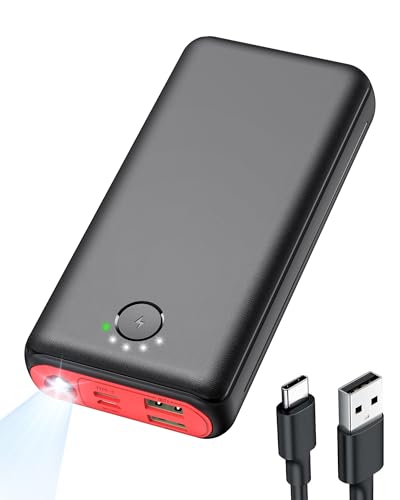
Portable Charger 40000mAh 22.5W — Best phone-focused value
Not every big bank needs laptop ambitions, and this 22.5W model is the guide’s argument for focus. Its output is tuned to the fast-charging standards mainstream phones actually use — 22.5W is the pace a large share of Android handsets call fast, and iPhones drink comfortably from it — delivered through the standard port mix, with a big store behind it and a design that spends its budget on capacity and competent electronics rather than on wattage its buyers’ phones cannot use. For the phone-only household, that focus is value in its purest form.
The lived pattern is endurance. A commuter with a long round trip, a delivery driver whose phone is a work tool, a teenager at a three-day tournament: each draws a phone-charge or two a day, and this bank carries close to a week’s worth of that pattern between its own refills. Its display keeps the owner informed, its refill over USB-C is an overnight affair, and its protection documentation meets the standard this guide applies to the whole class. Nothing about it reaches for a spec-sheet trophy, and that restraint is precisely its recommendation.
Against the LOVELEDI it trades a little all-round polish for its phone focus; against the 65W pick it concedes laptops entirely. Buyers should also note the class constants: the weight is real, the airline restriction applies, and 22.5W shared between two hungry phones divides rather than doubles. Judged as a phone endurance bank — the job most 40000mAh buyers actually have — it is the most direct route in this guide from money to days of phone power.
It is also the pick most likely to be bought twice, in the good sense: households that discover the pattern — one big bank living in the car or the work bag — tend to add a second for the other location rather than upgrading, because the formula already fits. Equipment that gets duplicated rather than replaced has passed the only review that cannot be faked.
- Capacity: 40000mAh
- Output: 22.5W fast charging for phones, multi-port
- Display: charge-level readout
- Input: USB-C refill, overnight pace
- Protection: documented multi-point system
Delivery and rideshare drivers are this bank’s quiet constituency, and their pattern is the purest endurance test in the guide: the phone runs a work app at full brightness for eight to ten hours, the car’s USB port is weak or occupied, and the bank under the seat is the difference between finishing the shift and watching the tool die at hour seven. A 22.5W feed matches the phone’s appetite while it works, and the big store means the bank itself needs refilling weekly rather than nightly. For that reader, this unglamorous pick is not an accessory at all — it is part of the vehicle’s equipment, bought once and relied on daily.
Strengths
- Output matched to real phone fast-charging standards.
- Days of phone endurance between refills.
- Straightforward design spends money where it counts.
Trade-offs
- No laptop-class output.
- Shared output divides between simultaneous devices.
- Same weight and air-travel limits as the whole class.
Best for: phone-heavy users — drivers, commuters, students — who need a week of top-ups from one bank. Not suited for: laptop charging, or travellers whose trips begin at an airport.

40000mAh Power Bank with Built-in Cables — Best for families
Built-in cables are a modest feature on a small bank and a transformative one on a big shared bank, because a 40000mAh unit serving a family otherwise needs a cable per connector type, and those cables live everywhere except with the bank. This model integrates leads for the main connector families — USB-C and Lightning among them — alongside standard ports for anything unusual, so the bank on the kitchen table during an outage, or in the car on a long drive, can charge whatever is handed to it without a drawer expedition. The cables stow into the body, keeping the brick tidy in a bag.
The family scenario is its home ground, and it is worth picturing concretely: four phones of two ecosystems, a tablet, a pair of earbuds, one bank, no sockets. The built-in leads handle the phones in rotation, the ports handle the rest, the display arbitrates the queue, and nobody’s device is excluded for want of the right cable — the failure that, in real households, ends more family charging sessions than capacity ever does. For grandparents’ houses, holiday cottages and storm kits, that inclusiveness is the product.
Built-in cables carry their known trade: they are the wear item. A lead flexed thousands of times at its root will eventually fail, and unlike a separate cable it cannot be swapped for a fresh one — the port beside it still works, but the convenience halves. Treat the leads gently, never carry the bank by them, and the design serves for years. The bank otherwise shares the class profile: phone-class output rather than laptop wattage, honest weight, and the airline restriction that applies to every model in this guide.
There is a subtle benefit for households with younger children: a bank with its cables attached is a bank that stays complete. Separate cables migrate to bedrooms and school bags within a week; attached cables are still attached in month six, and the storm kit audited in October contains a working system rather than a bank and a memory of cables. Completeness, in emergency equipment, is a safety property.
- Capacity: 40000mAh
- Cables: built-in leads for main connector types
- Ports: standard ports alongside the built-in leads
- Display: charge-level readout
- Protection: documented multi-point system
Holiday cottages and grandparents’ houses reveal a second family pattern: the bank as the house’s shared utility, left in a kitchen drawer for whoever visits. Guests arrive with dying phones and no cables anyone can find; the bank with its leads attached simply works, for every visitor, without a host rummaging through a decade of accumulated leads. Owners of second homes describe fitting one of these and watching the drawer-of-cables problem — a small, eternal domestic friction — quietly cease to exist. Few specifications promise that; completeness, again, is the feature.
Strengths
- Charges any family device without hunting for cables.
- Stays complete in shared and emergency-kit use.
- Ports remain available when a lead is busy or ageing.
Trade-offs
- Built-in leads are non-replaceable wear items.
- Phone-class output; not a laptop bank.
- Class-standard weight and air-travel restriction.
Best for: families, shared houses and storm kits where one bank must serve every connector type at the table. Not suited for: laptop users, or owners who are rough on cables and would rather replace a lead than a bank.
T-CORE 40000mAh Power Bank — Prose-only comparison
T-CORE’s big banks appear in a great many shopping sessions for this category: 40000mAh-class capacity, multiple ports, fast-charge claims and the aggressive pricing that defines the class’s value end. Readers will meet this brand early in any search, and its designs follow the now-standard big-bank formula — a heavy slab, a level indicator, phone-class output — competently enough that owner reports describe ordinary, uneventful service, which in this category is praise.
It is discussed here without a purchase link for a procedural reason that we state openly: the verified pool behind this guide contains only models whose current listings we checked end-to-end for this article, and this T-CORE model was not among the checked set, so sending readers to an unverified listing would break the discipline the rest of the guide is built on. Readers who pursue it independently should apply the guide’s screens — verify the exact listing and its protection documentation, do the delivered-capacity arithmetic, and buy through a channel with painless returns so the individual unit can be tested on arrival.
As a comparison point it clarifies the linked picks’ value. Against the LOVELEDI it competes on the same all-round ground; the LOVELEDI carries this guide’s recommendation because its listing, display and documentation passed our verification in full. That is a procedural victory rather than a claim that the T-CORE is a poor bank — the honest summary is that it is a typical, widely bought big bank about which we could not complete our checks, and in a category storing this much energy, “could not complete our checks” is reason enough to point the link elsewhere.
- Capacity: 40000mAh class
- Output: multi-port, phone-class fast charging
- Indicator: LED charge level
- Role in this guide: comparison point for the value end of the class
- Purchase route: none provided — see the explanation above
For readers who already own a T-CORE bank, the useful guidance is the care routine elsewhere in this guide rather than a replacement pitch: a sound big bank, kept cool, cycled occasionally and inspected honestly, has years of service in it regardless of which guide linked it. Replace on condition — swelling, heat, collapsed delivered capacity — and not on the arrival of a newer shortlist. That advice generalises across this whole category, and it is offered here in the certain knowledge that it costs sales: a guide’s credibility is worth more than any single commission, especially in a category where trust is the product.
Strengths
- Widely available value-end option with many owner reports.
- Standard big-bank formula covers the common use cases.
- Aggressive pricing typical of the class’s competitive end.
Trade-offs
- Appears without a link; our verification pass for this article did not include it.
- Buyers must run their own listing and protection checks.
- Indicator is basic beside the digital displays of linked rivals.
Best for: readers researching the whole class who want the value end represented before choosing a verified pick. Not suited for: anyone who wants to buy directly from this guide — the linked LOVELEDI covers the same ground with verification behind it.
Comparison Table
| Pick | Capacity | Max output | Signature feature | Link status |
|---|---|---|---|---|
| LOVELEDI 40000mAh | 40000mAh | Multi-port fast charge | Percentage display, flat pack shape | Linked |
| 65W 40000mAh | 40000mAh | 65W USB-C | True laptop charging | Linked |
| FlyKangaroo 40000mAh | 40000mAh | Multi-port | Shared travel duty | Linked |
| 40000mAh 22.5W | 40000mAh | 22.5W | Phone-focused endurance | Linked |
| 40000mAh Built-in Cables | 40000mAh | Multi-port | Integrated leads for all connectors | Linked |
| T-CORE 40000mAh | 40000mAh class | Multi-port | Value-end fixture of the class | Prose-only |
How many charges do the best 40000 mah portable chargers actually deliver?
Do the conversion once and you can read the whole category clearly. The headline figure counts the internal cells at about 3.7 volts, which makes a 40000mAh bank a store of roughly 148 watt-hours. Your phone charges at 5 volts and above, so the bank converts upward and loses a share — a tenth to a fifth, depending on the bank and the cable — in the process. The honest delivered figure lands around 24000 to 28000mAh at phone voltage for a well-made bank of this class, and the better listings in this category print a rated capacity in that neighbourhood, which is one of the trust signals this guide weighted.
Against real phones, that delivered store is generous: a modern handset with a battery in the 4000 to 5000mAh region can be refilled from empty roughly five times, give or take the phone’s size and how much of each charge is spent while the phone is also being used. A tablet takes a much larger bite — one full tablet charge plus phones is a fair expectation — and a laptop on the 65W pick converts the same store into a substantial fraction of a full notebook charge, or hours of extended running. Plan a trip on those numbers and the bank will meet the plan; plan it on the box’s implied ten phone charges and it will not.
The same arithmetic explains the airline rule mentioned at the top of this guide. Aviation limits are written in watt-hours, and 148 watt-hours sits above the threshold that flies without approval and below the absolute ceiling only in the band where airlines may grant permission case by case. Most travellers should simply accept that this class stays on the ground, and flyers should look at banks a quarter of this size, which sail through every checkpoint.
How long does a 40000mAh bank take to recharge itself?
Longer than most first-time buyers expect, and the input specification — not the capacity — decides the exact sentence. A bank of this size fed by a modest input can need the better part of a day to go from empty to full; fed by the higher-rate inputs fitted to the better picks here, an overnight charge does the job. This is why the guide treated input wattage as a headline trait rather than a footnote: a big bank’s usefulness is a rhythm of discharge and refill, and a bank that cannot refill overnight fails the rhythm on the second day of any trip.
Practical habits follow. Charge the big bank the night before a journey as deliberately as you charge the devices themselves; top it during long drives, when the vehicle’s power is free; and never judge a bank faulty for an empty morning that a slow input made inevitable. Owners who adopt the rhythm find the class effortless; owners who expect phone-like refill times find it perpetually disappointing, and the difference is expectation, not equipment.
Partial refills are also worth understanding: a big bank does not need to be full to be useful. Two hours on a decent input restores enough for several phone charges, which rescues most real situations. The full overnight charge is for departures and storm warnings; the opportunistic top-up is for everything else, and a bank with a clear percentage display — most of the linked picks here — makes judging those partial states easy.
How should you store and care for a high-capacity bank?
A 40000mAh bank is stored energy on a scale that deserves a routine. Keep it at partial charge — roughly half to two-thirds — for long storage rather than brimful or empty, in a cool, dry place away from radiators and sunny sills, and cycle it every few months: run it down through honest use, refill it to its storage level. A bank kept this way will hold its health across years; a bank filled, forgotten in a hot garage and found two summers later will often be a shadow of itself, and occasionally a swollen warning about the routine it deserved.
Inspect it as you would any safety-relevant equipment. Swelling, a case that no longer sits flat, unusual heat during ordinary charging, a chemical smell, or damage from a drop onto concrete are all retirement signals, not quirks to monitor. Retire through a battery recycling point, never household waste, and never puncture or dismantle a bank yourself. These are not premium-brand cautions; they are the standard terms on which a household keeps this much lithium in a drawer, and they apply to every pick in this guide equally.
Travel storage deserves its own sentence in the routine. A big bank in a vehicle should ride low, secured against sliding, out of direct sun and away from anything that could crush or puncture its case in a sudden stop; in a rucksack it wants a sleeve or a pocket of its own rather than loose contact with keys, tools and tent pegs. The bank’s energy is an asset exactly as long as its case is intact, and the five seconds spent stowing it properly are the cheapest insurance in the whole travel kit.
Finally, keep the bank’s cables and ports as a system: one known-good high-rate cable lives with the bank, so its refill speed is the speed you planned for, and the storm kit or travel bag contains a tested arrangement rather than a bank and a hope. Big banks reward system thinking more than any other accessory class, because their whole value is realised in bad moments — the outage, the breakdown, the third day of the trip — when improvisation is least available.
Who actually needs 40000mAh, and who is better served smaller?
The honest census of big-bank owners has four tribes. The off-grid traveller — camper, festival-goer, road-tripper — whose days run longer than their access to sockets. The professional whose phone or laptop is a tool of the trade and whose work happens in vehicles, sites and fields: couriers, inspectors, photographers, tradespeople between jobs. The prepared household, which keeps one bank in the storm kit the way it keeps torches and bottled water, and hopes to use it rarely. And the shared household — students in a house-share, families in one car — where several people’s devices draw on one store.
Against those tribes, the people who should buy smaller are just as identifiable. Air travellers, for the regulatory reasons this guide repeats deliberately. Daily commuters whose need is one rescue charge, for whom a 10000mAh bank in the pocket beats a 40000mAh bank in the drawer at home by the only margin that counts. And minimalists whose devices are few and whose sockets are many. The capacity classes exist because needs differ by an order of magnitude; the expensive mistake is not buying too little or too much, but buying a size whose natural home is a different life from yours.
How do big banks behave in heat, cold and rough handling?
Heat is the enemy this class feels most, because a large store ages faster when warm and because big banks are so often kept in cars — the hottest storage environment most households own. A bank that summers in a glovebox will lose capacity noticeably faster than its twin in a hallway drawer, and a bank left on a dashboard in direct sun is being genuinely abused. The routine answer is boring and effective: the big bank lives in the house or the shaded boot, comes out for journeys, and goes back indoors after them.
Cold cuts the other way: a chilled bank delivers less and accepts charge reluctantly until it warms, which winter campers learn on the first trip. Carried inside a jacket or slept near — the old expedition trick of keeping batteries warm with body heat applies to banks too — it recovers its manners. Rough handling is the third test, and here the class’s weight cuts both ways: a heavy bank survives a rucksack’s life if its shell is sound, but a drop onto concrete carries more energy than a small bank’s fall, and a bank that has taken a hard drop deserves inspection before its next charge rather than blind trust. Treat the big bank like the energy store it is — cool, dry, un-dropped — and it will behave like infrastructure for years.
What separates a trustworthy big bank from a risky one?
Start with the paperwork of trust: a maker you can find, a protection system described in specifics rather than adjectives, a rated or delivered capacity printed alongside the headline figure, and a weight consistent with the energy claimed. Each of those is checkable from a listing in minutes, and together they filter out most of the category’s danger before money moves. Then apply the arrival test this guide recommends for every bank: charge it fully, discharge it into a phone while counting honestly, feel for abnormal heat, and use the returns window without sentimentality if the unit fails any part of that audition.
The deeper separation is behavioural over time. Trustworthy banks age gracefully — capacity fading gradually, case intact, behaviour predictable — because their cells were honestly graded and their protection never sleeps. Risky banks age suddenly, because marginal cells and minimal protection hide their nature until heat, age or a hard week exposes it. You cannot see that difference on a product page, which is precisely why this guide’s linked picks are confined to listings that passed verification and why one popular model sits in prose-only: at this energy level, the burden of proof belongs on the bank, not on the buyer.
Common Mistakes
The category’s signature mistake is believing the headline capacity and planning around it: the family that expects ten phone charges discovers five, on day two, at a campsite. The arithmetic section above is the vaccine. Read delivered capacity, plan on it, and let the surplus be a pleasant surprise rather than the plan’s foundation.
Second is buying a 40000mAh bank for air travel. The watt-hour ceiling is not a technicality that gate staff waive for a confident manner; banks above the limit are refused or confiscated, and the traveller loses both the bank and the plan. Flyers belong in the 10000 to 20000mAh classes, which exist precisely inside the rules.
Third is neglecting the refill side: choosing by output wattage alone, then living with a bank that needs a day to recover. Input speed is half the product at this capacity. Fourth is storage neglect — the storm-kit bank left full in a hot garage for two years, swelling quietly toward its discovery during the storm. The care routine in this guide takes minutes per quarter; skip it and the biggest bank in the house becomes the least reliable object in the emergency kit.
Final Recommendation
Choose by the load you actually carry. Phones and tablets on the road or through outages: the LOVELEDI is the balanced default, with the FlyKangaroo tuned to shared travel and the 22.5W model the focused phone-endurance buy. A laptop in the load changes the answer outright — the 65W pick is the only one here that charges one properly, and laptop owners should start and end their shortlist there. Families and storm kits should take the built-in-cables model, whose completeness in a crisis outweighs its leads’ finite life. And treat the prose-only T-CORE as this guide treats it: a legitimate part of the landscape, assessed openly, but not where our link sends your money, because at 148 watt-hours in a bag, verification is not bureaucracy — it is the feature everything else depends on. Buy the bank a week before the trip, not the night before; run it through one full charge and discharge at home, where a dud is an inconvenience and a returns label is easy; and then let it settle into the unglamorous role it was bought for, which is to be forgotten about until the moment everything else has failed and it has not.
Frequently Asked Questions
Can I take a 40000mAh power bank on a plane?
Generally, no. At roughly 148 watt-hours, a bank of this size exceeds the 100 watt-hour limit that flies in cabin baggage without airline approval, and sits in the band where approval is discretionary and often impractical to arrange for a consumer accessory. Rules vary slightly by airline and country, but the safe planning assumption is that 40000mAh banks travel by road. Frequent flyers should buy a bank of 10000 to 20000mAh, which sits comfortably inside the limits.
How many times will a 40000mAh bank charge my phone?
Realistically around five full charges for a typical modern phone, once conversion losses are counted — the delivered capacity of a good bank in this class is roughly 24000 to 28000mAh at phone voltage. Bigger phones get fewer, smaller phones get more, and charging a phone while gaming on it spends part of the transfer on the game. Anyone promising you ten full charges from this capacity is doing box arithmetic, not physics.
Can a 40000mAh bank charge a laptop?
Only if its output is built for it. The 65W pick in this guide charges most USB-C laptops properly. The phone-focused picks can, at best, slow-charge a sleeping laptop or extend its runtime modestly, and some laptops refuse low-wattage sources entirely. If laptop charging is a requirement rather than a bonus, filter by output first — 65W is the practical threshold — and by capacity second.
Can one big bank replace several small ones?
For stationary and vehicle-based life, largely yes — one 40000mAh bank in the car or the storm kit covers the aggregate need that four pocket banks were bought for, with one refill rhythm and one state to check. For distributed life, no: the small bank in a jacket pocket solves a geography problem the big bank at home cannot. Most households that think it through end with a two-tier system — the big bank as the reservoir, one or two small banks as the canteens — and find that the tiers stop competing and start cooperating, the small ones refilled from the large when sockets are scarce.
Why is my big bank so heavy?
Because energy has mass. A genuine 40000mAh store requires a substantial stack of lithium cells, and a bank of this capacity that feels light is a bank whose cells are not what the label claims — weight is one of the quickest fraud detectors in this category. Expect a solid, bag-noticeable object, choose a flat shape that packs well, and be suspicious of any listing that promises this capacity in a featherweight body.
How do I know when a big bank needs replacing?
By delivered performance and by condition. A bank that once gave five phone charges and now gives three has faded to the point where replacement is reasonable for critical use. Any bank that swells, heats abnormally, smells chemical or suffers case damage should be retired immediately regardless of performance, and recycled through a proper battery point. For emergency-kit banks, test the delivered capacity once a year — one full phone charge counted honestly — so the discovery never happens during the emergency.
Can I charge devices while the bank itself is charging?
Many banks in this class support pass-through charging — feeding a phone while the bank refills — and it is convenient on travel nights with one socket. Used occasionally it does no meaningful harm; used as a permanent arrangement it keeps the bank hot and cycling at high charge, the two conditions that age lithium fastest, and it can confuse the bank’s own gauge. Treat pass-through as a travel convenience, not a lifestyle: in the morning, unplug, let the bank finish its own refill alone, and let it work from its store like it was designed to.
Is it safe to leave a 40000mAh bank charging overnight?
With a verified bank from a maker with documented protection, overnight charging on a hard, clear surface is the normal refill pattern for this class — the bank’s systems terminate and monitor the charge. The precautions scale with the energy: keep it off bedding and out of direct sun, use the cable and adapter its input expects, and do not charge a bank that is damaged or swollen at any hour. Owners who prefer belt and braces can refill during waking hours; the bank does not care which hours it drinks in.
Related Guides
Balance the big bank with its smaller companions — the pocket bank for the day, the wall charger for the refill, the solar panel for the long off-grid week — using our guides to the best 20 dollar portable chargers for everyday carry, the best 65 watt USB-C chargers for wall-speed refills, and the best 12 volt solar chargers for off-grid top-ups.
Related guide: Best Portable Chargers with Pass-Through Charging
Related guide: Best MagSafe Portable Chargers


