What's inside
- Key Takeaways
- Quick Picks
- How We Chose These Picks
- Why Does Headline Wattage Mislead Budget Charger Shoppers?
- What Should You Check Before a Cheap Pad Reaches Your Nightstand?
- Which of the Six Pads Fits Your Rooms, Phones and Habits?
- How Do the Six Pads Compare Side by Side?
- What Mistakes Do Budget Charger Buyers Keep Making?
- How Should You Set Up a Cheap Pad for Reliable Overnight Charging?
- How Does Wireless Charging Treat a Battery Across Years of Nights?
- Which Rooms Gain Most From a Second or Third Pad?
- What Does Qi Certification Actually Guarantee a Buyer?
- How Do Cases, Stands and Desk Clutter Change the Result?
- When Is a Cable Still the Smarter Answer?
- What Should a Second Pad Teach You About the First One?
- How Long Should a Budget Pad Last Before Replacement Makes Sense?
- Final Recommendation
- Frequently Asked Questions
- Related Guides
As an Amazon Associate I earn from qualifying purchases. This post may contain affiliate links at no extra cost to you.
widgetverdict.com is reader-supported. When you buy through links on our site, we may earn an affiliate commission.
Where to buy: each pad below links to its own Amazon listing, where the box contents matter more than usual at this end of the market, because two of the six ship without a wall adapter and one arrives as a twin pack.
A bedside pad does not need to be clever. It needs to start charging when a tired hand drops a phone roughly in the middle of it, keep going through a case, and still be working a year later. That is the whole job description behind the best inexpensive wireless chargers, and it is why this guide judges six budget pads on alignment tolerance, adapter honesty and surface grip rather than on headline wattage alone. Cheap wireless charging fails in boring ways: a coil sweet spot the size of a coin, a pad that slides across a nightstand, a cable in the box but no plug to feed it.
The six pads split into three camps. Three are plain Qi pads rated at 10W or 15W, built for overnight charging where speed barely matters. One is an unbranded pad claiming 30W, a figure treated with open scepticism further down. One is a 25W Qi2.2 magnetic pad, the only genuinely fast option here and the only one that snaps into alignment. Prices stay low across the group, so the real cost differences hide in what you must add: a wall adapter here, a second pad there.
Drivers solve this problem differently, with mounts covered in best car qi chargers, while people sleeping in vehicles lean on the solar and battery gear in best chargers for car camping. Readers who care how hardware survives knocks rather than how it charges may also enjoy best external hard drives durability, where drop resistance replaces coil alignment as the deciding test.
Our Top Picks
 Amazon Basics 25W Qi2.2 Certified Wireless Charging Pad2.36x2.36x0.32 inches2.36 x 2.36 x 0.32 inches0.2 poundsCheck on Amazon
Key Takeaways
- The Amazon Basics 25W Qi2.2 pad is the speed pick: magnetic snap alignment plus the highest rated output in this group.
- Yootech’s 10W pad ships with no AC adapter, so its low ticket only stays low if a spare USB plug already lives near your bed.
- Belkin’s twin pack solves the two-room problem in one purchase, one pad for the nightstand and one for the desk.
- The unbranded 30W pad carries the boldest wattage claim and the least brand accountability behind it; buy it as an experiment, not a foundation.
- TOZO’s aluminium W1 Max adds anti-slip surfacing and a sleep-friendly light, small details that matter at 2 a.m.
- Every pad here charges through ordinary slim cases, so removing a case nightly should never be part of the routine.
Quick Picks
| Pick | Badge | Why it earns its place |
|---|---|---|
| Yootech 10W Wireless Charging Pad | The bare-bones nightstand pad | A simple 10W Qi pad for iPhone, Galaxy and AirPods owners who already own a spare wall adapter. |
| Amazon Basics 15W Qi Wireless Charging Pad | The certified all-rounder | Qi certification, a USB cable in the box and case-friendly charging in a plain black disc. |
| TOZO W1 Max 15W Wireless Charger | The grippy aluminium pad | Aircraft-aluminium body, anti-slip surface and a light designed not to glare across a dark bedroom. |
| Belkin 15W Wireless Charging Pad (2-pack) | The two-room bundle | Two 15W pads in one box, covering iPhone, AirPods, Galaxy and Pixel households in a single order. |
| Wireless Charger 30W Fast Charging Pad (unbranded) | The big-claim gamble | An unbranded pad advertising 30W across a long compatibility list, sold on ambition rather than reputation. |
| Amazon Basics 25W Qi2.2 Wireless Charging Pad | The magnetic speed option | Qi2.2 certification, MagSafe-compatible snap alignment and 25W rating, though the adapter stays in your drawer, not the box. |
How We Chose These Picks
Selection started with a price ceiling in spirit rather than a number: every candidate had to sit in the impulse-buy tier where a second pad for another room feels reasonable. Within that tier, listing titles were read for the details that separate a good cheap pad from a frustrating one. Rated wattage counted, but so did certification language, whether a cable or adapter was included, case compatibility claims, and surface or light features that affect nightly use.
Brand accountability acted as a quiet filter. Five of the six carry a name that also runs a warranty process and a support page; the sixth is included deliberately, clearly labelled unbranded, because its 30W claim is exactly the sort of listing shoppers meet first and deserve a sober reading of. No pad was credited with a feature its title does not state. Where a title stays silent, the spec boxes below say so in plain language instead of filling the gap with a guess.
Why Does Headline Wattage Mislead Budget Charger Shoppers?
A pad’s wattage is a ceiling, not a promise. It describes the most the pad can deliver to a phone that asks for that much, through a coil alignment that is nearly perfect, fed by an adapter strong enough to supply it. Change any one of those three conditions and the delivered power falls. A phone resting a few millimetres off centre, a thin adapter borrowed from an old handset, or a handset whose own wireless intake sits below the pad’s rating will each quietly turn a 15W pad into a much slower one.
Overnight charging forgives all of this. A phone left on a pad for seven hours needs only a modest, steady trickle of power to reach full, and even a misaligned 10W pad usually gets there with hours to spare. Wattage starts to matter when the pad lives on a desk and the phone visits it in twenty-minute gaps between meetings. In that pattern the magnetic Qi2.2 pad pulls ahead, because its magnets remove the alignment variable and its higher ceiling shortens each top-up.
Heat is the third character in this story. Wireless charging wastes more energy as warmth than a cable does, and a pad pushed near its ceiling on a summer night can persuade a phone to slow itself down for protection. A slightly lower-rated pad running comfortably often matches a strained higher-rated one across a full night. This is why the reviews below treat wattage as one clue among several, and why the unbranded 30W claim is weighed against the absence of a brand standing behind it.
What Should You Check Before a Cheap Pad Reaches Your Nightstand?
Start with the adapter question, because it decides the true cost. Two pads in this guide arrive without an AC adapter. If a suitable USB plug already sits spare in a drawer, that is no penalty at all. If you must buy one, the saving over a pad that bundles its power supply can evaporate. Check which connector the included or required cable uses, and whether the spare adapter in your kitchen drawer matches both the plug type and the output the pad expects.
Next, think about the surface the pad will live on and the surface of the pad itself. A smooth plastic disc on a polished nightstand can travel as a phone vibrates through the night, ending the morning a few percent lower than expected. Anti-slip rings, matte finishes and heavier metal bodies all fight that slow drift. The TOZO pad makes grip an explicit feature; with the plainer discs, a pad placed against a book or lamp base gains the same insurance.
Finally, consider the light. A status LED that seems trivial in a product photo becomes a small lighthouse in a dark room. Sleep-friendly designs dim or soften that indicator. If you are light-sensitive, that single line in a listing title is worth more than five extra watts. If the pad is destined for a kitchen counter or hallway, ignore the point entirely and spend your attention on cable length and adapter inclusion instead.
Which of the Six Pads Fits Your Rooms, Phones and Habits?
The detailed reviews follow a simple logic. Pads built for the nightstand are judged on forgiveness: how they behave when a phone lands crooked at midnight. Pads built for desks are judged on recovery speed between short visits. The twin pack is judged as a household purchase rather than a single gadget, and the magnetic pad is judged against the newer Qi2.2 standard it belongs to, not against the plain discs it shares this page with.
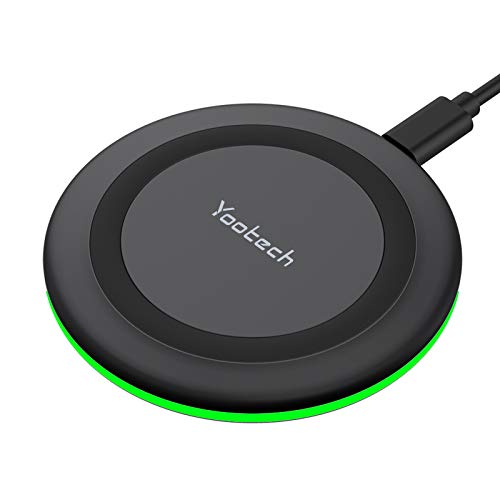
Yootech 10W Wireless Charging Pad — The bare-bones nightstand pad
Yootech has sold simple charging pads for years, and this 10W disc shows that experience in what it leaves out. There is no adapter in the box, a fact the listing title states openly, and no magnetic alignment, no stand, no fan. What remains is a flat Qi pad rated at 10W maximum, listed for a long run of iPhones from the 12 through the 18 Pro Max, Samsung Galaxy models through the S25 line, and AirPods from the second generation onward. For an overnight charge, 10W delivered steadily is genuinely enough, and the pad’s simplicity is the point.
The ownership pattern suits a household that already owns the missing piece. Most homes accumulate spare USB adapters from retired phones, and pairing one of those with this pad produces a complete bedside setup for very little money. The flat profile also slides into a travel wash bag more easily than a stand would, and a traveller who charges overnight in hotels asks nothing more of it. Where the Yootech asks for care is placement: with no magnets and no raised guide, a sleepy drop that lands the phone half off the coil can mean a slow or interrupted charge, discovered at the alarm rather than at midnight.
AirPods owners get quiet value here, since the same pad handles the earbuds case during the day and the phone at night. Galaxy owners should note the 10W ceiling is the pad’s maximum across the board; nothing in the title promises a higher rate for any particular handset. Read the Yootech 10W pad listing for the current box contents before ordering, especially if your spare adapter drawer turns out to be emptier than memory suggests.
- Form: flat wireless charging pad
- Rated output: 10W maximum
- Adapter: no AC adapter included, per the listing title
- Listed compatibility: iPhone 12 to 18 Pro ranges, Samsung Galaxy S23 to S25 ranges, AirPods 2 through 5 and Pro
- Alignment: free placement, no magnets mentioned in the title
- Cable inclusion: the title does not spell out the cable contents, so confirm them on the listing page
Strengths
- Honest packaging: the missing adapter is declared in the title rather than discovered at unboxing.
- Broad handset coverage spanning recent iPhone, Galaxy and AirPods generations in one inexpensive disc.
- Flat, light shape that travels well and disappears on a crowded nightstand.
Trade-offs
- A crooked midnight placement can undercharge, since nothing guides or holds the phone.
- The 10W ceiling feels slow for daytime top-ups between outings.
- Total cost depends on owning a suitable adapter already.
Best for: a bedside or guest-room pad in a home with spare USB adapters already in a drawer.
Not suited for: anyone expecting a complete kit from the box alone, or rapid daytime charging.

Amazon Basics 15W Qi Wireless Charging Pad — The certified all-rounder
The Amazon Basics pad is the safe pair of hands in this group. Its title leads with Qi certification and a 15W rating, includes a USB cable in the box, and states case compatibility directly, three reassurances that budget listings often leave vague. Compatibility covers iPhone models from the X through the 15, plus Samsung and LG handsets. The black disc styling is deliberately anonymous, which on a desk full of other anonymous black rectangles counts as a virtue.
Case compatibility deserves emphasis because it removes the nightly ritual that kills wireless charging habits. A pad that demands a bare phone trains its owner to stop using it within a month. This one is sold as working through a case, so the phone lands as it is, wallet bulge and all, within reason. The included cable similarly removes a scavenger hunt, though the adapter question still needs an answer from your own drawer, since the title promises a cable rather than a wall plug.
Against the Yootech, the extra rated wattage and certification language justify its place as the default recommendation for a first wireless pad. Against the Qi2.2 model further down, it lacks magnets and the newer standard’s higher ceiling, so alignment remains a manual skill. The Amazon Basics 15W pad page spells out the cable and case details if your handset or case sits at the edge of the listed ranges.
- Form: flat wireless charging pad, black
- Rated output: 15W
- Certification: Qi certified, per the listing title
- In the box: USB cable included; wall adapter not promised in the title
- Case use: stated as case compatible
- Listed compatibility: iPhone X through 15 generations, Samsung and LG handsets
Strengths
- Qi certification gives a standards anchor that anonymous pads do not offer.
- Case-friendly charging preserves the drop-and-forget habit that makes pads worthwhile.
- USB cable included, so only an adapter needs sourcing.
Trade-offs
- Free placement still punishes a badly centred phone.
- Plain styling and a single colour will not dress up a desk.
- LG owners get a mention but no model-by-model promise in the title.
Best for: a first wireless charging pad for a desk or nightstand, especially under a cased phone.
Not suited for: shoppers wanting magnetic snap alignment or the fastest standard currently sold.

TOZO W1 Max 15W Wireless Charger — The grippy aluminium pad
TOZO built the W1 Max around the two annoyances that plain plastic discs ignore: sliding and glare. The title promises an anti-slip surface, a sleep-friendly light, and a body machined from aircraft aluminium, finished here in Ink Black. Rated at 15W, it lists compatibility with iPhone generations 14 through 17 and Samsung’s S23, S24 and S25 lines. The metal body also gives the pad a planted weight that resists being dragged across the nightstand by a stiff cable.
That anti-slip surface changes the overnight maths more than wattage does. A phone that stays where it was dropped keeps its coil overlap for the full night, so the delivered charge is the steady one rather than the interrupted one. The sleep-friendly indicator addresses the other classic complaint, the status light that pulses in a dark room. Together these details describe a pad designed by someone who has actually slept next to a charger, which is rarer in this price tier than it should be.
The aluminium shell will feel cooler to the touch and may shed warmth from the coil area more readily than plastic, though the title makes no thermal claims and none are invented here. Travellers may find the metal disc slightly heavier than a plastic rival, a fair exchange for a pad that stays put on a hotel nightstand. Check the TOZO W1 Max listing for what ships alongside the pad itself, since the title concentrates on the pad’s materials and light rather than its cable bundle.
- Form: flat pad in aircraft aluminium, Ink Black finish
- Rated output: 15W
- Surface: anti-slip, per the listing title
- Indicator: sleep-friendly light design
- Listed compatibility: iPhone 14 to 17 ranges, Samsung Galaxy S23, S24 and S25
- Adapter and cable contents: not detailed in the title, so check the listing before ordering
Strengths
- Anti-slip face keeps the phone’s coil overlap stable through the night.
- Dim, bedroom-aware indicator respects light sleepers.
- Metal body feels planted and shrugs off cable drag.
Trade-offs
- Heavier than plastic rivals, a small tax on travel use.
- No magnets, so initial placement is still your responsibility.
- Compatibility list in the title skews to recent handsets only.
Best for: light sleepers and anyone whose current pad migrates across the nightstand by morning.
Not suited for: owners of older handsets outside the listed generations who need an explicit compatibility promise.

Belkin 15W Wireless Charging Pad (2-pack) — The two-room bundle
Most charger guides pretend a household owns one phone and sleeps in one room. Belkin’s twin pack starts from the truer picture: the phone charges beside the bed at night and begs for power beside the sofa or desk by day, and buying two separate pads means two checkouts, two cables to manage and two chances to cheap out on the second one. This box holds two 15W Qi pads, listed for iPhone generations through the 17, AirPods, Samsung Galaxy S25 and S24 models, and Google Pixel handsets.
Belkin’s name carries weight in charging because the company sells through mainstream retail and maintains a recognisable support trail. That matters more for a product that sits plugged in, warm, on your furniture for years than it does for a phone case. The per-pad experience is deliberately ordinary: flat disc, free placement, case-friendly in the manner of its class. The bundle is the feature, and judged as a bundle the value logic is strong, since the second location is where wireless charging actually changes behaviour. A pad you pass ten times a day collects top-ups a bedside-only pad never sees.
Households mixing iPhone and Pixel or Galaxy handsets benefit from the broad title compatibility, because one purchase covers both nightstands even when the phones differ. What the title does not detail is the cable and adapter arrangement for two pads, which decides whether the box truly completes both rooms. Confirm that on the Belkin twin-pack listing before assuming two full setups are inside.
- Form: two flat wireless charging pads in one box
- Rated output: 15W per pad
- Standard: Qi charger, per the listing title
- Listed compatibility: iPhone 14 to 17 ranges, AirPods, Samsung Galaxy S24 and S25, Google Pixel
- Colour and cable contents: not spelled out in the title; verify them on the listing
- Alignment: free placement on both pads
Strengths
- Two rooms solved in a single purchase, with matched pads and behaviour.
- Compatibility spans Apple, Samsung and Google handsets in one household buy.
- An established accessories brand stands behind a product that lives plugged in.
Trade-offs
- Single-pad shoppers pay for a second disc they may never place.
- Cable and adapter contents need confirming before the two-room plan is final.
- No magnetic alignment on either pad.
Best for: couples and two-room households standardising on one pad model everywhere.
Not suited for: a single-desk shopper who would rather spend the whole budget on one magnetic pad.

Wireless Charger 30W Fast Charging Pad (unbranded) — The big-claim gamble
This pad is unbranded, and this guide labels it that way every time it appears, because the absence of a brand is material information. Its listing title claims 30W fast wireless charging and recites a long roll of compatible handsets: iPhones from the 8 through the 15, Samsung Galaxy models from the S8 to the S24 plus the Note range, AirPods and Galaxy Buds, and Pixel and LG G-series phones. On paper it out-powers everything else in this guide. Paper is exactly where that advantage lives until a known maker stands behind the number.
Treat the 30W figure as a ceiling claimed by the seller, not a rate your phone will necessarily request or accept. Handsets cap their own wireless intake, and many models in that long compatibility list accept far less than 30W regardless of what a pad offers. The realistic reading is narrower: this is a very inexpensive flat pad that will charge the listed phones wirelessly, at speeds set mostly by the phone. Bought with that expectation, it can serve perfectly well on a kitchen counter or in a teenager’s room, where loss and damage are likelier than in your own study.
The gamble is about recourse. If a branded pad fails, a warranty conversation exists. If an unbranded pad fails, the listing itself may have changed hands by then. Some buyers accept that trade happily at this price tier, and for a spare-room pad the logic can hold. Just do not build your only charging spot on it, and do not pay a premium for the wattage claim. The unbranded 30W pad listing is the place to weigh its current terms with clear eyes.
- Form: flat wireless charging pad, sold without a brand name
- Claimed output: 30W, as stated by the seller in the title
- Listed compatibility: iPhone 8 to 15, Galaxy S8 to S24 and Note models, AirPods, Galaxy Buds, Pixel and LG G7 and G8
- Brand accountability: none stated; the listing is the whole warranty conversation
- Adapter and cable contents: not detailed in the title; check the listing
- Alignment: free placement, no magnetic feature mentioned
Strengths
- The widest handset compatibility list in this guide, reaching back to older models.
- A high claimed ceiling costs nothing extra if the phone can use part of it.
- Inexpensive enough to treat as a sacrificial spare-room or kitchen pad.
Trade-offs
- No brand means no dependable warranty path if the pad fails early.
- The 30W claim will not translate into 30W charging on most listed phones.
- Box contents are unclear from the title alone.
Best for: a low-stakes spare pad for a counter, guest room or teenager, bought with modest expectations.
Not suited for: being the household’s only charger, or anyone paying extra specifically for the 30W headline.
Amazon Basics 25W Qi2.2 Wireless Charging Pad — The magnetic speed option
The white Amazon Basics pad belongs to a newer generation than the other five. It is Qi2.2 certified, rated at 25W, MagSafe compatible for iPhones from the 12 through the 17, and described as magnetic compatible for Android and Google smartphones. The magnets change the daily experience more than the wattage does: the phone seats itself with a small snap, the coils align every time, and the slow-or-nothing charge caused by a crooked drop largely disappears.
Qi2.2 is the current Wireless Power Consortium standard built around magnetic alignment and higher power delivery than the original Qi pads managed. A certified pad built to it, paired with a handset that supports the same standard, is the closest wireless charging gets to the predictability of a cable. Android owners should read the magnetic wording carefully: the title promises magnetic compatibility rather than naming specific models, so the snap experience depends on the handset or case carrying the right magnetic arrangement.
The familiar budget caveat applies at the end of the title: adapter not included. A 25W pad fed by a weak old plug is a 10W pad wearing a nicer badge, so budget for a capable USB-C adapter if your drawer lacks one. Even with that addition, this is the pad in the guide that a desk worker will feel the difference from daily. The Amazon Basics Qi2.2 pad page carries the adapter guidance and the handset notes worth reading before checkout.
- Form: flat magnetic wireless charging pad, white
- Rated output: 25W
- Certification: Qi2.2 certified, per the listing title
- Alignment: magnetic snap, MagSafe compatible for iPhone 12 to 17
- Android support: described as magnetic compatible for Android and Google smartphones
- Adapter: not included, stated plainly in the title
Strengths
- Magnetic alignment removes the main failure mode of cheap pads.
- The highest certified ceiling in this guide, ready for current handsets.
- Qi2.2 certification gives the speed claim a standards body behind it.
Trade-offs
- Needs a strong adapter you supply yourself to reach its ceiling.
- Older Android phones without magnetic cases will not feel the snap benefit.
- White finish will show desk grime sooner than the black discs.
Best for: desk top-ups and newer iPhone owners wanting alignment they never think about.
Not suited for: shoppers whose spare adapters are weak, or who charge several different bare Android phones.
How Do the Six Pads Compare Side by Side?
| Pad | Rated output | Alignment | Included extras per title | Standout trait |
|---|---|---|---|---|
| Yootech 10W Pad | 10W | Free placement | No AC adapter | Slimmest, simplest nightstand disc |
| Amazon Basics 15W Pad | 15W | Free placement | USB cable | Qi certification plus case-friendly charging |
| TOZO W1 Max | 15W | Free placement, anti-slip face | Not detailed in title | Aluminium body and sleep-friendly light |
| Belkin 15W 2-pack | 15W each | Free placement | Two pads in one box | Two rooms covered by one purchase |
| Unbranded 30W Pad | 30W claimed | Free placement | Not detailed in title | Longest compatibility list, no brand |
| Amazon Basics Qi2.2 | 25W | Magnetic snap | Adapter not included | Qi2.2 certification and MagSafe compatibility |
Read the table as a map of priorities rather than a league ladder. If your phone sleeps beside you, grip and light behaviour outweigh raw wattage, which favours the TOZO. If your phone grazes at a desk, alignment and ceiling dominate, which favours the Qi2.2 pad. If the house needs coverage in two places, the Belkin bundle wins by arithmetic. The plain Amazon Basics 15W sits in the middle of every axis, which is precisely why it is the default. The Yootech and the unbranded pad compete on minimal outlay, one with a known name and modest rating, the other with a bold claim and no name at all.
What Mistakes Do Budget Charger Buyers Keep Making?
The commonest error is buying the pad and forgetting the plug. A listing that excludes the adapter is not a trick, but it becomes one in the buyer’s head when the parcel arrives and the only available adapter is a decade old. The second error is judging by wattage alone, paying for a claimed ceiling the phone cannot use while ignoring grip, light and certification, the qualities felt every night. The third is placing a smooth pad where vibration walks it: a phone that buzzes through the small hours can shuffle itself off the coil sweet spot one notification at a time.
A fourth mistake is expecting one pad to serve two rhythms. Overnight charging rewards forgiveness; desk charging rewards speed and alignment. A household that buys a single slow pad for the desk often concludes wireless charging is disappointing, when the real problem was a mismatch between pad and pattern. Splitting the jobs, a forgiving pad by the bed and a magnetic pad at the desk, costs little in this tier and satisfies both. Finally, buyers overlook the earbuds case: a pad that also handles AirPods or Galaxy Buds quietly replaces a second cable on the nightstand.
How Should You Set Up a Cheap Pad for Reliable Overnight Charging?
Setup takes five minutes and pays back every night. Feed the pad with the strongest suitable adapter you own, not the weakest that happens to fit. Centre the pad where your hand naturally lands, away from the nightstand edge, and give the cable a little slack so its stiffness does not drag the disc. Place the phone, confirm the charging indicator or the phone’s own charging symbol, then nudge the handset once to learn where the coil centre sits relative to the pad’s markings or texture. That small calibration, done once while awake, replaces a hundred sleepy guesses.
For the following week, glance at the morning battery level. A pad doing its job delivers a full battery every morning without drama. A shortfall pattern points to placement drift, a case thicker than the pad tolerates, or an adapter sagging under load, and each cause has a cheap fix: reposition against a fixed object, remove a metal plate from the case, or swap the adapter. Magnetic pads skip most of this ritual, which is their understated luxury.
How Does Wireless Charging Treat a Battery Across Years of Nights?
Battery anxiety drives many charger purchases, so the longevity question deserves a straight answer. Wireless charging converts some energy to heat at the pad and some inside the phone, and heat is the ingredient batteries age fastest on. A phone that spends its nights warm on a poorly aligned pad, charging slowly for hours at elevated temperature, lives a harder life than one that fills quickly on a cable and then rests cool. Alignment, again, is the hidden variable: a well-centred phone charges efficiently and warms modestly, while a crooked one wastes energy as heat for the whole night.
The practical defences are simple and cheap. Choose a pad whose ceiling roughly matches what the phone can accept rather than one straining far beyond it, keep the pad out of direct morning sun on a windowsill nightstand, and avoid stacking the phone on a pad that is itself sitting on a soft, insulating surface like a duvet. Phones also help themselves: most modern handsets taper charging near full and many offer optimised overnight modes that hold the battery at a partial level until shortly before the alarm. A budget pad does not cancel those protections. The system negotiates as a whole, and a certified pad from a known maker participates in that negotiation predictably, one more quiet argument for certification over a mystery listing.
None of this should scare anyone away from a nightstand pad. The convenience of a full battery every morning, gathered without fumbling for a cable in the dark, is the reason this product category exists. It simply rewards the buyer who spends thirty seconds on placement and adapter choice at setup, then forgets the whole subject. Batteries are consumables with a multi-year horizon; a sensibly chosen cheap pad does not meaningfully shorten that horizon, while a careless setup, any nightstand gadget left cooking on a bed, deserves the scepticism it gets.
Which Rooms Gain Most From a Second or Third Pad?
The kitchen counter is the unsung charging location. Phones land there during cooking, recipe-reading and the morning news scan, exactly the short, frequent visits that keep a battery in its comfortable middle range. A pad beside the kettle collects those visits without a cable trailing across a worktop. The hallway console table runs a close second: keys, post and phone all land in the same spot, and a pad built into that landing ritual means the phone leaves the house fuller than it arrived home.
Home offices reward a different quality, persistence. A desk pad sits within arm’s reach for eight hours, so even a modest 10W or 15W disc keeps a phone topped up indefinitely, provided the owner actually returns the phone to it between calls. Habit, not hardware, is the limiting factor, and a pad with a grippy surface or magnetic seat lowers the effort of each return enough to matter across a working week. This is where the Belkin twin pack’s logic compounds: identical pads in bedroom and office mean the hand learns one landing spot shape and repeats it everywhere.
Guest rooms and teenagers’ rooms are where the unbranded and entry-level pads earn their keep. A guest who can charge without borrowing a cable sleeps better, and a pad that costs little softens the blow when it eventually vanishes into a school bag. Rental properties and holiday homes follow the same arithmetic. In each case the buying question is not which pad is best in the abstract, but which pad’s strengths match the room’s rhythm: forgiveness for sleep, grip for counters, speed for desks, disposability for spare rooms.
What Does Qi Certification Actually Guarantee a Buyer?
Qi is a standard maintained by the Wireless Power Consortium, and certification means a sample of the product passed interoperability and safety testing against that standard. For a buyer, the practical content of the badge is threefold. The pad should work with any handset that follows the same standard, not just the models in its marketing list. Its foreign-object behaviour, the ability to notice a coin or key trapped between pad and phone and respond safely, has been examined. And its power delivery claims have been stated within a framework that gives the numbers meaning.
Qi2 and Qi2.2 extend the original standard with a magnetic power profile, the ring of magnets that produces the snap alignment popularised by MagSafe, plus support for higher wattages in the newer revision. When the Amazon Basics pad in this guide calls itself Qi2.2 certified and MagSafe compatible, it is claiming tested membership of that newer club. When the plain Amazon Basics 15W calls itself Qi certified, it claims the older, slower, still perfectly serviceable membership. The unbranded pad claims neither, which does not prove it unsafe or ineffective, but leaves the buyer as the only tester.
Certification is therefore best read as a risk dial rather than a quality trophy. At the price tier of this guide, the dial matters because the savings from skipping it are small in absolute terms. A certified pad asks little more money than an uncertified one, and for a device that will sit energised on wooden furniture for years, that small premium buys a disproportionate amount of peace of mind. Save the gamble for the spare room, and even there, buy it knowingly.
How Do Cases, Stands and Desk Clutter Change the Result?
A phone case is part of the charging system whether the buyer plans it that way or not. Every millimetre of material between coil and handset weakens the magnetic coupling that moves the power, and some materials interfere outright. Plain silicone and leather cases in ordinary thicknesses are effectively transparent to these pads. Cases carrying metal kickstand rings, magnetic card wallets snapped over the charging area, or decorative plates can block charging, heat up, or fool a pad’s foreign-object detection into refusing the session. The test costs nothing: one night cased, one night bare, and a comparison of morning charge and warmth tells you which side your case falls on.
Desk clutter plays a subtler role. A pad buried under papers charges a phone that is also buried under papers, insulated and warm. A pad kept in a clear landing zone, the way a coaster claims its corner of a table, gets used ten times more often and runs cooler each time. Cable routing matters here too. A cable stretched taut across a desk drags a light pad slowly out of position over days; a cable with slack, or a heavier aluminium pad like the TOZO, holds the geometry you set. These are housekeeping observations rather than specifications, yet they decide real-world performance more often than a five-watt difference between rival listings does.
Stand-style chargers, absent from this guide because the keyword and the budget point at flat pads, solve a different problem: video calls and alarm-clock visibility. A flat pad hides the screen, which is a virtue at midnight and a limitation at a desk where notifications matter. Buyers who find themselves propping a phone against a mug should read that as a signal to buy a stand for the desk and keep the flat pad for the bedroom, rather than expecting one shape to flatter both rooms.
When Is a Cable Still the Smarter Answer?
Honesty requires a section for the rival technology. A cable charges faster, wastes less energy as heat, works while the phone is in your hand, and costs less than any pad in this guide. For a traveller counting grams, a single cable plus a small adapter beats a pad. For a household charging a tablet, a handheld console and two phones from one socket strip, cables multiply more gracefully than pads do. And for the fastest possible turnaround before leaving the house, plugging in remains undefeated.
Wireless charging wins on friction, not physics. It converts charging from a small task, find cable, orient plug, insert, into a non-task: put phone down. That conversion pays out in the places a phone already rests, the nightstand, the desk corner, the hallway table, and it pays out nightly. The sensible household is therefore hybrid, pads where phones sleep and graze, cables where speed or shared sockets rule. Every pad in this guide was judged inside that hybrid logic, as a convenience purchase that must justify itself against a nearly free alternative. The ones that do, do so by disappearing into a routine, which is why grip, light, alignment and certification, the qualities of disappearance, dominate these reviews.
One more cable case deserves naming: households with small children or pets, where a pad’s cable still trails but the pad itself invites investigation. A flat disc is a less interesting object than a dangling cable end, and a pad tucked behind a lamp removes the temptation almost entirely. Safety testing under the Qi standard covers the electrical side; the domestic side remains, as ever, a matter of placement and common sense.
What Should a Second Pad Teach You About the First One?
Most households buy their second wireless pad within a few months of the first, and that second purchase is the honest review of the first. If the first pad migrates rooms constantly, the lesson is that one landing spot was never enough. If the second order is the same model without a moment’s research, the first pad did its job invisibly, the highest praise available. If the second order is a different design entirely, something specific irritated: a wandering disc, a glaring light, a phone found at half charge before a flight. Naming that irritation before reordering is the cheapest expertise in this whole category.
The pattern also explains the shape of this guide’s six. The Belkin bundle anticipates the second-pad moment and prices it into the first purchase. The TOZO exists for buyers whose first pad slid or glared. The Qi2.2 pad exists for buyers whose first pad taught them that alignment, not wattage, was the missing ingredient. The Yootech exists for the room that simply never had a pad. Reading your own history this way turns a commodity purchase into a small act of household engineering, and it is why the comparison table above is organised by trait rather than by rank: your second pad should be bought by trait, against the trait your first one lacked.
Keep the receipt-side lesson too. Budget pads fail occasionally, and the brands in this guide run return and warranty processes that make a failure a minor errand rather than a write-off. That back-office quality never appears in a listing title, yet across a five-year life on a nightstand it can matter more than any single specification printed there.
How Long Should a Budget Pad Last Before Replacement Makes Sense?
A wireless pad has no moving parts, no battery of its own and no consumable element, so its service life is set by its electronics, its cable strain relief and the standards drifting around it. A well-kept pad should serve for years, and many early Qi pads still work today, charging modern handsets slowly but surely. Replacement becomes sensible when the standard moves, as it has with magnetic Qi2.2, or when the pad’s surface wears slick enough that phones wander, or when a new handset’s coil position changes the alignment geometry you had memorised. Until one of those moments arrives, a working budget pad is not obsolete merely because a faster one exists; overnight, yesterday’s pad and today’s pad deliver the same full battery by morning, and the difference only shows in the daytime grazing hours.
Final Recommendation
Buy the Amazon Basics 15W pad if this is your first wireless charger and you want one sensible disc that simply works through a case. Buy the Amazon Basics Qi2.2 pad instead if your phone supports magnetic charging and the pad will live at a desk, because alignment plus headroom is the combination you will notice daily. Choose the Belkin twin pack when two rooms need covering, the TOZO when a restless phone or a bright LED is your current irritation, and the Yootech when a spare adapter already waits in a drawer. Take the unbranded pad only as a spare bought with open eyes.
A cheap pad earns its keep in a currency of small mornings: the battery is full, the cable stayed in the drawer, and nobody thought about charging at all, which is the finest verdict any nightstand gadget can collect.
Frequently Asked Questions
Will a 10W pad fully charge a modern phone overnight?
Yes, in ordinary conditions. A full night offers far more hours than even a modest pad needs, provided the phone starts the night reasonably aligned and the adapter feeding the pad is sound. Problems arise from drift, thick metal-plated cases or a failing adapter, not from the 10W ceiling itself.
Does the phone or the pad decide the charging speed?
Both, and the slower of the two wins. The pad offers a ceiling, the handset requests what its own wireless hardware accepts, and the adapter must be able to supply the pad in the first place. That is why a claimed 30W pad does not turn an older handset into a fast-charging one.
Can these pads charge through a phone case?
Slim and medium cases are the design assumption for pads in this class, and the Amazon Basics 15W states case compatibility outright. Cases with metal plates, thick wallet backs or magnetic card holders positioned over the coil can block or weaken charging, whatever the pad. If a cased phone charges slowly, test one night without the case to isolate the cause.
Is Qi2.2 worth choosing over a plain Qi pad?
For a bedside pad, the gain is mostly the magnetic alignment, which removes crooked-placement failures. For a desk pad used in short sessions, the higher ceiling also shortens each visit. If your handset predates magnetic charging entirely, a certified plain Qi pad remains a rational, cheaper answer.
Why do some pads exclude the wall adapter?
Excluding the adapter trims cost and electronic waste, on the assumption that households already own suitable USB plugs. The saving is real only when that assumption holds for you. Before ordering any pad in this guide, check its title for the adapter line and inventory your drawer honestly.
Do earbuds and smaller devices charge well on these full-size pads?
Mostly yes, with a placement caveat. Earbud cases carry smaller coils than phones, so the overlap window shrinks and a casually dropped case may sit outside the pad’s effective area. The fix is a slower, more deliberate placement, watching for the case’s own charging light before walking away. Once centred, AirPods and Galaxy Buds cases charge uneventfully on the pads here, which is why several titles list them explicitly, and sharing one pad between phone by night and earbuds by day is a genuinely economical pattern for a small household.
Should I leave a phone on a pad all night, every night?
Modern handsets manage their own charge levels and taper as they fill, so overnight pad use is a normal pattern these products are built for. A pad that runs noticeably hot, or a phone that repeatedly wakes undercharged, signals a placement or adapter problem to fix rather than a habit to abandon.
Related Guides
Charging follows you out of the house: mounts that power a phone on the road are compared in best car qi chargers, off-grid weekends are covered by best chargers for car camping, and the durability-first storage picks live in best external hard drives durability.


